


Tofersen is an antisense oligonucleotide that reduces the synthesis of superoxide dismutase 1 (SOD1) protein in people with amyotrophic lateral sclerosis (ALS) caused by pathogenic variants in the SOD1 gene. Reference McCampbell, Cole and Wegener1 Intrathecal tofersen administration every 4 weeks has been shown to lower CSF SOD1 and both serum and CSF neurofilament levels and to slow disease progression in people with SOD1-ALS, Reference Miller, Cudkowicz and Genge2 leading to Health Canada approval in early 2025. SOD1-ALS accounts for approximately 2% of all cases of ALS, Reference Bunton-Stasyshyn, Saccon, Fratta and Fisher3 suggesting that roughly 60 of the estimated 3000 Canadians living with ALS may be eligible for monthly intrathecal therapy. Reference Wolfson, Gauvin, Ishola and Oskoui4 Delivering up to 720 intrathecal injections annually (12 doses for approximately 60 people) poses significant logistical challenges for Canadian multidisciplinary clinics operating near capacity. No guidelines address models of care for tofersen administration, and substantial regional variability exists. In principle, treatment could be delivered by any practitioner competent in lumbar puncture (LP). The Calgary Neuromuscular Clinical Trials Group gained experience as a site in the phase 3 and open-label extension studies of tofersen Reference Miller, Cudkowicz and Genge2,Reference Miller, Cudkowicz and Shaw5 and through treatment of patients under the Health Canada Special Access Program, informing development of a nurse-practitioner-and neurologist-led Motor Neuron Disease Intrathecal Therapeutics Clinic (MND IT Clinic) in Calgary.
The MND IT Clinic operates within the broader framework of the Calgary ALS and Motor Neuron Disease Clinic. Most people treated in the MND IT Clinic have SOD1-ALS, although adults with spinal muscular atrophy receiving intrathecal nusinersen therapy every 4 months are also included. The MND IT Clinic runs once monthly, with intrathecal injections administered by a nurse practitioner (NP) and/or neurologist depending on clinic volume. Since tofersen requires three loading doses every 2 weeks at initiation, an additional NP or neurologist appointment is scheduled between clinics in the first month of treatment. Typically, the clinic accommodates 6–8 procedures per half-day. A single practitioner can comfortably perform one procedure every 30 minutes, but two practitioners improve patient flow and minimize delays if complications occur. The MND IT Clinic began operation in January 2024, initially treating people with SOD1-ALS with tofersen under the Health Canada Special Access Program prior to Health Canada Notice of Compliance. Since then, 7 people with SOD1-ALS have been treated for a total of approximately 175 IT injections (mean 25 per person), including an estimated 117 (2/3) administered by the NP.
The NP practices autonomously within the MND IT Clinic, independently obtaining consent, ordering and reviewing investigations and performing and documenting procedures. The NP role is nationally established in Canada, with the scope of practice regulated by provincial Colleges. NPs may perform advanced procedures such as LP and intrathecal injection within their individual competence. 6 The current MND IT Clinic NP is a dedicated neurology practitioner who also provides inpatient neurology and diagnostic LP services and was already an experienced, independent LP provider before the clinic began. Initial competence in LP was acquired through a neurologist-supervised pathway of didactic teaching, observation and supervised performance of approximately 10 procedures, after which the supervising neurologists assessed competence before independent practice. A similar process was followed for intrathecal injection, with competence achieved after approximately three observed procedures. A neurologist remains available on site to assist with failed procedures or complications but is not present in the procedure room. The NP also teaches LP and intrathecal injection skills to resident trainees.
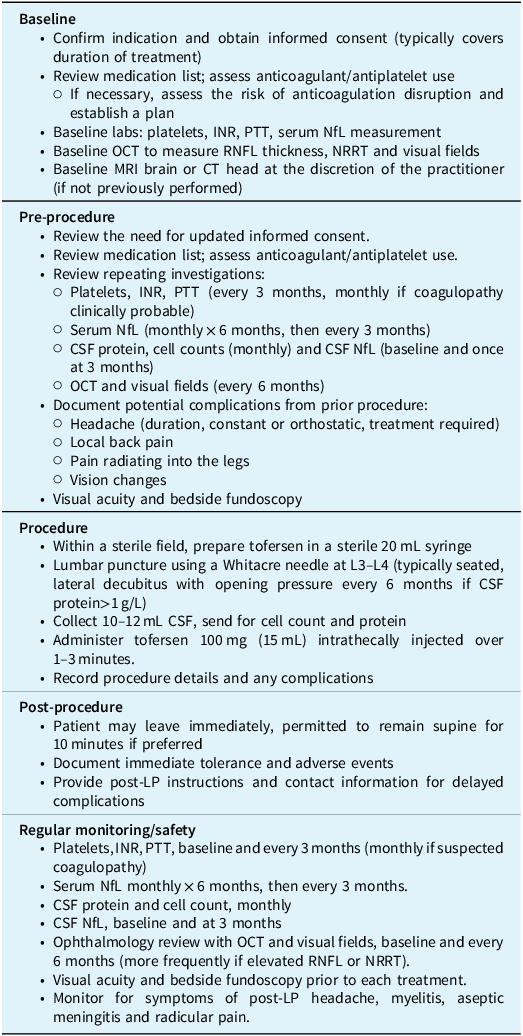
Informed consent is obtained before the first treatment and applies to the full course of therapy. It is repeated only if there is a substantial change in individualized procedural risk or new adverse events are frequently reported in the literature. Baseline labs include platelet count, international normalized ratio (INR) and partial thromboplastin time (PTT), rechecked every 3 months or monthly if coagulopathy is clinically probable. Baseline head imaging is at the discretion of the initial treating practitioner, but most patients with ALS have had a prior MRI brain or CT head during their diagnostic workup. Serum neurofilament light chain (NfL) levels are measured using a Simoa assay (MitogenDx LDT, Calgary, AB) prior to the first treatment (baseline), then monthly for 6 months and every 3 months thereafter. Although evidence is insufficient to use serial serum NfL to guide continuation of therapy, our experience suggests a substantial decrease may indicate therapeutic benefit. Reference De Wel, Mobach, Pfeffer and Jewett7 A protocol for managing antiplatelet and anticoagulant medications according to thrombotic risk is in place, though no patient has required it. The risk–benefit balance of temporarily withholding these medications requires careful consideration. The workflow of the clinic is summarized in Table 1.
Workflow of the Calgary Motor Neuron Disease Intrathecal Therapeutics Clinic, outlining pre-procedure preparation, procedural steps, post-procedure care and ongoing safety monitoring for intrathecal tofersen delivery. A checklist is used to ensure the protocol is followed at each visit

Table 1. Long description
Table summarizing the workflow of the Calgary Motor Neuron Disease Intrathecal Therapeutics Clinic, including a row each for baseline assessment, pre-procedure testing and data collection, the intrathecal procedure, post-procedure practices, and regular monitoring procedures. The table summarizes the content from the remainder of the paper.
INR = international normalized ratio; LP = lumbar puncture; NfL = neurofilament light chain; NRRT = neuroretinal rim thickness; OCT = optical coherence tomography; PTT = partial thromboplastin time; RNFL = retinal nerve fiber layer.
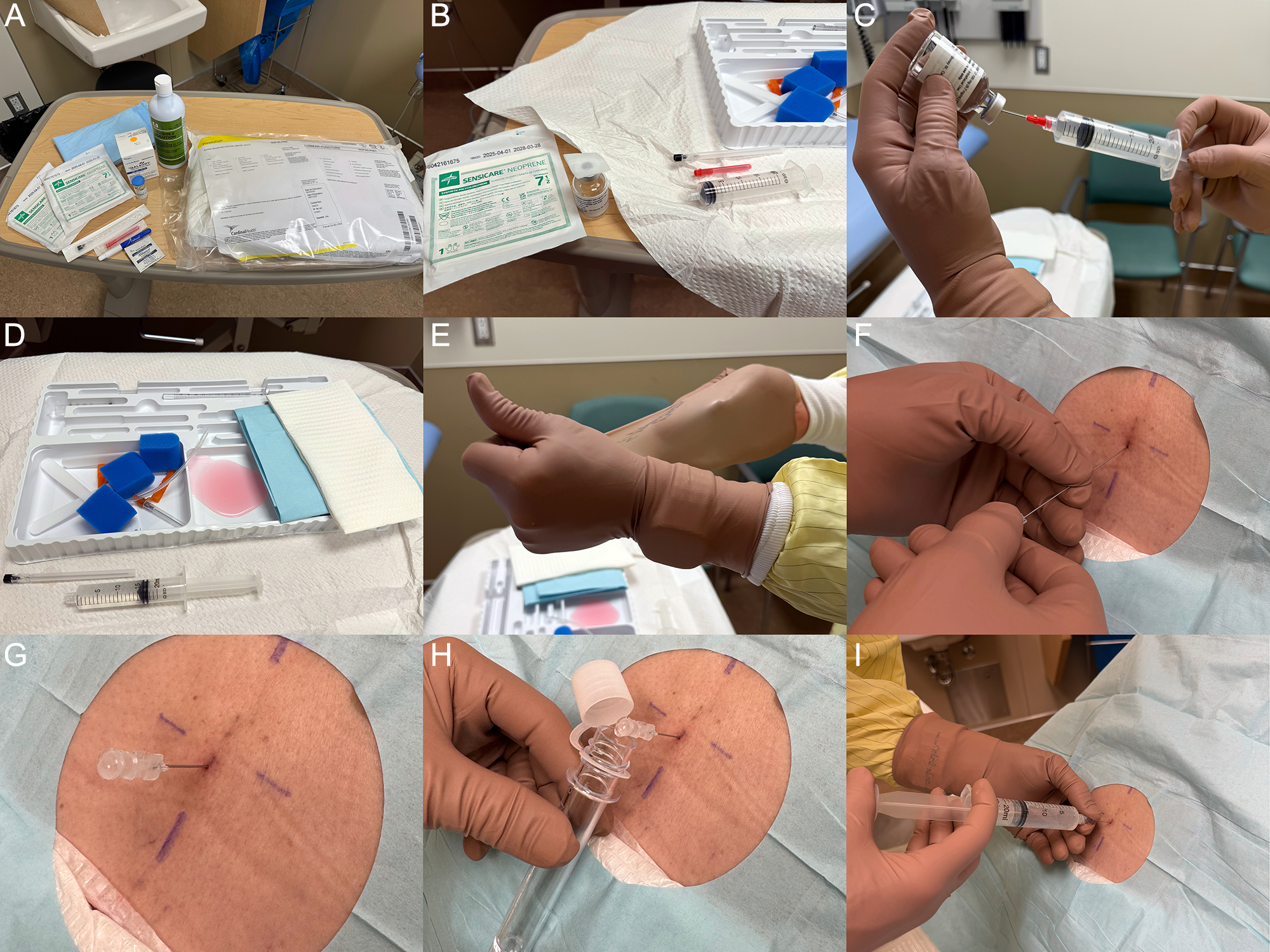
Prior to LP, we set up the sterile field and then don sterile gloves to draw up tofersen in a sterile 20 mL syringe. This is deposited in the sterile field, and sterile gloves are changed. A standard LP protocol is then followed using a 22-gauge, 3.5-inch Whitacre needle, typically at the L3–L4 interspinous space with the patient in a seated position. Approximately 10–12 mL of CSF is collected before intrathecal administration of tofersen 100 mg (15 mL volume) over 1–3 minutes (Figure 1). The CSF sample is sent for cell count and protein analysis, and CSF NfL is measured after the first treatment and once subsequently after 3 months. Patients may leave immediately following the procedure without mandated supine rest; however, they can rest supine for up to 10 minutes at their discretion. In cases of failed procedures or challenging anatomy, fluoroscopy-guided LP through interventional radiology, point-of-care ultrasound guidance and procedural sedation with support of cardiology nurses are available; to date, fluoroscopy and procedural sedation have been utilized for nusinersen only with some patients pre-identified due to scoliosis, but not tofersen.
(A) In addition to standard lumbar puncture (LP) supplies, a Whitacre needle, two pairs of sterile gloves, a sterile 20 mL syringe and a blunt fill needle are gathered. (B) The Whitacre needle, 20 mL syringe and blunt fill needle are placed onto the sterile field. (C) Maintaining sterile technique, tofersen is drawn into the 20 mL syringe. (D) The syringe is then returned to the sterile field. Note that the left hand becomes contaminated after contacting the nonsterile tofersen vial and should not touch sterile equipment again. (E) The gloves are removed and replaced with a new pair of sterile gloves. (F, G) LP is performed. (H) A total of 10–12 mL of CSF is collected and sent for cell count, protein and neurofilament light chain at baseline and 3 months. (I) One hand stabilizes the LP needle and is braced against the patient, while 15 mL of tofersen is injected over 1–3 minutes.

Figure 1. Long description
Panel of 9 images illustrating the tofersen inject procedure. Images include: 1) the supplies needed for the procedure on a table, 2) the syringe and blunt needle on the sterile field, 3) drawing tofersen into a syringe, 4) the filled tofersen syringe on the sterile field, 5) a clinician removing sterile gloves, 6) the lumbar puncture needle inserted into the lumbar spine, 7) collecting CSF with a tube from the lumbar puncture needle, 8) injecting tofersen into the lumbar puncture needle that is inserted in the patient’s lumbar spine.
In addition to the typical complications of LP, several treatment-related adverse events associated with tofersen have been reported, including myelitis, aseptic meningitis, lumbar radiculopathy, raised intracranial pressure and papilledema. Reference Miller, Cudkowicz and Genge2,Reference Lovett, Chary and Babu8 CSF pleocytosis and protein elevation are common, although their clinical significance remains uncertain. Self-limited post-procedure radicular pain, suggestive of radiculitis, occurs infrequently but may recur in some individuals, and there is currently no consensus on management. We have trialed periprocedural oral prednisone 60–100 mg in selected individuals with recurrent radicular pain, without clear benefit.
In our experience, post-LP headaches are infrequent (< 5%), and there have been no epidural blood patches, nerve root injuries or epidural hematomas. We have encountered two cases of intracranial hypertension with vision-threatening papilledema. Both were asymptomatic and had been receiving long-term tofersen therapy with CSF protein levels exceeding 1.0 g/L. However, papilledema after fewer than 20 doses and with CSF protein <1.0 g/L has been reported previously. Reference Lovett, Chary and Babu8 Because of the risk of asymptomatic intracranial hypertension, we obtain baseline optical coherence tomography (OCT) of retinal nerve fiber layer and neuroretinal rim thickness (NRRT) without delaying tofersen initiation, repeated approximately every 6 months and more frequently if NRRT is elevated. Standard 24–2 visual field tests with Swedish Interactive Thresholding Algorithm strategy are also obtained to assess for blind spot enlargement. Before each treatment, visual acuity is assessed, and bedside fundoscopy is performed. If CSF protein exceeds 1.0 g/L, LP is conducted in the lateral decubitus position with opening pressure measured every 6 months. Both cases of intracranial hypertension were successfully managed with acetazolamide and larger periprocedural CSF volume removal, with papilledema resolving while tofersen continued under close ophthalmologic supervision. A close working relationship with ophthalmology is essential to facilitate timely assessment and management of papilledema. Community optometrists are often able to obtain OCT and visual field testing in settings where close ophthalmology collaboration is not available, although this may be associated with direct patient cost. Severe cases of transverse myelitis treated with high-dose glucocorticoids have been reported elsewhere; Reference Lovett, Chary and Babu8 therefore, patients should be educated regarding symptoms that warrant urgent medical attention. Our current monitoring regime including serology, CSF, NfL and ophthalmologic assessments is resource intensive, and evidence to guide a specific regimen is lacking; we acknowledge that with increasing global tofersen experience, it may be feasible to refine monitoring to reduce costs.
Efficient, scalable models are essential to safely deliver intrathecal tofersen for SOD1-ALS. Although tofersen is currently indicated for only a small subset of the ALS population, the development of intrathecal therapies for sporadic ALS or other neurological disorders could rapidly overwhelm existing clinical delivery systems. Reference Morganroth, Bardakjian, Dratch, Quinn and Elman9 To prepare for this possibility, non-physician administration by NPs or other healthcare professionals trained in LP should be explored. Alternative delivery approaches, such as intrathecal ports, Reference Capozza, Triarico, Mastrangelo, Attinà, Maurizi and Ruggiero10 show promise and may be preferred by patients but remain experimental and could introduce additional procedural burden, complications, time and cost. Given limited ALS and neuromuscular program capacity in Canada, a national strategy for intrathecal delivery will be essential to support sustainable integration into existing clinics and to harmonize safety standards. It must also include flexible delivery models that account for regional resource limitations and ensure equitable access for individuals living in rural and remote communities. The experience of the Calgary MND IT Clinic offers one model for how collaborative, NP-and neurologist-led programs can safely and efficiently deliver these treatments within existing clinic structures.
Author contributions
Gordon Jewett was responsible for conceptualization, investigation, project administration and writing (original draft, review and editing). Collin Luk and Theodore Mobach were responsible for conceptualization, project administration, supervision and writing (review and editing). Ellen Chan was responsible for conceptualization and writing (review and editing). Kris Jagt, Janet Petrillo Ballantyne, Jason Wesolosky, Tefani Perera, Vikram Karnik and Christopher Hahn were responsible for writing (review and editing).
Funding statement
This work received no external funding.
Competing interests
Gordon Jewett reports research support paid to his institution from Muscular Dystrophy Canada, the Canadian Institutes of Health Research, ALS Canada, Amylyx Pharmaceuticals, the New Frontiers in Research Fund, NSERC and Alberta Innovates; speaker fees from Biogen, Novartis, Amylyx Pharmaceuticals and Tanabe Pharma; participation on the tofersen CDA Advisory Panel; travel support from ALS Canada; participation on medical advisory boards for Roche, Argenx Canada and Tanabe Pharma; and leadership of the Alberta ALS Research Network. Theodore Mobach reports consulting fees from Biogen, Quralis, Eli Lilly and Novartis and participation on the tofersen CDA Advisory Panel. Janet Petrillo Ballantyne reports consulting fees from Eli Lilly, KASTx Ventures and Lumiio; speaker fees from TREAT-NMD; meeting registration support from Dynamic Global Events; and participation in advisory boards for Qualisure and Eli Lilly. Christopher Hahn reports speaker honoraria from Alexion and AstraZeneca. Collin Luk reports leadership of the Calgary ALS and Motor Neuron Disease Clinic. Jason Wesolosky, Vikram Karnik, Ellen Chan, Kris Jagt and Tefani Perera declare no competing interests.

 Open access

