Introduction
The literature has consistently shown that individuals with bipolar disorders (BD) are at high risk of premature death, which is not only related to suicide or natural accidents, but mainly to associated medical conditions (Chan, Tong, Wong, Chen, & Chang, Reference Chan, Tong, Wong, Chen and Chang2022). Mortality rates due to medical causes (mostly cardiovascular diseases) are between 1.5 and 3 times higher in adults with BD as compared to the general population and life expectancy has been estimated to be 10 and 20 years shorter for individuals with BD as compared to the non-affected general population (Andersen, Reference Andersen2017; Chang et al., Reference Chang, Hayes, Perera, Broadbent, Fernandes, Lee and Stewart2011; Correll et al., Reference Correll, Solmi, Veronese, Bortolato, Rosson, Santonastaso and Stubbs2017; Hayes, Miles, Walters, King, & Osborn, Reference Hayes, Miles, Walters, King and Osborn2015; Roshanaei-Moghaddam & Katon, Reference Roshanaei-Moghaddam and Katon2009; Walker, McGee, & Druss, Reference Walker, McGee and Druss2015). This premature mortality is mostly related to a high level of physical morbidity (Kessing, Ziersen, Andersen, & Vinberg, Reference Kessing, Ziersen, Andersen and Vinberg2021). Many determinants of this increased medical morbidity in BD have been suggested, among which an unhealthy lifestyle (including sedentary behaviors, chronic sleep disturbances, or the use of tobacco, alcohol and illicit drugs), the exposure to psychotropic drugs that can lead to medical consequences, and possible genetic overlaps between BD and several somatic conditions (Amare, Schubert, Klingler-Hoffmann, Cohen-Woods, & Baune, Reference Amare, Schubert, Klingler-Hoffmann, Cohen-Woods and Baune2017; Leboyer et al., Reference Leboyer, Soreca, Scott, Frye, Henry, Tamouza and Kupfer2012; WHO, 2018).
A few recent studies also suggest that childhood maltreatment is an additional plausible explanation of the greater medical morbidity in individuals with BD. A cross-sectional study of 900 outpatients with BD showed that the number of medical conditions was significantly associated with childhood adversity (however defined as a proxy, i.e. positive parental history of psychiatric illness) (Post et al., Reference Post, Altshuler, Leverich, Frye, Suppes, McElroy and Rowe2013). Cross-sectional studies in the UK (248 individuals with recurrent Major Depressive Disorders (MDD) and 72 with BD) showed that childhood maltreatment – abuse or neglect – was significantly associated with an increased medical morbidity in BD, but not in MDD (Hosang, Fisher, Hodgson, Maughan, & Farmer, Reference Hosang, Fisher, Hodgson, Maughan and Farmer2018; Hosang et al., Reference Hosang, Fisher, Uher, Cohen-Woods, Maughan, McGuffin and Farmer2017). In a large sample of adults (National Epidemiologic Survey on Alcohol and Related Conditions) with mood disorders, it was found an additive association of both mood disorders and childhood maltreatment on medical morbidity at study entry and three years later (Stapp et al., Reference Stapp, Williams, Kalb, Holingue, Van Eck, Ballard and Gallo2020).
A few studies also specifically focused on metabolic and cardio-vascular diseases, showing a trend for an association between parental loss and higher systolic blood pressure in a cross-sectional study (n = 135 individuals with BD) (McIntyre et al., Reference McIntyre, Soczynska, Liauw, Woldeyohannes, Brietzke, Nathanson and Kennedy2012). An association has also been reported between childhood sexual abuse and higher body mass index (BMI) in individuals with BD, but depending on the age at onset of BD (Leclerc et al., Reference Leclerc, Mansur, Grassi-Oliveira, Cordeiro, Kapczinski, McIntyre and Brietzke2018). In a large sample of 2390 individuals with BD, we have further suggested some links between childhood maltreatment and the components of the metabolic syndrome, but only in specific subgroups of individuals with BD (i.e. in males and in early onset BD) (Godin et al., Reference Godin, Gaube, Olie, Belzeaux, Bellivier, Loftus and Etain2021).
This emerging literature is possibly hampered by several methodological issues, i.e. the inclusion of samples mixing various types of mood disorders, small to moderate sample sizes for some studies, the use of surrogates for childhood adversities (without direct assessment of childhood maltreatment) and/or a restricted number of medical conditions being assessed. Furthermore, little attention has been paid to potential confounding factors that have been demonstrated to increase the medical morbidity in BD. Therefore, it remains unclear whether childhood maltreatment may contribute to the medical morbidity of individuals with BD, and independently of other risk factors. The objectives of this study were therefore to describe the prevalence and age at onset of medical comorbidities in a large sample of individuals with BD and to investigate any association between medical comorbidities and childhood maltreatment (any type, childhood neglect and childhood abuse). We hypothesized that individuals with BD who reported an exposure to childhood maltreatment would experience a higher medical morbidity, with physical comorbidities occurring earlier in lifespan.
Material and methods
Study population
The study sample consisted in individuals who were clinically assessed in the French network of FondaMental Advanced Centers of Expertise in Bipolar Disorders (FACE-BD) from 2009 to 2020. This network is supported by the French Ministry of Health and has been developed under the aegis of the Fondation FondaMental, to offer standardized, specialized and personalized care for individuals with BD. All outpatients aged 16 years or older, diagnosed with BD according to DSM-IV criteria (all bipolar subtypes [I, II, and not otherwise specified: NOS]) (American Psychiatric Association, 1994) received a standardized clinical assessment and were enrolled in the FACE-BD cohort. There were 12 expert centers in France and all used the same systematic, standardized and comprehensive clinical assessments, described in details elsewhere (Henry et al., Reference Henry, Godin, Courtet, Azorin, Gard, Bellivier and Etain2017). The assessment protocol was approved by the institutional review board (Comité de Protection des Personnes Ile de France IX; January 18, 2010), in accordance with the French laws for non-interventional studies and requires only an information letter.
Clinical psychiatric assessment
At baseline, a multidisciplinary team (psychiatrist, psychologist) interviewed the individuals using the SCID (First, Sptzer, Gibbon, & William, Reference First, Sptzer, Gibbon and William1995) and systematically recorded information related to the patient's education, marital status, onset and course of BD and psychiatric comorbidities (anxiety and substance use disorders). Current mood state (residual depressive and hypomanic symptoms) were respectively assessed with the Montgomery Asberg Depression Rating Scale (Montgomery & Asberg, Reference Montgomery and Asberg1979) and the Young Mania Rating Scale (Young, Biggs, Ziegler, & Meyer, Reference Young, Biggs, Ziegler and Meyer1978). Current psychotropic treatments (first-generation neuroleptics, antidepressants, atypical antipsychotics, mood stabilizers including lithium and anticonvulsants) were recorded. Sleep disturbances were assessed using the Pittsburgh Sleep Quality Index (PSQI) (Buysse, Reynolds, Monk, Berman, & Kupfer, Reference Buysse, Reynolds, Monk, Berman and Kupfer1989).
Childhood maltreatment was assessed using the Childhood Trauma Questionnaire (CTQ) (Bernstein et al., Reference Bernstein, Stein, Newcomb, Walker, Pogge, Ahluvalia and Zule2003). The CTQ is a 28-item self-report questionnaire that yields a total score and five sub-scores for emotional and physical neglect, as well as emotional, physical and sexual abuse. To define the presence of childhood maltreatment subtypes, we used the previously described cut-off scores defined by (Bernstein et al., Reference Bernstein, Stein, Newcomb, Walker, Pogge, Ahluvalia and Zule2003).
Medical history assessment
Lifetime diagnoses of 29 medical disorders were recorded using a systematic interview that was administered to all participants by psychiatrists or residents in psychiatry. A total number of comorbidities was then calculated by summing the lifetime presence of these 29 possible disorders: neurological disorders (headache/migraine, multiple sclerosis, epilepsy, meningitis, stroke, head injury), cardiovascular disorders (hypertension, coronary disease, myocardial infarction, cardiac dysrhythmia), endocrine and metabolic disorders (diabetes, thyroid disorders, hypercholesterolemia, hypertriglyceridemia), urinary tract disorders (nephropathy, acute retention of urine), skin disorders (psoriasis, eczema, toxidermia/rash, acne), liver and digestive disorders (cirrhosis, hepatitis, peptic ulcer, inflammatory chronic intestinal diseases), allergic and auto-immune-inflammatory disorders (asthma, allergy, systemic lupus erythematosus, rheumatoid polyarthritis), cancer and chronic infectious disorders (HIV, chronic viral hepatitis), hypertension, hyperglycemia, hypercholesterolemia and hypertriglyceridemia. Each comorbidity was described in terms of lifetime prevalence and age at onset (corresponding to age at first diagnosis by a physician).
Statistical analysis
Socio-demographic and clinical characteristics are presented using measures of means and dispersion (standard deviation: s.d.) for continuous data and percentage for categorical variables.
CTQ variables were defined as follows: tertiles for CTQ total score, absence v. presence (i.e. no/low v. moderate/severe) for CTQ subscores by using defined cut-off scores. Sums of abuse and neglect scores were also calculated.
We identified any potential confounders by testing for associations between the number of medical disorders and demographical, clinical variables, and current prescriptions of psychotropic medications (Mann–Whitney tests). All variables with univariable p-value < 0.10 were included in multivariable analyses.
We used linear regression models to test the associations between medical morbidity and childhood maltreatment, while adjusting for age and sex (forced into the model) and potential confounding variables. A stepwise option was used to select variables that were significantly associated with medical morbidity. Variable Inflation Factor (VIF) was used to assess multicollinearity.
Statistical analyses were performed with SAS (release 9.3; SAS Statistical Institute, Cary, NC) and R Statistical Software version 3.4.4. All statistical tests were two-tailed, with α level set at 0.05.
Results
Sample characteristics
The sample consisted in 2891 adults. The characteristics of individuals were described in online Supplementary Table S1. Most participants were females (62.2%). The mean age at interview was 40.5 years old (s.d. = 12.9). Regarding BD subtypes, 45.9% had a BD type I and 43.6% had BD type II. The mean age at onset was 23.7 (s.d. = 9.4) years old and the mean number of episodes was 8.8 (s.d. = 9.3). At inclusion, individuals had moderate depressive symptoms (mean MADRS score around 10), low manic symptoms (mean YMRS score around 2) and low sleep quality (mean PSQI score around 7). Lifetime anxiety disorders and substance use disorders were frequent (respectively 44.5% and 36.3%). Almost one half of the sample was currently smoking (46%). The mean number of psychotropic drugs at inclusion was around 2.2. The most frequently prescribed medications were anticonvulsants (52%), atypical antipsychotics (39%), antidepressants (39%) and lithium (34%).
The median CTQ total score was 39 (IQR 32–50 – range 15–119). The most frequent maltreatment subtype was emotional neglect (31.4%), followed by emotional abuse (29.4%), sexual abuse (18.4%), physical neglect (15.6%) and physical abuse (11.9%) (Table 1).
Medical morbidity by levels of exposure to childhood maltreatment

* Kruskal–Wallis or Mann–Whitney tests, CTQ, Childhood Trauma Questionnaire.
One quarter of individuals had no comorbidities (27.5%), while 45.6% had at least 2 comorbidities. The mean number of comorbidities per individual was 1.65 (s.d. 1.55) (median = 1 IQR 0–3 – range 0–10). Each medical comorbidity is described in terms of prevalence in online Supplementary Table S2.
Association between medical morbidity, childhood maltreatment and confounding factors
As shown in Table 2, childhood maltreatment was associated with the medical morbidity, with a significantly higher number of medical conditions in the upper tertile of the CTQ total score (p = 0.00008). Regarding childhood maltreatment subtypes, there were significant associations mainly between the medical morbidity, the presence of emotional neglect, emotional abuse, and sexual abuse (respectively p = 0.0004, p = 0.0002, p = 0.0001).
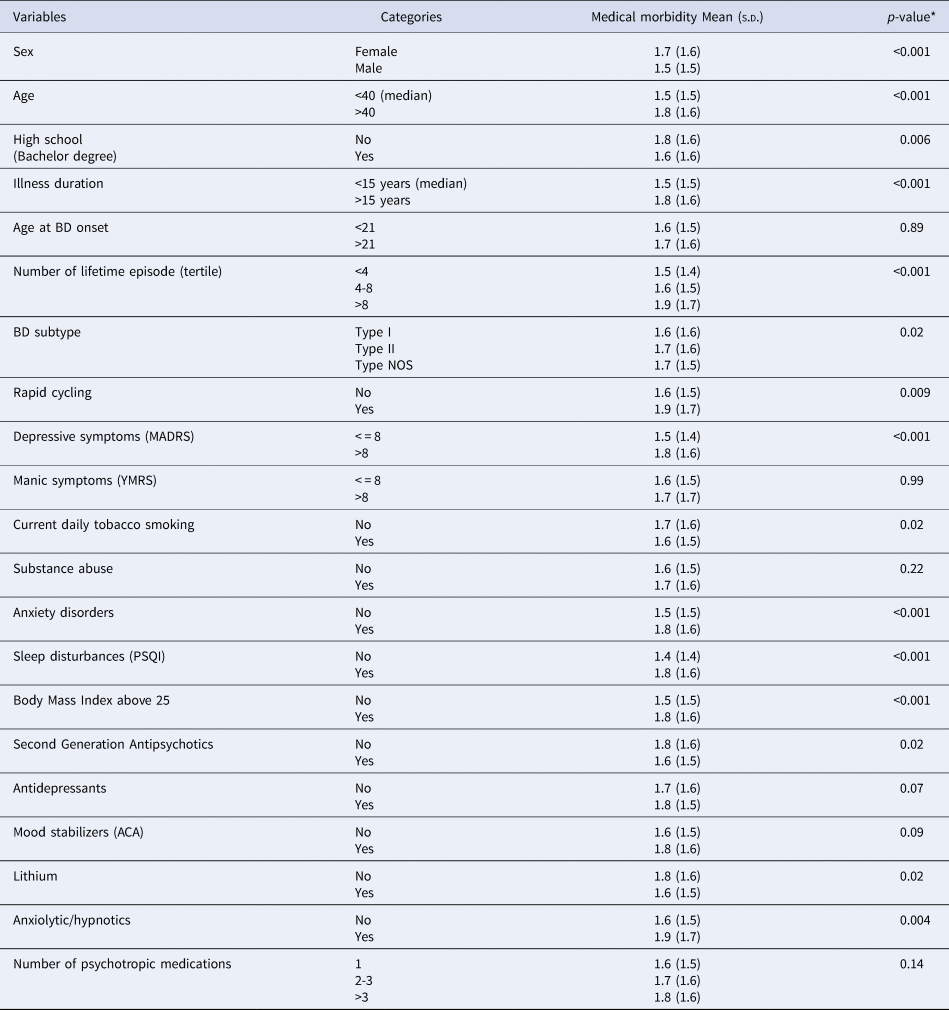
Univariate associations between variables at baseline and the number of medical disorders (n = 2891)

* Mann–Whitney Wilcoxon tests.
MADRS, Montgomery Asberg Depression Rating scale; YMRS, Young Mania rating Scale; MARS, Medication Adherence rating Scale; ACA, AntiConvulsant Agents; SD, Standard Deviation; PSQI, Pittsburgh Sleep Quality Index; BD, Bipolar Disorder (type I or II).
Several socio-demographic and clinical factors were also associated with the medical morbidity with the most significant associations being observed for sex, age, illness duration, depressive symptoms, lifetime anxiety disorders, current sleep disturbances, current obesity, number of lifetime mood episodes, current use of anxiolytics/hypnotics (all p values <0.005, see Table 2 for details).
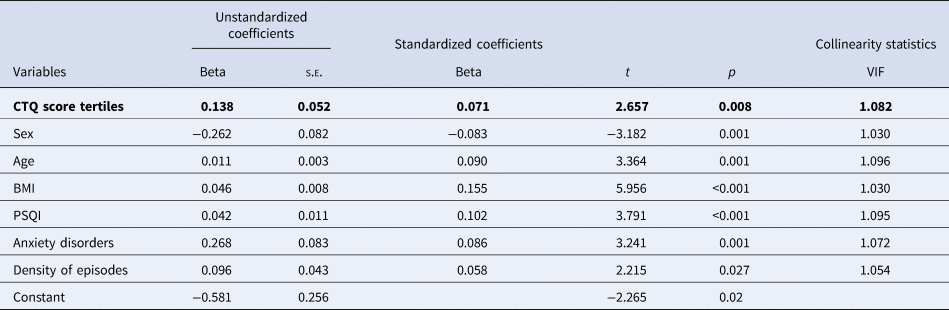
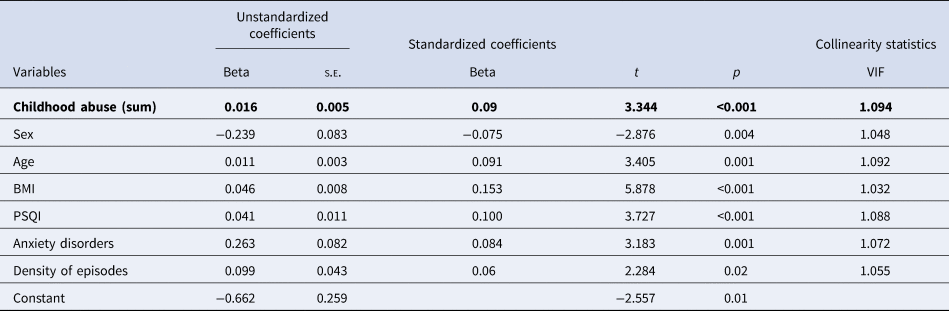
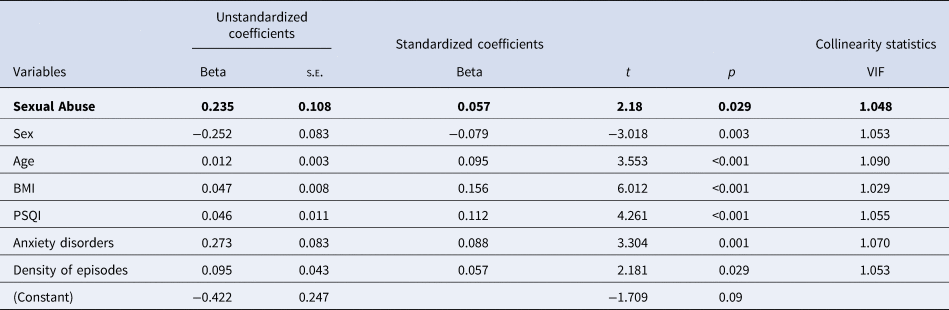
Linear regressions analyses were used to test the associations between medical morbidity and various definitions of childhood maltreatment, while adjusting for potential confounding factors. Results are presented in Tables 3–5. In each model, age, sex, BMI, sleep disturbances, anxiety disorders and density of lifetime mood episodes were associated with the medical morbidity. We observed associations between medical morbidity, childhood maltreatment (based on tertiles of CTQ total score), sum of childhood abuse and the presence of sexual abuse (respectively p = 0.008, p < 0.001 and p = 0.03).
Associations between medical morbidity and childhood maltreatment adjusted for potential confounders: Model using tertiles of CTQ total score

Associations between medical morbidity and childhood maltreatment adjusted for potential confounders: Model using both sum of abuse and sum of neglect

Associations between medical morbidity and childhood maltreatment adjusted for potential confounders: Model using all childhood maltreatment subtypes

BMI, Body Mass Index; PSQI, Pittsburgh Sleep Quality Index; SE, Standard Error; VIF, Variable Inflation Factors.
Association between childhood maltreatment, prevalence and age at onset of the most frequent comorbidities
Online Supplementary Table S3 describes the lifetime prevalence and the age at onset for the 15 most frequent comorbidities. The six medical comorbidities with a prevalence above 10% were headache/migraine (20.8%), allergy (other than asthma) (18.6%), dyslipidemia (14.9%), acne (13%), eczema (11.8%) and thyroid diseases (11.5%). Most of these 15 frequent comorbidities occurred after the onset of BD. Plots of prevalence and median age at onset are described in Fig. 1.
Diagrammatic representation of the prevalence and age at onset (AAO) of the 15 most frequent medical disorders.
The location of the bubble on the vertical axis indicates the median AAO of each disorder. The size of each bubble is proportional to the prevalence of the disorder (e.g. the size of the bubble for bipolar disorders corresponds to 100%). Light grey: bipolar disorder; Dark grey: medical conditions.

Four of the 15 most frequent comorbidities were more frequent in the upper tertile of the CTQ total score: migraine/headache (p < 0.0001), drug eruption (p = 0.04), duodenal ulcer (p = 0.005), and thyroid diseases (p = 0.0002) (see online Supplementary Table S4). None of the 15 frequent comorbidities had an earlier age at onset in individuals with greater exposure to childhood trauma (see online Supplementary Table S5).
Discussion
In a large sample of 2891 individuals with BD, we suggested that childhood maltreatment (mainly sum of abuse, and sexual abuse) was associated with a higher number of medical disorders, independently of other potential confounders. Indeed, the multivariate analyses showed that, beyond childhood maltreatment, older age, male sex, higher BMI, lower sleep quality, lifetime anxiety disorders and higher density of mood episodes were also associated with a significantly higher number of medical disorders. Regarding the most frequent medical comorbidities, childhood maltreatment tended to increase the lifetime prevalence of some (i.e. migraine/headache, drug eruption, duodenal ulcer and thyroid diseases), but did not appear to significantly decrease their respective age at onset.
In individuals with BD, emerging evidence suggest that childhood maltreatment might be related to a greater likelihood of developing physical health problems but this hypothesis has been investigated only in a few studies (Hosang et al., Reference Hosang, Fisher, Uher, Cohen-Woods, Maughan, McGuffin and Farmer2017, Reference Hosang, Fisher, Hodgson, Maughan and Farmer2018; Leclerc et al., Reference Leclerc, Mansur, Grassi-Oliveira, Cordeiro, Kapczinski, McIntyre and Brietzke2018; McIntyre et al., Reference McIntyre, Soczynska, Liauw, Woldeyohannes, Brietzke, Nathanson and Kennedy2012; Post et al., Reference Post, Altshuler, Leverich, Frye, Suppes, McElroy and Rowe2013) with some methodological limitations, as such as small sample sizes, a restricted number of medical conditions being assessed, and a lack of confounding factors being taken into account. When compared to the literature, our study has several strengths: a large sample size, the use of a reliable and standardized psychiatric interview, the assessment of various subtypes of childhood maltreatment, the recording of many associated medical disorders, as well as the investigation of many potential confounding factors.
Nevertheless, several limitations should be discussed. Due to the cross-sectional design of the study, we were unable to draw any firm conclusions concerning the causal nature of the associations observed, even if plausible. In this context, longitudinal studies would be required to infer causality. Recall bias have possibly hampered the retrospective assessment of medical disorders (mainly in terms of age at onset), as well as the self-reported assessment for childhood maltreatment. Of note, a recent study demonstrated good reliability and convergent validity of retrospective reports of childhood maltreatment by individuals with BD (Hosang, Manoli, Shakoor, Fisher, & Parker, Reference Hosang, Manoli, Shakoor, Fisher and Parker2023). All medical comorbidities were self-declarative, although checked against medical notes and all sources of available information. We did not include any control group (healthy control or another clinical sample with depressive disorders for instance), which precludes to conclude about the specificity of these findings to BD. The representativeness of this sample as compared to the whole population of individuals with BD remains questionable, since all were assessed in university-affiliated psychiatric services. We cannot exclude that the fact that we did not find any association between childhood maltreatment and ages at onset of most frequent comorbidities (online Supplementary Table 4) due to a lack of statistical power, even if our sample was large. Replication in larger samples might be able to identify some associations between childhood maltreatment and age at onset of some specific comorbidities.
There is an important literature mainly from the general population suggesting that various forms of childhood maltreatment may have a negative impact on physical health (Danese & Tan, Reference Danese and Tan2014; Norman et al., Reference Norman, Byambaa, De, Butchart, Scott and Vos2012). A systematic review and meta-analysis including 124 studies suggested a causal relationship between non-sexual childhood maltreatment and a wide range of mental disorders, drug misuse, suicide attempts, sexually transmitted infections, and risky sexual behaviors (Norman et al., Reference Norman, Byambaa, De, Butchart, Scott and Vos2012). Furthermore, this review found associations between childhood maltreatment and several physical conditions such as obesity, arthritis, headache/migraine, peptic ulcer, neurological disorders, asthma, bronchitis/emphysema, and cardiovascular diseases. These finding were further supported by a systematic review and meta-analysis of 41 studies, showing that childhood maltreatment was associated with elevated risk of developing obesity over the life-course (Danese & Tan, Reference Danese and Tan2014). These results were also consistent with a more recent meta-analysis showing weak or modest associations for overweight or obesity, and diabetes and moderate associations for cancer, heart diseases, and respiratory diseases (Hughes et al., Reference Hughes, Bellis, Hardcastle, Sethi, Butchart, Mikton and Dunne2017). This suggests that childhood maltreatment may contribute, not only to a greater risk for poor psychiatric health, but also to a worse physical health.
Several mechanisms may explain the association between childhood maltreatment and medical morbidity in individuals with BD. First, individuals who have been exposed to childhood maltreatment develop a more severe and unstable clinical presentation of BD (Agnew-Blais & Danese, Reference Agnew-Blais and Danese2016; Etain et al., Reference Etain, Aas, Andreassen, Lorentzen, Dieset, Gard and Henry2013; Grillault Laroche et al., Reference Grillault Laroche, Godin, Belzeaux, M'Bailara, Loftus, Courtet and Etain2022a). The potential correlate is a greater exposure to polypharmacy and consequently to more severe adverse effects of medications and/or combinations of medications. This may be particularly true for metabolic syndrome components. Second, childhood maltreatment increases the risk of comorbid substance use disorders in BD (tobacco, alcohol, cannabis and illicit drugs) (Agnew-Blais & Danese, Reference Agnew-Blais and Danese2016; Etain et al., Reference Etain, Aas, Andreassen, Lorentzen, Dieset, Gard and Henry2013; Grillault Laroche et al., Reference Grillault Laroche, Godin, Dansou, Belzeaux, Aouizerate, Burte and Etain2022b), that are well-known providers of poor physical health (WHO, 2018). Third, childhood maltreatment may act on several biological pathways that may predispose to a higher medical morbidity. For example, childhood maltreatment has been associated with alterations of cortisol secretion, altered HPA axis gene expression and levels of several pro-inflammatory cytokines (such as IL-6, TNF- α, and C-reactive protein) (Baumeister, Akhtar, Ciufolini, Pariante, & Mondelli, Reference Baumeister, Akhtar, Ciufolini, Pariante and Mondelli2016; Bernard, Frost, Bennett, & Lindhiem, Reference Bernard, Frost, Bennett and Lindhiem2017; D'Elia et al., Reference D'Elia, Matsuzaka, Neto, Mello, Juruena and Mello2018; Grillault Laroche et al., Reference Grillault Laroche, Curis, Bellivier, Nepost, Courtin, Etain and Marie-Claire2020; Tursich et al., Reference Tursich, Neufeld, Frewen, Harricharan, Kibler, Rhind and Lanius2014). Childhood maltreatment may therefore induce a low-grade chronic inflammation that associates with poor physical health. Fourth, childhood maltreatment may also have long-term consequences on sleep quality, possibly through modifications of the circadian system (Grillault Laroche et al., Reference Grillault Laroche, Curis, Bellivier, Nepost, Gross, Etain and Marie-Claire2021; Pfaff & Schlarb, Reference Pfaff and Schlarb2022), and chronic sleep disturbances and circadian rhythms abnormalities are risk factors for poor physical health, especially metabolic health (Kwok et al., Reference Kwok, Kontopantelis, Kuligowski, Gray, Muhyaldeen, Gale and Mamas2018). Finally, childhood maltreatment has been associated with accelerated DNA methylation age (Wolf et al., Reference Wolf, Maniates, Nugent, Maihofer, Armstrong, Ratanatharathorn and Logue2018) and telomere attrition (Aas et al., Reference Aas, Elvsashagen, Westlye, Kaufmann, Athanasiu, Djurovic and Andreassen2019; Hanssen, Schutte, Malouff, & Epel, Reference Hanssen, Schutte, Malouff and Epel2017; Li, He, Wang, Tang, & Chen, Reference Li, He, Wang, Tang and Chen2017) that may represent mediators for the observed consequences on physical health.
Future research is recommended for a better understanding of the links between childhood maltreatment and the medical burden in BD. First, the findings of this study should be replicated in independent and larger datasets [possibly collected as part as international collaborations, such as the Bipolar Global Cohort (Burdick et al., Reference Burdick, Millett, Yocum, Altimus, Andreassen, Aubin and McInnis2022)]. For instance, we did not find any association between childhood maltreatment and the ages at onset of medical comorbidities. With larger samples collected across multiple sites and in different countries, some results might be identified in favor of an earlier occurrence of some specific medical comorbidities. Second, studies using longitudinal design would be more appropriate to describe the occurrence of certain medical comorbidities. This particularly applies to medical comorbidities that are likely to occur after the onset of BD. For this purpose, further research should be performed for instance in samples of individuals recruited after a first manic episode. Finally, there is an urgent need to identify clinical and biological factors that might mediate the links between childhood maltreatment and medical comorbidities in BD. For instance, chronic sleep disturbances, smoking or substance use disorders, inflammation, oxidative stress or accelerated ageing (as mentioned above in the discussion) might be durably altered by childhood maltreatment and – in turn – might increase the risk to develop certain medical comorbidities (Hosang et al., Reference Hosang, Fisher, Uher, Cohen-Woods, Maughan, McGuffin and Farmer2017, Reference Hosang, Fisher, Hodgson, Maughan and Farmer2018). This approach would help identifying potential targets for future prevention (and possibly treatment) of medical conditions in individuals with BD – in general but more specifically those who have been exposed to early adversities.
Since the mortality trends in BD tended to stay stable in recent decades (Lomholt et al., Reference Lomholt, Andersen, Sejrsgaard-Jacobsen, Ozdemir, Graff, Schjerning and Nielsen2019), there is an urgent need to identify risk factors that contribute to a poor physical health in BD. This study suggests that childhood maltreatment, and particularly childhood abuse and sexual abuse, may contribute to the medical morbidity of individuals with BD, independently of other potential confounders. In a recent report, the WHO has proposed several recommendations for the management of physical health conditions in individuals with severe mental disorders (WHO, 2018). Beyond the classical risk factors for a poor physical health (unhealthy lifestyle, sedentary behavior, harmful use of drugs, medications), childhood maltreatment should be systematically assessed in every individual with BD, especially those with a high medical morbidity. As such, psychosocial interventions that target childhood maltreatment and its consequences should be evaluated to assess any potential impact on physical health improvement.
Supplementary material
The supplementary material for this article can be found at https://doi.org/10.1017/S0033291723000922.
Acknowledgements
We thank the FondaMental Foundation (www-fondation-fondamental.org) for scientific cooperation in mental health, which is developing a new model for translational research in psychiatry in France and supports the infrastructure of Centers of Expertise in BD. We express our thanks to the nurses, and to the individuals who were included in the present study. We thank Hakim Laouamri, and his team (Seif Ben Salem, Karmène Souyris, Victor Barteau and Mohamed Laaidi) for the development of the FACE-BD computer interface (eBipolar©), data management, quality control and regulatory aspects.
Author contributions
O. G. and B. E. managed the literature searches and the statistical analyses, interpreted the results and wrote the manuscript.
All other authors contributed to data collection, proposed critical review of the manuscript and approved the final version of the article final.
Financial support
This research was supported by the Foundation FondaMental, Institut National de la Santé et de la Recherche Médicale (INSERM), AP-HP, and by the Investissements d'Avenir program managed by the ANR under reference ANR-11-IDEX-0004-02 and ANR-10-COHO-10-01. This funding source had no role in the study design, data collection, analysis, preparation of the manuscript, or decision to submit the manuscript for publication.
Conflict of interest
All other authors reported no biomedical financial interests or potential conflicts of interest related to this article.
Ethical standards
The assessment protocol was approved by the institutional review board (Comité de Protection des Personnes Ile de France IX; January 18, 2010), in accordance with the French laws for non-interventional studies and requires only an information letter.