INTRODUCTION
Dottybacks (Pseudochromidae) are relatively small and often brightly-coloured fish that inhabit Indo-Pacific coral reefs (Allen et al., Reference Allen, Steene, Humann and Deloach2003; Froese & Pauly, Reference Froese and Pauly2012). Living in crevices, their behaviour is highly secretive and dottybacks venture into the open only for short moments to catch prey. This explains that they are rarely seen despite being relatively common. Due to their size and behaviour, dottybacks are not targeted by fishermen and have often been overseen by divers. Therefore, several species of the Pseudochromidae have been described relatively recently (e.g. Allen & Erdmann, Reference Allen and Erdmann2007; Randall & Schultz, Reference Randall and Schultz2009; Gill et al., Reference Gill, Allen and Erdmann2012).
Gill (Reference Gill2004) reviewed the subfamily Pseudochrominae and described the new genus Manonichthys as differing from other pseudochromid genera in having an incomplete lower lip and a varying pterygiophore formula of the dorsal fin. Furthermore, species belonging to the genus Manonichthys facultatively live within large tubular sponges (Gill & Williams, Reference Gill and Williams2011). Gill (Reference Gill2004) recognized five species within the genus Manonichthys of which only M. winterbottomi Gill, Reference Gill2004, was found in the central Philippines. Later Gill & Williams (Reference Gill and Williams2011) described a new species Manonichthys scintilla Gill & Williams, Reference Gill and Williams2011, from the western central Philippines, which brought the number of representatives of this genus to two for the entire Philippine archipelago. The present study reports the first record of a third representative of the genus Manonichthys in the Philippines and describes the size and features of the localities of the observed specimens.
MATERIALS AND METHODS
On 25 May 2011, the first author observed a representative of the genus Manonichthys at a depth of 28 m while SCUBA diving in a coral reef in the Davao Gulf, the Philippines (7°0′43.53″N–125°42′39.35″E). Unfortunately, the specimen rapidly disappeared into a tubular sponge not allowing the identification of the species. Also the resulting photograph did not allow identifying the fish at species level. The coral reef was revisited on 28 June 2012 in an attempt to find and identify the Manonichthys representative. Multiple dives were conducted using SCUBA gear. Once a specimen was found, the locality was carefully studied for about 20 minutes and the specimen was photographed when leaving its refuge. The specimens were identified from the photographs using Gill (Reference Gill2004) and Gill & Williams (Reference Gill and Williams2011).
RESULTS
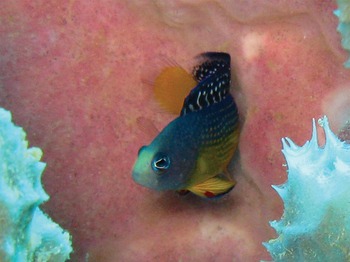
On 28 June 2012, a specimen of Manonichthys alleni was observed at a depth of 23 m (Figure 1) in the same coral reef where a representative of the genus Manonichthys was observed in May 2011. A large colony of the tubular sponge Callyspongia aerizusa Desqueyroux-Faúndez, 1984, formed the home range of this specimen. Two additional specimens were found at 19 and 20 m depth, each living in a separate tubular sponge of C. aerizusa. All specimens had one prominent crimson spot near the anterior base of each pelvic fin (Figure 1). This differentiated the observed specimens from other species of this genus. Total length of the specimens was estimated at 45–60 mm. All specimens behaved highly secretively and hid within tubes of the sponges. The specimens avoided leaving their refuge while being observed by a diver.
Manonichthys alleni Gill, Reference Gill2004, at 23 m in a coral reef in the Davao Gulf, the Philippines (photograph: A.R. Bos).

DISCUSSION
Coral reef fish have been intensively studied in the Philippines, but ichthyological research has mainly concentrated on the central islands (Visayas and Palawan) and the northern island (Luzon) of the country (e.g. Russ et al., Reference Russ, Stockwell and Alcala2005; Samoilys et al., Reference Samoilys, Martin-Smith, Giles, Cabrera, Anticamara, Brunio and Vincent2007; Bos, Reference Bos2011). Political instability in the southern islands (Tawi-Tawi, Sulu, Basilan and Mindanao) has hampered the development of a research infrastructure and, as a consequence, a limited number of studies has been performed in these regions. Recently however, several interesting phenomena were recorded in the Davao Gulf (south-east Mindanao). Symbiotic fish were firstly observed (Bos, Reference Bos2012) in association with the mushroom coral Heliofungia actiniformis Quoy & Gaimard, 1833, earlier known to only host invertebrate fauna (Hoeksema et al., Reference Hoeksema, van der Meij and Fransen2012). Also a symbiotic relationship may exist between the dottyback Manonichthys alleni and the tubular sponge Callyspongia aerizusa. Furthermore, a new predator of the crown-of-thorns seastar Acanthaster planci (Linneaus, 1758) was discovered in the Davao Gulf (Bos et al., Reference Bos, Gumanao and Salac2008, Reference Bos, Mueller and Gumanao2011). The present study describing the first record of Manonichthys alleni in the Philippines is another example of a unique observation in coral reefs in south-east Mindanao. The above observations are proof that this region contains a wealth of biological and ecological information yet to be discovered. Therefore it seems plausible that species, earlier reported from the adjacent Celebes Sea or other seas within the Coral Triangle, may be recorded in the future.
ACKNOWLEDGEMENTS
We greatly acknowledge the support of J. Bayogan, G. Gumanao, and the field staff of the Davao del Norte State College. Furthermore, we thank R. van Soest and N. de Voogd from the Naturalis Biodiversity Center for identifying the tubular sponge. This research received no specific grant from any funding agency, commercial or not-for-profit sectors.