Introduction
The genus Antimora (Moridae, Gadiformes) includes two species: Pacific flatnose (Antimora microlepis) Bean, 1890 and blue antimora (Antimora rostrata) (Günther, 1878) (Cohen, Inada, Iwamoto, & Scialabba, Reference Cohen, Inada, Iwamoto and Scialabba1990; Orlov, Grigorov, & Lazareva, Reference Orlov, Grigorov and Lazareva2018a; Small, Reference Small1981). Antimora microlepis inhabits the North Pacific Ocean, while A. rostrata is found in many other parts of the world. Antimora rostrata is most abundant in temperate and cold waters but is not present in the Arctic Ocean and semi-enclosed seas (i.e. the Sea of Japan and the Caribbean and Mediterranean seas) or in most tropical and subtropical areas (with the exception of the Gulf of Guinea, the Canary Islands and Madeira, the Indian Ocean underwater ridges, Hawaii, Taiwan, the Gulf of California and the northern coast of South America) (Cohen et al., Reference Cohen, Inada, Iwamoto and Scialabba1990; Orlov et al., Reference Orlov, Sytov, Mari, Figueroa, Barbini, Costa and Mincarone2019; Small, Reference Small1981). Blue antimora is a bentho-pelagic deep-sea species that is capable of forming dense concentrations. It is caught as bycatch in bottom trawl and longline fisheries (Fossen & Bergstad, Reference Fossen and Bergstad2006; Horn & Sutton, Reference Horn and Sutton2015; Iwamoto, Reference Iwamoto1975; Kulka, Simpson, & Inkpen, Reference Kulka, Simpson and Inkpen2003) and considered as a promising commercial target (Priede, Reference Priede2017).
Published information about the life cycle of A. rostrata is limited and fragmentary (Collins, Priede, & Bagley, Reference Collins, Priede and Bagley1999; Gordon & Duncan, Reference Gordon and Duncan1985; Iwamoto, Reference Iwamoto1975; Kulka et al., Reference Kulka, Simpson and Inkpen2003; Novikov & Timokhin, Reference Novikov and Timokhin2009; Wenner & Musick, Reference Wenner and Musick1977). The age and growth of blue antimora have been studied in the waters of Iceland (Magnússon, Reference Magnússon2001), the Ross Sea and New Zealand waters (Horn & Sutton, Reference Horn and Sutton2015) and the Lazarev and Weddell seas (Vedishcheva, Korostelev, Gordeev, & Orlov, Reference Vedishcheva, Korostelev, Gordeev and Orlov2019), as well as in several areas of the North Atlantic, including the waters of both coasts of Greenland and the Mid-Atlantic Ridge (Fossen & Bergstad, Reference Fossen and Bergstad2006; Orlov, Vedishcheva, Trofimova, & Orlova, Reference Orlov, Vedishcheva, Trofimova and Orlova2018b). However, no age validations were provided in publications documenting those studies.
The purpose of this paper is, for the first time, to report the data on the age and growth of blue antimora from the waters of the Kerguelen and Crozet Islands (southeastern Indian Ocean) and to compare those results with previously published data regarding other parts of range.
Materials and methods
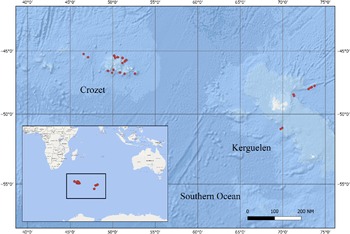
Blue antimora otoliths (sagitta) were collected from bycatch specimens of commercial longline fishing targeting Patagonian toothfish Dissostichus eleginoides off the French Kerguelen and Crozet Islands Exclusive Economic Zone (Fig. 1), a part of the Convention area of the Commission for the Conservation of Antarctic Marine Living Resources (CCAMLR). Otoliths were collected by French fishery observers on six different longliners operating in these areas during the 2016/2017 and 2017/2018 fishing campaigns and dry-stored in paper envelopes with labels on the catch (date, set number and depth) to be linked to the fishing master logbook. The fishing method is described in Cherel, Weimerskirch, and Duhamel (Reference Cherel, Weimerskirch and Duhamel1996) and Duhamel (Reference Duhamel1992).
The sites (circles) where otoliths of blue antimora Antimora rostrata in the waters off Kerguelen and Crozet Islands were sampled.

A total of 164 individuals caught from depths of 515–1745 m were analysed. All the fish were analysed using standard methods (Laevastu, Reference Laevastu1965; Pravdin, Reference Pravdin1966). Measurements included total body length (TL) and body weight, and sex was registered when possible. Of the 164 fish caught, sex was determined in 97 specimens (76 females and 21 males); the other 67 specimens were unsexed; gonadal maturity was also not examined by observers.
Otoliths were extracted from freshly caught fish during the biological analyses onboard the ship. The measuring and weighing of otoliths and age determinations were carried out in the VNIRO laboratory. The length was measured in 133 otoliths using an electronic calliper (Kraftool GmbH, Löningen, Germany) with accuracy of 0.01 mm; the weight of these 133 otoliths was determined on an electronic scale (Sartorius GmbH, Goettingen, Germany) with accuracy of 0.001 g.
Since the beginning of the 1980s, when determining the age of fish, a “break and burn” method of age determination on otoliths has been widely used, which has proved to be good for demersal (including deep-water) fish of the west coast of the USA and Canada (Beamish & McFarlane, Reference Beamish, McFarlane, Summerfelt and Hall1987). Taking into account that blue antimora, like many deep-sea fish, is probably a long-lived species (Fossen & Bergstad, Reference Fossen and Bergstad2006; Horn & Sutton, Reference Horn and Sutton2015; Magnússon, Reference Magnússon2001; Orlov et al., Reference Orlov, Vedishcheva, Trofimova and Orlova2018b; Vedishcheva et al., Reference Vedishcheva, Korostelev, Gordeev and Orlov2019), age was determined in accordance with the methods developed specifically for some long-lived deep-sea fish (Beamish & Chilton, Reference Beamish and Chilton1982).
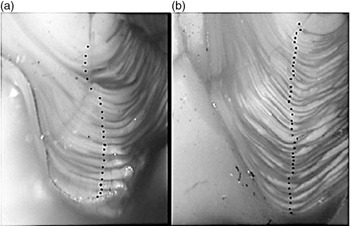
Accordingly, otoliths were broken transversely in half with a lancet and baked, then polished if necessary. Otoliths were burned in the flame of an alcohol burner. For the preparation of polished cross-sections of the otoliths, abrasive discs with aluminium-oxide- or silicon-carbide-coated grit of 0.1−0.9 µm (Buehler, USA) were used. The readiness of each otolith for further analysis was determined individually on the basis of visual observations. We used a trinocular microscope (Olympus SXZ12) with a DFPLAPO 1×PF lens to view the cross-sections at 1×20–40 magnification. Otolith cross-sections were coated with glycerine and illuminated with reflected light (Fig. 2). In total, 164 otoliths were analysed based on the readings made by 3 independent readers. The average percent error (APE) index was calculated according to the methods proposed by Beamish and Fournier (Reference Beamish and Fournier1981) for comparison of age determinations by different readers. Age for an individual fish was determined as a mean age based on the three independent readings. Between-reader age determinations were based on pairwise comparisons and were considered consistent if APE values were less than 10% (Arkhipkin et al., Reference Arkhipkin, Baumgartner, Brickle, Laptikhovsky, Pompert and Shcherbich2008).
Cross-sections of otoliths of blue antimora Antimora rostrata from waters of Kerguelen and Crozet Islands: (a) TL 40.3 cm, 24 years; (b) TL 66.9 cm, 40 years. Dots are annual growth zones, TL = total length.

Fisher’s exact tests were used to assess relationships between the TL and body weight, length and weight of the otolith, TL and otolith weight, as well as age and otolith weight. Test outputs were calculated in MS Excel®.
Age curves were plotted and the coefficients of von Bertalanffy growth equations were calculated using PAST version 3.14 software (Hammer, Harper, & Ryan, Reference Hammer, Harper and Ryan2001).
Results
Otoliths were collected from representative samples of commercial catches of bottom longlines, in which blue antimora was represented by specimens with a TL ranging from 39 to 70 cm (smaller fish were not observed in catches due to selectivity of longlines that caught larger specimens). Fish with a TL of 55–65 cm (56%) dominated with a mean length of 57.0 ± 6.9 (SE) cm. The mean weight of fish in catches was 1434 ± 566 g with minimum and maximum values of 400 and 3310 g, respectively. Individuals weighing 1200–1700 g accounted for 42% of the total number of fish; there were smaller numbers in other weight groups in catches.
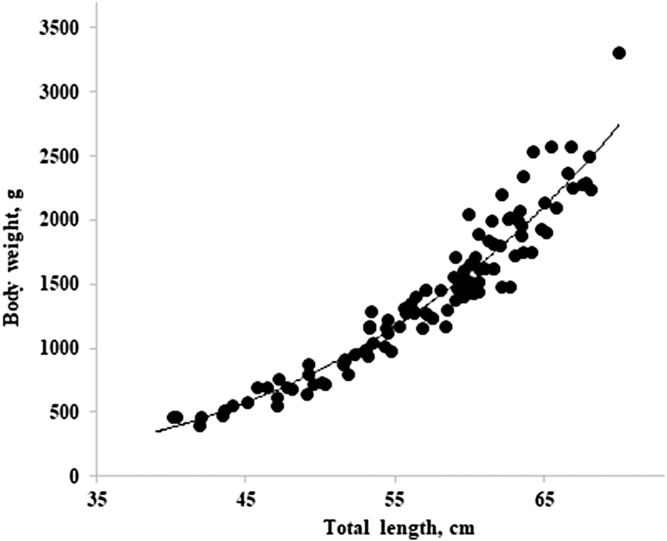
The relationship between the length and weight of blue antimora was better described (R 2 = 0.94, statistically significant at p < 0.01) by a power function (Fig. 3):
 $${\rm{BW}} = 0.0008 \times {\rm{TL}}^{3.5793}$$
where BW = body weight (g) and TL = total length (cm).
Relationship between the total length and body weight of blue antimora Antimora rostrata from waters of Kerguelen and Crozet Islands.

Males were caught less often than females (males: 22% vs. females: 78%). Females captured were considerably longer (mean total length 58.77±6.12 vs. 52.00±8.56 cm) and heavier than males (mean weight 1566±552 vs. 1112±586 g).
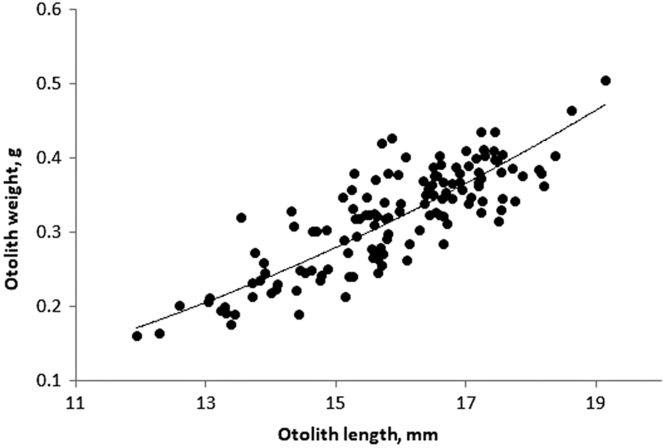
The weight of otoliths ranged between 0.161 and 0.505 g, with a mean weight of 0.320±0.070 g, while the length of otoliths ranged between 11.94 and 19.13 mm, with a mean of 15.85±1.40 mm. The relationship between the length and weight of otoliths (Fig. 4) can be described by a power function (R 2= 0.719, p < 0.001):
 $${W_o} = 0.0008 \times L_o^{2.1527}$$
where W o represents otolith weight (g) and L o represents otolith length (mm). As our analysis shows, the power function describes this relationship better than linear one (R 2 = 0.693). This means that the otolith gets increasingly bulky as it grows.
Relationship between otolith weight and otolith length of blue antimora Antimora rostrata from waters of Kerguelen and Crozet Islands.

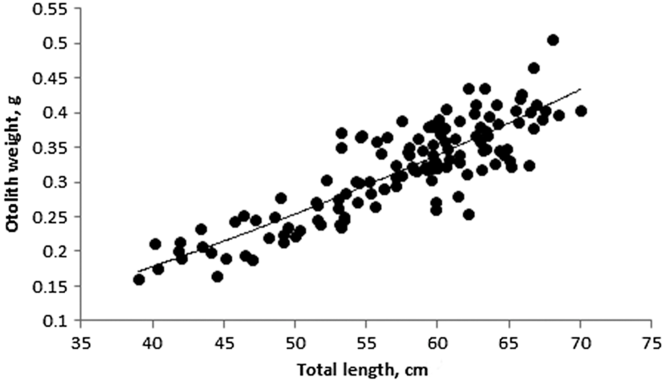
The otolith weight positively correlated with the total length of the fish (R 2 = 0.764, p < 0.001), and the relationship between the considered parameters (Fig. 5) can be described by a power function:
 $${W_o} = 0.0005 \times {\rm{TL}}^{1.5904}$$
where W o represents the weight of the otolith (g) and TL represents total length (cm). The power function describes this relationship better than linear one (R 2 = 0.726).
Relationship between otolith weight and total length of blue antimora Antimora rostrata from waters of Kerguelen and Crozet Islands.

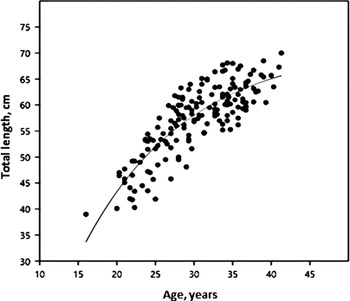
According to our data, in longline catches in the waters off the Kerguelen and Crozet Islands, blue antimora (if the rings in otoliths of this fish actually represent annual rings) was aged 16–41 years (Fig. 6) with a mean age of 30.4 years. The age determinations might be considered as quite repeatable since the APE indexes for readers 1, 2 and 3 were 6.04%, 5.18% and 5.81%, respectively.
Fitted von Bertalanffy curve to growth data (sexes combined, n = 148) of blue antimora Antimora rostrata from waters of Kerguelen and Crozet Islands.

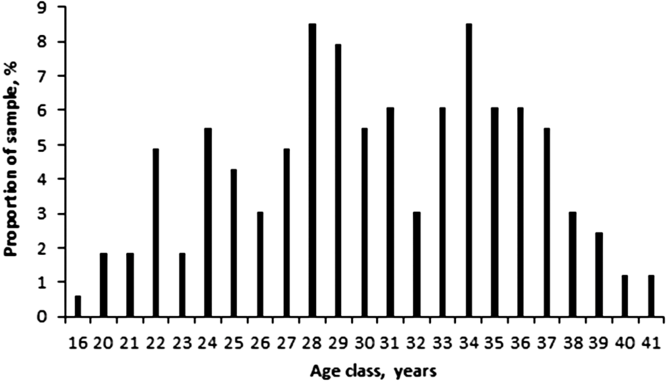
The age classes with the greatest numbers were represented by fish aged 34 years (9%), 28 years (9%) and 29 years (8%), which together accounted for 26% of the total catch (Fig. 7).
Age composition of blue antimora Antimora rostrata sample from waters of Kerguelen and Crozet Islands.

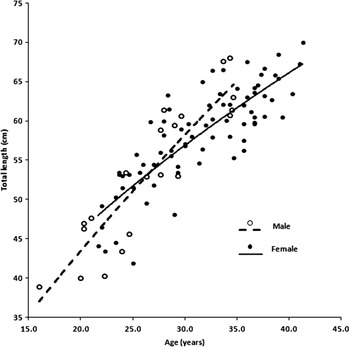
The youngest male in the catches was 16 years old with a TL of 39 cm (Fig. 8). The oldest male was aged 37 years with a TL of 68.1 cm and a weight of 2240 g. The mean age of males was 26.8 years. The youngest female in catches was 22 years old with a TL of 43.4 cm and a weight of 480 g, while the oldest age of 41 years was recorded for a female individual with a TL of 70 cm and a weight of 3310 g. The mean age of females was 31.5 years.
Growth of male and female blue antimora Antimora rostrata from waters of Kerguelen and Crozet Islands.

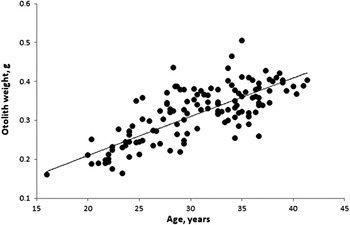
The relationship between the age of fish and the weight of otoliths (Fig. 9) can be described (R 2 = 0.602) by a power equation:
 $${W_o} = 0.0118 \times {A^{0.9622}}$$
where W orepresents otolith weight (g) and A represents age (years).
Relationship between otolith weight and age of blue antimora Antimora rostrata from waters of Kerguelen and Crozet Islands.

Discussion
Size composition of blue antimora caught off Kerguelen and Crozet Islands by longlines during 2016/2017 and 2017/2018 fishing campaigns differed from that during the 1995/1996 season (Duhamel, Pruvost, & Capdeville, Reference Duhamel, Pruvost and Capdeville1997). Thus, TL of this species in our catches and in 1995/1996 was 39–70 cm and 22–65 cm, respectively, with mode 55–65 vs. 52 cm and mean TL 57 vs. 45.9 cm. The main possible reason of smaller fish caught during 1995/1996 season is shallower depths fished (300–1700 vs. 515–1745 m in 2016–2018), since smaller and younger individuals of this species occur at shallower depths (Cohen et al., Reference Cohen, Inada, Iwamoto and Scialabba1990).
The sex ratio of blue antimora varies across areas and depths surveyed. Males dominated at depths of 500 m of the northwestern Atlantic, while the proportion of females increased with increasing depth (Kulka et al., Reference Kulka, Simpson and Inkpen2003). In Greenland waters, depths of over 900 m were also dominated by females (Orlov et al., Reference Orlov, Vedishcheva, Trofimova and Orlova2018b). In the waters of the North Atlantic coast of the USA at depths up to 1500 m, the number of males was higher than that of females (Wenner & Musick, Reference Wenner and Musick1977). Populations of the Indo-Oceanic blue antimora significantly differ from the North Atlantic in sex ratio. According to Novikov and Timokhin (Reference Novikov and Timokhin2009), on the underwater ridges of the Indian Ocean at depths ranged 900–1700 m, the sex ratio was close to 1:1 on the Southwest Indian Ridge with some predominance of females (1:1.2–1.4) in other areas. In the Southern Ocean, the number of males in the Lazarev and Weddell seas was higher than females at depths of 1100–1800 m (Vedishcheva et al., Reference Vedishcheva, Korostelev, Gordeev and Orlov2019). Furthermore, at depths of 800–2000 m in the Ross Sea, the percentage of females was up to 90% (Horn & Sutton, Reference Horn and Sutton2015), which is similar to our data (78% vs. 22%). In our opinion, the sex ratio of blue antimora in different areas is dependent not only on depth surveyed but also on type of fishing gear used. Thus, longlines are more selective gear in relation to size composition and catch larger fish, which in case of blue antimora are dominated by females.
The majority of authors who studied the age of blue antimora using otoliths (Fossen & Bergstad, Reference Fossen and Bergstad2006; Horn & Sutton, Reference Horn and Sutton2015; Orlov et al., Reference Orlov, Vedishcheva, Trofimova and Orlova2018b; Vedishcheva et al., Reference Vedishcheva, Korostelev, Gordeev and Orlov2019) note the challenges associated with the difficulty in interpreting the otolith zones, which was quite evident in our studies. In this study, we consider all visible rings as annuli similar to other previous studies where age estimations were unvalidated. Preliminary results from further research suggest that the number of rings placed on otoliths and vertebrae do not differ significantly (Korostelev, Frey, & Orlov unpublished) and we therefore consider the rings on otoliths and vertebrate to be laid annually. Despite the absence of well-defined seasonality at great depths, in high latitudes, seasonal changes on the ocean surface (changes in daylight hours, temperature, etc.) lead to changes in the flow of organic matter into deep-sea layers and thus can affect the overall productivity of deep waters and the availability of food for deep-sea fishes.
Given that commercial longline fishing catches mainly large fish, our samples of blue antimora had a relatively narrow size range, which can explain the low R 2 value for the relationship between the length of the blue antimora and the weight of its otoliths, as well as between the weight and age of otoliths. The example from the waters of southwestern Greenland can serve as confirmation of this (Orlov et al., Reference Orlov, Vedishcheva, Trofimova and Orlova2018b): the R 2 value for juvenile individuals with a length of 18–42 cm was equal to 0.58, while for females with a broader size range (21–70 cm), it was 0.95.
The contradictory information available in the literature on the growth rates of female and male blue antimora is probably associated with difficulties that relate to ageing long-lived deep-water fish. In the waters off Iceland, males were smaller than females of the same age (Magnússon, Reference Magnússon2001), while no such difference was found off Greenland and the Mid-Atlantic Ridge (Fossen & Bergstad, Reference Fossen and Bergstad2006), as well as in the Ross Sea and off New Zealand (Horn & Sutton, Reference Horn and Sutton2015). Male blue antimora (up to the age of 14 years) off southwestern Greenland grow faster than females, whereas 15–16-year-old individuals of both sexes have comparable growth rates in length and weight. In subsequent years, females are noticeably longer and heavier than males of the same age (Orlov et al., Reference Orlov, Vedishcheva, Trofimova and Orlova2018b). In our study area, female blue antimora were much larger than males and slightly older (31.9 vs. 27.9 years on average), which is probably due to females growing larger than males and the lifespan of males being considerably shorter (Fossen & Bergstad, Reference Fossen and Bergstad2006; Horn & Sutton, Reference Horn and Sutton2015).
The age composition of the catches of blue antimora in various areas is different. In the waters of the Mid-Atlantic Ridge, catches were represented by individuals aged 6–25 years with a predominance of fish older than 10 years; in the waters off Greenland, the age of fish varied within a range of 1–20 years with a predominance of individuals under 10 years (Fossen & Bergstad, Reference Fossen and Bergstad2006). In general, catches in both areas were dominated by individuals aged 7–14 years. In the Ross Sea, catches of blue antimora ranged in age between 11 and 41 years; and in the waters off New Zealand, they ranged between 4 and 28 years (Horn & Sutton, Reference Horn and Sutton2015). In catches from southwestern Greenland, individuals aged 7– 38 years with a numerical dominance of fish aged from 11 to 21 years were observed (Orlov et al., Reference Orlov, Vedishcheva, Trofimova and Orlova2018b), while 25–27-year-old individuals of blue antimora were most numerous in catches in the Lazarev and Weddell seas (Vedishcheva et al., Reference Vedishcheva, Korostelev, Gordeev and Orlov2019). In our catches, the age classes with the greatest numbers were represented by fish aged 34 years (9%), 28 years (9%) and 29 years (8%), which together accounted for 26% of the total catch. Since larger and older individuals of this species are known to generally occur at deeper depths (Cohen et al., Reference Cohen, Inada, Iwamoto and Scialabba1990), the described differences in the age composition of the catches are likely to be associated with obtaining the studied material from various authors in different bathymetric ranges. Between-area differences can also be influenced by the relative proportions of males and females in each sample, assuming that, in general, females are larger at age than males. The differences observed might also partly be explained by the different fishing gear (trawls and longlines) used in the various research studies. Longlines selectively caught larger and older fish, and therefore, blue antimora from the Ross, Lazarev and Weddell Seas and the waters of Kerguelen and Crozet Islands (Horn & Sutton, Reference Horn and Sutton2015; Vedishcheva et al., Reference Vedishcheva, Korostelev, Gordeev and Orlov2019; our data) were older than fish caught by trawls in the North Atlantic and off Greenland and New Zealand (Fossen & Bergstad, Reference Fossen and Bergstad2006; Horn & Sutton, Reference Horn and Sutton2015; Orlov et al., Reference Orlov, Vedishcheva, Trofimova and Orlova2018b). A greater proportion of small fish were caught by survey gear with smaller hooks and smaller mesh (Kulka et al., Reference Kulka, Simpson and Inkpen2003).
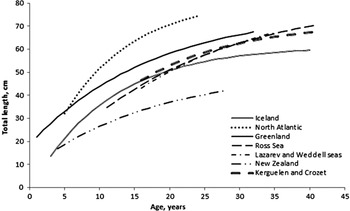
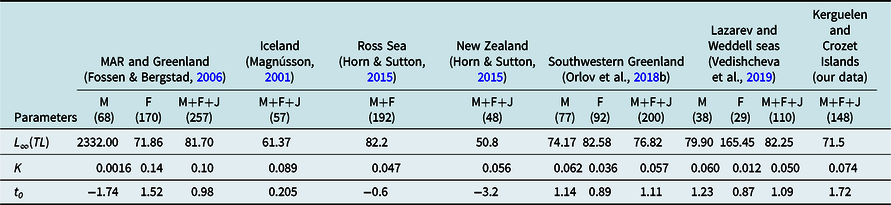
A comparison of blue antimora growth in different parts of its range (Fig. 10, Table 1) shows that growth curves for Kerguelen and Crozet Islands (our data) are very similar to those for the Ross Sea (Horn & Sutton, Reference Horn and Sutton2015), waters off Greenland (Orlov et al., Reference Orlov, Vedishcheva, Trofimova and Orlova2018b), and the Lazarev and Weddell Seas (Vedishcheva et al., Reference Vedishcheva, Korostelev, Gordeev and Orlov2019). Conversely, our data differ quite substantially from that obtained off the coast of New Zealand (Horn & Sutton, Reference Horn and Sutton2015), Iceland (Magnússon, Reference Magnússon2001) and the North Atlantic (Fossen & Bergstad, Reference Fossen and Bergstad2006). Blue antimora from New Zealand waters (Horn & Sutton, Reference Horn and Sutton2015) shows slower growth rates compared to our results, while in the North Atlantic (Fossen & Bergstad, Reference Fossen and Bergstad2006), this species demonstrates faster growth than in the waters of Kerguelen and Crozet Islands. In Icelandic waters (Magnússon, Reference Magnússon2001), blue antimora grows faster up to about 20 years, followed by a slower growth rate in older individuals compared to our data.
The growth of blue antimora Antimora rostrata in various parts of species’ range (Iceland – Magnússon, Reference Magnússon2001; North Atlantic – Fossen & Bergstad, Reference Fossen and Bergstad2006; Ross Sea – Horn & Sutton, Reference Horn and Sutton2015; New Zealand – Horn & Sutton, Reference Horn and Sutton2015; Greenland – Orlov et al., Reference Orlov, Vedishcheva, Trofimova and Orlova2018b; Lazarev and Weddell seas – Vedishcheva et al., Reference Vedishcheva, Korostelev, Gordeev and Orlov2019; Kerguelen and Crozet Islands, our data).

The parameters of von Bertalanffy growth equation of blue antimora Antimora rostrata in different regions.

MAR = Mid-Atlantic ridge, M = males, F = females, J = juveniles, number of fish is given in parentheses.
Conclusions
The similarity of blue antimora growth patterns in the Ross, Lazarev and Weddell seas and the waters of Kerguelen and Crozet Islands might indicate that this species forms a single population in the Southern Ocean that might be confirmed by recent molecular genetic study (Orlov, Bannikov, & Orlova, Reference Orlov, Bannikov and Orlova2020). This study also showed a difference of haplotype composition between blue antimora samples from the Southern Ocean and the North Atlantic. However, the growth pattern of this species in the Southern Ocean and Greenland waters is quite similar and might be due to the similar environmental conditions of both areas (temperature, forage conditions, etc.).
While our results are relatively similar to previous ones (Horn & Sutton, Reference Horn and Sutton2015; Orlov et al., Reference Orlov, Vedishcheva, Trofimova and Orlova2018b; Vedishcheva et al., Reference Vedishcheva, Korostelev, Gordeev and Orlov2019), the age determination of A. rostrata remains unvalidated and requires further research to validate the annual deposition of rings and confirm the real age. A valid comparison between studies would also require confirmation that all workers used the same otolith zone interpretation method. However, it is necessary to apply validation techniques based on Pb-210/Ra-226 disequilibrium (Cailliet et al., Reference Cailliet, Andrews, Burton, Watters, Kline and Ferry-Graham2001; Smith, Nelson, & Campana, Reference Smith, Nelson, Campana, Kershaw and Woodhead1991). We recently measured the elemental composition of A. rostrata and A. microlepis otoliths, and preliminary results suggest that Pb concentrations are sufficient for further age validation research based on the disequilibrium of Pb-210/Ra-226 (Kostelev & Orlov, Reference Korostelev and Orlov2020).
Current fishing methods and depth coverage do not allow for catching the juvenile part of the population, introducing another bias in the growth curves. Therefore, in future research, it is necessary to target juveniles to improve estimations of the younger ages just after nucleus formation.
Acknowledgements
The authors thank the fishery observers of Territoire des Terres Australes et Antarctiques Françaises and crew of French longliners for providing blue antimora otoliths and associated data from specimens caught off the Kerguelen and Crozet Islands. They are grateful to Charlotte Chazeau and Guy Duhamel (Muséum national d’histoire naturelle, Paris, France) for the collection’s protocol given to observers and for the arrangement of the transfer of material to VNIRO. The authors are also sincerely grateful to Guy Duhamel who critically read the manuscript and made the number of valuable comments. Special thanks to Roman Sinyavsky and Vladimir Belyakov (interns of the Moscow Zoo scientific department) for the reading of otoliths. The improvement of the English language was made by Proofed Inc. (Dover, DE, USA). Authors also thank two anonymous reviewers whose comments and suggestions helped significantly to improve the manuscript.
Financial support
None.
Conflict of interest
None.
Ethical standards
The authors assert that all procedures contributing to this work comply with the ethical standards of the relevant national and institutional guides on the care and use of laboratory animals.