Can an intervention that improves attitudes toward social out-groups also affect attitudes toward political organizations and their members? While scholars have long considered ways of improving attitudes toward stigmatized out-groups (Tajfel Reference Tajfel1981; Paluck and Green Reference Paluck and Green2009; Steele Reference Steele2010), evidence has recently emerged in support of one particular approach: analogic perspective-taking, whereby people exchange relevant narratives (Adida, Lo and Platas Reference Adida, Lo and Platas2018; Kalla and Broockman Reference Kalla and Broockman2020). When conducted in-person or over the telephone, analogic perspective-taking been found to improve attitudes toward the transgender community as well as undocumented immigrants (Kalla and Broockman Reference Kalla and Broockman2020).
Here, we examine whether analogic perspective-taking can also affect attitudes toward political organizations. Specifically, we examine whether such interventions can improve attitudes toward teachers’ unions. While teachers’ unions have long been a focus of public opprobrium (Cramer Reference Cramer, Bartels and Bermeo2014) – in part because of critical media coverage (Schmidt Reference Schmidt1993) and perceptions that union members are “undeserving” of the benefits they receive (Kane and Newman Reference Kane and Newman2019) – their members do not constitute a stigmatized social out-group in the same way that members of the transgender community, and undocumented immigrants, do.
As defined by Kalla and Broockman (Reference Kalla and Broockman2021, pp. 3), analogic perspective-taking depends on prompting people to “recall[] a similar situation from one’s own experience.” The party attempting to persuade shares their relevant experiences and solicits their target to do the same while refraining from judging the target. Such interventions build on prior work attesting to the ability of perspective-taking exercises to reduce reliance on stereotypes (Galinsky and Moskowitz Reference Galinsky and Moskowitz2000) and reduce prejudice (Galinsky and Ku Reference Galinsky and Ku2004). By requiring the exchange of narratives, analogic-perspective taking is indebted to findings about the capacity of narratives to “transport” the listener to a place far afield from his or her own perspective, and have their attitudes changed in the process (Green, Brock and Kaufman Reference Green, Brock and Kaufman2006). The research on narrative and transportation does not find that narratives must be exchanged, as analogic perspective-taking requires. In our experiment, we separate the effects of the exchange of narratives from the effects of the narrative delivered by the party trying to persuade. In doing so, we shed light on whether the effects attributed to analogic perspective-taking can also be attributed to the provision of narrative alone. Unlike prior work on analogic perspective-taking, our intervention is delivered over the Internet. While this requires us to slightly modify analogic perspective-taking, it also allows us to investigate whether such interventions must be done in-person to be effective, a question with significant implications for the intervention’s scalability.
We find that analogic perspective-taking improved attitudes toward teachers’ unions and union members. It even increased willingness to pay higher taxes for education. However, the intervention also proved capable of increasing support for some anti-union politics. We observed similar results across outcomes when subjects only listened to a narrative, without being asked to provide their own. Consistent with other recent findings (Kalla and Broockman Reference Kalla and Broockman2021), our evidence suggests that the effects of exchanging narrative perspectives can be smaller than the effects of only being exposed to a narrative. In a follow-up study, we find evidence that it is difficult for survey respondents to distinguish policies that benefit unions from those that do not. The data from this follow-up study indicate that subjects find it more difficult to evaluate the helpfulness of union-related policies than the immigration-related policies studied by Kalla and Broockman (Reference Kalla and Broockman2020).
Our results help map the scope of analogic perspective-taking’s effects: such interventions can affect attitudes toward members of political organizations as well as social groups, but they do not necessarily affect policy attitudes in the intended direction, and they may sometimes be inferior to the exchange of narrative alone.
Experimental design
The study was conducted in partnership with the Iowa State Education Association (ISEA), the Iowa affiliate of the National Education Association, the largest nationwide teachers union federation. The ISEA was interested in understanding how to improve public attitudes towards their union and members in light of national polarization around teachers unions and more recent events in their state. Footnote 1 We administered our experiment in the fall of 2019. Study participants were recruited via Qualtrics, with targets to match national benchmarks on partisanship, ideology, age, race, education, and sex. We also included an oversample of respondents from Minnesota, South Dakota, Iowa, Wisconsin, Nebraska, and Missouri, to better understand the attitudes of the public in states similar to Iowa. 3,300 subjects were recruited to match the national benchmarks, with an additional 700 subjects in the oversample.
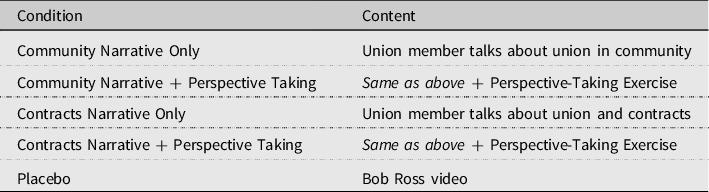
After answering questions about employment status, union membership, school-aged children, and any personal experiences with the ISEA, participants were randomly assigned to one of five conditions. Footnote 2 In the Contracts Narrative Only condition, subjects were exposed to a video in which an ISEA member spoke about how ISEA had helped her local secure more fair contracts. In the Community Narrative Only condition, subjects were exposed to a video in which the same ISEA member spoke about how the ISEA had supported her local’s work in their community. Footnote 3 In the Contracts Narrative and Perspective Taking and Community Outreach Narrative and Perspective-Taking conditions, subjects watched the corresponding video and then completed a perspective-taking exercise. Finally, subjects in Placebo watched a placebo video. The videos included closed captions. Complete text of the videos are in the appendix. The conditions are summarized in Table 1.
Treatment Conditions

The treatments were devised after discussions with this ISEA member, so that their content would reflect her real-life experiences. The Contracts video was motivated by the idea that attitudes toward unions and members would improve if subjects were informed about the efforts unions take to secure fair contracts for members. The ISEA member featured in the video described how an ISEA contracts expert had helped her local during contract negotiations. The member also spoke about how ISEA had stopped the Sioux City school district’s plan to prohibit teachers from taking paid breaks during the day. In the Community Outreach narrative video, the member described the work her local did to better the surrounding community. Again, she offered a concrete example, describing how her local maintained a food pantry and distributed food to needy children.
The perspective-taking exercise for the Contracts Narrative and Perspective-Taking condition began by asking respondents to reflect on a time when they had been treated unfairly by supervisor, or if not applicable, when a friend or family member had been. A text box was provided below. Respondents were then asked how their experiences relate to the teacher in the video, and how their experiences might have differed had they been part of a union. Again, a text box was provided below. Similarly, the perspective-taking exercise for the Community Narrative and Perspective-Taking condition began by asking participants to reflect on a time when they did work for their community, or, if not applicable, to reflect on a time when a family member or friend did so. A text box was provided below. Participants were then asked how their experiences related to the teacher in the video, and how their experiences might have differed had they been part of a union like the teacher, with a text box provided below.
This perspective-taking exercise differs somewhat from that employed in Kalla and Broockman (Reference Kalla and Broockman2020). Subjects were not given any indication that they were being listened to in real time. Offering that sort of indication would have required us to try to deceive our subjects; even then, we are skeptical that they would have regarded such a claim as plausible. On the other hand, the absence of a real-time listener may have mitigated subjects’ concerns that they were being judged for their responses, thereby approximating the standard analogic perspective-taking criterion of non-judgmentality. In any event, comparisons between our study and previous studies should be made with this difference in mind.
We chose to focus our treatments on contracts and community outreach for several reasons. Negotiating contracts is pivotal to any union’s purpose; if describing the work that unions do on that front does not improve attitudes, it would suggest that little could. We chose community outreach as the second theme in our treatments because of our conversations with union members. These conversations stressed how much the union was doing for local communities that went unseen by the public. Footnote 4 We hypothesized a parallel between these “unseen” union activities in local communities and the literature on the “submerged” welfare state (Mettler Reference Mettler2011). That literature emphasizes how many social programs are designed in ways that make it difficult for individuals to see themselves as beneficiaries of government policy. It also suggests that increasing their individuals’ knowledge about those program and their use can improve attitudes to social programs (Buell, Porter and Norton Reference Buell, Porter and Norton2020). Perhaps revealing the “submerged” community work that unions do might similarly enhance perceptions.
To evaluate effects on perceptions of teachers’ unions and members, we created an index based on responses to 10 questions, including whether respondents believe teachers’ unions “ensure that teachers are paid fairly for their efforts” and “help out in local communities.” Another index averages support for raising taxes to pay for higher teacher salaries, hiring more teachers, hiring more support staff, and enacting universal pre-K. A third index average support for legislative proposals that would curb union rights, including recertification requirements for union collective bargaining and so-called paycheck protection. Support for these proposals would amount to support for anti-union policies. A final index focuses on support for teachers’ right to collectively bargain. The indices were pre-specificed in our pre-analysis plan. Complete text of all questions can be found in the appendix.
As described in our pre-analysis plan, we hypothesized that engaging in analogic perspective-taking would increase agreement with positive statements about teachers’ unions; support for teachers’ collective bargaining rights; support for higher taxes to pay for more public education; and would decrease support for legislative proposals that would curb teachers’ collective bargaining rights. To investigate our interest in the differences between analogic perspective-taking and more conventional forms of persuasion, we would compare the effect sizes of the conditions with and without perspective-taking and report the results.
Results
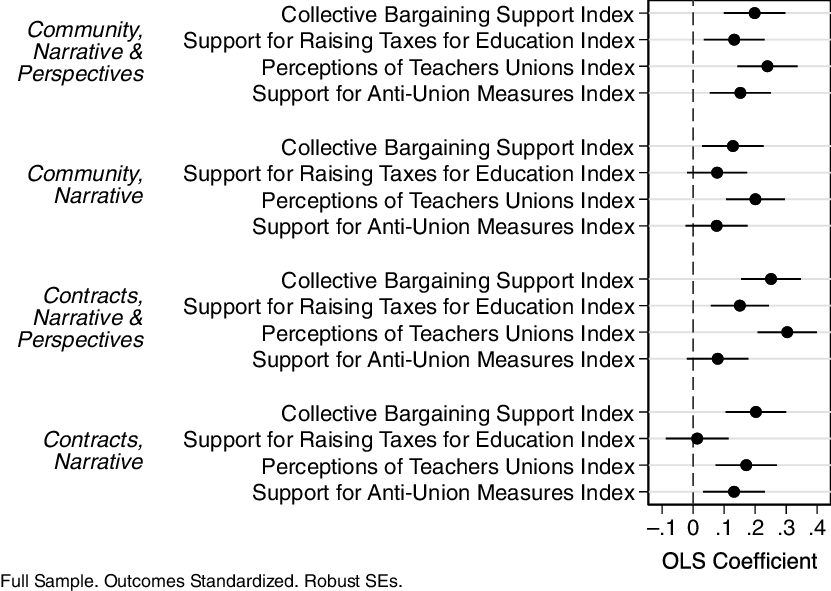
Table A1 presents descriptive statistics and evidence of balance. Results for each condition and each outcome are displayed in Figure 1, which shows OLS coefficients associated with each of the four treatments on the four outcome indices. Several conclusions are readily apparent. Multiple conditions proved capable of generating effects in the expected direction, with effects averaging between 0.1 to 0.2 standard deviations. Every condition improved perceptions of unions and increased support for collective bargaining. Yet not all the effects were in the anticipated direction. For example, while the Community Narrative and Perspective-Taking condition caused respondents to become more supportive of collective bargaining, raising taxes for education, and pushed them to hold more positive views of teachers’ unions in general, it also made them more supportive of anti-union measures. (Consistent with our pre-analysis plan, support for anti-union measures is coded so that larger numbers indicate more support for those measures). Such bidirectional effects were not limited to perspective-taking conditions; the Contracts Narrative Only condition also improved perceptions of unions and increased support for collective bargaining, while increasing support for the same antiunion measures. Regression results are in Table A3.
Treatment Effects on Union Attitudes.
The figure shows the OLS coefficients associated with the four treatments on union attitudes. All outcomes are standardized to have mean of zero and standard deviation of one. Lines indicate 95% confidence intervals. Estimates with covariates can be located in Figure A1.

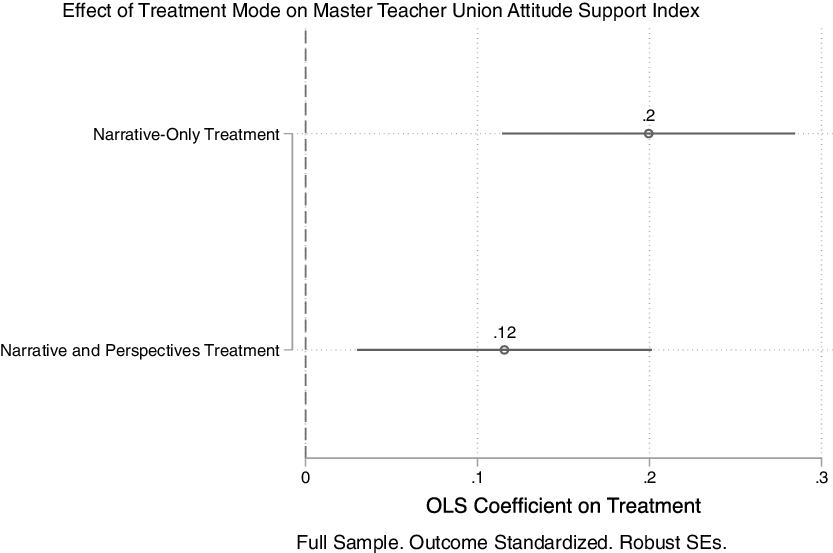
Did effects differ between the conditions that featured narrative exchange and those that did not? Figure 2 provides the answer. In that figure, we collapse the narrative-only conditions and perspective-taking conditions, and estimate their effects on an aggregate index of the indices discussed above (rescaling the support for anti-union measures, adding the standardized sub-indices together into a single index, and then standardizing this master index to have a mean of zero and standard deviation of one). Footnote 5 Overall, summarizing across conditions and across outcomes, both kinds of treatments are remarkably similar to one another. Regression results for this master index are in Table A5. Table A4 decomposes results by specific items, and Table A6 presents results with covariates. While we did not pre-register this analysis, the difference between treatment effects across modes is significant, as shown in Table A5. Yet this difference is sensitive to model selection. When covariates are included, as shown in Table A6, the difference is not significant by the standard we pre-registered. Ultimately, we regard this difference as suggestive but not definitive evidence in favor of the superiority of the Narrative-Only treatment.
Narrative versus Narrative and Perspective Taking Treatments on Aggregate Union Attitudes.
The figure shows the OLS coefficient associated with either a narrative only treatment or a narrative and perspective taking treatment on the aggregate union attitudes index (averaging the four outcomes depicted in Figure 1. Outcome is standardized to have mean of zero and standard deviation of one. Lines indicate 95% confidence intervals. Results pool contracts and community treatments.

These figures depict effects on the full sample. Figures depicting results for the non-Midwest sample can be found in the appendix. The results are substantively identical when the oversample is included. We also fail to find any significant differences by subgroups specified in our pre-analysis plan, including by partisanship, having school-aged children, or knowing a public school teacher personally. Timing data indicates that respondents took their assignments seriously, with those assigned to perspective-taking conditions taking an average of 147 s longer to complete the survey than those in narrative-only conditions. This difference approximates how long one might expect to complete the perspective-taking exercise, and is significant.
Why are effects on policy bidirectional?
The mixed nature of our effects on policy attitudes is deserving of further investigation. On the one hand, we observe narrative-only as well as narrative and-perspective treatments causing individuals to become more supportive of collective bargaining and more willing to pay higher taxes to support education. On the other hand, we find both kinds of conditions leading people to become more supportive of certain anti-union policies – specifically, more supportive of requirements that unions hold regular recertification elections and obtain permission from members before participating in elections.
What might explain this discrepancy? One possible answer is that, while the policies in question are understood by experts and union leadership to be antiunion, subjects do not share this interpretation. Low overall rates of union membership, and modest levels of political knowledge, may limit the extent to which respondents are familiar with the debate about union policies. To study this possibility, in the fall of 2020, we fielded a second study in which we asked a separate sample to assess how helpful certain policies would be to teachers’ unions.
We asked subjects to rate how helpful a policy would be to require teachers’ unions to obtain permission from their members before collecting money to use in elections; how helpful a policy would be to require unions to hold regular certification elections before they could collectively bargain; and how helpful a policy would be that permitted teachers unions to collectively bargain for higher salaries. Responses were given on a 1–7 scale, from “Very helpful” to “Very unhelpful.” We randomized the order of the scale, so that half the sample saw choices that ranged from “Very helpful” to “Very helpful,” while the other half saw the opposite. Results presented here reflect recoding, with a larger number associated with perceptions that a policy is helpful. The survey was fielded over Lucid, a provider of online survey respondents benchmarked to Census data on age, gender, ethnicity, and region. Prior work has shown that Lucid compares favorably to other sample providers, such as Mechanical Turk (Coppock and McClellan Reference Coppock and McClellan2019). To weed out non-attentive respondents, we presented an attention check before our substantive questions, removing those who failed the check. Complete text of all questions can be found in the appendix.
Of the three union-related policies we asked about, we viewed two – a requirement that they obtain permission before election spending and a requirement that they face regular certification elections–as clearly unhelpful to unions. (In our pre-registration for the experiment, we described both policies as anti-union.) In addition, unions themselves have aggressively fought proposed iterations of both policies in recent years. Meanwhile, we viewed the remaining question, about the legal right to collectively bargain, as helpful to unions.
We also asked two questions that draw on the “Anti-Immigrant Policy Index” of Kalla and Broockman (Reference Kalla and Broockman2020), which is based in part on agreement with statements that assert the federal government should provide legal aid to undocumented immigrants, and that local police should rely on federal law enforcement when they encounter undocumented immigrants. We asked respondents whether those policies would be helpful to undocumented immigrants. Following Kalla and Broockman (Reference Kalla and Broockman2020), who regarded the first item as “inclusive” toward immigrants and the second exclusive, we expected the first item to be viewed as more helpful toward immigrants than the second.
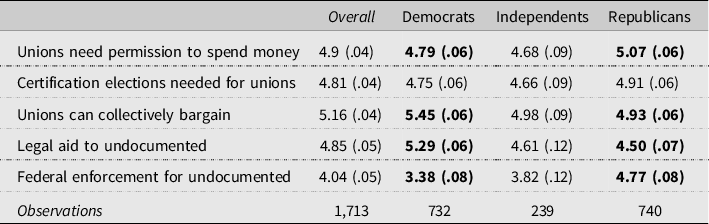
Table 2 displays results. Partisan identity was measured prior to data collection by Lucid on a 1–10 scale. For ease of exposition, the scale has been collapsed into terciles. Those who declined to identify with either party after a follow-up question are included only in the “overall” column. Each column presents the mean response of the 1–7 helpfulness scale, with higher numbers corresponding to higher levels of perceived helpfulness. Standard errors are in parentheses. Significant differences between mean partisan responses to items are in bold.
Study 2: Can People Separate Helpful From Unhelpful Policies?

Among union items, collective bargaining was understood to be the most helpful to unions, with the other two considered less helpful. Subjects did not distinguish pro- from anti-union policies in the manner we expected. The mean response for the requirement that unions need member permission to spend money on elections was 4.9 (.04) – nearly “somewhat helpful.” The mean response about the helpfulness of required certification responses was only slightly lower. The partisan differences are further illuminating. Republicans believed that requiring unions to gain permission from their members to spend money would be more helpful than not. Indeed, they viewed this item as the most helpful item, more than collective bargaining. The partisan pattern of responses suggests that, rather than evaluating the helpfulness of the policy items to teachers’ unions, respondents may have instead expressed how they felt about each policy. Footnote 6
Alternatively, some antiunion respondents may genuinely believe that policies that unions and scholars regard as unhelpful would, if enacted, actually improve unions’ fortunes. Perceptions of what constitutes “good” and “bad” policies are surely not universal. This disconnect – between what activists and scholars believe, and what some members of the mass public believe – may explain why treatments such as ours can be effective at changing attitudes, although not in the manner anticipated by their creators.
For the items concerning undocumented immigrants, the pattern is similar. While respondents overall regard legal aid as more helpful than relying on federal law enforcement, Republicans believe the latter is more helpful than the former – offering further evidence that, rather than evaluating the helpfulness of policies to target groups, respondents share their personal views about the policy. However, the overall mean response to relying on federal enforcement for undocumented immigrants, 4.03 (0.05), is the only policy of all five tested that approximates the median choice. It is significantly lower than the mean response provided to both unhelpful union items. Differences in our results with Kalla and Broockman (Reference Kalla and Broockman2020) appear to be explained in part by differences in the ease with which subjects separate helpful from unhelpful policies toward the target group.
Discussion
We have shown that a technique previously shown to be effective at improving attitudes toward social out-groups can also improve some attitudes toward political organizations. Analogic perspective-taking, facilitated by the exchange of narrative perspectives, can improve attitudes about unions. We find that it can improve perceptions of teachers’ unions and their members; increase support for collective bargaining; and even increase willingness to support higher taxes for education-related purposes. We also find that analogic perspective-taking can be effective when delivered entirely online. Taken together, our results suggest that analogic perspective-taking can improve attitudes toward more kinds of groups than previously thought, and that such interventions can also be effective when delivered online – suggesting they are capable of being widely deployed, and at the behest of more target groups, than previously thought.
However, at least when it comes to improving attitudes toward political organizations, the exchange of narratives is not required. Indeed, our data suggest that, at least in this case, the provision of narratives may be superior to the exchange of narratives. A similar conclusion is reached by Kalla and Broockman (Reference Kalla and Broockman2021). In their study of various attempts to reduce exclusionary attitudes, they find that “perspective-getting,” or simply hearing the perspective of an out-group member (akin to our “Narrative Only” conditions), reduces such attitudes most consistently. Our findings echo theirs.
Not all of the effects were in the expected direction. Even though treatments increased support for collective bargaining and higher education-related taxes, they also increased support for some antiunion policies. As a follow-up study suggests, these bidirectional effects are likely attributable to subjects’ limited capacity to identify pro-union policies. To an extent not knowable now, our findings may be affected by our reliance on opt-in samples. It is possible that attitudes toward unions are more calcified among people who select not to participate in such surveys, compared to those who do. But it is also possible that people who select into such samples grow increasingly resistant to any and all treatments to which they are exposed. If the former holds, then we have overestimated the effects of our treatments; if the latter, we have underestimated them. We cannot resolve this matter with current data.
Nevertheless, our evidence shows that, on its own, analogic perspective-taking is not enough to overcome the challenges associated with interpreting complex, less salient policy debates. These findings suggest that, though factual “backfire” is rare and that subjects generally move in the direction suggested by information (Porter and Wood Reference Porter and Wood2019), pre-treatment levels of issue salience and policy complexity may make attitudinal backfire more likely (Druckman and Leeper Reference Druckman and Leeper2012).
The deficiencies of this study suggest avenues for future research. We did not measure the durability of our effects. As previous work has shown (Broockman and Kalla Reference Broockman and Kalla2016), it is possible that the exchange of narratives leads to more active processing than the provision of narratives alone, which may make for a more lasting impact. Because we administered the experiment online, we were unable to simulate “actively listening,” a key component of analogic perspective-taking. Future work should measure whether interventions like ours can improve attitudes over the long term, and should attempt to approximate active listening in online settings.
For now, however, our evidence indicates that both the exchange of narratives, and narratives alone, can improve some – but not all – attitudes toward political groups. Views toward teachers’ unions, and related public policies, are not set in stone. Listening to a person’s narrative, as well as offering one’s own, can change people’s minds about political organizations.
Supplementary Material
To view supplementary material for this article, please visit https://doi.org/10.1017/XPS.2021.28
Data Availability
The data, code, and any additional materials required to replicate all analyses in this article are available at the Journal of Experimental Political Science Dataverse within the Harvard Dataverse Network, at: https://doi.org/10.7910/DVN/8IEROH (Hertel-Fernandez and Porter Reference Hertel-Fernandez and Porter2021).
Conflict of Interest
The experiment was paid for by the Iowa State Educational Association (ISEA). ISEA had no control over the design, implementation, analysis, or interpretation of the experiment. The authors have received no compensation or fees from ISEA.