Introduction
Each year in the United States, more than 166,000 patients experience out-of-hospital cardiac arrest.Reference Rosamond, Flegal and Furie 1 Postresuscitation induced hypothermia (IH) has been shown to reduce neurological complications in comatose survivors of cardiopulmonary arrest.Reference Rosamond, Flegal and Furie 1 Based on the growing body of literature and evidence, IH is recommended by the American Heart Association (AHA) and the International Liaison Committee on Resuscitation in the immediate postresuscitation care of these patients.Reference Nolan, Morley, Hoek and Hickey 2 - 3
A limited body of literature suggests that prehospital initiation of hypothermia is beneficial. Ice packs used to cool patients resulted in an odds ratio for good outcome of 5.25% (95% CI) in the IH group compared to normothermic groups.Reference Bernard, Gray and Buist 4 This recommendation suggested that unconscious adult patients who have return of spontaneous circulation (ROSC) in out-of-hospital cardiac arrest should be cooled to 32°C to 34°C for 12 to 24 hours, primarily when the initial rhythm was ventricular fibrillation (VF). 3 Those recommendations also note that there may be benefit for IH in patients with cardiac rhythm disturbances other than VF.Reference Bernard, Gray and Buist 4
Studies by Abella and Bernard have found that rapid cooling contributes to improved survivability.Reference Abella, Zhao, Alvarado, Hamann, Vanden Hoek and Becker 5 , Reference Bernard, Buist, Monteiro and Smith 6 Animal studies show that oxidant injury occurs rapidly after cardiac arrest.Reference Idris, Roberts and Caruso 7 Abella reports that in a murine model, earlier cooling appears to impact survival.Reference Abella, Zhao, Alvarado, Hamann, Vanden Hoek and Becker 5 Bernard et al concluded that “rapid infusion of large volume, ice-cold crystalloid fluid is an inexpensive and effective method of inducing hypothermia in comatose survivors of out-of-hospital cardiac arrest, and is associated with beneficial haemodynamic, renal and acid-base effects.”Reference Bernard, Buist, Monteiro and Smith 6 In a standard 70 kg adult, this is equivalent to rapid infusion of 2.1 L of crystalloid at 4°C.Reference Bernard, Buist, Monteiro and Smith 6
Factors that limit the ability of Emergency Medical Services (EMS) systems to implement rapid cooling are primarily related to the refrigeration units. Both cost and space may be prohibiting factors for many EMS agencies. A survey of the National Association of Emergency Medical Services Physicians shows that the practice of prehospital IH is rare.Reference Suffoletto, Salcido and Menegazzi 8 In January, 2009, New York City (New York, USA) began a regional system of care designed to take patients to hospitals that have IH.Reference Freese 9 In 2011, Pennsylvania (USA) added IH via 20 to 30 cc/kg bolus of 4°C 0.9% normal saline solution (NSS) as a potential Medical Command Orders in its postresuscitation statewide Advanced Life Support (ALS) protocol. 10
This feasibility study's objective was to determine whether inexpensive, commercially available coolers would maintain two 1 L bags of NSS at 4°C for 12 hours (the length of a typical EMS shift on board an ambulance) in varying external environmental conditions, and to see whether cost effective means to generate prehospital cooling exist. However, it should be noted that based on recent studies, the efficacy of prehospital IH has been questioned.
Methods
Study Design
The research was designed as a prospective feasibility study that used convenience sampling. No human subjects were enrolled; the target items focused on for this study were two commercially available brands of coolers. An attempt was made to collect data in varying weather conditions. Study data were collected by volunteer emergency medical technicians and paramedics from seven different EMS services in an eastern Pennsylvania geographic region, along with resident emergency medicine physicians from a Level 1 trauma center during the residents’ ambulance ride-along time as part of their EMS rotation. Note these different agencies have shifts of varying lengths, which accounts for the differing lengths that occurred in data collection.
Human Subjects Review
This project was reviewed by Lehigh Valley Health Network's Institutional Review Board (IRB) and was determined to be nonhuman subject research, and therefore exempt from IRB oversight.
Study Protocol/Procedures
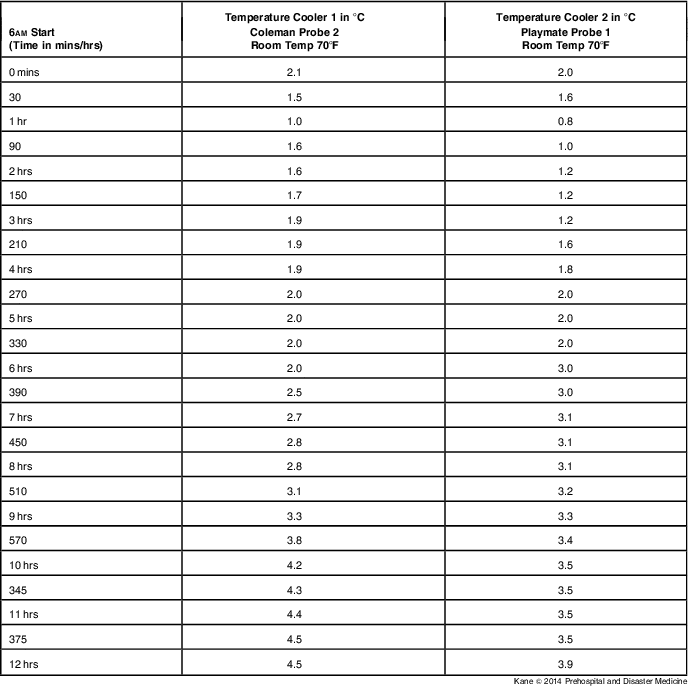
The initial pilot testing placed the coolers in a stable temperature environment. Data on the saline temperature were gathered for 12-hour intervals using two electronic temperature probes. To ensure that temperature probes did not influence the temperatures recorded, the probes were crossed over in the coolers. Any cooler that did not maintain saline at 4°C for 12 hours was eliminated in this pilot phase. Once the coolers were determined to be effective under controlled conditions, it was further sought to determine whether they were able to maintain the NSS at 4°C on EMS units.
The coolers selected after the pilot study above were chosen based on availability and affordability from two major nationally available brands, Igloo and Coleman. The Igloo MaxxCold (Igloo Products Corp., Katy, Texas USA) and Coleman (The Coleman Company, Wichita, Kansas USA) were both 8.5 L (nine-quart) coolers that were chosen to be adequate for holding two 1 L bags of saline solution, as well as the ice packs designated in the study design, and small enough for ease of placement on EMS units.
Prior to initiating data collection, each volunteer collector was given instruction as to proper study technique using a Microsoft Word Version 11.6359.8172 document and Microsoft PowerPoint Version 11.6361.8172 presentation (Microsoft Corporation, Redmond, Washington USA) reviewing chilling methods for the NSS bags, appropriate placement of ice packs, NSS bags, and thermometers, as well as data collection.
For each day's data collection, two 1 L 0.9% NSS bags were cooled to ≤ 4°C, but never to visual freezing. The NSS was cooled using either an ice bath prior to the start of data collection, refrigeration overnight, or a combination of the two methods in order to achieve the appropriate starting temperature. The ice bath was typically created in another cooler not being used for data collection that day. Variation in temperature in refrigeration units at EMS agencies mandated the use of multiple methods to achieve the appropriate starting temperature.
Once the saline solution was cooled to a temperature of <4°C, but >0°C, the temperature probe from a TruTemp electric thermometer (Taylor Precision Products, Oakbrook, Illinois USA) was inserted into the medication port of one NSS bag. Both chilled NSS bags were then placed in the study coolers on top of three frozen 6.7 cm x 13 cm x 3.2 cm FreezPak (LIFOAM Industries, Hunt Valley, Maryland USA) reusable ice packs and then covered with two frozen 12.1 cm x 19.1 cm x 1.8 cm FreezPak reusable ice packs. The cooler was then closed, leaving the cord from the TruTemp probe exiting through the cooler lid to the thermometer's readout panel, which was kept outside of the cooler. The full cooler with the TruTemp thermometer and a mercury thermometer for measuring the internal ambulance temperature were then placed in an accessible area of the patient compartment of the in-service ambulance the study participant would be using that day. Temperature measurements were taken of the NSS using the TruTemp thermometer. Internal ambulance temperature near the cooler was measured on the mercury thermometer, which was located adjacent to the packed cooler. Regional temperatures were collected from the Internet log from documented temperatures at a nearby International Airport.
Measurements
Data were collected, including date, time, and internal temperature, external cooler temperature, and regional temperatures (all in degrees Celsius) at 30-minute to 12-hour intervals over a total 12-hour study period per data set. In addition, the EMS service, date, data collector, location on the ambulance, and unit number were recorded. Data were collected on a premade form, starting at elapsed time zero and finishing at an elapsed time of up to 12 hours. After each 12-hour period, the unpunctured NSS bag and reusable ice packs were placed back into refrigerators, freezers, or ice baths to prepare them for the next use. The NSS bag that was punctured by the TruTemp thermometer was replaced with a new NSS bag, which was chilled per the above protocol for the next day's use. To ensure that patient care was never interrupted for data collection in these in-service ambulances, data entry was delayed until a study team member entered the data from the logbook into a Microsoft Excel Version 11.6355.8172 (Microsoft Corporation, Redmond, Washington USA) database.
Data Analysis
Repeated measurements recorded over a 12-hour period from 19 individual coolers were summarized by individual time points using descriptive statistics performed with SAS statistical software, version 9.2 (SAS Institute, Inc., Cary, North Carolina USA). Descriptive statistics included the number of samples, the arithmetic average, the median, range, and 95% confidence limits. Separately, the lowest value over the entire 12-hour time period was derived to determine if there was any evidence of measurements below the a priori threshold of 4°C. The number of samples below 4°C was also summarized by counts, percentages, and exact 95% binomial confidence limits.
Results
Initial pilot data to determine the feasibility of using coolers are shown in Table 1. This in situ work demonstrated that the coolers, using the appropriate preparation and number of ice packs, were sufficient to keep the saline below 4°C for the time duration selected by the study team for field investigation.
Pilot Data

Data were collected on 35 samples over a 14-month period from August, 2010, through October, 2011. Nineteen samples of data were collected through 12 complete hours. While data were intended to be collected every 30 minutes, most EMS units reported that patient care or report completion delayed data collection; most samples had only hourly data collection. Of the baseline samples recorded, the minimum starting temperature was negative 4°C, while the maximum starting temperature was 9°C. Of the 12-hour samples recorded, the minimum value was negative 4°C and the maximum value was 13°C. Eighteen of the 35 samples were placed in the ambulance on the bench seat, the others stored in various locations within the ambulance. While both cooler types were utilized, the Coleman cooler was used in 27 of the 35 data collections. This was due to cooler availability within the EMS unit; EMS agencies typically possessed only one type of cooler and some EMS agencies collected more data than other agencies.
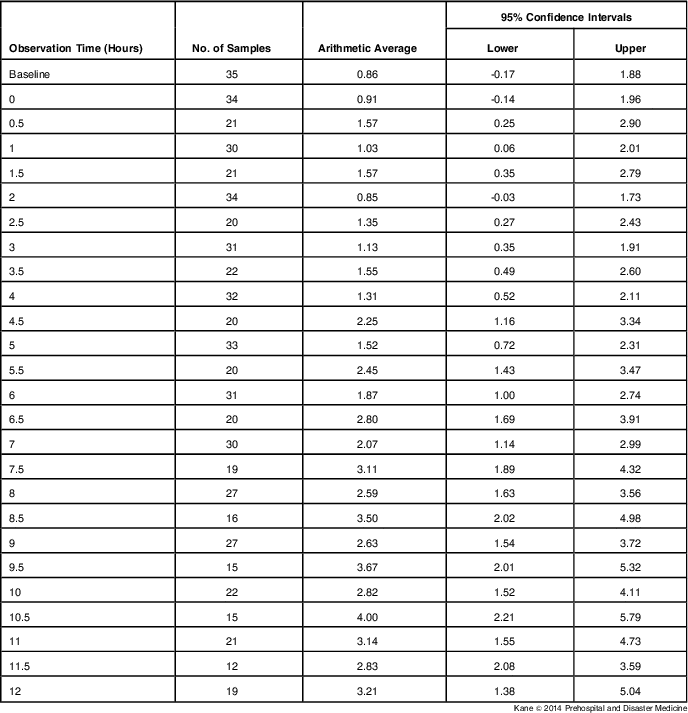
Table 2 contains the data in an intent-to-treat fashion, including all 12-hour runs, regardless of whether the two 1 L NSS bags were properly cooled to below 4°C at initiation. With these samples, the 12-hour outcome demonstrated a 95% CI from 1.38°C to 5.04°C. While this does not meet the researchers’ a priori definition of statistical significance, the clinical significance of 4°C versus 5°C saline solution for field-initiated cooling must be considered.
Univariate Analysis Performed on the Internal Saline Temperature (Centigrade) Measurements for All Samples, by Time

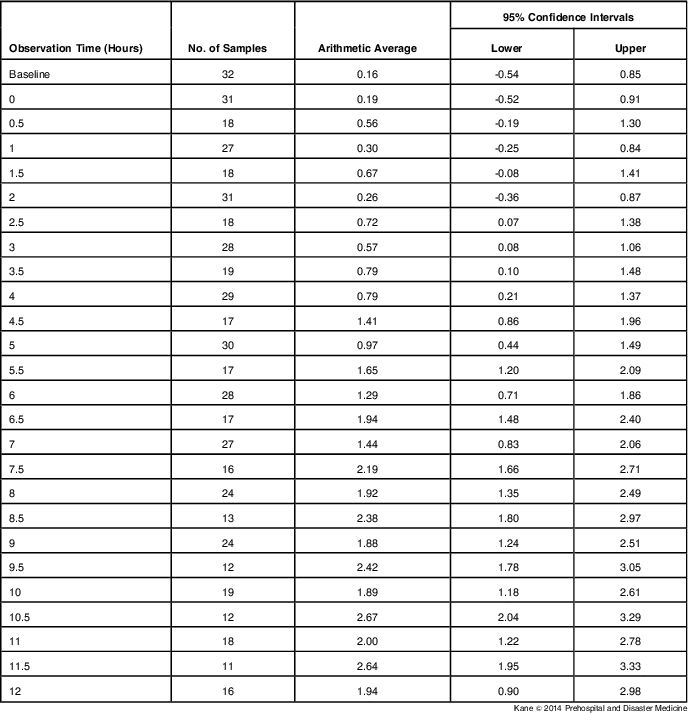
The 32 properly processed samples, meaning those which were at or below 4°C at baseline, are presented in Table 3. This data set demonstrates, with statistical significance, that at 12 hours, the coolers were effective at keeping the saline below 4°C. The statistical analysis indicates that additional data would not change the outcome. Sixteen samples had data collected for 12 hours; of these, all samples were at or below 4°C at the completion of data collection.
Univariate Analysis Performed on the Internal Saline Temperature (Centigrade) Measurements for All Samples That Started at ≤ 4°C, by Time

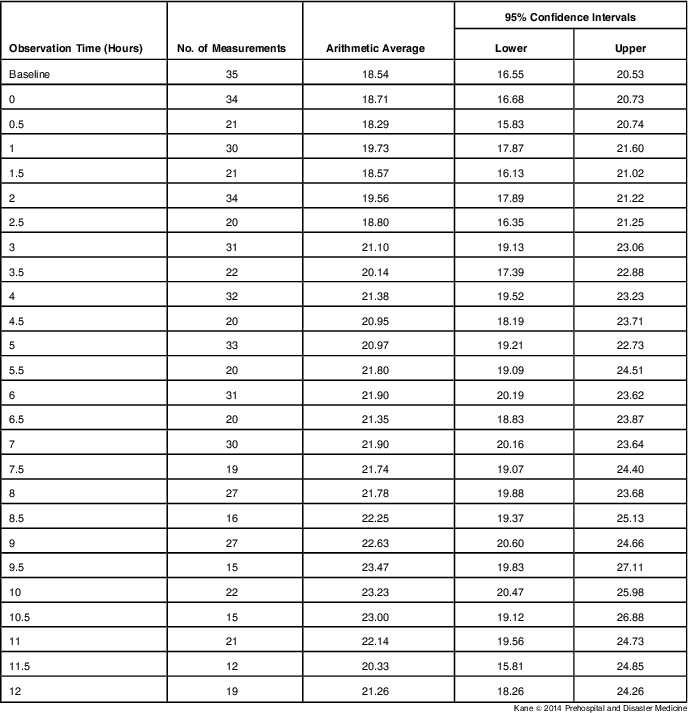
Regional temperatures varied from a low of 0°C and a high of 28°C at the initiation of data collection and a low of 4°C and a high of 28°C at the end of data collection. Temperatures within the ambulances are reported in Table 4 and demonstrate that the coolers functioned despite the ambient temperature trending upwards within the ambulance over the course of the study.
Univariate Analysis Performed on the External Temperature (Centigrade) Measurements, by Time

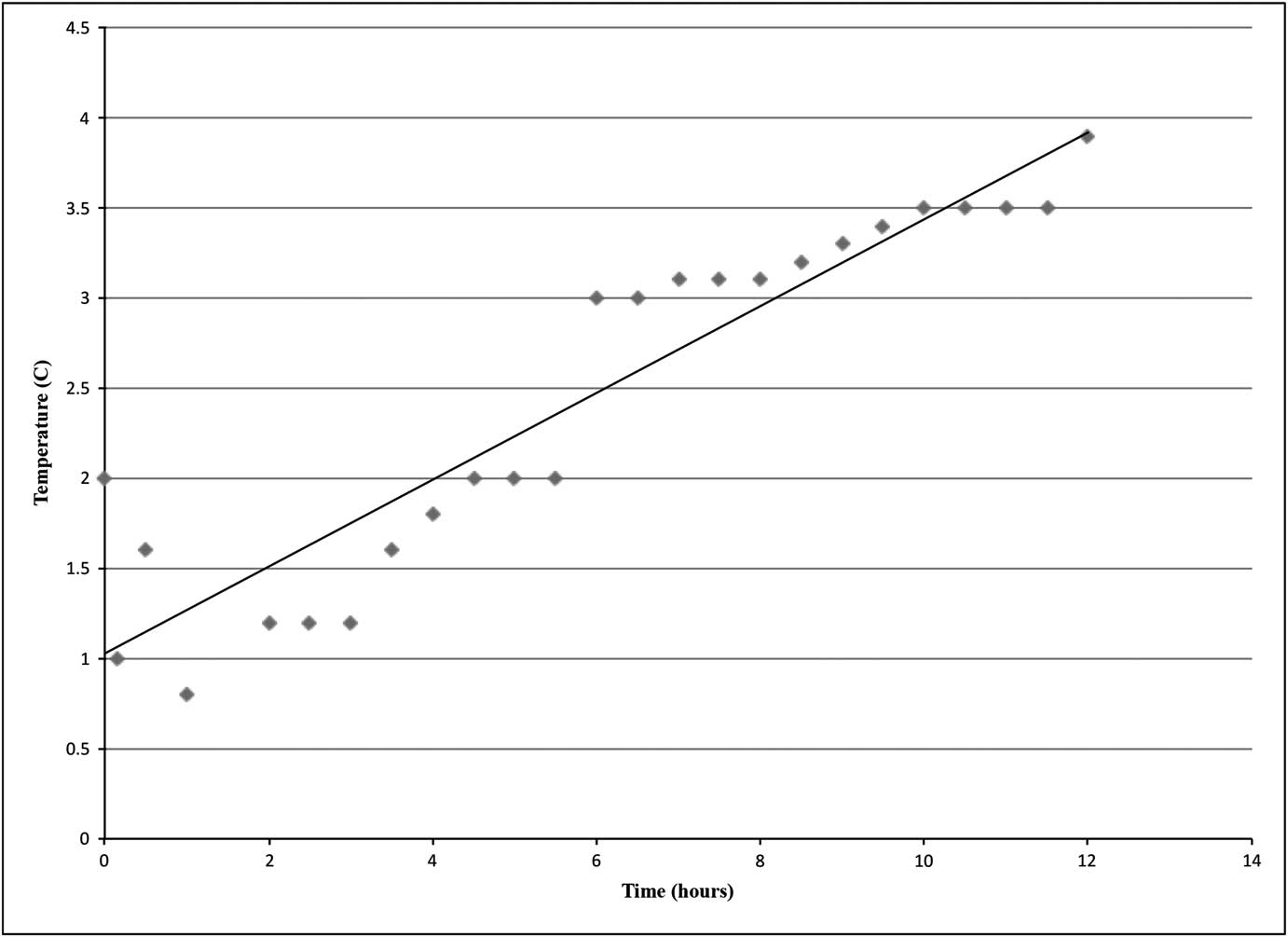
Figure 1 demonstrates a best fit line for the trend of the saline temperature over time, demonstrating that the coolers, with statistical significance, maintain the two 1 L bags of NSS at or below 4°C for an entire 12-hour EMS shift.
Saline Temperature over Time (Playmate Cooler)

Discussion
Current literature supports the early initiation of IH in comatose survivors of cardiac arrest. Many of these patients suffer out-of-hospital arrest. While prolonged IH requires specialized equipment and protocols, IH has been shown to be successfully initiated by administration of 20 to 30 cc/kg of NSS at 4°C. In most adults, this is equivalent to two 1 L bags of NSS. Commercial refrigeration units are available for ambulance use. However, these refrigeration units can be costly, and even busy ambulance services are expected to encounter patients appropriate for initiation of IH few times a year. This work demonstrates that a simple protocol and inexpensive, commercially available coolers can prepare an EMS agency for initiation of IH. The AHA guidelines currently recommend the initiation of IH in unresponsive patients with ROSC. Prehospital initiation of IH has been included in several EMS protocols, both as standing orders or potential medical command directives.
Bernard et al demonstrated more rapid cooling in patients with ROSC for which VF was the presenting rhythm randomized to prehospital cooling compared with cooling initiated in the hospital.Reference Bernard, Smith and Cameron 11 While patients achieved target hypothermia more rapidly, that difference disappeared over the initial hour.Reference Bernard, Smith and Cameron 11 However, a recent randomized trial including both VF and non-VF rhythms demonstrated that the use of prehospital cooling utilizing up to 2 L of NSS at 4°C, with the addition of other medications, successfully reduced core temperatures, though it failed to demonstrate improvements in survival or neurologic status, regardless of initial cardiac rhythm. Subgroup analysis still did not demonstrate benefit.Reference Kim, Nichol and Maynard 12 As IH evolves, further study is needed to determine the best methods to achieve cooling.
The variation in starting temperatures provided the motivation to develop several methods of cooling the NSS. However, the starting temperature of some of the study samples was less than 0°C. Despite this, upon visual inspection at the start of the data collection, none of the 1 L bags of NSS demonstrated ice crystals. It should be noted the coolers were not opened with every data collection point. Use of several search strategies in PubMed (National Center for Biotechnology Information, Bethesda, Maryland USA) failed to locate data on infusion of saline at temperatures less than 0°C. Theoretically, ice crystals may have formed that may be harmful to the patient if administered to patients prior to warming. Caution with use of the protocol upon initiation and measurement of the saline temperature prior to placement in the cooler could mitigate this concern. The researchers’ selection of a goal temperature of 4°C was based upon the work of Bernard et al.Reference Bernard, Buist, Monteiro and Smith 6 While lower saline temperatures may ensure appropriate initiation of hypothermia, saline at lower temperatures may predispose the patient to complications.
Emergency Medical Services providers encounter patients with multiple complaints during the course of a normal shift. They require rapid access to multiple medications and interventions. The ability to simplify medications or fluid administration can be beneficial. As more regulatory agencies consider adding IH to their prehospital protocols, more EMS services will need to find appropriate methods for carrying cooled saline solution. The number of ice packs used in this study was based upon convenience and fit in the coolers. It is possible that even fewer ice packs could serve to provide adequate cooling to maintain the two 1 L bags of NSS at or below the desired 4°C. If larger coolers that could hold additional bags of NSS were utilized, additional ice packs would presumably be required. While dry ice could also be used, it is more challenging to handle and may result in the saline bags reaching freezing temperatures.
Limitations
Several limitations exist in this study. First, as ambulance permission to carry the coolers came appropriately with an acknowledgement that gathering study data would not interfere with patient care, the timing of the data collection may have been incomplete over the 12-hour shift. Each day of data collection involved placing new precooled saline and ice packs in the cooler. Often, EMS agencies reported limited data collection because of the time needed to refreeze ice packs, and cooling additional NSS.
Second, the study's volunteer data collectors had difficulty obtaining the appropriate saline solution starting temperature in some instances. Both variation in EMS refrigeration temperatures and protocol confusion were cited. Adherence improved after inclusion of the ice bath as a possible method of cooling. This may indicate that some EMS agencies may have difficulty utilizing this methodology to successfully prepare for prehospital IH.
Further, while having a temperature probe in the saline bags is unlikely to largely affect the saline solution's temperature, it is acknowledged that these probes may not be present in real world use of NSS for prehospital initiation of IH. However, this is not considered a significant limitation because it is likely that temperature monitoring of NSS would be implemented as a quality control measure. Incomplete closure of the cooler secondary to the necessary temperature probe wire exiting the cooler might actually decrease the efficiency of the cooler. Additionally, the thermometers used in this study were not calibrated daily. They were commercially available and other quality control for these devices was not implemented.
Finally, the study does not address the continued educational requirement for ambulance personnel over time. Repeated education was needed in some cases to correct protocol noncompliance, resulting in starting saline solution temperatures above the targeted starting temperature of 0°C to 4°C. It is hypothesized that this arose from variations in the refrigeration units at the various EMS agencies, thus prompting the ice bath immersion technique to obtain the appropriate starting temperature. Most EMS agencies have refrigeration units available for medication storage; however, given that the study did not involve the administration of the NSS, the saline solution was unable to be placed in those units. If an EMS agency were to adopt this protocol, refrigeration units that currently exist with appropriate quality control protocols could be utilized.
Conclusion
The results demonstrate that simple, inexpensive commercially available coolers can be utilized to keep two 1 L bags of 0.9% NSS at 4°C for 8 to 12 hours. Given that studies have already shown two 1 L bags of appropriately cooled saline solution is able to cool patients to levels of hypothermia (which has been shown to reduce oxidant injury in cardiac arrest patients with ROSC) prehospital IH may now be an affordable and practical option for EMS units.
Acknowledgement
The authors acknowledge Bruce C. Stouch, PhD, for his statistical analysis, and Valerie Rupp, BSN, CRNP, for the operations and project management of this study.