Introduction
In the UK, the prevalence of nasal blockage is estimated to be just over 30 per cent, with the majority of cases being inflammatory. Allergic rhinitis accounts for two-thirds of cases,Reference Pawanker, Canonica, Holgate and Lockey1 chronic rhinosinusitis for one-thirdReference Fokkens, Lund, Mullol and Bachert2 and structural abnormalities (e.g. deviated nasal septum) for a small minority.
There is currently no clear consensus amongst otolaryngologists as to standard assessment methods for nasal blockage. Moreover, 30 per cent of patients are dissatisfied following surgery for obstruction.Reference Konstantinidis, Triaridis, Triaridis, Karagiannidis and Kontzoglou3 This highlights the need to improve evaluation of nasal patency and, in particular, to better address patient concerns and education regarding their condition and potential treatment.
The primary aim of this patient survey (end-user questionnaire) was to determine the experience and preferences of patients in terms of nasal blockage clinical assessments. We attempted to explore the methods used to investigate nasal blockage, patients’ satisfaction with current methods and how to improve patients’ understanding of their obstruction. The secondary aims of the study were: to determine how long patients suffer with nasal obstruction, and establish whether or not patients would be willing to spend more time in clinic for its assessment.
Materials and methods
Seventy-two questionnaires were distributed to patients with nasal obstruction, who were under the care of the senior author, between January and August 2016. The questionnaire was distributed at the same time as the 22-item Sino-Nasal Outcome Test, the Nasal Obstruction Symptom Evaluation scale and a visual analogue scale (VAS), and was completed before consultation with the clinician. The questionnaire contained closed-format questions, of multiple choice, Likert, dichotomous or VAS form.
Ethical approval was attained at the time of the study. Verbal consent was obtained from all patients. No financial incentives were offered for participating in the study.
The revised end-user questionnaire attempted to explore three domains. First, it addressed components of the patients’ history; that is, how long they had suffered nasal blockage, which side their blockage feels worse on, the severity of their nasal blockage, any previous nasal surgery, and whether or not nasal blockage had been assessed previously. Second, it examined the investigations undertaken to assess their nasal blockage, focusing on which subjective and objective measures were performed, how long it took to perform these measures, whether or not these investigations helped them understand their blockage, and how much extra time they would be willing to spend in clinic to have their blockage further assessed. Third, it explored means of improving patients’ understanding of their blockage, by asking whether using a numerical and/or visual aid to represent their blockage would help the patient understand their blockage.
All data collected were anonymised and analysed using Microsoft Excel® spreadsheet software. Chi-square tests were performed on the data using the chi-square function on a Casio (model fx-85GT PLUS) calculator; a p-value of less than 0.05 was considered statistically significant.
Results
Of the 72 questionnaires distributed, 60 were completed (a response rate of 83 per cent). However, for those questionnaires completed, some questions were left unanswered, or answers were illegible or could not be interpreted. The mean completion rate for the questions was 87 per cent, with a standard deviation of 11.8 per cent.
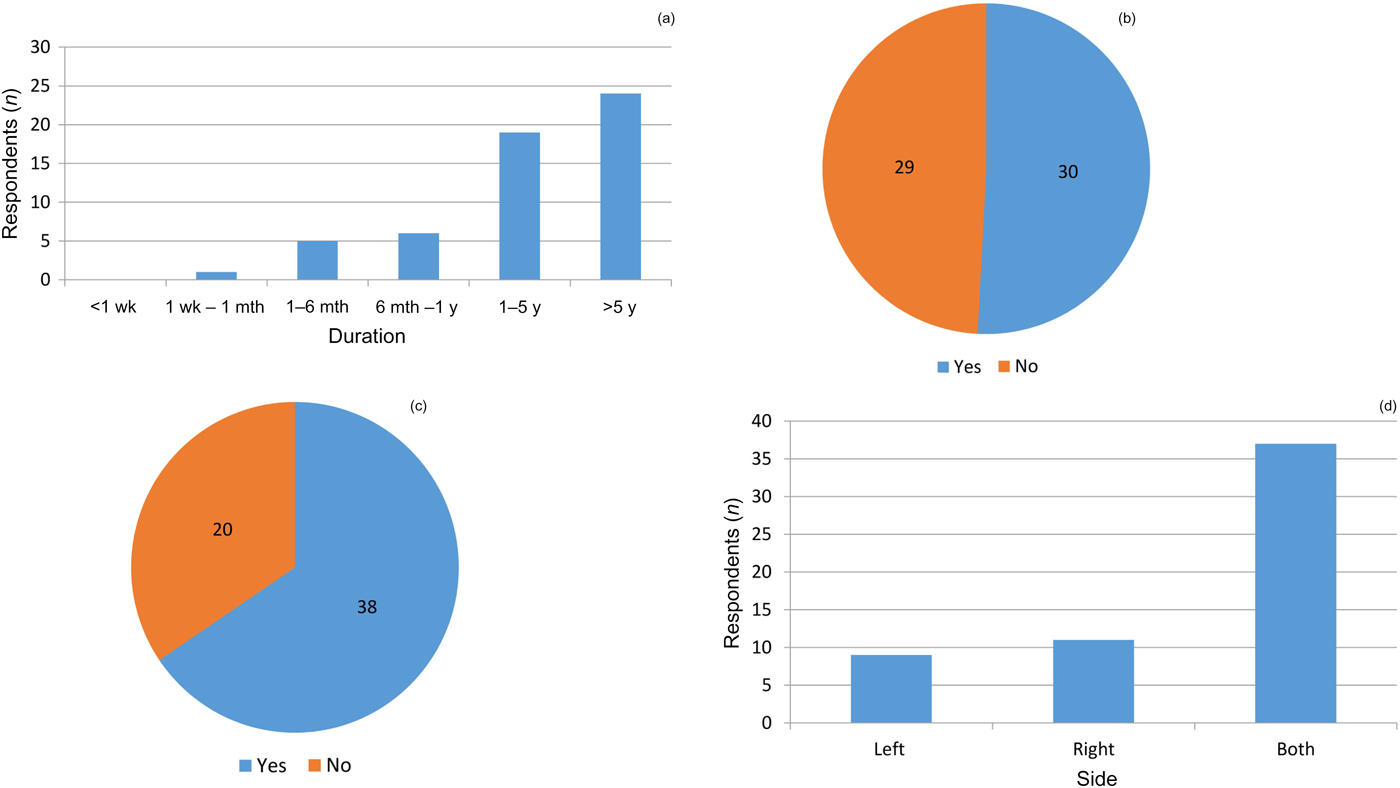
Seventy-eight per cent of respondents had experienced nasal blockage for over one year. Two-thirds of patients had previously sought help for their blockage, with 51 per cent having undergone previous surgery (Figure 1).
Results from the first domain of questions enquiring about the patients’ nasal blockage history, showing responses to the following questions: (a) how long have you experienced nasal blockage?, (b) any previous nasal surgery?, (c) has nasal blockage been assessed previously? and (d) which side is the blockage worse on?. Wk = weeks; mth = months; y = years

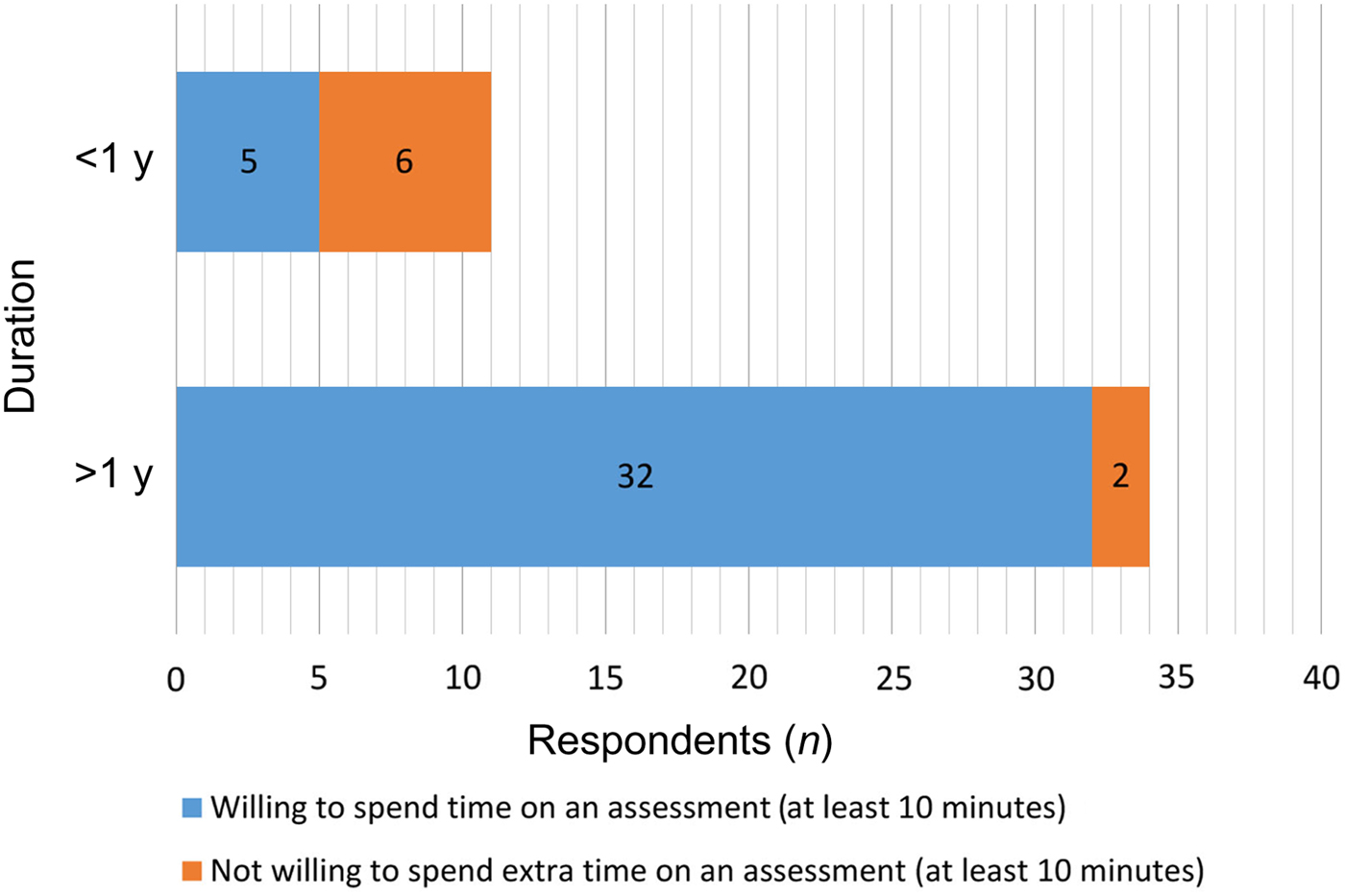
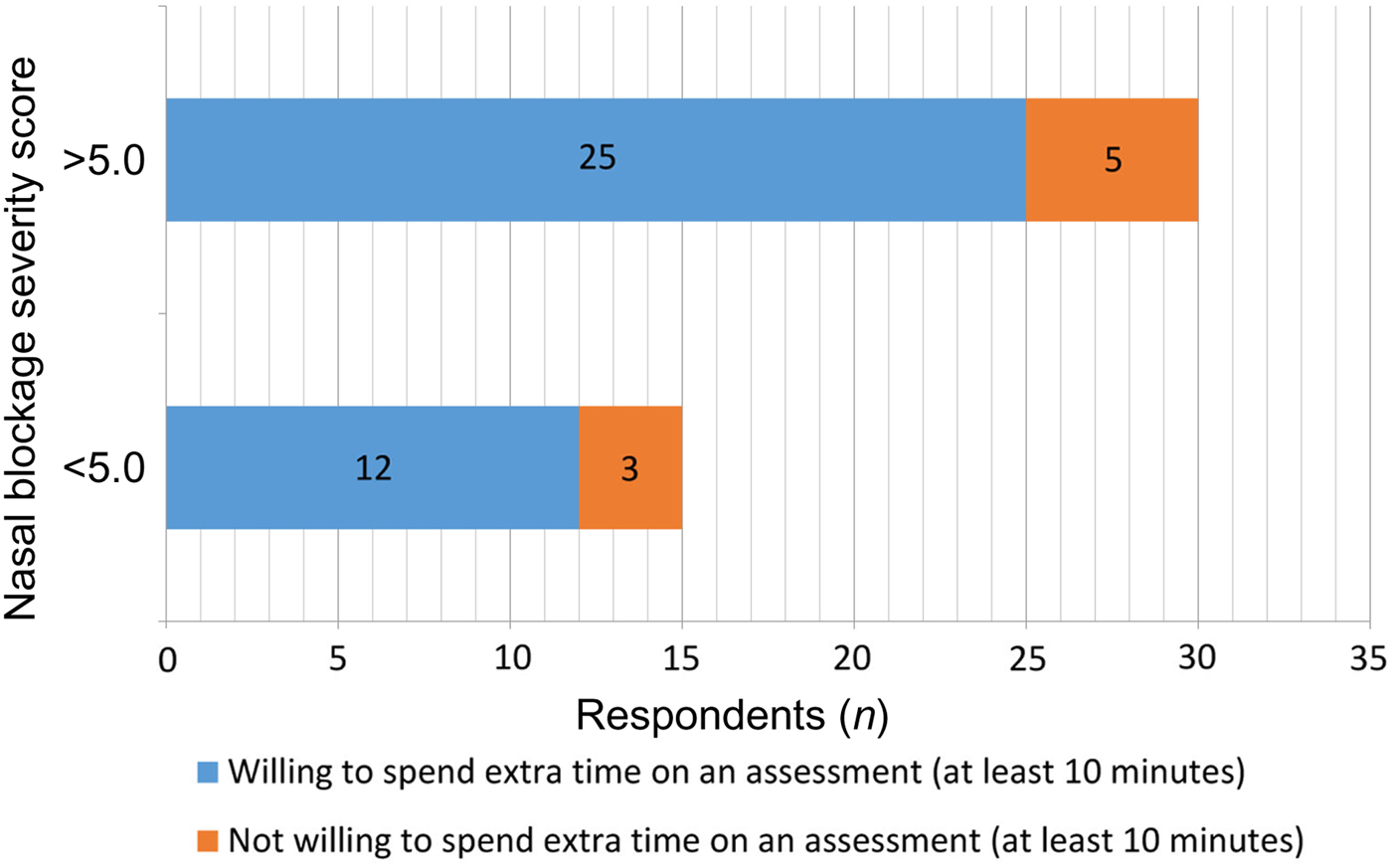
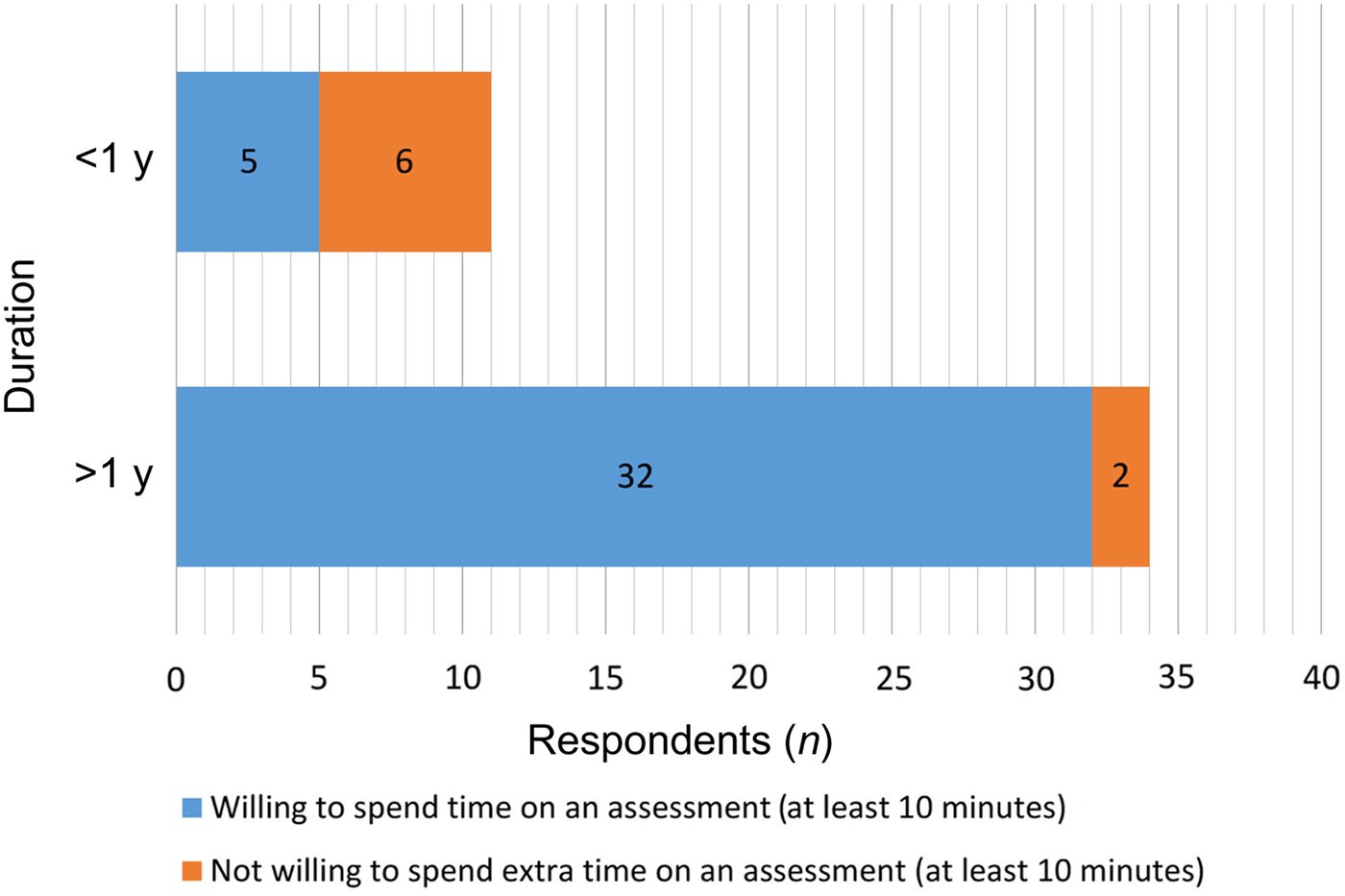
Patients who had experienced nasal obstruction for more than 1 year were more willing to spend time (defined as at least 10 minutes) undergoing an assessment (χ 2 = 13.5, p = 0.00024). Interestingly, we found that nasal blockage severity (defined as greater than 5.0 on the VAS) had no effect on patients’ willingness to spend more time in clinic (χ 2 = 0.076, p = 0.783). These data are shown in Figures 2 and 3.
Nasal blockage duration and willingness to spend time on assessment. Y = years
Nasal blockage severity scores (out of 10) and willingness to spend time on assessment.

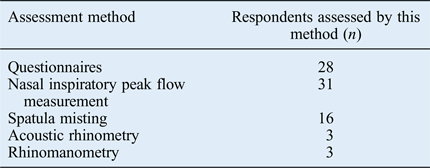
Table I depicts the different methods of assessment that patients have undergone. Of the 58 patients who responded to this question, 20 had never undergone any form of assessment for their nasal blockage. The remaining 38 respondents had undergone assessment with at least 1 of the currently available methods. We found that questionnaires and nasal inspiratory peak flow measurement are the methods most commonly used to assess nasal blockage. Conversely, spatula misting is infrequently used, and acoustic rhinometry or rhinomanometry is rarely performed. When asked whether or not these measurements were useful in understanding their blockage, 51 per cent reported that they were useful and 49 per cent said they were not.
Methods of nasal blockage assessment

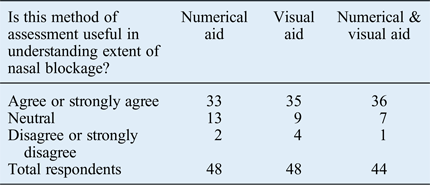
When the patients were asked, using Likert scales, what would help them understand their blockage, 69 per cent of patients agreed or strongly agreed that a numerical aid would help. Seventy-three per cent agreed or strongly agreed that a visual representation would help, and 82 per cent reported that both a numerical and visual aid would help (Table II).
Usefulness of visual and/or numerical aids for understanding extent of nasal blockage

Data represent numbers of responses
Discussion
Key findings
The primary aim of this study was to determine patient experience and preferences for the measurement of nasal obstruction.
There has been a general under-utilisation of objective methods across the UK in the assessment of nasal patency, predominately because of lack of availability, time consumption and a weak correlation with symptom scores.Reference Andrews, Jacques, Nip, Li and Leung4 From this survey of our tertiary referral centre, we have shown there is good uptake of subjective questionnaires and objective methods such as nasal inspiratory peak flow measurement, perhaps in part because of better availability of the latter resource. However, only 51 per cent of participants found these methods useful in understanding their blockage. Spatula misting, which often helps patients understand blockage, was used only in 42 per cent of cases. When utilised, it was in conjunction with other methods. This suggests that spatula misting was performed as a supplementary test to help patients understand other results. We have found that a large group of patients are dissatisfied with current methods.
When asked whether having both a numerical and visual aid together would help in understanding their blockage, the vast majority (82 per cent) agreed or strongly agreed. A large majority also agreed or strongly agreed that a visual representation (73 per cent) or numerical representation (69 per cent) used alone would help. Of the methods commonly used during consultation, only spatula misting provides a visual representation and only nasal inspiratory peak flow measurement provides a numerical representation of patency. Acoustic rhinometry and rhinomanometry were rarely used. Thus, a tool to help educate patients would ideally provide both a visual and a numerical representation of the obstruction.
We found that 78 per cent of patients had experienced nasal blockage for over one year, with two-thirds of cases previously seeking help for their problem and half of the cases having had prior surgery. This highlights the chronic burden that nasal blockage has on patients. We have also shown that patients with longer durations of nasal obstruction (over 1 year) are more willing to undergo longer assessment (more than 10 minutes), as compared to those with a higher degree of obstruction.
Comparison with other studies
To our knowledge, this is the first study to specifically address patient experience and preferences for the measurement of nasal obstruction.
Study limitations
Data were only collected from one centre, potentially introducing selection bias regarding patient demographics and conditions assessed. The voluntary nature of the questionnaire could also have introduced a selection bias, targeting more motivated individuals. However, the questionnaires were completed on different days, at different times, by a variety of patients arriving at clinic, which helps to mitigate bias and attempts to ensure a more random selection process. In addition, the response rate of 83 per cent and a completion rate of 87 per cent were reasonable. The sample included a mix of both follow-up and new patients. This may have caused significant bias regarding which techniques were used, and influenced the patients’ responses towards less or more familiar techniques in the question stem. In the referral centre where the study took place, it was standard practice to assess patients’ subjective symptom scores and nasal inspiratory peak flow.
Clinical applicability
This study provides an overview of the patient's experience during their initial assessment of nasal obstruction. It gives insight into the various methods used in assessing nasal blockage and highlights the relative lack of educational value they offer the patient. The consequent lack of patient understanding, both at the level of their own pathology, and at the investigative and treatment level, may contribute towards the weak correlations observed between subjective and objective measures of nasal patency. It may also potentially contribute towards high patient dissatisfaction rates following surgery for nasal obstruction. There could therefore be an argument to improve satisfaction rates by educating the patient during their rhinological journey.
In particular, there is a need to reassure a subset of patients who feel subjectively blocked (and comment so on subjective symptom scores), but who have patent airways on examination and on objective measures.
Acoustic rhinometry, rhinomanometry and nasal inspiratory peak flow measurementReference Hilberg5–Reference Chaves, de Andrade and Ibiapina7 are used for clinical and research purposes. However, none of these techniques can simultaneously assess resting breathing without being user-dependent, expensive or time-consuming.
The results of this study support the development of a novel assessment device. Such a device must be capable of providing an objective evaluation of nasal airflow, which correlates with the patients’ subjective experience of blockage and allows the patient and clinician to understand (both visually and numerically) their pathology during resting nasal breathing. In addition, it should be a quick and easy test to perform, allow measurement of non-forced resting breathing, and be capable of assessing both nostrils independently. Direct real-time comparison of unilateral nasal aerodynamics would be of great use in planning surgery for septoplasty or functional septorhinoplasty, and for assessing post-operative outcomes in clinical practice and research.
• Objective and subjective nasal obstruction measures often correlate poorly; novel assessment techniques may be beneficial
• No other studies have investigated patients’ experience or preferences for clinical assessment of nasal obstruction
• Patients are dissatisfied with current assessment techniques
• Duration of obstruction, rather than severity, affects patients’ willingness to undergo more in-depth clinical assessment
• A novel device with visual and/or numerical results would help patients understand their nasal obstruction
Given our results, development of a patency assessment tool could also potentially aid the general practitioner. An inexpensive and accurate diagnostic tool for assessing normal resting breathing, which correlates with subjective sensation, would be invaluable in terms of reducing the time to referral in complex cases, and would provide an accurate and definitive test for simpler cases. In both scenarios, such a device would give the physician confidence that the patient had been set on the right path. We are currently conducting a further study to investigate the requirements of such a device if it were to be used in general practice, aiming to explore what features would appeal to general practitioners given the different timescales and resources available to them.
Conclusion
This study revealed that: (1) a large group of patients are dissatisfied with current clinical objective measures; (2) a novel device with visual and numerical results can serve to better explain nasal blockage in simple terms; and (3) the duration, not the severity, of nasal blockage influences a patient's willingness to spend more time in clinic.