Implications
This study was designed to determine whether the chop length of typical forages fed to late lactation and dry cows was important in terms of its effect on eating, rumination and rumen function. When feeding low-quality grass hay or straw, cows tended to sort against long particles but there was no difference in chewing, ruminating or rumen variables. This study shows that when low-quality forage is needed in the diet of late lactation or dry cows, chopping it fine enough to minimize sorting is the best recommendation so that cows consume that forage for the desired diet outcome.
Introduction
When balancing for fiber content in dairy rations, physical characteristics of fiber associated with digestion kinetics, digesta passage rate and proper rumen metabolism need to be taken into account (Mertens, Reference Mertens1997). The concept of physically effective NDF (peNDF) proposed by Mertens (Reference Mertens1997) considers physical characteristics of fiber, mainly particle length of the diet. Accordingly, large particles are believed not to be immediately available for passage from the rumen, having a greater ability to stimulate chewing activity in addition to the chemical composition of feeds. Increasing forage particle length increases chewing time (Kononoff and Heinrichs, Reference Kononoff and Heinrichs2003; Yang and Beauchemin, Reference Yang and Beauchemin2006), which stimulates saliva secretion (Allen, Reference Allen1997) in lactating cows. Beauchemin et al. (Reference Beauchemin, Eriksen, Nørgaard and Rode2008) observed that greater proportions of forage dry matter (DM), NDF and longer particle length in the diet increased total daily salivary secretion by lowering eating rate, thus prolonging the time spent eating. An increase in total saliva secretion may improve rumen buffering, preventing a decline in rumen pH and potentially reducing the risk of ruminal acidosis (Beauchemin et al., Reference Beauchemin, Eriksen, Nørgaard and Rode2008). Krause et al. (Reference Krause, Combs and Beauchemin2002) observed that pH decreased when geometric mean particle length (X gm) of alfalfa silage decreased from 13.6 to 3.7 mm (fed at 39 : 61 forage to concentrate ratio, F : C).
Although little work has been done in late lactation or dry cows with lower intakes, peNDF provided a satisfactory estimation of mean ruminal pH and fiber digestibility, explaining 67% of ruminal pH variation in early lactation cows fed a total mixed ration (TMR, Zebeli et al., Reference Zebeli, Tafaj, Steingass, Metzler and Drochner2006). There is, however, a huge range in particles >1.18 mm, as has been defined in other studies. Kononoff and Heinrichs (Reference Kononoff and Heinrichs2003) fed four diets in which TMR X gm differed, but total amount of TMR DM >1.18 mm did not. In that study, total time spent chewing had a tendency and chewing minutes per kilogram of DM intake (DMI) significantly increased when diets with greater X gm were fed; rumen pH did not follow the same trend and had a quadratic effect. Although there was no evidence of sorting at the end of the day, pH quadratic effect may have been due to sorting throughout the day. Typically cows will sort rations against longer particles and in favor of shorter particles and to a greater degree in rations with greater particle length (Leonardi and Armentano, Reference Leonardi and Armentano2003; Maulfair et al., Reference Maulfair, Zanton, Fustini and Heinrichs2010). However, opposite sorting behavior has been observed in induced severe acidosis where cows sorted against shorter particles (DeVries et al., Reference DeVries, Dohme and Beauchemin2008).
A common practice to increase fiber content in dairy cow rations containing high proportions of corn silage is to include small amounts of high NDF dry forage, typically hay or straw chopped for long particle length (Krause and Oetzel, Reference Krause and Oetzel2006). Forage length should be sufficient to provide adequate eating and ruminating time and short enough to discourage sorting. Therefore, the hypothesis of this study was that forage particle length may affect sorting and eating activity in late lactation and dry cows. We also wanted to observe any impacts of forage particle length on rumen pH and fill in rations with similar peNDF but greatly different mean particle length fed to late lactation and dry cows. The forages chosen for this study were grass hay and oat straw, which are common feeds used to add effective fiber to dairy rations in North America and parts of Europe.
Material and methods
Two experiments were conducted to achieve the objective. Late lactation and dry cows were chosen for the experiments because of their lower energy demands. Thus, either high NDF hay or straw could be used as the only forage source. Animal care procedures followed a protocol approved by the Pennsylvania State University Institutional Animal Care and Use Committee.
In the first experiment (E1), one primiparous and two multiparous (434 ± 9 days in milk (DIM); 718 ± 30 kg initial BW; mean ± s.e.), non-pregnant Holstein cows fitted with a rumen cannula (Bar Diamond, Parma, ID, USA) and housed in a mechanically ventilated tie stall barn were used in a 3 × 3 Latin square design. Treatments consisted of three diets differing only in length of first-cutting orchard grass (Dactylis glomerata L.) hay (X gm ± standard deviation of particle length; S gm, mm): short (5.4 ± 3.8; S), medium (8.96 ± 4.42; M) and long (77.9 ± 4.07; L). The hay lengths were obtained by using none or a combination of bale choppers. Hay L was fed directly from the bale; M and S were chopped with a Roto Grind model 760 tub grinder (Burrows Enterprises, Inc., Greeley, CO, USA), and S was additionally run through a New Holland model 718 forage harvester (New Holland Ag, Racine, WI, USA). Rations were formulated according to National Research Council recommendations (NRC, 2001) and had 50 : 50 F : C. A single batch of grain was mixed to last through the duration of the experiment. Feed was offered twice daily at 0830 and 2030 h and adjusted daily to allow 5% refusals. Grain was top dressed to forage because DM content and particle length of forage would not provide a consistent mix. Water was offered free choice. Periods consisted of 10 days for adaptation followed by 4 days for sampling. Starting at morning feeding on day 11, chewing behavior was visually monitored for 48 h at 2-min intervals, and each activity was assumed to persist for the entire 2-min interval. Data are expressed as eating, ruminating and total chewing (TC; sum of eating and ruminating time) activity (Kononoff and Heinrichs, Reference Kononoff and Heinrichs2003). On day 13, ruminal contents were sampled at −1, 0, 1, 2, 4, 8 and 12 h after morning feeding, and subsamples were collected at five different rumen locations (dorsal, ventral, anterior, caudal and central), composited and strained through four layers of cheesecloth; pH of the liquid portion was immediately determined using a hand-held pH meter (phTestr 10 BNC, Oakton, Vernon Hills, IL, USA). Refusals were collected and weighed daily before morning feeding, and on days 11 and 12 were sampled to determine particle length. Samples of the offered forage from each treatment, grain mix and refusals from days 11 and 12 of each period were sieved for particle length determination as stipulated by the American Society of Agricultural and Biological Engineers (ASABE, 2007). Length of each particle retained on the top screen was manually measured to determine average particle length of this screen according to ASABE (2007) procedure. Chemical analyses of forage and grain included DM, ash, minerals, CP, ADF (Association of Official Analytical Chemists, 2000), NDF with alpha amylase pretreatment (Van Soest et al., Reference Van Soest, Robertson and Lewis1991), acid-detergent insoluble lignin (Goering and Van Soest, Reference Goering and Van Soest1970) and soluble CP (Krishnamoorthy et al., Reference Krishnamoorthy, Muscato, Sniffen and Van Soest1982). Whatman 934-AH glass micro-fiber filters (Whatman Laboratory Products Inc., Clifton, NJ, USA) with 1.5 μm particle retention in place of fitted glass crucible, were used for ADF, NDF and lignin. Both ADF and NDF are expressed with residual ash. For total ration X gm used in sorting analysis, weights of forage and grain retained on each sieve were added proportionally to the F : C ratio of diets. Sorting was calculated by dividing X gm of the consumed ration by X gm of the offered ration; values >1 indicate that cows are consuming a ration longer than what was offered and values <1 indicate that cows are consuming a ration shorter than what was offered (Maulfair et al., Reference Maulfair, Zanton, Fustini and Heinrichs2010). Four hours after feeding on day 14, rumen contents were totally evacuated; weight and volume were determined. Rumen contents and remaining feed were changed to the animal that had that treatment for next period, to shorten the adaptation period.
The second experiment (E2) used the same cows and had the same design with similar methods, deviations from E1 were that cows (678 ± 12 kg initial BW) were not lactating, forage was oat (Avena sativa L.) straw and F : C was 75 : 25. Particle lengths of straw (X gm ± S gm, mm: 80.37 ± 3.46 L, 24.64 ± 3.78 M and 10.16 ± 2.83 S) differed from those of hay. Medium length straw was obtained by chopping with a Case IH model 8610 bale processor (Case IH, Racine, WI, USA), S was treated as in E1 and L was not chopped. One liter of a molasses–water mix (50% v/v) was top dressed to forage and grain at each feeding to increase palatability of forage. Refusals were sampled from days 8 to 12 and composited for analysis.
Statistical analyses
Data were analyzed as a 3 × 3 Latin square for each experiment, with period and diet as fixed effects and cow as random. The mixed procedure of SAS (Version 9.1.3, SAS Institute Inc., Cary, NC, USA) was used to analyze all data. Linear and quadratic contrasts were tested using the CONTRAST statement, because particle length of forages was unequally spaced coefficients used to construct the polynomials were calculated as described by Robson (Reference Robson1959). Because rumen sampling was unequally spaced, mean daily pH of rumen fluid was determined by calculating area under the response curve according to the trapezoidal rule (Shipley and Clark, Reference Shipley and Clark1972). Significance was declared at P ⩽ 0.05 and trends are discussed at P ⩽ 0.10. All results presented are least squares means.
Results and discussion
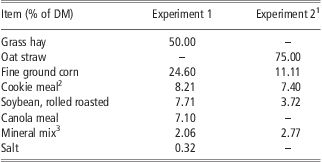
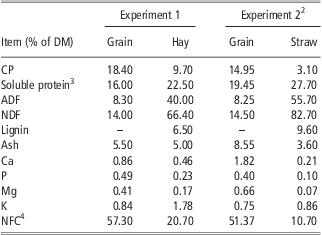
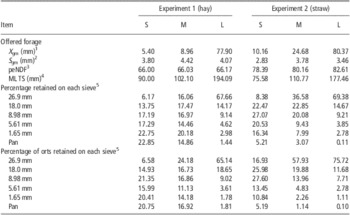
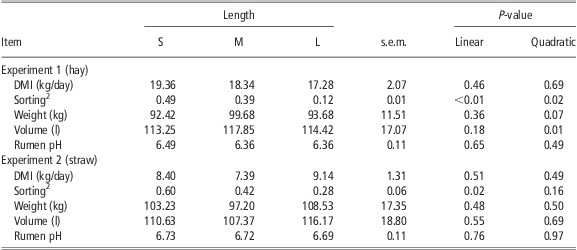
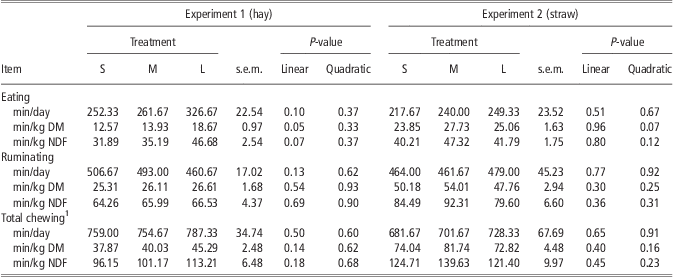
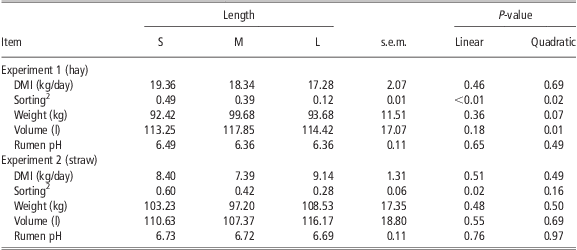
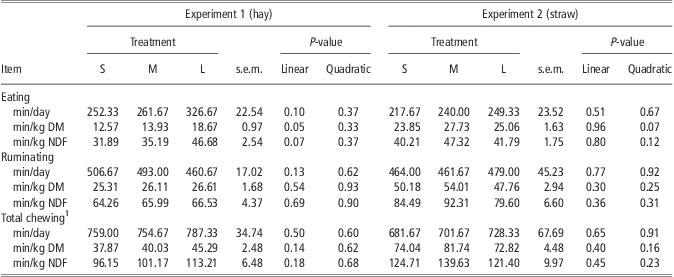
Ingredient composition of diets is presented in Table 1, chemical composition in Table 2 and particle length of forages in Table 3. Particle length of forages varied greatly as planned. In spite of large differences in dietary forage particle length, no statistical differences were observed in DMI (Table 4). Failure to detect differences in DMI has been reported in cows averaging 189 ± 38 DIM (Beauchemin et al., Reference Beauchemin, Yang and Rode2003); 153 ± 7 DIM (Leonardi and Armentano, Reference Leonardi and Armentano2003); 189 ± 39 DIM (Yang and Beauchemin, Reference Yang and Beauchemin2006); and 175 ± 21 DIM (Nasrollahi et al., Reference Nasrollahi, Khorvash, Ghorbani, Teimouri-Yansari, Zali and Zebeli2012). In contrast, other studies with cows averaging 19 ± 4 DIM (Kononoff and Heinrichs, Reference Kononoff and Heinrichs2003) and 81 ± 15 DIM (Teimouri Yansari et al., Reference Teimouri Yansari, Valizadeh, Naserian, Christensen, Yu and Shahroodi2004) observed an increase in DMI when forage particle length was reduced (reported DIM were at the beginning of the experiments). In E1, DMI increased numerically as particle length decreased but standard errors were high, which may be the reason for the failure to detect differences. Intake is driven to meet energy needs (NRC, 2001); cows in this study were in late lactation (E1) or not lactating (E2), and their energy needs were low and thus they could be satisfied at low intakes. There seems to be a relationship between DIM and the response in DMI at different forage particle length; a review by Allen (Reference Allen1996) suggested that forage particle length may have a greater influence on intake in early lactation when energy demands are greater than the energy supplied by DMI and intake is limited by rumen fill. In E1, time spent eating (Table 5) expressed as minutes per day was not different, whereas minutes per kilogram of DMI and NDF intake (NDFI) had a linear trend to increase as forage length increased. In E2, total time spent eating and minutes per kilogram of NDFI were not different, whereas a trend for a quadratic effect of minutes per kilogram of DMI was observed; however, with small numerical differences this trend is probably not of physiological importance. Kononoff and Heinrichs (Reference Kononoff and Heinrichs2003) and Teimouri Yansari et al. (Reference Teimouri Yansari, Valizadeh, Naserian, Christensen, Yu and Shahroodi2004) using lactating cows observed a linear increase in eating time per day and minutes per kg of DMI and NDFI as (alfalfa haylage in the first study and alfalfa hay in the second) particle length increased. Nasrollahi et al. (Reference Nasrollahi, Khorvash, Ghorbani, Teimouri-Yansari, Zali and Zebeli2012) also observed an increase of the same variables for greater alfalfa hay particle length, whereas Yang and Beauchemin (Reference Yang and Beauchemin2006) observed no differences when barley silage particle length increased. In the current study, no differences in total ruminating or TC minutes per kg of DMI or NDFI were observed, whereas Teimouri Yansari et al. (Reference Teimouri Yansari, Valizadeh, Naserian, Christensen, Yu and Shahroodi2004) observed a linear increase of the same parameters as particle length increased. Yang and Beauchemin (Reference Yang and Beauchemin2006) observed a linear increase in TC parameters as particle length decreased, but for ruminating parameters only time per day followed this tendency. Nasrollahi et al. (Reference Nasrollahi, Khorvash, Ghorbani, Teimouri-Yansari, Zali and Zebeli2012) observed an increase in TC time for greater particle length and no differences in ruminating. However, comparisons of the current results to these experiments should take into consideration differences between experiments that affect chewing behavior: F : C (De Boever et al., Reference De Boever, Andries, De Brabander, Cottyn and Buysse1990; Tafaj et al., Reference Tafaj, Maulbetsch, Zebeli, Steingass and Drochner2005), cows’ physiological stage (De Boever et al., Reference De Boever, Andries, De Brabander, Cottyn and Buysse1990), level of feed intake (De Boever et al., Reference De Boever, Andries, De Brabander, Cottyn and Buysse1990; Beauchemin, Reference Beauchemin1991), forage quality (Welch and Smith, Reference Welch and Smith1970; Zebeli et al., Reference Zebeli, Aschenbach, Tafaj, Boguhn, Ametaj and Drochner2012), feeding method (Maekawa et al., Reference Maekawa, Beauchemin and Christensen2002) and rumen fermentability of the diet (Allen, Reference Allen1997; Nasrollahi et al., Reference Nasrollahi, Khorvash, Ghorbani, Teimouri-Yansari, Zali and Zebeli2012; Zebeli et al., Reference Zebeli, Aschenbach, Tafaj, Boguhn, Ametaj and Drochner2012).
Ingredient composition of diets
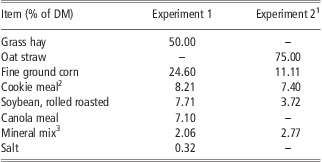
DM = dry matter; NFC = non-fiber carbohydrate.
1855 g (DM) of molasses were added (top dressed) in Experiment 2.
2Contained 12.8% CP, 14.1% NDF, 9.2% crude fat and 59.8% NFC.
3Contained 14.9% Ca, 0.37% P, 4.84% Mg, 0.44% K, 0.32% S, 2.66% Na, 4.11% Cl, 191.6 mg/kg Fe, 1146.5 mg/kg Zn, 378.2 mg/kg Cu, 1131.6 mg/kg Mn, 7 mg/kg Se, 5.4 mg/kg Co, 13.4 mg/kg I, 277.55 KIU/kg vitamin A, 69.28 KIU/kg vitamin D and 2088.36 IU/kg vitamin E.
Chemical composition of dietsFootnote 1
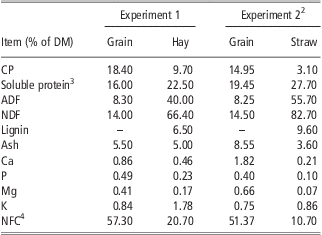
DM = dry matter; NFC = non-fiber carbohydrate; NRC = National Research Council.
1 Analyzed by Cumberland Valley Analytical Services Laboratory (Maugansville, MD, USA).
2 Molasses was added as a top dress in Experiment 2. Molasses contained 5.8% CP, 0.2% ADF, 0.4% NDF and 82.2 NFC on DM basis.
3 Percent of CP.
4 Calculated from ingredients (NRC, 2001).
Particle length of offered forage and orts

S = short; M = medium; L = long; peNDF = physically effective NDF; ASABE = American Society of Agricultural and Biological Engineers.
1Geometric mean length as calculated by ASABE (2007).
2Standard deviation as calculated by ASABE (2007).
3peNDF = forage NDF × kg DM > 1.18 mm.
4Mean length of particles retained on the top screen of the ASABE particle size separator.
5Square hole diagonal, ASABE (2007). Approximate equivalence to Penn State Particle Separator: top sieve (26.9 + 19.0 mm), middle sieve (8.98 mm), lower sieve (5.61 + 1.65 mm) and pan (pan).
Effect of forage particle length on DMI, sorting and rumen parametersFootnote 1
DMI = dry matter intake; S = short; M = medium; L = long.
1 Weight and volume of rumen digesta determined by total rumen evacuation 4-h post feeding.
2 Particle length selection index as described by Maulfair et al. (Reference Maulfair, Zanton, Fustini and Heinrichs2010).
Effects of forage particle length on chewing behavior of dairy cows
S = short; M = medium; L = long; DM = dry matter.
1Sum of eating and ruminating time (Kononoff and Heinrichs, Reference Kononoff and Heinrichs2003).
To reduce particle length of forage, cows can either increase time spent eating and ruminating, increase rate of chewing or both (Yang and Beauchemin, Reference Yang and Beauchemin2006). In the present study, minutes per kg of DMI for eating, ruminating and TC are greater than those observed by Kononoff and Heinrichs (Reference Kononoff and Heinrichs2003), Teimouri Yansari et al. (Reference Teimouri Yansari, Valizadeh, Naserian, Christensen, Yu and Shahroodi2004) and Nasrollahi et al. (Reference Nasrollahi, Khorvash, Ghorbani, Teimouri-Yansari, Zali and Zebeli2012). Greater minutes per kg of DMI of eating, ruminating and TC gives cows an opportunity to reduce particle length by increasing chewing rate as diet particle length increases, rather than needing to increase time spent ruminating.
In E1, rumen volume had a quadratic response, and weight had a tendency for a quadratic response (Table 4); with small numeric differences, these data are likely of little physiological importance. Rumen volume and weight of rumen digesta were similar among treatments in E2. In both experiments, cows sorted the ration, eating a ration smaller in particle length than offered (Table 4), this behavior linearly increased as particle length of forage increased.
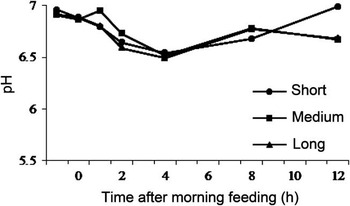
Rumen pH (Table 4, Figures 1 and 2) was not different across treatments; these observations are in agreement with those of Yang and Beauchemin (Reference Yang and Beauchemin2006), who measured pH continuously for 72 h using indwelling probes, but differ from Kononoff and Heinrichs (Reference Kononoff and Heinrichs2003), who observed a quadratic effect measuring pH with a technique similar to the present study. Teimouri Yansari et al. (Reference Teimouri Yansari, Valizadeh, Naserian, Christensen, Yu and Shahroodi2004) used a stomach probe to measure pH 3 h after feeding and observed a lower pH for shorter length. Nasrollahi et al. (Reference Nasrollahi, Khorvash, Ghorbani, Teimouri-Yansari, Zali and Zebeli2012) also used a stomach probe and observed lower pH for shorter length 3 h after feeding, but no difference 6 h after feeding. Conflicting results may be due to different techniques for measuring pH, but also due to differences in the degradability of grain in the diets, among the previously mentioned factors. In the study by Nasrollahi et al. (Reference Nasrollahi, Khorvash, Ghorbani, Teimouri-Yansari, Zali and Zebeli2012) where the effects of particle length where compared within grain degradability, it is suggested that forage length role is more critical when rapidly degradable starch diets are fed. Moreover, Allen (Reference Allen1997) suggested an interaction between rumen fermentability of ration carbohydrates and physically effective fiber. It is likely that diets and DMI in this study did not represent a challenge to proper rumen fermentation. In both experiments, TC was greater than the minimum chewing index recommended by Nørgaard et al. (Reference Nørgaard, Nadeau and Randby2011; 32 min/kg DM). Under the conditions and intakes of this study, cows were able to achieve similar results in eating and ruminating times regardless of particle length of the forage offered. In addition, the resulting rumen parameters were similar across treatments, even though cows were able to sort rations differently. In this study, short chopped hay or straw provided similar results as long forage and thus chopping forage was beneficial in reducing sorting.
Effect of hay particle length on rumen pH in late-lactation cows in Experiment 1 (s.e. = 0.15).

Effect of straw particle length on rumen pH in non-lactating cows in Experiment 2 (s.e. = 0.13).

Particle length of forage retained on the top screen (Table 3) varied greatly across treatments in both experiments. This observation confirms that to accurately determine X gm of forage, the length of particles retained on the top screen has to be manually measured. Using a constant length value for this fraction of a sample may under- or overestimate total X gm. In the ASABE method (ASABE, 2007), representative subsamples of the particles retained on the top screen have to be manually measured when its weight exceeds 1% of total sample weight.
Conclusions
Despite great differences in particle length of rations, chewing activity, rumen pH and rumen fill remained similar, suggesting that these parameters are related to peNDF, which was similar across rations. Sorting against greater particle length increased as particle length of the diet increased. These results suggest that when adding small amounts of high NDF forage to a late lactation or dry cow ration, finer chopping of forage has the same overall result as feeding long forage in chewing activity, rumen pH and fill while allowing for less potential sorting of the forage in rations of these animals.
Acknowledgments
This research was supported in part by agricultural research funds administered by The Pennsylvania Department of Agriculture. The assistance of M. Long with laboratory analyses, and C. Jones with editing, both of The Pennsylvania State University is greatly appreciated.