1. Introduction
The Silurian–Devonian boundary represents a geological system boundary of worldwide significance. The Global Stratotype Section and Point (GSSP) occurs within a succession of micritic limestones and shales at Klonk, near Suchomasty, Czech Republic (Martinsson, Reference Martinsson1977; http://www.stratigraphy.org/sildev.htm). Chlupáč & Hladil (Reference Chlupáč and Hladil2000) give an account of the significant biotic changes recorded at this reference locality (see also Chlupáč & Vacek, Reference Chlupáč and Vacek2003; Brocke, Fatka & Wilde, Reference Brocke, Fatka and Wilde2006). However, biodiversity changes during the Pridoli age do not exactly correspond to the overall evolutionarily ‘quiet’ Silurian–Devonian boundary (see summary in Copper, Reference Copper, Kiessling, Flügel and Golonka2002; House, Reference House2002), where only a fifth-order global bio-event has been documented by Kaljo (in Barnes et al. Reference Barnes, Hallam, Kaljo, Kauffman, Walliser and Walliser1996, p. 328). On the other hand, the Klonk Event, which was characterized by an episode of distinctive oceanographical change affecting both graptolite and conodont faunas (e.g. Porębska & Sawłowicz, Reference Porębska and Sawłowicz1997; Barrick, Meyer & Ruppel, Reference Barrick, Meyer and Ruppel2005) and most other groups (such as chitinozoans and trilobites), was established by Jeppsson (Reference Jeppsson, Landing and Johnson1998, p. 253) within the Silurian–Devonian transition. On the other hand, acmes of floating crinoid Scyphocrinites, recorded in the widespread sedimentation of marker coarse-grained encrinites, are a particularly well-known biotic character (e.g. Walliser, Reference Walliser and Walliser1996; Lubeseder, Reference Lubeseder2008). Notably, the Silurian–Devonian boundary event was preceded by a more severe middle Pridoli oceanic event, which had a particularly drastic effect on graptolites (Kaljo et al. Reference Kaljo, Boucot, Corfield, Herisse, Koren, Kriz, Männik, Maerss, Nestor, Shaver, Siveter, Viira and Walliser1996, Reference Kaljo, Martma, Männik and Viira2003; Kaljo in Barnes et al. Reference Barnes, Hallam, Kaljo, Kauffman, Walliser and Walliser1996; Jeppsson, Reference Jeppsson, Landing and Johnson1998). In addition, major perturbation in carbon cycling across the Silurian–Devonian boundary has been recently recognized (Saltzman, Reference Saltzman2002; Buggisch & Mann, Reference Buggisch and Mann2004; Gill, Lyons & Saltzman, Reference Gill, Lyons and Saltzman2007; evidenced also in Podolian well-preserved brachiopod shell calcites: Azmy et al. Reference Azmy, Veizer, Bassett and Copper1998; Veizer et al. Reference Veizer, Ala, Azmy, Bruckschen, Buhl, Bruhn, Carden, Diener, Ebneth, Goddéris, Jasper, Korte, Pawellek, Podlaha and Strauss1999; Prokoph, Shields & Veizer, Reference Prokoph, Shields and Veizer2008; http://www.science.uottawa.ca/geology/isotope_data/), being, in terms of the magnitude of its δ13C excursion, among the largest well-documented biogeochemical turnovers during Palaeozoic times.
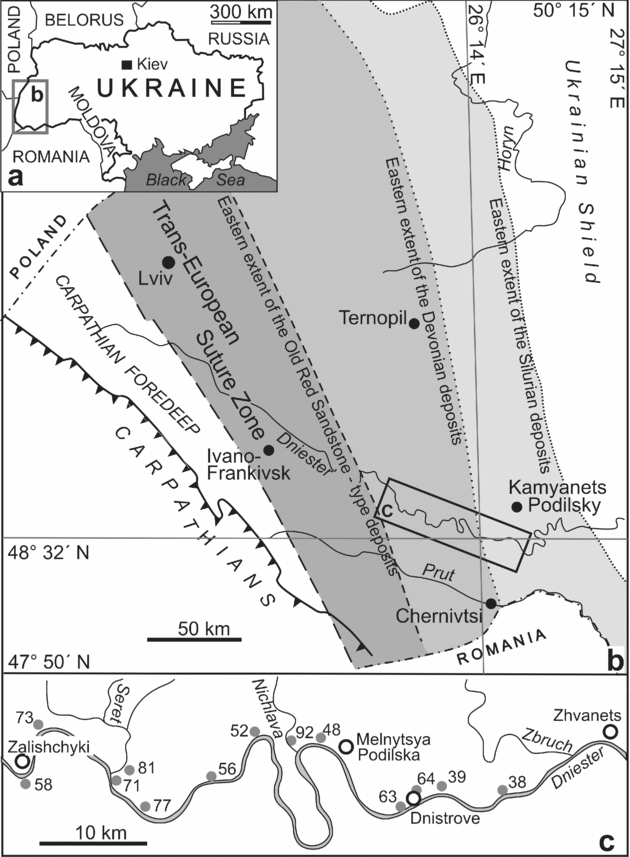
Upper Silurian and Lower Devonian sedimentary rocks crop out at many localities in the Dniester Valley, southwestern Ukraine (Fig. 1), and provide a complete record of an upward transition from open-marine (fossiliferous Pridoli limestones) through marginal-marine to fluvial (upper Lochkovian–?lower Pragian redbeds) conditions. Although comprehensively studied from a palaeontological and stratigraphical viewpoint (e.g. Nikiforova et al. Reference Nikiforova, Predtechensky, Abushik, Ignatovich, Modzalevskaya, Berger, Novoselova and Burkov1972; Tsegelnyuk, Reference Tsegelnyuk1994; Drygant, Reference Drygant1984, Reference Drygant2000, Reference Drygant2003; Paris & Grahn, Reference Paris and Grahn1996), many other aspects of this reference succession remain poorly known. Here we present new δ13C and δ18O curves, as a basis for high-resolution stratigraphy on a supra-regional scale, derived from remarkably thick and continuous, correlative successions with an updated position of the Silurian–Devonian boundary, as discussed in detail by Buggisch & Mann (Reference Buggisch and Mann2004). The main aim of this contribution is to investigate the Podolian isotope record with respect to global biogeochemical signals recognized in this eventful time interval, and to test the hypothesis of large-scale secular changes in the carbon isotope ratio of seawater. This is a complementary study to recent work of Kaljo et al. (Reference Kaljo, Grytsenko, Martma and Mõtus2007), who proved three stratigraphically older (Wenlock–Ludlow) global carbon isotopic perturbations in the Podolian epeiric succession.
(a) General location of the study area in Ukraine. (b) Distribution of the Silurian and Devonian deposits in Podolia, SW Ukraine, and geological setting of the study area. (c) Location of sampled outcrops in the vicinity of Dniester valley (see Table 1). Section numbers after Nikiforova et al. (Reference Nikiforova, Predtechensky, Abushik, Ignatovich, Modzalevskaya, Berger, Novoselova and Burkov1972).

In this report, the first two authors are responsible for the geochemical data and their interpretation, while the contributions of the succeeding authors pertain primarily to regional geological and stratigraphical questions.
2. Geological setting and stratigraphy
The Silurian–Devonian epicratonic sequence in Podolia is strongly influenced by its location in the peripheral zone of the East European Platform, close to the mobile NW-trending Trans-European Suture Zone (Fig. 1b; or Teisseyre–Törnquist Fault Zone), which is now buried under the Carpathian Foreland Basin. The sequence thickens toward the suture zone, constituting a major element of the westward-dipping, undeformed to weakly deformed Volyn'–Podolia Monocline which is developed west of the metamorphic core of the Ukrainian Shield. Tectonic processes, linked to the transition from the Caledonian to Variscan orogenies, resulted in facially differentiated, palaeogeographically distinctive epeiric successions. Subsidence rates were controlled by platform-margin faults, manifested also in wide (80–150 km) half-graben and flexural bending due to Caledonian thrust loading (e.g. Drygant, Reference Drygant2000; Uchman et al. Reference Uchman, Drygant, Paszkowski, Porębski and Turnau2004).
The Silurian to Lower Devonian succession forms an internally conformable, regressive unit that is bounded by regional erosional hiatuses of early Silurian (middle–late Llandovery) and Middle Devonian age. Despite its overall continuity, three depositional phases are distinguished (Drygant, Reference Drygant2003):
(1) A phase of stabilized carbonate shelf sedimentation in the Wenlock–Ludlow, marked by many bioherms and biostromes (e.g. Skompski et al. Reference Skompski, Łuczyński, Drygant and Kozłowski2008).
(2) The Pridoli phase of active synsedimentary tectonic movements (due to dextral transtension) in the developing Trans-European Suture Zone paired with rapid but differentiated subsidence and sedimentation rates (resulting in 700–800 m and 150–160 m thick successions in the southwestern and eastern parts, respectively).
(3) A succeeding Early Devonian phase of regression in stable and uniform tectonic/subsidence regimes, with increasing terrigenous inputs and shrinking marine settings in the western part only.
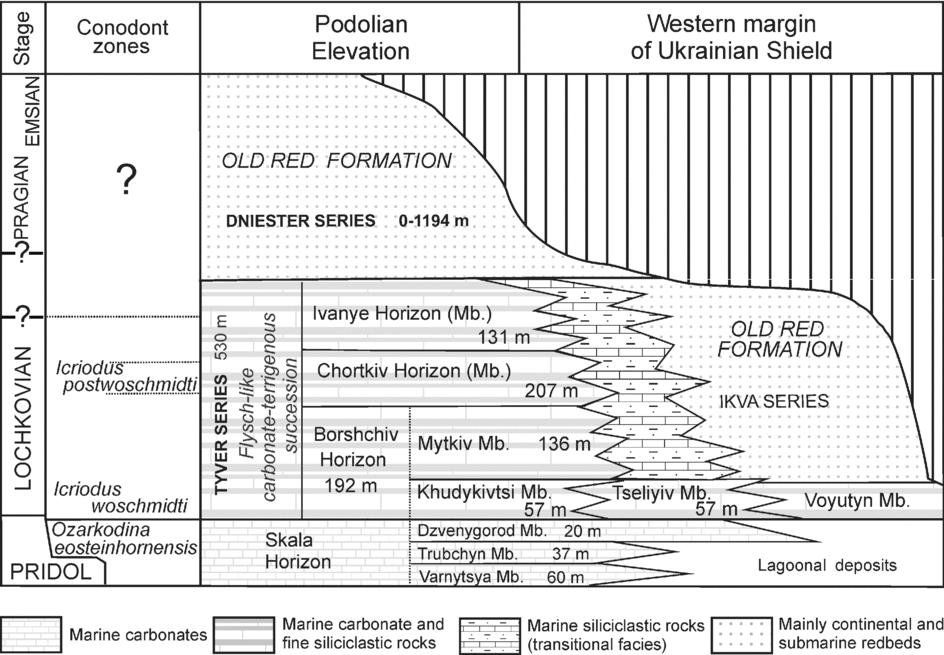
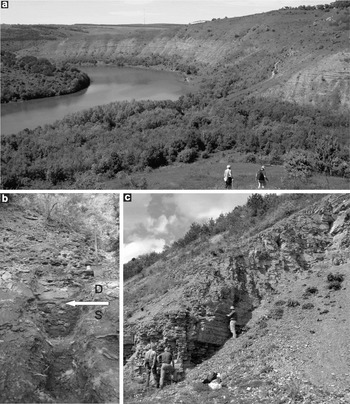
The mostly calcareous, upper Silurian Trubchyn and Dzvenygorod members form the upper part of the Skala Horizon (see Skompski et al. Reference Skompski, Łuczyński, Drygant and Kozłowski2008; Fig. 2). Dark, fossiliferous, nodular limestones, 19 m thick, predominate in the topmost interval, and contain many characteristic Silurian brachiopod, trilobite and particularly conodont species, including Ozarkodina eosteinhornensis (Walliser) and Ligonodina elegans (Walliser), which provide a reference (Drygant, Reference Drygant1984). The Silurian–Devonian boundary is placed 3.2 m above the top of the dark, nodular limestone interval, in the middle part of a sequence of interbedded greenish-grey argillaceous shales and marls containing dark grey limestone nodules. The boundary is characterized by the first appearance of the trilobite Acastella heberti Gosselet, brachiopods Clorinda pseudolinguifera Kozłowski and Glossoleptaena emarginata (Barrande) and the conodont Ozarkodina remscheidensis (Ziegler) (see fossil lists in Nikiforova et al. Reference Nikiforova, Predtechensky, Abushik, Ignatovich, Modzalevskaya, Berger, Novoselova and Burkov1972 and Nikiforova, Reference Nikiforova and Martinsson1977). The guide graptolite species Monograptus uniformis angustidens Přibyl is found at the reference Dnistrove (formerly Volkovtsy) section only, in shales interbedded within the nodular and scyphocrinoid limestone layers (Fig. 3b). These biostratigraphical data (see also Nikiforova et al. Reference Nikiforova, Predtechensky, Abushik, Ignatovich, Modzalevskaya, Berger, Novoselova and Burkov1972; Nikiforova, Reference Nikiforova and Martinsson1977) allow a fairly reliable correlation with the global boundary point at the Klonk stratotype section (Chlupáč & Hladil, Reference Chlupáč and Hladil2000). Furthermore, the conodont genus Icriodus, even if commonly considered as a guide fossil for the Devonian, is observed in the Podolian section as Icriodus woschmidti Ziegler sensu lato, which is found 1.5 m below the graptolite-based Silurian–Devonian boundary (Mashkova, Reference Mashkova1971), as in other reference successions (Martinsson, Reference Martinsson1977; but see also Carls et al. Reference Carls, Slavík and Valenzuela-Ríos2007 for a summary of doubtful problems). Notably, in lithostratigraphical terms, the Silurian–Devonian boundary is placed in the basalmost part of the Tyver Series (Borshchiv Horizon, see below; Figs 2, 4), as indicated after the chitinozoan analysis by Paris & Grahn (Reference Paris and Grahn1996).
Stratigraphy of the Silurian–Devonian boundary beds in Podolia (after Drygant, Reference Drygant2003, modified). Traditional informal division terms from the regional lithostratigraphical scheme are used, because its formal revision, according to the International Stratigraphic Guide (Salvador, Reference Salvador1994) recommendations, should be joined with a detailed description of unit boundaries and diagnostic characters, selection of stratotypes, etc.

Field photos of selected Podolian localities. (a) Typical view of natural outcrops of Silurian strata in the Dniester River valley (Tarnawa tributary at Kitaygorod village); the height of rocky cliff is ~ 40 m. (b) Trenched interval, re-exposed in 2004, of clayey–calcareous Silurian–Devonian boundary beds of basal Khudykivtsi Member at section 64 by the Dnistrove (= Volkovtsy) village (see Fig. 6), the spade in the upper right for scale (1.1 m height); arrow is at occurrence level of the guide graptolite subspecies Monograptus uniformis angustidens Přibyl. (c) Platy limestones of upper Khudykivtsi Member, Khudykivtsi outcrop (48).

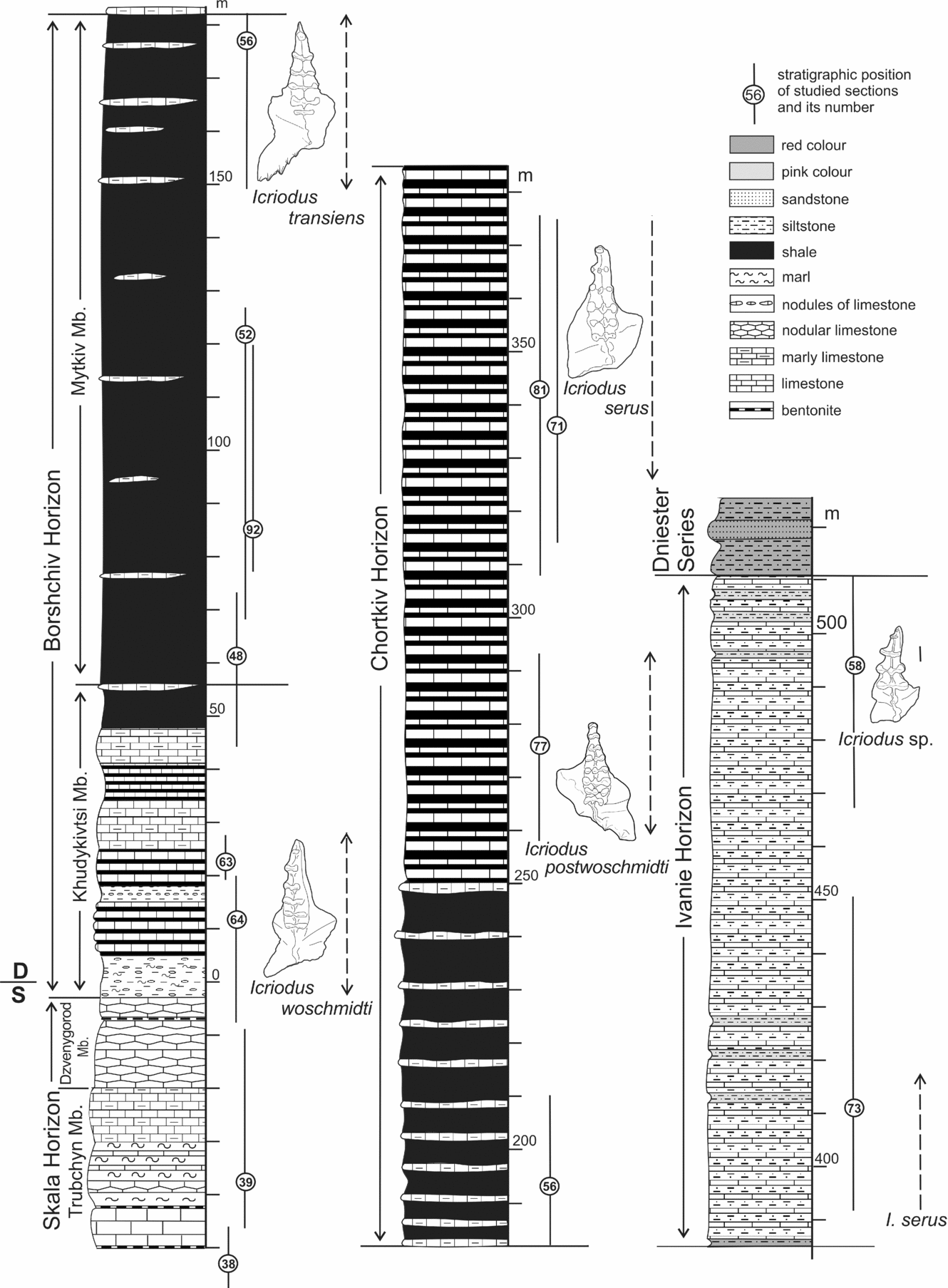
Simplified composite stratigraphical column of the investigated Podolian Silurian and Devonian sections (see Figs 1c, 2). Numbering and correlation of the sections after Nikiforova et al. (Reference Nikiforova, Predtechensky, Abushik, Ignatovich, Modzalevskaya, Berger, Novoselova and Burkov1972). Occurrence of the guide conodont species of the genus Icriodus after Drygant (Reference Drygant1984) and present investigations.

Within the Lower Devonian succession in Podolia, two successive, broad lithostratigraphical divisions have been recognized for over 100 years (Fig. 2):
(1) An argillaceous–calcareous sequence representing open-marine facies with abundant brachiopod, ostracod and tentaculitid faunas (see Kozłowski, Reference Kozłowski1929). The fossiliferous deposits, presently named the Tyver Series (Nikiforova & Obut, Reference Nikiforova and Obut1960; see Nikiforova et al. Reference Nikiforova, Predtechensky, Abushik, Ignatovich, Modzalevskaya, Berger, Novoselova and Burkov1972), are an uninterrupted continuation of the Silurian marine deposition.
(2) An Old Red Sandstone siliciclastic succession, termed the Dniester Series (Gurevich et al. Reference Gurevich, Zavyalova, Pomyanovskaya and Khizhnyakov1963; see Fig. 2), up to 1800 m thick in the Trans-European Suture Zone, with fossil remains limited to numerous agnathan fish vertebrae occurring at many levels (see Zych, Reference Zych1927; Narbutas, Reference Narbutas1984; Uchman et al. Reference Uchman, Drygant, Paszkowski, Porębski and Turnau2004).
The Tyver Series, up to 530 m thick, is subdivided into three well-known horizons: Borshchiv, Chortkiv and Ivanye (the latter two units are herein re-classified as members; see Fig. 2), which, together with the Skala Horizon, are the focus of this study (Fig. 4). This fossil-rich, open-marine Lochkovian suite (see more detail in Kozłowski, Reference Kozłowski1929; Nikiforova & Predtechensky, Reference Nikiforova and Predtechensky1968; Nikiforova et al. Reference Nikiforova, Predtechensky, Abushik, Ignatovich, Modzalevskaya, Berger, Novoselova and Burkov1972; Tsegelnyuk, Reference Tsegelnyuk1994; Drygant, Reference Drygant1984, Reference Drygant2000) is replaced laterally by dolomitic and siliciclastic Old Red Sandstone strata to the northwest (Ikva Formation).
The Borshchiv Horizon includes the Khudykivtsi and Mytkiv members (total 180 m thick). The Khudykivtsi Member comprises platy limestones and variably interbedded dark grey argillaceous shales, marls and marly to micritic limestones (Fig. 3b, c), intercalated with rare bioclastic limestones (mostly encrinites) in the higher part. The overlying Mytkiv Member is composed of a thick succession of dark grey argillaceous shales with rare and thin intercalations and lenticles of grey marly or biodetrital limestones, exemplified by brachiopod coquinas.
The Chortkiv Member, more than 200 m thick, is represented in the studied outcrops by alternating dark grey argillaceous shales and thin (up to 20 cm) fine-grained limestones (Fig. 4). In the upper, more carbonate-rich part, brownish and reddish claystones, up to 3 m thick, appear for the first time in the Podolian succession. In addition to abundant marine invertebrate fossils, numerous agnathan remains occur.
Higher in the sequence, the Ivanye Member, ~ 126 m thick, comprises dark, variably silty shales, with intercalations of thin, nodular, biodetrital limestones. The upper part of the interval is dominated by siltstone beds containing scarce fossil assemblages that include agnathans, ostracods, brachiopods and gigantostracans. Passage into the overlying Old Red-type facies is typified by the appearance of thick-bedded red sandstones and sandy shales with siltstone admixtures (Narbutas, Reference Narbutas1984), representing inshore lagoon to fluvial–estuarine regimes (Uchman et al. Reference Uchman, Drygant, Paszkowski, Porębski and Turnau2004).
This turning point in depositional evolution is still uncertainly dated. The whole Ivanye Member was considered to be lower Gedinnian (= Lochkovian) by Nikiforova et al. (Reference Nikiforova, Predtechensky, Abushik, Ignatovich, Modzalevskaya, Berger, Novoselova and Burkov1972), mainly because of the supposed occurrence of the agnathan Belgicaspis crouchi (Lankester). However, conclusive determination of the species in Podolia is not possible because it is known here only as fragments (e.g. Voichyshyn, Reference Voichyshyn2001). Results of the studies of spore and graptolite assemblages (Arkhangelskaya, Reference Arkhangelskaya1980; Uchman et al. Reference Uchman, Drygant, Paszkowski, Porębski and Turnau2004), chitinozoans (Paris & Grahn, Reference Paris and Grahn1996) and vertebrate faunas (Blieck & Cloutier, Reference Blieck and Cloutier2000; Dupret & Blieck, Reference Dupret and Blieck2009), obtained from the lower parts of the Dniester Series, also suggest a Lochkovian age for the member. However, Drygant (Reference Drygant2000), based on results of ostracod studies (Abushik, Reference Abushik1971), and his own preliminary conodont studies, concluded that the upper part of the Ivanye Member may be of Pragian age. Unfortunately, conodonts are very rare in this part of the Podolian succession.
2.a. Localities studied
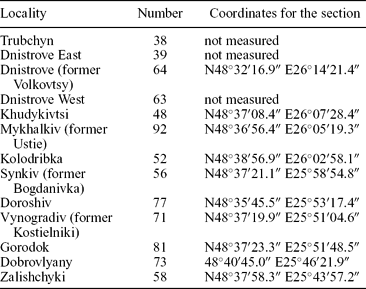
The Upper Silurian and Lower Devonian strata were systematically sampled from natural exposures on the banks of the Dniester River and its tributary during the summer seasons of 2004, 2005 and 2008 (see Figs 1c, 3). In total, 13 sections were selected and mostly sampled for geochemical investigations, representing a nearly continuous stratigraphical record of the Pridoli to upper Lochkovian (Table 1), as shown in Figures 4 and 5.
Sections under study, given in stratigraphical order (see Fig. 4), numbered after Nikiforova et al. (Reference Nikiforova, Predtechensky, Abushik, Ignatovich, Modzalevskaya, Berger, Novoselova and Burkov1972, fig. 1C)

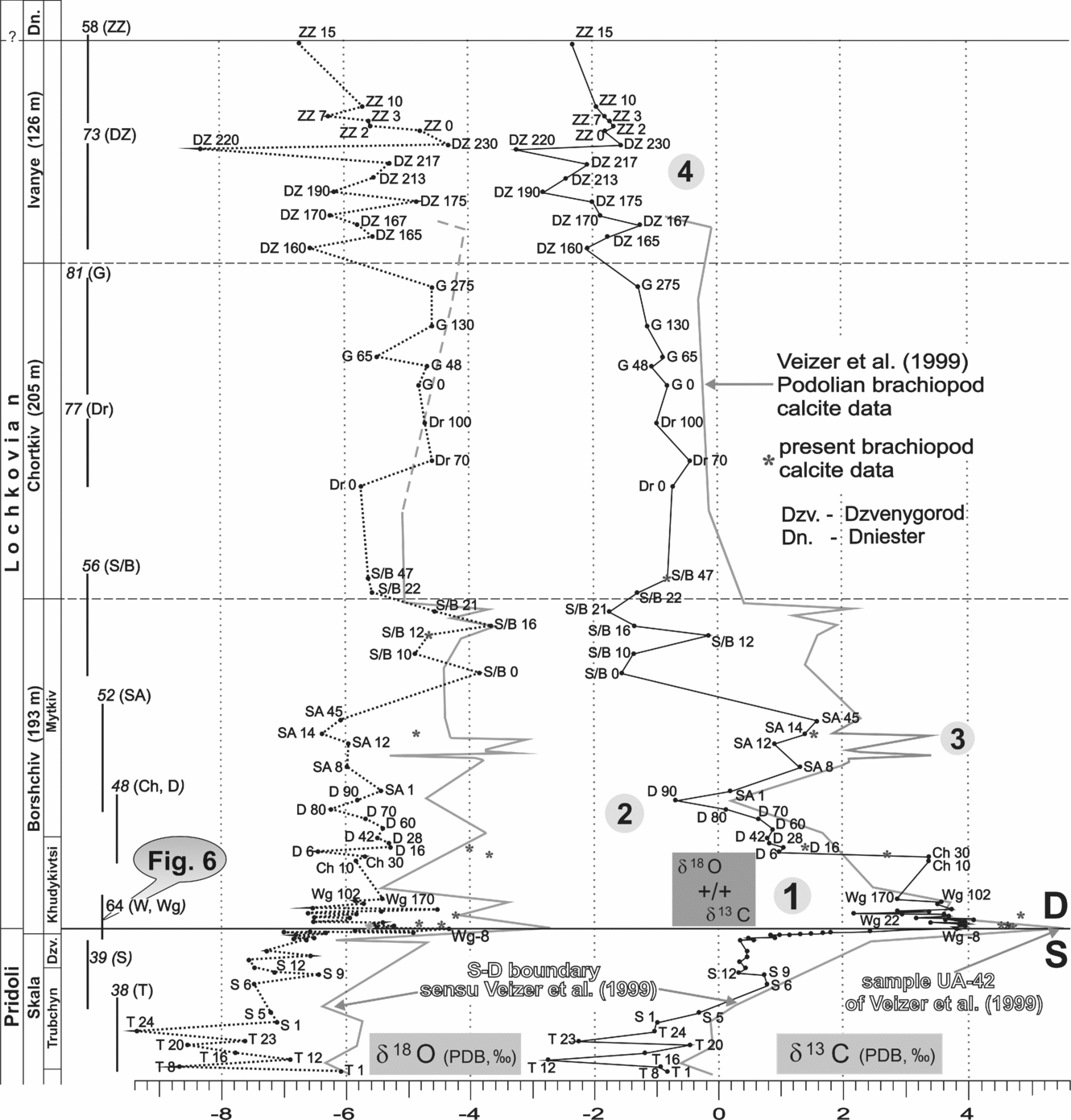
Plot of δ13C and δ18O values against the composite stratigraphical succession of the investigated Silurian and Devonian sections (see Figs 1c, 4; Tables 1, 2). Broken line reveals mostly diagenetically overprinted oxygen isotopic ratios; four-step δ13C variation (events 1–4, shaded circles), as well as correlative δ18O and δ13C temporal trends across the Silurian–Devonian boundary during the major biogeochemical perturbation (event 1) are shown. Comparative δ13C and δ18O curves are based on Podolian brachiopod calcite data, taken from the Web Site Ottawa database of Veizer et al. (Reference Veizer, Ala, Azmy, Bruckschen, Buhl, Bruhn, Carden, Diener, Ebneth, Goddéris, Jasper, Korte, Pawellek, Podlaha and Strauss1999; http://www.science.uottawa.ca/geology/isotope_data/), but slightly modified according to correlative chemostratigraphical trends at the intra-stage scale because this sample succession is originally arranged in somewhat arbitrarily calculated time intervals, without relation to real sedimentary rock thicknesses. In addition, the peak of positive excursions (sample UA-42), originally thought to distinctly post-date the Silurian–Devonian boundary by at least 0.3 Ma, implied erroneously low positioning of the system boundary in the sample succession of Veizer et al. (Reference Veizer, Ala, Azmy, Bruckschen, Buhl, Bruhn, Carden, Diener, Ebneth, Goddéris, Jasper, Korte, Pawellek, Podlaha and Strauss1999; shown by arrow), as indicated by present data and chemocorrelation with the proposed worldwide δ13C curve of Buggisch & Mann (Reference Buggisch and Mann2004; see Fig. 7); thus, the only approximately coeval sample series is re-arranged around the reference sample UA-42 (D443; rhynchonellid shell).

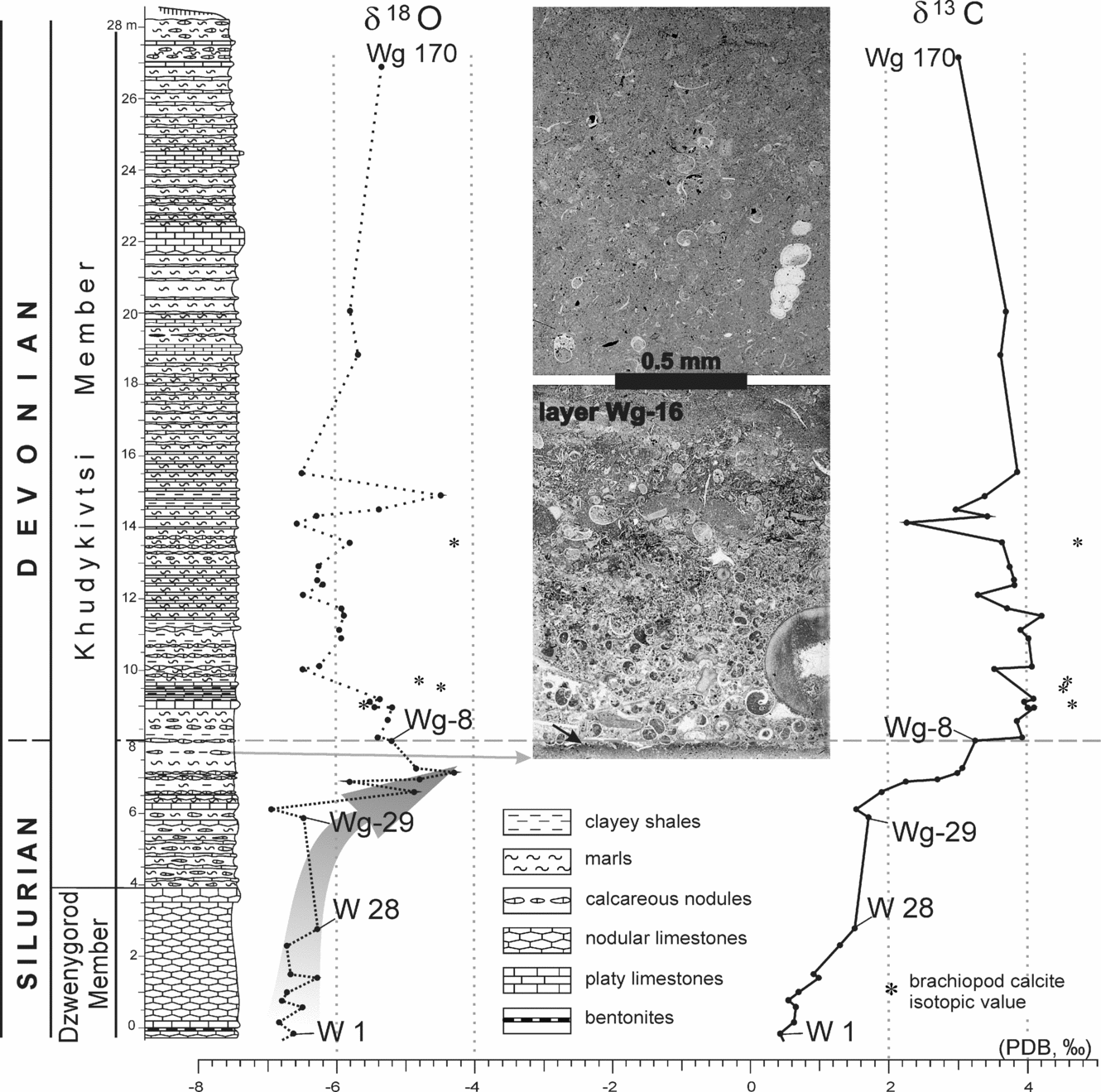
Of key significance is the above mentioned Dnistrove (= Volkovtsy, 64) section (Fig. 6), which is a regional reference succession across the Silurian–Devonian boundary within the Dzvenygorod and Khudykivtsi members; the exposure was previously extensively covered and overgrown by bushes but has been improved by new excavations (Fig. 3b).
Secular pattern of δ13C and δ18O values against the Silurian–Devonian boundary beds at section 64 by the Dnistrove (= Volkovtsy) village (see Figs 3b, 5), with the probably preserved main original δ18O trend arrowed (compare with brachiopod calcite data in Fig. 5). Lithology after Nikiforova et al. (Reference Nikiforova, Predtechensky, Abushik, Ignatovich, Modzalevskaya, Berger, Novoselova and Burkov1972, fig. 82), modified. Microfacies photos present the bottom and upper parts of graded bioclastic layer Wg-16, showing erosion surface (arrowed) covered by unsorted crinoid–shelly grainstone, and grading upward into bioturbated gastropod–brachiopod wackestone (typical of quiet-water, subtidal facies), the predominating limestone variety being a major bulk source of the isotopic data.

3. Sampling procedures and methods
Most of the carbonate layers in all the examined sections were sampled for quantitative analysis of carbon and oxygen stable isotope ratios. The bulk-rock samples were collected from fresh, broken, marly micritic limestone layers (see the microfacies type in Fig. 6) with a stratigraphical spacing of decimetres to metres; the most dense sampling was conducted through the Silurian–Devonian transition beds (Figs 5, 6). A total of 104 bulk-rock samples, supplemented by eight brachiopod shells, were analysed for carbon and oxygen stable isotopes (Table 2).

The carbonate powder for analysis was extracted with a microdrill from fresh surfaces of rock samples, and from brachiopod shells comprised of low-Mg calcite. Calcium carbonate samples were digested under vacuum with 100 % H3PO4 (ortho-phosphoric acid) for 24 h at 25 °C (McCrea, Reference McCrea1950). Released CO2, after freezing it out from the separation line, was analysed using a Finnigan Mat delta plus gas mass-spectrometer in the Light Stable Isotopes Laboratory of the Institute of Geological Sciences and Institute of Palaeobiology, Polish Academy of Sciences, Warsaw. The gas sample was introduced into the spectrometer in dual inlet mode and measurements were repeated eight times, to calculate the mean value. The standard error of the spectrometer measurements was 0.02 ‰.
The results are reported in per mil deviation from the Vienna Peedee Belemnite (VPDB) standard using δ (delta) notation. The precision (reproducibility of replicate analyses) of both carbon and oxygen isotope analysis was usually better than ± 0.1 ‰. Data are normalized to the VPDB scale using National Bureau of Standards NBS-19 (δ18O = −2.20 ‰ and δ13C = 1.95 ‰).
4. Results and reliability of the record
The composite isotopic curve, presented in Figure 5, is a compilation of fragmentary results obtained from the individual measured sections, which were combined based on previous stratigraphical studies (Nikiforova et al. Reference Nikiforova, Predtechensky, Abushik, Ignatovich, Modzalevskaya, Berger, Novoselova and Burkov1972; Drygant, Reference Drygant1984). The isotopic measurements in this study therefore provide precise chemostratigraphical corroboration of the correctness of the earlier bio- and litho-correlations (see Fig. 4).
The C isotope changes in the examined geological time interval are very distinctive. At Trubchyn (38), the Silurian δ13C values start at −0.7 to −2.7 ‰. In the Dnistrove (= Volkovtsy, 64) sections, from initial values between 0.4 to 0.8 ‰, δ13C gradually increases over 8 m to a value of 4 ‰ (Fig. 6). The accelerated ‘heavy carbon’ enrichment correlates well with the Silurian–Devonian boundary (excursion 1 in Fig. 5), although the peak of 4.2 ‰ in bulk-rock samples (and 4.7 ‰ in brachiopod calcites) occurs slightly above the graptolite-defined boundary. The high δ13C values (above 3 ‰) continue for ~ 40 m upwards into the Lochkovian succession throughout most of the Khudykivtsi Member, then diminish in stratigraphically higher sections of the Borshchiv Horizon to nearly −2 ‰ (localities: Khudykivtsi (48), Mykhalkiv (92), Kolidrobka (52); excursion 2). Higher in the succession, there is an observed increase in δ13C values by ~ 3.5 ‰ initially, recorded at Synkiv (former Bogdanivka) section (56; excursion 3), followed by a more gradual and fluctuating 13C depletion trend by 5 ‰ (from 1.65 to −3.3 ‰) within the Chortkiv and Ivanye members (excursion 4).
The oxygen isotopic time curve initially co-varies with the carbon curve: the δ18O begins with values between −6.1 to −9.3 ‰ and increases up to −4.5 ‰ (even to −3.7 ‰ in brachiopod calcites) across the Silurian–Devonian boundary, gradually diminishes by about 2 ‰ and then increases gradually up to −4.5 ‰, in a trend opposite that of the carbon curve established in the upper Mytkiv Member at Synkiv (Fig. 5). Moderate correlations re-appear in succeeding higher Lochkovian localities (Synkiv to Zalishchyki), where both curves show a synchronized, parallel drop in value of 2 ‰.
Results of the organic geochemical and preliminary palynofacies studies at Dnistrove are mostly obscured by thermal maturity (on the order of 80–90 °C; confirmed by conodont colour alteration index CAI = 1.5–2). Kranendonck (Reference Kranendonck2004, p. 32 and table 3.1 therein) reported low organic carbon contents on samples from this site (from 0.09 to 0.73 wt %, with a mean value of 0.19 wt %), as well as only a small detectable amount of low pyrolysis (S2) hydrocarbons due to intense weathering and biodegradation.
5. Interpretation of the isotopic signals
The δ13C and δ18O values from eight Podolian brachiopod calcite shells show close or slightly heavier isotopic signals (less than 1.1 ‰ and 1.7 ‰ higher, respectively) than the surrounding micritic matrix (Figs 5, 6). However, when compared to less stratigraphically refined, well-preserved brachiopod reference data (for which precise geochronological equivalency is somewhat problematic) from the Dniestr River outcrop of Veizer et al. (Reference Veizer, Ala, Azmy, Bruckschen, Buhl, Bruhn, Carden, Diener, Ebneth, Goddéris, Jasper, Korte, Pawellek, Podlaha and Strauss1999; http://www.science.uottawa.ca/geology/isotope_data/), the bulk samples systematically display lighter values mostly greater than 1 ‰ (Fig. 5). Comparative analysis of the only approximately synchronous brachiopod and whole rock δ13C records shows a good match in the lower limestone-dominated part of the investigated interval, but rock samples reveal significantly lower δ13C values in the middle shale-dominated part of the Podolian succession (sections 48, 52, 56 of the Borshchiv Horizon), with an offset possibly as great as 3–4 ‰ in comparison to brachiopod shells. This discrepancy may be explained by the reduced chance of preservation of original isotope composition of carbonates from rhythmic clay-enriched lithofacies (Joachimski et al. Reference Joachimski, Pancost, Freeman, Ostertag–Henning and Buggisch2002; Buggisch & Mann, Reference Buggisch and Mann2004; Buggisch & Joachimski, Reference Buggisch and Joachimski2006), and organic carbon isotope proxies are more reliable, especially for deeper-water depositional settings (e.g. Loydell & Frýda, Reference Loydell and Frýda2007). In addition, the topmost part of the shallowing-upward limestone succession (Tyver Formation), enriched in light carbon and oxygen isotopes both in the micrite and brachiopod calcite (see Fig. 5), is probably overprinted by ‘ageing’ of seawater masses with long residence times and/or early meteoritic processes in an episodically restricted epeiric setting (Immenhauser et al. Reference Immenhauser, Della Porta, Kenter and Bahamonde2003; Gomez et al. Reference Gomez, Ogle, Astini and Kalin2007; Hamon & Merzeraud, Reference Hamon and Merzeraud2007), exaggerating the final negative trend (see Figs 5, 7).
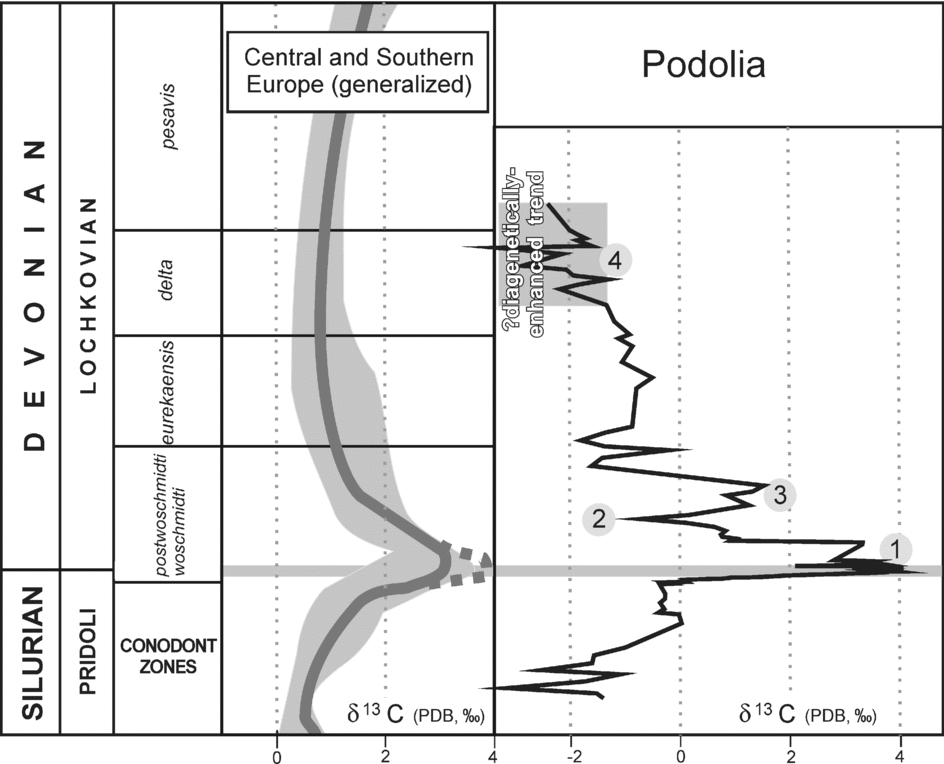
Chemocorrelation of the Podolian δ13C curve (Fig. 5) with the proposed worldwide carbon isotope stratigraphy across the Silurian–Devonian transition; based on figure 13 compiled by Buggisch & Mann (Reference Buggisch and Mann2004), with kind permission from Springer Science+Business Media. The solid line corresponds to mean values of all European curves, the changing width of the shaded area reflects a variation range of δ13C values obtained in the localities (see figs 11, 12 in Buggisch & Mann, Reference Buggisch and Mann2004), while the grey dashed line represents local Silurian–Devonian boundary excursions (maximally as heavy as +5.8 ‰ in well-dated North American sections: Saltzman, Reference Saltzman2002).

Any primary metastable carbonate components will recrystallize during a variety of processes. However, the diagenetic stabilization and cementation of shallow-water sediments usually occurs very early in the post-depositional history of the rocks, when pore solutions still approximate chemically the original seawater characteristics, as discussed by Veizer et al. (Reference Veizer, Ala, Azmy, Bruckschen, Buhl, Bruhn, Carden, Diener, Ebneth, Goddéris, Jasper, Korte, Pawellek, Podlaha and Strauss1999, pp. 75–6 and 81–2; see examples in Wynn & Read, Reference Wynn and Read2007 and Ando et al. Reference Ando, Kaihoa, Hodaka Kawahata and Kakegawa2008). Undoubtedly, however, the measured isotopic results do not represent strictly the original hydrochemical signature of the Silurian and Devonian calcite seas, with δ18O values, in particular, more prone to bias (e.g. Marshall, 1992; Brand, Reference Brand2004). For instance, as illustrated by Veizer et al. (Reference Veizer, Ala, Azmy, Bruckschen, Buhl, Bruhn, Carden, Diener, Ebneth, Goddéris, Jasper, Korte, Pawellek, Podlaha and Strauss1999, fig. 20) for the Silurian brachiopod/bulk series from Gotland, the δ13C means are well comparable, while δ18O values derived from whole rock are depleted systematically by ~ 2 ‰ relative to brachiopod signatures. The same divergence in δ13C is generally more evident for material younger than Middle Devonian (Brand, Reference Brand2004). As shown in Figure 5, however, the principal secular trends of the brachiopod and approximately contemporaneous whole rock datasets across the key Silurian–Devonian transition are quite similar. This is well demonstrated by the δ18O increase from ~ −7.5 to −4.5 ‰ in micrite samples, and from ~ −6.4 to −2.7 ‰ in brachiopod shells studied by Veizer et al. (Reference Veizer, Ala, Azmy, Bruckschen, Buhl, Bruhn, Carden, Diener, Ebneth, Goddéris, Jasper, Korte, Pawellek, Podlaha and Strauss1999). Nevertheless, the δ18O curve does not merit extended discussion in this paper (see Section 6 below).
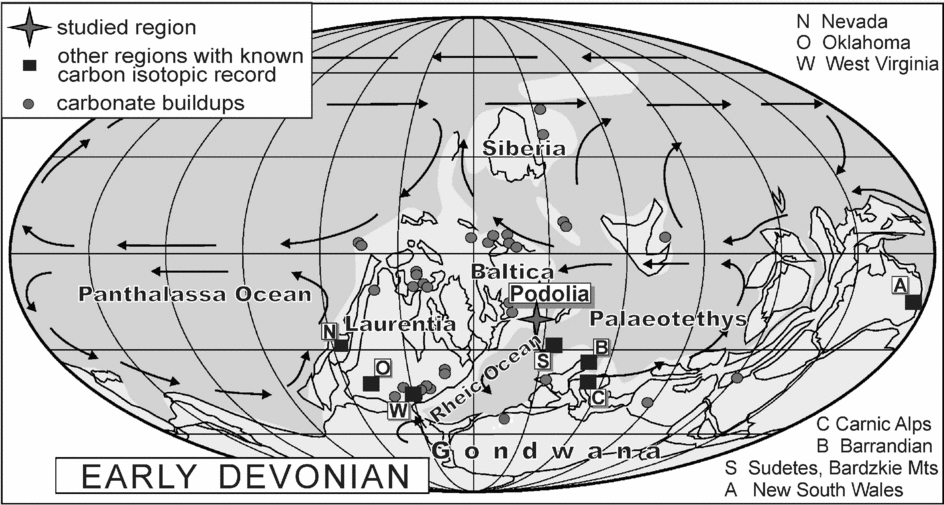
Although useful in some cases (e.g. in chemostratigraphical studies on the Precambrian algal-micritic sequences: Azmy et al. Reference Azmy, Kaufman, Misi and de Oliveira2006), trace element (Sr, Fe, Mn) and cathodoluminiscence preservation tests of a primary signal might be indecisive in whole-rock isotopic analyses (Brand, Reference Brand2004; Ando et al. Reference Ando, Kaihoa, Hodaka Kawahata and Kakegawa2008), even in Neogene Bahama carbonates (Melim et al. Reference Melim, Westphal, Swart, Eberli and Munnecke2002). Conversely, as stressed by Buggisch & Mann (Reference Buggisch and Mann2004, p. 524), ‘similar stratigraphical trends of δ13C values in different sections of the same age are a strong argument for regional or global variations in the carbon isotope composition’. Chronostratigraphical correlation of the examined sections, and therefore the relative timing of the isotopic signals, is based on previous investigations (see Section 2 above). At least some of the reliable correlations, recorded in generally deeper-shelf (subtidal) facies, may be extrapolated from this shelf on a supra-regional scale, as shown by comparison with the compiled, probably worldwide δ13C curve of Buggisch & Mann (Reference Buggisch and Mann2004; Fig. 7). In particular, a major perturbation in carbon cycling is reliably confirmed by the Silurian–Devonian boundary positive shifts in Podolia (6.9 ‰ in micrites, 6.2 ‰ in brachiopod shells), that are paralleled by the coeval heaviest carbonate and organic δ13C values reported from several separate Euroamerican and Gondwanan carbonate shelves (Andrew et al. Reference Andrew, Hamilton, Mawson, Talent and Whitford1994; Buggisch & Joachimski in Schönlaub et al. Reference Schönlaub, Kreutzer, Joachimski, Buggisch and Buggisch1994; Hladíková, Hladil & Kříbek, Reference Hladíková, Hladil and Kříbek1997; Hladíková, Hladil & Jackova, Reference Hladíková, Hladil and Jackova1999; Saltzman, Reference Saltzman2002; Buggisch & Mann, Reference Buggisch and Mann2004; Gill, Lyons & Saltzman, Reference Gill, Lyons and Saltzman2007; Fig. 8). This excursion results in carbonate δ13C values as high as 5.8 ‰ (Buggisch & Mann, Reference Buggisch and Mann2004; Gill, Lyons & Saltzman, Reference Gill, Lyons and Saltzman2007), perhaps peaking at 8 ‰ in Australia (Andrew et al. Reference Andrew, Hamilton, Mawson, Talent and Whitford1994). When combined with the occurrence of the cosmopolitan conodont species Icriodus woschmidti, the substantial (> 4 ‰) carbon isotope excursion provides an additional chemostratigraphical tool for recognizing the Silurian–Devonian boundary (Williams & Saltzman, Reference Williams and Saltzman2005).
Palaeogeographical map, global distribution of carbonate build-ups (circles) and oceanic circulation pattern (arrows) during the Lochkovian to early Pragian, showing location of the study area (Podolia), along with previously studied Silurian–Devonian boundary localities in Europe (Czech Republic, Austria), North America and Australia (see summary in Buggisch & Mann, Reference Buggisch and Mann2004). Adapted figure 11B from Lubeseder (Reference Lubeseder2008), copyright ©2008, with permission from Elsevier; that based on figure 5 of Kiessling (in Copper, Reference Copper, Kiessling, Flügel and Golonka2002), with permission from SEPM (Society for Sedimentary Geology).

In summary, these observations and parallels, despite the more or less significant lithology-dependent post-depositional resetting of isotope values in the Podolian limestone samples, strongly suggest that the carbonates in the current study provide an insight into the relative isotopic changes through time and preserve principal signals of ambient seawater in this epeiric domain (see also discussion in Kaljo et al. Reference Kaljo, Grytsenko, Martma and Mõtus2007). Thus, recognized δ13C secular trends are considered as a proxy of evolving global carbon cycling, indicated by the large-scale Silurian–Devonian boundary biogeochemical perturbation. Two of the observed δ13C excursions from Podolia (major positive shift 1 and negative shift 2 in Fig. 5) may be easily compared with the proposed worldwide C isotope stratigraphy of Buggisch & Mann (Reference Buggisch and Mann2004), as shown in Figure 7. On the other hand, the subordinate positive δ13C excursion (event 3), interrupting the 13C depletion secular trend, is identifiable especially in the Bohemian organic carbon signature (Klonk borehole; Buggisch & Mann, Reference Buggisch and Mann2004, fig. 2 therein), but a chemostratigraphical correlation needs refined conodont biostratigraphical verification in Ukrainian successions. Notably, the Podolian Lower Devonian stratigraphical record is the most expanded and continuous of such sequences, as exemplified by the contrasting thicknesses of the Lochkovian successions: ~ 500 m in Podolia (Fig. 2), 90 m in Bohemia and 20–75 m in the Carnic Alps (Buggisch & Mann, Reference Buggisch and Mann2004, figs 2 and 6 therein). As a consequence, chemostratigraphical correlations suggest a middle-late Lochkovian age for the sampled uppermost part of Tyver Formation (that is, carbonate–clastic transition to the Old Red Sandstone deposition in the Ivanye Member), because the distinguishing supra-regional positive δ13C shift to a value of 3 ‰ in the lower Pragian (see fig. 13 in Buggisch & Mann, Reference Buggisch and Mann2004) is not recognized in the studied sections.
In addition to tracking worldwide oceanographical trends, isotope ratio trends also record intra-shelf factors controlling carbon cycling, such as input of weathered carbon and the oxidation of organic matter (e.g. Wigforss-Lange, Reference Wigforss-Lange1999; Saltzman, Reference Saltzman2001; Panchuk, Holmden & Kump, Reference Panchuk, Holmden and Kump2005; Panchuk, Holmden & Leslie, Reference Panchuk, Holmden and Leslie2006; Gomez et al. Reference Gomez, Ogle, Astini and Kalin2007; Hamon & Merzeraud, Reference Hamon and Merzeraud2007). Comparison of the Podolian data with the secular curve of Buggisch & Mann (Reference Buggisch and Mann2004) exhibits more negative δ13C values for the stratigraphically oldest and, especially, youngest Podolian samples (Fig. 7), confirmed by the brachiopod data of Azmy et al. (Reference Azmy, Veizer, Bassett and Copper1998) and Veizer et al. (Reference Veizer, Ala, Azmy, Bruckschen, Buhl, Bruhn, Carden, Diener, Ebneth, Goddéris, Jasper, Korte, Pawellek, Podlaha and Strauss1999). Similar 13C depletions are reported from the Baltic (Kaljo, Kiipli & Martma, Reference Kaljo, Kiipli, Martma, Landing and Johnson1998, fig. 7; Kaljo et al. Reference Kaljo, Martma, Männik and Viira2003, fig. 3) and North American (Saltzman, Reference Saltzman2002, fig. 3) Pridoli successions, as well as in the middle Lochkovian of the Cantabrian Mountains (Buggisch & Mann, Reference Buggisch and Mann2004, figs 8, 9). Thus, the interregional differences may reflect partly decoupled, local-to-regional carbon cycling processes and individualized isotopic ratios in these transiently semi-restricted epeiric basins.
6. Causes of the Silurian–Devonian carbon isotopic excursion
The abrupt and high-amplitude δ13C peak at the Silurian–Devonian transition may be seen as a final step of the destabilization of the late Silurian oceanic ecosystem (Brunton et al. Reference Brunton, Smith, Dixon, Copper, Kershaw, Nestor, Landing and Johnson1998, fig. 3; Kaljo et al. Reference Kaljo, Martma, Männik and Viira2003, p. 63). The proposed cause of this major biogeochemical perturbation remains equivocal (Saltzman, Reference Saltzman2002; Buggisch & Mann, Reference Buggisch and Mann2004; Buggisch & Joachimski, Reference Buggisch and Joachimski2006; Gill, Lyons & Saltzman, Reference Gill, Lyons and Saltzman2007), but the crucial factors certainly triggered increases in carbon pumping and organic matter burial during the short-term sea-level fall, recorded in organic-rich deposition in some peri-Gondwanan basins (Hladíková, Hladil & Kříbek, Reference Gurevich, Zavyalova, Pomyanovskaya and Khizhnyakov1997; Buggisch & Mann, Reference Buggisch and Mann2004, p. 538; also, e.g. Loydell & Frýda, Reference Loydell and Frýda2007). In addition, Saltzman (Reference Saltzman2002) suggested that the volume of extra carbonate eroded from exposed carbonate shelves might have rapidly increased the δ13C index of the riverine weathering input. The flux of 34S-depleted sulphur to the ocean, recorded in a negative δ34S excursion (15 ‰) preserved in carbonate-associated sulphate, and antithetic to the positive δ13C excursion, seems to support the weathering hypothesis (Gill, Lyons & Saltzman, Reference Gill, Lyons and Saltzman2007). The sea-level change pattern remains equivocal, however (Walliser, Reference Walliser and Walliser1996; Buggisch & Mann, Reference Buggisch and Mann2004). The Podolian depositional record is also indecisive in the context: while scyphocrinoid limestones are usually linked with sea-level lowstands (Vacek, Reference Vacek2007; Lubeseder, Reference Lubeseder2008), the graptolite-shale parting at the Silurian–Devonian boundary may reflect a pelagic interlude in the transiently drowned carbonate shelf (suggested also by Skompski et al. Reference Skompski, Łuczyński, Drygant and Kozłowski2008).
Furthermore, Saltzman (Reference Saltzman2002) has also not presented explicit evidence based on widespread successions of eroded Silurian carbonate platform, but, on the other hand, C-rich deposits were gradually eroded during an Early Devonian sea regression. It seems that the long-term oxidation of sedimentary organic matter and light carbon isotope recycling is recorded in a generally falling δ13C trend.
The observed 13C acme signal in the Silurian–Devonian transition might be regionally exaggerated by various forcing agents in the epeiric realm, especially an elevated level of biological pumping (e.g. Saltzman, Groessens & Zhuravlev, Reference Saltzman, Groessens and Zhuravlev2004; Hamon & Merzeraud, Reference Hamon and Merzeraud2007). In the deep-sea clayey–siliceous succession of the Sudetes (SW Poland), the δ13C excursion across the Silurian–Devonian boundary measured in organic carbon is as low as 1.5 ‰ (Porębska, Sawłowicz & Strauss, Reference Porębska, Sawłowicz and Strauss1999). This distinctive bathymetric isotopic gradient, noted by Buggisch & Mann (Reference Buggisch and Mann2004, p. 537), is repeated in other Silurian positive δ13C excursions (Munnecke, Samtleben & Bickert, Reference Munnecke, Samtleben and Bickert2003; Loydell, Reference Loydell2007), suggestive of major burial loci of organic carbon in epicontinental domains. A similar trend was recognized by Herten & Mann (Reference Herten and Mann2003), who evaluated bioproductivity trends in different marine environments of Gondwana, Laurentia and Baltica. These authors indicated enhanced primary production at the Silurian–Devonian transition, paired with a consequential rise in organic δ13C from less than −30 ‰ for the deep-marine to −25 ‰ for the shallow-marine domain. Herten & Mann (Reference Herten and Mann2003) concluded that ‘beside the general interpretation of a different carbon isotope partitioning at individual marine environments, we suggest that heavier isotopic values in coastal areas are related to an involvement of early land plants and/or their precursors’. Thus, the accelerated expansion of life from marine to terrestrial domains likely represented a major biogeochemical impact on the latest Silurian global ecosystem (even if usually accepted for Late Devonian deep-rooted forests: e.g. Simon et al. Reference Simon, Goddéris, Werner, Strauss and Joachimski2007), as further proposed for Early Palaeozoic carbon cycling in epicontinental basins (Panchuk, Holmden & Kump, Reference Panchuk, Holmden and Kump2005; Gomez et al. Reference Gomez, Ogle, Astini and Kalin2007). Therefore, in addition to increased carbonate weathering in sea-level lowstands (Saltzman, Reference Saltzman2002; Loydell, Reference Loydell2007), biogeochemical aspects of the progressive vegetation spread in extensive near-coastal shallows and deltas around the suturing late Caledonian continents need re-consideration (see further discussion in Małkowski & Racki, Reference Małkowski and Racki2009).
Finally, the more efficient organic carbon pumping was responsible for the rapid enhancement of carbon burial, and resulted also in the drop of atmospheric CO2 levels and a global cooling episode during the Silurian–Devonian transition. As modelled by Simon et al. (Reference Simon, Goddéris, Werner, Strauss and Joachimski2007), the short-lived lowering of pCO2 to concentrations around 2000 ppmv was a result of effective organic carbon burial because of increasing phosphorus input to the marine reservoirs during the global regression acme. Near the Silurian–Devonian boundary, a positive δ18O shift in bulk-rock samples was reported from the Barrandian succession (Hladíková, Hladil & Kříbek, Reference Hladíková, Hladil and Kříbek1997; Hladíková, Hladil & Jackova, Reference Hladíková, Hladil and Jackova1999) and Carnic Alps (Buggisch & Joachimski in Schönlaub et al. Reference Schönlaub, Kreutzer, Joachimski, Buggisch and Buggisch1994), in agreement with the Podolian record (Fig. 6), especially with the more reliable δ18O values from well-preserved brachiopod calcites which increase by 3.7 ‰ (Fig. 5). Even if this main original seawater trend is still preserved (see comprehensive discussion of the primary versus secondary dilemma in Veizer et al. Reference Veizer, Ala, Azmy, Bruckschen, Buhl, Bruhn, Carden, Diener, Ebneth, Goddéris, Jasper, Korte, Pawellek, Podlaha and Strauss1999, pp. 74–82; Li et al. Reference Li, Jenkyns, Wang, Hu, Chen, Wei, Huang and Cui2006; Wynn & Read, Reference Wynn and Read2007; Ando et al. Reference Ando, Kaihoa, Hodaka Kawahata and Kakegawa2008, among others), refined interpretation of the δ18O signal is difficult because several overriding controls, such as alkalinity, salinity and temperature, may be involved (e.g. Cramer & Saltzman, Reference Cramer and Saltzman2007; Gomez et al. Reference Gomez, Ogle, Astini and Kalin2007; Ando et al. Reference Ando, Kaihoa, Hodaka Kawahata and Kakegawa2008). Nevertheless, the predicted climatic cooling pulse can be tentatively supported by the oxygen isotopic signature of the Klonk Event, especially in the light of a short-term interregional shallowing of the upwelling system in the Rheic Ocean, recognized by Porębska & Sawłowicz (Reference Porębska and Sawłowicz1997). Furthermore, a cool-water upwelling of nutrient-rich waters is interpreted by Lubeseder (Reference Lubeseder2008) to have triggered the episodic blooming of marker planktic scyphocrinoids.
7. Conclusions
Marine carbonates from the stratigraphically well-constrained and expanded, continuous Podolian succession spanning the Silurian–Devonian transition reveal a major positive δ13C shift beginning in the late Pridoli and that reached peak values as heavy as 4.2 ‰ in earliest Lochkovian times, followed by a generally falling δ13C trend later in the Lochkovian (Fig. 5). Despite more or less significant lithology-dependent diagenetic effects in the Podolian whole-rock samples, they mostly match the less stratigraphically refined brachiopod calcite reference data of Veizer et al. (Reference Veizer, Ala, Azmy, Bruckschen, Buhl, Bruhn, Carden, Diener, Ebneth, Goddéris, Jasper, Korte, Pawellek, Podlaha and Strauss1999), and therefore are interpreted as preserving a near-primary C-isotopic composition of Silurian and Devonian seawater in this part of the Laurussian shelf.
The relatively high resolution sampling of the investigated Podolian sections is consistent with the previously inferred global biogeochemical perturbation across the Silurian–Devonian boundary that can be correlated with the Klonk biotic event. In the broad context, the pattern of carbon isotope stratigraphy probably reflects a multifaceted interaction of palaeogeographical, biogeochemical and evolutionary processes in the late Caledonian geodynamic setting. Independently of the highlighted scenario of increased carbonate weathering during sea-level fall (Saltzman, Reference Saltzman2002; Loydell, Reference Loydell2007), a stimulating role of the expanding vegetation in vast near-coastal shallows and deltas needs re-evaluation in the geochemical context (Małkowski & Racki, Reference Małkowski and Racki2009). The rapidly enhanced bioproductivity and organic carbon burial resulted also in a drop of atmospheric CO2 content and a corresponding global cooling episode during the Silurian–Devonian transition.
Acknowledgements
This work has been supported by NATO Collaborative Linkage Grant no. 980500 and a grant N N307 057834, supported by the Ministry of Science and Higher Education. We particularly thank Drs Jared Morrow and Richard Cifelli for careful reading and many helpful remarks, and Professor Tom J. Algeo, Drs Karem Azmy, Wolf Kiessling and particularly David K. Loydell, as well as four anonymous reviewers, for constructive suggestions and critical comments on earlier versions of the manuscript. Field and photographic assistance of Drs Andrzej Baliński, Ryszard Wrona, Victor Voichyshyn and Anatolij Mamchur, as well as M.Sc. Aleksandra Hołda-Michalska for digital preparation of figures, is gratefully acknowledged. Drs Paweł Filipiak and Leszek Marynowski kindly provided us with preliminary palynofacies and organic geochemistry data, respectively.