1. INTRODUCTION
Laser-plasmas interaction is a very important issue of inertial confinement fusion (ICF). Parametric instabilities, such as stimulated Raman scattering (SRS) and stimulated Brillouin scattering (SBS), may occur during the laser-plasmas interaction. With the development of the chirped pulse amplification technique (Mourou et al., Reference Mourou, Tajima and Bulanov2006), ultraintense short laser pulses with a peak intensity as high as I > 1021 W/cm2 and contrast ratios in excess of 1010 W/cm2 are now available, allowing for studies of laser interaction with ultrathin targets (Mackinnon et al., Reference Mackinnon, Sentoku, Patel, Price, Hatchett, Key, Andersen, Snavely and Freeman2002; Antici et al., Reference Antici, Fuchs, d'Humières, Lefebvre, Borghesi, Brambrink, Cecchetti, Gaillard, Romagnani, Sentoku, Toncian, Willi, Audebert and Pépin2007). Energetic plasmas can be produced by means of intense laser light interacting with thin foils. These laser-plasma interaction are attracting much attention due to a wide range of fundamental research and potential applications covering radiograph transient processes (Borghesi et al., Reference Borghesi, Campbell, Schiavi, Haines, Willi, MacKinnon, Patel, Gizzi, Galimberti, Clarke, Pegoraro, Ruhl and Bulanov2002), such as beam self-focusing (Sodha et al., Reference Sodha, Prasad and Tripathi1975; Ritchie, Reference Ritchie1994; Subbarao, 2003), filamentation (Young et al., Reference Young, Baldis, Drake, Campbell and Estrabrook1988; Sharma et al., Reference Sharma, Sharma and Chauhan2007), beam self-compression (Bergé, Reference Bergé1997; Shorokhov et al., Reference Shorokhov, Pukhov and Kostyukov2003), resonance absorption (Mulser et al., Reference Mulser, Kanapathipillai and Hoffmann2005), laser-plasma accelerator (Tajima & Dawson, Reference Tajima and Dawson1979, Lifschitz et al., Reference Lifschitz, Faure, Glinec, Malka and Mora2006), fast ignition of fusion cores (Roth et al., Reference Roth, Cowan, Key, Hatchett, Brown, Fountain, Johnson, Pennington, Snavely, Wilks, Yasuike, Ruhl, Pegoraro, Bulanov, Campbell, Perry and Powell2001; Naumova et al., Reference Naumova, Schlegel, Tikhonchuk, Labaune, Sokolov and Mourou2009; Badiei et al., Reference Badiei, Andersson and Holmlid2010), harmonic generation (Ceccherini et al., Reference Ceccherini, Boscolo, Poletto, Tondello, Villoresi, Altucci, Bruzzese, De Lisio, Nisoli, Stagira, De Silvestri and Svelto2000; Gupta et al., Reference Gupta, Sharma and Mahmoud2007; Sadighi-Bonabi et al., Reference Sadighi-Bonabi, Hora, Riazi, Yazdani and Sadighi2010), and so on.
If in plasma, the frequency exceeds the natural frequency of the electron oscillations, then the electrons will be forced out of the beam field. The laser beam exerts a radial ponderomotive force on electrons and expels them outward of the beam, producing a lower density in the center regions, which results in focusing the following radiation. In plasma, the refractive index can be changed through two mechanisms: electron effective mass increase caused by relativistic quiver motion and expulsion of electrons caused by the laser ponderomotive force. Self-focusing of laser beams has been studied in detail both theoretically as well as experimentally case. Sodha et al. (Reference Sodha, Prasad and Tripathi1975) studied nonstationary self-focusing of a Gaussian pulse in a plasma by applied the Wentzel-Kramers-Brillouin (WKB) and paraxial ray approximations to solve the wave equation. Bruce et al. (1991) analyzed dynamics of ponderomotive self-focusing in plasmas. Bharuthram and Parashar (Reference Bharuthram and Parashar1999) used paraxial ray theory and explored cross-focusing of two copropagating laser beams in plasma. Subbarao et al. (Reference Subbarao, Batra and Uma2003) investigated paraxial theory of slow-focusing and found the laser beam focuses to a constant beam width with a small phase-front curvature depending on the extent of absorption. Batra et al. (Reference Batra, Mitra, Subbarao, Sharma and Uma2005) used the standard eikonal formalism and the corrected paraxial theory discusses the underlying dynamics of self-focusing. Liu et al. (Reference Liu, Wu, Xie and Yu2008) based on the paraxial approximation describing the propagation of a subcycle axicon Gaussian laser pulse in vacuum. Singh et al. (Reference Singh, Aggarwal and Gill2009) used the WKB and paraxial ray approximation to investigate the dynamics of Gaussian spikes on Gaussian laser beam in relativistic plasma. Asthana et al. (Reference Asthana, Rathore and Varshney2009) applied the framework of WKB and a paraxial ray theory and studied effect of self-generated axial magnetic field and on propagation of intense laser radiation in plasmas. These researches have already shown that the laser beam would get high self-focusing in plasma and present single beam density profile due to ponderomotive force and relativistic effect in paraxial approximation.
The interaction of high power laser beam with overdense plasmas in nonparaxial have been studied for a number of years, and are important because one needs to understand laser propagation at high intensities before one can interpret the results from other nonlinear phenomena. Ritchie (Reference Ritchie1994) applied the nonparaxial wave propagation theory to study relativistic self-focusing and channel formation in the propagation of an intense, short-pulse laser through underdense plasma. Hafizi et al. (Reference Hafizi, Roberson and Sprangle2000) analyzed three-dimensional characteristics of short free-electron laser pulses and discussed the matched beam solutions of the wave equation, including diffraction and nonparaxial effects. Esarey et al. (Reference Esarey, Schroeder, Shadwick, Wurtele and Leemans2000) examined nonparaxial propagation of ultrashort, high-power laser pulses in plasma channels. Jha et al. (Reference Jha, Wadhwani, Upadhyaya and Raj2004) analyzed nonparaxial, nonlinear propagation of a relativistic laser pulse in a preformed plasma channel having a parabolic density profile. Kumar and Tripathi (Reference Kumar and Tripathi2006) studied the non-paraxial theory of self-defocusing/focusing of a laser pulse in a multiple-ionizing gas. Gupta et al. (Reference Gupta, Sharma, Chauhan, Rafat and Sharma2009) investigates the generation of plasma wave and third harmonic generation in hot collisionless plasma by an intense laser beam. Within the nonparaxial ray approximation, filamentary structures of the laser beam are observed due to relativistic nonlinearity. Monteiro et al. (Reference Monteiro, Maia Neto and Nussenzveig2009) found the diffraction-limited focused beam has unexpected properties resulting from a strong interplay between the angular spatial structure and the local polarization in the nonparaxial regime. Recently, Sharma et al. (Reference Sharma, Sharma and Chauhan2007), Sharma and Chauhan (Reference Sharma and Chauhan2008), Sodha and Faisal (Reference Sodha and Faisal2008), and Sharma (Reference Sharma and Sharma2009) investigated beam self-focusing, beam filamentation, and suppression of SRS in laser-plasma interaction, due to the influence of off-axis components a 2 and a 4 in nonparaxial region, they found the single highly self-focusing laser beam intensity would split two intensity profile and some new nonlinear phenomenon. In sum, lots references have been shown that laser beams in laser-plasma interaction also would generate self-focusing and present more interesting nonlinear phenomenon in nonparaxial region.
In the WKB approximation, following Sharma et al. (Reference Sharma, Sharma and Chauhan2007), Sharma and Chauhan (Reference Sharma and Chauhan2008), Sodha and Faisal (Reference Sodha and Faisal2008), and Sharma (2009) approaches, we have further discussed the nonlinear phenomenon of the interaction of intense lasers with overdense plasmas. We will show that, comparing with paraxial region, the beam width presents more complex nonlinear variation, and laser beams intensity profile would split due to the nonlinear ponderomotive force by the influence of nonparaxial region. In Section 2, we have given the equation of intense laser beams in overdense plasmas. We continue in Section 3 with a discussion of numerical results and analysis and laser beams localization in collisional plasmas. The main conclusions are summarized in the last section.
2. EQUATION OF INTENSE LASER BEAMS IN OVERDENSE PLASMAS
Consider the propagation of a Gaussian laser beam of frequency ω along the z-direction. The initial intensity distribution of the beam is given by:
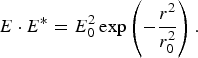
Where r is the radial coordinate of the cylindrical coordinate system and r 0 is its initial beam width. The laser beam wave equation governing the electric field of the incident laser beam in the plasma can be written as:
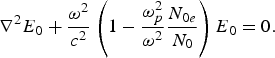
Where ωp is the plasma wave frequency, ω is the laser wave frequency, N 0 is the density of plasma electrons in the absence of a laser beam, and N 0e is modified density of plasma electrons due to ponderomotive force, given by:

Where α = e 2m i/6k 0T 0γm e2ω2 is the nonlinearity parameter.
Assuming the variation of the electric field as:

One obtains the following equation:

Moreover, A 0 is a complex function of space, k 0 = ωɛ01/2/c is the wave number of the laser beam in the plasma, where the intensity dependent dielectric constant in nonparaxial region is given by:

Where we assume the variation of A 0 as:

Where S 0 is the real function of space, and assuming S 0(r, z) and A 00(r, z) in nonparaxial region are given by:


Where S 00, S 2, S 4, a 2, a 4 and the beam width parameter f are function of z. The parameters S 00, S 2, and S 4 are components of the eikonal; S 2 is indicative of the spherical curvature of the wavefront and S 4 corresponds to its departure from the spherical nature. Parameters a 2 and a 4 are indicative of the departure of the beam from the Gaussian nature. Substituting Eq. (7) into Eq. (5) and separating the real and imaginary parts of the resulting equation, the following set of equations is obtained.
The real part as:
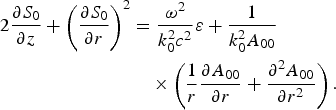
And the imaginary parts as:

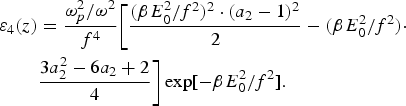
Where the intensity dependent dielectric constant ɛ relate to ɛ0, ɛ2, and ɛ4, the expressions for the parameters ɛ0, ɛ2 and the modified expression ɛ4 corresponding to the ponderomotive nonlinearity in nonparaxial region are as follows:


Substituting Eqs. (6), (8), (9) and the dielectric constant ɛ into Eqs. (10) and (11), and equating the coefficient of r 2 and r 4 on both sides of the equation, we obtain the equation for the coefficient a 2 and the modified approximate equations of a 4, S 4′ and the beam width f in nonparaxial region:
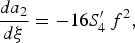
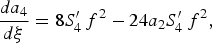


The parameters a 2 and a 4 are indicative of the departure of the beam from the Gaussian nature. Where S 4′ = S 4ω/c, ξ = zc/ωr 02 is the dimensionless distance of propagation, ρ = r 0ω/c is the dimensionless width of the beam at z = 0. When a 2 = a 4 = S 4′= 0 express the paraxial approximation, a 2 ≠ a 4 ≠ S 4′ ≠ 0 express the nonparaxial region.
3. NUMERICAL RESULTS AND ANALYSIS
The solution can be obtained by simultaneous solution of Eqs. (12)–(18) with the initial conditions f = 1 and df/dξ = 0 (parallel beam) at ξ = 0. For numerical appreciation of the results, the profile of thezdependence of the electron density has been assumed to be linear, i.e., ωp2 = 0.9ω2(1 + bξ). And the ponderomotive nonlinearity is considered to be the dominant mechanism of self-focusing. The overdense region is characterized by ωp2/ω 2 > 1, that b ξ is greater than nearly 0.11 (Sodha & Faisal, Reference Sodha and Faisal2008). According to simultaneous numerical calculation results, we attain the follow figures. Corresponding to specific parameters has been illustrated in figures.
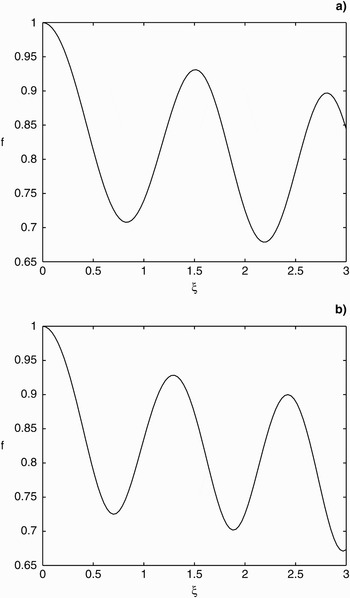
Figure 1 presents the variation of beam width f for parameters βE 02 and ρ2 in paraxial approximation (a 2 = 0, a 4 = 0, S 4′ = 0) and nonparaxial region (a 2 ≠ a 4 ≠ S 4′ ≠ 0) for Gaussian pulse. Figure 1a shows that the beam width f accompany continuously periodic oscillatory variation and the peak value of beam width steadily decrease with the increase of ξ. In the nonparaxial region, the beam width has the similar phenomenon with paraxial region. Comparing with Figure 1a, beam width oscillatory variation get faster in the same amount of distance, it means the laser beam localization would get faster in nonparaxial region.
Variation of beam width parameter f with dimensionless distance of propagation ξ for the parameters βE 02 and ρ2 in Gaussian pulse. (a) βE 02 = 3, ρ2 = 20 in paraxial (a 2 = 0, a 4 = 0, S 4′ = 0), (b) βE 02 = 3, ρ2 = 20 in nonparaxial region (a 2 ≠ a 4 ≠ S 4′ ≠ 0).

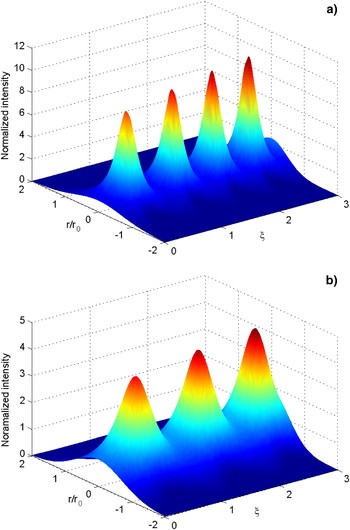
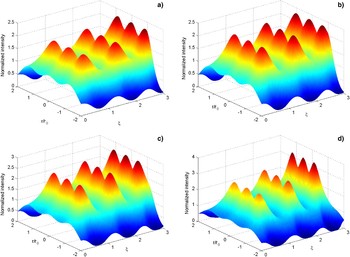
Figure 2 shows the laser beam normalized intensity profile (A 002) with normalized distance ξ and radial distance r in paraxial region. It is obvious from Figure 2 that as the beam propagates through the plasma it gets highly localized in the presence of ponderomotive nonlinearity, besides, the intensity of the laser beams is maximum at r = 0 along the propagation distance ξ. In addition, laser beam normalized intensity increases slowly and continuously with the increase of the distance of propagation ξ. Comparing with Figure 2a, increase the parameter of βE 02, the self-focusing and filamentation of laser beam decrease, i.e., the beam width increase and less number of filaments is generated in the same amount of distance, respectively.
(Color online) Variation in laser beam intensity with normalized distance ξ and radial distance r/r 0 for laser power βE 02 = 1 (a), 2 (b) and ρ2 = 20 in the paraxial approximation.

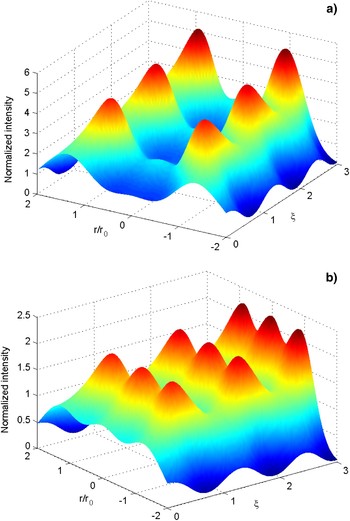
Figure 3 shows the laser beam intensity profile with normalized distance and radial distance in nonparaxial region. In the case, we first find the three-splitted beam intensity profile in nonparaxial region. According to the difference of initial condition (the value of a 20, a 40, and S 40′ at ξ = 0), the laser beam intensity profile would split two kinds of different phenomenon. Comparing with Figure 2, in paraxial approximation, laser beam are highly localized and form single laser beam intensity profile, in fact, the paraxial approximation is an idealized treatment of the theory model, while the nonparaxial region is general in the true interaction of intense lasers with overdense plasmas. For the splitted beam profile phenomenon, the initial values (a 20 and S 40′ at ξ = 0) of the parameter a 2 and S 4′ plays the major roles, when the initial value a 20 > 0.1 or S 40′ > 0.027, the laser beam can not split several beams profile, but, in 0 ≤ a 20 ≤ 0.1, altering the initial values of a 40 and S 40′, we can attain two-splitted and three-splitted laser beam intensity profile, respectively. In the case, a 40 determines whether beam form the two-splitted and three-splitted beam profile phenomenon; S 40′ effects mainly the amplitude of splitted beam profile. Obviously, the two-splitted and three-splitted beam profile mean to self-focusing becomes faster in the nonparaxial case in comparison to the paraxial case due to the participation of off-axis part. Applied the initial values of a 20, a 40, and S 40′ to meet the initial conditions of a 20 = 0.1, a 40 = 1.5, S 4′ = 0.001 and a 20 = 0.1, a 40 = 3, S 4′ = 0.001, we attain Figures 3a and 3b, respectively. For the reason why two-splitted and three-splitted beam profile of beam, we think that they may the ponderomotive force results from the changing of the channel density, and the refractive index increases and the laser gets focused in the overdense plasmas. In the interaction of intense laser and over-tense plasmas, the refraction laser wave has formed a single highly localized beam profile due to the ponderomotive force in paraxial region. While the splitted the refraction laser wave, secondary incident wave and secondary reflected wave in nonparaxial region all are possible localized due to the more complex nonlinear ponderomotive force, hence, two-splitted and three-splitted beam profile would be probably formed in certain cases. Here, changing the value of a 20, a 40, and S 40′, four-splitted or others splitted beam profile cannot form for laser power βE 02 = 3 and ρ2 = 20 in the nonparaxial region.
(Color online) Variation in laser beam intensity with normalized distance ξ and radial distance r/r 0.

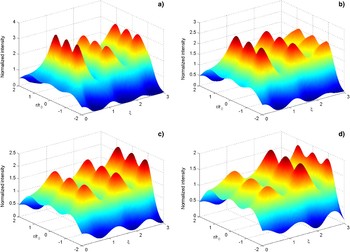
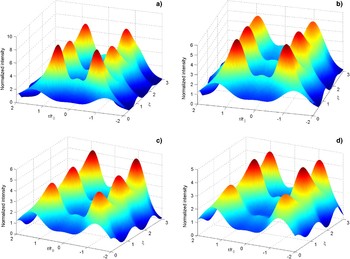
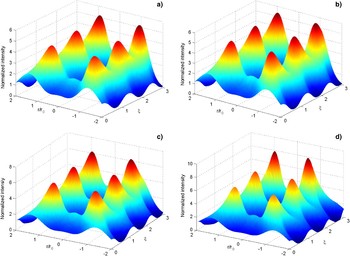
In addition, in the paper, we discuss detailed the influence of the parameters βE 02 and ρ2 on splitted beam profiles. Figures 4 and 5 presents three-splitted and two-splitted beam profiles of laser beam with normalized distance ξ and radial distance r/r 0 for various laser powers and ρ2 = 20 in the nonparaxial region. Figures 4 and 5 shows that the normalized intensity of laser beam decrease with the increase of βE 02, but the splitted beam width (including transverse axis r and longitudinal axis ξ) increases with the increase of βE 02, besides, three-splitted beam profile and two-splitted beam intensity profile take on an oscillation variation with the increase of βE 02 along the propagation distance ξ.
(Color online) Three-splitted beam profile of laser beam intensity with normalized distance ξ and radial distance r/r 0 for laser power βE 02 = 2, (a), 2.5, (b), 3, (c), 3.5, (d) and ρ2 = 20 in the nonparaxial region.

(Color online) Two-splitted beam profile of laser beam intensity with normalized distance ξ and radial distance r/r 0 for laser power βE 02 = 2, (a), 2.5, (b), 3, (c), 3.5, (d) and ρ2 = 20 in the nonparaxial region.

Figures 6 and 7 presents three-splitted and two-splitted beam profiles of laser beam with normalized distance ξ and radial distance r/r 0 for laser power βE 02 = 3 and various values of ρ2 in the nonparaxial region. Figures 6 and 7 shows that the splitted beam width decrease with the increase of ρ2, but the normalized intensity of laser beam increases with the increase of ρ2, besides, three-splitted beam profile and two-splitted beam profile take on an oscillation variation with the increase of ρ2 along the propagation distance ξ.
(Color online) Three-splitted beam profile of laser beam intensity with normalized distance ξ and radial distance r/r 0 for laser power βE 02 = 3 and ρ2 = 20, (a), 25, (b), 30, (c), 35, (d) in the nonparaxial region.

(Color online) Two-splitted beam profile of laser beam with normalized distance ξ and radial distance r/r 0 for laser power βE 02 = 3 and ρ2 = 20, (a), 25, (b), 30, (c), 35, (d) in the nonparaxial region.

4. CONCLUSION
In this paper, the interaction of intense lasers with over dense plasmas in the nonparaxial region is investigated. Based on the modified nonlinear wave equation describing the interaction of intense laser and overdense plasmas, we first find the three-splitted laser beam intensity profile. The simulation results show that the single highly self-focusing beam would split two-splitted beam and three-splitted beam in certain initial values of a 20, a 40, and S 40′. For the splitted beam profile phenomenon, the initial values a 20 and S 40′ of the parameter a 2 and S 4′ plays the major roles, when the initial value a 20 > 0.1 or S 40′ > 0.027, the laser beam intensity can not split several beams profile, but, in a 20 ≥ 0.1, to alter the initial values of a 4 and S 4′, we can attain two-splitted and three-splitted beam intensity profile, respectively. In the case, a 40 determine the form of splitted phenomenon; S 40′ determine mainly the amplitude of splitted beam profile. Changing the value of a 20, a 40, and S 40′, four-splitted or others splitted beam profile can not form in the nonparaxial region. In addition, the parameters βE 02 and ρ2 affect obviously the normalized beam intensity and the splitted beam width.
ACKNOWLEDGMENT
This work was supported by the National Science Foundation of China under Grant No. 2006CB921605.