Introduction
Obesity is one of the biggest health problems today, affecting a person not only physically but psychologically as well. Although a topic of some medical concern for centuries, obesity has gradually progressed from being an amusing curiosity to a major public health issue, as well as a theme for sophisticated physiologic and behavioural research.
Once considered a problem related to affluence, obesity is now rapidly growing in many developing countries and in poor neighbourhoods of developed countries (WHO, 2003). Even in countries like India, which is typically known for its high prevalence of undernutrition, significant proportions of overweight and obesity now co-exist with the undernourished (Popkin, Reference Popkin2002). The understanding of how and why obesity occurs is incomplete; however, it involves the integration of social, behavioural, cultural, physiological, metabolic and genetic factors (National Research Council, 1989). Obesity is a condition in which the fat stores are excessive for an individual's height, weight, gender and race, and produce adverse health outcomes. Excessive adiposity results from an imbalance in energy, i.e. energy intake either has been or is greater than energy expenditure (WHO, 2005).
In developing countries, obesity is more common in middle-aged women, people of higher socioeconomic status and those living in urban communities. In more affluent and developed countries, obesity is common not only in the middle-aged, but is also becoming increasingly prevalent among younger adults and children. Furthermore, it tends to be associated with lower socioeconomic status, especially in women, and the urban–rural differences are diminished or even reversed. Obesity has very high costs for societies, as the resulting disabilities and diseases create huge burdens for families and health systems. The experience of developed countries clearly demonstrates that the cost of morbidity and mortality associated with increasing obesity and related non-communicable diseases would be overwhelming for developing countries (WHO, 2000). Rapidly changing diets and lifestyles are fuelling the global obesity epidemic (WHO, 2003).
Previous research in India has found the prevalence of obesity to be higher among women (Kapoor et al., Reference Kapoor, Kapoor, Durnin, Bhatnagar, Verma and Mokha1999; Zargar et al., Reference Zargar, Masoodi, Laway, Khan, Wani, Bashir and Akhtar2000; Misra et al., Reference Misra, Pandey, Devi, Sharma, Vikram and Khanna2001; Sinha & Kapoor, Reference Sinha and Kapoor2005) and among economically better-off persons (Singh et al., Reference Singh, Beehom, Verma, Haque, Singh and Mehta2000; Griffiths & Bentley, Reference Griffiths and Bentley2001).
In a study conducted among twelve populations of north-east India aged between 18 and 62 years with a view to understanding their nutritional status, it was observed that the variation in mean BMIs between populations was highly significant, ranging between 18.3 and 20.5 kg/m2 (Khongsdier, Reference Khongsdier2001). With a few exceptions, the mean values of BMI in the tribal populations were significantly higher than in the caste groups. The prevalence of chronic energy deficiency was also lower in the tribal than in the Hinduized and caste populations. Although it is difficult to explain why the tribals have higher BMIs than the higher castes, the cormic index was significantly lower among the caste groups as compared with some tribal groups of north-east India. The differences in BMI between ethnic groups may not only be due to nutrition, but due to other environmental and genetic factors as well (Khongsdier, Reference Khongsdier2001). Strickland & Tuffrey (Reference Strickland and Tuffrey1997) have also observed lower values of cormic index in the non-Mongoloid (caste) populations of Nepal, which are consistent with their lower mean BMI.
Epidemiological studies have demonstrated the importance of body fatness and its distribution, and as a clinical marker of health risk among populations. The fat distribution pattern has been extensively studied for decades (Garn, Reference Garn1954; Satwanti et al., Reference Satwanti and Bharadwaj1980; Joyce & Kapoor, Reference Joyce and Kapoor1996; Sinha & Kapoor, Reference Sinha and Kapoor2005), including the ethnic variation in fat distribution (Satwanti et al., Reference Satwanti and Singh1977; Wardle et al., Reference Wardle, Wrightson and Gibson1996) and the effect of level of physical activity on the fat distribution pattern (Bhalla et al., Reference Bhalla, Kapoor and Singh1983; Satwanti et al., Reference Satwanti, Bhalla and Singh1984; Depress et al., Reference Depress, Bouchard, Trembley, Savard and Marcotte1985; Brown & Jones, 1997). It has become apparent that the fat distribution pattern is population, sex and age specific, along with the increase in obesity level. Body fat mass increases with age, and the re-distribution of fat takes place in later age resulting in centripetal adiposity and increased associated risk (Singh et al., Reference Singh, Ghosh, Beegom, Mehta, De and Haque1998; Orden & Oyhenart, Reference Orden and Oyhenart2006; Sinha & Kapoor, Reference Sinha and Kapoor2006).
It has been suggested that body fat composition varies considerably between ethnic groups (Norgan, Reference Norgan1990; Gallagher et al., Reference Gallagher, Heymsfield, Heo, Jebb, Murgatroyd and Sakamoto2000). The World Health Organization (WHO) Regional Office for the Western Pacific Region, along with the International Association for the Study of Obesity (IASO) and the International Obesity Task Force (IOTF), has recommended a BMI of 23.0 kg/m2 as the cut-off point for defining overweight in Asian populations (WHO, 2000).
Classification of obesity and overweight
Obesity is usually determined using body mass index (BMI), calculated as the weight in kilograms divided by the square of the height in metres (kg/m2). A BMI over 25 kg/m2 is defined as overweight, and a BMI of over 30 kg/m2 as obese. These markers provide common benchmarks for assessment, but the risks of disease in all populations can increase progressively from lower BMI levels onwards (WHO, 2005).
In Asian subjects, the risk associated with diabetes and cardiovascular diseases occurs at lower levels of BMI when compared with the white population (Mckeigue et al., Reference Mckeigue, Shah and Marmott1991; Banerji et al., Reference Banerji, Faridi, Atluri, Chaiken and Lebovitz1999). This is attributed to body fat distribution; Asian Indians tend to have more visceral adipose tissue, causing higher insulin resistance, despite having a lean BMI (Banerji et al., Reference Banerji, Faridi, Atluri, Chaiken and Lebovitz1999; Chandalia et al., Reference Chandalia, Abate, Garg, StrayGundersen and Grundy1999). The WHO also advocated a lower limit of normal BMI in Asian Indians (WHO, 2000). A WHO expert consultation (2004) concluded that the proportion of Asian people with a high risk of type-2 diabetes and cardiovascular disease is substantial at BMIs lower than the existing WHO cut-off point for overweight (≥25 kg/m2).
For many Asian populations, additional trigger points for public health action were identified as 23 kg/m2 or higher, representing increased risk, and 27.5 kg/m2 or higher as representing high risk. The suggested categories are as follows: less than 18.5 kg/m2 underweight; 18.5–23 kg/m2 increasing but acceptable risk; 23–27.5 kg/m2 increased risk; and 27.5 kg/m2 or higher high risk. The consultation identified further potential public health action points (23.0, 27.5, 32.5 and 37.5 kg/m2) along the continuum of BMI, and proposed methods by which countries could make decisions about the definitions of increased risk for their population (WHO Expert Consultation, 2004).
Subjects and Methods
A cross-sectional study was carried out among 346 Tangkhul Naga women, ranging in age from 20 to 70 years during the period November 2005 to March 2006. The subjects were divided into five 10-year age groups, viz. 20–29, 30–39, 40–49, 50–59 and 60–70 years, to study the age trend of biological as well as socioeconomic change among them. The purpose of the study and techniques to be used were explained to each subject. Only those who volunteered and gave written consent were studied. All experiments were performed in accordance with relevant guidelines and regulations. The research described was compliant with basic ethical standards.
A pilot survey was conducted prior to the main study in order to standardize the techniques used. A door-to-door survey was carried out among Tangkhul Naga women of Ukhrul district, Manipur, in north-east India, to collect the anthropometric data along with information regarding socioeconomic indicators like occupation, educational status, income, diet and ethnographic information about the Tangkhul Nagas. Pregnant women and those who were in lactation period were not included in the study. Keeping age constant, subjects were categorized into six groups according to their occupation as student, government job, private job, farmer, housewife and others, and into four groups according to their educational level as illiterate, education until high school, higher secondary and graduates and above. Subjects were also grouped into three groups according to their family income per month as low (<5000 rupees), middle (5000–10,000 rupees) and high (>10,000 rupees).
For the assessment of overweight and obesity, height and weight measurements were taken on each subject using standard protocols given by Weiner & Lourie (Reference Weiner and Lourie1981). Stature was measured by anthropometer to the nearest 0.1 cm and body weight was measured using a portable spring weighing machine with least count of 0.5 kg, in light clothing and without shoes. The data collected were analysed using SPSS 10.0 (Statistical Package for Social Sciences). The data were analysed for descriptive statistics and in order to test the level of significance of the differences between the groups, the t-test was applied. The value of BMI was calculated and summarized by age group, and in order to assess overweight and obesity both the WHO International Standard and recommended cut-off points for Asians were used and evaluated. To determine the association of overweight and obesity with socioeconomic variables such as occupation, education and income of the subjects, the recommended cut-off point for Asians was used.
Manipur is inhabited by different ethnic groups and there are nine districts. Tangkhul Nagas constitute the major bulk of the population of Ukhrul district of Manipur though there are also a small percentage of Kukis, Nepalese and other non-tribals in the area. The tribal regions are usually community-specific in Manipur and north-east India as a whole. Out of 109,275 inhabitants of Ukhrul district, the Tangkhul Nagas constitute 107,244 according to the 1991 census, which showed the Tangkhul Naga population to be the major constituent of the population of Ukhrul district of Manipur. The terrain of the Ukhrul district is hilly with a varying height of 913 m to 3114 m. The district headquarters, Ukhrul, is about 84 km from Imphal, the state capital. The population of Tangkhul Naga is 146,075 and the literacy rate is 72.7% (Census of India, 2001). In Manipur, Tangkhuls are the second largest tribe, constituting 19.7% of the state's total Scheduled Tribes population.
Scheduled Tribes are spread across the country and live mainly in forest and hilly regions. The tribal population of India, as per the 2001 census, is 84.3 million, constituting 8.2% of the total population. The population of Manipur is 2,166,788. The Scheduled Tribes constitute 34.2% of the total population of the state of Manipur. Manipur is predominantly inhabited by the ‘Meitei’ population. The state registered a 17.2% decadal growth in its Scheduled Tribe population in 1991–2001. The Tangkhul Nagas constitute 6.7% of the total population of Manipur. The present study was conducted among the Tangkhul Nagas from different villages of Ukhrul district.
Tangkhul Naga is one of the sub-groups of the Naga tribe. The Nagas live not only in north-east India but also in the western parts of Myanmar. Tribes are social groups occupying specific geographic territories and having their own socio-cultural, economic and political milieus, independent of, or having little contact with, the dominant national society of the country. Usually they live in isolated pockets on the periphery of the dominant national society (Majumdar, Reference Majumdar1950). The Tangkhul Nagas are of Mongoloid stock, and linguistically they belong to the Tibeto-Burman, which is within the Sino-Tibetan language family.
The traditional religion of Tangkhul Naga, known as ‘Hao Religion’, is a monotheistic religion. The Tangkhuls had left their traditional religion to embrace Christianity (99%). Ukhrul district, the home of the Tangkhuls, is the birthplace of Christianity and Western education in Manipur State, brought as early as 1896 by a Baptist Missionary called Rev. Pettigrew. The advent of Christianity among the Tangkhul Nagas in the later part of the 19th century played a major role in the transformation of their belief system, traditional practices, worldview and education, which is the key to development and socioeconomic changes among them.
Traditionally the main sources of income of the people were agriculture, in which both terrace and wetland farming are practised, along with small-scale industries, animal husbandry, forest wealth and river wealth. With growing urbanization there has been a major shift in their occupation and many of them have taken up business and jobs in both public as well as private sectors, though some of them are still engaged in farming. With modernization and economic development improvement in socioeconomic status and lifestyle over the years has been observed among the Tangkhul Nagas.
The staple food of the Tangkhul Nagas is rice. Most of them consume fewer sweets, oily foods and milk products when compared with the mainland Indian populations, but they eat a lot of non-vegetarian food and leafy vegetables. Young people often eat junk food and soft drinks. Nutritional transition characterized by a growing intake of fat-rich and processed foods, and adoption of the fast-food culture, has been observed over the years among the Tangkhul Nagas and Manipuri in general, though most of the older people do not indulge in it as they are not used to the new pattern of dietary habit.
The Tangkhul Naga tribe has undergone a lot of changes in the past century in every sphere of their lives, in terms of occupation, religion, traditional practices, dietary intake, physical activity levels and overall lifestyle. This transition has brought about changes in their body composition, physiological functions and also health, among others. It has also contributed to the problem of increasing overweight and obesity in the Tangkhul population, especially among women. In the present study an attempt has been made to find the prevalence of overweight and obesity, and its association with socioeconomic change among Tangkhul Naga women of Manipur, north-east India, and also to make a comparison with other non-tribal female populations of India, and is the first study of its kind.
In India, the traditional tribes represent a substantial percentage of the country's population, but few tribes, especially in the north-eastern region of India, have been explored in spite of India's diversity in terms of biological and socio-cultural backgrounds. There are 33 scheduled tribes in Manipur, but few have been studied. Studies attempting to understand the relationship between socioeconomic status, change in traditional practices and lifestyle, and its influence on BMI over the decades are scanty, in spite of the growing urbanization and social change in the region. The biological attributes of the Tangkhul Nagas have not been studied, and the present work is perhaps a pioneering biosocial study.
Results
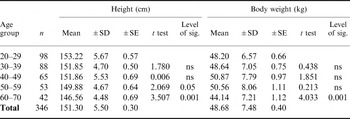
Table 1 displays the basic data of Tangkhul Naga women of Manipur in five different age groups. Their mean body height was 151.3 cm, and mean weight was 48.7 kg. Mean height decreased with age, whereas body weight increased with age until 49 years and decreased thereafter, but the differences were statistically significant only between the 50–59 and 60–70 year age groups.
Basic data of the Tangkhul Naga women of Manipur

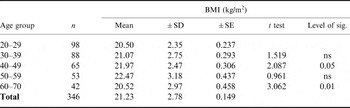
Table 2 shows the mean BMI of the women by age group. Mean BMI was found to be lowest in the 20–29 year age group, and it increased steadily with age until 59 years and declined thereafter. The differences in mean BMI were statistically significant between the 30–39 and 40–49 year, and also between the 50–59 and 60–70 year age groups, whereas the differences among the rest of the groups were not statistically significant. The mean value of all the age groups for BMI was found to be 21.2 kg/m2.
BMI among Tangkhul Naga women of Manipur

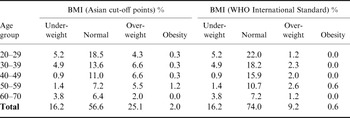
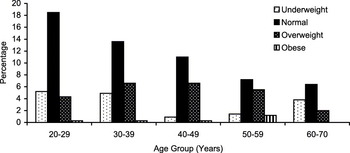
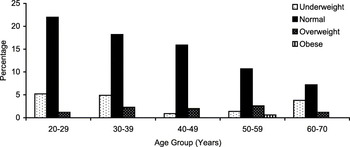
Table 3 shows the distribution of subjects by age in different BMI categories as assessed from the Asian cut-off points and WHO International Standard, and the same has been represented in Figs 1 and 2. The results show that there was a significant amount of overweight and obesity, and the prevalence increased with age until 59 years and declined sharply thereafter. From both the standards, it was assessed that the percentage of subjects with normal BMI was found to be highest among the youngest (20–29 year) age group and lowest among the oldest (60–70 year) age group. The prevalence of underweight was found to be highest among the youngest and lowest among the 40–49 year age group. The prevalence of overweight was found to be more among the three middle-age groups, i.e. 30–39, 40–49 and 50–59 years, and was more or less evenly distributed. As assessed from the Asian cut-off point, the highest percentage of obesity was found among the 50–59 year age group. Obesity was only found in this age group when WHO International Standards were used for BMI.
Age-wise distribution of subjects in different BMI category as assessed from Asian cut-off points and the WHO International Standard

Age-wise distribution of subjects on the basis of BMI as assessed from Asian cut-off points.

Age-wise distribution of subjects on the basis of BMI as assessed from WHO International cut-off points.

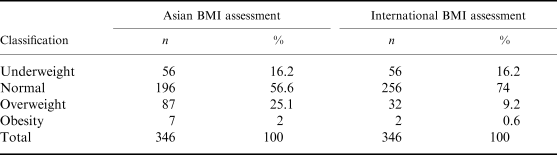
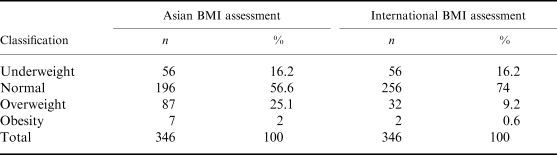
Table 4 shows the distribution of subjects on the basis of BMI as assessed from both Asian and International cut-off points. The prevalences of overweight and obesity were 25.1 and 2.0% respectively as assessed from the Asians cut-off point. Out of 346 females, only 56 females (16.2%) were underweight and 196 (56.6%) were normal, while 87 (25.1%) were overweight and 7 (2.0%) were obese. When BMI was assessed using the WHO International Standard the prevalences of overweight and obesity were found to be 9.2 and 0.6% respectively.
Distribution of subjects on the basis of BMI as assessed from Asian and International cut-off points
Socioeconomic indicators such as occupation, education and income were assessed in each age group. The most common occupation was housewife, followed by student and farmer. Farming as an occupation was found to be highest among the oldest age group and declined in successive age groups, the lowest incidence being found among the youngest group, showing the change in the traditional occupation. The number of subjects taking up jobs in both government and private firms increased among the younger age groups.
Educational status among Tangkhul Naga women was also studied. Of the total sample 8.4% were illiterate and the highest number of subjects (39.30%) studied until higher secondary school. None of the subjects in the youngest age group was illiterate, whereas the highest number of illiterate was found among the oldest age group. The number of higher secondary, graduates and postgraduate subjects increased among the younger age groups, showing the improvement in educational status in each decade.
The greatest numbers of subjects in the older age groups were in the low income group, whereas among the youngest age group the greatest number were in the high income group, which shows that income has improved over the years. Growing urbanization, increased literacy and a general shift in occupation to the non-agricultural sector, which generates more income, has paved the way for an improvement in the economy. There has been an improvement in socioeconomic status over the years as assessed from occupation, educational status and income of the subjects, with a simultaneous increase in relatively sedentary professions among the younger women. The shift to better socioeconomic conditions and a more sedentary lifestyle corresponds to the increasing prevalence of overweight and obesity.
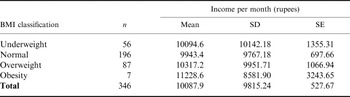
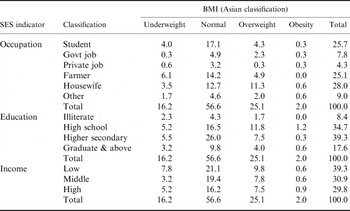
Table 5 shows the mean family monthly income among subjects in different BMI categories. The highest income was found among the obese category followed by overweight, showing the association of overweight and obesity with increase in family income. Table 6 depicts the distribution of subjects in different BMI categories according to different socioeconomic indicators, viz. occupation, education and income. There was not a single obese subject among the farmers and illiterates, which are indicators of low socioeconomic status and high level of occupational physical activity. The greatest number of overweight and obese subjects were found among housewives, those who studied until high school and among those in high-income groups.
Family monthly income in different BMI categories

Association of socioeconomic indicators with overweight and obesity

Discussion
An increasing secular trend in mean stature was evident from the oldest to the youngest age groups in this study. Improvement in socioeconomic conditions, better nutrition and growing knowledge and awareness among Tangkhul Nagas could be the reasons for this trend. The overall economic conditions of the world have been improving and there has been a tendency for children to become progressively larger at all ages. This trend has been operating for many years and is still continuing in many parts of the world. The decline in stature with age appears to be a common phenomenon and has been reported by Brahmam (Reference Brahmam1994), Tyagi & Kapoor (Reference Tyagi and Kapoor1999), Kapoor & Tyagi (Reference Kapoor, Tyagi, Bhasin and Malik2002) and Bhardwaj & Kapoor (Reference Bhardwaj and Kapoor2007).
Another reason for the decline in stature in advanced age could be the thinning of the intervertebral discs, as well as increased flabbiness of muscles, which changes the posture and has an impact on height among older subjects. Aiken (Reference Aiken1995) reported that a loss of collagen between the spinal vertebrae causes the spine to bow and height to shrink. With advancing age the cartilage disc between vertebrae degenerates causing the vertebrae to come closer together thus resulting in a decrease in stature. However, as mentioned earlier, the possibility of a secular trend cannot be totally ruled out in the present sample as over the years the living conditions and medical facilities have improved among the Tangkhul Nagas and all over Manipur.
Increase in body weight and BMI until middle age shows the accumulation of fat with age. This could be due to increased energy intake, a fat-rich diet and relatively less energy expenditure due to lesser involvement in physical activities. The decline in body weight in more advanced age may be attributed to the decrease in muscle mass in response to reduced amount of protein intake as well as a decline in number and size of muscle fibres due to degenerative diseases associated with ageing. It may partly be due to bones becoming lighter because of gradual mineral mass loss (Verma et al., Reference Verma, Kapoor and Singh1987). General tooth loss with age, resulting in restricting food items in the diet of the elderly, along with dietary restrictions due to degenerative diseases that occur with ageing, may be important factors in reducing caloric intake and absorption and hence loss in body weight in more advanced age groups (Kapoor & Tyagi, Reference Kapoor, Tyagi, Bhasin and Malik2002; Tyagi et al., Reference Tyagi, Kapoor and Kapoor2005; Tandon, Reference Tandon2006).
The decline in BMI and weight among women in older age groups could also be attributed to the fact that they were mostly farmers, and having being brought up in traditional families they have adopted physically active lifestyles throughout their lives. Being the most responsible persons in the family at their age they are more engaged in all types of physical activity, including household chores. Although Tangkhul Naga society is patriarchal, women enjoy considerable freedom and play an important role in family and community life and the economy, both in the past and also at present. The traditional occupations of Tangkhul men and women revolve around agriculture, which is their main source of sustenance. Almost every woman knows weaving, which she pursues in her spare time. Women growing up with a traditional lifestyle, and also those who are still settled in remote villages, work hard to support their family and have little time to rest. They wake up at dawn and after collecting firewood, carrying water and cooking lunch, go to work in the fields for the whole day with little rest before returning home in evening.
Change, however, is sweeping among the Tangkhul Nagas. Women of younger and middle age no longer depend on cultivation as their only means of sustenance and have developed alternative means of livelihood such as government or private jobs and business for income leading to an increasingly sedentary lifestyle. There has been a change in occupation among men also, with increasing numbers shifting to non-agricultural sectors, though some are still engaged in farming. Their income has risen considerably and educational status has also improved over the years.
This study found that improvement in socioeconomic status among the younger and middle-aged subjects corresponds to the increasing prevalence of overweight and obesity among them. Low socioeconomic status among the oldest age group was associated with a low prevalence of overweight and obesity. This shows the association of overweight and obesity with socioeconomic change among the Tangkhul Naga women. The growing urbanization and socioeconomic development, which has created changes in dietary intake, physical activity levels and overall lifestyle, could be the cause of higher prevalence of overweight and obesity among middle-age women.
Mean income of the subjects in different BMI categories showed that obese subjects had the highest mean family income per month, which was followed by those in the overweight category. There was a positive association between income and overweight and obesity. In the high-income group, educational level improved and their BMI increased, as advanced education bring better jobs and affordability, which leads to a more sedentary lifestyle and also nutritional change among the Tangkhul Nagas.
The distribution of Tangkhul Naga women according to different socioeconomic conditions in four BMI categories showed the prevalence of overweight and obesity to be higher among housewives, who basically have a sedentary lifestyle, and those in the high-income group. The highest number of underweight women were in the low-income group. None of the illiterates and farmers, whose lifestyle were physically very active, was obese, showing the association of obesity with socioeconomic status and physical activity level. Marital status also has an impact on BMI, with married women (widowed and divorced also included, though very few in number) showing a higher prevalence of overweight or obesity when compared with those who were single. Thus, overweight and obesity has an association with age, marital status, socioeconomic status and lifestyle.
An earlier study has shown employment grade and a measure of socioeconomic status to be strongly related to BMI (Martikainen & Marmot, Reference Martikainen and Marmot1999). Occupational level was positively associated with overweight and obesity among Tangkhul Naga women. A positive relation of socioeconomic status to adiposity is consistent with the findings of other studies (Bunker et al., Reference Bunker, Ukoli and Nwankwo1992; Gilberts et al., Reference Gilberts, Arnold and Grobbee1994; Bovet et al., Reference Bovet, Ross and Gervasoni2002).
Kruger et al. (Reference Kruger, Venter, Vorster and Margetts2002) found using univariate analysis a positive association between income and BMI, and no association between BMI and educational level in women from South Africa. The socioeconomic indicator associated with adiposity is mainly income in developing countries and education in developed countries (Sobal & Stunkard, Reference Sobal and Stunkard1989). Among the Tangkhul Naga women, occupation and income have a stronger positive association with overweight and obesity when compared to educational status. Fezeu et al. (Reference Fezeu, Minkoulou and Balkau2005) report similar finding in which there was a complex relationship between socioeconomic status and adiposity, a positive association between household amenities and occupational level, and no association with educational level.
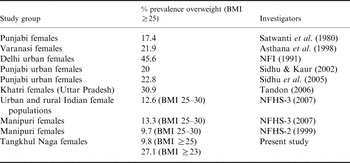
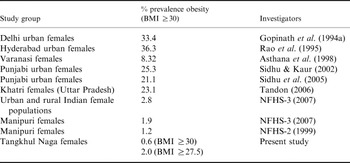
Assessing BMI using recommended cut-off points for Asians among Tangkhul Naga females showed the prevalence of overweight to be 25.1% and that for obesity to be 2%. It showed that 27.1% of the Tangkhul Naga females were either overweight or obese. When BMI was assessed using the WHO International Standard the prevalences of overweight and obesity were found to be 9.2% and 0.6% respectively, which means 9.8% of the Tangkhul females were either overweight or obese.
Among Manipuri women the prevalences of overweight and obesity were found to be 9.7% and 1.2% respectively, as reported in NFHS-2 (1999). The prevalences of overweight and obesity increased to 13.3% and 1.9% respectively in NFHS-3 (2007). When compared with the Manipuri women of NFHS-2 and 3, the prevalences of overweight and obesity were found to be lower among Tangkhul Naga women as assessed from the international cut-off point for BMI.
It is apparent that the prevalence of overweight and obesity in the present study was not very high as compared with other urban non-tribal female populations of India, as shown in Tables 7 and 8. A high prevalence of overweight and obesity in high-income groups was noted. Satwanti et al. (Reference Satwanti and Bharadwaj1980) studied Punjabi females and found the prevalence of overweight to be 17.4%. Varanasi females (Asthana et al., Reference Asthana, Gupta and Misra1998) were found to have a prevalence of overweight of 21.9%, and the prevalences of overweight and obesity among Punjabi Khatri females (Tandon, Reference Tandon2006) were reported as 30.9% and 23.1% respectively. Urban women of Delhi (Gopinath et al., Reference Gopinath, Chadha and Sood1994b) showed the prevalence of obesity to be 33.4%. Females of high socioeconomic status from Hyderabad (Rao et al., Reference Rao, Balakrishna and Shatrugna1995) were reported to be 36.3% obese. The prevalences of overweight and obesity among Punjabi urban females (Sidhu & Kaur, Reference Sidhu and Kaur2002) were found to be 20% and 25.3%, respectively.
Prevalence of overweight in some populations of India: a comparison

Prevalence of obesity in some populations of India: a comparison.

The observations from the World Health Organization MONICA study (WHO MONICA Project, 1989) regarding European populations showed that the prevalence of obesity and overweight was in the range of 50–70% in people aged between 35 and 64 years. The Punjabi Khatri females studied in 1980 (Satwanti et al., Reference Satwanti and Bharadwaj1980) had a 17.4% prevalence of overweight, while among those studied in 2006 (Tandon, Reference Tandon2006) the prevalence of overweight was reported to be 30.9%. This shows an increase of 13.5 points over a period of 26 years. This indicates either a greater energy intake than expenditure, or that physical activity is less than the energy consumption.
The National Family Health Survey (NFHS-3) showed 2.8% obese women with a BMI of 30 kg/m2 or more and 12.6% overweight with a BMI of 25–30 kg/m2 among both the urban and rural Indian female population. Though the prevalence of obesity among Tangkhul females was lower when compared with the Indian female population, the prevalence of overweight was not far behind, though it is a population where the majority of them were believed to be thin traditionally owing to difficult hilly terrain habitation and physically active lifestyle. The figure was still higher when BMI was assessed using the recommended cut-off points for Asians. The higher prevalence of overweight and obesity among the urban non-tribal Indian female population than the Tangkhul Naga females can be attributed to the better socioeconomic condition among the former groups showing the association of overweight and obesity with socioeconomic status.
Conclusion
With increased urbanization and economic development, nutritional transition and improvement in socioeconomic status, an increasingly sedentary lifestyle has been observed among the Tangkhul Naga women, which has contributed to the increasing prevalence of overweight and obesity. When compared with the Manipuri and urban non-tribal Indian women population of better socioeconomic status, Tangkhul Naga women displayed lower prevalence of overweight and obesity. Overweight and obesity was found to be associated with age, marital status, physical activity level, lifestyle and improvement in socioeconomic status, especially occupation and income. Various socioeconomic changes observed over the years among the Tangkhul Nagas were found to be the covariates of overweight and obesity among Tangkhul Naga tribal women of north-east India.
Acknowledgments
The authors are grateful to all the subjects for their co-operation and patience. It was a noble experience working among my own people (N.K.M). N.K.M is grateful to the University Grants Commission (UGC) for providing financial assistance through a Rajiv Gandhi National Fellowship and also to the Department of Anthropology, University of Delhi, for providing the infrastructure necessary for the study. The authors report no conflicts of interest. The authors alone are responsible for the content and writing of the paper.