1 Introduction
Sound change is a frequently attested phenomenon in circumstances of minority language endangerment (Cook Reference Cook1989, Wolfram Reference Wolfram, Chambers and Schilling2002, Bird Reference Bird2008). Particularly common changes in these contexts include contact-induced transfer (Weinrich Reference Weinrich1953, Thomason & Kaufman Reference Thomason and Kaufman1988, Goodfellow Reference Goodfellow2005, Matras Reference Matras2009), and the loss of contrasts that are not shared by the socially dominant language (Andersen Reference Andersen, Lambert and Freed1982). Increased variability is likewise reported in the application of phonological rules, which may be overgeneralized, lost, or become optional as a language is spoken less (Campbell & Muntzel Reference Campbell, Muntzel and Dorian1989). Yet, some phonetic studies have shown that even in situations of significant language shift, phonological knowledge is retained. For instance, Yu (Reference Yu2008) describes how younger speakers of Washo continue to distinguish phonemic vowel length, though the distinction is less robust among the younger generation, while Babel (Reference Babel, Stanford and Preston2009) finds that a younger speaker of Northern Paiute maintains allophonic sibilant alternations, despite the allophones showing evidence of transfer from English. This research suggests that phonetic analysis can provide a more nuanced picture of the phonological systems of endangered languages and uncover features showing different degrees of intergenerational stability. However, phonetic studies of ongoing sound changes in minority languages are limited, especially those with sufficient participants to allow for generalization to the broader population.
This paper contributes to the typology of sound change in endangered languages with a phonetic analysis of sibilant harmony in contemporary Diné Bizaad (Navajo). Diné Bizaad continues to be actively spoken by a considerable number of bilinguals, but like other languages indigenous to North America, is facing rapid intergenerational shift to English. Sibilant harmony, described in detail below, is a non-local assimilatory process that applies to Diné words. Though sibilant harmony is well documented in earlier literature, a recent acoustic study reports that speakers do not harmonize in all prescribed conditions (Berkson Reference Berkson2013). The present study seeks to confirm this finding in data drawn from more prefixes and participants, and to evaluate whether sibilant harmony is undergoing phonetic or phonological change.
1.1 Diné Bizaad
Diné Bizaad is a Southern Dene (Athabaskan) language spoken primarily in and around the Navajo Nation, a large reservation located in the present-day American Southwest. Due to factors deriving from ongoing settler colonialism, the contemporary speech community is experiencing intergenerational shift to English (House Reference House2002, Spolsky Reference Spolsky2002, Benally & Viri Reference Benally and Viri2005). Language usage tends to be highly correlated with speaker age. At the risk of overgeneralizing, many people over 65 are bilingual with Diné Bizaad dominance, those in the age group 40–65 tend to be bilingual, and those under 40 often understand, but do not speak much Diné Bizaad (Field Reference Field1998, Reference Field, Kroskrity and Field2009; House Reference House2002, Jacobsen Reference Jacobsen2017). Numerous Diné language programs are found throughout the Navajo Nation and greater Southwest region in an effort to sustain the language (Lee Reference Lee2007).
1.2 Diné Bizaad sibilant harmony
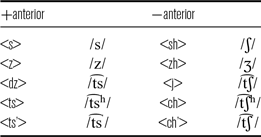
Diné Bizaad sibilant harmony is a mostly regressive phonological process whereby speakers produce sibilants that match in anteriority: all sibilants in a word will be either alveolar or alveolo-palatal (Reichard Reference Reichard1951, Hansson Reference Hansson2001, McDonough Reference McDonough2003).Footnote 1 Sibilant harmony occurs in many Dene languages (Rice Reference Rice1989, Gafos Reference Gafos1999, de Reuse Reference de Reuse2006, Hansson Reference Hansson2010) and may be re-constructible to Proto-Athabaskan-Eyak (Krauss Reference Krauss1964). Table 1 shows the Diné Bizaad sibilants alongside their orthographic representations.
Diné Bizaad sibilant harmony applies to sibilants within nominal and verbal stems, a nominal possessive prefix, and five verbal prefixes that typically harmonize to match the anteriority of the stem sibilant, or in some cases, other verbal prefixes.Footnote 2 Likewise, sibilants in compounds are expected to assimilate to sibilants in the word-final stem, though harmony in compounds is more variable (Sapir & Hoijer Reference Sapir and Hoijer1967, Martin Reference Martin2005).
Diné Bizaad sibilants.

Three harmonizing prefixes are analyzed in this study: nominal /ʃi/- 1sg.possessive, verbal /ʃ/- 1sg.imperfective, and verbal /sɛ́/- 1sg.perfective. Examples (1)–(6) below illustrate these prefixes with words elicited in the fieldwork interviews (see Section 2.1 below). Example source annotations refer to archived audio files.
First, example (1) shows the nominal possessive prefix /ʃɪ/- attaching to a stem containing no sibilants, and then example (2) demonstrates how a speaker harmonizes this prefix to [sɪ]- to match the [+anterior] stem sibilant /s/.Footnote 3


Next, examples (3) and (4) show the first-person singular imperfective prefix /ʃ/- realized as /ʃ/ when there is no sibilant in the stem, and as /s/- when affixed to a [+anterior] stem sibilant.


In examples (5)–(6), the first-person singular perfective prefix /sɛ́/- is realized as /sɛ́/ when there is no sibilant in the stem and harmonizes to /ʃɛ́/ when co-occurring with a [−anterior] stem sibilant.Footnote 4


Previous studies of Diné Bizaad note that sibilant harmony is not a consistent regressive process (Reichard Reference Reichard1951; Sapir & Hoijer Reference Sapir and Hoijer1967; Kari Reference Kari1976; McDonough Reference McDonough1991, Reference McDonough2003; Martin Reference Martin2005). For instance, in certain prefixes that attach further from the verb-final stem,Footnote 5 sibilants rarely harmonize (Sapir & Hoijer Reference Sapir and Hoijer1967), and the aforementioned recent study of sibilant harmony finds that noun stems do not trigger harmony in the nominal possessive prefix (Berkson Reference Berkson2013). While such instances of the harmony being variably realized are widely acknowledged in the literature, an explanation for why harmony appears optional in certain contexts is not well understood (McDonough Reference McDonough2003).
Moreover, given high rates of bilingualism and increasing English usage, the degree to which sibilant harmony is maintained by younger speakers remains unknown. In line with observations of phonological rules becoming more variable in endangered languages, a study of sibilant harmony in another North American language, Barbareño or Shmuwich Chumash, finds that later generations of speakers produce more disharmonic forms (Beeler Reference Beeler1970, Mithun Reference Mithun, Hill, Mistry and Campbell1997). The increase in disharmony has been attributed to the fact that inflectional morphemes resist allomorphy as a language is spoken less (Beeler Reference Beeler1970). Alternatively, later speakers may harmonize less because of increased meta-linguistic awareness rather than language attrition; the speakers represented in the documentary record worked extensively on their language and were likely aware of the basic forms of many harmonizing morphemes and thus may have avoided producing harmonized forms in elicitation (Mithun Reference Mithun, Hill, Mistry and Campbell1997). In the Diné Bizaad context, speaker age is similarly expected to influence harmony production.
1.3 The phonetics of sibilant harmony
Accounts of sibilant harmony in Diné Bizaad, as well as the broader Dene language family, have largely focused on characterizing sibilant harmony as a phonological process rather than describing its phonetic realization.Footnote 6 At present, little is known about whether Diné Bizaad sibilant harmony triggers full or partial assimilation, and whether the phonological variation described above correlates with phonetic variation due to morphological or social factors. Within Dene languages, partial assimilation has been observed in Plains Apache (Bittle Reference Bittle1963) and Tahltan (Hansson Reference Hansson2010), but phonetic studies of sibilant harmony would contribute missing descriptive detail. For instance, acoustic analyses of sibilant harmony in other languages have used spectral measurements to determine that the process triggers incomplete neutralization in harmonizing sibilants in Moroccan Arabic (Zellou Reference Zellou2013), and categorical alternation in Cree (Melnychuk Reference Melnychuk and Pentland1999).
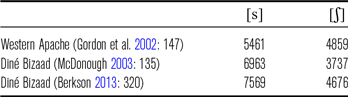
However, phonetic studies of Dene sibilants are available. Table 2 presents center of gravity, or spectral means, for the targeted sibilants in Diné Bizaad and closely related Western Apache. Center of gravity (COG) is a measurement of the average frequencies in a spectrum and serves as an acoustic correlate to articulatory constriction. Sounds with a more anterior articulation tend to have more energy at higher frequencies, resulting in a higher COG (Gordon, Barthmaier & Sands Reference Gordon, Barthmaier and Sands2002). In the studies referenced in Table 2, [s] and [ʃ] significantly differ in mean COG.
Mean center of gravity frequencies in Hertz of Dene [s] and [∫].

Note: The Western Apache data come from three women and five men. The sibilants occur in words following /i/ and preceding /a/. The McDonough (Reference McDonough2003) data come from ten women and four men. Sibilants are measured in different word positions and before different vowels, though a high degree of acoustic consistency is noted (McDonough Reference McDonough2003: 137). The Berkson data come from two women and one man. Tokens of [ʃ] occur in the 1sg.poss prefix, while tokens of [s] occur in different word positions and before different vowels. Berkson 2010 attributes the higher means to the female speakers producing sibilants with much higher COG frequencies.
One acoustic study of Diné Bizaad sibilant harmony in the nominal possessive prefix has been conducted (Berkson Reference Berkson2013). In that analysis, the author elicited tokens of the 1sg.poss prefix occurring with 89 noun stems, 62 of which were expected to trigger harmony. The three participants were in their late 20s and grew up in the Northeast corner of the Navajo Nation in Arizona. The statistical analysis compared sibilants in filler and harmony conditions using four measurements: duration, center of gravity frequency, lower bound of frication energy frequency, and F2 transition frequency. Contrary to the descriptive literature, the analysis demonstrated that speakers do not harmonize and in most cases there were no acoustic differences between sibilants expected to harmonize and filler sibilants; one female speaker produced sibilants with a statistical difference in mean onset frication energy and one male speaker produced a difference in center of gravity means in sibilants before adjacent stems. Though limited to three participants, these results raise the question of whether sibilant harmony is still mandatory in the nominal possessive prefix.
1.4 Goals
Based on this background, the current analysis focuses on three prefixes with the expectation that participants will not uniformly harmonize in all harmony triggering conditions. The current analysis has two main goals. The first is to provide a phonetic description, using COG, of the harmony in the three specified prefixes. The second goal is to test the hypothesis that there are significant age group differences in the phonetic and phonological realization of sibilant harmony across the different prefixes. Due to intergenerational patterns of ongoing language shift, younger speakers are expected to harmonize less frequently and to produce harmonized sibilants that show less complete assimilation relative to the other participants in the study. Such a gradient difference in assimilation would be interpreted as phonetic weakening of the harmony process, as the language is spoken less. The hypotheses specific to each prefix are shown in Table 3.
Hypotheses for each prefix.

2 Method
2.1 Data
Sibilant tokens come from interviews recorded in 2016 and 2017 with bilingual Diné Bizaad–English participants. The interviews were conducted as part of a larger project investigating sociolinguistic variation in several features, as well as contemporary language ideologies (Palakurthy Reference Palakurthy2019a).Footnote 7 Interviews were recorded using a Tascam DR-100 MK II digital audio recorder at a sampling rate of 44.1 Hz and a depth of 24 bits. Participants wore a Shure SM35-XLR microphone. The interviews are archived and accessible through the Alaska Native Language Archive (Palakurthy Reference Palakurthy2019b).
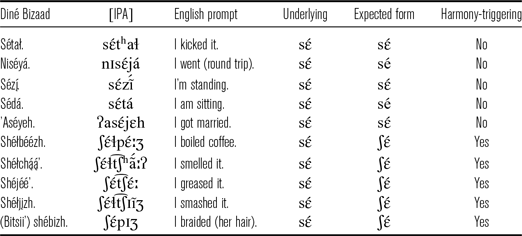
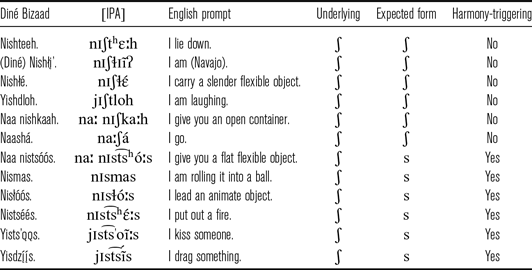
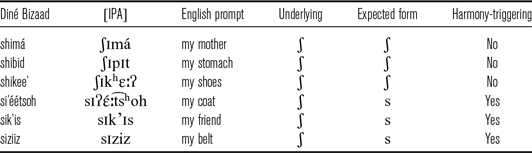
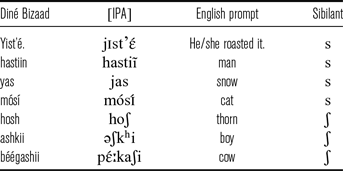
Analyzed sibilants were extracted from a Diné Bizaad wordlist, elicited through oral translation, and a personal narrative recounted in Diné Bizaad. The wordlist, presented in the appendix, comes from citations in the Young & Morgan (Reference Young and Morgan1987) dictionary and from consultation with a bilingual speaker, linguist, and language instructor (Lorene B. Legah p.c.). Each word was repeated twice by each speaker, though occasionally words were skipped or alternative forms used. Tokens with excessive background noise were not analyzed. Elicited words include prefixes /sɛ́/- 1sg.perfective, /ʃ/- 1sg.imperfective, and /ʃɪ/- 1sg.possessive occurring in harmony-triggering and non-harmony triggering conditions, as well as filler words containing /s/ or /ʃ/. Kendralyn Begay, a bilingual research assistant, transcribed and translated the narratives in ELAN (Sloetjas & Wittenburg Reference Sloetjes and Wittenburg2008, ELAN 2019). All spontaneous tokens of the targeted prefixes and filler sibilants were extracted from the narratives.Footnote 8 In order to isolate the differences between non-harmonized and harmonized sibilants, tokens in which the stem contained a sibilant that already matched the prefix in anteriority were removed (e.g shijáád [ʃɪ-t͡ʃáːt] ‘my leg’).
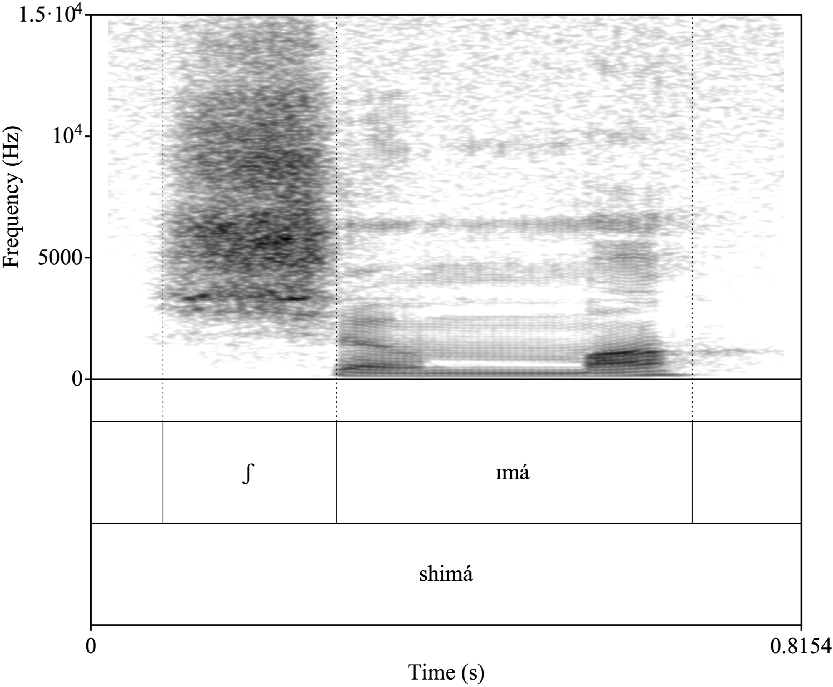
Tokens of the targeted prefixes were manually segmented in Praat (Boersma & Weenink Reference Boersma and Weenink2017) and auditorily coded by the author as an /s/ or /ʃ/. Sibilant boundaries aligned with the onset and offset of visible aperiodic frication present in the spectrogram. Figure 1 shows a sample segmentation of /ʃ/ in the word shimá from the wordlist.
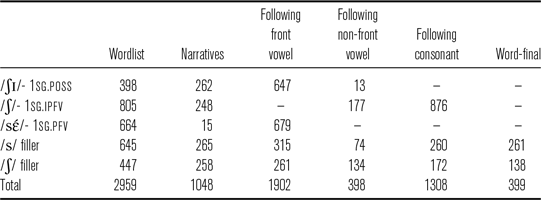
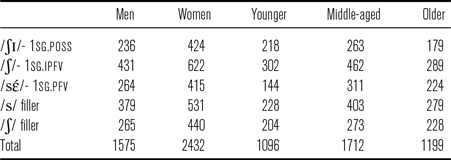
A total of 4007 sibilants were analyzed. Table 4 shows the distribution of analyzed sibilants by task and following segment. As is evident from Tables 4 and 5, for some factors, the data are highly imbalanced.
Sample segmentation of [∫] (Blaine Henry Interview 00:06:47.524).

Distribution of analyzed sibilants by task and following segment.

Distribution of analyzed sibilants by gender and age group.

2.2 Participants
Fifty-one self-identified bilinguals participated in the study.Footnote 9 No proficiency metrics were used; instead recruited participants were asked that they be comfortable recounting a short story in Diné Bizaad. The participants included 31 women and 20 men: 14 younger speakers (aged 18–38 years), 22 middle-aged speakers (aged 39–58 years), and 15 older speakers (aged 59–78 years). Because of community-wide sociocultural changes, the designated age groups tend to share similar language backgrounds. The older participants acquired Diné Bizaad as a first language, grew up in Diné Bizaad-speaking homes, and did not speak English until beginning school at around age six. Most middle-aged participants similarly acquired Diné Bizaad as a first language in the home, while two learned the language later in school. Among the younger participants, all were raised by, or spent significant time with, their Diné Bizaad-speaking grandparents, though not all participants spoke Diné Bizaad at home as children. Half of the younger participants attended immersion schools. Due to these sociolinguistic experiences, the category Age Group is correlated with differences in acquisition background, language exposure, and proficiency.
Table 5 shows the distribution of sibilants by morpheme, gender and age group. Speaker gender is classified based on the author’s interpretation of overt gender presentation. Gender is not independently of interest but is included as a control because previous research finds that women produce sibilants with a higher COG frequency (Fox & Nissen Reference Fox and Nissen2005).
2.3 Acoustic measurements and categorization
Time-averaged COG frequencies were measured from the middle 80
 $\%$
of each sibilant using a Praat script (DiCanio Reference DiCanio2013) set to a 10 millisecond measurement window. COG was selected as the acoustic variable because it has been measured in previous phonetic studies of Dene sibilants (Gordon et al. Reference Gordon, Barthmaier and Sands2002, McDonough Reference McDonough2003) and sibilant harmony (Berkson Reference Berkson2013), and studies of other languages support its utility as an acoustic correlate for sibilant anteriority (Zellou Reference Zellou2013, Phillips Reference Phillips2020). Significantly higher COG means are expected for the fronter [+anterior] /s/ than for [−anterior] /ʃ/.
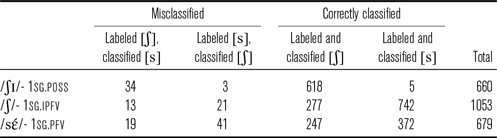
Following the auditory coding of realized sibilants as [s] or [ʃ], a linear discriminant model was trained on the COG data from the filler sibilants: 910 tokens of [s] and 705 tokens of [ʃ]. Linear discriminant analysis was conducted using the MASS package in R (Venables & Ripley Reference Venables and Ripley2002, R Core Team 2017). The trained model was then used to categorize the remaining 2392 prefix sibilants as [s] or [ʃ]. The linear discriminant categorization was consistent with the auditory annotation for 91
$\%$
of sibilants labeled [s] and 96
$\%$
of sibilants labeled [ʃ]; 65 tokens were labeled [s] in the auditory coding and [ʃ] by the linear discriminant analysis and 66 tokens were labeled [ʃ] in the auditory coding and [s] by the linear discriminant analysis. Table 6 shows the distribution of the tokens by prefix, as classified by the linear discriminant analysis. Of the misclassified tokens, 21 of the possessive prefixes, 21 of the imperfective prefixes, and 19 of the perfective prefixes occur in harmony triggering contexts. Misclassification of these forms could be due to analyst error, speech production error, or intermediate realization of a harmonized sibilant between [s] and [ʃ].
Distribution of classified tokens by prefix.

2.4 Statistical analysis
To test whether there are significant Age Group differences in the acoustic realization of sibilant harmony across the different prefixes, COG measurements were analyzed in R using mixed-effects linear regression implemented with the lme4 package (Bates et al. Reference Bates, Mächler, Bolker and Walker2015). Two models, one for tokens classified as [s] and one for tokens classified as [ʃ], were fit with COG as the dependent variable and Speaker included as a random intercept. Default treatment contrasts were used for all categorical predictors. For each model, a maximal model was computed with maximum likelihood estimation and included Gender (man, woman) as an additive fixed effect and a two-way interaction between Prefix (imperfective, perfective, possessive), and Age Group (younger, middle-aged, older). Though Following Segment may affect COG values, in these data, Following Segment strongly correlates with Prefix, and was excluded from the statistical analysis. More parsimonious models were constructed based on the results of a backwards model selection process: non-significant predictors were identified using the drop1 function and individually removed from the model (Gries Reference Gries2013). The final models were computed with restricted maximum likelihood estimation, and p-values calculated using lmerTest (Kuznetsova et al. Reference Kuznetsova, Brockhoff and Christensen2015). The final model for [ʃ] includes Prefix as a main effect (Pr(χ2) < .001), while the model for [s] includes Age Group as a marginally significant main effect (Pr(χ2) = .05).
3 Results
3.1 Phonological realization of sibilant harmony
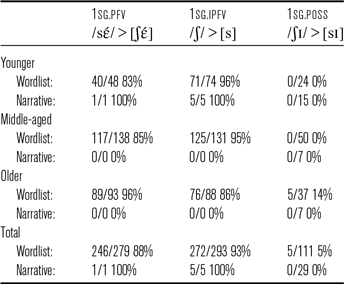
Table 7 presents the frequency of harmonizing sibilants, out of a total number of tokens occurring in harmony-triggering contexts, organized by Age Group and Task. Sibilant categories come from the linear discriminant analysis classification; tokens that were misclassified are not included in these frequencies.
Frequency of harmony by age group and task.

Note: There are, in total, 15 tokens of the perfective prefix, 248 tokens of the imperfective prefix, and 262 tokens of the possessive prefix in the narrative data.
This distribution indicates that sibilant harmony is variably realized in the different prefixes: speakers tend to harmonize the two verbal prefixes but not the nominal prefix. There do not appear to be substantial differences in the harmony patterns due to Age Group, though only older participants produce any harmonized forms of the nominal possessive prefix. As is evident from Table 7, these prefixes rarely occur in harmony-triggering contexts in the narratives. This pattern – though perhaps not representative of all naturally-occurring speech – suggests that speakers are likely to produce, and listeners are likely to hear, many more tokens of non-harmonized prefix forms.
3.2 Phonetic realization of sibilant harmony
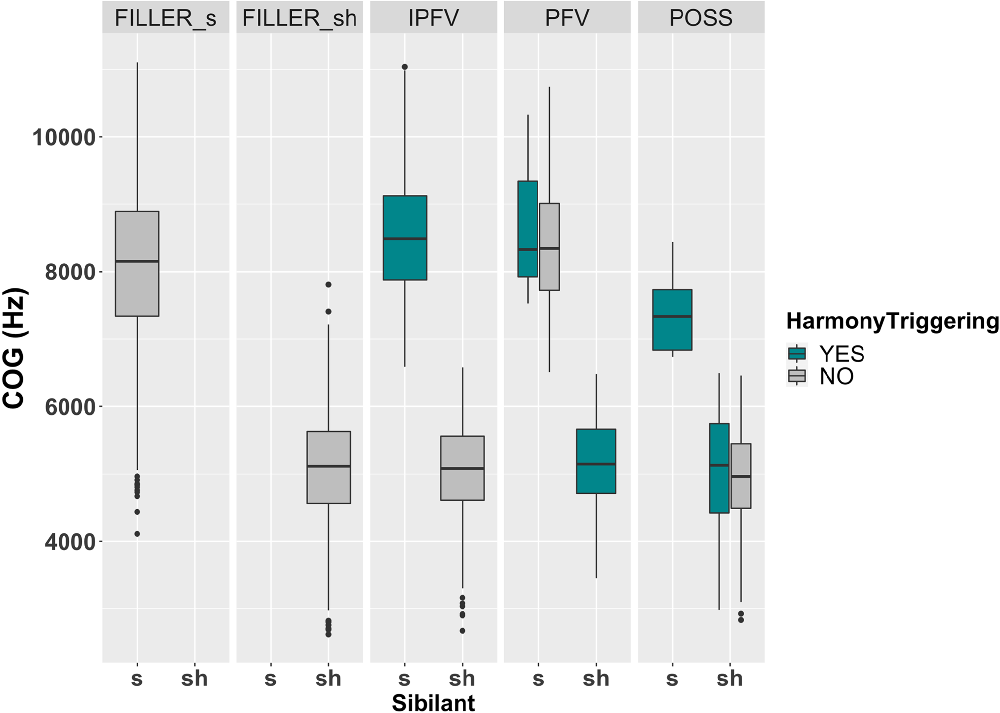
Figure 2 presents the COG measurements combined from wordlist and personal narrative sibilants by prefix, sibilant, and harmony environment. Sibilant labels on the x-axis indicate the sibilant classification, as specified by the linear discriminant analysis as [s] or [ʃ]. Misclassified tokens are excluded. Again, as shown in Table 7, speakers rarely harmonize the nominal possessive prefix, so the measurements for harmonized [s] in the YES condition come from only five observations, while 114 tokens of the possessive prefix in the YES condition were classified as a non-harmonized [ʃ]. In contrast, speakers harmonize most of the imperfective and perfective prefixes when they occur in the YES condition. Therefore, Figure 2 displays measurements from only 14 tokens of the perfective prefix produced as non-harmonized [s] in the YES condition and no tokens of the non-harmonized imperfective [ʃ] in the YES condition. Filler sibilant measurements are included for comparison. Figures 2 and 3 were created with ggplot2 (Wickham Reference Wickham2009).
Center of gravity measurements in Hertz by prefix, sibilant, and harmony environment.

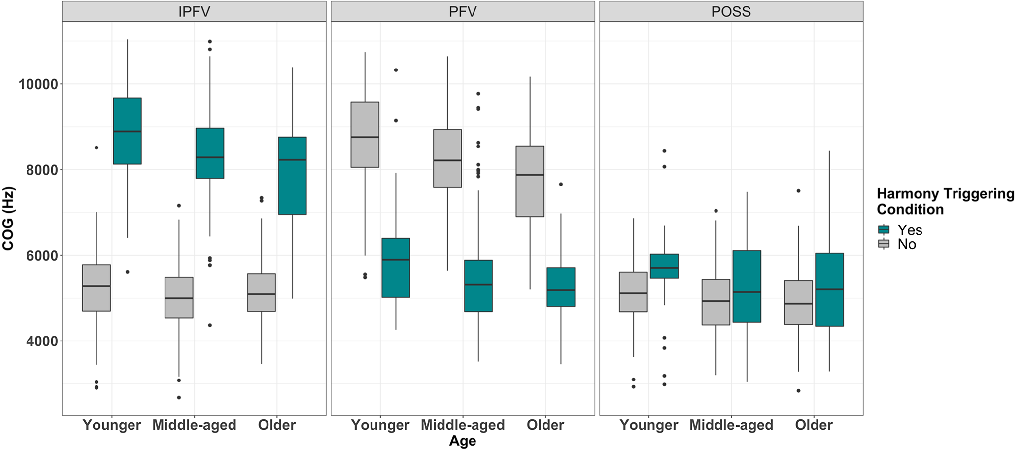
Center of gravity in Hertz by prefix, age group, and harmony condition.

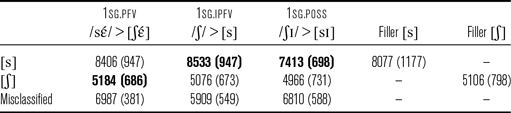
Table 8 displays the COG means and standard deviations from the same tokens. COG frequencies measured in harmonized sibilants are bolded. Additionally, Table 8 displays measurements from the misclassified tokens occurring in harmony triggering environments on a separate row. The misclassified tokens comprise 19 tokens of the perfective prefix, 21 tokens of the imperfective prefix, and 21 tokens of the possessive prefix. The remaining 70 misclassified tokens occur in non-harmony triggering environments and are not discussed further.
Mean and standard deviation of center of gravity in Hertz by morpheme and sibilant. (Bold marks COG frequencies measured in harmonized sibilants.)

These measurements show that in the majority of tokens of verbal prefixes, 1sg.pfv and 1sg.ipfv, sibilant harmony is realized as categorical phonetic assimilation: there are robust center of gravity differences between harmonized and non-harmonized sibilants. However, as mentioned, in the harmony triggering condition, 14 tokens of 1sg.pfv sibilants are classified as [s], matching the underlying form of the prefix rather than the harmony target. In these cases, the harmony condition appears to have no effect on the COG of produced sibilants. Additionally, as reflected by the misclassified forms, a small number of tokens of both verbal prefixes (n = 40) were initially annotated as harmonized sibilants, but subsequently classified by the linear discriminant analysis as non-harmonized because they were produced with a higher or lower COG than the fully harmonized target. Again, the discrepancy in classification can be interpreted as a case of researcher error, speech error, or tentatively as instances of incomplete assimilation.
In the case of the 1sg.possessive prefix, most sibilants in harmony triggering environments do not differ acoustically from underlying /ʃ/: 114 sibilants occur in these contexts but are acoustically realized as [ʃ]. In contrast, in the same harmony condition, only 5 sibilants are realized as [s]. There are also 21 misclassified tokens of sibilants in the harmony triggering environment where the tokens were annotated as [ʃ] but produced with COG means more typical of the harmony target [s]. Therefore, in the possessive prefix, where most sibilants do not harmonize, there is likewise a discrepancy in the classification of a small number of tokens that may be acoustic evidence of an effect of residual harmony.
3.3 Age group differences in sibilant harmony
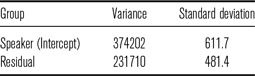
The results of the statistical analyses are presented with the output of the final regression models displayed below. First, Tables 9 and 10 show results for the model fit to COG based on 1607 observations of [ʃ]. This model includes a significant main effect of Prefix, with an estimate provided for /ʃ/ in the underlying imperfective form as the reference level (intercept) in Table 10.
Random effects.

Note: Model fit to center of gravity measured in tokens of [∫].
Fixed effects.

Note: Model fit to center of gravity measured in tokens of [∫].
As shown in Table 10, the estimate for the COG of [ʃ] in the harmonized form of the perfective prefix is predicted to be 93 Hz higher than the imperfective prefix. This is a small but significant difference (p < .05). The estimate for the COG of /ʃ/ in the underlying form of the possessive prefix is predicted to be 53 Hz lower than imperfective /ʃ/, though this difference is only marginally significant (p = .05). Age is not significant as an independent main effect, or in an interaction with Prefix. Overall, this model has limited explanatory power: marginal R2 = 4
$\%$
; conditional R2 = 62
$\%$
.
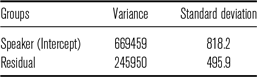
Next, Tables 11 and 12 show results for the model fit to COG based on 649 observations of [s]. These tokens include non-harmonized forms of the perfective prefix and harmonized forms of the imperfective prefix. Due to low frequency, the five harmonized possessive prefixes were excluded prior to model fitting. The final model includes a marginally significant main effect of Age Group irrespective of Prefix. Table 11 presents the estimate for the COG of [s] produced by older speakers as the reference level.
Random effects.

Note: Model fit to center of gravity measured in tokens of [s].
Fixed effects.

Note: Model fit to center of gravity measured in tokens of [s].
Middle-aged speakers are predicted to produce [s] with a COG that is 389 Hz higher than older speakers, while younger speakers are predicted to produce [s] with a COG that is 777 Hz higher; the only significant difference is that between older and younger speakers (p < .05). Prefix is not significant as an independent main effect, or in an interaction with Age Group. This model also has limited explanatory power: marginal R2 = 8
$\%$
; conditional R2 = 75
$\%$
.
Most relevant to the posed hypotheses, both models show that there is no significant interaction between Age Group and Prefix, suggesting that there are no robust COG differences in harmonized prefix sibilants that are conditional on age. Indeed, Figure 3 displays the observed COG means for sibilants in each harmony triggering condition, organized by Prefix and Age Group.
Despite some minor differences in COG ranges, this figure visualizes the consistent production between age groups. As confirmed by the statistical model, the COG of [s] is higher for younger than older speakers, perhaps indicating an intergenerational shift towards a fronter [s]. However, this effect is orthogonal to the prefix or harmony status of the sibilant. Figure 3 clearly illustrates that when harmony takes place in the verbal prefixes, younger speakers, like the middle-aged and older speakers, produce a robust COG contrast between sibilants.
The statistical results disprove the hypothesis that younger speakers will produce prefix sibilants with significantly different COG means. Across all speakers, there is a small, but significant difference, whereby harmonized perfective [ʃ] is slightly higher in COG than a non-harmonized imperfective [ʃ], and younger speakers have a higher overall COG mean for [s].
4 Discussion
Together, results show that participants do not uniformly harmonize in all prescribed conditions, but instead consistently harmonize sibilants in the verbal imperfective and perfective prefixes and do not harmonize sibilants in the nominal possessive prefix. Speakers of all ages harmonize these prefixes similarly, despite some speakers rarely using the language, and the prefixes being infrequent in samples of spontaneous speech (see Table 7). In contrast to the posed hypotheses, younger speakers do not harmonize less frequently than other speakers, and do not produce harmonized sibilants that show less complete assimilation.
Overall, when harmony is realized in the verbal prefixes, it is phonetically categorical for speakers of all ages. Speakers predominantly harmonize the imperfective sibilants /ʃ/> [s] and the perfective sibilants /s/ > [ʃ]. Nevertheless, in a small percentage of perfective sibilants, the harmony condition has no effect on the COG of the sibilant, or sibilants annotated as harmonized [ʃ] are produced with a higher COG, closer to underlying /s/. Similarly, a small percentage of imperfective sibilants were annotated as harmonized [s] but produced with a COG more characteristic of an underlying /ʃ/. If one disregards the possibility of researcher or speaker error, these limited instances of misclassified sibilants show that speakers occasionally produce harmonized sibilants that show spectrally incomplete assimilation. There is also a small but significant COG difference where tokens of harmonized perfective [ʃ] have a higher mean COG than tokens of underlying imperfective /ʃ/; the higher COG means may be a lingering effect of the underlying /s/. In contrast to sibilants in the verbal prefixes, the possessive prefix sibilants seldom harmonize /ʃ/> [s]. Like the verbal prefixes, a small percentage of the possessive sibilants were annotated as harmonized [s] but produced with a COG closer to underlying /ʃ/. These misclassified tokens may indicate residual harmony effects.
The largely stable phonological and phonetic realization of the verbal harmony provides a counterexample to frequent observations about sound changes in endangered languages. There are several potential explanations for this finding. First, there is no clear linguistic motivation for speakers to stop harmonizing. Whereas, in analyses of other segments from these interviews, participants show effects of phonemic, as well as phonetic transfer, from similar English segments (Palakurthy to appear) – a common phenomenon in bilingual phonology (see Flege Reference Flege, Petra, Thorsten and Andreas2002) – in the case of sibilant harmony, phonetic convergence with similar English sounds /s/ and /ʃ/, would not weaken the harmony.
Second, I suggest that the sociolinguistic dynamics of the Diné Bizaad speech community may promote intergenerational phonological stability. While English is becoming the preferred language of communication in many domains for Diné speakers, most younger speakers, including the participants in this study, learned Diné Bizaad from Elders and grandparents. Furthermore, the younger speakers in this study report primarily using Diné Bizaad with Elders and not with peers in a ‘vertical communication network’ (Schmidt Reference Schmidt1985). The speech of Elders remains a prestigious form of the language (Peterson Reference Peterson2006), and thus younger speakers and learners likely target this variety. If speakers consistently hear sibilant harmony in the speech of Elders, these factors could help militate against contact-induced changes. This situation is not unique to Diné Bizaad. Many Indigenous and immigrant language communities share this pattern of usage as they experience intergenerational shift. However, Diné Bizaad is the most spoken Indigenous language in North America and is unique as an endangered language in that the community retains such a large number of active first language and bilingual speakers whom young people are exposed to. I further hypothesize that examples of change in endangered languages may be overly represented in research on account of their greater likelihood of drawing metalinguistic commentary from speakers, and the attention of researchers. Stable phonological features and processes may be more prevalent than reported.
Third, the fact that sibilant harmony is represented orthographically may have a preservative effect. For instance, a Navajo language teacher in the study explicitly ascribes her growing awareness of sibilant harmony to her literacy in Diné Bizaad. She refers here to the compound dzaanééz ‘donkey’. ‘I used to say jaanééz, with a j … I didn’t really pay attention when my husband was saying, dzaanééz with a dz, until I started taking classes’ (Louise Ramone Interview 00:27:51.25). She goes on to recount how she changed her pronunciation to the harmonized form of the compound. This anecdote exemplifies how the process of harmony is salient to many Diné Bizaad speakers, especially those who are literate in the language, and in some cases, there is overt prescriptivism associated with harmony rules. Though Diné Bizaad literacy rates are low (Spolsky & Irvine Reference Spolsky, Irvine, Barkin, Brandt and Ornstein-Galiciae1982, Jacobsen Reference Jacobsen2017), the majority of participants in this study do read and write in Diné Bizaad, and literacy rates are especially high among the younger speakers who attended immersion schools. These factors could contribute to verbal sibilant harmony being so consistently realized by this group of speakers.
Yet, while sibilant harmony is robustly maintained in the verbal prefixes, sibilant harmony is strongly dis-preferred for the nominal possessive prefix. There are no intergenerational differences in the production of this prefix, but in comparing these findings to earlier descriptions, there is evidence that a change has occurred whereby harmony is no longer mandatory in this prefix. This supports Berkson’s (Reference Berkson2013) finding that sibilant harmony is optional in the nominal possessive prefix. I interpret these findings as relating to the morphological status of the nominal prefix; nominal /ʃɪ/- is more salient and independent than other morphemes, including the verbal prefixes. For instance, nominal /ʃɪ/- is one of the only Diné Bizaad morphemes that speakers freely combine with English words in forms such as shi-heart ‘my heart’ or shi-buddy ‘my buddy’ (Webster Reference Webster2015). In these and other forms, the prefix is often written <shi>. A greater awareness of this form could override expected harmony processes similar to what has been described among speakers with high levels of meta-linguistic awareness in the aforementioned Chumash case (Mithun Reference Mithun, Hill, Mistry and Campbell1997). In contrast, the verbal prefixes are less likely to be associated with a specific form since most speakers are not aware of the form and meaning of individual verbal morphemes (Chee Reference Chee2017). It may also be the case that morphophonological link between the first-person possessive and the noun stem is not as strong as within the verb.
These results contribute to longstanding questions posed in the Dene literature regarding sibilant harmony as a variable process. Of the factors that have been proposed as explaining variability in sibilant harmony – syllable adjacency, morphological domain, speech rate, and dialect – only the relevance of morphological domain is supported by these findings. The role of syllable adjacency cannot be tested with these data, as imperfective and perfective prefixes always occur in the syllable immediately preceding the stem. Speech rate does not explain the results: participants in this study harmonize consistently in both the slower, more carefully articulated wordlist and the personal narratives. Likewise, participants do not differ in their harmony patterns despite representing different regional dialect areas. To a limited extent, speakers do realize sibilants with a variable COG depending on their Age Group: younger speakers produce [s] with a higher COG.
6 Conclusions
This study analyzes the phonetic realization of sibilant harmony in three Diné Bizaad prefixes. Analysis reveals that among contemporary speakers, Diné Bizaad sibilant harmony is robustly maintained as a mostly categorical assimilatory process in two verbal prefixes. In contrast with earlier descriptions of the language, sibilant harmony no longer applies to the nominal possessive prefix. Sibilant harmony, as it is produced in the verbal prefixes, is an instance of a stable phonological process in an endangered language, despite the process not being shared with the contact language. These data show no evidence of contact-induced change or language attrition, and the application of sibilant harmony in the verb is not becoming more variable as the language is spoken less.
Acknowledgments
Ahéhee’ to all the Diné participants who shared their time and stories with me. Thank you to Kendralyn Begay for her excellent transcription and translation work, to Barsine Benally, Louise Ramone, and Melvatha Chee for their help in recruiting participants, and to Mikaela Moore and Steven Castro for their assistance with transcription and annotation. I am grateful for support from the Navajo Nation Historic Preservation Department and the Navajo Language Academy. Thank you to Marianne Mithun, Matt Gordon, Lorene B. Legah, Myriam Lapierre, Lal Zimman, Georgia Zellou, Robert Bayley and two anonymous reviewers for helpful feedback on earlier drafts of this paper. This research has been supported by the National Science Foundation (GRFP 2014178334, DEL DDIG 1713793, and SPRF 1907948).
Appendix. Elicited wordlist items
Perfective prefix tokens.

Imperfective prefix tokens.

Nominal possessive prefix tokens.

Filler tokens.

Supplementary material
To view supplementary material for this article (including audio files to accompany the language examples), please visit https://doi.org/10.1017/S0025100321000220.