INTRODUCTION
The two siganids Siganus luridus (Rüppel, 1829) and Siganus rivulatus Forsskål in Niebuhr, Reference Forsskål and Niebuhr1775 (rabbitfishes or spinefoots) are classic examples of successful lessepsian colonizers (Galil, Reference Galil2007). These two fishes entered the Mediterranean from the Red Sea through the Suez Canal and colonized the Levantine coasts, where they established large populations (Harmelin-Vivien et al., Reference Harmelin-Vivien, Bitar, Harmelin and Monestiez2005), to the point that they are now commercially fished (EastMed, 2010 and references therein). Following a long period in which these fish did not extend beyond the eastern Mediterranean, both species gradually spread westwards, a trend which, given that both are thermophilic, has been interpreted as correlated with a gradual warming of Mediterranean surface waters (Francour et al., Reference Francour, Boudouresque, Harmelin, Harmelin-Vivien and Quignard1994; Occhipinti-Ambrogi, Reference Occhipinti-Ambrogi2007; Ben Rais Lasram et al., Reference Ben Rais Lasram, Tomasini, Guilhaumon, Romdhane, Do Chi and Mouillot2008; CIESM, Reference Briand2008; Lejeusne et al., Reference Lejeusne, Chevaldonne, Pergent-Martini, Boudouresque and Perez2010), although it may also have been facilitated by recent hydrographic changes in the east Mediterranean basin related to the Eastern Mediterranean Transient and to climatic events, which are bound to have had an effect also on the central Mediterranean and the western basin (Gasparini et al., Reference Gasparini, Schroeder, Tesi, Vetrano and Astraldi2007; Francour et al., Reference Francour, Mangialajo, Pastor, Golani and Appelbaum-Golani2010).
Siganus rivulatus (marbled spinefoot) was first reported in the Mediterranean in 1924 from off the coast of Israel (Steinitz, Reference Steinitz1927; Ben-Tuvia, Reference Ben-Tuvia1964). It gradually colonized first the eastern part of the East Basin and then the central Mediterranean, from where it was first recorded from the Libyan coast in 1970 (Stirn, Reference Stirn1970) and then from that of Tunisia in 1974 (Ktari & Ktari, Reference Ktari and Ktari1974). In 2004 it penetrated into the southern Adriatic (Dulčić & Pallaoro, Reference Dulčić and Pallaoro2004).
The first report of Siganus luridus (dusky spinefoot) in the Mediterranean was in 1956 (Ben-Tuvia, Reference Ben-Tuvia1964) also from the Israeli coast. The pattern of spread of this species followed that of its cogener; it reached the central Mediterranean in the late 1960s, with a number of reports from the coasts of Libya and Tunisia starting in 1969 (Stirn, Reference Stirn1970; Ktari-Chakroun & Bouhlal, Reference Ktari-Chakroun and Boualal1971; Ktari & Ktari, Reference Ktari and Ktari1974; Bradai et al., Reference Bradai, Quignard, Bouain, Jarboui, Ouannes-Ghorbel, Ben Abdallah, Zaouali and Ben Salem2004), and the island of Linosa in 2000 (Azzurro & Andaloro, Reference Azzurro and Andaloro2004). Unlike its cogener, Siganus luridus has not yet penetrated into the Adriatic; however, it has entered the southern Tyrrhenian Sea (recorded from northern Sicily in 2004: Castriota & Andaloro, Reference Castriota and Andaloro2005) and it reached one sector of the north-west Mediterranean, the Gulf of Lions, in 2008 (Daniel et al., Reference Daniel, Piro, Charbonnel, Francour and Letourneur2009).
Both species of Siganus have been reported from the Maltese Islands. In his catalogue of Maltese fishes, Lanfranco (Reference Lanfranco1993) mentions Siganus rivulatus (‘This species has entered the Mediterranean from the Red Sea, and is apparently spreading to this area’.) but he does not enumerate it as he does other fish that he records from Malta, the implication being that he includes this species because he thinks it might occur and not because he, or the sources he based his catalogue upon, have recorded it. On the other hand Sammut (Reference Sammut2001) includes this species in his guide and comments that while rare, amateur fishermen occasionally find it entangled in their trammel nets. Malta is listed as one locality of occurrence for Siganus rivulatus in the FishBase (Froese & Pauly, Reference Froese and Pauly2011), DAISIE factsheet (DAISIE European Invasive Alien Species Gateway: http://www.europe-aliens.org) and the IUCN Red List (Fricke, Reference Fricke2010) entries for this species; however, all these records give Lanfranco (Reference Lanfranco1993) as their source.
In the case of Siganus luridus, Castriota & Andaloro (Reference Castriota and Andaloro2005) state that a Maltese diver communicated to them that this species had been observed by SCUBA divers in Maltese waters since the 1990s. FishBase lists records from 2002 and 2003 by the same diver (Alexander Buttigieg). DAISIE does not include Malta in its list of localities for Siganus luridus (Galil, Reference Galil2006), while the IUCN Red List does not include an entry for this species. Neither Lanfranco (Reference Lanfranco1993) nor Sammut (Reference Sammut2001) include this species.
Sciberras & Schembri (Reference Sciberras and Schembri2007) attempted to evaluate all records of non-indigenous species reported from Maltese waters in order to set a baseline for future work. In the case of the siganids, they were able to confirm the occurrence of Siganus luridus based on the reliable records of Azzurro et al. (Reference Azzurro, Piermarini, Scarpato and Andaloro2007); however, they were not able to authenticate Siganus rivulatus as they could find no specific records of this species but only the general entry in Sammut (Reference Sammut2001). These authors noted that while Sammut (Reference Sammut2001) includes Siganus rivulatus, he does not mention Siganus luridus at all, giving rise to the suspicion that the records of Siganus rivulatus may actually refer to Siganus luridus; for this reason, Sciberras & Schembri (Reference Sciberras and Schembri2007) regarded the occurrence of Siganus rivulatus in Malta as unconfirmed.
This is an intriguing possibility, especially since Siganus rivulatus is not only included in semi-popular (Lanfranco, Reference Lanfranco1993) and popular (Sammut, Reference Sammut2001) guides to Maltese fish and in websites for sports fishers and marine enthusiasts (e.g. ‘Fish found in Malta’: http://renotonna.yolasite.com/), but it even has a Maltese name Qawsalla (Barbara, Reference Barbara1961), which Siganus luridus does not. In order to address the question of whether both or only one of the alien siganids occur in the Maltese Islands, we searched for and evaluated all records of siganids collected or photographed in Maltese waters and we report upon our results here.
MATERIALS AND METHODS
The material studied consisted of collected specimens that were examined personally, fish observed and identified in situ by the authors and photographs of landed or living specimens submitted to the authors by fishers, divers and other sea users. Those fish that could be identified with certainty based on actual specimens or on photographs were termed authenticated records. In the case of photographs, the main character used to distinguish between the two species was the shape of the tail (forked in Siganus rivulatus and straight or slightly concave in Siganus luridus) since this character was usually clearly visible in most images; other characters, such as the anterior nostril having a long flap covering the posterior nostril when depressed in Siganus luridus (only reaching approximately halfway to orifice of posterior nostril in Siganus rivulatus), were also used when it was possible to see these in the images. Other records of fish observed personally and identified by the authors, but which are not supported by actual specimens or by images, were considered as unauthenticated.
Where we were able to trace the person responsible for a website showing siganids purportedly from Malta, we questioned the person concerned as to the provenance of any images published on the site.
RESULTS
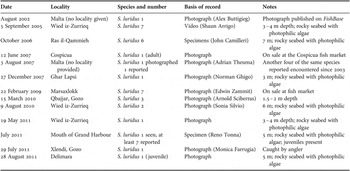
Using our criteria, we were able to authenticate 13 records comprising at least 33 specimens as Siganus luridus but none as Siganus rivulatus (Table 1). The earliest of the authenticated records (an image posted on FishBase) dated from 2002. All fish for which depth and habitat data were available came from shallow rocky bottoms with photophilic algae.
Authenticated records of Siganus spp. from the Maltese Islands.

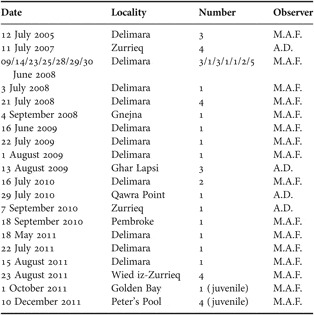
In addition, we have 25 unauthenticated records of 48 individual rabbitfish which were all identified as Siganus luridus (Table 2), and no records at all that may be ascribed to Siganus rivulatus.
Unauthenticated records of Siganus spp. from the Maltese Islands. All specimens were identified as Siganus luridus.

A.D., Alan Deidun, M.A.F., Mark Anthony Falzon.
Interviews with the persons responsible for Maltese websites that feature images of Siganus rivulatus revealed that none of the images of this species posted were actually taken in Maltese waters.
DISCUSSION
Whereas there is no doubt whatsoever that Siganus luridus is well established in Malta and is becoming more common, to the point that it has started being offered for sale at local fish markets (see Table 1), we did not encounter any specimens of Siganus rivulatus at all and neither did we find any images of this species taken locally. In fact, all reports of this species from Malta appear to stem from its inclusion in the guide to Maltese fish by Lanfranco (Reference Lanfranco1993). However, this author did not actually state that this species occurs, but that it ‘is apparently spreading to this area'. Lanfranco (Reference Lanfranco1993) also gives the Maltese name (Qawsalla) and cites Barbara (Reference Barbara1961) for this. Barbara (Reference Barbara1961) was an attempt by the Maltese governmental fisheries agency to standardize the names given to Mediterranean fish caught locally. It is clear from Barbara's introductory comments that he was giving the vernacular Maltese names to species known to occur in the central Mediterranean, without any regard as to whether these species actually formed part of the Maltese fauna or not.
There are therefore two possibilities. The first is that Siganus rivulatus used to occur in Maltese waters at the time that Barbara (Reference Barbara1961) compiled his list of names and has since become extinct, or at least very rare indeed. The second is that Barbara (Reference Barbara1961), followed by Lanfranco (Reference Lanfranco1993), included this species in their respective works on the assumption that since it was spreading westwards from the eastern Mediterranean, it would eventually occur in Maltese waters. The second possibilty is more likely.
This leaves Sammut (Reference Sammut2001) as the only record of Siganus rivulatus from Malta. Given that this author states that the fish is occasionally caught in Maltese waters but that, in spite of our searches, we have not encountered the species, and because Sammut (Reference Sammut2001) does not include Siganus luridus even though this fish was present in local waters at the time Sammut was writing (Alexander Buttigieg in personal communication to Castriota & Andaloro, Reference Castriota and Andaloro2005), it is likely that Sammut (Reference Sammut2001) has confused the two species and was actually writing about Siganus luridus rather than Siganus rivulatus. Therefore, all evidence suggests that Siganus rivulatus has never been recorded from the Maltese Islands and does not occur, and Malta should be removed as a locality for this species, especially from international databases which are widely consulted. Accuracy of occurrence data is especially important for localities such as Malta which is on or close to the boundary between the eastern and western Mediterranean biogeographical sectors (Bianchi, Reference Bianchi2007), particularly if such data are used to formulate models of dispersal between the east and west basins.
One interesting question that arises from our results is why does Siganus rivulatus not occur given that it is present along central Mediterranean coasts, including those of Libya and Tunisia, less than 350 km from Malta. Both Siganus luridus and Siganus rivulatus are very fecund, potentially producing more than 250,000 eggs per spawning season (Bariche et al., Reference Bariche, Sadek and Azzurro2009) and with a surface planktonic larval period that may last up to four weeks (Woodland Reference Woodland, Séret and Sire1999); potentially therefore, surface currents may transport larvae for up to 1000 km (Azzurro et al., Reference Azzurro, Golani, Bucciarelli and Bernardi2006). Moreover, adult siganids may disperse by active swimming, perhaps in association with drifting weed (Azzurro et al., Reference Azzurro, Golani, Bucciarelli and Bernardi2006 and references therein). The potential for Siganus rivulatus to reach Malta, as was done by Siganus luridus therefore exists. A similar situation occurs in the Ionian Sea where Siganus luridus is abundant but where Siganus rivulatus has not established itself and has only very occasionally been recorded (Bardamaskos et al., 2009). It has been suggested that niche overlap between these species in the different environment of the Ionian may result in Siganus luridus outcompeting Siganus rivulatus (Bardamaskos et al., 2009). Similarly, Shakman (Reference Shakman2008) has suggested that competition between the two siganids may account for his observations that Siganus luridus is more abundant in the Gulf of Sirte (also known as the Gulf of Sidra) and the western Libyan coast whereas Siganus rivulatus is more abundant along the eastern Libyan coast.
ACKNOWLEDGEMENTS
We are grateful to all the persons listed in Table 1 who supplied us with their records, specimens and photographs and who allowed us to report on them. This paper benefited from the helpful remarks of two referees, whom we thank.