Case
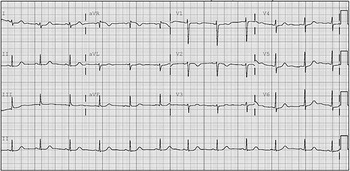
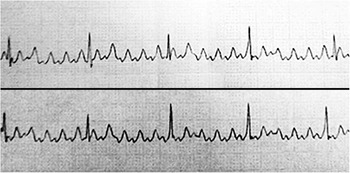
A 15-year-old girl was admitted to our hospital after ingesting 200 mg immediate-release methylphenidate. She had altered mental status but was haemodynamically stable. Her past history was insignificant, except for occasional pre-syncope. The patient transiently required benzodiazepines for agitation and supportive management. Electrocardiogram (Fig 1) and echocardiogram studies were unremarkable. Even after resolution of the acute episode, her pre-syncopal symptoms persisted. During hospitalisation, review of remote telemetry demonstrated intermittent episodes of reported atrial flutter (300/minute) with saw-toothed P waves (Fig 2). Her haemodynamics remained stable, and the patient denied any symptoms during the reported arrhythmia. On evaluation, she was playing her portable media device, an off-brand compact disc player, close to her remote telemetry device (Philips IntelliVue TRx/TRx+ Transceivers, Philips, Andover, MA, United States of America). This interfered with the transmission and an organised abnormal rhythm resembling atrial flutter was recorded.
Baseline electrocardiogram.

Telemetry strip demonstrating the artefactual atrial flutter (300/minute).

Interference with pacemakers due to portable media devices initially received media attention in 2007. Atrial flutter due to electrical interference has been previously described during continuous veno-venous haemofiltration.Reference Kaltman and Shah 1 Electronic interference is often seen as high-frequency noise on the recorded electrocardiogram channel. In our case, instead of a poor or noisy signal, the use of a portable media device resulted in a recording of artefactual atrial flutter.
As health-care professionals, we use portable electronic devices daily in patient care areas. Although manufacturers test these devices for interference, as technology evolves, there may be a need to re-assess the risk of electronic interference; however, the gold standard continues to be clinical re-assessment of the patient in the face of a potential arrhythmia.
Acknowledgements
None.
Financial support
This research received no specific grant from any funding agency, commercial, or not-for-profit sectors.
Conflicts of Interest
None.