This article focuses our attention on the issue of the family and revisits the idea that family reunification is the heart of US immigration policies, which at first glance appears to be true. After all, the 1965 Immigration Act (also known as the Hart-Celler Act) grants immediate family members of US citizens, including underage children, spouses, and parents, nonquota status and qualifies them for immediate family reunification. Moreover, the latest United Nations Human Development Report indicates that around seventy percent of immigrants enter the United States for the purpose of family reunification.Footnote 3 However, this laudable figure elides the fact that the law promotes the reunification of a select group of families. Banned from reunification are families likely to become a public charge, nonheterosexual families, and, among others, families of low-wage migrant workers.
In globalization, we have witnessed what Saskia Sassen calls the “opposite turns of nationalism,” which refers to the “denationalization of economies” and “renationalization of politics.”Footnote 4 The global restructuring of economies, triggered by transnational corporatism and postnational finance capitalism, has heightened the demand for low-wage workers in global cities, where highly paid professionals are concentrated. At the same time, this recent wave of migration has met sentiments of nationalism often expressed in xenophobic policies. Conflicts arise when the reunification of the family disagrees with the “renationalization of politics” as well as the labor needs of a capitalist state. We find that the growing influence of nationalist politics and big businesses trumps immigration law's humanitarian goal of family reunification. We see this occurring in experiences of the families of migrant domestic workers and temporary workers, as well as in mixed-status and poor families in the United States. As we will glean from these examples, the triumph of labor needs and border protection over family reunification results in the legally authorized, prolonged, and forcible separation of working-class and poor families. This fact belies the notion that family reunification is the cornerstone of US immigration policies and points to the violation of human rights—in this case the right to family reunification—in US law.
This essay begins with a summary of family migration policies in the United States. Then it describes various circumstances in which family reunification is denied to migrants with legal status, specifically the incorporation of migrant domestic workers, family reunification of low-income workers, the forced separation of mixed-status families which include both citizens and non-citizens, and lastly, the stunted incorporation of temporary labor migrants. These examples are neither exceptions nor mere anomalies. Instead, they indicate the selective reunification that underlies US immigration policies on family formation. As we argue, defeating the human rights of family is the greater priority of renationalized politics and corporate-driven policies. Our conclusion illustrates that the labor market needs of the US, as much as the rights of family, undergird US immigration law.
Family Reunification in the Law
Commentators and historians have touted the 1965 Immigration Act (also known as the Hart-Celler Act) as watershed legislation that “changed the face of America.”Footnote 5 The law repudiated the last vestiges of racial discrimination and established the principle of equality in the letter of immigration law. It abolished the national origins quota, a system that assessed immigrants' desirability based on race; repealed the Asian Pacific Triangle; and established a ceiling of 20,000 applicable to countries of the Eastern Hemisphere (that is, Europe, Asia, and Africa). The Hart-Celler legislation formally expanded immigration and citizenship to individuals regardless of race or nationality.Footnote 6
The legislation also served as a major victory for proponents of family reunification by reversing the preference system established in 1952 that had required at least fifty percent of each country's annual quota go to immigrants with “specialized skills.”Footnote 7 The 1965 Immigration Act established a new and expanded set of preferences, with four out of sevenFootnote 8 going to family reunification and claiming seventy-four percent of available visas, leaving but twenty percent to professionals and skilled/unskilled workers and six percent to refugees.Footnote 9 The new law also set a global ceiling of 290,000 per year, imposing numerical restrictions on Western Hemisphere countries for the first time.Footnote 10
Subsequent amendments expanded possibilities for family immigration. Congress enacted another reform in 1990 and increased the numerical ceiling to 700,000 for the first three years and 650,000 thereafter. It maintained family reunification as the major entry path by giving it 480,000 visas, compared with 140,000 economic visas. Moreover, it expedited family reunification of the beneficiaries of the Immigration Reform Act of 1986 by granting amnesty to their undocumented immediate family members.Footnote 11 As historian David Reimers argues, this series of legislation enabled the Third World to come to America.Footnote 12
Yet recent scholars have begun to challenge the notion that the 1965 Immigration Act symbolizes the triumph of liberalism and equality in immigration law. Historian Mae Ngai, in her critical work Impossible Subjects: Illegal Aliens and the Making of Modern America, argues that this new law did not in fact “open” immigration to all. Instead, the confluence of a liberal agenda and economic nationalism dictated the formulation of a policy that eliminated old forms of restriction and created new ones, and, in turn, bifurcated the fate of Third World immigrants from the Eastern and Western Hemisphere. On the one hand, the repeal of the Asian Pacific Triangle and the expansion of family preferences enabled Asian immigrants to establish a foundation for new chains of family migration. On the other hand, the 1965 law and its subsequent amendment in 1976, which applied the 20,000 limit to countries of the Western Hemisphere, significantly reduced “legal” immigration from Mexico. With “legal” migration delimited, existing Mexican immigration was reconstituted as “illegal.”Footnote 13 Thus, although racial discrimination had been expunged from the letter of the law, the immediate consequences of the 1965 Immigration Act remain marred by racial discrimination.
The contemporary process of legal migration continues to produce de facto racial exclusion. The 20,000 country limit has created a backlog of potential immigrants from high-migrant source countries and as a consequence has protracted the waiting period for family reunification for migrants from these countries. In addition, family reunification remains limited to the nuclear family and fails to consider adult children of permanent residents. For instance, siblings and adult children of permanent residents must wait for their relatives to naturalize before they can become eligible. Thus, for families from countries with severe backlog problems, separation is prolonged, if not indefinite.
Recent changes in policies portend a future no brighter than the past. In the last two decades of the twentieth century, we have witnessed the “denationalization of economies” in conjunction with the “nationalization of politics.”Footnote 14 We see this trend happening in the United States, where, although family reunification remains a major entry path for many immigrants, the economic drive behind US immigration laws has been gaining considerable, if not dominant, influence. In the last two decades, Congress has enacted a series of amendments to immigration law that increased admissions of temporary skilled and unskilled workers. For example, the 1990 immigration law increased the nation's economic dependence on skilled temporary labor with the expansion of the H1B visa program.Footnote 15 However, the growing visibility of immigrants also parallels the resurgence of anti-immigrant sentiments, sometimes expressed in ballot measures and legislation that limit immigrants' access to public benefits, including Proposition 187 and the Personal Responsibility and Work Opportunity Reconciliation Act of 1996. In immigration law, the confluence of corporate and nationalist forces has given birth to policies authorizing the prolonged and forcible separation of working-class and poor families. We discuss, at some length, four concrete examples.
Labor Certification Program of Domestic Workers
Domestic work in the United States has historically been one of the few avenues for legal entry for immigrant women. In the past, some domestic servants (such as chauffeurs, valets, ladies' maids, nursemaids, and private social secretaries) were granted entry into the United States when accompanied by employers. According to immigration records in 1950, 16.5 percent of Mexican immigrant women and 10 percent of white immigrant women in the United States worked in private households.Footnote 16 Despite the significant number of these immigrants, the Immigration Act of 1952 deemed domestic work an “unskilled” labor, thus excluding it from the occupational visa preference. The Immigration Act of 1965 reversed this policy by including live-in domestic workers in the sixth preference category of workers (both “skilled” and “unskilled”) eligible for permanent immigration. However, the inclusion of “unskilled” labor in the occupational preference categories came with a cost: The 1965 Immigration Act also expanded the scope of the labor certification program and set up more onerous requirements for immigrants.Footnote 17
This policy stands today. Migrant domestic workers qualify for permanent residency under the Labor Certification Program. Under this program, employers may serve as sponsors for the permanent migration of foreign workers if they are unable to attract “native” workers to fill their specific labor needs. While one's petition for labor migration is pending, one is technically an “out of status” migrant. During this time, one is unable to leave the United States and visit one's family in the country of origin due to the insecurity of reentry.Footnote 18 Migrants must also stay employed with the sponsoring employer, which places them in a position of bonded servitude.
Seemingly family-friendly, the law entitles domestic workers to sponsor their spouses and children as derivatives of their application for permanent residency. Yet reunification of the family is not immediate, perhaps taking as long as ten years. According to a volunteer at Damayan, a New York-based grassroots organization for Filipino domestic workers, migrant domestic workers sponsored under the Labor Certification Program typically wait ten years before their application for permanent residency is granted. During this time, the children of the sponsored migrant—in limbo as well—wait with the hope that their mothers receive legal status before they become too old to be eligible to join them in the United States, a situation referred to as “aging out.”
In August 2002, President George W. Bush signed the Child Status Protection Act (CSPA), which protects children in the process of legal migration from aging out by “freezing” the age of derivative children on the date of filing the petition. However, the law does not protect children while their parents' application is under review for certification at the Labor Department, where substantial delays occur. Protection from aging out only begins once the application process for permanent residency is turned over to the Department of Justice. Thus, although the state has set provisions to facilitate family reunification, bureaucratic delays and loopholes within the law continue to bar children from reuniting with their migrant worker parents.Footnote 19
Reunification of Poor Families
Poor families represent another group that has suffered because of restrictive immigration policies. First written into law in 1882, “likely to become a public charge” (LPC) became a mechanism for exclusion of indigent immigrants assessed not only in their current state but also in their potential to be in poverty.Footnote 20 In the decades following the First World War, assessment of potential poverty occurred at the border, with women enduring most of the brunt of this exclusionary measure. During the height of the Great Depression, immigration officials applied LPC more frequently, not only in restricting admission of poor immigrants but also in repatriating those who had used public benefits.Footnote 21
Assessment of immigrants' “undesirability” based on LPC remains a critical component of American immigration policy. In 1996, Congress passed the Illegal Immigration Reform and Immigrant Responsibility Act (IIRIRA), institutionalizing a minimum income requirement of 125 percent above the poverty line for legal sponsors and further holding sponsors responsible to financially support immigrants until they had worked for ten years or became citizens. This provision has made reunification almost impossible for many families. The Urban Institute, tabulating the Current Population Survey in 1998, found that among families with children in which both parents are noncitizens, forty-five percent have incomes under the poverty line while thirty-four percent of mixed-status families fall under the poverty line.Footnote 22 Humanizing these figures, Hung Thai, in his important study of international marriages between working-class Vietnamese immigrant men and highly educated women in Vietnam, found cases in which couples were forced to maintain “transnational split households” because the husbands did not earn enough to sponsor their wives.Footnote 23 Potentially, they might get relatives to sponsor their spouses, which some do. However, for many even this option proves elusive.
Mixed-Status Families
Likewise, mixed-status families with US-citizen children and noncitizen parents placed under deportation proceedings, legalFootnote 24 or undocumented, are now at a higher risk of becoming forcibly separated.Footnote 25 Before the passage of IIRIRA, immigrants could avoid deportation if they could prove that it would cause “extreme hardship.” One consideration was whether they had a US-born citizen child. However, the immigration reform in 1996 toughened the standard for what is known as the “cancellation of removal” by requiring immigrants to prove that deportation would cause “exceptional or extremely unusual hardship.” The authors of this law specify that
[T]he alien must provide evidence of harm to his spouse, parent, or child substantially beyond that which ordinarily would be expected to result from the alien's deportation. … Similarly, showing that an alien's United States citizen child would fare less well in the alien's country of nationality than in the United States does not establish “exceptional” or “extremely unusual” hardship and thus would not support a grant of relief under this provision.Footnote 26
This provision ensures that an “alien” parent does not “derive immigration benefits through his or her child who is a United States citizen.”Footnote 27
Increasingly, parents under deportation proceedings are forced to choose between leaving their children in the United States or relocating to their home countries with their US-born citizen children, thereby denying the children their birthright citizenship. This was the dilemma faced by Elvira Arellano. An undocumented immigrant from Mexico, Elvira came to the United States in 1997, soon gave birth to her son, and in 2000, found employment as a cleaner at O'Hare International Airport. As a consequence of more stringent security checks on airport personnel after the September 11, 2001 attacks, she was arrested in 2002 for using a false Social Security number in order to gain employment. This arrest prompted a deportation order, which, after several deferrals, was deemed final in 2006. Defying an order to surrender to immigration officials, Elvira sought sanctuary in Chicago's Adalberto United Methodist Church with her US-born citizen child, during which time she also became a prominent activist decrying the unjust deportation of immigrants. In 2007, after speaking at an immigration rally in Los Angeles, she was arrested and deported. She left her son in the care of a priest from the Chicago church.Footnote 28
Temporary Labor Migrants
Turning to our last example, we also see the greater priority given to production rather than reproduction in the recent rise of temporary visas. First, we recapitulate the history of the temporary worker program in the United States.
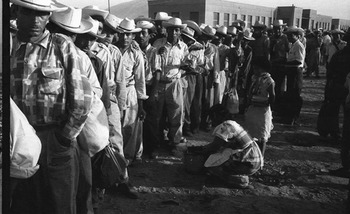
A woman sells food to braceros waiting at the US border in Monterrey, Mexico. Photograph by Leonard Nadel, courtesy of National Museum of American History, Smithsonian Institution. A large collection of Nadel's photos of the bracero experience can be viewed online at the Bracero History Archive: http://braceroarchive.org.

During the First World War, the state reversed the Contract Labor Law of 1885 in order to allow recruitment of workers to fill the agriculture labor crisis. Thereafter, the Department of Labor promoted the importation of temporary farm workers from Mexico, Canada, the West Indies, and Puerto Rico. The migration of temporary workers halted shortly during the Great Depression, only to resurge at the height of the Second World War. In 1942, the governments of the United States and Mexico signed the agreement that gave birth to the Bracero Program and supplied temporary agriculture workers in the Southwest and West. Several months later, in 1943, British colonial governments in the West Indies forged a similar arrangement with the United States, known as the West Indian Program. The emergency need for farm workers grew and remained unabated even after the war. Hence, the flow of braceros and West Indian workers continued. The West Indian Program was subsequently institutionalized by the Immigration Act of 1952 and given the name H-2. The Bracero Program eventually ended in 1964, when the Labor Department refused to certify the West Coast growers' need for foreign labor, prompting Congress officially to sanction its cessation.Footnote 29
The United States continues to recruit unskilled temporary labor in increasing numbers through an expanded version of the H-2 program: H-2A (agriculture workers) and H-2B (construction, health care, landscaping, lumber, manufacturing, food service/processing, and resort/hospitality services). H-2 visas are valid for a maximum of one year, although renewals may be extended for a maximum of three years in one-year increments. Upon reaching completion of the maximum stay, a temporary worker must depart the United States for an uninterrupted period of at least three months.Footnote 30 Only H-2B is capped at 60,000 visas per annum, although the Department of Homeland Security recorded 180,503 admissions for both programs in 2006, a notable increase from 129,327 in 2005.Footnote 31
In the United States, temporary workers are also eligible to bring their spouses and unmarried children through H-4 visas. H-4 visa holders, however, are not permitted to work. This restriction, coupled with the low wages of temporary labor migrants,Footnote 32 deters the migration of spouses. Consequently, while the letter of the law allows for family reunification, many of its provisions continue to separate temporary workers and their families.Footnote 33
Conclusion
In her illuminating analysis of the congressional discussion surrounding the 1996 amendments in immigration law, historian Dorothee Schneider identifies legislators' ideal of citizenship, which informed the passage of welfare and immigration reform laws. Three themes prominently emerged as standards against which an immigrant's desirability is measured: the character of the immigrant's labor (“skilled” as opposed to nonexistent or exploited labor), his or her role as a taxpayer who rarely uses public benefits (or only uses them), and membership in a nuclear family.Footnote 34 The congressional debate demonstrated the continued importance of family reunification. However, when we look at the examples above, we notice the once-touted pillar of American immigration policy beginning to crumble and witness the growing prominence of proproduction and antireproduction culture in immigration law.
American policy reflects a growing global trend in which countries design their immigration laws to facilitate the admission of temporary workers while disregarding their rights to reproduction. Millions of temporary workers now leave their families in order to earn a living in Europe, North America, the Middle East, and developed East Asian countries.Footnote 35 While some countries allow for residency and family reunification, many have increasingly foreclosed such possibilities. In the United States, the increasing popularity of the H-2 program foreshadows a similar future.Footnote 36
But if indeed Americans hope to uphold the tenets of equality and human rights under the law, the current immigration policy needs reevaluation. We do not propose an overhaul of immigration law or suggest an open-border policy, a complex topic requiring a discussion far beyond what this paper can achieve. Rather, we simply advocate for the recognition of the reproductive needs of productive workers.