INTRODUCTION
Since praziquantel, a highly effective and safe anti-schistosomal drug, was developed (Gönnert and Andrews, Reference Gönnert and Andrews1977; Seubert et al. Reference Seubert, Pohlke and Loebich1977) it has replaced all other schistosomacidal agents to become the only anti-schistosomal drug of choice for treatment against all the major species of schistosome (WHO, 1993). Praziquantel makes mass chemotherapy possible as the priority control strategy in almost all countries that are endemic for schistosomiasis worldwide (WHO, 1993). Under laboratory conditions it is possible to induce resistance of Schistosoma mansoni to praziquantel with multiple subcurative doses (Fallon and Doenhoff, Reference Fallon and Doenhoff1994). Although there is little evidence of the existence of praziquantel-resistant field isolates, a decreased sensitivity of S. mansoni to praziquantel has been found in many endemic areas (Ismail et al. Reference Ismail, Attia, Metweally, Farghaly, Bruce, Bennett, el-Badawy and Hussein1994a, Reference Ismail, Metwally, Farghaly, Bruce, Tao and Bennett1996, Reference Ismail, Botros, Metwally, William, Farghally, Tao, Day and Bennett1999; Fallon et al. Reference Fallon, Sturrock, Niang and Doenhoff1995; Stelma et al. Reference Stelma, Talla, Sow, Kongs, Niang, Polman, Deelder and Gryseels1995, Reference Stelma, Sall, Daff, Sow, Niang and Gryseels1997; Bennett et al. Reference Bennett, Day, Liang, Ismail and Farghaly1997; Tchuem-Tchuenté et al. Reference Tchuem Tchuenté, Southgate, Mbaye, Engels and Gryseels2001; Danso-Appiah and De Vlas, Reference Danso-Appiah and De Vlas2002; Melman et al. Reference Melman, Steinauer, Cunningham, Kubatko, Mwangi, Wynn, Mutuku, Karanja, Colley, Black, Secor, Mkoji and Loker2009). There are also several schistosomiasis cases caused by S. haematobium in which repeated standard treatment failed to clear the infection reported (Prociv, Reference Prociv1997; Silva et al. Reference Silva, Thiengo, Conceição, Rey, Lenzi, Pereira Filho and Ribeiro2005; Alonso et al. Reference Alonso, Muñoz, Gascón, Valls and Corachan2006). Therefore, it is of great importance to monitor praziquantel efficacy in regions where the drug is widely used because firstly, there is concern that continued use of praziquantel may give rise to populations of resistant parasites, and secondly, there is currently no other drug being developed for treatment of this widespread disease.
Schistosomiasis japonica, which is still a major public health problem in China, remains endemic in the marshland and lake regions of 5 provinces (Hunan, Hubei, Anhui, Jiangsu and Jiangxi) along the middle and lower reaches of the Yangtze River, and in some mountainous areas in the provinces of Sichuan and Yunnan (Zhou et al. Reference Zhou, Wang, Wang, Guo, Yu, Xu, Wang, Chen and Tia2004; Hao et al. Reference Hao, Wu, Zheng, Wang, Guo, Xia, Chen and Zhou2008; Wang et al. Reference Wang, Utzinger and Zhou2008; Li et al. Reference Li, Luz, Wang, Xu, Wang, Qian, Wu, Guo, Xia, Wang and Zhou2009). Currently, about 726 000 people living in China are thought to have this disease (Zhou et al. Reference Zhou, Guo, Wu, Jiang, Zheng, Dang, Wang, Xu, Zhu, Wu, Li, Xu, Chen, Wang, Zhu, Qiu, Dong, Zhao, Zhang, Zhao, Xia, Wang, Zhang, Lin, Chen and Hao2007). Since 1992, the World Bank Loan Project for Schistosomiasis Control initiated in China, praziquantel-based chemotherapy has been conducted to control the morbidity and reduce the prevalence and intensity of S. japonicum infection (Chen et al. Reference Chen, Wang, Cai, Zhou, Zheng, Guo, Wu, Engels and Chen2005), and the strategy, which was an important part of Chinese National Schistosomiasis Control Program, has been proved to be generally effective (Chen, Reference Chen2005; Xiao, Reference Xiao2005; Zhou et al. Reference Zhou, Guo, Wu, Jiang, Zheng, Dang, Wang, Xu, Zhu, Wu, Li, Xu, Chen, Wang, Zhu, Qiu, Dong, Zhao, Zhang, Zhao, Xia, Wang, Zhang, Lin, Chen and Hao2007; McManus et al. Reference McManus, Li, Gray and Ross2009). After extensive, long-term repeated praziquantel chemotherapy, the possibility of reduced susceptibility of praziquantel against S. japonicum has been widely investigated (Mitchell et al. Reference Mitchell, Davern, Wood, Wright, Argyropoulos, McLeod, Tiu and Garcia1990; Yue et al. Reference Yue, Yu and Xu1990; He et al. Reference He, Hu and Yu1992; Liang et al. Reference Liang, Dai, Ning, Yu, Xu, Zhu and Coles2001; Yu et al. Reference Yu, Li, Sleigh, Yu, Li, Wei, Liang and McManus2001). Here, a field study was carried out in the main schistosomiasis-endemic foci of China to survey and evaluate the current sensitivity to praziquantel in S. japonicum.
MATERIALS AND METHODS
Study area and subjects
Eleven villages in 5 provinces that are endemic for S. japonicm along the Yangtze River and in mountainous areas were selected (Fig. 1), namely Biaoen and Changshan villages in Poyang County of Jiangxi Province, with populations of 1035 and 1682, and 39% and 40% infection rates of S. japonicum, respectively (local epidemiological data in 2003), Nandi and Chehun villages in Hanshou County of Hunan Province, with populations of 1742 and 1246, and 16% and 19% of the people infected, respectively (local epidemiological data in 2003), Gudi and Fanhu villages in Jiangling County of Hubei Province, with populations of 2753 and 1017, and 17% and 16% of the people infected, respectively (local epidemiological data in 2003), Tanzhu and Sanguan villages in Dantu District of Jiangsu Province, with populations of 1078 and 1156, and 2 8% and 1 8% of the people infected (local epidemiological data in 2003), and Shujie, Gumudi and Duma villages in Weishan County of Yunnan Province, with total population of 4863 and 21 3% total infection rates (local epidemiological data in 2003). Mass synchronous chemotherapy for both humans and domestic animals (mainly bovine) with praziquantel has been successively carried out in these villages for more than 10 years with the World Bank Loan Project for Schistosomiasis Control.
Locations of the study villages in China.

Survey of general information and symptoms and history related to schistosomiasis
An individual questionnaire was designed and then used for the study. Staff from local schistosomiasis control institutions were employed to obtain information including name, age, sex, symptoms related to the disease and history of treatment for schistosomiasis, etc.
Parasitological examination for Schistosoma japonicum infection
During the period of schistosomiasis non-transmission (from November, 2004 to March, 2005), a random sample of 4760 volunteers aged from 6 to 70 years from the study villages was involved in the present study, but pregnant women were excluded. The villagers were detected for S. japonicum infection with parasitological stool examinations using the Kato-Katz technique (examination of 1 stool sample with 3 thick smears) (Katz et al. Reference Katz, Chaves and Pellegrino1972). Briefly, each faecal sample was pressed through a sieve and an amount of 41 7 mg sieved stool measured by a standard template was transferred to a microscope slide where a piece of cellophane soaked in glycerine was pressed onto the sample. Three Kato-Katz thick smears were made from each stool specimen and the total number of eggs detected in each Kato-Katz thick smear was recorded.
Praziquantel treatment
Praziquantel tablets (Nanjing Pharmaceutical Factory Co. Ltd, Nanjing, China; Batch No. 20040202) were administered to those villagers whose stool examinations were positive with a single oral dose of 40 mg/kg. Fecal samples were collected for parasitological stool examinations 6 weeks post-treatment. Those villagers still excreting eggs were treated a second time with the same dose of praziquantel. The stool samples of the villagers, including those re-treated with praziquantel, were collected and re-examined 6 weeks after the second treatment. Those villagers remaining positive were treated for a third time with a dose of 60 mg/kg of praziquantel.
Ethical consideration
This study was approved by the Ethics Review Committee of Jiangsu Institute of Parasitic Diseases. Informed consent was obtained from all participants following a detailed description of the purpose and potential benefits of the study. Praziquantel (a single oral dose of 40 or 60 mg/kg) was offered to those cases with stool-egg without charge, and all subjects accepted the treatment strategy.
Statistical analysis
All data were entered in Excel (Microsoft Corporation; Redmond, WA, USA) and all statistical analyses were performed using the statistical software Statistical Package for the Social Sciences v. 11.0 (SPSS 11.0, SPSS Inc., Chicago, IL, USA). Differences of proportions were tested for statistical significance with the chi-square test; t-test and 95% confidence intervals of means were used to compare groups. A P value <0 05 was considered significant.
RESULTS
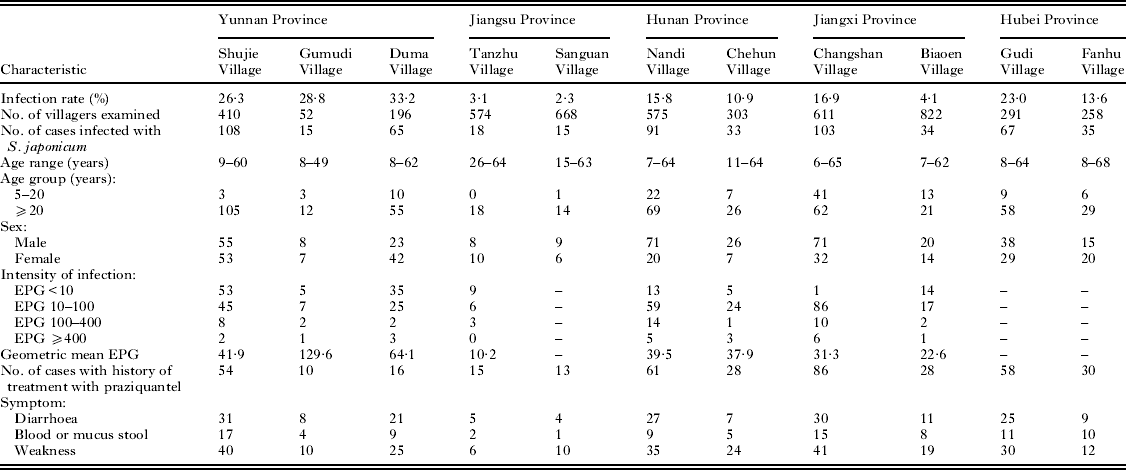
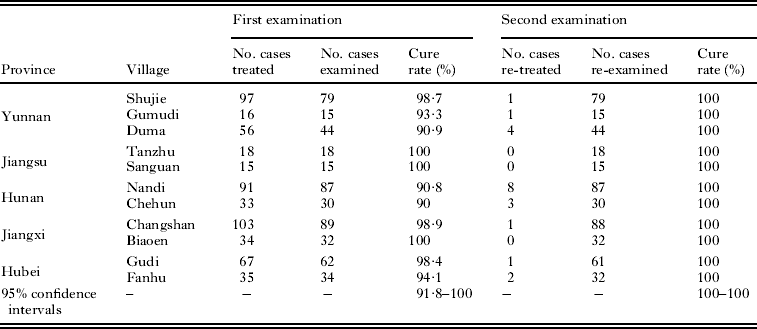
The infection rate, age, sex ratio, intensity of infection, symptom related to schistosomiasis and history of treatment for schistosomiasis with praziquantel of all the subjects from 11 villages of 5 provinces pre-treatment are shown in Table 1. Of the 4760 villagers examined, 584 had S. japonicum eggs in the first faecal sample, with a prevalence rate of 12 27%, among whom 565 infected subjects received praziquantel treatment in a dose of 40 mg/kg. Six weeks after treatment, 505 of the treated villagers were re-examined and 480 (95 05%) had no detectable S. japonicum eggs. Twenty-one subjects still excreting eggs after the first treatment were administered with praziquantel for the second time. Six weeks after the second treatment, the stool samples from all treated villagers, including those with the second treatment, were collected and re-examined, no stool-egg-positives were detected. There were no significant differences in cure rates among the 11 villages (P value >0 05) and no differences between either age groups or male or female villagers, among different intensity of infection groups (all P values >0 05) (Table 2). The 21 cases with high intensity of infection (EPG⩾400) were successfully treated with a single dose.
Demographical features of schistosomiasis patients from 11 villages in 5 Schistosoma japonicum-endemic provinces of China

Efficacy of praziquantel (40 mg/kg) against Schistosoma japonicum in villagers in 5 provinces of China

DISCUSSION
Since the 1980s praziquantel has been the drug of choice for the treatment of S. japonicum infection and it is used widely in endemic areas of China. Over this period, it is estimated that more than 10 million infected people in China have been treated with the drug (Chen, Reference Chen2005; Anon, 1986). Treatment of a population for schistosomiasis with praziquantel at a dose of 40 or 50 mg/kg usually results in short-term parasitological cure rates of 97 6%–100%. However, increased dosage produced no significant improved cure rates (Fu et al. Reference Fu, Xiao and Catto1988). As a result of experimental and field studies, since 1984 either a single dose of 40 mg/kg or a total daily dose of 40 mg/kg divided into 2 doses given 6 h apart has been recommended (MOH, 1993). Our findings showed that the cure rate reached 95 1% with a single oral dose of 40 mg/kg of praziquantel and 100% with 2 treatments with praziquantel. The results from this study demonstrate that the efficacy of praziquantel against S. japonicum is still high in main endemic areas of China. The present study shows that the current susceptibility of praziquantel against S. japonicum has not changed after more than 2 decades of repeated, expanded chemotherapy in China. This is important information for both the public health workers and health policy makers in the field of schistosomiasis control, considering that praziquantel plays an essential role in the current Chinese National Schistosomiasis Control Program. Earlier studies (Liang et al. Reference Liang, Dai, Ning, Yu, Xu, Zhu and Coles2001; Yu et al. Reference Yu, Li, Sleigh, Yu, Li, Wei, Liang and McManus2001) also reached the same conclusion. However, only 1 endemic province was selected for each study. In this study, we chose 11 villages from 5 out of 7 main schistosome-endemic provinces both in marshland and lake regions and in mountainous areas. The conclusion we draw, therefore, is more persuasive.
Unlike S. mansoni and S. haematobium, S. japonicum is truly a zoonosis and besides humans, livestock, especially cattle, which are considered as the main sources of infection in China, are incriminated as reservoir hosts (Wang, Reference Wang2005, 2009; Wang et al. Reference Wang, Vang Johansen, Zhang, Wang, Wu, Zhang, Pan, Ju and Ørnbjerg2005; Yang et al. Reference Yang, Zhao, Li, Krewski and Wen2009; Yu et al. Reference Yu, Wang, Lü, Wang, Wu, Wang and Guo2009). In all villages in this study, mass synchronous chemotherapy for both humans and livestock has been systematically implemented for more than 10 years. There was, therefore, the possibility that S. japonicum might begin to develop resistance to praziquantel. One of the purposes of the present study was to determine whether tolerance or resistance to praziquantel exists in S. japonicum populations, as there have been many reports of diminished susceptibility or tolerance to praziquantel against S. mansoni in Africa (Ismail et al. Reference Ismail, Attia, Metweally, Farghaly, Bruce, Bennett, el-Badawy and Hussein1994a, Reference Ismail, Metwally, Farghaly, Bruce, Tao and Bennett1996, Reference Ismail, Botros, Metwally, William, Farghally, Tao, Day and Bennett1999; Fallon et al. Reference Fallon, Sturrock, Niang and Doenhoff1995; Stelma et al. Reference Stelma, Talla, Sow, Kongs, Niang, Polman, Deelder and Gryseels1995, Reference Stelma, Sall, Daff, Sow, Niang and Gryseels1997; Bennett et al. Reference Bennett, Day, Liang, Ismail and Farghaly1997; Tchuem-Tchuenté et al. Reference Tchuem Tchuenté, Southgate, Mbaye, Engels and Gryseels2001; Danso-Appiah and De Vlas, Reference Danso-Appiah and De Vlas2002; Melman et al. Reference Melman, Steinauer, Cunningham, Kubatko, Mwangi, Wynn, Mutuku, Karanja, Colley, Black, Secor, Mkoji and Loker2009; Gryseels et al. Reference Gryseels, Stelma, Talla, van Dam, Polman, Sow, Diaw, Sturrock, Doehring-Schwerdtfeger, Kardorff, Decam, Niang and Deelder1994; Guisse et al. Reference Guisse, Polman, Stelma, Mbaye, Talla, Niang, Deelder, Ndir and Gryseels1997). There were also some case reports of failure of repeated standard praziquantel treatment to clear S. haematobium infections (Prociv, Reference Prociv1997; Silva et al. Reference Silva, Thiengo, Conceição, Rey, Lenzi, Pereira Filho and Ribeiro2005; Alonso et al. Reference Alonso, Muñoz, Gascón, Valls and Corachan2006). Tolerance of S. mansoni to praziquantel has already been induced in the laboratory (Fallon and Doenhoff, Reference Fallon and Doenhoff1994; Ismail et al. Reference Ismail, Taha, Farghaly and el-Azony1994b). The normal cure rates of a single dose of 40 mg/kg of praziquantel, as recommended by the World Health Organization for the treatment of S. mansoni in both adults and children, are usually 60%–90% (WHO, 1993; Jordon et al. Reference Jordon, Webbe and Sturrock1993; Kumar and Gryseels, Reference Kumar and Gryseels1994), while the cure rates of S. japonicum exceed 90%. It was concluded that the adults of S. japonicum are more sensitive to praziquantel than S. mansoni by comparing the in vitro responses of adult S. japonicum and S. mansoni (Sobhon and Upatham, Reference Sobhon and Upatham1990).
The Kato-Katz technique was used to detect S. japonicum infection in this study. Currently, the Kato-Katz technique (3 thick smear slides for 1 stool specimen) is still the golden standard used for the diagnosis of schistosomiasis (Zhou et al. Reference Zhou, Guo, Wu, Jiang, Zheng, Dang, Wang, Xu, Zhu, Wu, Li, Xu, Chen, Wang, Zhu, Qiu, Dong, Zhao, Zhang, Zhao, Xia, Wang, Zhang, Lin, Chen and Hao2007). It has been shown that the routine Kato-Katz technique underestimates the real prevalence of S. japonicum in endemic areas with low-intensity infections (Lin et al. Reference Lin, Liu, Liu, Hu, Zhang, Xu, Li, Bergquist, Wu and Wu2008; Zhang et al. Reference Zhang, Luo, Liu, Wang, Chen, Xu, Xu, Wu, Tu, Wu, Zhang and Wu2009). Considering that several EPG scores in infected individuals were lower than 10, the missing situation of S. japonicum-infected villagers cannot be excluded. The search for a better diagnostic test that can be applied in the endemic field situation in China is therefore essential and should be given high priority.
The present study described here indicates that the efficacy of praziquantel remains high despite its extensive use, and no evidence of reduced susceptibility of praziquantel in S. japonicum populations was detected. The fact that the 21 infected cases who needed to be re-treated is thought probably to be due to the presence of the immature worms, which are known to be less sensitive to praziquantel (Xiao et al. 1985, Reference Xiao, Yue, Yang and You1987; Sabah et al. Reference Sabah, Fletcher, Webbe and Doenhoff1986; You et al. Reference You, Xiao and Yue1986). For example, the 3-h schistosomula and the adult worms aged more than 28 days of S. japonicum are susceptible to the drug, but those schistosomula aged 3–21 days are not sensitive to praziquantel. It is also thought that the 3-h schistosomula are more susceptible to praziquantel than those aged 12–48 h. Those patients with high intensity of infection are usually re-infected cases (Wu et al. Reference Wu, Zhang, Pan, Hu, Wei, Gao, Li and Uwe1993), among whom both adult worms and schistosomula are found in body. The adults that are susceptible to praziquantel were killed during the initial treatment. And after 6 weeks, the immature schistosomula developed futher to mature adult worms, which are sensitive to praziquantel, and then were given the second treatment, all patients turned negative. It is indicated that the positive cases after the first treatment are due to the remaining schistosomula. It is also proved that the adults developing from the schistosomula remain susceptible to praziquantel.
The current efficacy of praziquantel against S. japonicum appears satisfactory in China, however, it does not mean that resistance can not occur nor that in different geographical regions the response of S. japonicum will be the same. We, therefore, should not reduce our vigilance to the possible development of drug resistance by the parasite. Fortunately, the drug resistance can be easily detected by testing miracidia hatched from eggs passed by patients (Liang et al. Reference Liang, Coles and Doenhoff2000). Further periodical studies monitoring both the efficacy of schistosomes to the drug and the development and epidemiology of praziquantel resistance of different geographical isolates of S. japonicum in China are still required, and these would be further used to develop field surveillance of drug susceptibility in S. japonicum in China.
ACKNOWLEDGEMENTS
We are grateful to Professor An Ning from Jiangxi Provincial Institute of Parasitic Diseases, Dr Dong-Bao Yu from Hunan Institute of Parasitic Diseases, Professor Xing-Jian Xu from Hubei Provincial Center for Disease Control and Prevention, Dr Yuan-Lin Li from Dali Prefecture Institute of Schistosomiasis Control, Chief Physician Hong-Tao Song from Zhenjiang Municipal Center for Disease Control and Prevention, and all staff from the schistosomiasis control stations of Poyang, Hanshou, Jiangling, Dantu and Weishan counties (district) for their enthusiastic help throughout the study. Thanks are also addressed to the villagers in the study areas for their active cooperation during the examinations and treatment. The experiments in this study are in compliance with the current laws and regulations in China.
FINANCIAL SUPPORT
This study received funding from the National Science & Technology Pillar Program of China (grant no. 2009BAI78B06 to Y.S.L), the National Natural Science Foundation of China (grant no. 30471516 to Y.S.L), Jiangsu Province's Outstanding Medical Academic Leader Program (grant no. LJ200608 to Y.S.L) and Jiangsu Department of Health (grant no. X200912 to W.W.).
CONFLICTS OF INTEREST
The authors have declared that no competing interests exist.
AUTHOR CONTRIBUTIONS
W.W., D.J.R. and Y.S.L conceived and designed the study. W.W., H.J.L. and X.H.S. collected baseline data. X.H.S. provided logistical support for part of the fieldwork. W.W., H.J.L., J.R.D. and Y.S.L. took part in all of the fieldwork. W.W. carried out the statistical analysis and interpretation of the data and prepared the manuscript. Y.S.L revised the manuscript. All authors read and approved the final manuscript. Y.S.L. is guarantor of the paper.