Introduction
The cosmopolitan braconid subfamily Euphorinae (sensu Shaw, Reference Shaw1985, Reference Shaw1987, Reference Shaw, Hanson and Gauld1995, Reference Shaw, Wharton, Marsh and Sharkey1997, Reference Shaw2004) comprises at least 36 genera that parasitize the adult stages of holometabolous insects or the late-instar nymphs and adults of hemimetabolous insects (Muesebeck, Reference Muesebeck1963; Loan, Reference Loan1983; Shaw, 1988a, 2004). The euphorine tribe Dinocampini was defined by Shaw (Reference Shaw1985, Reference Shaw1988a, Reference Shawb, Reference Shaw2002) as comprising four genera (Ropalophorus Curtis 1837, Dinocampus Foerster 1862, Centistina Enderlein 1912 and Betelgeuse Shaw 1988b) with a long antennal scape (at least three times longer than wide) and the labial palpus reduced to two segments. As far as is known, members of the tribe Dinocampini parasitize adult beetles. Dinocampus parasitizes Coccinellidae (Balduf, Reference Balduf1926; Smith, Reference Smith1960; David and Wilde, Reference David and Wilde1973; Semyanov, Reference Semyanov1979; Shenefelt, Reference Shenefelt1980; Obrycki et al., Reference Obrycki, Tauber and Tauber1985) and Ropalophorus parasitizes Scolytidae (Shenefelt, 1960, Reference Shenefelt1980; Shaw, 1988b). Centistina is known only by five rare species from Africa and Costa Rica, and its hosts are unknown (van Achterberg and Shaw, Reference van Achterberg and Shaw2000). Betelgeuse is known only by three rare species from Mexico and its hosts are also unknown (Shaw, 1988b, Reference Shaw2002). The purpose of this paper is to describe a new genus and new species of the tribe Dinocampini, recently discovered at a high-elevation cloud forest in Ecuador, and to discuss its behaviour.
Materials and methods
Specimens for this study were collected during the Caterpillars and Parasitoids of the Eastern Andes of Ecuador project (Miller and Dyer, Reference Miller and Dyer2009). Specimens were sampled using yellow pans and by Malaise traps during 2007, 2008, 2009 and 2010. During mid-June of 2010 and mid-May of 2011, abundant live males were discovered, photographed and hand-collected off the leaves of Asteraceae seedlings identified as Dendrophorbium lloense (Hieron) C. Jeffrey, 1992. All specimens were sampled in the Yanayacu Biological Station and Center for Creative Studies (elevation 2163 m; 00°35.9′S, 77°53.4′W), which is situated on the north-eastern slope of the Andes in Napo Province, Ecuador. The watershed streams at the Yanayacu Biological Research Station are tributaries to the Río Napo, a major tributary to the Amazon River. The reserve comprises both primary- and secondary-growth montane forests (Miller and Dyer, Reference Miller and Dyer2009). The Holdridge life zone is tropical montane moist forest (Holdridge, Reference Holdridge1967). The plant community at Yanayacu is very diverse and complex, comprising trees, shrubs, epiphytes and herbaceous plant species from at least 76 families (Rab Green et al., Reference Rab Green, Gentry, Greeney and Dyer2011).
For the recognition of the subfamily Euphorinae, see van Achterberg (Reference van Achterberg1990, Reference van Achterberg1993, Reference van Achterberg1997) or Shaw (Reference Shaw, Hanson and Gauld1995, Reference Shaw, Hanson and Gauld2006), and for the terminology used in this paper, see Shaw (Reference Shaw2002) or Sharkey and Wharton (Reference Sharkey, Wharton, Wharton, Marsh and Sharkey1997). Microsculpture terminology follows that of Harris (1979). Scanning electron microscopy was done at the University of Wyoming Microscopy Core Facility using a Hitachi tabletop scanning electron microscope (Model TM-1000). Specimens were examined uncoated at an operating voltage of 15 kV.
The holotype of Napo townsendi is deposited in the University of Wyoming Insect Museum (UWIM). One male paratype is deposited at the Museum of Comparative Zoology, Harvard University, another male paratype is deposited at the Museo Ecuatoriano de Ciencias Naturales, and the remaining paratypes are deposited at the UWIM.
Results
Genus Napo, NEW GENUS
Type species: Napo townsendi NEW SPECIES
Etymology
This genus is named for the type locality in Napo Province, Ecuador, and for the indigenous Napo tribe of eastern Ecuador.
Generic diagnosis
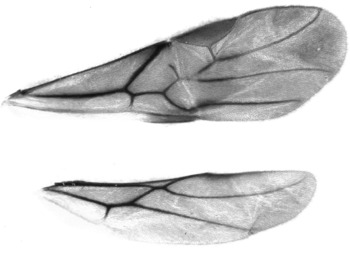
Head transverse; antennal scape elongate slender, more than 4 × longer than wide; female antenna filiform with 15 or 16 flagellomeres; malar suture present; maxillary palpus five-segmented; labial palpus two-segmented; face convex, in dorsal view roundly protruding; frons laterally, face, clypeus and gena finely colliculate to granulate; occipital carina complete, with short median vertical carina running anteriorly towards ocellar triangle; mesosternum medially deeply impressed as a wide groove, functioning as an ovipositor guide; postero-lateral corners of propodeum developed as large, coarsely sculptured, strongly projecting tubercles; female with RS+M vein of the forewing complete; male with RS+M vein of the forewing highly variable, either present, absent or partly present (Fig. 7).
Discussion
The new genus Napo is easily assignable to the euphorine tribe Dinocampini (sensu Shaw 1988, Reference Shaw2002) based on the elongated antennal scape (in this case, more than 4 × longer than wide) and the reduction of the labial palpus to only two segments. Among the previously known genera, Napo is most closely related to Ropalophorus and Betelgeuse based on the synapomorphic shared presence of large propodeal tubercles in all three genera. However, Napo females are easily distinguished from females of both Ropalophorus and Betelgeuse by the strikingly different antennal flagellum forms. The female flagellum of Ropalophorus is strongly reduced to only eight flagellomeres and slightly clavate (tapering to a slender club), while the flagellum of Betelgeuse females is reduced to 9–13 flagellomeres and is distinctly serrate (saw-toothed). By contrast, the flagellum of Napo females is filiform (slender) with 15 flagellomeres. While it could be argued that the filiform condition of the antennal flagellum in Napo females is plesiomorphic, when compared with the serrate condition of Betelgeuse females or the very short and slightly clavate condition of Ropalophorus females, it is clear that the condition in Napo is still unique and somewhat specialized when compared with more basal genera, such as Dinocampus and Centistina. While it is true that Napo, Dinocampus and Centistina share a generalized ‘filiform’ flagellar form, the flagellums of Dinocampus and Centistina are substantially longer and composed of 20 or more flagellomeres (van Achterberg and Shaw, Reference van Achterberg and Shaw2000). The flagellum of Napo females is filiform with only 15 flagellomeres, the length of the antenna is shorter, and the apical flagellomeres are more compact than in the basal genera Dinocampus and Centistina. Therefore, the unique condition of the flagellum in Napo females can be regarded as a defining apomorphy for the genus, despite retaining a filiform state. Other apomorphic features of the females of this new genus include the convex and bulging face and the abundant colliculate to granular head microsculpture.
So far, as is known, the more basal genera of Dinocampini (Centistina, Dinocampus and Ropalophorus) reproduce by thelyotoky (parthenogenetic females) and males are rarely seen. On the other hand, males are common in both Betelgeuse and Napo, perhaps indicating a closer relationship between these two genera. Another unusual shared character of males of both genera is the extreme variability of the RS+M vein of the forewing (Shaw, Reference Shaw2002), which may be either present, absent or partly present (Fig. 7) in different individuals.
Napo townsendi NEW SPECIES
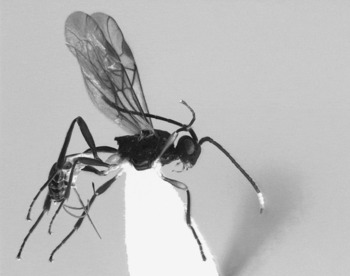
Napo townsendi sp. n., female, lateral habitus

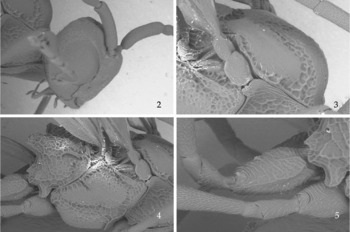
Scanning electron micrograph images of Napo townsendi Shaw, female: 2, head, lateral view; 3, mesonotum, lateral view; 4, mesosoma and propodeum, lateral view; 5, hind coxa, lateral view.

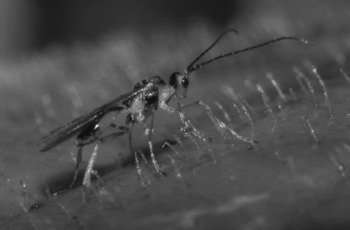
Napo townsendi, live male perching on the leaf of Dendrophorbium seedling

Napo townsendi, wing venation of the male

Type data
Holotype female, ECUADOR: Napo Province, Yanayacu Biological Station, 00°35.9′S, 77°53.4′W, 2163 m elevation, 17 August 2006, yellow pan, Macucoloma trail, A. C. Townsend, collector. Paratypes: one male, same data as holotype; one male, same data except collected 14 August 2006; one male, same data except collected 1–8 February 2007, Malaise trap; one female, same data except collected 1–8 June 2007, Malaise trap, J. Simbaña, collector; one male, same data except collected 1–8 September 2007, Malaise trap; one female, same data except collected 1–10 July 2008, yellow pans; one female, same locality except collected 1–10 May 2009, Malaise trap, J. Simbaña, collector; one female, same data except collected 1–10 May 2009; four males, same data except collected 13 June 2010, Ridge trail, hand-collected off the leaves of Asteraceae seedlings, D. lloense, N. M. Zitani, collector; one female, one male, same data except 14 June 2010 (morning), Ridge trail, hand-collected off the leaves of Asteraceae seedlings, D. lloense, collected off the same leaf, S. R. Shaw, collector; ten males, same data except 14 June 2010 (afternoon), Ridge trail, hand-collected off the leaves of Asteraceae seedlings, D. lloense, S. R. Shaw and B. Samuelson, collectors; two males, same data except collected 15 June 2010, Ridge trail, hand-collected off the leaves of Asteraceae seedlings, D. lloense, S. R. Shaw, collector; three males, same data except collected 17 June 2010, Ridge trail, hand-collected off the leaves of Asteraceae seedlings, D. lloense, S. R. Shaw, collector; one male (specimen photographed), same data except collected 17 June 2010, Ridge trail, hand-collected off the leaves of Asteraceae seedlings, D. lloense, T. Walla, collector; three males, same data except collected 18 June 2010, Ridge trail, hand-collected off the leaves of Asteraceae seedlings, D. lloense, S. R. Shaw, collector; three males, same data except collected 12 May 2011; two males, same data except collected 15 May 2011; 12 males, same data except collected 16 May 2011; four males, same data except collected 17 May 2011; two males, same data except collected 18 May 2011; five males, same data except collected 20 May 2011; eight males, same data except collected 21 May 2011, H. Aguirre, collector; one female, same data except collected 18 June 2010, Ridge trail, yellow pan, S. R. Shaw, collector.
Description of holotype female (Fig. 1)
Body length 5.2 mm; forewing length 4.7 mm; head transverse, in dorsal view 1.4 × broader than long; frons laterally, face, clypeus and gena finely colliculate to granulate (Fig. 2); eye elongate oval, not bulging anteriorly beyond face; eye 1.47 × taller than wide; eyes in anterior view distinctly converging ventrally; shortest inter-ocular distance 1.1 × clypeus width; eyes apparently glabrous but with sparse minute setae; inter-antennal distance 0.86 × antenna socket width; scrobes not protuberant; scape elongate, gradually curved, narrow basally, slightly wider apically; scape length 4.39 × width at apex; pedicel length 1.47 × width at apex; flagellum filiform with 15 elongate, cylindrical flagellomeres; F1 4.8 × longer than wide; F2 4.0 × longer than wide; F3 3.6 × longer than wide; F4 3.0 × longer than wide; F5 2.7 × longer than wide; F6 2.4 × longer than wide; F7 2.4 × longer than wide; F8 2.2 × longer than wide; F9 2.0 × longer than wide; F10 2.0 × longer than wide; F11 2.0 × longer than wide; F12 2.0 × longer than wide; F13 1.8 × longer than wide; F14 1.8 × longer than wide; F15 (apical flagellomere) 3.0 × longer than wide, tapering to acute point apically; ocelli and ocellar triangle small, slightly isosceles; distance between lateral ocellus and compound eye 5.25 × lateral ocellus width; distance between lateral ocellus and median ocellus slightly greater than one ocellus width; frons with minute median groove anterior to median ocellus; malar space 1.4 × mandible width; mandible slender, sharply pointed, with basal carina between anterior and posterior condyles; eye height 2.5 × malar space width; cheek broad, cheek width at mid-point of eye 1.0 × eye width; vertex finely colliculate to granulate; occiput with small longitudinally rugose area medially above occipital carina, with stronger median carina extending vertically towards ocelli; frons and ocellar triangle mostly lacking setae; temple, occiput and gena with sparse fine white decumbent setae arching anterolaterally. Mesosoma mostly with lacunose foveate sculpture; lateral mesonotal lobes smooth and polished; notauli coarsely foveate and indistinct from lacunose foveate sculpture of mesonotum postero-medially (Fig. 3); scutellar furrow coarsely foveate, with five cross-carinae; scutellar disc smooth medially, foveate laterally and posteriorly; mesopleuron mostly foveate to areolate, smooth postero-medially, ventrally grading into smooth mesosternum (Fig. 4); sternaulus depressed and broadly areolate but indistinct from surrounding coarse mesopleural sculpture; propodeum with a deep broad postero-median impression; propodeum and postero-lateral propodeal tubercles coarsely areolate (Fig. 4); ventral petiolar notch short, extending slightly less than half-way between metacoxae; hind coxa and mesocoxa rugose (Fig. 5), remainder of legs finely granular to colliculate; metafemur length 6.0 × maximum width; tarsal claws simple but long, sharply pointed and strongly hooked, with clusters of long setae basally; forewing with pterostigma 3.66 × longer than wide, not semicircular; forewing vein RS+M diverging from M vein distinctly below parastigma, therefore short vein 1RS present; 1RS vein equal to 1.0 × parastigma length; vein RS+M straight and entirely present; vein RS+Mb present, equal to length of vein 2RS; vein r short, straight and diverging posteriorly directly from ventral centre of pterostigma; vein r about 0.5 × as long as pterostigma maximum width; vein 3RS long and gently curving to near wing apex; vein 2M long and pigmented to near wing margin; vein M+CU slightly curved basally, straight apically; vein 1CUa not parallel with M+CU, diverging posteriorly at 45° angle from M+CU; vein 1CUa slightly shorter than vein 1cu-a; vein 2CU long and pigmented to near wing margin. Metasoma with petiole not fused ventrally, apex 4.3 × broader than base, about 0.68 × as long as metasoma beyond petiole (excluding ovipositor); tergum 1 smooth dorsally; dorsopes indicated by tiny oval dorso-lateral pits on petiole sub-basally; glymma present as broad shallow baso-lateral depression; petiolar spiracles just beyond middle of petiole, not prominent; syntergum 2+3 smooth and highly polished; tergum 8 short and strongly compressed to form a vertical slit above ovipositor; ovipositor (fully exserted) slightly longer than head and metasoma combined; sheath narrower, shorter. Ovipositor length 2.3 mm.
Colour: head mostly black, except scape, pedicel, and flagellomeres 1–10, fore-femur, tibia, and tarsus dark chocolate brown; flagellomeres 11–13 yellowish white; flagellomere 14 light brown; apical flagellomere (15) and maxillary palpus brown; labrum and mandible basally light yellowish brown; mandible apically and labial palpus dark reddish brown; compound eye dark iridescent silver; ocelli whitish transparent. Mesosoma dark chocolate brown to black, except smooth lateral mesonotal lobes reddish brown; legs dark brown, except all coxa white; trochanters white with infused brown patches; wings lightly tinted with brown infumation, venation dark brown; tegula yellowish white. Metasoma dark chocolate brown to black dorsally, segments 1–4 ventrally with pale white membranous areas; ovipositor pale brown; ovipositor sheaths pale brown laterally, white along inner sides facing ovipositor.
Variation, paratype females
Body length 3.9–5.2 mm; forewing length 3.6–4.7 mm; head, in dorsal view, 1.50–1.59 × broader than long; scape length 4.29–4.69 × width at apex; pedicel length 1.47–1.66 × width at apex; lateral lobes of mesonotum varying from reddish brown to black; subapical white annulus of flagellum comprising 4–6 flagellomeres.
Variation, paratype males
Aside from primary sexual differences, similar to female except body length 4.9–5.3 mm; forewing length 4.8–5.2 mm; head, in dorsal view, 1.47–1.59 × broader than long; face medially, labrum medially, and area above compound eye weakly rugose; vertex, temple, and occipital sculpture smoother and less granulate than female; eye smaller and rounder, 1.42 × taller than wide; eyes in anterior view less converging ventrally, shortest inter-ocular distance 1.5 × clypeus width; antenna more widely spaced, inter-antennal distance 1.4 × antenna socket width; flagellum with 15–16 flagellomeres, more slender and longer than in female; F1 8.0 × longer than wide; malar space wider, 1.7–2.5 × mandible width; eye smaller, eye height 1.15–1.25 × malar space width; cheek broader, cheek width at mid-point of eye 1.2 × eye width; forewing vein RS+M vein quite variable, either present, absent or partly present (see Fig. 1) in different individuals, sometimes differing in the right and left wings of the same individual male. Metasoma with petiole (tergum 1) shorter, and more coarsely sculptured than in female, apex 4.2 × broader than base, about 0.61 × as long as metasoma beyond petiole; tergum 1 longitudinally rugose on basal 1/2, smooth apically; petiolar spiracles located distinctly beyond middle of petiole.
Colour (males) (Fig. 6): head mostly yellowish orange, except frons medially, vertex and occiput black; antenna almost entirely black, except scape basally orange brown; apex of flagellum usually without distinct annulus, except rarely subapical two flagellomeres light brown; fore-femur, tibia and tarsus pale yellowish brown; maxillary palpus yellowish white; mandible entirely yellowish orange except apically (teeth) reddish brown. Mesosoma black except pronotum, prosternum, lateral mesonotal lobes posteriorly, and posterior scutellar margin yellowish orange; metapleuron yellowish white; fore- and mid-coxa yellowish white, hind coxa black; trochanters infused with dark reddish brown to black, posterior trochanter darkest; hind femur black on basal 1/2, yellow apically; wings lightly tinted with brown infumation, venation dark brown; tegula yellowish white. Metasoma dark chocolate brown to black dorsally, segments 1–4 ventrally pale yellowish white.
Distribution
Known only from the type locality at the Yanayacu Biological Station, Napo Province, Ecuador. Malaise traps and yellow pans were set along the Macucoloma and Ridge trails in a high-elevation primary cloud forest.
Etymology
This species is named for the collector of the holotype specimen, Andrew C. Townsend, the Station Manager for the Yanayacu Biological Station and Center for Creative Studies, Napo Province, Cosanga, Ecuador during 2009.
Discussion
Behavioural observations
During mid-June of 2010 and mid-May of 2011, abundant live males were discovered, photographed and hand-collected off the leaves of Asteraceae seedlings identified as D. lloense. The behaviour of the males is very consistent. Males were found on sunny days during the late morning or early afternoon, perching on the leaves of Dendrophorbium seedlings between 0.5 and 2.0 m tall. Unlike other insects seen walking on these plants, or coming and going actively, the males of N. townsendi remain fairly immobile near the middle of one leaf and do not readily fly away (Fig. 6). If another insect lands on the same leaf, or if one puts a finger or vial near the wasp, the male usually just turns in that direction to observe the ‘intruder’. Most of the males sampled were hand-collected simply by placing a plastic 4-dram vial over the wasp. Even then the male usually does not fly, and needs to be coaxed into walking into the vial. In several cases, more than one male was found on the same plant, but on different leaves. It is hypothesized that the observed behaviour of males perching preferentially on Dendrophorbium seedlings may be a lekking behaviour with males waiting for virgin females to arrive. However, only in one instance was a female and a male observed and collected from the same leaf, and in that case, the female seemed disinterested in the male and was presumably already mated. That female and male were collected alive into the same 4-dram plastic tube, and were kept alive together for 48 h. No attempt at mating was observed. The female remained actively moving about in the tube, with her metasoma bent downwards and the ovipositor projecting forwards between the legs, in an ovipositing stance. The male remained mostly in one spot, but kept rotating to watch the movement of the female. It is interesting to observe that while female specimens are actually somewhat larger and longer than male specimens, the living female appeared smaller because of the bending of the metasoma under the body (a behavioural position that is not preserved in death). It is possible that the observed male behaviour is not lekking but is simply abundant males that have recently emerged as adults, and have not sufficiently matured to begin searching for females. However, in all cases, the observed males appeared to be well-pigmented and well-sclerotized, and there was no indication that they had recently emerged (no host remains or vacated parasitoid cocoons were found). Also, the hypothesis of recent emergence does not explain the male behaviour of staying in place on the leaf and turning to observe any approaching insect, or the strong preference of males for seedlings of the Dendrophorbium plant. The fact that males will turn, walk, run or sometimes fly away in response to a stimulus (a collecting vial, finger or another insect) suggests that they are not just recently emerged, or needing to mature further before activity.
The host insect for N. townsendi remains unknown, but I am continuing to make observations on Dendrophorbium plants and hope to observe mating, egg laying into a host insect, and confirm the host by rearing the wasp, eventually. Previously I suspected that the host might be a bark beetle, because of the phylogenetic affinity of this new genus to the genus Ropalophorus, which are only known to utilize bark beetles as hosts. But since the discovery that Napo females carry the ovipositor in a forward striking position, suggesting that the females attack an exposed host directly, it seems more likely that the host will be found to be an active and exposed insect, perhaps an adult beetle associated with Dendrophorbium trees. The scarcity of females relative to males may just be an artefact of their behaviours. Dendrophorbium matures into tall trees, 20 m or higher. Once mated, the females may return to the forest canopy to search for hosts, making it difficult to find females near the forest floor.
Conclusions
A new genus and new species of parasitoid wasp N. townsendi (Hymenoptera: Braconidae: Euphorinae: Dinocampini) was discovered from the Yanayacu Biological Station in Napo Province, Ecuador. The new genus and species is described and compared with the most closely related genus Betelgeuse Shaw 1988. Males of N. townsendi were found preferentially perching on the leaves of the seedlings of the asteraceous tree, D. lloense. It is hypothesized that the observed behaviour of males perching preferentially on Dendrophorbium seedlings is a lekking behaviour with males waiting for virgin females to arrive.
Acknowledgements
Harold Greeney and Andrew Townsend are thanked for providing local arrangements and hospitality while at the Yanayacu Biological Station. This research was supported by the National Science Foundation (NSF) grants BSI-03-46729, BSI-07-17458, DEB-07-17034 and DEB-10-20751 (Caterpillars and Parasitoids in the Eastern Andes of Ecuador), and the NSF Research Experience for Undergraduates supplemental grants DEB-08-23094, DEB-09-13110 and DEB-10-26103. Any opinions, findings and conclusions expressed are those of the author and do not necessarily reflect the views of the National Science Foundation. Travel to Ecuador was also supported, in part, by grants from the U.W. International Programs, the U.W. Environment and Natural Resources Program, the Wyoming NASA Space Grant Consortium (NASA grant #NNG05G165H) and the U.W. Global Perspectives Program. Nina M. Zitani is thanked for her keen eyes and collecting skill in being the first to notice the presence of live N. townsendi males on Dendrophorbium leaves, and bringing it to my attention. Tom Walla, of Mesa State College, provided the photograph of the living male specimen perched on a leaf. Miranda Bryant provided critical assistance with Adobe Photoshop, and helped with the arrangement of photos into a plate. Dr Zhaojie Zhang of the University of Wyoming Microscopy Core Facility is thanked for his kind assistance and advice with scanning electron microscopy.