On August 25, 2017 Hurricane Harvey made landfall near Corpus Christi, Texas, as a Category 4 hurricane with a diameter of 280 miles and 130 mph winds.1 Harvey, a 500-year flood event, was unprecedented in its scale and impact.Reference Garfield2 The storm dumped over 27 trillion gallons of water on Texas and Louisiana in 6 days and set a record in the continental United States for rainfall during a storm of 51 inches.1 The catastrophic flooding left tens of thousands of residents stranded in their homes and damaged hundreds of thousands of structures.Reference Zelinsky3 Approximately 336 000 people lost power and 30 000 water rescues were conducted.Reference Zelinsky3 In the first 15 hours of the storm, Houston 911 received 56 000 calls, and emergency services continued to receive an estimated 1000 calls per hour 4 days after the storm.1 Overall, an estimated 40 000 people were displaced and 68 people killed as a direct result of Hurricane Harvey in the United States.Reference Zelinsky3
Harvey was part of an unprecedented hurricane season that included Hurricane Maria, a Category 5 storm that devastated parts of the Caribbean, including much of Puerto Rico, and Hurricane Irma, a Category 4 storm that caused severe damage in Western Florida. The acute and long-term effects of such natural disasters are well established in the literature.Reference Fergusson, Horwood, Boden and Mulder4–Reference Thienkrua, Cardozo and Chakkraband14 Previous research has demonstrated that increased exposure to a natural disaster is associated with increased symptoms of anxiety, depression, and/or posttraumatic stress disorder (PTSD) immediately post-disaster and later in life.Reference Fergusson, Horwood, Boden and Mulder4–Reference Maclean, Popovici and French6,Reference Schwartz, Liu and Sison8–Reference Thienkrua, Cardozo and Chakkraband14 Experiencing a natural disaster has also been found to be correlated with increased suicidal ideation and attempts, as well as substance use.Reference Fergusson, Horwood, Boden and Mulder4,Reference Stein, Chiu and Hwang13 These impacts on mental health have been found to be directly related to the intensity and type of disaster exposure experienced by an individual.Reference Fergusson, Horwood, Boden and Mulder4,Reference Norris and Rosen7,Reference La Greca, Silverman and Wasserstein15–Reference van Griensven, Chakkraband and Thienkrua18
Due to its proximity to the Gulf of Mexico, Houston, nicknamed the “Bayou City,” is particularly vulnerable to flooding, and Hurricane Harvey was the third 500-year flood (ie, a flood with a 1-in-500 (0.2%) chance of occurring in any given year) in the city in less than a decade.Reference Fergusson, Horwood, Boden and Mulder4 Houston and its surrounding areas are located on a gulf coastal plain that was once forest, marsh, and swampland, and downtown Houston sits only 50 feet above sea level.Reference Garfield2 The city’s vulnerability to flooding is further exacerbated by clay soil that does not absorb water well and the paving and development of over 38 000 acres that were once wetlands.Reference Quinn19 The frequency and severity of floods in Houston make it a unique environment in which to study the impacts of hurricane exposure.
In addition to its unique geographical attributes, Houston is also uniquely diverse. A city of approximately 2.3 million people, 58% of residents identify as White, 22.8% as Black or African American, 6.7% as Asian, and 44.3% as Latino or Hispanic.20 Houston is home to large immigrant populations, including Vietnamese, Ethiopian, and Indian communities, among others.Reference Mejia21 An estimated 145 languages are spoken in the city, and it is considered the most ethnically diverse metropolitan area in the United States.Reference Klineberg22 Research on the impact of natural disasters on certain ethnic minority groups is mixed. While studies have found that minorities may be at higher risk for mental health issues following a natural disaster,Reference Toldson, Ray, Hatcher and Straughn Louis23,Reference Wang, Gruber and Powers24 the literature also suggests that being a member of an ethnic minority group may be a protective factor.Reference Fussell, Sastry and VanLandingham25 In this way, the impacts of Hurricane Harvey should be examined in the context of the city’s racial and ethnic makeup.
Preliminary data have been published on the acute mental health impacts of Hurricane Harvey.Reference Shultz and Galea26,Reference Taioli, Tuminello and Lieberman-Cribbin27 However, this report builds on the existing literature by assessing longer term psychological health at 5 months post-hurricane. The current study aims to assess whether increased negative experiences due to Hurricane Harvey are associated with increased symptoms of PTSD, perceived stress, anxiety, and depression within the context of a highly diverse and geographically unique setting.
Approval for this study was given by the Institutional Review Board of Northwell Health (IRB# 13-499B).
METHODS
Participants
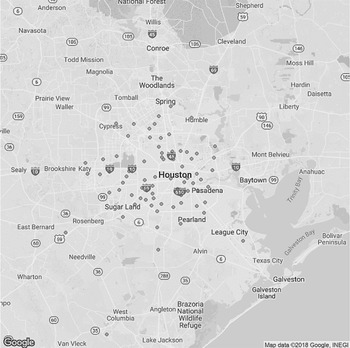
The study enrolled 161 consenting participants living in the greater Houston area during Hurricane Harvey. Study staff used convenience sampling facilitated by community and academic partnerships in the Houston area. Community partners assisted staff in organizing and promoting recruitment events over the course of 1 week in January 2018 at 5 community partner locations, including local libraries and community centers. Efforts were made to recruit a study sample reflective of the ethnic and racial makeup of Houston by holding recruitment events in distinct neighborhoods throughout the Houston metropolitan area. Recruitment and survey administration took place from January 25-29, 2018. Individuals who did not speak English or Spanish or those who had cognitive impairment that might hinder their ability to provide informed consent were excluded from the study. Figure 1 represents the geographic distribution of participants.
Distribution of Zip Codes of Pilot Sample of Residents in Houston, TX, January 2018.

Surveys
Pilot Survey
Demographic and lifestyle information were collected from all participants. The pilot survey contained validated measures of symptoms of behavioral and mental health, including alcohol and substance misuse, PTSD, perceived stress, anxiety, and depression. Participants also completed a section specific to exposure to Hurricane Harvey. The survey took approximately 30 minutes to complete, and participants were given the option to complete the survey on paper or on an iPad. All participants were provided US $20 on a rechargeable gift card as compensation for completing the survey.
Independent Variable
The hurricane exposure tool, used in previous research with Hurricane SandyReference Lieberman-Cribbin, Liu and Schneider5,Reference Schwartz, Liu and Sison8,Reference Schwartz, Rasul and Kerath10–Reference Schwartz, Sison and Kerath12 and informed by previous research conducted during Hurricanes KatrinaReference Harville, Xiong and Smith28 and Andrew,Reference Norris, Perilla and Riad29 was tailored to Hurricane Harvey. It included 30 Yes/No items of possible hurricane experiences. Participants were asked, “Did any of the following apply to your experience during Hurricane Harvey?” Items included personal exposure measures such as injury/death of a friend or family member and property exposure such as a damaged/destroyed home.Reference Schwartz, Liu and Sison8 The number of hurricane exposures checked was summed to define a hurricane exposure score.
Outcome Variables
Mental health symptom evaluated included PTSD, perceived stress, anxiety, and depression. PTSD during the last month was measured using the self-reported Post-Traumatic Stress Disorder Checklist Specific (PCL-5), a validated 20-item checklist widely used in previous disaster studies.Reference Blevins, Weathers and Davis30 Each item on the scale was asked specifically in relation to Hurricane Harvey. Perceived stress over the last month was defined using the 10-item Perceived Stress Scale (PSS), which is validated and used earlier in disaster studies.Reference Cohen, Kamarck and Mermelstein31 Anxiety and depression symptoms during the previous 2 weeks were measured using the Generalized Anxiety Disorder-7 (GAD-7)Reference Löwe, Decker and Müller32 and the Patient Health Questionnaire (PHQ-9)Reference Martin, Rief, Klaiberg and Braehler33 instruments. Items from each instrument were summed to create symptom severity scores for PTSD (range = 0-80), PSS (range = 0-40), depression (range = 0-27), and anxiety (range = 0-21). If a participant missed ≥ 3 items in a scale, his/her symptom severity score was considered missing and was therefore not included in the analysis. Each mental health symptom severity score was then dichotomized as yes/no indicators of probable PTSD (≥ 30/< 30),Reference Weathers, Litz and Herman34 probable anxiety (> 10/≤ 10),Reference Löwe, Decker and Müller32 and probable depression (> 10/≤ 10).Reference Martin, Rief, Klaiberg and Braehler33 As a post-hoc exploratory analysis, a composite measure of overall mental health was created to indicate any elevated symptoms of PTSD, anxiety, or depression.
Substance abuse outcomes measured were alcohol misuse and recreational drug use. Alcohol abuse was defined using criteria for excessive drinking. If in the past year a male drank ≥ 5 drinks in a day (≥ 4 drinks for a female) on a monthly basis or more, or drank ≥ 15 drinks a week (≥ 8 drinks for a female), she/he was categorized as engaging in alcohol misuse.35 Recreational drug use was defined as using recreational drugs or using a prescription drug for nonmedical use at least once or twice or more frequently within the last year.36
Other Study Variables
Demographic variables included age, gender, race (White, American Indian/Alaska Native, Black, Asian, other, multiple races), Hispanic ethnicity (yes/no), level of education (completed high school [HS] or above, some HS or below), being born in the United States (yes/no), and yearly household income (< US $9000, $10 000-$38 000, $39 000-$92 000, $93 000-$192 000, > $193 000).Reference Pomerleau37 Yearly household income was dichotomized as ≤ US $38 000 and ≥ US $39 000 for analysis. Current tobacco use was assessed based on a question asking about current smoking status.38 Those who reported having been diagnosed with a mental health condition prior to the hurricane were categorized as having a history of mental illness. Current mental health treatment status was measured with a yes/no question. Participants were also asked with a yes/no question whether they experienced past hurricanes.
Statistical Analysis
Participants were described by study characteristics overall and by number of hurricane exposure items. Differences between characteristics and the hurricane exposure score were assessed using the Mann-Whitney Rank Sum tests or Kruskal-Wallis test, and Spearman’s Rank Correlation (rho) for categorical and discrete study variables, respectively. The distribution of zip codes that participants resided in was generated from R statistical programming language 3.5.1,39 using the “ggmaps” package.Reference Kahle and Wickham40
A multiple linear regression was performed to determine the association between the hurricane exposure score and PSS symptom score. Because the distribution of the residuals for anxiety, depression, and PTSD symptom scores was not normal and heteroscedastic, the dichotomous variables of probable anxiety, probable depression, and probable PTSD were used as outcomes and modeled using the multivariable exact logistic regression. All models adjusted for variables significantly associated (P < 0.2) with outcomes at the univariable level. A multivariable logistic regression was also fitted to evaluate the association between hurricane exposure and substance abuse outcomes, alcohol misuse and current smoking status, with the same adjustments. Recreational drug use was not modeled due to instability of parameter estimates. For logistic regression models, adjusted odds ratios (OR) and 95% confidence intervals (95% CI) are reported. For linear regression models, adjusted parameter estimates (B) are reported. All analyses were conducted using SAS 9.4 (SAS Institute, Cary, NC).
RESULTS
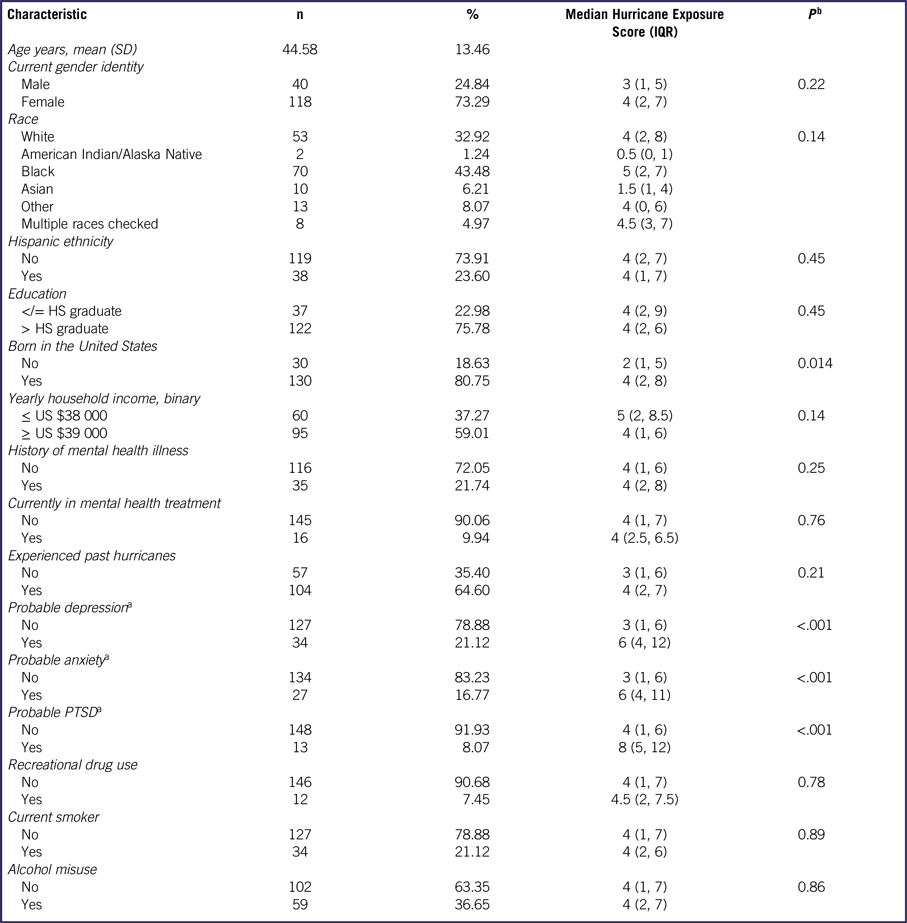
Participants had an average age of 44.58 years (SD = 13.46) (Table 1). Blacks and Whites comprised 43.48% and 32.92% of the sample, and 23.60% identified as Hispanic. About 75% of the sample had greater than an HS education and 80.75% were born in the United States. Approximately 20% of participants indicated that they had a history of mental illness, and 9.94% were currently being treated for mental health issues. Sixty-four percent indicated that they had experienced past hurricanes.
Characteristics of a Pilot Sample of Residents and Median Hurricane Exposure Score in Houston, TX, January 2018

Note. HS = high school; PTSD = posttraumatic stress disorder; SD = standard deviation.
a Probable PTSD (≥ 30/≤ 30), probable anxiety (> 10/≤ 10), and probable depression (> 10/≤ 10) are dichotomized indicators based on symptom severity scores from PCL-5, GAD-7, and PHQ-9 instruments, respectively.
b P value based on Mann–Whitney rank-sum test or Kruskal–Wallis test to assess the difference in distribution in hurricane exposure score by study variables.
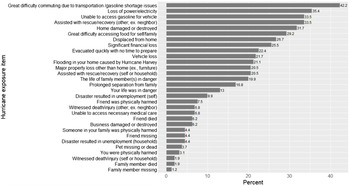
The survey was completed about 5 months after Hurricane Harvey for all participants. Median hurricane exposure score was 4 (interquartile: 2-7). Participants most frequently indicated having difficulty commuting to work/school and losing power/electricity (Figure 2). Death, injury, or missing family members was indicated less than 5% of the time. However, 6.21% of participants had a friend who died, and 7.45% had a friend who was physically harmed.
Percent Endorsing Hurricane Exposure Items in a Pilot Sample of Residents in Houston, TX, January 2018.

Greater hurricane exposure was significantly associated with being born in the United States (see Table 1). It was also weakly positively correlated with PSS (rho = 0.257), anxiety (rho = 0.286), and depression symptom severity scores (rho = 0.329), and moderately with PTSD symptom severity scores (rho = 0.524). No other associations with study characteristics were found.
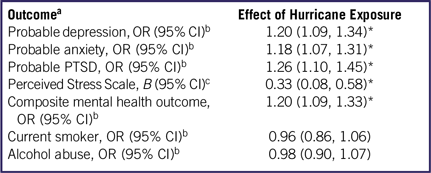
From the multivariable logistic regression models (N = 150, 93.2%), an increased hurricane exposure score (Table 2) was significantly associated with increased odds for probable depression (OR = 1.20, 95% CI: 1.09, 1.34), probable anxiety (OR = 1.18, 95% CI: 1.07, 1.31), and probable PTSD (OR = 1.26, 95% CI: 1.10, 1.45), after adjusting for US born status and history of mental illness (which were significantly associated with the 3 outcomes at the univariable level). Those who had a history of mental illness had increased odds for probable depression (OR = 3.23, 95% CI: 1.19, 8.80) and being a current smoker (OR = 3.09, 95% CI: 1.23, 7.75) compared to those without a history of mental illness, but it was not significant for the other outcomes. US born status was not associated with any of the outcomes.
Effects Between Increased Hurricane Exposure and Outcomes in a Pilot Sample of Residents in Houston, TX, January 2018

Note. B = beta coefficient; CI = confidence interval; OR = odds ratio; PTSD = posttraumatic stress disorder.
a Probable PTSD (≥ 30/≤ 30), probable anxiety (> 10/≤ 10), and probable depression (> 10/≤ 10) are dichotomized indicators based on symptom severity scores from PCL-5, GAD-7, and PHQ-9 instruments, respectively.
b Odds ratios are from exact logistic regressions, adjusted for US born status and history of mental health difficulty.
c Beta coefficient is from multiple linear regression, adjusted for gender.
* Significance at P = 0.05.
From the linear regression (N = 158, 98.1%), an increase in hurricane exposure score was also significantly associated with a 0.33 point increase in PSS symptom score (95% CI: 0.08, 0.58), while adjusting for gender. Female gender was also associated with a 2.55 (95% CI: 0.15, 4.96) point increase in PSS symptom score compared to male gender. No significant associations were found between the hurricane exposure score and substance abuse outcomes. Similar to the main analysis, the post hoc analysis involving the composite measure of overall mental health showed that an increased hurricane exposure score was associated with 1.2 (95% CI: 1.09, 1.33) increased odds of having any elevated mental health symptoms.
DISCUSSION
The present analysis indicates that exposure to Hurricane Harvey is significantly associated with symptoms of PTSD, anxiety, depression, and perceived stress. The association between hurricane exposure and current mental health symptoms remains when adjusting for factors associated with such symptoms on the univariable level in our sample, including having a history of mental health difficulties, which is consistently a strong predictor of current mental health symptoms.Reference Sastry and VanLandingham41–Reference Schwartz, Tuminello and Kerath44 US born status and history of mental health difficulties were significantly associated with anxiety, depression, and PTSD on the univariable level and were therefore adjusted for in multivariable modeling. Gender was the only demographic variable associated with perceived stress univariably and was therefore adjusted for in the multivariable model. These results suggest that post-disaster intervention should focus not only on the immediate physical safety and well-being of survivors, but also on their long-term mental health.
Interestingly, demographic characteristics typically found to be associated with increased risk of mental health difficulties in the wake of a natural disaster were not associated with increased odds of mental health difficulties in this sample following Hurricane Harvey, with the exception of the association between gender and perceived stress. As mentioned previously, literature on the impact of natural disasters on racial and ethnic minority groups is varied with some studies finding an increased risk of mental health difficulties among minorities post-disasterReference Toldson, Ray, Hatcher and Straughn Louis23,Reference Wang, Gruber and Powers24 and other studies, suggesting that membership in certain ethnic minority groups, for example, the Vietnamese community in the wake of Hurricane Katrina, may be protective against mental health difficulties post-disaster.Reference Fussell, Sastry and VanLandingham25 Unlike our sample, lower educational attainment has previously been found to be associated with greater mental health difficulties post-disaster,Reference Sastry and VanLandingham41 including increased odds of PTSDReference Lieberman-Cribbin, Liu and Schneider5,Reference Schwartz, Sison and Kerath12 and depression.Reference Schwartz, Sison and Kerath12 Finally, literature also suggests that less-resourced individuals or those of lower socioeconomic status may also be more vulnerable to the mental health impacts of a natural disaster.Reference Sastry and VanLandingham41,Reference Subaiya, Moussavi, Velasquez and Stillman42
It is possible that our results differ from these aforementioned studies on disparities among survivors due to contextual factors specific to each hurricane, such as policies and messaging around evacuation. For example, earlier studies have shown that differential impacts of hurricane exposure on mental health can be attributed, in part, to barriers to evacuation faced by vulnerable populations.Reference Toldson, Ray, Hatcher and Straughn Louis23 For a storm of its magnitude, Hurricane Harvey was unique in that no mandatory evacuation was ordered for the area. Our findings could reflect the fact that, because the Houston’s 2.4 million residents were not ordered to evacuate,Reference Andone43 vulnerable groups as well as more well-resourced inhabitants may have been equally exposed to the hurricane and thus were at equal risk for mental health difficulties post-storm. However, longer term impacts of such disasters like exposure to toxins or chemicals,Reference Schwartz, Tuminello and Kerath44 the burden of rebuilding,Reference Klineberg22 and the disruption of mental health treatmentReference Wang, Gruber and Powers24 may still disproportionately affect certain vulnerable subpopulations across different hurricanes and other natural disasters. Such disparities should be examined in future research among Hurricane Harvey survivors.
The association between perceived stress and female gender in our sample supports existing literature, which indicates that women and girls are at increased risk for mental health difficulties post-disaster.Reference Fothergill, Enarson and Morrow45,Reference Neumayer and Plümper46 Past research suggests that women are more likely to evacuate their homes during a hurricane,Reference Fothergill, Enarson and Morrow45,Reference Bateman and Edwards47,Reference Bolin, Jackson, Crist, Elaine and Morrow48 possibly due to a heightened perception of riskReference Fothergill, Enarson and Morrow45 and familial obligations such as child and parental caregiving.Reference Gladwin, Peacock, Gladwin and Peacock49 Because displacement has been found to be associated with mental health difficulties,Reference Schwartz, Rasul and Kerath10 evacuation may place women at greater risk of such difficulties following a disaster. A post hoc analysis of our sample supported the literature, with more women than men evacuating their homes prior to, during, and after the storm, though our sample size was too small to test for significance. Future research may focus on better understanding the psychosocial risk factors that place women at greater risk of mental health difficulties, and specific vulnerabilities faced by women in a post-disaster context should be considered in the development of any post-disaster mental health intervention.
The results should be interpreted within the context of the study’s limitations. Convenience sampling was used to recruit participants, and, while the geographic distribution of participations by zip code in Figure 1 indicates that the sample covered a diverse geographic area, this strategy may have introduced self-selection bias wherein individuals more impacted by Harvey may have been more willing to participate. Although we have a diverse sample, due to convenience sampling, it is not representative of the larger Houston population. Perhaps a greater inclusion of people with fewer resources (lower educational attainment) would have demonstrated greater exposure and potentially greater mental health symptoms, as previous literature has indicated.Reference Lieberman-Cribbin, Liu and Schneider5,Reference Schwartz, Sison and Kerath12,Reference Sastry and VanLandingham41,Reference Subaiya, Moussavi, Velasquez and Stillman42 Another potential limitation is the small pilot sample size of 161 participants. Future research should attempt to recruit a larger sample of the Houston metropolitan area using a random sampling of residents. Finally, mental health symptomatology was collected via self-reporting using validated measures. Future research could establish mental health burden through diagnosis by a mental health professional in order to reduce potential reporting bias.
CONCLUSIONS
Houston’s proximity to the Gulf of Mexico and the continued development of wetlands place the city and its surrounding area at continued risk for severe flooding after future hurricanes. While the physical health and safety of the survivors of natural disasters is often prioritized in the days and weeks following a major weather event, the mental health burden experienced by survivors may last months and years post-disaster.Reference Lieberman-Cribbin, Liu and Schneider5,Reference Schwartz, Sison and Kerath12 Greater public health preparedness planning is needed to develop infrastructure in which mental health services can be rapidly provided in the immediate aftermath of a future hurricane, as well as to provide sustainability for a longer term mental health service provision for individuals with chronic mental health concerns.Reference Rasul50
Financial Support
This study was funded by a private gift to Northwell Health.
Conflict of Interest Statement
The authors have no conflicts of interest to declare.