Introduction
Femoral fractures are painful injuries frequently encountered by prehospital practitioners and can be associated with a high morbidity and mortality, particularly in elderly patients.Reference Lee and Porter 1 - Reference McClure, Turner, Peel, Spinks, Eakin and Hughes 3 Systemic opioids are commonly used to manage pain after femoral fractures.Reference Mcmanus and Sallee 4 - Reference Thomas and Shewakramani 6 Along with side effects such as nausea and vomiting, they can cause hypotension and respiratory depression leading to hypoxemia, which may worsen outcomes in trauma.Reference Middleton, Simpson, Sinclair, Dobbins, Math and Bendall 5 - Reference Davidson, Ginosar and Avidan 10
Oligoanalgesia often leads to inadequate pain control for patients both in and out of hospital.Reference Albrecht, Taffe, Yersin, Schoettker, Decosterd and Hugli 11 - Reference Motov and Khan 13 The suboptimal management of pain can result in: a reduction of quality of life; impaired sleep; impaired physical function; posttraumatic stress disorders; the development of chronic pain syndromes; and a higher economic burden for the treatment of patients suffering the effects of poor pain management.Reference Sinatra 14
Regional techniques for providing analgesia, such as Fascia Iliaca Compartment Block (FICB), may provide superior targeted pain relief and reduce opioid requirements in the trauma patient.Reference Fletcher, Rigby and Heyes 2 , Reference Wathen, Gao, Merritt, Georgopoulos and Battan 15 - Reference Høgh, Dremstrup, Jensen and Lindholt 18 Lower-limb nerve blocks have previously been demonstrated to deliver effective pain relief in patients suffering neck-of-femur or femoral shaft fractures in a hospital setting.Reference Foss, Kristensen and Bundgaard 19 - Reference Christos, Chiampas, Offman and Rifenburg 21
The FICB was first described in 1989 by Dalens, et alReference Dalens, Vanneuville and Tanguy 22 where it was reported to have a higher success rate at blocking the femoral, lateral cutaneous, and obturator nerves when compared to the “3-in-1” block. The FICB was described as inexpensive and did not require special skills or equipment to perform. These qualities give FICB the potential to be a suitable prehospital intervention.
The purpose of this systematic review is to collate and analyze current evidence of the prehospital use of FICB in patients of any age suffering fractures to the femoral bone; in particular, to assess whether FICB provides effective prehospital analgesia in this group of patients and is a feasible analgesic technique. The reported success rates and adverse effects of FICB performed in a prehospital setting are investigated along with any data on patient satisfaction and scene time delays.
Methods
Preferred Reporting Items for Systematic Reviews and Meta-Analyses (PRISMA) guidelines were used to create a structured and reproducible methodology.Reference Moher, Liberati, Tetzlaff and Altman 23 A search strategy was created (Appendix 1; available online only) and applied to multiple electronic databases between 1989, the date the FICB was first described by Dalens, et al,Reference Dalens, Vanneuville and Tanguy 22 and February 1, 2017. The search was developed using a standardized search filter for the term “prehospital” to ensure all relevant studies were included.Reference Smith, McDonald, Wasiak, Jennings, MacPherson and Archer 24 The search was applied to MEDLINE/PubMED (National Center for Biotechnology Information, National Institutes of Health; Bethesda, Maryland USA); Embase (Elsevier; Amsterdam, Netherlands); OVID (Ovid Technologies; New York, New York USA); Scopus (Elsevier; Amsterdam, Netherlands); Web of Science (Thomson Reuters; New York, New York USA); and the Cochrane Database (The Cochrane Collaboration; Oxford, United Kingdom). In addition to this, reference lists of review articles were reviewed and the contents pages of the British Journal of Anaesthesia (The Royal College of Anaesthetists [London, UK]; The College of Anaesthetists of Ireland [Dublin, Ireland]; and The Hong Kong College of Anaesthesiologists [Aberdeen, Hong Kong]) 2016-2017 along with the journal Prehospital Emergency Care (National Association of Emergency Medical Service Physicians [Overland Park, Kansas USA]; National Association of State Emergency Medical Service Officials [Falls Church, Virginia USA]; National Association of Emergency Medical Service Educators [Pittsburgh, Pennsylvania USA]; and the National Association of Emergency Medical Technicians [Clinton, Mississippi USA]) 2016-2017 were hand searched as these journals were identified as being likely to include relevant studies and to ensure that no newly published articles were missed.
Trials and studies of any design were included and no language or publication status restrictions were imposed. The study characteristics for inclusion are given below:
∙ The Population – Patients of any age suffering femoral fractures, including neck-of-femur fracture or femoral shaft fracture, in a prehospital setting.
∙ The Interventions or Exposures – FICB performed in a prehospital setting by any practitioner using the landmark technique (ie, without ultrasound guidance).
∙ The Comparator Group – Where possible, the block will be compared to a group of patients suffering femoral fractures who receive alternative forms of analgesia (eg, oral and intravenous analgesics).
∙ The Outcomes – Primary outcome measure: pain scores of patients before and after the FICB is administered; Secondary outcome measures: success rates of performing the prehospital FICB, complications or adverse events resulting from the FICB, patient satisfaction, and FICB procedure length.
∙ The Study Designs – Comparative studies of any design investigating FICB delivered in a prehospital setting. To assess the feasibility and complications of FICB, studies evaluating prehospital use of FICB were also included and may include any other type of study design, including cohort studies and case reports.
An eligibility assessment for each identified study was performed by two reviewers independently. Once a potentially eligible study was identified, each reviewer performed a full-text screen of the study and evaluated its quality and validity, assigning it a level of evidence according to the Oxford Centre for Evidence-Based Medicine (OCEBM; Oxford, UK). 25 Reviewers assessed the risk of bias for each study using the Cochrane risk of bias tool consisting of five items (sequence generation, allocation concealment, blinding, incomplete outcome data, and selective outcome reporting).Reference Higgins and Green 26 Any disagreement between reviewers was settled by a third reviewer. A data extraction form based on the Cochrane Consumers and Communication Review Group’s template 27 was created and used by each reviewer to extract the relevant data from identified studies.
The data extraction form gathered the following information from each study:
∙ Characteristics of Study Participants – Any age, any gender, suffering a femoral fracture in prehospital setting, including the type of fracture.
∙ Intervention – FICB performed in a prehospital setting. Method of FICB, type of local anesthetic, dose, time FICB delivered after injury, person performing FICB (eg, clinician or paramedic), and length of time performing FICB. If comparator group type of prehospital analgesia given: which drugs, dosages, route, and timings. In all patients: other injuries sustained and other analgesia/interventions (eg, pelvic binders or leg splinting).
∙ Outcomes – Pain scores before and after administration of FICB, success rates of performing a prehospital FICB (as defined by sensory loss in the femoral nerve distribution), complications resulting from the FICB, patient satisfaction, and time taken to perform FICB.
The primary outcome measure, where possible, was the mean difference in pain score before and after the administration of FICB using a numerical pain scale.
Results
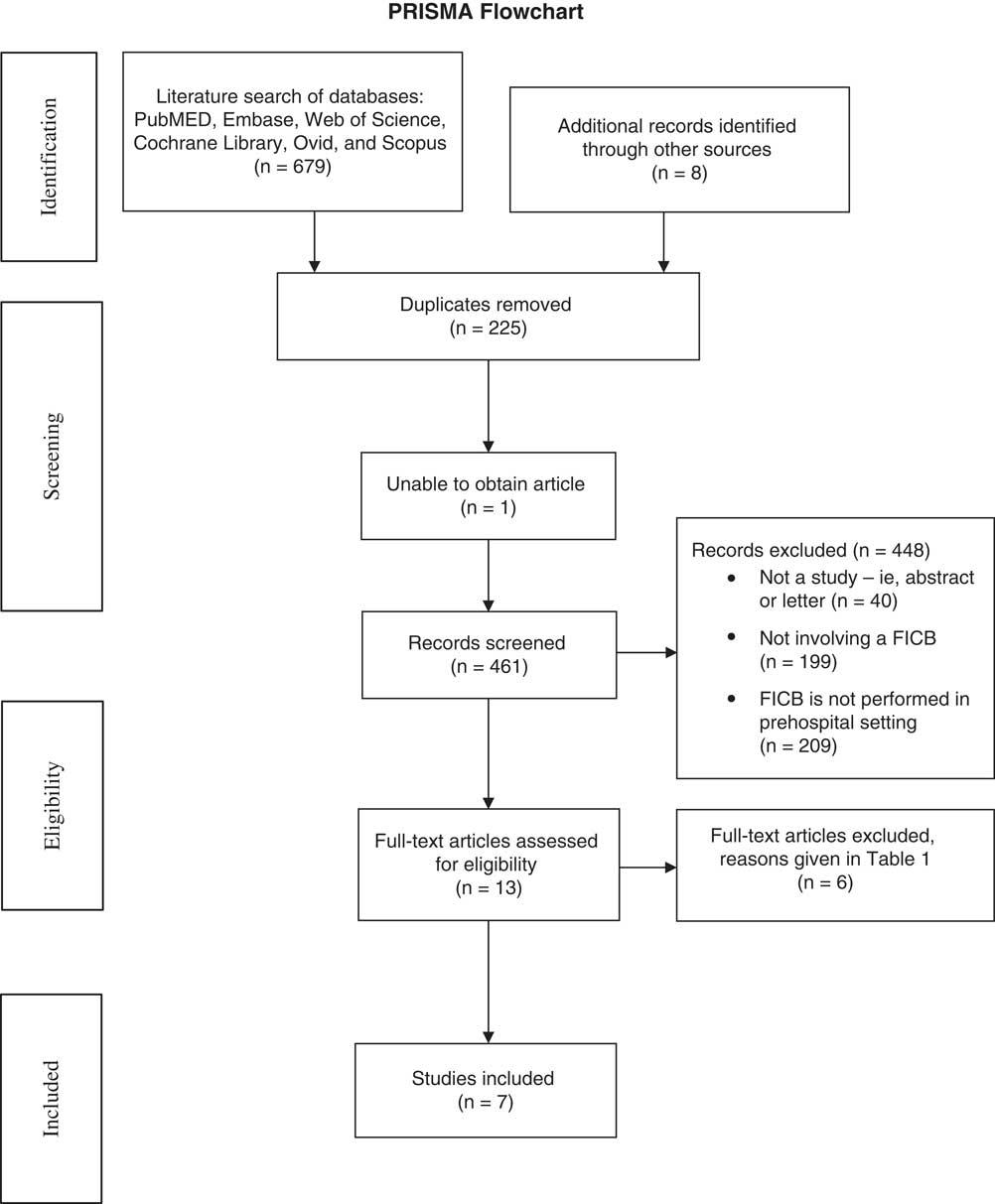
Each step of the search and review process is described in a flow chart following the PRISMA template (Figure 1).
PRISMA Flow Chart.Abbreviations: FICB, Fascia Iliaca Compartment Block; PRISMA, Preferred Reporting Items for Systematic Reviews and Meta-Analyses.

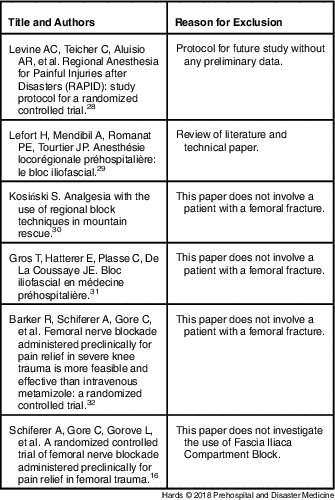
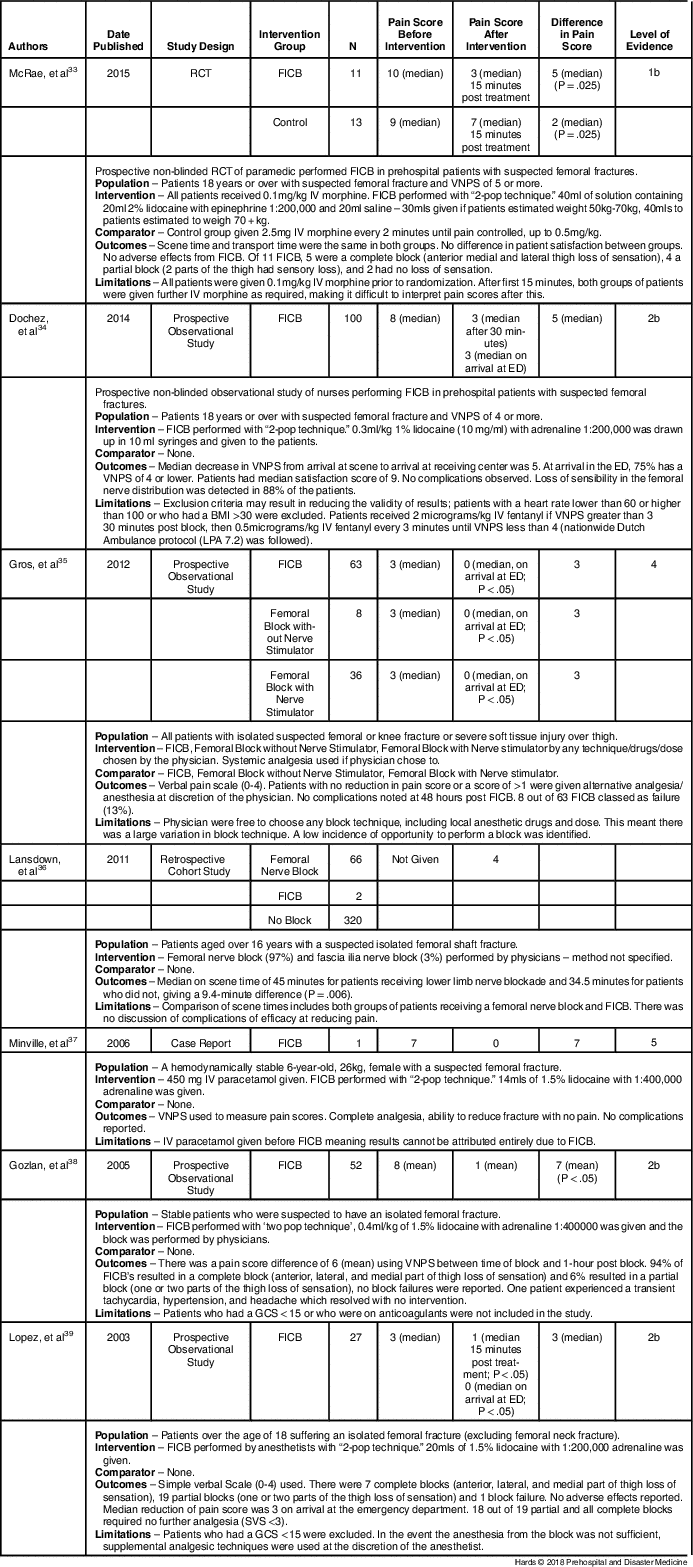
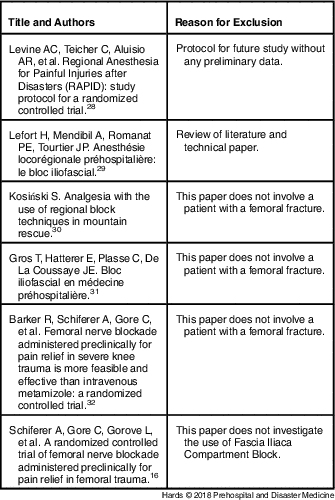
A total of 461 studies were identified and screened after duplicates from the primary search were removed. It was not possible to obtain the full text of one study from the original search for screening. Initial eligibility screening with the inclusion criteria given above identified 13 papers which went on to have full-text eligibility screening. Of these, six studies were excludedReference Høgh, Dremstrup, Jensen and Lindholt 18 , Reference Levine, Teicher and Aluisio 28 - Reference Barker, Schiferer and Gore 32 (Table 1) and seven studies were selected for inclusionReference McRae, Bendall, Madigan and Middleton 33 - Reference Lopez, Gros, Bernard, Plasse and Capdevila 39 (one randomized controlled trial [RCT], four prospective observational studies, one retrospective observational study, and one case report) with a total of 699 patients. Table 2 summarizes each included study with details on levels of evidence, patient numbers, treatments, and results, where appropriate.
Reasons for Paper Exclusion After Full-Text Screening
Details of Included Papers
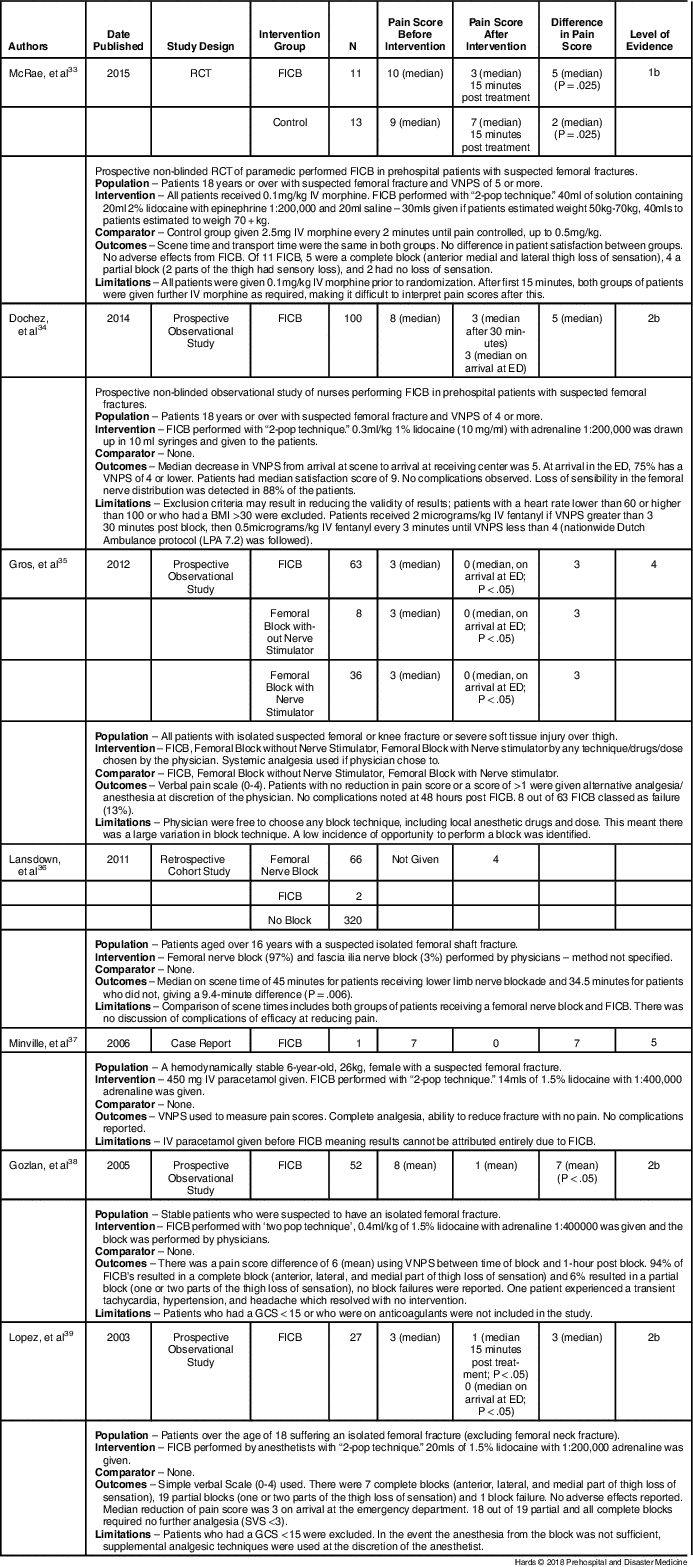
Abbreviations: ED, emergency department; FICB, Fascia Iliaca Compartment Block; IV, intravenous; RCT, randomized control trial; VNPS, Verbal Numerical Pain Score.
FICB Effect on Pain Scores
The RCT by McRae, et alReference McRae, Bendall, Madigan and Middleton 33 directly compared pain scores of a FICB group (n=11) and a standard care group (n=13). All patients received 0.1mg/kg intravenous (IV) morphine based on estimated weights. The control group received 2.5mg of IV morphine every two minutes, up to a maximum of 0.5mg/kg. The block group received a FICB performed using the “2-pop technique,” the original technique described by Dalens, et al,Reference Dalens, Vanneuville and Tanguy 22 and 40mls of solution containing 20ml 2% lidocaine with adrenaline 1:200,000, and 20ml saline was injected if the patient’s weight was estimated as over 70kg. If the patient’s weight was estimated at 50kg-70kg, 30mls of the same solution was injected. Both groups had their pain score recorded before the intervention and 15 minutes after the intervention using a standard Verbal Numerical Pain Score (VNPS) from zero to 10. The initial median pain scores for the FICB and control group were 10 and nine, respectively. Fifteen minutes post-intervention, these had reduced to three for the FICB group and seven for the control group, giving a median difference in pain score of three between both groups (P=.025). After 15 minutes, both groups were given further doses of IV morphine until pain was controlled.
In the prospective observational study by Dochez, et al,Reference Dochez, van Geffen, Bruhn, Hoogerwerf, van de Pas and Scheffer 34 they used the “2-pop technique” to deliver a FICB comprising of 0.3ml/kg 1% lidocaine (10mg/ml) with adrenaline 1:200,000 drawn up into 10ml syringes. Pain scores were measured using a VNPS (zero to 10) before the intervention and 10, 20, and 30 minutes after the procedure, and on arrival at the emergency department. If the pain score 30 minutes after the FICB was greater than three, then 0.5μg/kg fentanyl was given every three minutes until the pain score was lower than four, as per the nationwide Dutch ambulance protocol. The median pain score before intervention was eight and reduced to six at 10 minutes, four at 20 minutes, three at 30 minutes, and three on arrival at the emergency department.
Gros, et al’sReference Gros, Hatterer, Plasse and De La Coussaye 31 observational study used a simple verbal pain score from zero to four to assess pain in patients before the block, 10 minutes after, and on arrival to the emergency department. The FICB was performed with no standardized technique, and a variety of different local anesthetics, volumes, and doses were used at the physicians’ discretion. Patients with a pain score of two or above were given further analgesia, as deemed appropriate by the attending physician. The median pain score recorded was three before FICB, one at 10 minutes post-block, and zero on arrival at the emergency department (P<.05).
The observational study by Gozlan, et alReference Gozlan, Minville, Asehnoune, Raynal, Zetlaoui and Benhamou 38 used the “2-pop technique” for the FICB with 0.4ml/kg 1.5% lidocaine with adrenaline 1:400,000 and categorized the pain score before the block and then in 10-minute intervals until 70 minutes after the block. In the event of block failure, as defined by no sensory loss in any part of the thigh, IV fentanyl was given up to a maximum dose of 100μg. They used a VNPS to measure pain scores. The mean pain score before the block was eight, at 10 minutes the pain score was five (P<.05), and at 60 minutes, the pain score was one (P<.05).
Lopez, et alReference Lopez, Gros, Bernard, Plasse and Capdevila 39 used a simple verbal pain score (zero to four) to assess pain in their prospective observational study, and again performed the FICB with a “2-pop technique” to deliver 20mls of 1.5% lidocaine with adrenaline 1:200,000. If there was insufficient analgesia from the block, additional analgesia was given at the physician’s discretion. The median pain score before the block was given was three, 10 minutes after the block, it was one (P<.05), and on arrival at the emergency department, it was zero (P<.05).
Minville, et alReference Minville, Gozlan, Asehnoune, Zetlaoui, Chassery and Benhamou 37 performed a case study of a single FICB on a 6-year-old female. They used a pediatric objective pain scale (zero to 10). The FICB was delivered as 14mls of 1.5% lidocaine with 1:400,000 adrenaline using the “2-pop technique,” and 450mg paracetamol was also given. The objective pain score before the block was seven, and after 10 minutes, it was zero.
Lansdown, et alReference Lansdown, Lupton and Reid 36 did not comment on pain scores either before or after administration of FICB as the paper’s focus was on scene time delays after regional blocks.
Success Rate of FICB Performed in a Prehospital Setting
There was marked variation between studies when determining success or failure of a FICB. One criterion, which McRae, et al,Reference McRae, Bendall, Madigan and Middleton 33 Gozlan, et al,Reference Gozlan, Minville, Asehnoune, Raynal, Zetlaoui and Benhamou 38 and Lopez, et alReference Lopez, Gros, Bernard, Plasse and Capdevila 39 used, was to assess sensory loss over the anterior, medial, and lateral parts of the thigh after the block. A complete block was defined as loss of sensation in all three parts of the thigh, a partial block as loss of sensation in either one or two parts of the thigh, and a failure as no loss of sensation in any part of the thigh. Between these three studies, a total of 90 prehospital FICBs were performed with 61 complete blocks (68%), 26 partial blocks (29%), and three block failures (3%).
The studies by Dochez, et al,Reference Dochez, van Geffen, Bruhn, Hoogerwerf, van de Pas and Scheffer 34 Gros, et al,Reference Gros, Viel, Ripart, Delire, Eledjam and Sebbane 35 and Minville, et alReference Minville, Gozlan, Asehnoune, Zetlaoui, Chassery and Benhamou 37 recognized a FICB as successful if there was sensory loss in the femoral nerve distribution. A total of 164 prehospital FICBs were performed over these three studies with 142 (87%) successful and 22 (13%) block failures.
Lansdown, et alReference Lansdown, Lupton and Reid 36 did not comment on the success or failure of FICB or any method to determine its effectiveness.
Across all studies, out of a total of 254 prehospital FICBs, there was a success rate of 90% where a success was defined as some loss of sensation in the femoral nerve distribution.
Patient Satisfaction from FICB
Of the seven papers included in this systematic review, two assessed the patient satisfaction of a prehospital FICB.
McRae, et alReference McRae, Bendall, Madigan and Middleton 33 used a 5-point scale where patients assessed the quality of analgesia as nil, poor, average, good, or excellent. They found no difference in patient satisfaction between the FICB group and the control group; no patients in either group rated satisfaction as nil or poor. One patient in the FICB group reported average satisfaction, with all other patients in both groups reporting either good or excellent.
In the study by Dochez, et al,Reference Dochez, van Geffen, Bruhn, Hoogerwerf, van de Pas and Scheffer 34 they assessed patient satisfaction of their prehospital analgesia using a score system from one (absolutely not satisfied) to 10 (very satisfied). Patients were asked during their hospital stay. Patients reported high levels of satisfaction with the median satisfaction score being nine.
Adverse Events from FICB
Across all studies, a total of 256 FICBs were performed in a prehospital environment by a variety of practitioners (145 by physicians, 100 by nurses, and 11 by paramedics). Lansdown, et alReference Lansdown, Lupton and Reid 36 made no mention of the presence or absence of adverse effects. Of the remaining 254 FICBs from the other studies, one adverse effect was reported. Gozlan, et alReference Gozlan, Minville, Asehnoune, Raynal, Zetlaoui and Benhamou 38 described a patient who developed a transient tachycardia, elevated blood pressure, and headache 10 minutes following the administration of the block. The symptoms were attributed to rapid absorption of local anesthetic and were resolved spontaneously with no treatment needed and no clinical consequence.
Delays at Scene or to Transport Times from FICB
Two of the seven included studies commented on any scene delays or increase in transport time as a result of a FICB.
McRae, et alReference McRae, Bendall, Madigan and Middleton 33 identified no difference between scene times or transport times for patients receiving FICB when compared to a control group receiving standard care with IV opioids; although, their small patient numbers meant no level of significance was achieved to support this.
In the retrospective cohort study by Lansdown, et al,Reference Lansdown, Lupton and Reid 36 they identified an increase in on-scene time of 9.4 minutes, a median time of 45 minutes for patients receiving lower-limb nerve blockade, and 34.5 minutes for patients who did not (P=.006). However, the paper compared both femoral nerve blocks and FICB (66 femoral nerve blocks and two FICBs) to 320 patients who received no lower-limb block, but who also had a clinically suspected femoral shaft fracture.
Discussion
The available literature suggests that patients receiving a prehospital FICB for femoral fractures, including neck-of-femur fractures or femoral shaft fractures, benefit from a reduced pain score. Out of a total of 254 prehospital FICBs, there was a success rate of 90% and only one adverse effect, suggesting that the block is safe and can be performed reliably in a prehospital setting. There are little data investigating the effects of prehospital FICB on patient satisfaction and scene time delays. Few studies commented on hospital length-of-stay or morbidity/mortality and no significant data were collected.
Pain scores reduced after prehospital FICB across all studies and some achieved a level of significance to support this. Most studies used the “2-pop technique,” which was originally described by Dalens, et al,Reference Dalens, Vanneuville and Tanguy 22 and there is little variation in the technique used to deliver the FICB. The dosage and mixture of local anesthetic and adrenaline varied between studies with some giving a standardized volume to patients in different weight ranges and others more precisely calculating the dose based on the patients measured weight. The FICB given is therefore not identical across studies, and this must be considered when analyzing the results; however, there was no extreme variation between doses and volume delivered.
McRae, et alReference McRae, Bendall, Madigan and Middleton 33 compared FICB to a control group receiving IV morphine; they demonstrated a reduction in VNPS of seven for the FICB group and two for the control group (P=.025). This study achieved a level of evidence of “1b” according to OCEBM guidelines; however, there were a number of limitations. All patients initially received 0.1mg/kg of IV morphine before being allocated to a group; this makes the results difficult to interpret and reductions in pain score cannot be solely attributed to the FICB. Further to this, both groups of patients were given additional doses of IV morphine, if required, after the first 15 minutes.
Dochez, et alReference Dochez, van Geffen, Bruhn, Hoogerwerf, van de Pas and Scheffer 34 also reports a reduction in pain score post-FICB and records the VNPS at 10, 20, and 30 minutes, and on arrival to the emergency department. After 30 minutes, they give all patients IV fentanyl if the pain score was greater than three, and they do not comment on how many patients received this, making pain scores recorded after 30 minutes invalid when assessing the analgesic effect of FICB. They also exclude patients who have a heart rate outside of 60-100, meaning they may be missing an important subset of patients who have severe pain causing tachycardia.
Gozlan, et alReference Gozlan, Minville, Asehnoune, Raynal, Zetlaoui and Benhamou 38 and Lopez, et alReference Lopez, Gros, Bernard, Plasse and Capdevila 39 both demonstrated a reduction in pain score following block administration. They were both prospective observational studies and did not have any comparator; due to the study designs, they were both given an OCEBM level of evidence of “2b.” Gros, et alReference Gros, Hatterer, Plasse and De La Coussaye 31 assessed 63 FICBs, but physicians were free to choose the dose and technique of the block. They were also permitted to use systemic analgesia, if desired, meaning the pain scores are hard to interpret and resulting in this study being assigned a OCEBM level of evidence of “4.” Minville, et alReference Minville, Gozlan, Asehnoune, Zetlaoui, Chassery and Benhamou 37 describe a pain score reduction in a 6-year-old girl post-FICB, although IV paracetmol given before the block is performed making the pain score measurement unreliable. The paper is assigned an OCEBM level of evidence of “5” as it is a single case study.
A high success rate was seen across all studies and ranged from 80%-100%. The high success rates in a prehospital environment reflect the simplicity of the block and its suitability to be performed by a variety of practitioners in an environment more austere than a hospital. There is a lack of consistency between studies for determining block success, with some attributing sensory loss in the femoral nerve distribution as a successful block and other further categorizing the success into a complete, partial, or failed block. Most studies counted a partial block as a success. This may be misleading as, although there will have been some sensory loss, it does not necessarily reflect adequate analgesia for the patient. Similarly, blocks classed as having provided sensory loss in the femoral nerve distribution may include those which anaesthetize all parts of the thigh and those which provide minimal sensory loss to one part. The high success rates must therefore be interpreted cautiously and subjective measurements, such as the pain score and patient satisfaction, should be included in the assessment of blocks to determine their success.
Few papers directly investigated the effect of a prehospital FICB on patient satisfaction. McRae, et alReference McRae, Bendall, Madigan and Middleton 33 compared a systemic opioid control group to a FICB group and found no difference in patient satisfaction scores. Their study had small patient numbers and both groups received 0.1mg/kg morphine, making their finding difficult to interpret. High rates of satisfaction were reported by Dochez, et alReference Dochez, van Geffen, Bruhn, Hoogerwerf, van de Pas and Scheffer 34 with a median satisfaction score of nine out of 10 for 100 patients receiving FICB; although, they had no control group to compare this to. The results from both papers suggest that patient satisfaction from a FICB is high, although further evaluation compared to systemic opioids is required to determine which is superior.
The potential complications of FICB are the same for any peripheral nerve blocks and include local anesthetic toxicity, temporary or permanent nerve damage, infection, allergy, or bleeding.Reference Jeng, Torrillo and Rosenblatt 40 Across all included studies, only one adverse event was reported; a transient tachycardia, elevated blood pressure, and headache which settled after 10 minutes. These symptoms were attributed to local anesthetic toxicity and were resolved without treatment.
McRae, et alReference McRae, Bendall, Madigan and Middleton 33 identified two potentially significant adverse effects in the group receiving standard care with morphine and midazolam, in addition to five cases of nausea or vomiting, whereas their FICB group had no complications or side effects reported. Although the number of patients in this study was low, it highlights the potential for FICB to reduce the requirement for systemic analgesia and the side effects associated with its use. No other studies commented on any reduction in complications compared to opioid use. Some of the included studies did not follow-up patients after they left the emergency department, and this limitation means some late complications may have been missed. However, the rate of immediate complications was low and FICB appears to be a safe analgesic technique.
An important barrier to the widespread introduction of prehospital peripheral nerve blocks is the potential for on scene delays when delivering the intervention, and any perceived worsening of outcomes for the trauma patient as a result of this delay. Two papers commented on scene times in their investigation of FICB. McRae, et alReference McRae, Bendall, Madigan and Middleton 33 did not find any difference in scene time between a FICB and control group; however, small patient numbers mean no level of significance was achieved to support this.
Lansdown, et alReference Lansdown, Lupton and Reid 36 found a significant increase in scene time of 9.4 minutes for patients receiving FICB when compared to patients who did not (P=.006). Their results included a total of 68 lower limb blocks, two of which were FICB and 66 of which were a femoral nerve block. This result cannot be directly applied to a prehospital FICB; however, it does suggest an increase in scene time for any patient who receives a peripheral nerve block, meaning FICB may not be suitable for unstable trauma patients for whom reduced scene and transfer times may improve outcomes.
Limitations
Limitations of this review include the variation of the volume of FICB delivered between studies, along with concurrent use of systemic analgesia. Reduction in pain score in studies which use other analgesics alongside FICB cannot be entirely attributed to the block. Further to this, femur shaft and neck-of-femur fractures are not differentiated and the different demographics of each type of injury will interfere with results. The small number of studies identified in this review make it impossible to draw any definitive conclusions from the data collected.
Conclusion
In this review, a total of seven papers examining FICB performed in a prehospital setting for femoral fractures, including neck-of-femur fractures or femoral shaft fractures, were identified. All the available evidence indicates that FICB is safe and can be performed with high levels of success by a variety of different practitioners in the prehospital environment. Patients report a good analgesic effect from the block, making it a suitable option for the initial pain management in this setting. There are little data investigating the effects of prehospital FICB on patient satisfaction and on scene time delays. Further studies are required to determine its efficacy when compared to systemic opioids, to determine the long-term effects of FICB on hospital length-of-stay, morbidity and mortality, and to assess whether this regional analgesic approach to femoral fractures should become routine practice for the initial management of femoral fractures.
Supplementary Material
To view supplementary material for this article, please visit https://doi.org/10.1017/S1049023X18000365