The term ‘post-international’ has been closely associated with the work of James RosenauFootnote 1 but can be used more generally for perspectives that begin from the model of the international system and then add complications or modifications. For such approaches to world politics ‘statism’ – involving the assumption that world politics is ultimately reducible to the model of the inter-state system – is untenable and needs to be transcended. Two leading authors argue that ‘the task of remapping political space is a critical one, precisely because the ‘Westphalian moment’ is passing’.Footnote 2 Citing the rise of non-state actors in world politics, the decline of the superpower blocs, the (re)emergence of novel political entities that straddle conventional boundaries, the sheer velocity of global flows of information and objects and the rise of ‘global consciousness’ and non-territorial communities, post-internationalists have called for a ‘conceptual jailbreak’ from the theories and concepts of International Relations (IR)Footnote 3 that ‘seem hopelessly obsolete’ or even ‘obfuscate the main features of present-day global politics’.Footnote 4 Moreover, post-internationalism is just one example of a wider search of for approaches that enable us to identify ‘alternative ways in which the world is politically partitioned’.Footnote 5 However, all too often such efforts lead to descriptions of complexity that rely on the old models and discourse for coherence. ‘Plus non-state-views’Footnote 6 of international relations, though focussed on all things below and beyond the state, suffer from an underlying reliance on statist categories which generates hyphenated terminology such as ‘trans-border’, ‘transnational’, ‘de-centred’ and ‘non-state’ that reassert the significance of borders, nations, centres, states, etc. and the models of hierarchy and anarchy that underly those categories. Post-internationalism's persistent claims about change thus end up sitting uncomfortably astride concepts and terminology soaked in what Rob Walker has called the ‘discursive horizons that express the spatiotemporal configurations of another era’.Footnote 7
This article aims to provide a new option for getting beyond this post-international condition, namely by appropriating and redefining the term ‘polity’. Interestingly, though seldom defined or theorised, the term is typically used in contemporary efforts to describe how hierarchies are disintegrating or being ‘unbundled’Footnote 8 or in situations where anarchy is clearly also not appropriate because new ‘assemblages’ of authority, rights and territoryFootnote 9 such as the EUFootnote 10 are congealing. In public discourse too, the polity concept has taken on a similar function. The British broadsheet The Daily Telegraph speculated that ‘Tony Blair, the new Middle East envoy, will be hard put to reconcile an Israeli government that continues to limp along and a dramatically split Palestinian polity’.Footnote 11 On the same day another newspaper referred to Belgium as ‘an already much devolved polity’.Footnote 12 When existing models of political space are under strain ‘polity’, it seems, comes to the rescue, including where there is talk of a ‘global polity’.
Despite this – and despite a whole academic discipline being named after it (politi-cal science) – a generic definition of what a polity is, for example stipulating what constitutes the boundaries and characteristics of such an entity, has been attempted surprisingly little. Existing accounts of a global polity, for example describe it a post-international way in terms of a ‘nascent’ or ‘incomplete’ global stateFootnote 13 or in terms of how it differs from an idealised version of the international system of states (anarchy), emphasising ‘complications’ to that model such as the growth of international institutions, proliferation of non-state actors and a weakening of the nation-state.Footnote 14 How would such conceptions of a global polity help us to understand other putative instances of polity-formation like the Palestinian polity the EU-polity or the Christian Polity, for example? They would not because they amount more to a list of features of globalisation (interconnectedness, weakening states, thin community, etc.) than to a theoretical model of polity which is then applied to ‘the global’.
With a generic notion of polity, conceiving of a global polity would no longer automatically involve reliance on either of the two classical models of hierarchy or anarchy. To pre-empt the argument it is suggested in this article that a polity-structure exists when a group of units become oriented towards the governance of a common ‘governance-object’. The latter can be defined as an object that is constructed as real, distinct, malleable and subject to political action, for example, constructs such as ‘France’ or ‘the climate’. By extension, a global polity will hence have emerged to the extent that actors of whatever kind have become oriented towards the governance of specifically global governance-objects (that is, objects considered real and malleable that are constituted in terms of an understanding of the ‘world as one place’ – see discussion of globality below). Thus, if for example ‘global poverty’ or in wider terms a ‘global society’ comes to be considered real and meaningful as an object that can and should be operated upon politically – and a set of actors become oriented towards governing this object, then a global polity will have come into existence.
Though simple, this definition of polity can be used to provide criteria for when a polity exists, where its boundaries lie, what its basic logics are and how one might vary while still remaining ‘a polity’. Rather than being a vague term for any set of political institutions, polities thus conceived would be a distinct analytical category picking out a specific kind of entity.
What is more, with a theory of polity, we have at least the option of going beyond the usual post-international notions of the international system of states and complications. Those wary of complexity should not be compelled to stick with the state model and its domestic-international distinction simply because they are in favour of analytical simplifying. It should, for example, become clear that an ‘American polity’ will not be the same entity as the US state. A global polity will not be the same object as a global state or a global society, or a modified international anarchy. It is suggested below that ‘polity’ defined anew could become a useful analytical construct in a world of increasingly deterritorialised politics where networks of governance, construction of new objects of governance and a multitude of different types of actors play a significant role and cannot be captured satisfactorily within the hierarchy-anarchy dichotomy (or the continuum between them) that so much IR theory remains wedded to.
The emphasis in this article will be presentation of the theory and the difference in research agenda that it implies. In particular, to date, governance-objects, their origins and significance and their changing natures have received far less attention than the subjects doing the governing. While there has been much debate about state-centric perspectives, it has seemingly gone unnoticed that almost all IR conceives of identity (implicitly or explicitly) in terms of relations between subjects Footnote 15 (both hierarchy and anarchy are defined according to whether subjects stand in relations of super and subordination). States gain their distinctive identities in relation to ‘Others’Footnote 16 or through inward-looking self-reflection – or by a mixture of the two.Footnote 17 The polity model, in contrast, draws attention to relations between subjects and objects. Perhaps because ‘domestic society’ within sovereign states have been the dominant governance object during the Westphalian moment, the idea of identifying and analysing governance-objects has not seemed necessary and polities have been roughly considered coterminous with hierarchies. The on-going search for tools to identify other kinds of political units indicates that this is no longer sustainable.
The rest of this article explores these ideas in the following stages. First the post-international problem of trying to describe change including a ‘global polity’ in terms of old models of political space and the discourses they created is set out further. And although they remain locked within the models they aim to move beyond post-international approaches are shown to have worthwhile aims. Second, existing alternative notions of political structure beyond hierarchy and anarchy such as ‘heterarchy’ are reviewed and found wanting, as are common existing definitions of ‘polity’. Third, the new definition of polity is expanded upon providing analytical building blocks for what a polity consists of, how it is ordered, how membership is decided upon and how polities may vary. Fourth, in order to illustrate, this definition of polity is briefly applied to the idea of a global polity contrasting it to two existing accounts of the global polity. The conclusion evaluates the new definition on offer and points to the research questions opened up by the new hierarchy-anarchy-polity triad of models.
The post-international problem
In the search for new ways of making sense of political space in a globalising world, post-international writers have provided a host of innovative terms and metaphors for analysing political processes that cut across, complicate or evade the familiar structures of the international system of anarchically arranged hierarchies: ‘multi-level governance’,Footnote 18 ‘complex multilateralism’,Footnote 19 ‘the attrition of established patterns, the lessening of order’, the Frontier, or the two-way process of ‘fragmegration’,Footnote 20 ‘complex multilateralism’,Footnote 21 ‘fuzzy’ borders,Footnote 22 even the nébuleuse Footnote 23 to name but a few. While such concepts capture significant trends and undoubtedly reflect a genuinely complex globalised reality, none of them rely on their own models of political space, often depending for coherence – paradoxically – on the ones they seek to move beyond, namely hierarchy and anarchy. For instance, complex multilateralism is characterised as ‘a movement away from a multilateralism based primarily on the activity of states’.Footnote 24 Multilevel governance is used to describe how overarching policy networks are ‘unraveling the central state’.Footnote 25 Rosenau describes a new Domestic-foreign Frontier ‘not so much as a single frontier but as a host of diverse frontiers […] in which background often becomes foreground, time becomes disjointed, nonlinear patterns predominate, organizations bifurcate, societies implode, regions unify, markets overlap and politics swirl about issues of identity, territoriality, and the interface between long-established patterns and emergent orientations’.Footnote 26 Irrespective of whether these are reasonable descriptions or not, the main alternative leitmotif suggested is complexity cast in relation to the orthodox IR models. The basic terminology and categories of the old era are used to declare the end (or illusory nature) of that era.
While useful for pointing out the deficiencies of the state model of sovereign states in anarchy, if we only have the old distinction and models to compare a fluid new reality to, the latter will tend to be framed in terms of ‘not being’, trans-this, post-that, etc. The resulting picture may focus on anomalies to the old model but as Thomas Kuhn suggested, anomalies without an alternative theory rarely seriously challenge a paradigm.Footnote 27 If those critical of the selective vision of the statist model only offer essentially notions of complexity, fuzziness and disorder, then discarding statism carries the extortionate analytical price tag of falling back on complexity as the prime analytical category. This is the essence of what can be called ‘the post-international problem’.
According to many – even constructivists – this condition is virtually unavoidable:
‘the distinction between domestic and international has broken down, we hear. But the only way to talk about this is to say that – the distinction between domestic and international has broken down. So we can get to the current complex situation from the distinction by adding complexity, but not from the complex situation and build the reality of the play around that (broken?) distinction?’.Footnote 28
The choice, we are told, is between going via the state or unwieldy complexity. Is there no other distinction to begin from? Barry Buzan, in defending a statist point of departure, warns against ‘the severe loss of analytical leverage that results from bundling huge complexities into a single concept, whether it be globalization or god’.Footnote 29 But this is more an argument against having no distinctions than a justification of the state/non-state distinction.
While simply beginning from the idea of complexity appears an increasingly popular strategy,Footnote 30 beginning from a new model or simplification of political space has been mooted by several approaches and for good reasons. Most explicitly, the global polity approachFootnote 31 recommends a ‘reversal of strategy for theory-building’.Footnote 32 Instead of always beginning from the model of the international system and then adding a number of complications, this urges us to begin with ‘a conception of one world political system, or an aspect of world politics, and then add the complications arising from the persistent reality that this system lacks a unified authority structure and has formally sovereign states among its fundamental building blocks’.Footnote 33 They see this as a necessary methodological move to avoid framing global politics in terms of modified anarchy or in terms of a nascent global hierarchy, rather than because they are claiming the wholesale disappearance of the state system.Footnote 34
Getting beyond post-internationalism makes sense if one shares post-internationalism's own legitimate worries about the blind spots of statist discourse.Footnote 35 Without a new idea of political space, statism's ‘impoverished picture of morphology’ remains in place perpetuating a sterile state-versus-global debate that pits the new as the inverse of the old.Footnote 36 Reliant on the old models, IR ‘has found it difficult to conceive of globality except as the negation of statehood and politics’.Footnote 37 This has polarised the debate unhelpfully and, paradoxically, kept the future of the state as the central question in the globalisation debate even in ‘third way’ transformationist literature.Footnote 38 The idea of a global polity has thus been discarded on the grounds that the state remains the main actor.Footnote 39 Moreover, going beyond post-internationalism and searching for ‘alternative ways in which the world is politically partitioned’Footnote 40 can be justified even if one is quite sanguine about the blind spots that statism has or happen to believe that it remains prudent to prioritise the state system for whatever reason. Even for those sceptical of the globalisation and radical change-thesis, the availability of an alternative lens for analysing political space can be considered important in terms of methodological pluralism. We may be over-estimating the importance of hierarchy and anarchy simply because we always begin with them. Finally, the utility of an alternative way of delimiting political entities could be of potential use beyond IR in other disciplines exploring political entities outside the settled framework of the nation-state. Other disciplines such as anthropology have a long history of studying non-state constellations,Footnote 41 policy studies increasingly explores policy-making across borders and sectors,Footnote 42 political geographers also focus on the unruly, complex and chaotic reconfigurations of globalised space,Footnote 43 political theorists rework classical problems of democracy, authority and legitimacy outside the hierarchic state setting,Footnote 44 and legal studies have shown an interest in rule-setting practices beyond traditional law or treaty-making.Footnote 45 Essentially they all operate with groups of actors oriented towards governance objects. However, the argument here is developed in relation to the field of IR and specifically the idea of a ‘global polity’.
While the aims of post-international perspectives are thus laudable, they have not had much success in providing a new analytical point of departure. Higgott & Ougaard see the ‘global polity approach’ as a collection of attempts to ‘transcend the state-centred perspective in a conscious theoretical fashion’Footnote 46 and they and others have deployed the term ‘polity’ attempting to break the mould of the state-centric frameworks.Footnote 47 But there has been no root and branch consideration of what a polity is. Higgott and Ouggaard thus define a global polity as ‘that totality of political structures, agents and processes, with transnational properties, that in the current historical context have developed a high level of interconnectedness and an element of thin community that transcends the territorial state’.Footnote 48 Such definitions of a global polity remain, it seems, post-international. ‘Transnational’ invokes the (crossing of) the national border as a defining feature of a global polity. The ‘element of thin community’ points towards a society ‘transcending’ the nation-state. Going via the story of the state system – again – is quite legitimate in itself, but affects no real methodological reversal. World politics is still compared to the model of international anarchy or alternatively as an approximation to global hierarchy when concepts developed in the context of a domestic state framework are transferred to the global. Elsewhere Ougaard makes the case for using concepts developed for analysis of domestic politics to understand a global polity in terms of a global state superstructure.Footnote 49
The root of this persistent post-internationalism even in global polity approaches may be found the lack of an analytical definition of polity or another ‘notion of totality’ that defines in positive terms what a polity is and how it is delimited.
Models of political structure
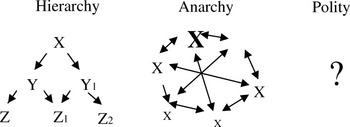
If polity is to be recast as a kind of political structure, it makes sense to look at what models we already have. Kenneth Waltz famously had some success in suggesting that only two models are necessary: hierarchy, where the units are ordered in relations of super – and subordination and therefore functionally differentiated (X, Y, Z), and anarchy, where the ordering principle is coordination among formally undifferentiated units that differ in strength (X, x, etc. – see Figure 1). Waltz warned that ‘a new concept should be introduced only to cover matters that existing concepts do not reach’.Footnote 50 Mixtures and borderline cases do not represent a third type: ‘To say that we have borderline cases is not to say that at the border a third type of system appears’.Footnote 51 By assuming that ordering principles are solely to do with one-dimensional power relations of super – and subordination, Waltz created a neat tautology: structure is hierarchy or the lack of it.
Waltz's theories of political structure.

Volumes of criticism (beyond the remit of this article) have been directed towards this dichotomy, especially in terms of it being unrealistically simplifying and structurally deterministic, unable to account for change.Footnote 52 The whole post-international approach is of course dedicated to – even defined by – showing how the model of the international system falls short because the system is changing and becoming more complex, post sovereign or interconnected. However, the question of an alternative model of political structure for grouping units and understanding their dynamics has been attempted surprisingly little.Footnote 53 In rejecting the twin models of anarchy and hierarchy, the very idea of models as ways of simplifying complex reality have often implicitly been rejected too, leaving little in the way of simplifying tools for heterodox scholars to reach for when describing world politics (hence the penchant for complexity and metaphors).
That critics of neo-realism have left this flank open is perhaps why, as Ole Wæver points out,Footnote 54 Waltz has of late defended his theory not so much in terms of what the world looks like but in terms of what he argues a theory is or should be, namely a ‘picture, mentally formed, of a bounded realm or domain of activity. A theory is a depiction of the organization of a domain and the connections among its parts’.Footnote 55 It is a simplification, invented by the analyst (‘mentally formed’) to make sense of a certain field and it is, in an important way ‘a picture’: ‘A theory […] is not a collection of variables’ it is, literally, a depiction that also simplifies: ‘to criticize a theory for its omissions is odd, because theories are mostly omission’.Footnote 56 This is different from the medium-range idea of a theory as a set of propositions about causes and effects, something Waltz considers to be a specification of a theory, rather than the theory itself. While many would disagree with this definition and concentrate on how a theory such as anarchy should be specified, perhaps including more variables or opening up the units to scrutiny, it is fair to say that a relatively small amount energy has gone into alternative ‘theories’ in the sense of pictures, mentally formed that make sense of the structure of a field. Therefore, a defense of this idea of theory can parade as a defence for one particular theory, namely Waltzian neo-realism. If pictures are crucial this would explain some of Waltz's success and resilience.
None the less intimations of alternative models of political structure exist within IR. Beyond hierarchy and anarchy, some like Ruggie have employed the concept of ‘heteronomy’ to denote interwoven and overlapping jurisdictions.Footnote 57 ‘Heterarchy’ has likewise been defined as a structure in which each element is either unranked relative to other elements, or possesses the potential for being ranked in a number of different waysFootnote 58 such concepts typically applied to structures such as the EUFootnote 59 or Medieval Christendom.Footnote 60 In heterarchy we learn that ‘political authority is neither centralized (as under conditions of hierarchy) nor decentralized (as under conditions of anarchy) but shared’.Footnote 61 The network metaphor used typically to capture political alternative structures particularly in a globalised world is another possible example of an alternative theory of political structure.Footnote 62 Organisation theory has posited ‘networks’ as the third organisational structure after hierarchy and the market (roughly equivalent to anarchy which Waltz of course moulded on economic theory).Footnote 63
However, although doubtless of value in themselves, such concepts remain generally difficult to picture, and typically rely on complexity (often explicitly in relation to hierarchy or anarchy) for their analytical power and are therefore not suited to the task we have set ourselves here of, in the interests of theoretical pluralism, facilitating a ‘reversal of strategy for theory-building’Footnote 64 starting from an alternatively delimited entity (in this case a global one – the global polity).Footnote 65 ‘Heteronomy’ remains essentially a complication of hierarchy (many overlapping ones) while ‘heterarchy’ is defined as ‘neither hierarchy nor anarchy’ leaving unspecified when a heterarchy is positively constituted and when not and how the limits of one might be decided upon (not to mention what the ‘logic’ of a heterarchy might be). Picturing a heterarchy is not easily done from this description. Networks, on the other hand, are sometimes defined simply as a set of units (or nodes) with connections between them.Footnote 66 Unlike hierarchies these nodes-with-connections-constellations are not fixed or constituted by a dominantnode or sovereign. Unlike anarchies the nodes in a network are not necessarily functionally equivalent or in competition. Beyond those negatives, however, networks can be structured in any number of ways. That something is ‘a network’ tells us little of the nature of the relations between units except that they are not fixed or hierarchical (since we would then call them ‘structures’ or ‘hierarchies’, respectively). Keck and Sikkink specify in more detail defining networks as essentially cooperative organisations ‘characterized by voluntary, reciprocal, and horizontal patterns of communication and exchange’Footnote 67 although it remains unclear why a network could not coerce or contain vertical patterns of communication and exchange. For the purposes of this argument it suffices to point out that a network can assume any number of basic morphologies and cannot thus be likened to a pictorial model of political structure or perform the function of effectuating a methodological reversal. Applied to the case of the global polity: describing a ‘global network’ may be worthwhile but is not equivalent to claiming a global polity, unless ‘polity’ is defined as simply connected actors (I argue that ‘system’ is the appropriate label for sets of connected actors of which hierarchy, anarchy also are types).
Saskia Sassens use of the term ‘global assemblages’ is promising too, concerning new constellations of key elements of the nation state (territory, authority and rights) but is expressly left un-theorised.Footnote 68 Nigel Thrift works creatively with new forms of social space and also makes use of ‘assemblage’, defining it in terms of old elements put together in a novel way that ‘breathes life into the elements that compose it and induces a novel perception of reality’.Footnote 69 Polities are of course assemblages in the sense of being entities that come into being through constellations that at some point are novel, but to be a pictorial theory of political structure polity must suggest how they are put together. Not all assemblages are polities, in other words, and so this concept is also of a different order. Finally, the idea of global or world society is also something different and broader than a global polity, denoting an integrated global social body with some form of community of shared norms or a more abstract world system of connected parts which again equates ‘polityness’ with interconnectedness.Footnote 70 Social theories of globality will be crucial for our understanding of global politics but do not equate to a pictorial theory of political structure.
This brings us to existing definitions of polity. Using the term as the label for a new model puts aside older definitions and focuses instead on the way the term currently functions. Some define ‘polity’ as a broad label roughly for any agent capable of commanding resources with some degree of common internal identity and institutions like empires, states or clans.Footnote 71 This relies at base on the model of hierarchy although it denotes a wider and more generic entity than a state and approximates Rosenau's idea of ‘spheres of authority’.Footnote 72 Most famously, Fergusonand Mansbach define a polity as something constituted by: (i) a distinct identity or ‘we-ness’; (ii) a capacity to mobilise resources and, (iii) ‘a degree of institutionalization and hierarchy’.Footnote 73 In comparison many current uses of ‘polity’ are intended precisely to capture broken or dispersed hierarchies (for example, ‘the Palestinian polity’, the ‘EU polity’ or ‘global polity’). Thus defined polity brings a more accommodating and historically sensitive idea of hierarchy than the usual narrow state-sovereignty conception, but it does not provide a new morphology or theory of political structure that transcends the hierarchy-anarchy continuum.
Polity is also at times defined in a more generic way, one modern encyclopaedia defining a polity as ‘a society's system for governance’.Footnote 74 This casts polity as an overarching term, despite the tendency for it to function in a more specific way. Moreover, to accept such a definition is to create a (poorly specified) synonym for ‘political system’Footnote 75 best known from political science in terms of a set of arrangements ‘through which values are authoritatively allocated for a society’.Footnote 76 This suggests something with inputs, gatekeepers, processes, outputs, feedback, etc. in a much more institutionalised sense, usually modelled on the modern pluralist state. This seems not very appropriate for something like a ‘global polity’ which is far less established. In another more minimalistic definition, for Hedley Bull a system of states is formed ‘when two or more states have sufficient contact between them, and have sufficient impact on one another's decisions to behave – at least in some measure – as parts of a whole’.Footnote 77 If polity were used in this way, then any two states interacting enough to behave ‘in some measure as a part of a whole’ would make up ‘a polity’. The US and Canada interact enough to take each other into account. But would we speak of a US-Canadian polity? China may be investing in Africa but could we speak of a Chinese-Angolan polity? Hardly. Something is missing. There is more to a polity than mere interaction. Additionally, such overarching definitions of polity stand in contrast to older definitions of polity, for example Aristotle's, in which polity denoted a specific system of rule in which many groups take turns to govern broadly in the interests of the whole community. But this latter definition resembles broadly what we today refer to as democracy.Footnote 78
Rejecting both the hierarchy-based and the catch-all system definition and the Aristotelian idea of polity, polity can be reserved, along with anarchy and hierarchy, as a theory of political structure – how parts in a system relate to one another – while ‘political system’ can remain the overarching term for any situation in which units interact sufficiently to have to take each other into account.
The structure of polity
According to what principle are units in ‘a polity’ arranged, if not by relations of super and subordination? Looking at much current usage I have suggested that a polity is constituted not by the presence or absence of hierarchy between subjects but by their orientation towards a common governance-object. Speak of a polity signals not the presence of a hierarchy but the presence or absence of an object considered governable towards which a set of actors are oriented. This, I suggest, is what constitutes polities.
Polity.
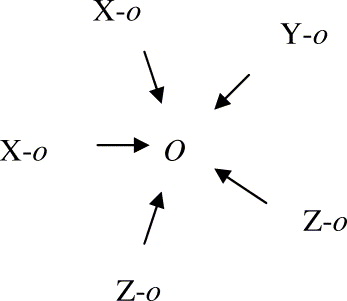
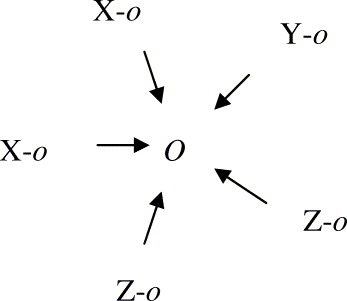
In formal terms a polity exists whenever a set of actors are oriented towards the governance of one or more common governance-objects. Figure 2 pictures a governance-object and X-o, Y-o and Z-o are different subjects oriented towards governing it. As will be explained, governance-objects may disappear or change over time, but without a common governance-object we can say that there is no polity. A polity thus conceived requires no common thick values or affinity between actors (and so is not identical to a society), or an ability for one agent to somehow coerce the others (and so is not defined by hierarchy) only a common interest in governing an object in some way. In contrast, an anarchy consists traditionally of units who define themselves in terms of governing their domestic spheres while they navigate in relation each other. Actors in anarchies and hierarchies do not necessarily have common governance objects.
Before considering more closely what, given this theory, a global polity might be, this basic definition of polity requires several points of clarification concerning: (i) what a ‘governance-object’ is; (ii) what governance-subjects are and why there needs to be a set of them; (iii) what the ordering principle of a polity is if not relations of super and sub-ordination, and finally, (iv) how polities relate to their environments, that is, how criteria of membership/non-membership of a polity can be conceived.
A ‘governance-object’ can be understood as an ‘object’ constituted as real, malleable and subject to attempts at steering. Status as ‘real’ is an obvious necessary precondition, but is one that has often been taken for granted. While constructivist approaches have given much thought to the construction of identity, the construction of the object of steering has been largely ignored. One notable exception is Foucault's governmentality lectures. In them he points out that rulers in Machiavelli's time saw themselves primarily as rulers of ‘territories’ whereas in modern governmental states decision-makers view the managing of ‘an economy’ or the nurturing of ‘populations’ or society as their main governance-objects.Footnote 79 Secondly, logically the governability of an object implies also malleability. For example, a society may agree on the reality of ‘the Earth beneath its crust’ but no credible options for altering or governing such and object is perceived to exist. Thirdly, the availability of technologies of governing (technologies understood broadly and without prejudice as to who or what controls them) is also part of what makes a governance-object. The development of statistics and the new science of economics was one factor in transforming western states' object of governance from territory to society. ‘The climate’ has only very recently been successfully constructed as a global governance-object, (arguably a major one in a nascent global polity), by being constituted as; a) a meaningful object that b) can be manipulated for example, by regulating the mix of gasses in the Earth's atmosphere or by other kinds of geo-engineering.Footnote 80
Governance-objects perhaps used to be defined primarily by governments and the term ‘governance’ used to be closely associated with state rule of a society or economy. However, governance has been loosened from its statist connotations now often denoting a more generic ‘steering’ regardless of who or what is doing that steering and whether it is done inside, outside or across states.Footnote 81 In fact in a post-international global governance discourse, governance came to denote steering involving non-state entities. Global governance literature largely defined governance in contradistinction to hierarchic power (‘the regulation of interdependent relations in the absence of overarching political authority’)Footnote 82 or in contrast to the antagonistic power politics traditionally associated with anarchy emphasising instead cooperation, solving common problems and generally dealing with transnational threats.Footnote 83By defining governance negatively against the rule of a sovereign and the coercion of anarchy, a degree of technocratic consensuality and cooperation was imputed into ‘global governance’. However, outside a post-international framework it is not necessary for ‘steering’ to be consensual or technocratic, and ‘interdependent relations’ need not be the sole object of governance.
The governance-subjects of a certain polity I suggest are therefore the ones who – within a specific social setting – are oriented towards somehow steering (consensually or antagonistically) a common governance-object. Many things will be construed as governable at any one time, but only a few come to define political relations. Global governance-subjects such as the ‘global justice movement’ constitute themselves as such through reference to the idea of a global society, ‘globalization’ or the implied object of ‘global justice’, for instance. Without such objects the identity of ‘global movements’ or actors would fall apart as coherent categories. There must be a set of actors because governance-objects as social constructions depend on social practices that define them intersubjectively.Footnote 84 Constructs about what is governable need to be authorised by an audience, so this is not a free-for-all: for example, Al-Qaeda in Iraq refers to itself as ‘Al-Qaeda in Mesopotamia’ (which can be seen as a polity-move), but ‘Mesopotamia’ is no longer consider a ‘real’ or governable entity in the same way that Iraq, Syria, Jordan, Lebanon, etc. now are. A subject can of course be oriented towards more than one governance-object since individual and group identity is typically multiple.Footnote 85 Most governance-subjects will, therefore, be members of more than one polity simultaneously. At the same time identity is structured and very often relatively stable and a governance-object will be of greater importance over time to some governance-subjects than others.Footnote 86 The Labour Party, for instance, has ‘Britain’ as its primary governance-object (without which Labour would not be Labour) but will also see itself in a different context as a party concerned with governing ‘The Commonwealth’ or global governance-objects such as ‘climate’, ‘global economic stability’, ‘global society’ or global public bads like ‘poverty’ or ‘global terror’. Finally, it may be worth noting that political identities tend to be shaped in relation to governance-objects of a certain level of abstraction like ‘Britain’ or ‘the global’ rather than single issues like the building of a shopping centre, the Three Gorges Dam or global supply of financial credit. The politics of a prospective shopping mall would not be likely to constitute a polity in itself, if identities of actors are rarely dependent upon single issues (this explains why there are not polities literally ‘everywhere’).
The ordering principle of polity can be called ‘object-orientation’ because actors are structured into a polity through their common orientation towards a governance-object. Whereas actors in a hierarchy are arranged vertically and in anarchies they are arranged in terms of polarity, they are arranged concentrically in a polity in the sense of being oriented towards the same centre (though not necessarily with equal distance). ‘Non-polities’ are then situations where subjects are not dependent for their identities upon the same governance-objects. A collection of actors in world politics, say Venezuela, Egypt, the USA, UNRWA and General Motors taken together, for instance, may be part of a politicalsystem (because they interact enough ways to have to take each other into account), but they cannot be said to make up ‘a polity’ since they are not oriented towards a common governance-object, just as they do not make up a hierarchy (they are not a unit defined in terms of relations of super and subordination).
The acquisition of ‘membership’ will differ between hierarchies, anarchies and polities. The question of membership pertains to the relation between a political structure and its environment. The threshold of a hierarchy is ultimately guarded by the centre. In a state, for example, citizenship is conferred upon citizens by the state. Membership of an anarchic system is not centralised but is also not a free-for-all, since membership is in principle decided systemically through mutual recognition. In practice, recognition by the strongest units may be crucial, but the principle of sovereignty is said to be reciprocal.Footnote 87 In the international system states recognise each other's sovereignty insofar as they recognise each other as states with equal formal status. In contrast, membership of a polity I will call decentralised. Instead of the centre determining the subjects, it is the subjects (in their structural and discursive contexts) that identify with and ultimately construct the centre. Exiled groups or terrorists are not necessarily citizens of the states which they seek to influence or terrorise, and neither are they recognised as legitimate or formally equal players by opposing actors in world politics. They thus fall outside both state hierarchies and anarchies. But they will be a part of a polity, insofar as they – as political agents – orient themselves (however perversely) towards the governance of an object, be that ‘a nation’, a region or a religious community.
This makes polities in principle open or ‘permeable’ structures and, in a mobile and mediated society in essence non-territorial (although polity members may happen to be within the same territory). Anybody who defines or enacts their identities in relation to a governance-object becomes de facto a member of the polity, irrespective of recognition from other members, and governance-subjects are therefore unlikely to be neatly limited to a certain geographical location.
Variations on the polity theme
Hierarchy and anarchy vary according to different subject-to-subject relations, for example, anarchy is unipolar or multipolar and hierarchy is dictatorial, oligarchic, or democratic. Looking through a polity-lens there are subject-to-object relations to consider too. Furthermore, both types of relations can also be considered diachronically over time. This results in four polity-variables: the density of a polity, level of stability over time, the level of antagonism and finally the degree of institutionalisation over time. These are not variations in structure, since they do not change the ordering principle of object-orientation (just as bi-polarity and multipolarity are variations on an anarchic structure). They are forms of interaction within the same structure.
Firstly, the density of a particular polity is not the same as how strong a polity is. The latter would violate the above definition by relying on an actor-oriented and hierarchy-based definition of a polity as an entity capable of mobilising resources.Footnote 88 Instead we may speak of density as a function of how defining the governance-object is for the actors concerned. To the extent at a global polity exists it is not particularly dense in the sense that global governance-objects are not central to most subject positions. Beyond this, polities can also be ranked from stable to unstable. In a stable polity it is the same identities that contest the governance of the same governance-object over time, whereas unstable polities would consist of changing subjects and/or governance-objects. Thirdly, polities may differ in terms of levels of conflict/cooperation. Actors may have a shared discourse and practices concerning the existence and governability of an object, but disagree on desired action regarding that governance-object. Actor-oriented definitions of polity assume basic cooperativeness or order within the polity, a shared identity, thin community or the ability to command resources.Footnote 89 But such traits are not necessary in the terms set out here. A polity gains its identity as a polity by a set of actors sharing not values or ‘agreed arrangements concerning expected behaviour (norms, rules, institutions)’Footnote 90 – but merely by them recognising the existence and importance of an object of governance of some kind. Hence a polity can be divided by friend-enemy relations or be relatively harmonious while being a polity in both cases. The Swiss and the Afghan polities could thus both be polities, albeit very different ones – one harmonious and peaceful, the other antagonistic and war-torn. Literature about international regimes and concepts such as International Society and World Society therefore refer to something necessarily involving shared norms or values. Polities can vary along the very variable that defines ‘societies’ and ‘regimes’, namely shared norms, values and expectations about behaviour. Fourthly, subjects in a polity may over time experience varying degrees of institutionalisation understood as ‘explicit principles, norms, rules and decision-making procedures around which actors' expectations converge in a given issue-area’.Footnote 91 Note that the institutionalisation-variable is not identical to level of cooperation, since even antagonistic polities can acquire explicit rules and norms, such as during the Cold War when an intricate system of arms negotiations, surveillance and arms control was established between the two superpowers, who were at loggerheads.
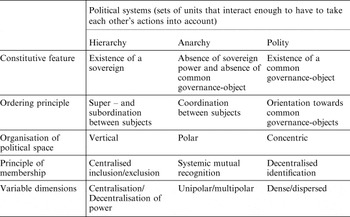
The differences between the structures of hierarchy, anarchy and polity are summarised in Table 1.
On a point of clarification, if ‘political system’ is the overarching term, and hierarchy, anarchy and polity are structural models, should they be regarded as mutually exclusive? Most people would see a polity as being a hierarchy also, for example. This statement confuses theory with ontology. The model of hierarchy is not the same as what it refers to. It is a truism that all social relations are somehow unequal, especially in world politics. This does not mean that only hierarchy exists. As pictures, mentally formed, that ‘convey a sense of the unobservable relation of things’ as Waltz has it,Footnote 92 hierarchy, anarchy and polity are abstractions that simplify reality in different ways. We may view global politics sequentially through each of these prisms to find evidence for or against a global hierarchy, a global anarchy or a global polity, picking out very different aspects of world politics as we go. In this sense they are analytically distinct concepts that pick out different objects. The international system as an anarchy (as defined by Waltz) is by definition not a polity of states since states in an anarchy are oriented primarily towards governing their own domestic spheres rather than a common governance-object. Likewise a hierarchy ‘is’ not a polity since a hierarchy is defined by relations of subordination between subjects rather than common orientation towards a governance-object. Inmates and prison warders may be part of a hierarchic system of subordination without them sharing a governance-object. Similarly, citizens within a state can be viewed as being part of a hierarchy by virtue of their subordination under the sovereign, not because their identities are dependent upon the same governance-object.
Summary of three different political structures

We can draw a parallel to ‘nation’, ‘state’ and ‘society’. These have been taken to refer to things that have at times been fairly well aligned, particularly during the ‘Westphalian moment’. This does not make them ‘the same’ in conceptual terms or mutually exclusive in empirical terms. What they each refer to may overlap in empirical terms but although a state may have a nation within it, we cannot say that a state ‘is’ a nation without muddling the concepts. Equally, a polity may have a distinct hierarchy or anarchy within it or vice versa, but this does not make them the same entities. All anarchies and polities will have an unequal distribution of power within them, but by characterising them as anarchies or polities we are defining them according to other features than their distribution of power.
A global polity?
While this article asks primarily what a global polity is rather than whether a global polity exists, a brief consideration of how the generic definition of polity could map onto global politics may help to clarify the ideas behind the model. The reader will appreciate that the limits of space will allow only a cursory glance at this potentially huge question, the main purpose of which is to point out the new research agenda opened up by the theory of polity. In particular global polity is compared in the following to two of the best developed existing accounts of global politics that seek to go beyond the state model.
Firstly, how should we understand the idea of ‘global’ governance-objects? While the term ‘global’ functions in many different ways, often as the opposite of ‘local’ or as a signal of transformation beyond internationalisationFootnote 93 it will be understood here as denoting substantial ‘space-time compression’ coupled with discourse supposing the world as one place. This follows the Roland Robertson's idea of globalisation as not simply shrinkage of geographical distance but also a growing consciousness of the world as a singular place of action.Footnote 94 Martin Shaw echoes this: beyond worldwide interconnectedness, ‘to be Global now refers, maximally, to the self-consciously common framework of human society worldwide’Footnote 95 though this does not necessarily imply any form of cosy community. Thus a global governance-object is not inclusive of every single square inch of the globe nor simply an object that is ‘cross-border’. Nor is it enough for subjects to utter the term ‘global’ for something to be constructed as a global governance-object as defined here. The construction of an object as ‘global’ will be an inter-subjective process constituting something in terms that reference the globe as a single place of human action, for example, ‘global poverty’, ‘global financial stability’ or ‘the [human-influenced] climate’.
When did global governance-objects begin to arise in public discourse? This is highly debatable, but it is crucially a different debate to the usual one about when globalisation began. Increased commerce or the ‘shrinking’ of space and time do not necessarily imply the emergence of a discourse constituting something as global and governable. Deities believed since ancient times to be present in the ‘whole world’ and ‘for all time’ arguably referenced the globe as one place, but were not considered governable and nor, in fact, was ‘globalisation’ as depicted recently by globalist liberals in awe of global markets who saw it as a bottom up non-steerable process of social change.Footnote 96 Thus, although it would be foolish to venture a precise date for the emergence of a global polity, the definition of a global governance-object frames a new type of question concerning not just when globality arose but also when governability of an object referencing the globe became widely accepted. Finally, if we also ask at what point actors became politically oriented towards such global governance-objects this pushes the birth of the global polity even closer to the present, probably to the rise of global movements, governments and other actors who's identities make sense only in relation to the governance of global objects.
Such global polity questions have not been much posed, but one observer suggests that ‘the global’ has been ‘constituted as a new object of thought and action’ towards the end of the Millennium as the ‘certainty about the factuality of the globalization process itself’ became generally accepted.Footnote 97 Another points to the recent growth in discourse on global governance that ‘tells us to act and to think as if the world were already a virtual global polity simply waiting to be lived in and worked out, one way or another’.Footnote 98 Anthony Giddens implies something similar: ‘The second globalization debate [after Seattle, 1999] is not about whether [globalisation] exists; it's about what globalization is, what its consequences are, and what kind of framework we can develop for the world to accommodate it’.Footnote 99 Building on the definition of globality given above, it can be argued that the emergence of the basis for a global polity began when the current human-dominated era of the Earth began to be recognised – what Paul J. Crutzen has controversially labelled the ‘Anthropocene’: the human dominated geological epoch supposedly taking over from the Holocene. While Crutzen dates the Anthropocene to the invention of the steam engine,Footnote 100 discourse constructing the globe as humanly governable has only recently become substantial and widespread.
Just how widespread discourse presupposing the existence of a global governance-object is a crucial question for global polity research but is beyond the scope of this article. Instead, the following examines two recent accounts of global politics that begin with an alternative conception of global politics and compares them to the theory of global polity advanced here.
According to Martin Shaw in his theoretical and historical exploration of the globalisation of state power, Theory of the Global State, globality involves a transformation of the national-international nexus rather than simply a tipping towards the international end of it: ‘accounts of transnationalism hardly amount to theories of globality’.Footnote 101 Although states will remain and inevitably form an important part of global politics, in a global setting ‘tensions [between national and international] reappear in novel terms, which are increasingly relativized by the greater consciousness of the global human whole’.Footnote 102 Within this emerging globality, Shaw argues that global state functions are gradually becoming globalised. This creates a nascent global state ‘conglomerate’ centred around the lone superpower of the US and shared institutions like NATO. The reorganisation of means of violence and legitimacy is at the heart of his notion of a global-Western conglomeration:
The globalized Western state-conglomerate, or global-Western state for short, is an integrated authoritative organization of violence which includes a large number of both juridically defined states and international interstate organizations.Footnote 103
States within the Western bloc and NATO in particular have become so enmeshed in each others' military machines and political institutions that they are no longer able to be grasped as nation-states interacting but must be seen as constitutive parts of a global Western state. The global state has internal structures strong enough to redefine ideas about national interest and sovereignty while it acts outwardly as a partially hegemonic bloc: ‘not only is western state power exercised world-wide, but it has a general (if strongly contested) global legitimacy’.Footnote 104 For Shaw, other theories of global governance, international regimes or security communities focus on how sovereign states cooperate and tussle while underestimating the ‘striking difference between nation-states within the West and outside it’.Footnote 105 A new distinction apart from the national-international is thus offered as a point of departure potentially fulfilling the aim of moving beyond post-internationalism.
Similarly focused on the politics of globalisation, though with a broader focus on more state functions than those related to violence and war-making, Morten Ougaard borrows concepts from historical materialism and state theory that have been refined in domestic analyses such as superstructure ‘persistence function’, and the reproduction of relations of power. Ougaard's project is also motivated by a wish to go beyond the model of the state system as a modified anarchy and he urges ‘a holistic perspective on world politics as an integrated phenomenon’.Footnote 106 He too thus aims to go beyond the anarchy model. The result is also a powerful analysis of a growing global superstructure of institutions. Like Shaw's, Ougaard's analysis leads him to identify a global state-like construction based on the major Western powers and global institutions ‘marked by dense contacts, routinized information exchange, mutual surveillance and peer pressure, strong analytical and statistical resources, and a capacity for development of joint strategies and policies’.Footnote 107
For conceptual clarity I will refer to these as examples of global state theory, and reserve global polity theory for the version advanced here. The aim is not to comprehensively assess these two theories of global politics and the historical narrative they are explained by, but to glean the theory of political space behind them and compare it to the one on offer here at an equivalent level of analysis.
Firstly, they largely succeed in offering an alternative to standard accounts of modified international anarchy because they begin from the global level of analysis. However, they base their account on hierarchy instead positing a global state-agent with a (relatively) ordered and pacific inside and a relatively anarchic outside. Both theorists measure the ‘global superstructure’ in relation to the idea of a hierarchic state able to command resources, build institutions and secure loyalty. Ougaard's account of the global polity is openly based on a domestic analogy – something which he argues is legitimate, indeed indispensable, provided such domestic analogies are not used ‘uncritically’.Footnote 108 Both emphasise the ‘incomplete’ nature of the global state which insulates somewhat against realist counterclaims about the primacy of state sovereignty but of course also suggests that the global revolution, over time, will or could be ‘completed’ into a proper global hierarchy.
This is perfectly legitimate and thanks to Marxist and state theory apparatus both are able to offer explanations and analysis of the globalisation of power structures often lacking in globalisation studies. But it does not fundamentally expand our repertoire of political morphologies beyond the two familiar ones of hierarchy and anarchy. Rather it transfers the morphology of hierarchy familiar from comparative politics and the methodological nationalism to the global level. Both warn against the uncritical use of concepts developed in a domestic setting. Yet transferred back down to the national level, it is hard to see how their global model of hierarchy would differ from standard state theory. The global state is by definition relatively pacific internally, institutionalised and possesses agent qualities, able to act towards an ‘outside’. Thus, in terms of theoretical pluralism, global state theory has value as an alternative starting point to anarchy, but tips towards the opposite end of the anarchy-hierarchy dichotomy already at the heart of the international paradigm.
While measuring the global political realm in relation to a model of hierarchy sheds useful light on important questions concerning world politics, it also inevitably obscures other questions. Firstly with global state theory there will be a propensity to find internal cohesion and ‘actorness’ in a global state when envisaging it as a state writ-large. The plausibility of the global state argument depends on the internal cohesion of the bloc or the uniformity of the global superstructure and critics were quick to charge that the global state could easily break up, making it essentially a multilateral form of cooperation between states rather than a new state formation.Footnote 109 In contrast a global polity as defined here need not have agent qualities and is not necessarily made up of shared institutions and common identity. A global polity as defined here would logically include the radical opponents of the West if they too aspire to govern global objects, as some have claimed Al-Qaeda does.Footnote 110 The view of the existence and governability of the global would be shared by all members, but little else would necessarily follow.
Secondly and linked to this is the fact that the idea of a global society hovers above the notion of a global state. Ougaard and Higgott identify a ‘growing sense of “community”’ and note the ‘recognition of the appropriateness of global discourse’.Footnote 111 as a central characteristic of the emerging global polity. Shaw's global state derives its cohesion in part from a common awareness of human society on a world scale (‘society becomes global when this becomes its dominant, constitutive framework’)Footnote 112 and externally has ‘a general (if strongly contested) global legitimacy’.Footnote 113 In contrast, a global polity as defined above requires no shared values or consciousness, except for discursive agreement on the existence and governability of global objects.
Thirdly, global state theory gives priority to institutions, with institutionalisation and hierarchic bureaucracy being core connotations of the concept of a state. Shaw's emphasis on the shift towards consciousness of the world as one place is at the crux of his idea of ‘global’, but neither global consciousness nor global discourse figure prominently in the idea of a global Western state bloc which is rather based on means of violence. The same goes for Ougaard's global superstructure, which is conceived of mainly in terms of institutions and leverage over subjects. The polity approach offered here in contrast puts global discourse at the heart of the emerging global polity in terms of the social construction of global governance-objects and the way subjects put (or do not put) such objects at the heart of their political identities.
Finally global state and global polity (as defined here) are different in their conceptions of territoriality. For Ougaard, all political actors are analysed as being part of a global polity which is planetary in scope, similar to Seyom Brown's idea of a world polity as the totality of local, national, regional and global political relations.Footnote 114 The ‘global superstructure’ is however, limited to roughly the same area as Shaw's global state, corresponding to a Western social transnational formation. The latter maintains a ‘territorial base’ defined by ‘the areas controlled by its component state units’.Footnote 115 In contrast, the global polity as defined here would be defined neither as the system-wide entity (not all actors define themselves in relation to global governance-objects), nor as a geographically based entity. For instance, the US government and pressure groups based in the US, such as the internet-based Avaaz.org may define themselves in relation to governing global objects such as ‘global peace and stability’ or ‘global justice’ but other US actors such as unions or state legislatures are oriented towards other polities such as the US polity or that grouped around the governance of a particular federal state. Within the same geography, actors may or may not be a part of the global polity.
Conclusion
Polity will not replace hierarchy and anarchy as theories, nor the need for analyses of how far world politics deviates from anarchy or hierarchy. As simplifications with which we can compare a complex reality, they remain useful. Nor are post-international accounts of world politics useless, especially not in terms of showing the inadequacy or selective nature of the statist model. Nor does our model of polity provide a specification of power relations or a grand theory of what drives history like that delivered by historical materialismFootnote 116 or evolutionary functionalist theory.Footnote 117 But at the level of morphologies or pictures, mentally formed, that provide scaffolding for making sense of political space, it can provide an alternative way of identifying, characterising and describing hybrid political entities that are emerging in large numbers today in the global age. A different object of analysis is brought into focus generating a different set of research questions about the global polity: when did ‘the global’ come to be constituted in the eyes of a group of actors as both real and governable? How is globality constructed as a governance-object? Who defines themselves in relation to such an object and how? How does the current configuration of the global polity rate on the variables identified? That is, how dense, stable, antagonistic or institutionalised is the global polity? If global polity discourse is spreading, what courses of action or global governance technologies are made plausible or possible (for example, global taxes, climate geo-engineering projects?). This contrasts with more traditional (post-) international questions such as ‘are states loosing or retaining power?’ ‘How many non-state actors are there and how significant are they (do they influence the international system)?’ ‘Are there shared values and norms in world politics?’ What are the prospects for a global state capable of wielding coercive power on a global scale?
Does the theory of polity presented allow us to identify when a polity has been established or dissolved? Yes and no. ‘No’, because it will always be difficult to draw the line. ‘Yes’, because with an analytical definition we know what to look for and how to argue about where to draw the line. Armed with a theory of polity, the question of the existence of a global polity becomes clearer, even if the answer to that question remains complex. As such polity differs little from other well-rehearsed analytical distinctions – such as the distinction between anarchical and hierarchical political systems: this too is an analytically clear distinction, but empirically often difficult to call either way.
Furthermore, polity improves the level of analytic leverage relative to some existing post-international conceptions that catch all transnational or non-state actors or processes. Notions such as the nebuleuse, ‘complex multilateralism’, ‘unbundling’ or ‘assemblages’ are evocative, but do not help us if we wish to go beyond deconstructions of the old organising principles and cut the analytical cake in a new way. The ‘non-state’ category itself initially lumps all non-state transnational actors together and as a consequence, concepts that build on that category such as ‘global civil society’,Footnote 118 and ‘transnational civil society’Footnote 119 usually have to begin by throwing out certain non-state elements, for example, private companies, terrorists, mafia groups for reasons unrelated to the state/non-state distinction.Footnote 120 Seyom Brown's notion of a ‘world polity’ defined as the worldwide configuration of systems of enforceable societal relationships is also analytically relatively empty since such simple sum of enforceable relations would by the author's own admission have ‘existed in one form or another throughout human history’.Footnote 121 In principle, a global polity could be dated to the emergence of a global governance object with importance for the identities of the governance-subjects.
Finally, the theory of polity here is also not bound to the idea of a ‘global’ polity and could be applied to other levels of analysis. A ‘European polity’, for example, would be a set of actors defined in relation to governance of ‘Europe’ or European governance-objects. A religious polity would be a group of actors who define themselves in relation to the governance of a particular religious object such as a community of believers. Polity thus has potential use outside IR in political geography, religious studies, anthropology and political science more widely.