Bacteriocins are low-molecular-mass ribosomally synthetised peptides, which usually have bactericidal activity against species closely related to the producing bacteria. Bacteriocins produced by probiotics are known to inhibit food-borne pathogens such as Listeria monocytogenes, Bacilllus cereus, Staphylococcus aureus, Clostridium perfringens, thereby contributing to the conservation of different kinds of food products (Yildirim et al. Reference Yildirim, Winters and Johnson1999; Cheikhyoussef et al. Reference Cheikhyoussef, Pogori, Chen, Tian, Chen, Tang and Zhang2009a). In recent years, the interest for probiotic bacteriocin production has constantly grown because of their use as food biopreservatives to satisfy the rising demand of consumers for natural foods without chemical preservatives.
Bifidobacteria, which proliferate in the human gastrointestinal tract, provide large health benefits to the host; therefore, they are widely used as probiotics in the industry of fermented foods. One of the main reason of their probiotic properties is the wide capacity of producing antimicrobial substances such as bifidocin B, bifidin I, bifilong and bifilact Bb-46 (Anand et al. Reference Anand, Srinivasan and Rao1984, Reference Anand, Srinivasan and Rao1985; Kang et al. Reference Kang, Shin, Park and Lee1989; Yildirim et al. Reference Yildirim, Winters and Johnson1999; Abd et al. Reference Abd, Saleh, Kholi, El-Sayed, Abdou and El- Shibiny2004; Von Ah, Reference Von Ah2006; Cheikhyoussef et al. Reference Cheikhyoussef, Cheikhyoussef, Chen, Zhao, Tang, Zhang and Chen2010) and bacteriocin like inhibitory substances (BLIS) (Collado et al. Reference Collado, Hernández and Sanz2005; Cheikhyoussef et al. Reference Cheikhyoussef, Pogori, Chen, Tian, Chen, Tang and Zhang2009a). The most research has been focused on bacteriocin production by lactic acid bacteria (LAB), especially Lactobacillus sp. and Pediococcus sp. (Deegan et al. Reference Deegan, Cotter, Hill and Ross2006), even though bacteriocins produced by Bifidobacterium sp. are gaining attention of the food industry because certain strains of this genus are recognised as safe (GRAS) (Picard et al. Reference Picard, Fioramonti, Francois, Robinson, Neant and Matuchansky2005), hence allowing easy application and customer acceptance.
Nonetheless, only a few studies have been done on the optimisation of bacteriocin production by Bifidobacterium sp., and only two review articles have been published on this issue (Cheikhyoussef et al. Reference Cheikhyoussef, Pogori, Chen and Zhang2008; Martinez et al. Reference Martinez, Balciunas, Converti, Cotter and Oliveira2013). However, these interesting reports have mainly focused on the separation and purification processes, or on the influence of pH and temperature, inhibitory compounds and bacteriocin structure stability rather than on the optimisation of medium composition for Bifidobacterium sp. cultivations (Yildirim & Johnson, Reference Yildirim and Johnson1998; Yildirim et al. Reference Yildirim, Winters and Johnson1999; Von Ah, Reference Von Ah2006; Cheikhyoussef et al. Reference Cheikhyoussef, Pogori, Chen, Zhao, Tang, Chen and Zhang2009b, Reference Cheikhyoussef, Cheikhyoussef, Chen, Zhao, Tang, Zhang and Chen2010; Lee et al. Reference Lee, Li and O'Sullivan2011). Additional significant issues that must be considered in bacteriocin production are the high cost of complex media, normally used in large scale fermentation processes such as Man, Rogosa and Sharpe (MRS) and Bifidus selective medium (BSM), as well as the low reproducibility and sensitivity of the agar diffusion method for the determination of bacteriocin activity (Pongtharangkul & Demirci, Reference Pongtharangkul and Demirci2004). Thus, no previous experimental design was yet performed to optimise the fermentation process aiming at bacteriocin production by Bifidobacterium sp.
Based on these issues, this study was first addressed to the enhancement of bacteriocin production in flasks by Bifidobacterium animalis subsp. lactis BL 04 by exploring the separate effects on BLIS production of the addition of yeast extract, Tween 80 or inulin to skim milk (SM) selected as an alternative low-cost medium. The second aim was to select the best conditions to use in the agar diffusion bioassay for determination of BLIS production.
Materials and methods
Bacterial strains
The commercial starter freeze-dried strain Bifidobacterium animalis subsp. lactis (Bifid. lactis) (Danisco, Sassenage, France) was maintained in Man, Rogosa and Sharpe (MRS) medium (Sigma, St. Louis, MO, USA) and used as BLIS producer, while Listeria monocytogenes ATCC 13932 was maintained in brain heart infusion (BHI) medium (DIFCO, Sparks, MD, USA) containing 40% (v/v) glycerol and used as BLIS indicator microorganism. Both strains were maintained at −70 °C.
Culture media
Bifid. lactis BL 04 was grown at 37 °C either in MRS medium (DIFCO) or in skim milk (SM, DIFCO) for comparison purposes. L-cysteine 10 g/l (Sigma) and sodium thioglycolate 100 μl/l (INLAB, São Paulo, SP, Brazil) were added in both media to improve the bacteriocin production and to ensure microaerophilic conditions.
SM was prepared adding 10 g skim powder milk in 100 g distilled water and then heated at 90 °C for 10 min in water bath, model 550A (Nova Ética, Vargem Grande Paulista, SP, Brazil). Flasks were kept at 30 °C overnight to check the possible presence of contaminants.
Inoculum preparation
A single colony of Bifid. lactis BL 04 grown in MRS agar was inoculated into 10 ml liquid MRS medium, incubated at 37 °C for 48 h and finally used to inoculate 100 ml MRS medium contained in 250 ml Erlenmeyer flasks. After further incubation of flasks at 37 °C, cells were collected by centrifugation (4800 g, 10 min, 4 °C), and pellets were washed and resuspended in sterile physiological solution (40–50 ml) until achieving an absorbance at 600 nm of about 0·9 (corresponding to about 108 CFU/ml).
Selection of ingredients to stimulate BLIS production
Flasks containing 50 ml SM or MRS medium were inoculated with 1000 μL of the above inoculum suspension and incubated under microaerophilic conditions in shaker at 37 °C, 50 rpm for 24 h. In order to stimulate BLIS production by Bifid. lactis BL 04, 1% Tween 80 (Alamar Tecno-Científica, Diadema, SP, Brazil), yeast extract (DIFCO) or inulin (Beneo-Orafti Corp., Malvern, PA, USA) were tested in triplicate for their well-known ability to improve bacteriocin expression. MRS medium and SM without additives were used as controls.
Analytical methods
Cell concentration (X) was determined by plating according to the pour-plate method and expressed as Colony Forming Units per unit volume (CFU/ml). To this purpose, serial dilutions of broth samples onto Bifidus selective medium (BSM, DIFCO) plus agar were made at 37 °C for 48 h in anaerobic jars.
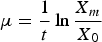
The average specific growth rate (μ) was then calculated at the time (t) of maximum cell concentration in each run (X m), according to the equation:
 $${\rm \mu} = \displaystyle{1 \over t}\ln \displaystyle{{{X_m}} \over {{X_0}}}$$
where X 0 is the starting biomass concentration, and the generation time (t g) as:
 $${t_g} = \displaystyle{{\ln 2} \over {\rm \mu}} $$
The pH of the medium was measured by using means of an external pH meter (Quimis, Campanário, SP, Brazil).
Glucose and lactose concentrations were determined by high-performance liquid chromatography (HPLC). To this purpose, 10 μl aliquots of media were injected into an HPLC, model Dionex Ultimate 3000 (Thermo Fisher Scientific, Waltham, MA, USA), supplied with a sugar-separation column (Aminex-HPX-87H) as described by Mendonça et al. (Reference Mendonça, Gomez, Buffoni, Sánchez Rodriguez, Schripsema, Lopes and Silva2013).
For BLIS activity determination, List. monocytogenes was inoculated in BHI broth (DIFCO) at 37 °C and 100 rpm for 4–6 h until it reached an optical cell density of about 0·9 at 600 nm. Subsequently, 500 μl of this suspension were inoculated into 50 ml BHI agar (pre-cooled and maintained at 40 °C), aseptically laid on sterile Petri dishes and allowed to solidify. Meanwhile, fermented samples were centrifuged at 4800 g for 10 min at 4 °C, and the supernatant was filtered through filters with 0·22 μm pore diameter (Merck-Millipore, MA, USA) to avoid any possible interference of viable cells. To exclude the inhibitory effect of lactic acid, the supernatant pH was adjusted to 6·0 with 1·0 M NaOH. Finally, the cell-free culture supernatant (CFCS) was heated at 80 °C for 10 min to inactivate proteolytic enzymes. Finally, the BLIS activity was determined by the spot-on-lawn method (Pongtharangkul & Demirci, Reference Pongtharangkul and Demirci2004), by distributing 20 μl of fermented broth, eventually diluted with phosphate buffer (10 mm, pH 6·5), onto plates containing List. monocytogenes ATCC 13932 as BLIS-sensitive microorganism. The BLIS activity was expressed in arbitrary units per ml (AU/ml) by the equation AU/ml = Dn × 1000/P, where D is the dilution factor, n the first dilution not exhibiting any inhibition zone, and P the volume of supernatant deposited onto the agar surface.
Statistical analyses
The results were analysed by the Statistica software, version 10 (StatSoft Inc. Tulsa, OK, USA). The coefficient of determination (R 2) was used to check the effectiveness of the above model equation, and its significance tested by the Fisher's test.
Results and discussion
Different additives were tested either in SM or in MRS medium to stimulate BLIS production by Bifid. animalis subsp. lactis, namely yeast extract (YE), inulin and Tween 80.
Cultures in MRS broth
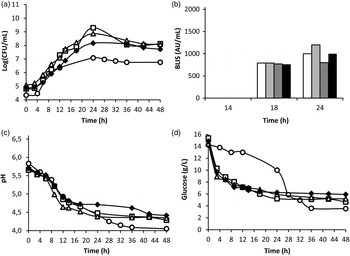
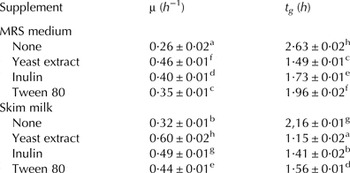
As shown in Fig. 1, the fermentation of Bifid. lactis in non-supplemented MRS broth gave, at the late exponential phase (24 h), a maximum biomass concentration of 7·08 Log CFU/ml, an average specific growth rate (μ) of 0·26 h−1 and a generation time (t g) of 2·63 h (Table 1); however, no production of BLIS was detected as a possible result of lack of its induction.
Cultures of Bifid. lactis BL 04 carried out in shaken flasks at 37 °C and 50 rpm on MRS broth supplemented with different additives: None (○); yeast extract (□); inulin (△); Tween 80 (⧫). (a) Biomass concentration (Log CFU/ml); (b) BLIS concentration (AU/ml); (c) pH; (d) glucose concentration (g/l).

Main parameters of Bifid. lactis BL 04 cultures carried out in MRS medium and skim milk (SM) either with or without different additives: Yeast extract, Tween 80, inulin

Different letters mean statistically-significant differences according to the test of Tukey (α < 0·05).
On the other hand, in the presence of all tested additives, biomass count was always higher than 8 Log (CFU/ml), and after 24 h of fermentation reached a maximum value in MRS medium of no less than 9·30 Log (CFU/ml) when 1% of YE was added. This value is one log unit higher than that reported by Janer et al. (Reference Janer, Pel and Requena2004) in the same medium, whereas it agrees with those reported by Ballongue (Reference Ballongue2004) and Von Ah (Reference Von Ah2006), who detected a strong stimulating effect of yeast extract.
The addition of YE to MRS medium stimulated the growth of Bifid. lactis considerably, giving a 43% reduction of generation time (t g) (1·49 h) and a 77% increase in μ (0·46 h−1) compared with MRS broth without any additive. This culture, which provided the best results in terms either of growth or BLIS production, exhibited a short exponential growth phase between 4 and 24 h, after which BLIS reached its maximum level (1200 AU/ml), which appeared to be related with maximum biomass concentration. Such a BLIS activity was 78, 90 and 80% higher than those reported in the literature for Bifidocin B (Yildirim et al. Reference Yildirim, Winters and Johnson1999), Thermophicilin B67 (Von Ah, Reference Von Ah2006) and Bifidin I (Cheikhyoussef et al. Reference Cheikhyoussef, Pogori, Chen, Tian, Chen, Tang and Zhang2009a, Reference Cheikhyoussef, Cheikhyoussef, Chen, Zhao, Tang, Zhang and Chen2010), respectively; however, none of these studies mentioned any previous screening or optimisation of the growth medium (Martinez et al. Reference Martinez, Balciunas, Converti, Cotter and Oliveira2013). A possible explanation of the stimulating action of YE on BLIS activity is that this ingredient provides small peptides and vitamins that can be used by bifidobacteria and could be essential for antimicrobial peptides synthesis and pH regulation (Avonts et al. Reference Avonts, Uytven and De Vuyst2004; Jalili et al. Reference Jalili, Razavi and Safari2010). Aasen et al. (Reference Aasen, Møretrø, Katla, Axelsson and Storrø2000) showed that an increase in YE concentration allowed remarkably enhanced bacteriocin production. Cabo et al. (Reference Cabo, Murado, Gonzalez, Vazquez and Pastoriza2001) proposed a possible buffering power of YE, while Leroy et al. (Reference Leroy, Vankrunkelsven, De Greef and De Vuyst2003) suggested that many inorganic compounds like sulphates, which are essential for the synthesis of class IIa bacteriocins and are abundant in YE, may exert positive effects over it. Even if peptides would not have benefits on the BLIS production, the vitamins present in YE could have (Cabo et al. Reference Cabo, Murado, Gonzalez, Vazquez and Pastoriza2001; Tomás et al. Reference Tomás, Bru and Nader-Macías2010).
Indeed, also inulin behaved as an ingredient able to stimulate Bifid. lactis BL 04 growth in MRS medium (Table 1), reaching a count of 8·86 Log (CFU/ml), μ = 0·40 h−1 and t g = 1·73 h, although its effect was weaker than that of YE. The stimulating effect of inulin on the growth of bifidobacteria was already observed by several authors (Ramirez-Farias et al. Reference Ramirez-Farias, Slezak, Fuller, Duncan, Holtrop and Louis2009; Oliveira et al. Reference Oliveira, Perego, Oliveira and Converti2012). On the other hand, its stimulating effect on BLIS production at the late exponential phase (about 24 h), which could be the result of the release of fructose monomers and their subsequent assimilation through the fructose-6-phosphate shunt as an additional carbon and energy source (Van der Meulen et al. Reference Van der Meulen, Adriany, Verbrugghe and De Vuyst2006; Oliveira et al. Reference Oliveira, Perego, Oliveira and Converti2012), was less marked than that of YE, its activity being only 800 AU/ml. The lower biomass level and BLIS titre compared with the culture carried out in MRS supplemented with YE could be explained by the strong inhibition of growth and synthesis of bacteriocins under nitrogen starvation conditions (Leroy & De Vuyst, Reference Leroy and De Vuyst2001; Tomás et al. Reference Tomás, Bru and Nader-Macías2010). The use of Tween 80 as a supplement led to a lower biomass concentration (8·16 Log CFU/ml) compared with YE and inulin, but BLIS activity was no less than 1000 AU/ml. Such a marked BLIS production might be related to different properties of Tween 80, among which are (a) promotion of bacteriocin agglomeration in aqueous solution by direct stimulation of protein secretion or deadsorption due to membrane alteration, (b) enforcement of bacteriocin action against the indicator micoroorganism by expression of binding receptors (Eijsink et al. Reference Eijsink, Axelsson, Diep, Håvarstein, Holo and Nes2002; Keren et al. Reference Keren, Yarmus, Halevy and Shapira2004; Collado et al. Reference Collado, Hernández and Sanz2005; Martinez et al. Reference Martinez, Balciunas, Converti, Cotter and Oliveira2013), and (c) permeabilisation of the indicator microorganism membrane (Collado et al. Reference Collado, Hernández and Sanz2005).
The progressive decrease of pH during all Bifid. lactis fermentations and the simultaneous decrease in glucose concentration are in agreement with the well-known heterolactic behaviour of this microorganism, while the progressive decrease of BLIS activity after 26 h of culture may be ascribed to BLIS consumption under carbon source depletion conditions.
Cultures in skim milk
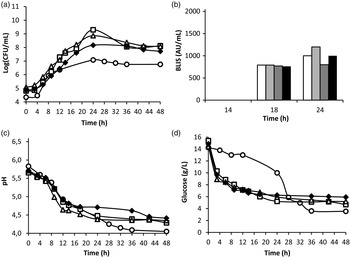
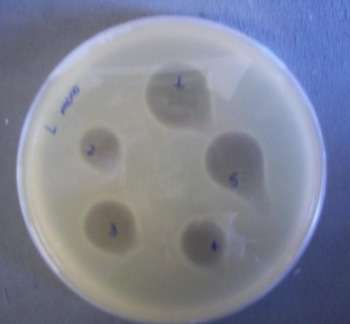
In general, skim milk (SM) allowed for better growth results than MRS medium (Fig. 2a, Table 1), consistently with its content in bifidogenic factors such k-casein, casein macropeptides, N-acetylglucosamine and N-acetylneuraminic acid (Ballongue, Reference Ballongue2004; Janer et al. Reference Janer, Pel and Requena2004). Confirming the considerations already made for MRS medium, the use of YE as a supplement ensured the highest BLIS concentration (2000 AU/ml) (Fig. 2b) as well as the highest biomass production, reaching at the late exponential phase (24 h) a count of 10·9 Log (CFU/ml), μ = 0·60 h−1 and t g = 1·15 h. These kinetic growth results are in agreement with those obtained by other authors (Aasen et al. Reference Aasen, Møretrø, Katla, Axelsson and Storrø2000; Ballongue, Reference Ballongue2004; Janer et al. Reference Janer, Pel and Requena2004; Jalili et al. Reference Jalili, Razavi and Safari2010). Figure 3 shows, as an example, the inhibition halos produced by five aliquots of filtered fermented broth on a plate colonised by List. monocytogtenes selected as an indicator microorganism.
Cultures of Bifid. lactis BL 04 carried out in shaken flasks at 37 °C and 50 rpm on skim milk supplemented with different additives: None (○); yeast extract (□); inulin (△); Tween 80 (⧫). (a) Biomass concentration (Log CFU/ml); (b) BLIS concentration (AU/ml); (c) pH; (D) lactose concentration (g/l).

Inhibitory activity of BLIS against List. monocytogenes ATCC 13932 in BHI agar.

Similarly to what was observed in MRS medium, inulin exerted a weaker stimulating effect either on growth [9·9 Log (CFU/ml), μ = 0·49 h−1, t g = 1·41 h] or on BLIS activity (1600 AU/ml) than YE, while Tween 80 inhibited growth [8·8 Log (CFU/ml), μ = 0·44 h−1, t g = 1·56 h] but stimulated BLIS activity (1800 AU/ml) compared with inulin. All these BLIS activities in SM are, as an average, about twice those detected in MRS medium, which highlights the suitability of SM as an alternative medium for BLIS production.
Finally, likewise the runs in MRS, the pH progressively decreased from 6·2–6·5 to about 4·5 throughout all the runs (Fig. 2c) because of the heterolactic production of lactic and acetic acids (Gomes & Malcata, Reference Gomes and Malcata1999; Van der Meulen et al. Reference Van der Meulen, Adriany, Verbrugghe and De Vuyst2006), and BLIS activity progressively decreased after carbon source (lactose) depletion (Fig. 2d), likely due to microbial consumption of BLIS as a carbon and nitrogen source (Collado et al. Reference Collado, Hernández and Sanz2005).
Conclusions
This study was focused on bacteriocin production in flasks by Bifid. animalis subsp. lactis BL 04 either in MRS medium or in skim milk. The separate effects of the addition of yeast extract, Tween 80 or inulin to skim milk on BLIS production and microbial growth were investigated.
Skim milk behaved as a better medium than MRS, and yeast extract was shown to ensure the best growth and BLIS production results. For instance, in skim milk supplemented with yeast extract, cell growth [10·9 Log (CFU/ml), μ = 0·60 h−1, t g = 1·15 h] and BLIS activity (2000 AU/ml) were remarkably higher than in the presence of inulin and Tween 80. All BLIS activity values in SM were, as an average, about twice those detected in MRS medium, which highlights the suitability of SM as an alternative medium for BLIS production.
We are grateful to CAPES, CNPq and FAPESP (Fundação de Amparo à Pesquisa do Estado de São Paulo) for financial support (process 2013/12713–1), to CAPES for Prof J. M. Domínguez fellowship as Special Visiting Researcher (Science without Borders Program, project n. 88881·062223/2014–01) and to CAPES for Prof A. Converti fellowship as Special Visiting Researcher (Science without Borders Program, ref. n. A003_2013, project n. 2609/2013). We would like to thank Prof Bernadette D.G.M. Franco who provided the Laboratório de Microbiologia de Alimentos for antimicrobial tests. We are also grateful to Prof José Gregório Cabrera Gomez (ICB/USP) by allowing us to use the HPLC for analyses of glucose and lactose concentrations.
Conflict of interest
The authors declare that have no conflict of interest.