After East and West Germany split into two separate states with different economic, social, and political systems and ideologies in 1949, there were many issues over which the two countries could not agree. One area, however, on which both East and West took a similar stance, was the condemnation of American popular culture. Historians such as Uta Poiger and Mark Fenemore have begun uncovering both East and West Germany's complicated relationship to American popular culture.Footnote 1 Its dominance among German youth was a pressing concern in the postwar era. Influenced by the large numbers of American soldiers stationed in West Germany and the increasing popularity of American culture, products such as comic books, films, and rock ’n’ roll seemed to be inescapable.
Prior to the construction of the Berlin Wall in 1961, it was quite easy for East German youth to cross the border and attain American goods and watch American films. Cinema and television functioned as important weapons in the ideological warfare over the hearts and minds of both East and West Germans. This agenda made Berlin an important location for the film and television industries. According to historian Michael Lemke, for the “American containment policy” determined to stem the tide of Soviet influence, West Berlin was a “bulwark of freedom,” but also a “display window” for the West.Footnote 2 Likewise, the GDR also hoped East Berlin could fulfill the same function as a “display window” of drawing West Berliners to socialism.Footnote 3 But West Germany had the upper hand because the majority of Berliners around 1948–1949 were more sympathetic towards the western Allies than the Soviets, but also because the East Germans who worked in and visited West Berlin functioned as a kind of ally who relayed positive impressions of the West to the rest of East Germany.Footnote 4 “Without Berlin, without its free people, its free press, its free radio stations, and the empathy and support of the free world, the middle of Germany would have long been hopelessly sovietized,” states Lemke.Footnote 5 Although the construction of the Berlin Wall in 1961 made it more difficult for East German youth to access American culture, this was still possible through transmission via television. Aside from the two regions in the southeast and northeast of the GDR, without access to West German television, satirically labeled “Tal der Ahnungslosen” (Valley of the Clueless), most young people in East Germany could still see West German trends broadcasted on television. As historian Rüdiger Steinmetz writes, “The German-German border was not closed off, for despite increasingly impenetrable boundaries (Berlin Wall, barbed wire, ‘death stretch’ since 1961), close human and medial relations persisted, even if ex negativo. Between the two German states there existed across the border a ‘contrastive dialogue’ in the domain of media.”Footnote 6
The focus of this article is an examination of two films that address the influence of American culture on youth in both Germanys before the construction of the Wall—Georg Tressler's Die Halbstarken (1956) filmed in West Berlin and Wolfgang Kohlhaase's Berlin–Ecke Schönhauser (1957) filmed in East Berlin.Footnote 7 My analysis specifically pertains to their portrayal of gender and its link to mass consumption and sexuality. In previous, comparative discussions of the films, authors have not paid much attention to the wildly different ways in which rebellious femininity is portrayed in the East and the West.Footnote 8 What I add to previous research is a more in-depth comparison of gender norms not just via formal film analysis, but also by consulting contemporary reviews about each film from both East and West Germany. By highlighting the ways the rebellious female leads are portrayed and the way they are discussed in the press, this article contributes to our understanding of differences and similarities in gender images between the two Germanys.
In this article I argue that East and West Germany's differing attitudes toward gender and consumption resulted in remarkably different Halbstarken heroines. Because West German society needed to maintain a positive model of consumerism, West German cinema had a tradition of melodrama that pitted the responsibly consuming “domesticated wife and mother versus the unregulated consuming woman,”Footnote 9 who is embodied by Sissy (played by Karin Baal) in Die Halbstarken. In contrast, in East Germany female emancipation was not tied to consumption, but to work.Footnote 10 Thus, instead of having a negative heroine to serve as an example of bad consumption, in Berlin–Ecke Schönhauser the problem of consumption is merely displaced to the West, suggesting that if one could stem Western influence, then the female protagonist could be saved. Thus, what saves Angela (played by Ilse Pagé) in this film is the impending marriage and child that allow her to build a home with Dieter, rescuing her from the negative influence of her mother and the streets. This is a distinction that is missed, for example, in Friedemann J. Weidauer's article comparing these films, precisely because he smooths out the differences between them. Weidauer misguidedly suggests that both films are trying to channel “excess desire into responsible consumerism.” And instead of recognizing the importance of gender in the discourse on consumerism in Die Halbstarken, he instead posits that the United States and not Sissy is the threatening factor; “the promise of too much from across the Atlantic.”Footnote 11 This is a claim my reading of the film will directly oppose.
Die Halbstarken centers around two brothers: Freddy and Jan. Freddy is the troublemaker, who moved out of his parents’ apartment because he couldn't get along with his father. Jan is Freddy's slightly younger brother, who has been forbidden from seeing Freddy. But at the start of the film, they run into each other by chance at the community pool. Jan is also having trouble at home with their father and is thus trapped between two poles: his actual father and his older brother. Freddy at first seems like he'd make a better father figure because he appears independent and successful: he has a job, fancy goods (which his brother doesn't realize are stolen), a girlfriend, and a group of friends who look up to him. Freddy's cool, consumer lifestyle eventually wins out. Jan abandons all hope of rehabilitating his respect for his father and decides to take matters into his own hands by engaging in Freddy's criminal exploits. Their criminal life ends badly, however, when two failed heists result in a violent shooting and imprisonment.
Berlin–Ecke Schönhauser follows several different characters: Dieter, Angela, Kohle, and Karl-Heinz. Each young person is faced with problems that are unique to their socio-historical situation. Dieter lost his parents during World War II and has to be looked after by his older brother, a member of the East German People's Police. Dieter is not quite the troublemaker that Freddy is; he has a good job at a construction site. But he isn't interested in joining the ranks of the Free German Youth (Freie Deutsche Jugend, FDJ), the youth organization of the ruling Socialist Unity Party (Sozialistische Einheitspartei Deutschlands, SED). Angela is an aspiring seamstress who still lives with her mother and often wanders the streets when her widowed mother wants to entertain a gentleman visitor. Kohle has been enchanted by the Hollywood films he watches in West Berlin, which serve as a form of escape from the abuse he endures at home where his mother's boyfriend beats him. Finally, Karl-Heinz is financially in the best situation. His parents own property in West Germany for which they secretly collect money. But though he has money enough and his parents have promised they will eventually move to the West, he is impatient and embarks on a life of crime in the West Berlin underworld in order to finance his fancy clothes. One important difference to Die Halbstarken is that while the West German film only really derides one parental figure, in Berlin–Ecke Schönhauser all of the parents in the film are portrayed rather negatively. Thus, in the world of this film by the Deutsche Film-Aktiengesellschaft (DEFA), which became after the founding of the German Democratic Republic (GDR) in 1949 its state-owned film studio, the future seems to belong to the youth.
Although the topic of gender and consumerism in East and West Germany has already been addressed by gender scholars such as Erica Carter and Jennifer Lynn, and these two films have been discussed comparatively in previous works,Footnote 12 what makes my article stand out is both applying Carter's and Lynn's cultural history of gender and consumerism to a comparison between the films and the archival research I have conducted, consulting film reviews from both East and West Germany. One surprising revelation in these reviews is how their authors discuss each film's respective female lead. Although the Western reviews tend more toward emphasizing and demonizing Baal's sexuality, reviewers in both countries are guilty of treating the actresses like inexperienced children compared to their male counterparts, a patronizing discourse that reveals similar underlying patriarchal views extant in both countries. By providing a more rigorous film analysis of these two films and consulting extratextual archival material, my article contributes to the newest gender research in East and West Germany that examines the nuanced differences between the countries, while also acknowledging similarities between the systems. A comparison between these films and their receptions reveals more about how much narrative and aesthetic decisions can affect audiences’ perception of a character rather than suggesting the two countries were so ideologically different when it comes to gender. In the following, I will first describe the films’ place within German film history, followed by a discussion of their socio-historical context, which will relate them to a larger, global film history. Then I will do a close analysis of the way gender is treated in each film followed by a discussion of their respective receptions.
The Cinema of the 1950s: Between UFA and Hollywood
During the 1950s, German cinema on both sides of the wall was recovering from a film industry that had been ideologically and structurally devasted by the war. Directors attempted to offer their audiences more hopeful images, turning away from the rubble films of the late 1940s. But neither country could entirely escape the legacy of Nazi film. In her 1995 study Cinema in Democratizing Germany: Reconstructing National Identity After Hitler, historian Heide Fehrenbach remarks that scholarship on Nazi films has accordingly shifted its focus from what makes Nazi films so particular to how are they similar to the entertainment films of other countries and periods.Footnote 13 Despite the fascist ideological content of Nazi films, the Nazis did actively incorporate the style of Hollywood films into their own productions in order to entertain the largest audience possible, distract them from the problems of the war and on the home front, and to possibly compete on an international market.Footnote 14 Fehrenbach remarks, “Hitler consolidated support for his regime through a determined drive to build a consumer society that would rival that of the United States … national socialism won popular support by keeping its population integrated into the international leisure and information circuit.”Footnote 15
One of the key characteristics that Nazi Unterhaltungsfilme (entertainment films) and the films of the 1950s have in common is that they “align their offering with audience expectations through genre, star systems and marketing.”Footnote 16 This can be observed in how both films, Die Halbstarken and Berlin–Ecke Schönhauser, emulate the American teenage rebel film and use the young stars of the two movies to market them. Another continuity is the Nazi films’ interest in Berlin. Cultural scholar Irina Scheidgen observes that “Stadtfilme (city movies), in which Berlin the capital of the Reich was the center of the plot, were among the most loved entertainment films of the Third Reich.”Footnote 17 In these Stadtfilme, which were already popular in Weimar Germany, one sees emancipated women similar to the female protagonists of the 1950s Halbstarken films: young women who enjoy a new-found independence in the public sphere. In these Nazi Stadtfilme, we are presented with feminine ideals who can reconcile individual freedom with the traditional roles of wife and mother, similar to Angela in Berlin–Ecke Schönhauser but contrary to Sissy in Die Halbstarken. Sissy does, however, conform to another common portrayal of women in Nazi films: negative foils for the male heroes. According to film scholar Eric Rentschler, “Nazi cinema goes far beyond the institutionalized sexism of Hollywood movies and the way in which the classical narrative recuperates even the strongest women in the male discourse. Nazi cinema does not leave it at simple recuperation, though; women are to be overcome, indeed sacrificed.”Footnote 18 Arguably, this is what happens to Sissy when Freddy beats her into submission at the end of Die Halbstarken.
In contrast to this violent, misogynist form of masculinity present in Nazi cinema, in the Heimatfilme of the 1950s, “a specific sort of male character emerges … as the ideal type for the German romantic lead—the man, that is, who will take Germany into the future … He is law-abiding to a point but not to a fault.”Footnote 19 For Fehrenbach, the Heimatfilm male protagonist is upstanding, but a man with a heart “something that signals his difference from the Nazi film hero.”Footnote 20 This describes Dieter, the main protagonist of Berlin–Ecke Schönhauser, but not Freddie who is at times either weak or destructive, but never the ideal of “moral masculinity” that a Heimatfilm would demand. It is not surprising that one would find similarities between Berlin–Ecke Schönhauser and Heimatfilme, as cultural studies scholar Johannes von Moltke argues that the Heimatfilm was not an exclusively West German phenomenon.Footnote 21 But it is interesting to consider that by associating negative consumerism with the West, the DEFA film is able to conquer intradiegetic negative influences without promoting a misogynist view of its female protagonist; perhaps because the socialist ideal with which it replaces the fascist ideals of earlier films has an implied acceptance of gender equality. In contrast, Die Halbstarken's demonization of Sissy and misogynist form of masculinity would imply that there is something compatible between earlier fascist ideals and postwar democracy when it comes to gender differences and role. But as always, the reality is much more complicated than it appears on the screen when you look at the two states more closely, both regarding their policies on gender and how they treated the Halbstarken rebellion against traditional gender roles.
Young People in East and West Postwar Germany: The Historical Context
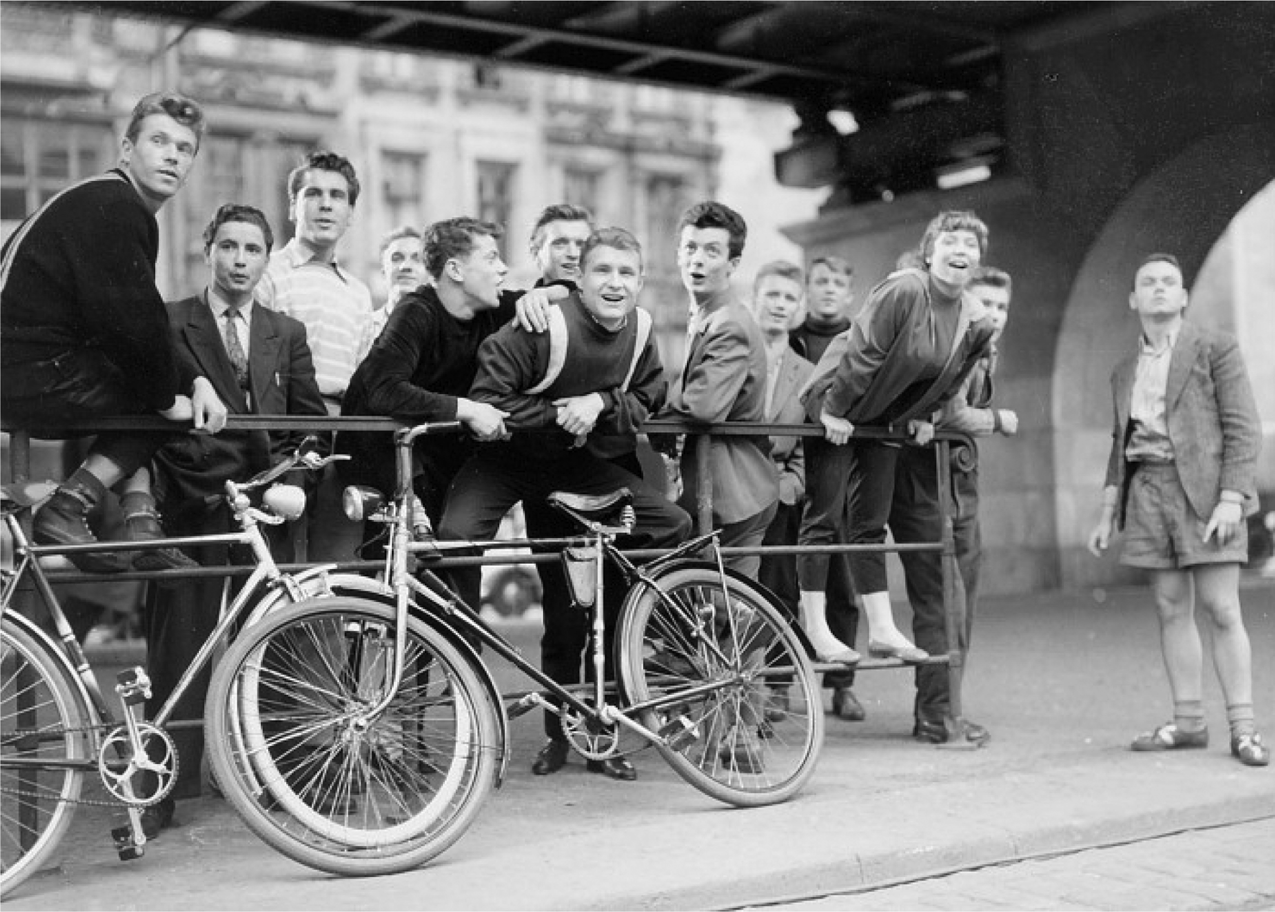
The phenomenon of Die Halbstarken referred to young men in the 1950s who adopted a certain American attitude—which historian Kaspar Maase describes as Lässigkeit (nonchalance)—in opposition to traditional German norms of masculinity.Footnote 22 Halbstarke were characterized by their appearance—an American style of jeans, Texas ties, and pompadours (see Figure 1)—their consumption of American music (rock ’n’ roll and jazz) and their lay about attitude. What influenced the emergence of this youth culture was not just the presence of American soldiers and products, but the cultural impact of Hollywood films such as The Wild One (1953), Blackboard Jungle (1955), and Rock Around the Clock (1956)—screenings of which occasionally resulted in rioting in West Germany.
A young extra on the set of Berlin–Ecke Schönhauser, dressed as a West Berlin Halbstarke wearing a “Texas tie” featuring the Berlin flag.

Although the East German government tried hard to dissuade young people from following West German youth culture, most young people in East Germany could still see it broadcasted on television even after 1961. Before, especially in Berlin, it was common for East Berliners to visit the West sector of the city and go to the movies. It is no coincidence that Klein's and Kohlhaase's film was released just a year after Tressler's. In an interview conducted with screenwriter Kohlhaase while he was in the process of filming Berlin–Ecke Schönhauser, he makes it clear that he intended to produce a better version of Die Halbstarken. But in his film, he would more explicitly address the underlying social problems of the youth rather than focus on sensational violence and criminality.Footnote 23
In the aforementioned interview, Kohlhaase suggests that the root of the Halbstarken problem can be found in the home; an assumption that directly connects to the gender issues in the postwar period. During the war millions of families had lost their husbands, fathers, and breadwinners. As a result, many women found themselves as head of the household, single-handedly rearing children. At the time, psychologists worried that these “fatherless” children would not only lack true discipline because of the missing male authority in the family, but that they would vehemently reject the world of the father, including any kind of authoritarian figure.Footnote 24 This crisis of discipline was compounded by the influence of American culture. As historians Maria Höhn and Uta Poiger observe, American culture was perceived by many East and West Germans in the 1950s as individualistic, hypersexual, and effeminate and thus contradicting traditional German values. Footnote 25 The older generation in both German societies feared that the rejection of authority and embracing of American culture by young Germans would result in a crisis of gender roles: too effeminate men and too sexualized and dominant women, who both skirted responsibilities and were obsessed with popular culture and mass consumption. These fears for society's youth would also inform each state's attempt at creating family policy that supported heterosexual families.
Since the founding of the Federal Republic of Germany (FRG) and the German Democratic Republic in 1949, the economic, social, and political differences between the two new states resulted in the context of the Cold War in quite different ideas about the family model, gender roles, and women's equality. As historian Hanna Schissler points out, in the FRG the Christian-conservative government aimed during the 1950s for gender relations that neither should reflect Nazi nor communist ideology. It perceived the gender relations in the East as forcibly doing away with a natural difference between the sexes. Instead it wished to “reconcile equality with difference” and establish a “‘harmonious inequality’ between women and men, and especially in the endeavor to anchor the model of the so-called ‘housewife marriage,’ which was based on a breadwinner husband and a mother and housewife without (or with part-time) employment.”Footnote 26 One major function of this policy was according to Schissler the reordering of the postwar gender relations by reintegrating the returning veterans via the family in society: “The men who returned from the front were frequently physically and mentally broken or otherwise seriously impaired” and therefore the West German government was interested in rehabilitating these men so that they could take their place as the breadwinners.Footnote 27
In East Germany, while the government implemented legal policies aiming at creating more gender equality—such as equal pay, equal access to education and employment opportunities, and encouraging all women, including married women and mothers, to work full-time and supporting working mothers with full-time state childcare—in everyday life the traditional division of labor between the sexes still dominated: women were mainly responsible for the household and family. Accordingly, tension arose in the conflict between “production” and “reproduction” and in the transition from the “patriarchal subordination of women to greater responsibility and independence.”Footnote 28
The greatest difference between East and West was that in GDR, women were not only encouraged to work, but to work full time. In contrast in the FRG, the Christian-conservative German government tried to persuade wives and mothers to stay home and care for the household and their children; at best part-time work of mothers was accepted as a “surplus income.” These dominating gender ideals in East and West Germany informed the discourse about the so-called Halbstarken problem in the media of both postwar societies because the problem of delinquent youth was often linked to failed child-rearing. This is not surprising given the anxiety around weak fathers and dominant mothers had already surfaced in American juvenile delinquent films after World War II, which served as the models for their West German counterparts.Footnote 29
The Femme Fatale from Wedding
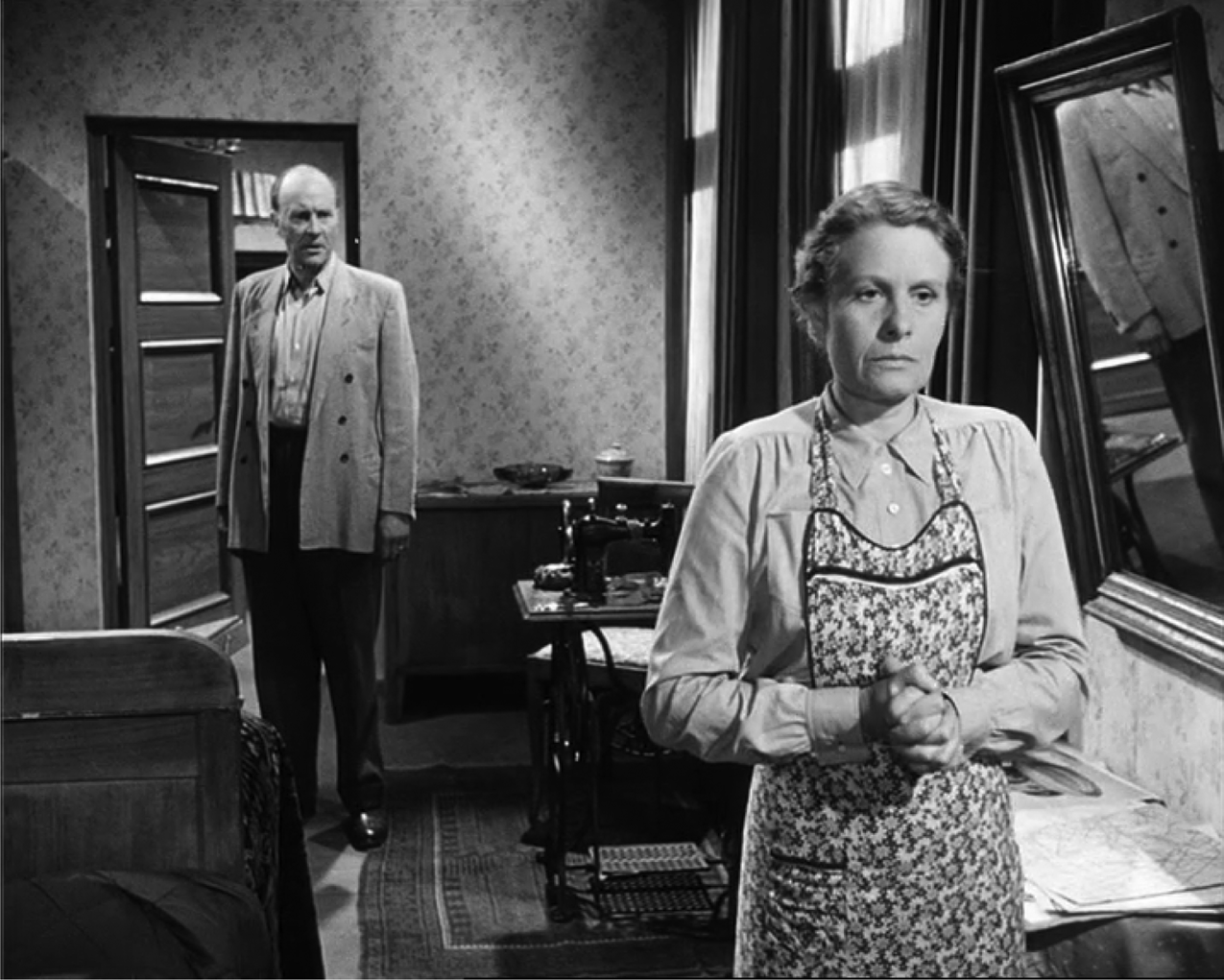
The dialectic of weak masculinity and wicked femininity is quite evident in Die Halbstarken. What sets the conflict of the film in motion is actually a problem between Freddy and Jan's parents, not between the brothers and their father. As film scholar Sebastian Heiduschke points out, the parents have “financial problems” and they “have to repay a debt of 3.000 Deutsche Marks following bankruptcy procedures.”Footnote 30 Heiduschke interprets the financial debt as an indicator of the father's weak masculinity. This weakness is conveyed aesthetically in a shot in which Jan and Freddy's mother turns her back to their father and at the same time his reflection in a mirror hanging on the wall cuts off his head—a symbolic decapitation that references his powerlessness (see Figure 2). However, what Heiduschke fails to mention is that the father blames his weak masculinity on his wife. It is her brother that needed him to cosign a loan. And when the brother's business goes bankrupt, he ends up paying half his wages each month to repay the bank. Thus, he is in debt because of her family and he holds her responsible, as is evident in his statement to her: “I expect you to agree with my position and not the position of your depraved family.”Footnote 31
Scene from Die Halbstarken. Freddy and Jan's father stands in the apartment in a dispute with their mother. Her back is turned toward him in defiance. The mirror hanging on the wall cuts him off at the head, emasculating him.

This debt has not only weakened the father, but it leads to both sons turning to crime. Freddy moves out because he refuses to recognize his father's authority. And I read Jan's motivation for getting involved in one of Freddy's heists, as his desire to repay the loan in order to rescue his father's masculinity.
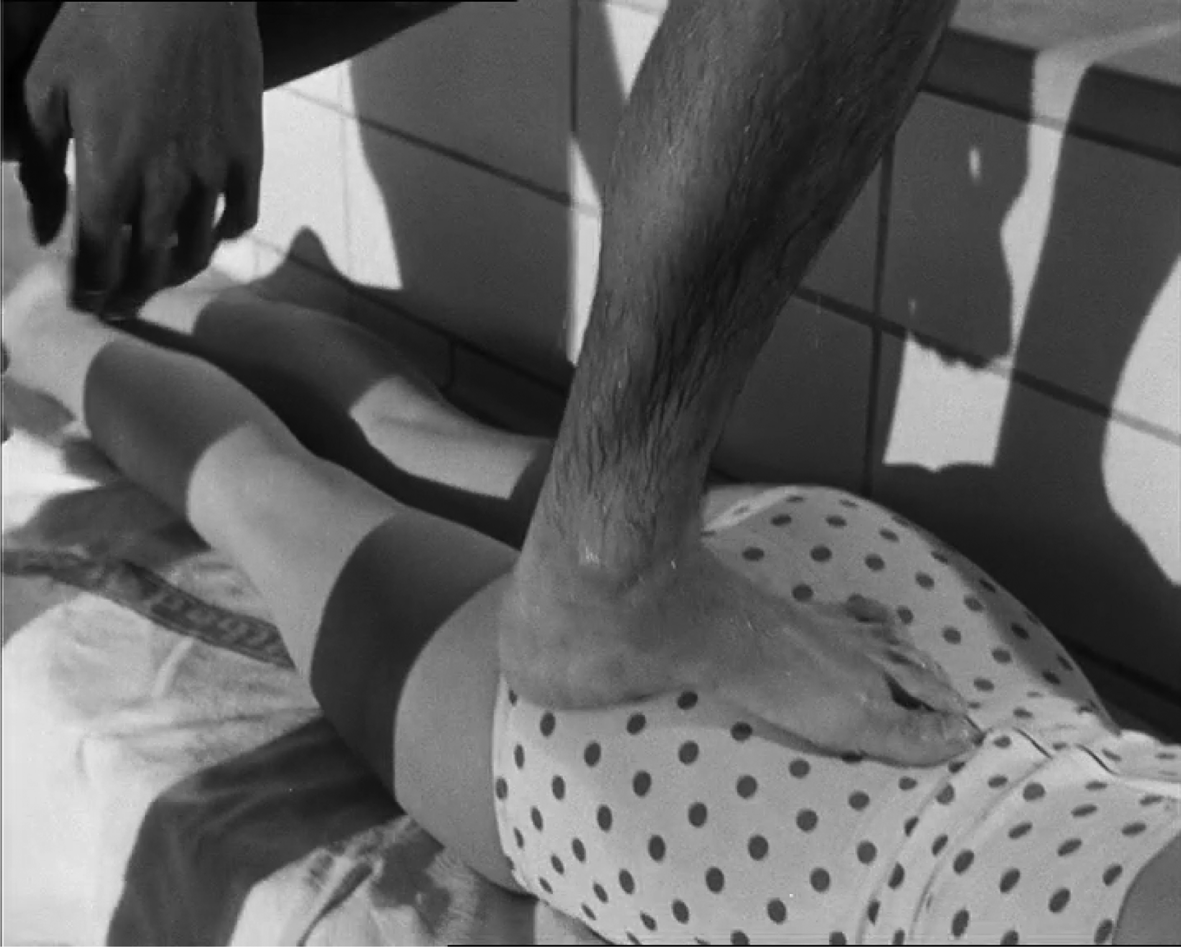
Sissy's character development from sex object to femme fatale becomes clear when one considers how she is first introduced in the narrative. When Freddy and Jan run into each other at the community pool, she is lying by the side of the pool wearing a bikini. Freddy introduces Sissy by first planting his foot firmly on her bottom—a move that marks her as his territory. Film historian Gerhard Bliersbach remarks about the scene, “Shortly after this opening scene, Freddy introduces his girlfriend Sissy to his brother Jan, while she is lying on a step by the side of the pool, and he lightly places his foot on her backside like the proud owner of a sports car places his foot on the footstep” (see Figure 3).Footnote 32 This image was even used as part of promotional materials for the film. Bliersbach also claims that Jan is attracted to Sissy, which is the reason why he follows the pair and why Freddy becomes jealous of his brother and needs to show him up with the mail truck heist.Footnote 33 Bliersbach's writes, “Jan covets Sissy. He follows her as if mechanically, absorbed by his desire. His wish to win Sissy pulls him away from his family.”Footnote 34 Bliersbach's interpretation reinforces the notion that Sissy is the negative element disturbing the family dynamic and setting both brothers on the wrong path.
Scene from Die Halbstarken. Close-up of Freddy's foot on Sissy's backside as she lies down at the side of the pool.

In this same scene at the pool, Freddy expresses his feeling of superiority over Sissy not only in his body language, but also in his remarks about her family life. When she becomes too curious about his and Jan's business, he tells her to go take a shower because her family's cramped quarters don't allow her to bathe regularly. Later on, we get a brief look into Freddy and Sissy's current living situation: they share a room in her mother's tenement apartment. Despite the fact that Freddy is actually a guest in the Brochert's apartment, the pinup girls hanging on the walls as part of the mise-en-scène mark the space as his territory and confirm how women are objectified and seen as currency by some West German teenagers.
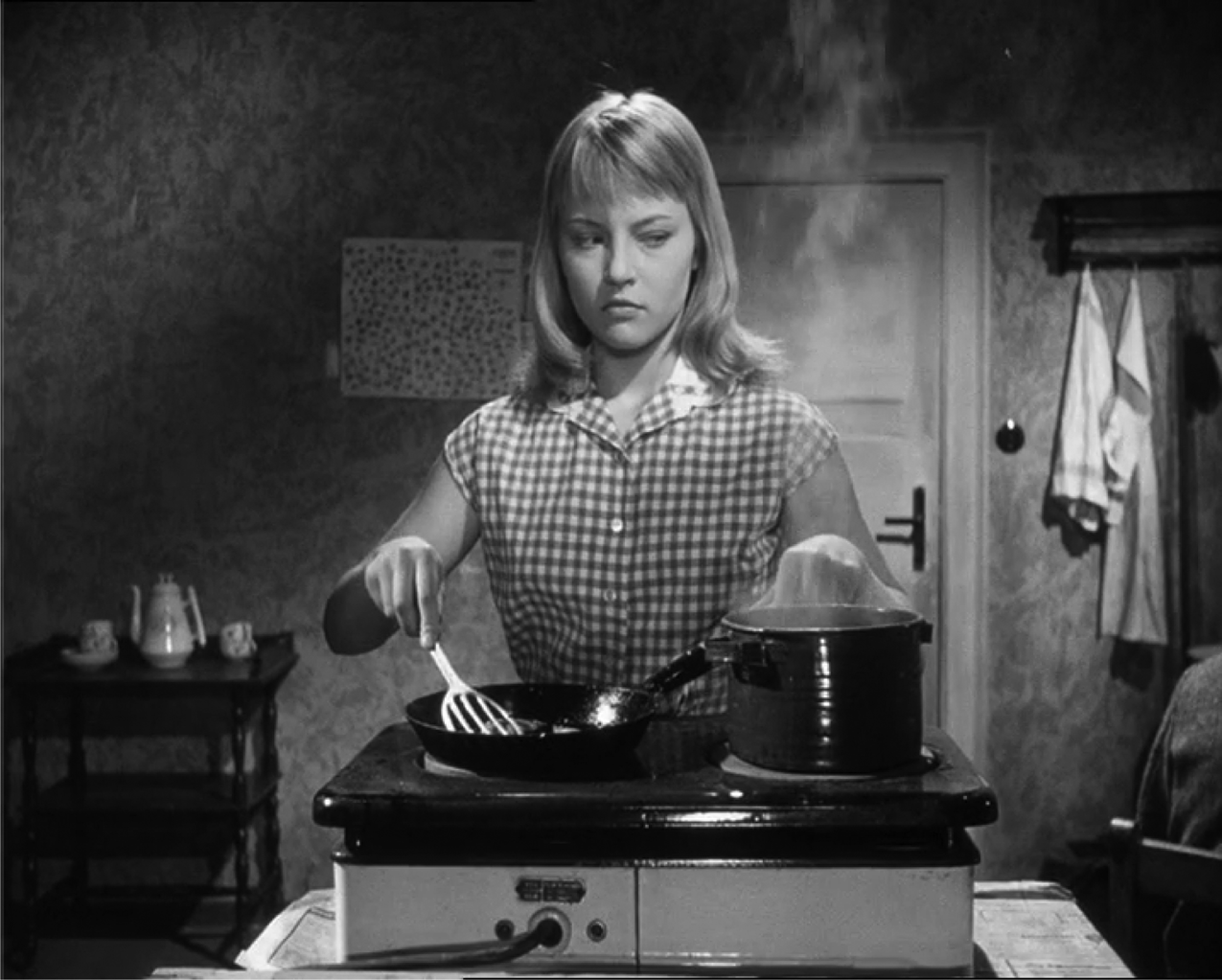
In the brief scenes at their apartment, Sissy is clearly unhappy with a domesticated role. Her mother scolds her for not doing the laundry. Her mother's appearance—tired, overworked, poor, and dirty—makes clear that this is clearly not a future Sissy desires. From the stovetop, as Sissy cooks for Freddy and Jan, she looks visibly upset (see Figure 4). But as her back is facing the men, only the audience is aware of her unhappiness and her deceptive two-faced nature, which Freddy and Jan will only discover at the end. From these scenes of an impoverished, domesticated life, it is clear why Sissy would like Freddy to commit a big heist that would free her from poverty and grant her more luxury. I would argue, contrary to Bliersbach, that it is actually Sissy who is the jealous one in the triangulation with Freddy and Jan. She is jealous that now that Freddy's brother has reentered his life, he will take precedence over her. Toward the end of the scene at Sissy's apartment, Sissy uses her sexuality to win Freddy over when she expresses her concerns that Jan has taken her place. As Freddy and Sissy embrace in a kiss, the camera cuts from a close-up of their faces to a close-up of Sissy's hand gripping the sofa. Most viewers likely read the cutaway to Sissy's hand gripping the sofa as a stand-in for a sexual act because such photography techniques were typical in film before it became more commonplace to show nudity and sexual intimacy following 1969, when West Germany loosened its restrictions on pornography.Footnote 35
Scene from Die Halbstarken. Sissy stands at the stovetop in the apartment she shares with her mother and Freddy. She listens in on Freddy and Jan's conversation, spying on them over her shoulder as she reluctantly prepares dinner for them.

Another thing Heiduschke's analysis overlooks is the role Sissy plays in causing the conflict that leads to the film's unhappy ending. Heiduschke states, “To purchase a car and start a life together, Freddy and Sissy suggest burglarizing the villa of a local bar owner.”Footnote 36 But rather than this being a mutual decision that the couple reaches together, in the film it is clearly Sissy who has the idea and plants it in Freddy's head, which demonstrates his lack of power over this manipulative femme fatale.Footnote 37 Furthermore, Freddy aspires to have a car and money only because he believes it will make Sissy happy. It does not seem like Freddy would embark on a risky operation of burglarizing a home if Sissy had not pressured him to do so. In both cases regarding the boys’ mother and Sissy, women are the cause of men's financial problems and trouble. Although Sissy's greed comes to a climax at the end of the film, where she is the ringleader of the robbery, we already get a sense of her selfishness near the beginning, when she convinces a girlfriend to join her and Jan at the soda shop with the expectation that he will pay for both of them. In an interesting shot, Jan sits across Sissy, outside of the frame, and blows smoke rings toward her (see Figure 5). Sissy defiantly stares into the camera and the smoke ring recalls a smoking gun, almost warning that the male protagonists better shoot Sissy first, before she shoots them or at least emasculates them with her gaze. And she does in fact shoot Freddy at the end of the film when the two attempt to pull off the heist at the villa and Freddy refuses to shoot the owner of the house, therefore making the earlier scene a foreshadowing of the violence to come.
Scene from Die Halbstarken. Sissy sits across from Jan in the soda parlor. Jan sits off screen and smokes a cigarette, blowing a smoke ring in her direction.

An Angelic Socialist Heroine
In contrast to the representation of Sissy as a greedy sex object, Angela, the protagonist of Berlin–Ecke Schönhauser, is portrayed quite differently. Angela is introduced by Dieter before she even appears on the screen. At the start of the film, Dieter shows up at a police station to confess to some trouble he and Kohle got into in West Berlin. But first Dieter attests to Angela's innocence, saying that though she might have hung around with the rowdy boys, she had nothing to do with the trouble. Dieter's proclamation of her innocence, and the innocence embodied in her name as a derivative of “angel,” already give the audience an indication of how we are supposed to read her character.
That being said, Angela is not a complete angel; like Sissy, she defiantly refuses to do any chores. A shot of her getting ready in a mirror, doubling her image, suggests she might have a good and a bad side. But she is coded with far more modesty than Sissy. Compared to Sissy in her flowing dresses, Angela's initial appearance in dark pants and a windbreaker make it hard to distinguish her from the boys in their crew (see Figure 6). In contrast to how Sissy is introduced in Die Halbstarken, it is not Angela who is introduced in a revealing manner, but her mother who undresses for us on the screen as she justifies her dating habits to her daughter as a necessary way to deal with the hardship and loneliness she has experienced as a war widow. When confronted with her mother's lover on her way out of the building, Angela casts her eyes down, diverting her gaze, unlike a defiant Sissy, whose gaze threatens to penetrate the men around her. I would also note that in this scene with her mother's lover, by placing Angela farther up on the stairs looking down at him, she is cast in a morally higher position. She stands above the immoral adults in her life, which will become even more evident in the film's reviews that constantly contrast Angela with her mother, making Angela into a victim.
Scene from Berlin–Ecke Schönhauser. Angela wears dark capri pants, a tight sweater, and a windbreaker. She leans against the railing underneath Schönhauser train station, the sole girl among a gang of boys.

Another revealing scene for how Angela is depicted is the sole sex scene in the film. Following a local dance, Dieter walks Angela home and they stop to kiss behind a screen. Right before Dieter kisses her and presses her into the screen, he poses several questions. Prior to this scene, the police falsely suspected Dieter of stealing some girls’ IDs to sell on the black market in West Berlin. Dieter asks Angela if she believes he would really do that, to which she responds no. Then he asks her if she is afraid, to which she also responds no and he proceeds to kiss her. Although her second “no” allegedly consents to their intimacy, by having her say no twice beforehand, it almost appears as if she is resisting, which would convey the “good girl” image with which she's been associated. Although in Die Halbstarken we see a lot of Sissy's body, a close-up of Freddy's foot on her bottom and a close-up of her in a swimsuit, in this “sex scene” we see nothing of Angela at all. With the camera positioned on the screen as the two lovers stand behind it, the only indication of the sexual act is that their bodies pierce the screen as Dieter simultaneously impregnates her. Though Dieter is briefly led astray, first by Karl-Heinz, who tries to involve him in money-making schemes, and then by Kohle, who flees West to escape his abusive father and criminal charges for a fight with Karl-Heinz, Dieter inevitably realizes that the only future for him lies in the East. And having a pregnant Angela to return to, for whom he must provide, makes his return to the East at the end of the film all the more fulfilling; an ending that reveals the heavy-handed, moralistic, and ideological argument being conveyed in the film.
Reception, Legacy and Sexism
When one compares how East and West German receptions of Berlin–Ecke Schönhauser and Die Halbstarken address gender and sexuality, the East German press stands out because it does not sexualize or demonize Angela. Rather, the press tends to show sympathy for her situation. She is described by one author as “the sad, discontent Angela.”Footnote 38 In her analysis of Berlin–Ecke Schönhauser, Uta Poiger notes that compared to West German film critics at the time, East German reviewers “did [not] discuss girls as instigators of male adolescent rebelliousness.”Footnote 39 This is reflected in the DEFA press release, which though not stressing her own agency, at least positively refers to Angela as “a young worker, who will stand by Dieter during this time.”Footnote 40 In fact, several reviewers stress Angela's importance in helping integrate Dieter into society. A review published in the Saxon newspaper Sächsische Zeitung in September 1957 observes, “A girl, Angela, makes it easier for the less complicated of the two boys [Dieter] to return.”Footnote 41 Similarly, a review published one month earlier in the newspaper Freiheit in Halle describes her as “The girl Angela—a young worker from the Berlin nationally owned company—is a good friend and helper of the welder's apprentice Dieter. Their young love is subject to countless problems and difficulties, which are rooted in the tensions of a divided Berlin.”Footnote 42 This review seems to legitimize both characters by stressing their employment. In fact, another review in the Saxon newspaper Freie Presse from September 1957 goes so far as praising Angela's work in the factory: “Angela, a girl who doesn't do a bad job at the factory during the day, spends her evenings at home in a cramped apartment where there is little room, because her mother, who lost her husband during the war, is paid a visit by her boyfriend.”Footnote 43 Not only does the film offer no evidence that Angela is a good worker, however, it actually points to the opposite. This does not prevent reviewers from stressing Angela's potential as a good wife, mother, and worker. Her character can be redeemed from Sissy's fate, who one East German reviewer simply described as a “bride of a hoodlum.”Footnote 44 It is also remarkable that the problems for their relationship are not placed with Angela or her desire for consumer goods. Rather, in East German reviews, the lures of the West are responsible, which are in such close proximity in the divided city of Berlin; suggesting that the young lovers’ problems are solely a result of their socio-historical context and the potential Western influence of consumer culture.
Most GDR reviews of Berlin–Ecke Schönhauser also praise actress Ilse Pagé for her acting. In September 1957 Wolfgang Joho writes in the high-circulation weekly Sonntag, dedicated to “Culture, Politics and Entertainment,” that “Ilse Pagé's Angela reveals a viable talent and one hopes to see this young girl in another film.”Footnote 45 A reviewer from the Sächsische Zeitung stated in the same month that “Even Ilse Pagè's role as the Berlin bobbysoxer could not have been given to a better actress.”Footnote 46 Likewise the review in the East Berlin weekly Fahrt Frei praises Pagé's acting and Angela's character: “Ilse Pagé, who had not had much exposure before the role, offers us a calm and by all means endearing Angela.”Footnote 47 The reviewers’ praise for Pagé and her acting skills suggest that they associated her with her role, collapsing them into one person. Accordingly, Dorothea Uebrig, wrote in the Wochenpost in September 1957, “She doesn't have to act; because she is already the same type as Angela and that's probably why she got the role.”Footnote 48
What allows reviewers to be so positive about Pagé is that they do not view the character of Angela as simply a bad seed. When it comes to describing the root of Angela's problems, reviewers focus on her family home. Wolfgang Joho explains in Sonntag, for example, “There's Angela, who has to live in a home without a father,” which implies she does not have the authoritarian, fatherly guidance, and discipline necessary for a proper upbringing.Footnote 49 In short, Angela has a good character, but grew up under difficult circumstances. Even Anna Teut, a West German reviewer for the conservative newspaper Die Welt, writes in September 1957, “Ilse Pagé as Angela is a snotty-nosed Berlin brat with a hidden, sensitive soul,” which makes her a candidate for redemption.Footnote 50 As a result the reviewers do not sexualize her, not even when they describe like Joho the sole sex scene in the film: “and the love scenes between Dieter and Angela have a natural and therefore moving intimacy.”Footnote 51 Remarkably, even most West German reviews of Berlin–Ecke Schönhauser are absent of any sexist or demeaning remarks about Angela.Footnote 52 One review in the Christian-conservative weekly Christ und Welt even suggests that to call Angela a “Halbstarken girl” would be “superficial” because “she has to take to the street, so that her mother can be alone with her boyfriend.”Footnote 53 The fact that both East and West German newspapers are so positive in their regard of Angela suggests that it is not just political ideology driving these opinions, but that the narrative of the film makes it difficult to feel anything but sympathy for this character.
In contrast, the West German press and the promotional materials for Die Halbstarken consistently sexualize Sissy and present her and the actor Karin Baal in a quite different way. Even before the film was shot, there were numerous newspaper reports written relaying how Karin Baal was cast. Like Pagé, Baal was a newcomer to the film industry and had no acting experience. The review in the left-liberal newspaper Telegraf, published in the British sector of West Berlin, writes in September 1957, “Someone chose her out of a huge crowd of young girls, because her appearance was most similar to the ideal in the script, that witch's charm of [French actress] Marina Vlady.”Footnote 54 The term witch's charm is of course implying that Vlady and Baal are deceptive and dangerous. The promotional brochure from Union Film Verleih, the movie's production company, accordingly states, “The girl [Baal] is so to speak the ‘devil in the background’ as director Tressler puts it.”Footnote 55 In another promotional material from the Union Film Verleih, an entire paragraph is dedicated to Baal's sexuality and budding film stardom: “The starlet from Wedding, who received a 1500-Mark-fee, is as coy as a cat and ‘clever’ as only a girl from Berlin can be and is gifted with such a stubborn charm that her career is on the rise.”Footnote 56 The word choice in this statement, describing Baal as “coy” and “stubborn,” is most striking in how it depicts her as tantalizing and teasing with her sexuality.
The numerous West German reviews written after the film's release merely added to the list of feminized, derogatory labels including “witch” and “devil.” Karin Baal is described with degrading labels such as “beast” (Biest)Footnote 57 or “evil, greedy slut” (bösen, habgierigen Flittchen).Footnote 58 In the liberal newspaper Süddeutsche Zeitung, Gunter Groll writes for example of Baal, whose real last name was Blauermel,Footnote 59 “and finally the talented Halbstarken-vamp Karin Blauermel, who will most definitely have a successful career and for this reason will call herself henceforth ‘Karin Baal,’ which of course sounds significantly more Babylonian. She was 15 as the film was shot, which was banned for youth. She was allowed to act in the film, but she wasn't allowed to watch it in the theaters. There's something wrong with that. Things are quite difficult for these Halbstarken.”Footnote 60 Groll's choice of words especially stand out here: Baal is a “vamp” from the decadent “Babylon,” which are terms that describe her as parasitic and associated with sin like the Old Testament city. And in the extreme right National Zeitung in January 1957, Karen Niehoff even calls her an “ambitious little Lilith” (ehrgeizige Klein-Lilith) while another reviewer named her an “Eve.” Both biblical names indicate that the trope of the femme fatale has been perpetuated in Western society long before the postwar film noir genre.Footnote 61 In addition to these demonizing words, something especially unsettling about Groll's remarks is that, although he attempts to convey disapproval over the fact that though the underage Baal was able to perform in the movie she would not have been allowed to watch it, his highlighting her young age also conveys the sense that it might be tantalizing for him and other male viewers to see such a young, natural girl performing on screen. This sentiment is also conveyed in additional reviews, such as the remark in the Telegraf from September 22, 1956, which compared Baal to the older French actress Marina Vlady: “Karin is luckily still too young and healthy that she would dare copy her famous colleague other than in her film role.”Footnote 62 Though the reviewer does not elaborate on what behavior Karin dare not copy, this statement both shames the adult woman Vlady for her behavior and warns Baal not to stray too far from her role as a coy, bad girl.
Several reviews reflect the notion that Baal's appeal is situated in her ability to occupy a liminal space between youth and adulthood, where she is old enough to be desired but not too old as to lose her playfulness and inexperience, which appears to fulfil the fantasies of older male reviewers. A reviewer in the Filmspiegel from October 1956 describes Baal as “a very appealing mix out of self-assurance and insecurity, intuition and reason, child and finished woman, and the flighty creature is wonderfully real.”Footnote 63 Similarly, in the weekly Deutsche Kommentare, Wolfgang Schimming observed one month earlier that Baal is “a child of the war year 1941. She wears blond bangs like Marina Vlady and has a look in her eyes that reflects the seldom allure of precocious childhood.”Footnote 64 And in October 1956 Will Fischer writes in the Rhein-Neckar-Zeitung that she is “the blond tramp that has barely grown out of her kids’ shoes and murders in cold blood.”Footnote 65 Fischer goes on to praise Baal: “the girl with the childlike unconscious who brings the hot breath of the French film school into the scenario.”Footnote 66 Here it appears that both Baal's young age and her cold demeanor are what make her appealing for male viewers.Footnote 67 Reviewers wanted to consume Baal's sexuality and youth while simultaneously taking a moral high ground and speaking about her in a paternalistic fashion.Footnote 68
This combination between fear of Sissy and attraction to her is found throughout the West German reviews. In his review for the conservative newspaper Frankfurter Allgemeine Zeitung, published in October 1956, Karl Korn refers to Sissy as the “sixteen-year-old feline predator Sissy” and plays up her role as femme fatale by referring to “the so-called cold charisma of the blond Karin Baal, a sixteen-year-old doll who may not have a heart, but has plenty of Halbstarken sex.”Footnote 69 By referring to Baal as a “doll,” Korn objectifies her in a manner that is consistent with the rest of the review, where he frequently only refers to the women in the film as objects to possess. He states that the Halbstarken want to “present themselves with fancy girls, because they've understood, how weak and depraved the generation of their role models is.”Footnote 70 He also claims that Freddy just wants to “get to the top and then honorably live with his wife and a house bar and be on top, like the others who show up at the gas station nights with their fancy cars and have something blonde at their side in the style of [Marilyn] Monroe.”Footnote 71 It is also remarkable that Korn explicitly references Baal's sexual nature, considering that sex is only implied in Die Halbstarken, whereas in Berlin–Ecke Schönhauser it is confirmed with Angela's pregnancy. Nonetheless, none of the East German reviews state anything explicitly about sex in this film nor do they remark on Angela's sexual behavior.
Korn's review also naturalizes Baal's performance and implies that she herself embodies these characteristics and is not just playing a role. The notion that Baal cannot act, but just plays herself, is further reinforced by a press release from Union Film Verleih, which states that “in order to maintain the primitiveness of her performance, director Georg Tressler did not give her the script to read, rather he directed her from scene to scene.”Footnote 72 In an interview, Tressler explicitly states that he didn't give her the script because “then I could more easily bend her into shape!” meaning, if Baal knew the script, she would be more likely to try and think for herself.Footnote 73 While these numerous men refuse to grant Baal any agency, in her own interview, Baal countered that despite having not read the script “I quickly figured out what kind of girl [Sissy] was … I'm not stupid.”Footnote 74 Rather than criticize this sexist and paternalist behavior of Tressler forbidding only Baal from reading the script, the reviewers seemed convinced it was the right thing to do. The Telegraf reviewer wrote in September 1956, “Georg Treßler [sic] tries to maintain the sympathetic naturalness and youthful sweetness by only explaining each scene to her as they shot it. Karin did not get the script.”Footnote 75 Despite the PR of the Union Film Verleih and the impressions reviewers presented to their readers, Karin Baal's performance was for her age quite professional. Cameraman Heinz Pehlke recalls, “Karin Baal was a wonderful discovery for us. At the time she was not a professional actress, but at the pool we saw that every one of her looks was correct. We knew, she would become an important actress.”Footnote 76
Such statements about both Baal and Pagé reflect a gendered attitude toward young actresses that insists that either young women cannot approach acting as a craft or that they perform better in roles if they come across as more “natural.” Nevertheless, when Pagé's youth and experience are invoked, even in a West German review, these details about her person are not used to degrade her.Footnote 77 In contrast, Baal's acting is regularly criticized. Both the reviews of Pagé and Baal reveal a conflation between the person and the role, but only Baal's role is interpreted as villainous and Page's role is viewed with empathy. Furthermore, compared to the statements made about Baal, the ones about Pagé might still be gendered, but they include no judgment about her character or sexuality. In general, both the press and marketing of Karin Baal, including her decision to change her surname to something that, in Groll's words “naturally sounds more Babylonian,” suggest a certain sexualization and commodification of Baal that does not take place in Pagé's case.
Conclusion
By analyzing these two films, this article contributes to the special issue's goal of considering some of the various paths explored in East and West German societies following their founding in 1949. Examining the female protagonists in Die Halbstarken and Berlin–Ecke Schönhauser more closely reveals related but different approaches to female rebellion that can be traced back to differing views on consumerism and gender. Historian Alexandra Seibel notes that within the system of capitalism, consumerism has long been sold as a concession to female emancipation because “If there has historically existed an activity in the public sphere in which women were allowed to move around freely and without harassment, it was, of course, shopping.”Footnote 78 And in How German Is She?, Erica Carter demonstrates that West German society had to celebrate some degree of female consumerism because “mass consumption was key to the restitution not only of the domestic economy but also of national integrity, [therefore] women … in their allotted function as domestic consumers, gained a new significance as prototypical models of the new consuming citizen.”Footnote 79 In contrast, as Jennifer Lynn concludes from her analysis of women's magazines from both states, in the GDR, women's emancipation was linked to paid labor rather than consumption. My analysis demonstrates how these different attitudes play out in Tressler's and Klein's films and why one movie focuses on a femme fatale, while the other offers us a “good girl,” even if both are framed within narratives about teenage rebellion.
Though I focus on differing views toward consumerism in each state, however, there are additional possible explanations for why these two female protagonists are so starkly different. One possible explanation is that Tressler and Klein had very different intentions for their films. From both the marketing materials and the film reviews, it is clear that while Die Halbstarken was meant to capitalize on sensationalism, specifically profiting from people's fears about an encroaching problem of rebellion, in contrast—as part of a larger project of building socialism—Berlin–Ecke Schönhauser is a film that does not just focus on a problem but offers a solution with the heterosexual relationship of an equal working couple in a socialist society. As Udo Klaus wrote in Die Welbühne in September 1957, the characters in Berlin–Ecke Schönhauser must choose between “the construction of socialism” and “the cheap temptations of West Berlin.”Footnote 80 And the DEFA press release for the film confirms this. It not only emphasizes that Dieter makes the right choice, but that this choice hinges partly on Angela: “Together with Angela he will create a meaningful life here [in the East].”Footnote 81 For historian Joshua Feinstein, “romantic love” is, in Berlin–Ecke Schönhauser, “a metaphor for loyalty to the state; the West stands for greed and egotism, the East for community.”Footnote 82
Finally, one might wonder, whether the different treatment of these female characters and actresses within the film and the reception not only says something about differing attitudes toward consumerism and the differing goals for the films, but also suggests a greater difference between how women were treated and respected in both Germanys. To the contrary, I suspect that rather than reflecting a fundamental difference between public attitudes and behavior regarding gender roles, instead the difference between these films and their receptions says more about how ideology can affect our perception of art. It is true that though the GDR promoted respect toward women as equals, in reality this attitude made room for only certain kinds of female emancipation that enabled women to be workers, but still required them to be wives and mothers, which is evident from the ending of Berlin–Ecke Schönhauser. Nevertheless, the East German ideology of respect toward women and a general resistance to objectification and commodification seemed to influence both the kinds of characters created for the film, as well as how audiences perceived them. Even the West German reviews of Angela in Berlin–Ecke Schönhauser were positive and did not necessarily condemn her as a symbol of socialist propaganda.
Despite the contradictions found in the GDR relating to gender and emancipation, the DEFA film's arguments are ideologically heavy-handed: young people are the future and they will thrive if they choose the socialist state and the nuclear family as an embodiment thereof. In contrast, Die Halbstarken more honestly reflects the mixed messages with which West German audiences were confronted in their society. On the one hand, one gets the sense from both the reviews and promotional materials for Die Halbstarken that sexuality was clearly useful for selling goods and there was no aversion to embracing this fact. On the other hand, this tantalizing view of sexuality had to be reconciled with 1950s West German conservatism. Thus, what is reflected in the reviews for Die Halbstarken is a desire to both consume Baal's sexuality and condemn her for putting it on display; to revel in the film's thrilling story but argue that it is more of a crime film than social critique.
To conclude, from both an analysis of the films themselves and their reviews, one can see that in Die Halbstarken there is clear desire to link consumerism, crime, and immorality with bad femininity. In Berlin–Ecke Schönhauser, such a demonization of femininity is not a part of the narrative, arguably because instead of having to contrast models of good and bad female consumption, which was necessary in the FRG, instead the directors could associate the allure of consumerism and imminent danger of capitalism with West Berlin. Nevertheless, the reception of the films and their actresses reveal similar patriarchal views in both countries. Thus, at first glance the movies and their perception create quite different gender images, but at the second glance the underlying patriarchal structure and gender hierarchy is quite similar and paternalistic and this only really becomes visible with a close reading of the movies from a perspective focusing on gender and from looking at the film reviews. Without considering all of these interlocking pieces—the films’ content, their reception, and their sociohistorical context—one cannot get the complete picture of the ideological stakes and effects of each film.