Zinc and iron deficiencies are common among young children in developing countries and are associated with a high incidence and prevalence of diarrhea, febrile illnesses (including acute respiratory infections), and iron deficiency anemia. Diarrhea-related illnesses are the leading cause of mortality in these children (Reference Bern, Martines and de Zoysa4;Reference Henry11;Reference Yoon, Black and Moulton38). According to current estimates, 1.6 million children annually die due to diarrhea (Reference Lopez, Mathers and Ezzati17). Iron deficiency anemia may impair cognitive development (Reference Lozoff, Beard and Connor18;Reference Walter37). Thus, as adults they may participate less in the workforce and also have lower-paying jobs. Therefore, the net impact of premature mortality and impaired cognitive development is loss of future earnings. This calls for preventative nutritional programs for young children that includes both zinc and iron—improvement in IQ scores by means of iron supplementation would be futile if the child dies of diarrhea, and so would be improvement in life expectancy by means of zinc supplementation if the child attains low IQ.
Sprinkles is a new approach to the prevention of micronutrient deficiencies through fortification of home-made complementary foods (known as “home-fortification”) (Reference Schauer and Zlotkin27). It contains micronutrients including zinc and iron which are bioavailable (Reference Tondeur, Schauer and Christofides34;Reference Zlotkin, Schauer and Agyei39), and effective against diarrhea and febrile illnesses (Reference Sharieff, Bhutta and Schauer30), and anemia (Reference Zlotkin, Schauer and Christofides40). An economic evaluation from a health care system perspective based on independent effects of zinc on diarrhea, and of iron on IQ scores concluded that Sprinkles were cost-effective (Reference Sharieff, Horton and Zlotkin31). A computer simulation model has also been developed that accurately predicts hemoglobin and serum ferritin concentrations in children given iron supplementation (Reference Sharieff, Zlotkin and Tondeur32).
Using data from the Pakistan Sprinkles Diarrhoea study (PSDS) (Reference Sharieff, Bhutta and Schauer30), we modified the model to compute rates of diarrhea and febrile days in children, in addition to their hemoglobin values. Thereupon, we carried out a probabilistic cost benefit analysis of home-fortification with Sprinkles from a broad societal perspective, on the basis of the combined impact of zinc and iron on lifetime earnings.
METHODS
Participants and Comparisons
Study participants represented a child population in an urban slum of Karachi, Pakistan. In Pakistan, the prevalence of zinc deficiency is around 38 percent (Reference Bhutta, Bird and Black5), and the prevalence of iron deficiency anemia is around 70 percent (Reference Molla, Khaurshed and Molla21). The mortality rate in children under 5 years of age is 125 per 1,000 live births. Life expectancy at birth is 62 years and, the per capita gross domestic product (GDP) is $417 (9). In the current study, we simulated a cohort of 5,000 male and female 6- to 12-month-old children who (at baseline) had a recent history of diarrhea—a population at moderate risk of mortality from diarrhea-related illnesses (Reference Bairagi, Koenig and Mazumder2). We assigned these individuals to daily supplements of Sprinkles or placebo administered over 4 months for a total of sixty supplements per individual to compare the mean costs and clinical outcomes in the two groups.
Type of Evaluation and Perspective
Using a human capital approach, we performed a cost benefit analysis from a societal perspective in which incremental benefit was expressed as the gain in lifetime earnings in the Sprinkles group relative to placebo, after accounting for the cost incurred in the two groups (Reference Hodgson12;Reference Layard and Glaister15). We included both direct medical costs and time costs incurred in the first year from baseline.
Resource Data and Assumptions
We used data from PSDS to specify sociodemographic and baseline biochemical characteristics of the simulated individuals in this study and to model the effect of Sprinkles on hemoglobin, longitudinal prevalence of diarrhea (percentage days of diarrhea out of observed child-days), febrile child-days, and drug utilization in relation to placebo. For outcomes not directly measured in PSDS, we made assumptions based on observations in other studies.
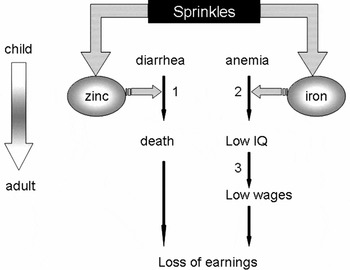
The key assumption was that, in zinc- and iron-deficient populations, micronutrient supplementation in children, through the immunopotentiating effects of zinc would reduce child mortality from diarrhea-related illnesses (Reference Shankar and Prasad29), and through the neurocognitive effects of iron would enhance work productivity in adult life (Reference Lozoff20). Underlying assumptions were as follows: (i) a 5 percent absolute increase in longitudinal prevalence of diarrhea is associated with a 17 percent increased risk of mortality (conversely a 5 percent absolute reduction would reduce mortality risk by 15 percent) (Reference Morris, Cousens and Kirkwood22); (ii) a 10 g/L increment in hemoglobin concentration at 9 months of age is associated with a 1.75 point rise in IQ (Wechsler intelligence test) at 5 years of age (Reference Palti, Pevsner and Adler23); (iii) the mean difference in IQ scores between treated and untreated groups would persist over lifetime (Reference Campbell, Pungello and Miller-Johnson8); and (iv) a one-point increment in IQ is associated with a 1.1 percent increment in wages (log scale) (Reference Alderman, Behrman and Ross1;Reference Salkever26). In addition, we assumed that (v) the effect of zinc on longitudinal prevalence of diarrhea would be confined to the period of supplementation (4 months); (vi) postintervention, individuals would have the same life expectancy as of the Pakistani population; (vii) individuals would join work force at 18 years of age and retire from work at 55 years of age; and (viii) the work participation and wage rates would remain constant over time (although individuals may be in or out of the work force). We have schematically presented the key assumptions in Figure 1.
Schematic presentation of the key assumptions.

Costs
We identified cost items as Sprinkles sachets, oral rehydration therapy (ORT) sachets, over-the-counter (OTC) drugs, antibiotics, physician fees, and hospital charges, where applicable.
The unit price for Sprinkles sachets (including distribution and overhead) was estimated at $0.02 (or $0.08 international dollars) (Reference Zlotkin, Schauer and Christofides40). Multiplying this unit price by the volume of resource utilization, which in this study was fixed at sixty sachets per child, we calculated that the cost per child for Sprinkles was $1.2 (or $5.25 international dollars). Similarly, we obtained unit prices for other items listed above directly from local sources. We multiplied these unit prices by the resource volumes, which in this study were simulated using raw data from PSDS. However, PSDS did not have data on resource volumes for physician fees and hospitalization. Thus, we obtained a range of values for these items from local sources and simulated their distributions. The model randomly picked a value for each individual from these distributions. Finally, we aggregated costs for each item to obtain the net total cost per child. As done by others, we restricted costing to resources consumed during the first year of the study (Reference Loevinsohn, Sutter and Costales16;Reference Sweat, Gregorich and Sangiwa33).
OUTCOMES
The main outcomes were prevalence of anemia (hemoglobin <100 g/L) at 4 months (end of supplementation), the number of deaths in the first year of study, IQ scores at 5 years of age, and lifetime earnings.
The Simulation Model
The starting point of the model was a data set of 5,000 individuals randomly assigned to Sprinkles or placebo. To create this data set of intercorrelated variables for sociodemographic characteristics, hemoglobin, longitudinal prevalence of diarrhea, febrile child-days and drug usage, we used Monte Carlo simulations using parameter estimates of PSDS. Baseline hemoglobin was not measured in PSDS—we assumed that the mean hemoglobin was 92 g/L (SD = 10 g/L) in both groups. We compared simulated data of the model with observed data of PSDS for internal validation—simulated data appeared similar to observed data (see Supplementary Table A, which can be viewed online at www.journals.cambridge.org/thc).
After internally validating the model, we followed these individuals for 55 years in a Markov process of time cycles, in which a given set(s) of current values of an individual predicted new values for the same individual in the next time cycle and so on. This model allowed us to examine the effects of intervention, co-interventions and time on outcomes.
Within the Markov process, we used each individual's value for longitudinal prevalence of diarrhea in the current time cycle to predict his/her survival in the next time cycle during the first year of study. Also, we related each individual's hemoglobin concentration at 9 months of age to his/her IQ at 5 years of age. However, we used parameter input for IQ scores from a Pakistani population (Reference Rahman, Maqbool and Zuberi24). Next, using parameters from PSDS, and gender and IQ score of each surviving individual, we computed his/her yearly work participation rates (P) and wages (W) from 18–55 years of age. Finally, we computed earnings by taking the product of work participation and wage (E = P × W) (Reference Schwartz28). We discounted these earnings at a yearly rate of 3 percent to the present monetary value. This was in accordance with the World Bank's recommendation. The complete details of model building and computations are described in a technical appendix, which is available from the authors upon request.
External Validation
For mortality rates, we compared the risk ratio (RR) of the two groups in the model with RR in a recent (unpublished) meta-analysis of randomized clinical trials conducted by R.E. Black (personal communication, 2007), which examined the effect of zinc on mortality by combining data from six trials that used zinc for diarrhea prevention and also reported mortality rates. We considered the model valid, if RR from the model was within the 95 percent confidence interval (CI) of the RR from the meta-analysis. For IQ scores, we compared the mean difference between the two groups in the model with the mean difference in a longitudinal study which reported IQ scores at ages 11–14 years in individuals who were iron deficient in infancy in relation to their counterparts who were not iron deficient, after adjusting for differences in potential confounding factors (gender, maternal IQ, and HOME score) (Reference Lozoff, Jimenez and Hagen19). Again, we considered the model valid, if mean difference from the model was within the CI of the mean difference from the longitudinal study—the authors of this study did not report the CI—we estimated it from their reported parameters. For earnings, we did not find any longitudinal study that followed infants stratified by iron status and reported their lifetime earnings—hence, projections on earnings could not be validated.
Economic Analyses
To calculate the incremental benefit of Sprinkles over placebo, first, we calculated the sum of each individual's yearly discounted earnings (discounted lifetime earnings) and the sum of costs incurred on each individual in the first year of the study (total costs). Next, we subtracted the total costs from the discounted lifetime earnings for each individual to obtain the net benefit for each individual. Then, we computed the means of net benefit for the Sprinkles and placebo groups, and took the difference of these means to calculate the incremental benefit.
To quantify uncertainty around these estimates, we performed two kinds of sensitivity analysis: probabilistic sensitivity analysis and scenario analysis (Reference Briggs7). The former analysis was to deal with the uncertainty arising from nonvalidated projected difference in lifetime earnings. Thus, we drew 2,000 random samples from the simulated population. Next, we calculated the means of incremental costs and incremental earnings for each sample. Last, we plotted the incremental costs against the incremental earnings, and also calculated the mean incremental benefit for each sample, and estimated the mean and 2.5th and 97.5th percentiles of these means (95 percent probability intervals).
The latter analysis was to deal with the uncertainty arising from variability in effects across populations—less effect in low-risk population and large effect in high-risk population. Thus, we varied the relationship between longitudinal prevalence of diarrhea and mortality, hemoglobin and IQ, and IQ and earnings, by setting the β-coefficients of all relationships at the lower bounds of their CIs (or ranges) for the low-risk scenario, or at the upper bounds for the high-risk scenario. Specifically, the low-risk scenario assumed that the effect of zinc on diarrhea, and the effect of iron on hemoglobin, would be 10 percent lower than the respective effects in the base case—conversely, the high-risk scenario assumed that the corresponding effects would be 10 percent higher. In addition, the low-risk scenario assumed that the under five mortality rate was 80/1,000 live births, a 5 percent decrease in longitudinal prevalence of diarrhea decreases risk of mortality by 5 percent, a 10 g/L increment in hemoglobin (at 9 months of age) is associated with a 0.38 point rise in IQ (at 5 years of age), and a one-point increment in IQ is associated with a 0.7 percent increment in logarithmically transformed wages. The high-risk scenario assumed that the corresponding values were 150/1,000 live births for under five mortality rate, 23 percent for risk in mortality, 3 points for rise in IQ, and 1.35 percent for logarithmically transformed wages.
For international comparison, we converted both costs and the discounted lifetime earnings calculated in Pakistani rupees to U.S. dollars at the 2003 exchange rate ($1 = 58.1 Pak rupees), and also to international dollars at the purchasing power parity (PPP) exchange rate of 13.25. We used SAS® (version 8.2, SAS institute, Carey, NC) for modeling and analyses.
RESULTS
Costs
Costs are shown in Supplementary Table B, which can be viewed online at www.journals.cambridge.org/thc. The placebo group had no costs for supplementation. However, this saving was offset by higher costs for ORT compared with the Sprinkles group. Net cost per child was $2.4–$108 (or $10.51–$473.04 international dollars) in the Sprinkles group and $0.3–$117 (or $1.31–$512.46 international dollars) in the placebo group.
Outcomes
Supplementary Table C, which can be viewed online at www.journals.cambridge.org/thc, shows clinical outcomes from model projections at various time points. The estimated risk ratio for 1 year mortality was 0.82 and the mean difference in IQ scores at 5 years of age was 1.3 points. These are similar to reference values of 0.90 for risk ratio (CI, 0.82 to 0.99) and 1.9 for mean difference in IQ scores (CI, −2.5 to 6.3); the estimates also lie within the respective CIs.
Economic Analyses
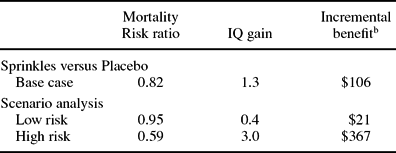
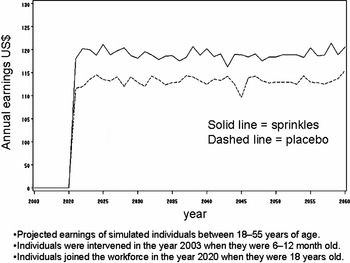
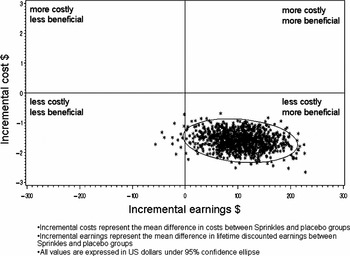
Individuals who received Sprinkles in their childhood had higher income during 18 to 55 years of age compared with those who received placebo (Figure 2). Probabilistic sensitivity analysis revealed that most of the data points were in the right lower quadrant—costs were lower, and earnings were higher in the Sprinkles group compared with placebo (Figure 3). There was 95 percent probability that the mean incremental benefit would be in the interval of $17 to $193 (or $74.54 to $846.27 international dollars). The present value of incremental benefit of intervening with Sprinkles in childhood was $106 per child, and varied from $21 (low-risk scenario) to $367 (high-risk scenario) (Table 1). In international dollars, this corresponds to $464.79 ($92.19 to $1,611.13).
Economic Analysesa

aIn the base case, under five mortality rate (MR) is 125/1,000 live births, a 5% decrease in longitudinal prevalence of diarrhea decreases risk of mortality by 15%, 10 g/L increment in hemoglobin (at 9 months of age) is associated with a 1.75 point rise in IQ (at 5 years of age), and a one-point increment in IQ is associated with a 1.1% increment in wages (log scale). The corresponding values are 80/1,000 live births for MR, 5% for mortality risk, 0.38 points for IQ, and 0.7% for wages, in the low-risk scenario, and 150/1,000 live births, 23%, 3 points and 1.35%, in the high-risk scenario. In addition, the low-risk scenario assumed that the effect of zinc on diarrhea, and the effect of iron on hemoglobin, would be 10% lower than the respective effects in the base case; conversely, the high-risk scenario assumed the corresponding effects to be 10% higher.
bIncremental benefit = mean net benefit [sprinkles] – mean net benefit [placebo]; where net benefit = earnings – cost.
Projection of undiscounted mean earnings (U.S. dollars).

Probabilistic sensitivity analysis.

DISCUSSION
We estimated the clinical and economic effects of home-fortification with micronutrients (including zinc and iron) taking into account the age, gender, and presupplementation longitudinal prevalence of diarrhea and hemoglobin concentrations. When all direct and indirect costs were included, the cost was $2.4 to $108 (or $10.51 to $473.04 international dollars) per child in the Sprinkles group and $0.3 to $117 (or $1.31 to 512.46 international dollars) in the placebo group. When long-term effects were modeled, home-fortification was associated with higher lifetime earnings due to reduction in mortality rates and higher IQ scores. The present value of the mean incremental benefit was $106 (95 percent probability interval = $17 to $193), which corresponds to $464.79 ($74.54 to $846.27) international dollars. This means that for each cohort of 10 million at-risk children, reached by a nutritional program, there is a 95 percent chance that the mean incremental benefit from the prevention of earning losses would be in the interval of $1.7 to $19.3 billion (or $7.45 to $84.62 billion international dollars).
Several studies have demonstrated the efficacy of zinc in treating acute and persistent diarrhea in sick children, and in preventing diarrhea in otherwise healthy children (presumably with zinc deficiency), with subsequent reduction in child mortality. In the treatment setting, all children would receive zinc supplementation. However, in the prevention setting, for efficient use of resources, it is prudent to identify children who may benefit from zinc supplementation. One criterion to identify such children is recent history of diarrhea (Reference Bairagi, Koenig and Mazumder2). PSDS, the study we used to simulate the model population, used this criterion, and thus, was neither purely a treatment trial (intervention in a high-risk population) nor purely a prevention trial (intervention in a low-risk population), but a hybrid of the two (intervention in a moderate risk population). Thus, the current model could project effects for both treatment and prevention settings: RR was 0.59 in the high-risk scenario, which is consistent with results from the pooled analysis of treatment trials (odds ratio, 0.58; CI, 0.37 to 0.90) (Reference Bhutta, Jiwani and Feroze6); and RR was 0.95 in the low-risk scenario which is consistent with results from Black's meta-analysis of prevention trials (RR, 0.90; CI, 0.82 to 0.99) (personal communication, 2007). The projected 18 percent reduction (RR, 0.82) in the moderate risk population rightly tends toward the lower bound of CI from prevention studies, but tends toward the upper bound of CI from treatment studies. Hence, the model projections on mortality appear valid.
There is ample evidence that iron plays a role in brain development and that iron deficiency during infancy (a crucial period of development) may irreversibly impair cognitive development (Reference Lozoff20). This is further supported by observations of Palti and colleagues (Reference Palti, Pevsner and Adler23), who followed a cohort from infancy to 5 years of age. IQ scores at 5 years of age were significantly higher for children who had higher hemoglobin concentrations at 9 months of age compared with their peers who had lower hemoglobin concentrations at the same age. Each 10 g/L increment in hemoglobin was associated with a 1.75-point rise in IQ after controlling for other factors such as parent education and schooling. They concluded that iron has a role in cognitive development. In Chile, Rivera and Walter (Reference Rivera and Walter25) performed IQ testing at age 10 years in a subset of their original cohort which was tested for iron deficiency in infancy, and so did Lozoff and colleagues (Reference Lozoff, Jimenez and Hagen19) in Costa Rica at age 11–14 years; in both studies on average IQ scores were approximately 5 points higher in individuals who were not iron deficient in infancy. Lozoff and colleagues adjusted the mean difference for gender, maternal IQ, and HOME score—there was a 1.9-points gain in IQ scores which was nonsignificant (most likely due to lack of power). Our projected gain of 1.3 IQ points is similar to this estimate; in scenario analyses, our estimates ranged from 0.48 IQ points (low risk) to 3.0 IQ points (high risk), which appear conservative, compared with the observed 5 IQ points difference in Chile and Cost Rica.
A moderate correlation between IQ and earnings (r = 0.4–0.6) has been observed in several studies across various countries, including Pakistan; (Reference Horton and Ross13) Alderman and colleagues (Reference Alderman, Behrman and Ross1) used regression models to estimate the effect of cognitive scores on wages using data from rural Pakistan. The dependent variable in their models was logarithm of wages. Beta coefficient ranged from 0.007 to 0.017, which means that each point increment in cognitive score was associated with 0.7 percent to 1.7 percent increment in log-transformed wages. They concluded that a one standard deviation increase in cognitive achievement suggests an increase in wages of over 20 percent. Therefore, our projected impact on wages and earnings is plausible.
Our results are not directly comparable to previous economic evaluations of iron interventions. We modeled the combined effect of zinc and iron on mortality and cognitive development using computer simulations. Thus, our results are not comparable to Baltussen and colleagues (Reference Baltussen, Knai and Sharan3), who restricted their analyses of cost-effectiveness of iron interventions to mortality in pregnant women, and did not model the effects of iron on cognitive development in children. Similarly, our results are not comparable to those of Horton and Ross (Reference Horton and Ross13), who did not model the effect of an iron intervention, but rather the economic consequences of iron deficiency. After a literature review, they conservatively deduced that a decrease in one-half standard deviation on cognitive scores is associated with a 4 percent drop in hourly wages for adults (or say one point decrement in cognitive score is associated with 0.53–0.8 percent drop in hourly wages). They assumed an average inter-correlation of 0.62 between IQ scores of childhood and adulthood, and assumed that childhood anemia is associated with a 2.5 percent drop in wages in adulthood (4 × 0.62). From further extrapolation, they estimated a median 5 percent of GDP per capita loss for Pakistan (including both sexes) due to childhood anemia. However, despite different analytic framework, we arrived at similar conclusions as those of Baltussen et al., and Horton and Ross—iron interventions are cost effective, and iron deficiency has economic consequences.
The idea of capturing cognitive effects on work productivity is inspired by Schwartz's work (Reference Schwartz28) which examined the effect of lead toxicity in the United States; high blood lead levels were associated with lower IQ, and lower IQ scores were associated with lower work participation rates and earnings. Following this, Salkever (Reference Salkever26) used data from the National Longitudinal Survey of Youth (NLSY), and estimated that each additional IQ point raises probability of work participation by 0.16 percent in males and 0.36 percent in females. Using linear regression fitted by least squares, he reported an independent effect of IQ on earnings after controlling for schooling, gender, parent education and race. This effect combines the effects of IQ on work participation and wages (from his data, we estimate that for each one point IQ rise, wages increase by 1.1 percent, which is similar to what Alderman et al. reported) (Reference Alderman, Behrman and Ross1). This was further examined by Grosse and colleagues (Reference Grosse, Matte and Schwartz10), who used data from the National Health and Nutrition Examination Surveys (NHANES), and estimated that each IQ point raises worker's productivity in the range of 1.76–2.38 percent. Recently, Trasande and colleagues (Reference Trasande, Landrigan and Schechter35) have used the same model to estimate economic burden from mercury toxicity. We have applied this approach in the context of iron deficiency in a developing country after accounting for local work participation and wage rates.
Our results should be used in the context of study limitations. Our model applies to children in developing countries who are at risk of premature mortality and impaired cognitive development because of zinc and iron deficiencies, and who may benefit the most from home-fortification; the benefits would be less in low-risk populations compared with high-risk populations. Thus, the results are not generalizable to the well-off segments of the population who do not have zinc and iron deficiencies, and thus, may not benefit from zinc and iron supplementation. Having acknowledged that, our results are generalizable to millions of children throughout the world who live in poverty (36). Other limitations included lack of direct observations from a Sprinkles intervention to support effect on mortality, IQ, and earnings. However, in Sprinkles, zinc (5 mg and 10 mg) and iron (30 mg and 45 mg) are bioavailable and are effective against diarrhea and iron deficiency anemia, respectively. Thus, there is sufficient biological and epidemiological evidence to support causal effects on mortality and IQ from this intervention. Furthermore, despite of indirectly modeling the effect of zinc on mortality (through the effect of zinc on diarrhea and the effect of diarrhea on mortality), and indirectly modeling the effect of iron on IQ (through the effect of iron on hemoglobin and the effect of hemoglobin on IQ), our results are in agreement with findings from previous studies. This attests to the validity of our results. Although, the effect on earnings could not be validated, sensitivity analyses revealed that upon varying the parameter values, our conclusions did not change—home-fortification is cost-effective. Thus, we believe that our conclusions are not adversely affected by the limitations in the current study.
POLICY IMPLICATIONS
In conclusion, home-fortification using Sprinkles is a cost-effective approach to combat common nutritional deficiencies and that it has long-lasting benefits that far outweigh its costs. Sprinkles have already been incorporated into the Lady Health Workers’ program in Pakistan on a nationwide scale (Reference Krivel14). Nevertheless, our results are applicable for evidence-based decision making in other developing countries, where collectively, 7–85 billion international dollars per 10 million at-risk children could be saved by preventing premature mortality and impaired cognitive development.
CONTACT INFORMATION
Waseem Sharieff, MD, PhD (doc.sharieff@utoronto.ca), Adjunct Faculty, Department of Health Policy, Management and Evaluation, University of Toronto, 155 College Street, Suite 425, Toronto, Ontario M5T 3M6, Canada; Resident Physician, Department of Postgraduate Medicine, Radiation, Oncology Program, McMaster University, 1200 Main Street West, Hamilton, Ontario L8S 4L8, Canada
Stanley H. Zlotkin, MD, PhD (Stanley.zlotkin@sickkids.ca), Professor, Department of Public Health Science, University of Toronto, 155 College Street, Toronto, Ontario, Canada, M5T 3M6; Senior Scientist, Program in Child Health and Evaluative Sciences, Research Institute, The Hospital for Sick Children, 555 University Avenue, Toronto, Ontario M5G 1X8, Canada
Wendy J. Ungar, PhD (wendy.ungar@sickkids.ca), Associate Professor, Departments of Heath Policy, Management & Evaluation, University of Toronto, 155 College Street, Suite 425, Toronto, Ontario M5T 3M6, Canada; Senior Scientist, Child Health Evaluative Sciences, The Hospital for Sick Children, 555 University Avenue, Toronto, Ontario M5G 1X8, Canada
Brian Feldman, MD, MSc (brian.feldman@sickkids.ca), Associate Professor, Department of Health Policy, Management, and Evaluation, University of Toronto, 155 College Street, Toronto, Ontario M5T 3M6, Canada; Rheumatologist, Division of Rheumatology, The Hospital for Sick Children, 555 University Avenue, Toronto, Ontario M5G 1XB, Canada
Murray D. Krahn, MD, MSc (murray.krahn@theta.utoronto.ca), Associate Professor, Heath Policy, Management & Evaluation, University of Toronto, 155 College Street, Suite 425, Toronto, Ontario M5T 3M6, Canada; Senior Scientist, Division of Clinical Decision-Making & Health Care, Toronto General Research Institute, 200 Elizabeth Street, Toronto, Ontario M5G 2C4, Canada
George Tomlinson, PhD (george.tomlinson@utoronto.ca), Assistant Professor, Public Health Sciences, University of Toronto, 6th Floor, 155 College Street, Health Sciences Building, Toronto, Ontario M5T 3M7, Canada; Scientist, Department of Medicine, Toronto General Hospital, 200 Elizabeth Street, Toronto, Ontario M5G 2C4, Canada