INTRODUCTION
Discarding is one of the most significant issues currently affecting many fisheries (Harris & Ulmestrand Reference Harris and Ulmestrand2004; Hall & Mainprize Reference Hall and Mainprize2005; Kelleher Reference Kelleher2005; Catchpole et al. Reference Catchpole, van Keeken, Gray and Piet2008; Aarts & Poos Reference Aarts and Poos2009; Poos et al. Reference Poos, Bogaards, Quirijns, Gillis and Rijnsdorp2010). The practice of returning part of the catch to the sea during fishing operations has generated substantial public attention recently and high profile media campaigns have been conducted to end the practice (for example Hugh's Fish Fight www.fishfight.net). The failure to make use of fish that are already caught is viewed by many as highly undesirable. Strong views have therefore been expressed by politicians, fishing industry, environmental groups, scientists and the public on the fact that discarding is threatening endangered species, wasting resources, increasing fishery costs and impacting on food webs (Catchpole et al. Reference Catchpole, Frid and Gray2005; Hall & Mainprize Reference Hall and Mainprize2005). Most commentators agree that discarding is a major problem, especially in mixed fisheries, and has serious social, economic and environmental consequences (Bergmann et al. Reference Bergmann, Wieczorek, Moore and Atkinson2002; Catchpole et al. Reference Catchpole, Tidd, Kell, Revill and Dunlin2007; Diamond & Beukers-Stewart Reference Diamond and Beukers-Stewart2011).
The full impacts on marine communities of discarding are not well understood (Catchpole et al. Reference Catchpole, Frid and Gray2005). However, given that species caught and subsequently discarded from fishing vessels could die as a result, discarding leads to a loss of potential income and food for humans, as well as impacting on marine ecosystems. Income is lost through the loss of potential growth and contribution to stock replacement when small or juvenile commercial fish are caught and killed. Cappell (Reference Cappell2001) estimated that 70% of the total value of the annual landings in the Dutch beam trawl fishery, and 42% of the annual landings in the UK roundfish fishery are directly lost due to the discarding of commercial species in the North Sea. Extensive discarding of commercial species results in substantial forgone potential yield and for declining stocks, discarding impedes rebuilding (ICES [International Council for the Exploration of the Sea] 2003). Some of the ecological impacts related to discarding include reduction in species diversity (Greenstreet et al. Reference Greenstreet, Spence and McMillan1999), changes in predator-prey interactions (Christensen et al. Reference Christensen, Guenette, Heymans, Walters, Watson, Zeller and Pauly2003), and changes in the relative abundance of species (Jennings et al. Reference Jennings, Greenstreet and Reynolds1999). These ecological effects of discarding are, however, inextricably linked with the overall effects of fishing mortality.
In the European Union (EU), discarding has taken place partly because of quota allocations awarded for each species through the Common Fisheries Policy (CFP). Current CFP regulations require fishing fleets to throw back any excess fish or shellfish when they catch more than their allocated quota, or species for which they do not have quota. This is exacerbated in fisheries that target many species when the proportion of quota for each species does not reflect the composition of the catch (Bergmann et al. Reference Bergmann, Wieczorek, Moore and Atkinson2002; Catchpole et al. Reference Catchpole, van Keeken, Gray and Piet2008; Poos et al. Reference Poos, Bogaards, Quirijns, Gillis and Rijnsdorp2010; Diamond & Beukers-Stewart Reference Diamond and Beukers-Stewart2011; Fernandes et al. Reference Fernandes, Coull, Davis, Clark, Catarino, Bailey, Fryer and Pout2011). It has recently been estimated that these ‘over-quota’ discards (quota species discarded above the legal minimum landing size) account for up to 27% of English discards (Enever et al. Reference Enever, Revill and Grant2009; Catchpole et al. Reference Catchpole, Enever, Maxwell, Armstrong, Reese and Revill2011; T.L. Catchpole, unpublished report to DEFRA 2011, available from the authors on request). Legal minimum landing sizes are in place for important commercial species to protect small or juvenile fish from being targeted and sold (Catchpole et al. Reference Catchpole, Frid and Gray2005; Diamond & Beukers-Stewart Reference Diamond and Beukers-Stewart2011). However, the mix of species found in most fisheries means that one size of net mesh is rarely suitable for all species (Bergmann et al. Reference Bergmann, Wieczorek, Moore and Atkinson2002; Catchpole et al. Reference Catchpole, van Keeken, Gray and Piet2008; Fernandes et al. Reference Fernandes, Coull, Davis, Clark, Catarino, Bailey, Fryer and Pout2011). Poor gear selectivity therefore results in many fish being caught below the required minimum landing size, which are then discarded. Around 19% of discards from the English fleets are of fish under the minimum landing size (Catchpole Reference Catchpole, Enever, Maxwell, Armstrong, Reese and Revill2011 a; T.L. Catchpole, unpublished report to DEFRA 2011, available from the authors on request).
Market conditions also influence discarding. Some species are discarded because they are not popular to eat and have no market, these make up 30% of English discards (Catchpole Reference Catchpole, Enever, Maxwell, Armstrong, Reese and Revill2011 a; T.L. Catchpole, unpublished report to DEFRA 2011, available from the authors on request). Others have a weak or inconsistent demand on the market, or there is inconsistency in landing these fish by fishers. Around 24% of English discards are attributed to inconsistencies in sorting and markets (Catchpole Reference Catchpole, Enever, Maxwell, Armstrong, Reese and Revill2011 a; T.L. Catchpole, unpublished report to DEFRA 2011, available from the authors on request). Discarding is therefore a highly complex problem influenced by environmental (mixed fisheries) and social (regulations and fishers’ behaviour) factors. It is a consequence of the composition of catches targeted by fishers, who are affected by landing constraints and economic forces (Catchpole et al. Reference Catchpole, Frid and Gray2005, Reference Catchpole, van Keeken, Gray and Piet2008; Diamond & Beukers-Stewart Reference Diamond and Beukers-Stewart2011; Fernandes et al. Reference Fernandes, Coull, Davis, Clark, Catarino, Bailey, Fryer and Pout2011). Further, the CFP regulations, such as quota restrictions, have been developed in theory to protect fish stocks from overfishing, which makes stopping discarding a complicated issue.
While fishers discard when they catch the wrong species, the wrong sizes of target species, the catch is damaged, or the species quota is reached, it is the use of unselective gear that has led to the continued high level of discarding (Catchpole et al. Reference Catchpole, Frid and Gray2005). The use of unselective gear is a consequence of fishers’ perceptions that using selective gear results in reduced profitability as gear modifications allow marketable fish to escape, as well as reducing discard levels. In addition, some technical gear modifications, such as benthos release panels, are prone to ‘chafe’ (affecting the visual appearance of the caught fish, thereby reducing their saleability and price), and therefore require too much maintenance (Revill & Jennings Reference Revill and Jennings2005). In most cases, large catches are appealing to fishers even if many fish have to be discarded subsequently, and as fishers are also in competition with each other there is prestige in large catches (Arnason Reference Arnason1994). Discard reduction strategies therefore need to address fishers’ objectives and reverse the incentive to discard.
EU ministers have agreed to change the CFP regulations by introducing a ban on discarding of pelagic species (such as mackerel Scomber scombrus, herring Clupea harengus and bluefin tuna Thunnus thynnus) in targeted fisheries by 2015, and demersal species that are under quota (such as cod Gadus morhua, haddock Melanogrammus aeglefinus and whiting Merlangius merlangus) by way of a phased implementation approach starting in 2016 and fully in place by 2019 (European Commission 2013). The ban means that fishers targeting pelagic species and demersal species under quota would be forced to land all fish of those species, except where the fish will be used for live bait, have good survival rates when discarded, or are not allowed to be landed. In some circumstances, a de minimis level of up to 5% of total catch of regulated species may be discarded if there are disproportionate costs handling and storing the fish on board (European Commission 2013). However, simply bringing the currently caught and unwanted catches ashore would not reduce the environmental impact of discarding or aid the building of commercial fish stocks. The objective of a discard ban should be to avoid catching unwanted fish in the first instance. However, there is likely to be a proportion of the catch that cannot be sold for human consumption. The question then becomes what will happen to the residual unavoidable catch? One option could be turning discards into useful commodities, but this needs to avoid creating any unwanted incentives. As species become serially depleted, what was once a discard could soon become a targeted resource (Hall & Mainprize Reference Hall and Mainprize2005).
In light of these changes to the CFP, the aim of this paper is to explore the implications of introducing a discards ban by assessing the practical and economic issues surrounding whether discards not destined for human consumption can be used by commercial outlets in the UK. We present analyses of data gathered through the Cefas (Centre for Environment, Fisheries and Aquaculture Science) Observer Programme to show current discarded quantities and to provide an indication of the volumes that would be available to commercial outlets when a ban is implemented. We also briefly discuss the regulations and approvals required to clarify the legal framework related to the use of discards in the UK. The availability of commercial outlets for discards not used in the human food chain is a key factor in the development and success of a potential discard use programme when the discard ban is implemented. Without their support, there would not be a foundation on which to develop a successful use programme. Consequently, this paper identifies existing outlets and use opportunities for discards in the UK and explores each commercial outlet's suitability in terms of locality to the catching sector; capacity to receive discards; limitations and uncertainties; associated revenues and costs for the catching sector; and requirements for additional investment such as storage facilities, sorting and grading, traceability, and processing.
METHODS
Legal framework
A review of the legal framework related to use of discards was conducted to clarify animal by-product regulations, approvals required and responsibilities. The review focused on regulations that would apply in the UK for the use of discards in products such as fishmeal and pet foods.
Discard data
Cefas fisheries observers accompany commercial fishing vessels registered in England and Wales so as to estimate discarding and retention of fish in accordance with the European Commission data collection framework. The vessels to be sampled are based on fishing effort data taken from the official statistics held by UK Government's Department for Environment, Food and Rural Affairs (Defra) on the fishing activities database. In each quarter, a list of vessels fulfilling the sampling criteria, are randomly selected and targeted (Enever et al. Reference Enever, Revill and Grant2007, Reference Enever, Revill and Grant2009). The discards data from the English fleet includes species, quantities and types of discards, and data have been collected consistently since 2002.
Questionnaires
We collated a list of all possible opportunities for discard use from previous projects (such as Fishing for the Markets, http://www.fishingforthemarkets.com/) and through the official list of premises approved to treat animal by-products held by Defra. The list also included details of two associations that represent the rendering industry: UKRA (UK Renderer's Association) and FABRA (Foodchain and Biomass Renewables Association). We contacted each commercial outlet by telephone and/or e-mail to establish their interest in using discards. A questionnaire that included both open- and closed-ended questions was used to gather detailed information on the suitability of each outlet. The questionnaire included general questions to establish the respondent's background in using fish and shellfish as raw material in their business.
The remainder of the questions gathered information on: (1) location of the company, including the location of other processing plants it owns; (2) the potential capacity of discards that they are able to process; (3) raw material requirements, including the quality of fish and shellfish, format required and any preference for certain species; (4) the cost of processing discards, including transport, price for the discards, and labour costs; (5) income including the product they would develop, where they would sell their processed material, and the revenue it would generate; and (6) infrastructure, including facilities for storage, sorting, grading and processing. Respondents were also asked to state whether there was a requirement for them to know the source of the raw material they process; and (7) whether the respondent perceived any limitations and uncertainties to using fish discards. In order to further explore perceptions of respondents towards discarding, we included an open-ended question on their opinions surrounding whether using discards in their business made commercial sense.
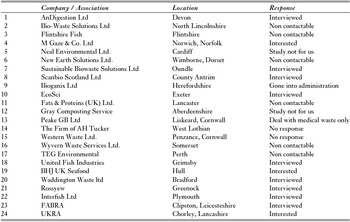
In total, 24 commercial outlets were contacted. Eight of them could not be reached due to incorrect contact details or lack of availability. One outlet had gone into administration, and three stated that they did not deal with fish. Three outlets initially expressed interest in taking part in the study, however they failed to complete the questionnaire in time. Detailed interviews were therefore conducted with nine commercial outlets (Table 1).
All outlets contacted, showing those who took part in the study.

Data analysis
An estimate was made of the quantities of discards by species, and by corresponding region and English port where those catches would be landed. An observed regional discard rate (average 2008–2010) was calculated and applied to the recorded landed weights derived from official logbooks from English registered vessels to generate an annual weight of discards by species and by landing port (Catchpole et al. Reference Catchpole, Enever, Maxwell, Armstrong, Reese and Revill2011). The current CFP proposal indicates that the ban on discards will start with fisheries targeting pelagics from January 2015. A ban on demersal species under quota will follow from January 2016. Analyses were therefore completed with the quantities discarded pooled into: (1) discards of species under quota; and (2) all species that are consistently discarded over the three-year (2008–2010) period.
Fishing vessels incur a range of operating costs (such as fuel, boxes, ice, sales commission and crew wages) that will change if fishers are to bring to shore all their catches. In order to illustrate the cost of bringing ashore discards not destined for human consumption, costs and earnings for specific vessel segments were taken from the 2009 Economic Survey of the UK Fishing Fleet (Curtis & Brodie Reference Curtis and Brodie2011). The cost of landing one tonne of fish or shellfish was calculated by dividing the annual operating costs by the total landings. Estimates of average discard rates (% of total catch weight discarded) for each vessel segment were obtained from the data collected through the Cefas Observer Programme (COP), and used together with the total landings to estimate the catch discarded per vessel segment. From this quantity, the proportion of discards that would not be destined for human consumption was estimated by adding together the proportion of discards of fish under the minimum landing size (19%) and the fish that are discarded because they are not popular to eat and have no market (30%).
RESULTS
Quantities discarded
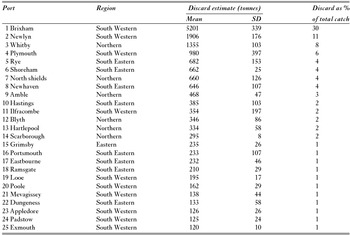
Data collected on board English fishing vessels show that a total of 17 402 ± 617 t of all species caught in England are discarded annually. Between 2008 and 2010, the majority of discarding took place in the south west of England, where 56% of all catches were discarded. Discard data also shows that 30% of all species discarded annually are related to the Brixham landing port (5201 ± 339 t yr−1), and 11% to Newlyn (1906 ± 176 t yr−1) (Table 2). Other major landing ports where a considerable amount of discards could be available include Whitby (1355 t yr−1) and North Shields (660 t yr−1) in the north, and Rye (682 t yr−1) and Shoreham (662 t yr−1) in the south east of England. It is worth noting that exceptions on fish that will be used for live bait, have good survival rates when discarded, or involve disproportionately high costs handling and storing on board, mean that fleets will be allowed to discard up to 5% of total catch, thereby reducing the amount of discards landed.
Estimated annual discard quantities of commercial species in tonnes by landing port showing the top 25 ports where the discards would be landed.

The top ten species discarded between 2008 and 2010 include cuttlefish (Sepia elegans), monkfish (Lophius piscatorius), whiting (M merlangus), plaice (Pleuronectes platessa), sole (Solea solea), haddock (M aeglefinus), rays (Raja montagui), cod (G morhua), Nephrops (Nephrops norvegicus) and lemon sole (Microstomus kitt). These species are usually discarded for a variety of reasons, including that they were below the minimum legal landing size; some have no minimum landing size but were discarded because they were too small to sell. Some of them were discarded because of inconsistencies in the markets for these fish, while others were discarded as a result of a response to quota restrictions, catch composition regulations or because they were damaged. Clearly, some of these species could be sold at the market if fishers are allowed to land them.
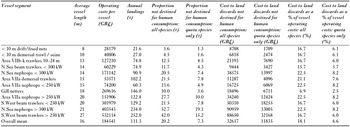
Results show that a discard ban will lead to increases in annual operating costs for fishers ranging from GB£ 4708 (£ 1 = US$ 1.52, May 2013) in under 10 m netters, to £ 90 959 per vessel for vessels > 300 kW targeting Nephrops in the North Sea (Table 3). If the ban is imposed on quota species alone, as is planned by the European Commission, then the annual increase in operating costs for each vessel will range from £ 1709 in the under 10 m netters, to £ 33 005 for vessels > 300kW targeting Nephrops in North Sea.
Estimates of discard rates for each vessel segment that were used to calculate the proportion of discards not destined for human consumption and the cost of discarding when the ban is applied to quota species only and a ban on all species.

Discard use opportunities
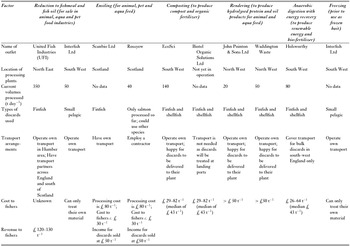
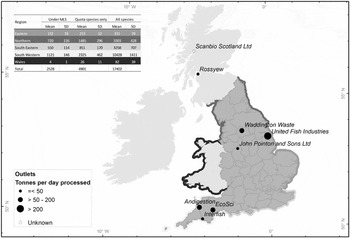
Surveys with commercial outlets keen to use discards in bulk indicate that the opportunities for using discards not fit for human consumption fall into six main categories: (1) reduction to fishmeal and fish oil; (2) ensiling (liquefied fish); (3) composting; (4) rendering; (5) anaerobic digestion with energy recovery; and (6) freezing prior to use as bait (Table 4). The nine main outlets that expressed interest in using discards indicated that they would use the discards as raw materials to process into animal, pet and aqua feed; compost and organic fertilizer; frozen bait; and other products, such as renewable energy generation. Surveys show that the nine commercial outlets have a total daily processing capacity of 730 tonnes. The largest processor is United Fish Industries (UFI), which processes 48% of all fish by-product (Fig. 1). All company managers interviewed indicated that they have capacity to process substantially more discards in their current plants.
Use opportunities for discards showing the products that the discards not destined for human consumption would be processed into, including a summary of location and potential capacity for each of the nine commercial outlets, and the region where the commercial outlet is located.

Map of UK showing location of commercial outlets and estimated quantities discarded in each region. The annual quantities discarded are presented based on: the proportion that is under minimum landing size (MLS); discards of species under quota; and the total discards from the English fleets between 2008 and 2010.

Most of the commercial outlets accept discards in all formats, including whole fish, trimmings, ensiled or fresh. Some commercial outlets, such as Scanbio, will only process fish by-products, while others, such as Pointon, will process both fish and shellfish by-products (Table 4). While the majority of commercial outlets can use any species that is available to them, some commercial outlets have preference for certain species. For instance, Interfish prefer to process small pelagics only. Rossyew currently process salmon by-products only, but managers stated they could also use other species; to achieve this, they will need to create a separate line for the plant, in order to keep the processing of salmon separate from that of other species.
The majority of commercial outlets either operate their own transport or have contractors who provide transport for them (Table 4). Some outlets, such as UFI, buy the discards from the fishing industry, while others, especially those involved in composting and rendering, require the fishers to pay a gate fee. Based on current information, Rossyew indicated that they would pay £ 50 t−1 for fish discards, while UFI indicated that they currently pay £ 120–130 t−1 whole fish. None of the commercial outlets were interested in providing a figure for the revenue they would generate by processing discards, stating that this was commercially-sensitive information. It is therefore not possible to derive a value-added figure for processing fish discards, however respondents stated that they would sell their processed products from discards at the highest prices to enable them generate as much revenue as is possible. Managers therefore stated confidently that it would be possible to make a profit from discard use.
In terms of the processing capacity, apart from Scanbio and Rossyew, who both stated that they would need to build new infrastructure such as storage facilities to accommodate discards, all other commercial outlets indicated that they already have sufficient processing capacity. One outlet (Interfish) stated that they would sort and grade the discards, while the remaining eight stated that they would not need to grade or sort the raw material. In terms of traceability, four outlets (UFI, Interfish, Rossyew and Ecosci) would be keen to know the source of the discards, since they do not accept illegal, unreported and unregulated fish, while five outlets (Scanbio, Holsworthy, Waddington Waste, Pointon and Biotel Organic Solutions) indicated that they do not need to know the source of the discards. Two outlets (Scanbio and Rossyew) expressed some limitations towards using discards, mainly concerned with the quantities that will be available to them as raw material; if the volumes were too small then it would not be economically viable. Rossyew also stated that the quality of the discards will be a limiting factor, as they would need the discards before they were decomposed and discards would have to be free from anything that would affect the quality of the final product. Rossyew would therefore need to control the quality of raw material so that they did not end up with low-quality processed products. However, the other commercial outlets did not see any limitations surrounding using discards in bulk.
When asked whether using fish discards made commercial sense, respondents stated that using a high proportion of the discards for human consumption was critical. Most felt that directing the remaining discards to outlets such as fishmeal, fish oil, animal feed, pet feed and organic fertilizer would act as a disincentive to catch unwanted fish. This is because fish by-product processing companies are unable to compete on the price paid for the fish to enter the human food chain. The respondents see the use of fish discards not destined for human consumption as making absolute sense. The entire business of some of the commercial outlets (UFI, Scanbio and Rossyew) is built on fisheries by-products, and the companies will have to make extra preparations for receiving discards if sufficient volumes of the right species exist.
Legal framework associated with use of discards
The main regulatory framework associated with the use of discards not intended for human consumption in bulk outlets is the EU regulations that control the use, sale and disposal of high- and low-risk animal by-products (ABP). Fish and shellfish automatically become an ABP when the decision is made that they are not intended for human consumption. This is an irreversible decision. EC Regulation 1069/2009 (EU 2009) and its corresponding implementing EU Regulation 142/2011 (EU 2011) therefore form the key European regulations related to fish discards. Wild-caught fish landed but not intended for human consumption will typically fall into Category 3 ABP, provided they do not show signs of disease communicable to humans or animals, in which case they would be Category 2 ABP. Category 3 is the lowest risk category and therefore has the greatest number of potential uses. All of the nine commercial outlets identified in this study are EU-approved facilities dedicated to processing ABP, including fish, and would be able to use discards not destined for human consumption.
DISCUSSION
We aimed to assess the implications of a discard ban by exploring the opportunities that are available for using discards not destined for human consumption in commercial bulk outlets and by collecting views from existing outlets on their ability to use discards. Nine major commercial outlets were interested in processing bulk fish discards into fishmeal and fish oil, animal, aqua and pet feeds, fertilizers and energy generation, although other facilities for options such as composting and anaerobic digestion are widely available across the UK. All of the respondents stated that dealing with by-products was their core business and, therefore, that using fish and shellfish discards would complement their existing operations. Existing commercial outlets saw this as a real opportunity to expand their business, and were keen to develop business models and pilot schemes to accommodate discards. The commercial outlets we interviewed all agreed in their perceptions that using discards made commercial sense. Most were keen to suggest that discarding should be stopped, and some of them, for example those involved in compost and energy recovery, thought that the gate fee they would charge could act as an incentive for fishers to adopt more selective fishing gear. However, most commercial outlets confirmed that should discards be landed then they would make full use of them, hence avoiding a situation where unwanted fish in the sea have been shifted to unwanted fish on land.
Finding potential uses for discards is important in the context of the proposed land-all-catch policy under the reformed CFP, but the emphasis needs to be on avoiding the capture of unwanted fish. A wide range of gear-based technical measures to reduce the capture of unwanted fish during fishing operations have been developed and trialled in several fishing grounds. For instance, trials with coverless trawls demonstrated reductions in catches of whiting (M. merlangus) across all age classes, with a 52% reduction above the minimum landing size (Eustace et al. Reference Eustace, Kelly, Jackson and Rihan2007). Similarly, Revill et al. (Reference Revill, Dunlin and Holst2006) compared catches from a cutaway trawl with three common designs of commercial trawls in use in Fern Deeps (North Sea) with cod-ends of 97 mm, 84 mm and 85 mm, and showed no significant difference between the landings of the cutaway trawl and those of the commercial trawls. The cutaway trawl was repeatedly found to have similar selectivity parameters to those of the commercial trawls in each of three selectivity trials, and further significantly reduced the catches of whiting that would have been discarded. Other selectivity devices, such as the benthos release panel (Anseeuw et al. Reference Anseeuw, Moreau, Vandemaele and Vandendriessche2008; Depestele et al. Reference Depestele, Polet, Van Craeynest and Vandendriessche2008), box trawl (T.L. Catchpole, D. Peach & S. Smith, unpublished report to DEFRA 2011, available from the authors on request), selection grids (Catchpole et al. Reference Catchpole, Revill and Dunlin2006; Valentinsson & Ulmestrand Reference Valentinsson and Ulmestrand2008; Drewery et al. Reference Drewery, Bova, Kynoch, Edridge, Fryer and O'Neill2010; Eigaard et al. Reference Eigaard, Herrmann and Nielsen2012), separator trawls (Rihan & McDonnell Reference Rihan and McDonnell2003; Holst et al. Reference Holst, Ferro, Krag, Kynoch and Madsen2009; Campbell et al. Reference Campbell, Harcus, Weirmana, Fryer, Kynoch and O'Neill2010) and the use of diamond mesh cod-end (Graham et al. Reference Graham, O'Neill, Fryer, Galbraith and Myklebust2004; Madsen et al. Reference Madsen, Skeide, Breen, Krag, Huse and Soldal2008; Enever et al. Reference Enever, Revill, Caslake and Grant2010) have been shown to reduce discards. Many of these trials have also been conducted in partnership with fishers, in order to increase the uptake of the selectivity measures by the fishing industry.
Despite the growing number of trials with different selectivity measures and the increase in positive findings towards the reduction of discards, adoption of the selective gears has been slow. This can be attributed to the fact that most fishers perceive that fishing unselectively provides better economic returns in the short term. Catchpole et al. (Reference Catchpole, Frid and Gray2005) identified four arguments that fishers used to justify using unselective fishing techniques, including the biology of the fished species, ability of fishers to avoid gear regulations, effectiveness of landing size regulations, and perceived non-legitimacy in stock forecasts. Although a minority, some of the findings from the gear selectivity trials have supported this argument by showing reductions in commercial catches with some of the selectivity devices, such as the benthos release panel (Anseeuw et al. Reference Anseeuw, Moreau, Vandemaele and Vandendriessche2008) and lightweight flexible grid for size selection in Nephrops (Loaec et al. Reference Loaec, Morandeau, Meillat and Davies2006).
More research is required to understand the motivational behaviour and attitudes underpinning discarding and to bolster behaviour change. For instance, Project 50% (Nelson Reference Nelson2009) was initiated by Cefas to reduce discards amongst Devon beam trawlers by 50%, and used social science skills to understand the reasons behind fishers’ resistance to adopting new gear modifications. Interviews were conducted with the fishers to gain a deeper understanding and insight into their behaviours (including the barriers, incentives, disincentives, rewards and opportunities for changing discarding behaviour) and to identify effective mechanisms to facilitate behaviour change. Working with local net-makers, the fishers trialled their own new net designs alongside standard trawling configurations. Results of the side-by-side trials showed average discards reductions of 52%, with the most successful vessel reducing discards by 69% (Cefas 2010). Project 50% was successful in that it raised the profile of the positive work being done by fishers in collaboration with scientists. The results were used as part of a package of measures to successfully negotiate for the reduction in the cut of the ICES area VIIe dover sole quota, and subsequent increases in quota (Cefas 2010). Given that the CFP reform proposal does not include an obligation to avoid unwanted catch, but only imposes an obligation to land the unwanted catches; and this limited measure to prevent discarding only applies to some specified species, there is need for better and simpler communication of selectivity measures that are deemed to work with the fishing industry to ensure that unwanted species are not caught.
If fishers are required to land everything they catch, then crew in most vessels will have to spend more time sorting the catch to separate what will be landed for the human food chain from the discards that will be sent to the commercial outlets. An increase in sorting time will most likely affect the fishing operation, thereby inconveniencing the crew and potentially reducing overall productivity (Condie et al. Reference Condie, Grant and Catchpole2013). For vessels that have conveyer belts, vessel owners may need to re-engineer such that the catch goes to a collection area in the deck. In fact, the increase in time required to sort the catch may be the single largest increase in fishing costs associated with landing discards, as it may necessitate employing more crew (Condie et al. Reference Condie, Grant and Catchpole2013). In some cases, fish holds may be filled more rapidly due to the requirement to land all fish. This may necessitate an early return to port with holds full of a large quantity of low-value fish. This, combined with the need to purchase extra boxes to accommodate the catch that would otherwise be discarded, more ice, and increased landing fees, means that fishers will most likely experience an increase in fishing costs. Assuming the discards end up as raw materials for fishmeal processing where the fishers will fetch c. £ 130 per tonne, then majority of the fishers will make losses in their fishing operations. Such losses could lead fishers to adopt more selective gears in order to use their time more effectively and avoid catching the unwanted species.
The proposed CFP reform will use catch quotas instead of landings quotas; the species-specific total allowable catch (TAC) will be calculated using the total caught instead of the proportion landed. The basic principle suggested is to provide a limit of total catch for a single or group of species, where all catches of the regulated species are landed and once any of the catch quotas in a fishery are met, fishing activities stop. Further, all catches of commercial fish will be retained on board, recorded and landed (discard ban), only excluding species with high survival rates, such as skates (Enever et al. Reference Enever, Revill, Caslake and Grant2010). The question therefore is what incentives should be instituted to encourage compliance or, conversely, what disincentives should there be to non-compliance? There is a danger that if full market price is paid for fish that contravenes conservation regulations, fishers will be encouraged to fish for it more (Hall & Mainprize Reference Hall and Mainprize2005). Conversely, if fishers are not compensated at all for the extra work and costs of landing the full catch, then there will be a temptation to continue discarding at sea. Thus, there needs to be balance between overcompensation and encouraging trade, and undercompensation, thus encouraging discarding. This, of course, assumes that there is a market for the catches currently discarded and they have a value. This will be true for the catches of the targeted species in that fishery or the target species of another fishery, but in the case of by-catches from multi-species fisheries, there may be no ready market for the catch and therefore suitable products and markets need to be developed.
The findings from this study fill this gap, and show that c. 85% of UK fisheries discards are currently converted into fishmeal and oil. From a fishing industry point of view, this is the most promising use for discards, as the commercial outlets engaged (such as UFI) would buy the discards from the fishers. This not only brings income to the fisher, but removes the need for the fisher to find ways to dispose of the landed discards. The outlets keen to convert fish discards to fishmeal and fish oil also accept all species of finfish and have existing transport and processing infrastructure. Further, the discards sent for fishmeal would, in turn, be used to feed poultry and pigs, thereby generating food for humans and reducing the need to import fishmeal. Increasing domestic and global demand for fishmeal and fish oil means that commercial outlets would accept greater volumes of raw materials, and they therefore see the use of discards as a situation which benefits all parties.
During the transitional period (2015–2019) before the ban is fully implemented, incentives such as the provision of additional quota will be required, as fishing vessels adjust to the new catch quota system. As we have discussed, there is also need to provide incentives to improve adoption of more selective fishing practices. Further, a system of full documentation of catches needs to be in place, to record and monitor all catches, not just targeted catch, and generate accurate statistics to enable effective introduction of catch quotas based on realistic estimates of fishing mortality. The EU Commission has indicated that, to achieve the obligation to record all catches, vessels will need to be properly equipped with the necessary technologies (such as electronic logbooks, vessel monitoring systems, closed circuit televisions [CCTV], observers or other new technologies). Further work therefore needs not only to evaluate what methods provide the fishing industry with the opportunity to participate in data collection for full documentation of catches, but also to create the incentives and drivers necessary for data collection and selective fishing to meet EU obligations. The overwhelming focus of efforts in recent years has been on the development and application of CCTV and associated electronic monitoring technologies as part of catch quota trials (see for example Ames et al. Reference Ames, Leaman and Ames2007; Evans et al. Reference Evans, Molony, Australia and Fisheries2011; Kindt-Larsen et al. Reference Kindt-Larsen, Kirkegaard and Dalskov2011; MMO [Marine Management Organization] 2012). These trials have generally shown positive results, however they need to be further evaluated alongside other approaches (such as self-reporting, self-sampling and the use of reference fleets) and in different fisheries to evaluate how well they work with regards to a range of species, vessel sizes, types of fishing gear and handling practices.
CONCLUSIONS
Commercial bulk outlets in the UK have expressed interest in using fish discards not destined for human consumption. Most see this as an opportunity to expand their current business, while others see it as an opportunity to develop further solutions to dealing with by-products. As a result, commercial outlets could use all of the discards that will be landed. Most commercial outlets agree that incentives are needed to enhance the efforts to reduce unwanted catches, and think that by either paying a very low price for discards or charging to receive discards they are then contributing towards incentives to fish more selectively. The relatively low value of bulk discards is unlikely to create an incentive for fishers to target more of the fish currently discarded.
ACKNOWLEDGEMENTS
This study was completed with financial support from Seafish Ltd (contract SR661) and Defra (contract MF1227 and MF1002). Special thanks to the nine managers of the commercial outlets who took part in the study and colleagues in the Applied Fisheries Science and Technology (AFST) group at Cefas for their useful comments.