An animal's fitness is in part based on its ability to manage the inherent risks (foraging costs, predation, exposure to disease) with the benefits (resource gain, access to mates, social interactions) of activity (Abrams Reference ABRAMS1991, Altizer et al. Reference ALTIZER, NUNN, THRALL, GITTLEMAN, ANTONOVICS, CUNNINGHAM, DOBSON, EZENWA, JONES and PEDERSEN2003, Lima & Bednekoff Reference LIMA and BEDNEKOFF1999, Rubenstein & Hohmann Reference RUBENSTEIN and HOHMANN1989, Wikelski et al. Reference WIKELSKI, CARBONE, BEDNEKOFF, CHOUDHURY and TEBBICH2001). Thus, understanding an animal's pattern of activity is key to understanding behavioural and ecological processes. However, while numerous laboratory methodologies are available to continuously quantify activity over long periods of time, logistical difficulties have greatly hindered activity studies of animals in the field (DeCoursey Reference DECOURSEY1990).
Traditionally, changes in pitch and frequency of received signals from radio collars have been used as a means to detect activity because the signal from a stationary or inactive animal changes less than when an animal is in motion, allowing an observer to categorize an animal as active or inactive. However, this method is problematic because it is time- and labour-intensive, and subject to observer bias. Furthermore, distant or weak signals are more difficult to categorize, and bouts of activity that occur when the study species is normally inactive are likely to be missed (Cochran Reference COCHRAN and Schemnitz1980, Kunkel et al. Reference KUNKEL, CHAPMAN, MECH and GESE1991). Here, we overcome these difficulties by using an Automated Radio Telemetry System (ARTS). Details on ARTS can be found in Crofoot et al. (Reference CROFOOT, GILBY, WIKELSKI and KAYS2008) and at http://www.princeton.edu/~wikelski/research/index.htm
We used ARTS to examine patterns of activity for the Central American agouti (Dasyprocta punctata). We were particularly interested in explaining the occasional bouts of nocturnal activity in this primarily diurnal species. Nocturnal activity represents risk behaviour, as at the study site the primary predators of agoutis are nocturnal ocelots (Leopardus pardalis). Indeed, 9 of 11 agouti deaths recorded in an ongoing project were the result of predation by ocelots, with all of these predation events occurring at night (Aliaga-Rossel et al. Reference ALIAGA-ROSSEL, MORENO, KAYS and GIACALONE2006). We examined agouti activity in relation to environmental variables to investigate four hypotheses concerning nocturnal agouti activity: (1) activity is dictated by the cost of foraging, with certain environmental conditions such as rainfall or day-time temperature increasing the costs of daytime foraging to the point that these costs outweigh the nightly risk of predation, (2) nocturnal activity is dictated by predation risk such that nocturnal activity occurs only when there is sufficient moonlight as to increase predator detection and reduce the predation risk (Milinski & Heller Reference MILINSKI and HELLER1978), (3) agoutis avoid activity on brightly moonlit nights due to lunar phobia (Thies et al. Reference THIES, KALKO and SCHNITZLER2006) (4) nocturnal activity is dictated by available resources (Gilliam & Fraser Reference GILLIAM and FRASER1987), either occurring when resources are scarce and the risk of starvation is high, or occurring when cacheable resources are abundant.
In order to examine these hypotheses we radio-collared eight agoutis (5 m, 3 f) and tracked their activity over a 9-mo period, March 2003–September 2003, on Barro Colorado Island, in central Panama (BCI, 1500 ha, 9°9′N, 79°51′W). The habitat is Moist Tropical Forest (Leigh Reference LEIGH1999), annual rainfall is ~2600 mm, with a pronounced dry season occurring from mid-December until the end of April, during which time less than 10% of the annual precipitation falls (Windsor Reference WINDSOR1990). This seasonality produces distinct periods of fruiting for most tree species on which many animals depend (Smythe Reference SMYTHE1978).
Daily temperature and precipitation values collected by weather stations on BCI were provided by the Terrestrial-Environmental Sciences Program of the Smithsonian Tropical Research Institute (available at http://striweb.si.edu/esp). As an index of moonlight, we calculated the percentage of the moon illuminated for hourly intervals using an astronomical calculator (U.S. Naval Observatory Astronomical Applications Department). While this index does not account for cloud cover, rains tend to occur in the afternoon, and nights are generally cloudless or only partially cloudy. Therefore, averaged over the length of the study, this is an adequate index of nocturnal illumination.
We created an index of food availability based on the seasonal intensity of fruiting by tree species found within each agouti's home range (information in home-range calculations can be found in Aliaga-Rossel et al. Reference ALIAGA–ROSSEL, KAYS and FRAGOSO2008). We focused on the three most important agouti food sources with large cacheable hard seeds: the arborescent palms Astrocaryum standleyanum and Attalea butyracea, and the tree Dipteryx oleifera (Aliaga-Rossel et al. Reference ALIAGA–ROSSEL, KAYS and FRAGOSO2008, Smythe Reference SMYTHE1978). We exhaustively searched each individual's home range for these species; then each month and species received a score of 0, 1 or 2 (not fruiting, low-fruiting and high-fruiting seasons respectively) based on long-term records of seed fall on BCI (Wright et al. Reference WRIGHT, MULLER-LANDAU, CALDERÓN and HERNANDÉZ2005). Finally, we calculated an index of fruit abundance for each individual agouti by multiplying the number of trees of a given species in an individual's home range with its fruit production value, and summing these across all fruiting species.
We used ARTS to quantify activity by comparing signal strength on a logarithmic scale (dB) between time t+1 and t and used the δ signal strengths to determine whether the animal was active (large δ signal strength, coded as a 1) or inactive (small δ signal strength, coded as a 0) (Cochran & Lord Reference COCHRAN and LORD1963). By using a logarithmic scale and quantifying the differences relative to the absolute level of signal strength potential biases related to weak signals are eliminated. The threshold values of δ signal strengths that were used to distinguish between activity and inactivity were determined through field calibration using human subjects simulating animal activity and by direct observations of agoutis. First we simulated activity using human test subjects wearing a radio-collar. The subjects followed a preset pattern of activity ranging from completely inactive to fast walking. We found a statistically significant separation of δ signal strength values between active and inactive behaviours, indicating the ARTS is effective at detecting activity. We further calibrated the system using direct observation of a collared agouti; again we found a statistically significant separation of δ signal strength values between active and inactive periods. Further information on these calibration efforts and on the use of ARTS to detect activity can be found at www.sparrowsystems.biz, ARTS activity manual.
Patterns of agouti activity in relation to environmental conditions were examined using time series cross-sectional regressions (Chatfield Reference CHATFIELD2004). These analytical procedures account for both temporal autocorrelation and autocorrelation from repeated measures of the same individual. Four time periods of activity were examined: total activity (activity over a 24-h period), diurnal activity (from sunrise to sunset), nocturnal activity (sunset until sunrise) and mid-day activity (from 11h00 until 14h00). Time series models were fitted for each combination of explanatory variable and time period, yielding a total of 16 models. Significance levels were adjusted using a sequential Bonferroni test, to reduce the possibility of Type I error (Rice Reference RICE1989).
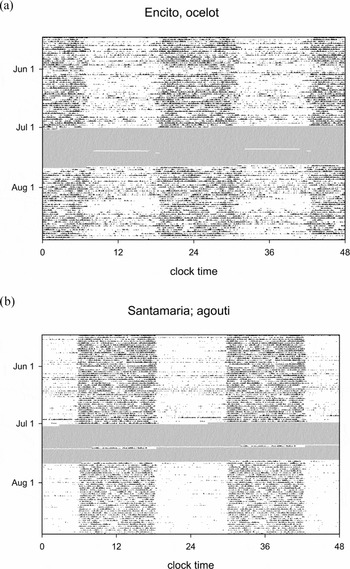
Our data and those from a hand-tracking study (Aliaga-Rossel et al. Reference ALIAGA–ROSSEL, KAYS and FRAGOSO2008) show agoutis generally displayed a typical diurnal pattern of activity, with peak activity occurring shortly after dawn and just before dusk (Figure 1). Such an activity pattern matches with the predictions that would be made if agoutis scheduled their activity bouts as to minimize exposure to predators and to simultaneously avoid activity when it would be most costly, such as in the heat of the day. However, the occasional bouts of nocturnal activity were surprising, as they expose the agouti to a greater risk of predation by ocelots. Of the 16 models created, only two were significant after the Bonferroni correction, with nocturnal activity positively relating to fruit availability (t = 7.65, Observed P < 0.0001, Critical P = 0.003125), and to mean daily temperature (t = 3.08, Observed P = 0.0022, Critical P = 0.0033). No other variables significantly explained agouti activity, and no other activity periods showed substantial variation.
Representative actograms displaying activity over 48-h period for a subadult male ocelot (a) and an adult male agouti (b) from mid-May to the end of August 2003. Data were collected from animals on Barro Colorado Island, Panama. A 48-h period is shown to better display both diurnal and nocturnal activity. The grey areas represent periods of missing data which are caused by several factors such as: animals venturing outside of the range of the system, the system being shut down for maintenance or the system's capacity being devoted to other species or system testing. Note that the ocelot is generally active at night with occasional activity bouts during day-time, whereas the agouti shows the opposite activity pattern.

Increased risk behaviour during periods of resource abundance is surprising given that risk behaviour must be counterweighted with a fitness reward, thus, we would predict risk behaviour to be a response to increased risk of starvation (McNamara Reference McNAMARA1996). Given the preliminary nature of our data, we can only speculate as to the cause of this pattern; however three explanations seem logical: (1) even during periods of resource abundance, the immediate risk of starvation outweighs the instantaneous risk of predation, (2) given that our data focused on cacheable resources (Dipteryx, Astrocaryum and Attalea), the future risk of starvation during periods of resource limitation may be greater than the risk of nocturnal activity, (3) by taking advantage of abundant cacheable resources, agoutis that avoid predation may increase their fitness by being able to mate and reproduce during periods of lower resource abundance.
Clearly, more extensive data are required to fully examine the merits of each of these explanations; however, based on currently available data the third seems the most likely to be correct. Explanation 1 does not fit with our observations of agouti deaths. While famine and starvation have been observed in the past on BCI, these are periodic and the result of severe climatic events (Wright et al. Reference WRIGHT, CARRASCO, CALDERON and PATTON1999). We, however, recorded no deaths as the result of starvation during the course of our study. Additionally, when resources are abundant, the risk of starvation should be the lowest. Thus, we would expect that the risk of starvation should only outweigh the instantaneous risk of predation during periods of low resource abundance, not high resource abundance, as we observed. Likewise, under explanation 2, we would expect the highest agouti mortality to occur during periods of resource limitation, which does not match with published observations (Moreno et al. Reference MORENO, KAYS and SAMUDIO2006).
However, reproductive output is directly tied to resources in other tropical rodents (Adler Reference ADLER1998). By fully exploiting cacheable resources when they are available, risk-taking agoutis that manage to avoid predation may experience increased fitness in periods of resource scarcity. It is possible that the magnitude of this fitness boost may relate to the density of both predators and inter/intraspecific competitors. Indeed, recent work has shown that trade-offs between current and future reproduction can lead to individuals with different degrees of risk-taking behavior in animal populations (Wolf et al. Reference WOLF, VAN DOORN, LEIMAR and WEISSING2007).
A longer-term study is needed that would track agouti activity and density, predator abundance, cacheable and non-cacheable resources along with the reproductive success of the agoutis. If our hypothesis is correct, we would expect that nocturnal activity would occur most often when agouti populations are high and trees that produce cacheable seeds are fruiting, while nocturnal behaviour would be rare when agoutis occur at low densities or when the only available resources are non-cacheable. When conditions are favourable, risk-taking behaviour should result in increased reproduction during periods of low resource availability and thus an increase in fitness. When conditions are unfavourable to risk-taking, nocturnal activity should result only in increased mortality with no subsequent reproductive reward.
Here we detail the use of stationary automated receivers to quantify activity of free-ranging animals and demonstrate the usefulness of this system with data collected on the activity patterns of the Central American agouti. These data revealed a surprising pattern of nocturnal activity in the primarily diurnal agouti, with these bouts of nocturnal activity relating to periods of abundant cacheable resources. Data such as those we analysed for agoutis would be difficult if not impossible to collect using conventional tracking methods.
ACKNOWLEDGEMENTS
We would like to thank William Cochran, Tony Borries, Axel Haenssen, Daniel Obando, Pablo Flores, Lisa Barnett, George Swenson, Franz Kuemmeth and many others for their help designing, building and maintaining the ARTS system. Meg Crofoot, Ricardo S. Moreno, Paula Capece, Vilma Fernandez and Eloisa Lasso are thanked for their help with the field work. The Princeton Tropical Ecology class assisted with the system calibration. Kamiel Spoelstra constructed Figure 1. Greg Adler and Scott Mangan provided input through discussion and comments on earlier versions of this manuscript. Funding was provided by the National Science Foundation (NSF-DBI #0201307 to MCW), the Frank Levinson Family Foundation, the National Geographic Society and the Dutch Foundation for the Advancement of Tropical Research (NWO-WOTRO #W84–584 to PAJ).