Introduction
Cytochrome P450 is the name given to a large group of heme-containing proteins present in all types of organisms from prokaryotes to eukaryotes, including plants, which catalyzes oxidative reactions involving a wide array of substrates (Porter & Coon, Reference Porter and Coon1991). The great diversity of insect cytochrome P450 enzymes has hampered the identification and characterization of the specific cytochrome P450 in insect, and even the P450-mediated insecticide resistance. Enzymatic and metabolic studies have long shown that insect cytochrome P450s play a major role in the detoxification of allelochemicals and synthetic insecticides (Brattsten et al., Reference Brattsten, Holyoke, Leeper and Raffa1986; Ranasinghe & Hobbs, Reference Ranasinghe and Hobbs1998). During the insect–plant coevolution, many cytochrome P450s in insect evolved to detoxify the wide array of toxic plant allelochemicals present in host plants, and then formed a ready-made system for detoxification of insecticides. Hence, overexpression of cytochrome P450 in insects is suspected to be a major cause of insecticide resistance, although this has been demonstrated only in few instances (Chen et al., Reference Chen, Yang and Wu2005; Yang et al., Reference Yang, Chen, Wu, Yue and Wu2006, Reference Yang, Yue, Chen and Wu2008; Joussen et al., Reference Joussen, Agnolet, Lorenz, Schone, Ellinger, Schneider and Heckel2012).
Since the first P450 gene was cloned from Helicoverpa armigera (Wang & Hobbs, Reference Wang and Hobbs1995), it has been reported that constitutive overexpression of CYP9A12, CYP9A14, CYP337B1 and CYP4S1 is associated with fenvalerate resistance in this pest (Yang et al., Reference Yang, Chen, Wu, Yue and Wu2006; Wee et al., Reference Wee, Lee, Robin and Heckel2008), and even CYP9A12 and CYP9A14 are conformed to metabolize pyrethroids (Yang et al., Reference Yang, Yue, Chen and Wu2008). In addition, inducible overexpression of CYP6AE14 is related to gossypol tolerance (Mao et al., Reference Mao, Cai, Wang, Hong, Tao, Wang, Huang and Chen2007). In our previous study, CYP6B6 expression was also up-regulated in H. armigera exposure to the 2-tridecanone (Liu et al., Reference Liu, Liang, Gao and Shi2006). To investigate the overexpression regulatory mechanism of the CYP6B6, we cloned CYP6B6 promoter, which had 2-tridecanone responsible region present in the −292 to −154 bp upstream of the transcription start site by transient transfection assay and mobility shift assays in vitro (Li et al., Reference Li, Liu, Zhu, Ma, Liu and Yang2014).
Although it is well known that insect P450 expression, including CYP6B6 from H. armigera, can be up-regulated as soon as insect encounters the xenobiotics in its diet, the transcriptional regulation of CYP6B6 expression is still poorly understood. In order to address this question, we used the yeast one-hybrid (Y1H) approach to identify the prey protein that had the capacity to regulate CYP6B6 expression by binding to 2-tridecanone responsible region of CYP6B6 promoter, and then the candidate protein was functionally evaluated. These results may help us to understand the CYP6B6-mediated 2-tridecanone metabolic mechanism and provide some useful clues for insect controlling.
Materials and methods
Insects, chemicals and reagents
H. armigera was reared on an artificial diet at 28 ± 1°C and photoperiod according to previously described in Liu et al. (Reference Liu, Liang, Gao and Shi2006).
We used kits and reagents as follow: 2-tridecanone (Sigma, St. Louis, USA); Matchmaker™ Gold Yeast One-Hybrid Library Screening System Kit, Easy Yeast Plasmid Isolation Kit, Matchmaker™ Insert Check PCR Mix 1, Matchmaker™ Insert Check PCR Mix 2, Y1HGold yeast strain, pGADT7-Rec AD Cloning Vector, pAbAi plasmid, Aureobasidin A (AbA), Lysogeny broth (LB) medium, yeast extract peptone dextrose medium with 0.003% adenine sulfate (YPDA) medium, SD/-Ura medium and SD/-Leu medium (Clontech, Mountain View, CA, USA); TRIzol kit (Invitrogen, Carlsbad, USA); T4 DNA ligase, DNase I, oligo (dT) 18 primer, RNase M-MLV (RNase H−), RNase inhibitor, deoxy-ribonucleoside triphosphate (dNTP) mixture, Taq polymerase and restriction endonuclease (Takara, Osaka, Japan); DIG High Prime DNA Labeling and Detection Starter Kit I (Roche, Basel, USA); QuantiFast SYBR Green kit (QIAGEN, Germantown, MD, USA); ImageQuant LAS4000 (Fijifilm, Tokyo, Japan). The primers, CYP6B6 promoter conservative four tandem copies (4r) and its mutant segment (4m) were synthesized and DNA was sequenced by Sangon Biotech (Shanghai, China).
Construction of reporter plasmids
Based on the conserved sequence (5′-CATGACACCTG-3′) of 2-tridecanone responsible region of CYP6B6 promoter, a four tandem segment (4r, 5′-CGAGCTCTATCTATATGTACCAAAACTAAAGCTGGCAATC GCTTTTCATACACTTAGCATGACACCTGCAAACGCCATATCTATATGTACCAAAACTAAAGCTGGCAATCGCTTTTCATACACTTAGCATGACACCTGCAAACGCCATATCTATATGTACCAAAACTAAAGCTGGCAATCGCTTTTCATACACTTAGCATGACACCTGCAAACGCCATATCTATATGTACCAAAACTAAAGCTGGCAATCGCTTTTCATACACTTAGCATGACACCTGCAAACGCCACTCGAGG-3′) was designed. In addition, a four tandem mutant segment (4m, 5′-CGAGCTCTATCTATATGTACCAAAACTA AAGCTGGCAATCGCTTTTCATACACTTAGAGTTAGCCCTGCAAACGCCATATCTATATGTACCAAAACTAAAGCTGGCAATCGCTTTTCATACACTTAGAGTTAGCCCTGCAAACGCCATATCTATATGTACCAAAACTAAAGCTGGCAATCGCTTTTCATACACTTAGAGTTAGCCCTGCAAACGCCATATCTATATGTACCAAAACTAAAGCTGGCAATCGCTTTTCATACACTTAGAGTTAGCCCTGCAAACGCCACTCGAGG-3′) was also designed as a control. Both the sequences with Xho I and Sac I sites were synthesized by Shanghai Sangon Company, and then inserted into the pAbAi plasmid digested with Xho I and Sac I, to obtain recombinant plasmids, p4r-AbAi and p4m-AbAi, respectively.
Construction of reporter yeast strains
The recombinant reporter plasmids were transformed into yeast Y1HGold strain to construct bait-reporter yeast strain Y1HGold (p4r-AbAi) and mutant-reporter yeast strain Y1HGold (p4m-AbAi) according to the instructions of Matchmaker™ Gold Yeast One-Hybrid Library Screening System Kit (Clontech, USA), whereas p53-AbAi was used as positive control. The transformed competent cells were then transferred onto agar solidified SD/-Ura media. The media was incubated at 30°C. After 3–5 days positive colonies were selected by colony PCR using the Matchmaker Insert Check PCR Mix 1, which will identify correctly integrated clones.
Testing of bait-reporter yeast strain for AbAr expression
To test the antibiotic system, healthy yeast colonies of each group were picked and resuspended with 0.9% NaCl, 100 µl yeast strain was transferred onto each of the following agar solidified media: SD/-Ura, SD/-Ura with AbA (25 ng ml−1), SD/-Ura with AbA (75 ng ml−1), SD/-Ura with AbA (100 ng ml−1) and SD/-Ura with AbA (200 ng ml−1). The colonies were allowed to grow for 2–3 days at 30°C.
Construction of complementary DNA (cDNA) AD (acidic domains) fusion library
Sixth instar larvae of H. armigera was exposed to the 10 mg g−1 2-tridecanone via the food source for 48 h. The midgut was isolated from the experimental larvae on ice, and then used for extraction of total RNA according to the instruction of TRIzol Reagent kit (Invitrogen, USA). The mRNA was isolated and purified with the instructions of the mRNA purification kit (Sangon, China). Then cDNA was synthesized, amplified and purified to obtain double strands cDNA (ds cDNA). The ds cDNA was transformed to Sma I-linearized pGADT7-Rec AD Cloning Vector, according to the instructions of Matchmaker™ Gold Yeast One-Hybrid Library Screening System Kit (Clontech, USA).
Y1H screening
The library plasmid was transformed into the two reporter yeast strains, respectively. Transformed yeast cells can harbor more than one version of a related plasmid. This means that in addition to containing a prey vector that expresses a protein responsible for activating the AbAr reporter, it may also contain one or more prey plasmids that do not express an interacting protein. So the healthy yeast monoclone was repeatedly screened on the SD/-Leu/AbA medium by increasing the concentration of AbA. Then the plasmid from yeast cells grown on SD/-Leu/AbA was rescued using the Easy Yeast Plasmid Isolation Kit. Since pGADT7-Rec contains an ampicillin resistance gene, the positive clones can be selected for on LB plus ampicillin using cloning strain of Escherichia coli (DH5α), and then the prey protein in the positive clone was identified by the plasmid PCR.
Validation of putative interactions in yeast strains
With all one-hybrid screens, there is a possibility of detecting false positives. Authentic bait sequence is able to activate the AbAr reporter for genuine positive or for false positive. Using the Yeast maker Transformation System 2 and the small-scale transformation procedure, 100 ng of rescued prey vector was transformed into two yeast strains Y1HGold (p4r-AbAi) and Y1HGold (p4m-AbAi), respectively. The products were coated on two media SD/-Leu and SD/-Leu/AbA at 30°C for 3–5 days, in which concentration of AbA is 100 ng ml−1. Once an interaction has been verified as being genuine, the prey inserted can be identified by sequencing. At last, the sequence was aligned with NCBI database.
Electrophoretic mobility shift assay (EMSA) and super-shift assay
The 4r repeated segment was prepared as DNA probe, named 4r. The fusion FK506 binding protein (FKBP), expressed in E. coli, was quantified using Bradford Protein Assay Kit (BIO TEKE, China). DNA probe labeling and subsequent color detection were performed by DIG High Prime DNA Labeling and Detection Starter Kit I (Roche, Switzerland) following manufacturer's protocol. For specific competition experiments, the excess of unlabeled DNA was added. For non-specific competition experiments, a 300 bp non-correlation sequence, from peptidoglycan recognition protein (PGRP) in Drosophila melanogaster was added, and the negative control was in the absence of the protein. For super-shift assay, FKBP-specific antibody was included in the binding reactions. Protein-bound probes were separated from free probes on 5% (w/v) nondenaturing polyacrylamide gel in Tris/Borate/EDTA buffer (TBE) and detected using ImageQuant LAS4000 (Fijifilm, Japan). The binding buffer composition as follows: 20 mM Tris–HCl (pH 7.6), 30 mM KCl, 0.2% (w/v) Tween20, 1 mM ethylene diamine tetraacetic acid (EDTA), 1 M DL-Dithiothreitol (DTT), 10 mM (NH4)2SO4.
Validation of the interaction in the H. armigera
To verify the interaction between CYP6B6 and the candidate protein from H. armigera treated with 2-tridecanone, the expression level of the CYP6B6 and FKBP of the cotton bollworm were quantified using a real-time quantitative PCR (qPCR). Sixth instar larvae of H. armigera were exposure to the different concentration of 2-tridecanone via the food source for different hours. At least 30 larvae were treated in each group. The midgut was isolated from the experimental larvae on ice and then used for extraction of total RNA according to the instruction of TRIzol Reagent kit. RNA was digested by DNase I in order to eliminate genomic DNA contamination. In addition, cDNA was synthesized by reverse transcription in 20 µl of reaction system according to the manufacture instructions. The qPCR of each cDNA sample and template-free was performed in triplicate. All the primer sets used in this study were listed as table 1. The β-actin was used as a reference gene to normalize the target gene expression levels among samples. The relative expression level of CYP6B6 and FKBP were calculated by the 2−∆∆CT method using Microsoft Excel. The data were analyzed using One-way analysis of variance (ANOVA) (GraphPad Prism 5). For each treatment, the correlation coefficient of relative expression level of CYP6B6 (Y) and FKBP (X) was calculated by SPSS software 19.
The qPCR primers of CYP6B6, FKBP and β-actin genes.

Results
Identification of yeast report strains and cDNA library
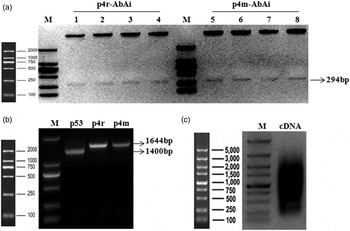
The recombinant reporter plasmids were verified by digestion with Xho I and Sac I (fig. 1a). According to the instructions, the linearized plasmids by Bbs I were transformed in the yeast strain Y1HGold, and the transformation mixture was plated on the agar solidified SD/-Ura media to select the positive yeast colonies using PCR. The expected size of PCR products were as follows: positive control, 1.4 kb; negative control, no band; bait strain, 1.6 kb (fig. 1b).
Identification of bait-reporter yeast strains and cDNA library. (a) Recombinant plasmid p4r-AbAi and p4m-AbAi digested with Sac I and Xho I. (b) Identification of the bait-reporter yeast strains. (c) Recycling result of cDNA Long Distance PCR.

The mRNA of cotton bollworm treated with 2-tridecanone was extracted, isolated and purified. Then we synthesized and recovered the cDNA, which size was determined between 0.25 and 3 kb (fig. 1c). It suggested that the cDNA library could be used for the screening of DNA-binding protein.
Testing for AbAr expression
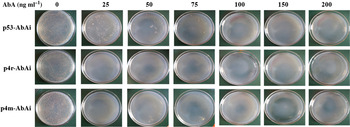
To omit the influence of the recognition of the target sequence by endogenous yeast transcription factors, the bait stains for AbAr expression were also tested. The testing results of a minimal inhibitory concentration of AbA for bait reporter yeast strains were showed in fig. 2. The minimal concentration of AbA needed to suppress the basal expression of the Y1HGold (p53–AbAi) yeast strain (positive control) was 100 ng ml−1. The minimal concentration of AbA needed to suppress the basal expression of the Y1HGold (p4r-AbAi) and Y1HGold (p4m-AbAi) yeast strains was 75 ng ml−1.
Testing the bait strains for AbAr expression. The minimal concentration of AbA needed to suppress the basal expression of both Y1HGold (p4r-AbAi) and Y1HGold (p4m-AbAi) was 75 ng ml−1, whereas the positive control group Y1HGold (p53-AbAi) was 100 ng ml−1.

Identification of the putative regulators
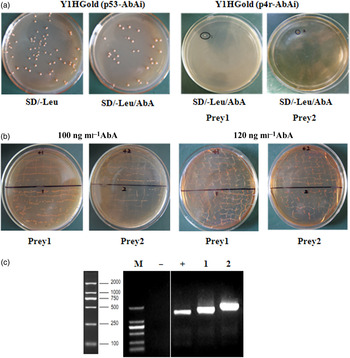
Both cDNA library and pGADT7-Rec plasmid were co-transformed into reporter yeast strains and coated on SD/-Leu/AbA medium with 75 ng ml−1 AbA. After 5 days, the growth of positive control Y1HGold (p53-AbAi) consistent with the Clontech kit instructions showed the process of transformation should be no problem. As for the experimental groups, the two clones were selected (fig. 3a). If the selected clone was false positive, it should be disappear along with AbA concentration gradually increased. When AbA concentration was up to 100 and 120 ng ml−1 in the SD/-Leu/AbA medium, the two screened clones (named Prey 1 and Prey 2) can also healthily grow (fig. 3b). So the two monoclonal plasmids were extracted and amplified using Matchmaker™ Insert Check PCR Mix2. The PCR electrophoresis showed the product of negative control had no band, and the size of p53 control insert in accordance with the instructions of the kit, 1.3 kb (fig. 3c). The plasmids in positive clones were sequenced to reveal that they belonged to two types of protein. One encoded FKBP(GenBank accession number: AF11759.1) derived from Manduca sexta, whereas the other encoded an unknown secreted protein from Papilio xuthus (GenBank accession number: AK401955.1).
Identification of the putative regulators. (a) The cDNA library screening by yeast one-hybridization, Y1HGold (p53-AbAi) as positive control. (b) Confirmation of reporter phenotype by streak two times on the SD/-Leu/AbA medium. (c): Yeast colony PCR analysis; −: negative control; + : p53 control insert; Lane 1: FKBP; Lane 2: fcaL24.

Validation of the interactions in yeast
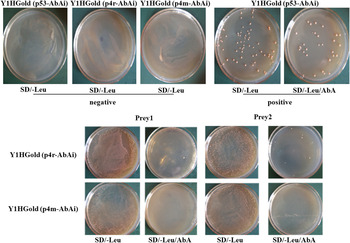
False positive clones might be screened by the Y1H method, so we extracted again high concentration plasmid of the two positive clones and transformed into two reporter yeast strains, Y1HGold (p4r-AbAi) and Y1HGold (p4m-AbAi), respectively, and then the cells were coated on SD/-Leu and SD/-Leu/AbA media. No clones could grow when the competent cells of three yeast strains was directly coated on leucine-deficient medium (fig. 4 negative). And Y1HGold (p53-AbAi) strain as the positive control could healthily grow on both SD/-Leu and SD/-Leu/AbA media (fig. 4 positive). The two results indicated the whole process of transformation was uncontaminated and reasonable.
The validation of putative interactions in yeast strains, Y1HGold (p4r-AbAi) and Y1HGold (p4m-AbAi).

If the testing results are positive, the AbA gene should be activated in the Y1HGold (p4r-AbAi) and not in the Y1HGold (p4m-AbAi) strain. As shown in fig. 4, about three clones could grow on the selection medium for the unknown secreted protein; seven colonies for the FKBP from screening yeast transformant, indicating both FKBP and the unknown secreted protein were able to interact with the 2-tridecanone responsible region.
Confirmation of FKBP binding to 2-tridecanone responsible region in vitro
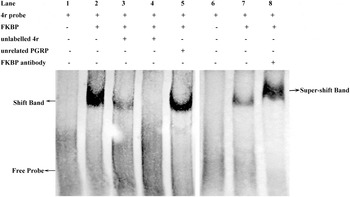
To further confirm DNA-binding activity of FKBP, mobility shift assay and super-shift assay were performed using the four tandem repeated copies from 2-tridecanone responsible region, named 4r as a probe. The FKBP of prokaryotic expression were prepared and used for binding reaction with the probe labeled with DIG in vitro. A major shifted band was observed from both positive tests (fig. 5 lanes 2 and 7). The addition of excess, increasing amounts of unlabeled 4r DNA to the reaction mixture, abolished the binding (fig. 5 lanes 3 and 4). This data strongly indicated that the FKBP could interact with 2-tridecanone responsible region. Super-shift assay using FKBP antibody was performed to verify the specific binding of FKBP to the probe in the presence of FKBP antibody (fig. 5 lane 8). Therefore, the FKBP exhibited sequence-specific binding activity to 2-tridecanone responsible region in vitro.
The interaction of FKBP and 4r segment from 2-tridecanone responsive region. The FKBP of prokaryotic expression was used in each reaction (except lanes 1 and 6). The FKBP was incubated and detected by labeled probe 4r (lanes 2 and 7). The FKBP was incubated with labeled probe 4r and unlabeled 4r competitor (the amount of unlabeled 4r competitor were 100- and 200-folds as much as that of labeled probe 4r in lanes 3 and 4, respectively) or unrelated oligonucleotides PGRP (lane 5). FKBP was incubated with labeled probe 4r and FKBP antibody in lane 8. The shift band indicated the interaction of 4r and the FKBP, and super-shift assay showed that there were interaction among 4r, the FKBP and FKBP antibody.

Testing the interactions of the FKBP and CYP6B6 in H. armigera treated with 2-tridecanone
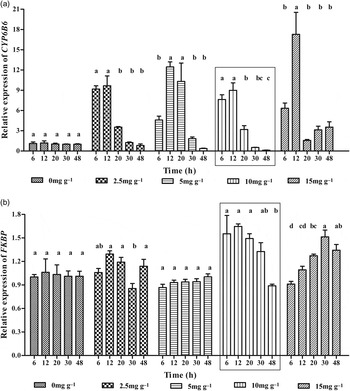
In order to further determine the FKBP can recognize 2-tridecanone responsible region to regulate the expression of CYP6B6 from the H. armigera exposure to 2-tridecanone, we detected the CYP6B6 and FKBP expression profile of the 6th instar larvae treated with 2-tridecanone by quantitative PCR. The results showed that after treatment with 2-tridecanone, the relative expression of CYP6B6 had a significant increase from 0 to 12 h (P < 0.001, except for 5 mg g−1 at 6 h is P < 0.05) and up to the maximum level of CYP6B6 expression at 12 h. And the level was decreased from 12 to 48 h and reached the lowest level at 48 h (P > 0.05). For the FKBP, there was not obvious changes at the lower dose (2.5 and 5 mg g−1, P > 0.05), and at 10 mg g−1 2-tridecanone, the expression level of FKBP could significantly increase compared with that of the non-2-tridecanone treatment during 20 h (P < 0.001) and then decrease the normal level, and at 15 mg g−1 2-tridecanone the expression level of FKBP also increase from 20 to 48 h (P < 0.05). In addition, we found that there were similar expression pattern of both CYP6B6 and FKBP from the cotton bollworm treated with 10 mg g−1 2-tridecanone treatment at 48 h, and the relative expression level of CYP6B6 decreased faster than that of FKBP (fig. 6).
The effect of 2-tridecanone on CYP6B6 and FKBP expression. H. armigera were treated with different concentration 2-tridecanone for different time, and mRNA relative expression level of CYP6B6 (a) and FKBP (b) were determined. The different letters represented the significant difference (P < 0.05, One-way ANOVA test).

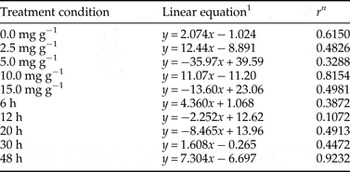
Then we calculated the correlation coefficient of relative expression level of CYP6B6 and FKBP. The results (table 2) showed that the correlation coefficient of relative expression level of CYP6B6 and FKBP was the highest, up to 0.815 at 10 mg g−1 2-tridecanone; while the cotton bollworm were treated with different concentration of 2-tridecanone for 48 h, and up to the highest (r = 0.923, P < 0.01, df = 5) at 48 h, when the cotton bollworm were treated with 10 mg g−1 2-tridecanone for the different time, which indicated that FKBP might take part in 2-tridecanone-inducible CYP6B6 overexpression.
The correlation analysis of expression level of CYP6B6 and FKBP.

1 In the equation x, y indicates the expression level of FKBP and CYP6B6, respectively; n is six replicates.
Discussion
In eukaryotes, gene regulation occurs primarily at the level of transcription that is controlled by cis-acting DNA elements and transcription factors (Harshman & James, Reference Harshman and James1998). Y1H screening is widely used to screen transcription factors. It is relatively fast, straightforward and sensitive to screen the binding proteins that have native and normal function in vivo. The sequence of DNA-binding protein is so directly obtained from the cDNA library that we do not separate and purify from the experimental materials. Furthermore, yeast is a eukaryote, so it is better to reflect the real situation about the regulation of eukaryotic gene than other techniques (Lopato et al., Reference Lopato, Bazanova, Morran, Milligan, Shirley and Langridge2006).
In the Y1H system, construction of cDNA AD fusion library for screening is a key step to obtain trans-acting protein factors (Meijer et al., Reference Meijer, Ouwerkerk and Hoge1998). Sometimes, this technology can produce false positive results, because the inserted target element may interact with the endogenous transcriptional activator of yeast or activate the transcription of reporter gene without transcriptional activator. Conversely, if the AD fusion protein is toxic or unstably expressed or misfolded or not located into the yeast nucleus in yeast cells, the bond of AD fusion protein and target element could be destructed so that produce false negative results (Liu et al., Reference Liu, Wilson, Milbrandt and Johnston1993). In order to improve the recognition efficiency of transcription factors and cis-elements, numerous studies have indicated that the most effective constructs contain at least three tandem copies of the DNA target, and added 50 bp nucleotides at upstream of cis-elements. In addition, the experimental material with appropriate treatment can induce a large number of mRNA encoding the transcription factors or receptors to improve the efficiency of screening. Therefore, we chose the 4r segment as the bait sequence, and total RNA was extracted from the midgut of 6th instar larvae treated with 10 mg g−1 2-tridecanone treatment for 48 h in our study. Purified mRNA was used to synthesis SMART ds cDNA by Long Distance-PCR, which was used to construct a cDNA AD fusion expression library for a Y1H system.
Cytochrome P450s play a crucial role in insect adaptation to their host plants and insecticide through metabolic detoxification. Owing to overexpression of P450s gene, insects could survive in the presence of toxic secondary metabolites and then develop the toleration to insecticide, even resistance strain (Ahmad et al., Reference Ahmad, Arif and Ahmad2001). The resistance mechanism may be involved gene amplification, mutations and transcription enhancement. The transcriptional activity of P450 genes were regulated by a variety of regulatory proteins and trans-acting factors. In Drosophila resistant strains, an insertion of 5′ flanking region of CYP6D1 by 15 bp fragment could result in CYP6D1 overexpression, which suggested that the 15 bp fragment have destructed the interaction of mdGfi-1 repressor and CYP6D1 promoter to regulate overexpression of CYP6D1 (Gao & Scott, Reference Gao and Scott2006). More and more cytochrome P450 genes have been reported, but few involved in the regulation of trans-acting factors, and limited in Drosophila, much less in cotton bollworm.
In this study, the 4r repeats sequence of 2-tridecanone responsible region was inserted in the yeast reporter vector, and the cDNA library of H. armigera with 2-tridecanone was transformed into yeast reporter strain. Then the co-transformation products were coated on the SD/-Leu/AbA medium to select positive strains. They were amplified by colony PCR to get two candidate cDNAs. With NCBI database blast, one may be a homology of an unknown protein of Papilio or the fcaL24 protein. The other was a homology of FKBP that belongs to FKBP-C family.
FKBPs are natural homologous receptors of immunosuppressant FK506 protein in the prokaryotic and eukaryotic cells. They can catalyze the bond conformation of N-terminal proline residues from the cis to the trans, thus affecting the protein activity, phosphorylation, protein–protein interaction, subcellular localization and stability of protein substrate (Yan et al., Reference Yan, Wang, Zhao, Jiang, Loh, Law, Chen and Qiu2014). The binding of FK506 and FKBP12 could inhibit the mammalian target of rapamycin (mTOR) signal transduction to affect gene transcription. FKBP12 participates in cellular metabolism, involving cell growth, cell survival and cell apoptosis (Aghdasi et al., Reference Aghdasi, Ye, Resnick, Huang, Ha, Guo, Dawson, Dawson and Snyder2001; Gaburjakova et al., Reference Gaburjakova, Gaburjakova, Reiken, Huang, Marx, Rosemblit and Marks2001; Maruyama et al., Reference Maruyama, Li, Chen, Xu, Song, Guatimosim, Zhu, Yong, Zhang, Bu, Lin, Fishbein, Lederer, Schild, Field, Rubart, Chen and Shou2011). FKBPs also respond to adverse environment to maintain normal physiological activity. In rice, OsFKBP20 is endowed capacity of high-temperature tolerance in yeast cells. OsFKBP20 protein interacts with OsSce1 protein to mediate plant growth in abiotic stress response (Nigam et al., Reference Nigam, Singh, Sahi, Chandramouli and Grover2008). Two FKBP12 genes were characterized from silkworm, Antheraea pernyi, and expressions of the two genes were up-regulated after heat-shock treatment, which indicated that FKBP12 was heat-inducible (Chen et al., Reference Chen, Chen, Yao, Li, Wang, Li and Liu2013). In H. armigera, the FKBP12 mRNA expression in the brain of diapause pupae was higher than that of the non-diapause, and the expression of FKBP12 was then down-regulated when the diapause was terminated, which indicated that FKBP12 may be involved in the diapause maintenance of H. armigera (Zhu, Reference Zhu2009). Therefore, it is possible that FKBP also involved in the regulatory mechanisms and detoxification pathway. In our research, we found that the purified fuse FKBP could change the mobility of 4r probe from the 2-tridecanone responsive region. And the expression of CYP6B6 was closely related to FKBP, correlation coefficient up to 0.923, when treated with 10 mg g−1 2-tridecanone for 48 h. These results indicated that FKBP might participate in the detoxification pathway of CYP6B6 under 2-tridecanone treatment.
In conclusion, we used Y1H to screen two potential transcription regulators of the CYP6B6 from H. armigera that responds to 2-tridecanone. Then we validated FKBP could combine with CYP6B6 promoter to regulate the expression of CYP6B6 protein by EMSA and qPCR technology. These findings will help us to understand the CYP6B6-mediated metabolic mechanism and provide some useful clue for insect controlling.
Acknowledgements
This work was supported by the Natural Science Foundation of China (grant numbers 31471781 and 31171887).
Conflicts of interest
None.