In an 1810 report, the anonymous Pest correspondent to the Allgemeine musikalische Zeitung related his impressions of Hungarian national music, most commonly performed by Gypsies:
Der Ungar kann bey seinem Tanze eben sowol wild jauchzen, als weinen, je nachdem die Saite seines Gefühls berührt wird. … Der Zusammenklang der Musik selbst geschieht ohne alle Gesetze der Tonkunst, denn die eigentlichen sogenannten ungarischen Lyranten, nämlich die Zigeuner, verstehen nichts von alle dem und sind blos Naturalisten.Footnote 1
In his dances, the Hungarian can just as well wildly exult as cry, depending on how his feelings are moved. … The harmony itself takes place without [following] all the rules of music, because the actual so-called Hungarian lyre players, namely the Gypsies, don't understand anything of that and are mere artists of nature.
Potentially elucidating how these Gypsy performers did not follow the ‘rules of music’, August Ellrich commented in his 1831 travelogue:
In anderen Ländern bedienen sich ambulante Virtuosen zum Einsammeln der Honorare eines Notenblattes, allein bei diesen ungarischen Tonkünstlern fällt das Notenblatt weg, denn sie kennen keine Note, spielen nur aus dem Kopfe und komponiren indem sie spielen. Daß diese Kompositionen zuweilen etwas chaotisch ausfallen, kann nicht befremden: ein ungarisches Musikstück aufzufassen, zu behalten, oder wohl nachzusingen ist rein unmöglich; es ist ein Irrgarten von Melodien, in welchem man, wie einst der im Irrgarten der Liebe herum taumelnde Kavalier ebenfalls herumtaumelt, ohne einen Ausweg zu finden.Footnote 2
In other lands wandering virtuosos use a page of music to collect their fees, but with these Hungarian musicians the page of music is dispensed with, for they cannot read music, play only from memory and compose as they play. That these compositions occasionally turn out rather chaotically is not surprising: to understand, to remember or to sing a piece of Hungarian music is totally impossible; it is a maze of melodies, in which one staggers around, like the cavalier who once staggered through the maze of love, without finding a way out.
The labyrinthine quality of Hungarian music, furthermore, was not only melodic; Ellrich asserts that it extended also to its harmony, which consisted of ‘ein unsägliche[s] Gewirr von Tönen’ (an unspeakable confusion of keys).Footnote 3 Although Ellrich's travelogue was published two decades after the anonymous correspondent's article, both authors agree on and emphasize the strangeness and difference of Hungarian-Gypsy music, implicitly contrasting it with Western European music: the former is a wild, chaotic and improvised tradition, while the latter is tame, orderly and literate. In other words, both descriptions present this foreign music as an exotic other to the Western norm. Many scholars have suggested that this alterity also extended to adaptations of Hungarian-Gypsy music by Western European composers (the so-called style hongrois) around 1800, yet this claim deserves further scrutiny.Footnote 4
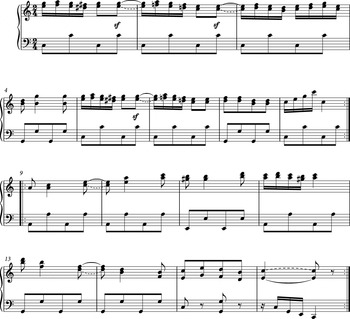
Example 1 reproduces a dance excerpted from Ferdinand Kauer's collection 12 Hongroises pour le clavecin ou piano forte, published by Kozeluch in Vienna in 1797.Footnote 5 Aside from its title, nothing in this dance suggests that it is anything other than typical Viennese Hausmusik from the turn of the nineteenth century: its melody consists of turn and broken-chord figures supported by a murky bass in the left hand; its sixteen bars are very simple harmonically, including only tonic and dominant chords, even during the brief excursion to the relative minor in bars 9–12; and it is formally repetitive, divisible into two-, four- and eight-bar units. In short, it is a charming, if banal, and easily executed dance; perhaps only its inclusion of syncopation within and across barlines prevents it from being utterly unremarkable.
Ferdinand Kauer, 12 Hongroises pour le clavecin ou piano forte, No. 10 (1797) (Ungarische Tänze für Klavier – Hungarian Dances for Piano, ed. Ferenc Bónis (Vienna: Doblinger, 1993)). Used by permission

In light of this and similar representative examples of Viennese adaptations of Hungarian-Gypsy music from the turn of the nineteenth century, I argue that assertions that the style hongrois ‘always has the same extraordinary, exotic sound’ and even that it is an ‘exotic musical style’ are inadequate.Footnote 6 Such assertions seem to be rooted in the uncritical assumption that the style hongrois was relatively stable over the course of approximately a century, and to derive from the concomitant definition of this style on the basis of much later works, particularly Liszt's Hungarian Rhapsodies, which are indeed exotic in every sense of the term.Footnote 7
The traditional understanding of exoticism as a purely stylistic category was already in evidence by the late 1950s, when Miriam Karpilow Whaples defined musical exoticism as ‘stylistic differentiation’.Footnote 8 This restrictive conceptualization has gone virtually unchallenged until quite recently, especially with respect to instrumental music, which, lacking text or staging, requires that difference be established compositionally, through ‘foreign’ musical gestures that contrast with the ‘native’ mainstream. That such gestures need not, and indeed most often do not, correspond to actual gestures in the music being evoked is now widely recognized. As Carl Dahlhaus has neatly summarized, ‘the crucial point is not the degree to which exoticism is “genuine,” but rather the function it serves as a legitimate departure from the aesthetic and compositional norms of European music’.Footnote 9 In order to assert, then, that Westernized Hungarian-Gypsy music ‘always has the same extraordinary, exotic sound’, one must demonstrate that it does, in fact, sound different from other contemporary Western European music. In many cases, this is difficult to do: in the late eighteenth and early nineteenth centuries, the domestication of Hungarian-Gypsy music by Western European composers often rendered it indistinguishable from native Austro-German music. In this sense, far from being an exotic other to, or ‘legitimate departure’ from, the mainstream, it constituted an integral part of it.
In his recent monograph Musical Exoticism: Images and Reflections, however, Ralph Locke has put forward a new paradigm, which he calls ‘All the Music in Full Context’, proposing that exoticism is not necessarily inherent in particular musical gestures or stylistic devices, but is better understood as the product of the interaction between music, its context and its reception.Footnote 10 A given work or repertoire may, therefore, be ‘exotic’ without necessarily being ‘exotic in style’. Most early Western adaptations of Hungarian-Gypsy music are examples of precisely such ‘non-exotic exoticism’,Footnote 11 for although they evoke a foreign place and foreign people, they generally do not do so through stylistic means. This observation is noteworthy for several reasons, not least of which is that existing studies of this repertoire have invariably presented it as exotic in style. Furthermore, as Locke observes, ‘non-exotic exoticism’ is most common in overtly programmatic genres, such as the symphonic poem and programme symphony, and in genres that include text and staging, such as the art song, oratorio, ballet and especially opera;Footnote 12 it is much rarer in purely instrumental music. Finally, the ‘non-exotic exoticism’ of Western adaptations of Hungarian-Gypsy music existed alongside what was arguably the most overtly exotic pre-nineteenth-century style, music alla turca, which, even in its purely instrumental incarnations, drew heavily on stylistic exoticisms to create a striking sound. Western adaptations of Hungarian-Gypsy music thus provide an interesting and under-studied opportunity to consider a different approach to foreign musical influences at the turn of the nineteenth century.
The music most commonly performed by Hungarian Gypsies around 1800, referred to as verbunk or verbunkos (a noun and an adjective respectively), arose as the result of both Hungarian and Gypsy influences: from Hungarian folk music, including the swineherd and Heyduck dances, from dances such as the ungaresca and saltus hungaricus, enjoyed as Tafelmusik and closely resembling Western European genres with a similar function, as well as from the performance styles of Gypsy musicians themselves.Footnote 13 Homophony, major–minor tonality and some facets of instrumentation in verbunk may also reflect the influence of Western European art music.Footnote 14
The word verbunk is a Magyarized version of the German Werbung, referring in this context to military recruitment and to the original function of this music as an accompaniment to the dancing of officers used to entice new volunteers. However, in the wake of Joseph II's attempted Germanizing reforms in the 1780s, the most resented of which was his declaration of German as the official language of the entire Habsburg Empire, verbunk came to represent the awakening of Hungarian national consciousness; as such, it was celebrated and enjoyed as dance music free of its original associations with military recruitment. By the end of the eighteenth century, the verbunkos style thus once again served popular interests; it originated in various folk and art musics, and its use for military recruiting in the service of the Habsburg army was only an intervening phase in a much longer history.
Dependent for their livelihood on the compensation they received for providing musical entertainment, ensembles of Gypsy musicians were largely active in urban settings – in the coffee houses, taverns, inns and dance halls of towns and cities.Footnote 15 It is therefore not surprising that these musicians began to appear in Vienna at roughly the same time that the national movement brought them to prominence in Hungary, for not only was Vienna geographically proximate to Pozsony, the new seat of the Diet since its relocation there by Leopold II in the autumn of 1790 and ‘the metropolis of the kingdom’ of Hungary, according to Robert Townson's travelogue,Footnote 16 but the Habsburg capital, with its multitude of coffee houses and other similar establishments, also presented numerous employment opportunities. Evidence detailing the circumstances in which Hungarian-Gypsy musicians entertained the Viennese is scarce, yet it is certain that composers could have heard their performances without leaving the city, although many did travel to Hungary. The Hungarian musicologist Julius Kaldy asserted over a century ago that Beethoven ‘listened to [the] playing’ of the great Gypsy violinist János Bihari ‘often[,] with great pleasure’;Footnote 17 Haydn must have heard ensembles of Gypsy musicians not only in Vienna but also in his native eastern Austria, as well as on the Esterházy estate; and Schubert is known to have written his Ungarische Melodie, d817, during a stay in Hungary.Footnote 18
Published descriptions of Hungarian-Gypsy music and its performers from the turn of the nineteenth century provide the best evidence of what Viennese audiences may have heard and of the materials Western European composers may have adapted. Such accounts were disseminated in music journals, in more general descriptive writings, including travelogues and aesthetic treatises, and as prefaces to published collections of Hungarian-Gypsy dances. These writings reflect a growing interest in foreign music and a developing consciousness of the role of music in defining national identity.Footnote 19
The quotations from Ellrich and the Pest correspondent underscore several of the most salient features of these descriptions, which particularly emphasized the virtuosity and improvisatory performance practice of Hungarian-Gypsy musicians and the striking tonal organization of their music, as well as the metric and rhythmic peculiarities and typical tempo variations of their dances.Footnote 20 In other words, these accounts highlight the stylistic exoticism of this music. A 1787 report from the Magyar Kurir documenting a performance by Hungarian-Gypsy musicians at an inn in Vienna, for instance, affirmed that they played ‘without the printed music’.Footnote 21 Similarly, an anonymous writer (almost certainly Heinrich Klein, a leading musician and teacher in Pozsony) confirmed that ‘almost all the pieces that are played in Hungarian national circles are the immediate product of the imagination’.Footnote 22 A preference for the minor mode and for modulations to distantly related keys, ‘snak[ing] their way wonderfully through nothing but semitones’Footnote 23 and resulting in what Klein referred to as ‘the most expressive harmony’,Footnote 24 was also often asserted. Finally, the tempo of verbunk, which was typically described as more often slow than fast, or as beginning with a section in a slow tempo, followed by one in a faster tempo, was usually mentioned alongside its prevalent inclusion of syncopation. As one anonymous author related, ‘the characteristic [element] of all Hungarian dances and songs lies in the accent, which usually is not on the first part of the beat’.Footnote 25 Despite their alterity with respect to Western European music, nearly all of these characteristics could have been notated according to standard Western practices, yet approximations of these gestures, or even generic exoticisms standing in for them, were most often absent in early Western adaptations of this repertoire.
Beginning with the printing of Joseph Bengraf's Ballet hongrois in 1784 and continuing until the 1820s, hundreds of Westernized Hungarian-Gypsy dances were issued by Viennese music publishers such as Artaria, Hoffmeister, Sauer and the Chemische Druckerey.Footnote 26 These dances most often appeared as collections in their own right, including anywhere from six, eight or twelve dances to twenty-two, twenty-four or twenty-eight.Footnote 27 Many of these collections were reissued, sometimes by the original publisher and sometimes by a different publisher who had acquired the plates, attesting to the commercial success of this music. In addition, several dances appeared in multiple collections.Footnote 28
Ilona Mona has suggested that the music publication industry in Hungary lagged behind that of Western Europe because of Hungary's prolonged engagement in war following the Battle of Mohács in 1526, first against the Turks and, after the signing of the Treaty of Karlowitz in 1699, against the Habsburgs.Footnote 29 Hungary's industrial development was further delayed by the colonial relationship Austria maintained with the Kingdom.Footnote 30 Thus, until Hungarian music publishers were established, the publication of Hungarian-Gypsy dances occurred primarily in Vienna. If Vienna was the most important centre of publication for this repertoire, however, it was not only because the Hungarian music publishing industry was underdeveloped. Even though some of the Viennese publications were distributed by music dealers in Pest, they were primarily intended for the Viennese market, and residents of the capital city were routinely informed of newly available Hungarian-Gypsy dances through numerous advertisements in the Wiener Zeitung.Footnote 31 In short, these dances were published in Vienna over a period of several decades because they were suitable for and successful in that city's musical market. The reasons for this success become evident through a consideration of the stylistic characteristics of this repertoire.
The approximately three hundred dances I have analysed, mostly from the period 1784–1810, constitute roughly half of those published in Vienna before 1830.Footnote 32 The parameters of my stylistic analysis were determined primarily by the musical characteristics most often commented upon in contemporary descriptions of verbunk. Additionally, the parameters employed in some earlier published analyses of (Westernized) Hungarian-Gypsy music have provided useful starting-points.Footnote 33 Although the stylistic characteristics of published Hungarian-Gypsy dances changed somewhat over time, with the complexity of these dances – and of Hausmusik more generally – increasing after about 1800, many of their features remained constant. The dances were most commonly issued in arrangements for solo keyboard (keyboard four hands in a few cases) or for string trio consisting of two violins and bass; many were published simultaneously, or in quick succession, in both instrumentations, a clear indication of their popularity and of the desire of publishers to capitalize on it. A few dances were published for other combinations of household instruments, such as for two violins, for piano and violin duet or for guitar, but these form a distinct minority within the corpus.
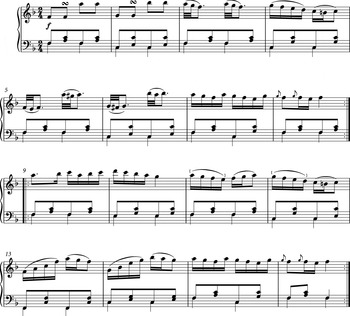
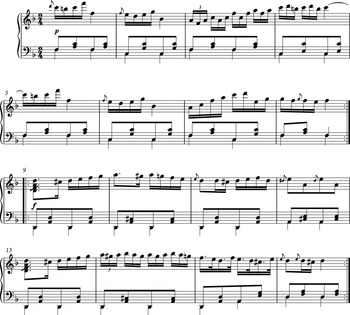
Despite contemporary assertions that most performed Hungarian-Gypsy music was in the minor mode, published collections include one and a half to eleven times more major- than minor-mode dances. Neither mode is correlated with particular tempos. The favoured keys in both modes are those with key signatures containing no more than three sharps or flats, ensuring their accessibility even to amateurs with little training; among the sources I have analysed, only three dances do not conform to this restriction. Furthermore, the tonal organization of these published dances reflects none of the stylistic exoticism described in contemporary accounts of Hungarian-Gypsy performances – there are virtually no strange modulations to be found. Until about 1800, it is just as common for these dances to contain no tonicizations or modulations as it is for these to be present, while after 1800, tonicizations and brief modulations become more frequent, but are still limited almost exclusively to diatonically related keys. Similarly, particularly in the early dances from the 1780s and 1790s, the harmony is quite simple, often consisting solely of an alternation between tonic and dominant chords. The supertonic, subdominant and submediant triads are also quite common, while chords built on the mediant and leading-note begin to appear in these published dances around 1800, but even then only infrequently; chromatic chords are yet rarer. In short, the harmonic scheme of these dances is extremely normal for the period, perhaps even simpler than that of much contemporary Hausmusik, and includes none of the anomalies typical of the supposedly untrained, improvised playing of Hungarian-Gypsy musicians. At most, one could point to open-fifth sonorities, as in the accompaniment in bars 9–15 of Example 4, or to the occasional drone-like effect produced by a tonic or dominant pedal, perhaps reminiscent of the static accompaniment typical of Hungarian-Gypsy ensembles. A standard type of accompaniment, termed esztam, consisted of alternating quavers played by the second violin and the bass. This is frequently encountered in published Hungarian-Gypsy dances, and may be considered an example of instrumental imitation in this repertoire;Footnote 34 the accompaniments in Examples 2–5 are typical imitations of esztam, and the murky bass in Example 1 may be a yet more stylized evocation of it. Example 2, furthermore, demonstrates the drone-like effect of static harmonies (particularly in bars 9–11 and 13–15), and is one of the very few dances to which one could look for an example of rather unusual harmony, here beginning on the minor dominant and prominently featuring the minor tonic. Harmonically, Example 2 is highly atypical of published Hungarian-Gypsy dances.
Anonymous, 25 originelle ungarische Nationaltänze für das Clavier, Volume 4 No. 4 (1810 or 1811) (Hungarian Dances 1784–1810, ed. Géza Papp, Musicalia Danubiana 7 (Budapest: Magyar Tudományos Akadémia, Zenetudományi Intézet, 1986)). Used by permission

If Ellrich's ‘unspeakable confusion of keys’ is thus not to be found in this published repertoire, his ‘maze of melodies’ is equally absent. Until about 1800, periodic phrase structure, with the repetition inherent in this question–answer form, accounts for the vast majority of these dances, while after 1800, although periodic constructions still dominate, sentence and hybrid forms occur with greater frequency.Footnote 35 Nonetheless, even in these later dances, the effect of ‘compos[ing] while play[ing]’ that Ellrich and his contemporaries so often noted as characteristic of performances by Hungarian-Gypsy ensembles is still entirely absent. The published dances most commonly consist of two units, each of eight bars and each framed by repeat signs; in this configuration, the quatrain – AABA – formally describes the overall construction of many dances, although AABB types are also common. These basic sixteen-bar forms are often extended in the post-1800 dances to include additional, most commonly eight-bar, units, sometimes labelled as trios or codas. Regardless, however, of the total length of a given dance, its construction is repetitive and modular.
The melodies of published Hungarian-Gypsy dances consist of short figures that are usually contained within a single beat, primarily constructed of quavers and semiquavers and often repeated sequentially. Figures proceeding either by skip (chordal arpeggiations or wide, usually chordal, leaps) or by step (either scalar or turn motives) are both very common (see Example 1 for both an arpeggiation (bar 8) and a turn figure (bar 1)). Also especially prevalent in and typical of these dances are anticipations, appoggiaturas and figures employing lower neighbour notes, both diatonic and chromatic (see Example 2 for both anticipations and appoggiaturas suggesting an imitation of the violin (bars 10–11) and lower-neighbour figures (last beat of bar 1)). Such lower-neighbour figures are far more common than upper-neighbour ones, most likely because of their resemblance to the so-called bokázó (heel-clicking) figure that is one of the few verbunkos elements to be retained in this published music.Footnote 36 The bokázó figure, and slight variations thereof, are ubiquitous in most of these dances, both within phrases and particularly at cadences, and, aside from their titles, the presence of this figure is largely what suggests their Hungarian-Gypsy origin – see Example 3, a quatrain in which the cadences in both bars 8 and 16 exhibit the bokázó figure. The first eight bars are a period in which wide chordal leaps (bar 1) and lower-neighbour figures (bar 5) predominate. The second eight-bar unit features sequential repetition of scalar (bar 11) and chordal (bar 13) figures, and the entire dance is harmonized very simply, with only tonic and dominant chords. For an example of a variation on the bokázó figure within a phrase see the figure on the downbeat of bar 11 in Example 4.
Anonymous, Ausgesuchte ungarische Nationaltaenze im Clavierauszug von verschiedenen Ziegeunern aus Galantha, No. 8 (1803) (Hungarian Dances 1784–1810, ed. Papp). Used by permission

Along with these melodic figures, notated ornamentation is also typical of this published repertoire. In the pre-1800 dances, it is essentially limited to occasional grace notes, while after 1800, reflecting a general trend towards increased decoration in keyboard music, embellishments proliferated. These included not only grace notes but also mordents, trills and demisemiquaver and triplet figurations. Interestingly, particularly because of their ubiquitousness in later nineteenth-century compositions evoking various foreign musics, even in the post-1800 repertoire augmented seconds are relatively rare, imparting an exotic touch only to a distinct minority of melodies. This infrequency is at odds with Liszt's later assertion of their indispensability to the so-called ‘Gypsy scale’, a harmonic minor scale with raised fourth scale degree (augmented seconds arising from such a scale are prominent in bars 9–14 of Example 2).Footnote 37 Whether augmented seconds were, in fact, widespread in Hungarian-Gypsy performances at the turn of the nineteenth century is now difficult to ascertain, but it seems likely that they were not often included in this published repertoire because they do not generally conform to ‘the rules of music’, one of the criticisms the Pest correspondent levelled at Hungarian-Gypsy ‘artists of nature’.
In the post-1800 dances, increased rhythmic interest is also responsible for the greater complexity of melodies.Footnote 38 Triplets and demisemiquavers, particularly used in conjunction with dotted semiquavers to create chains of dotted rhythms, are prevalent throughout these later dances and are one of their most important stylistic markers; both triplet and dotted figurations are illustrated in Example 4, bars 14–15.
Anonymous, Ausgesuchte ungarische Nationaltaenze im Clavierauszug von verschiedenen Ziegeunern aus Galantha, No. 2 (1803), bars 1–16 (Hungarian Dances 1784–1810, ed. Papp). Used by permission

Without exception, published Hungarian-Gypsy dances are in 2/4 metre. Many were issued without tempo indications, and among those with original indications, slow and fast tempos occur with approximately the same frequency. Furthermore, although there is ample contemporary testimony that Hungarian-Gypsy musicians began their dances in a slow tempo, which was followed by a section in a faster tempo, such a change in tempo is not reflected in the published musical sources. Each individual dance proceeds in a single tempo, where one is given; successive dances in a collection also fail consistently to reflect an alternation of slow and fast tempos.
One prominent feature of verbunk that was maintained in this published repertoire, however, is the accent on the upbeat or the weak part of the beat, a feature that virtually all contemporary observers noted was typical of Hungarian-Gypsy performances. The most common syncopated rhythmic figures are the anapaest (accented short–short–long; in these dances, most often two semiquavers followed by a quaver), the alla zoppa (accented short–long–short; here, often quaver–crotchet–quaver) and the Lombard or so-called Scotch snap (accented short–long; either quaver–crotchet or semiquaver–dotted quaver). Although such rhythms are characteristic of both pre- and post-1800 dances, in the later repertoire their syncopated effect is often enhanced through notated dynamic accents (sf or sfz); such accents also occur in conjunction with non-syncopated rhythms in order to produce the effect of syncopation.
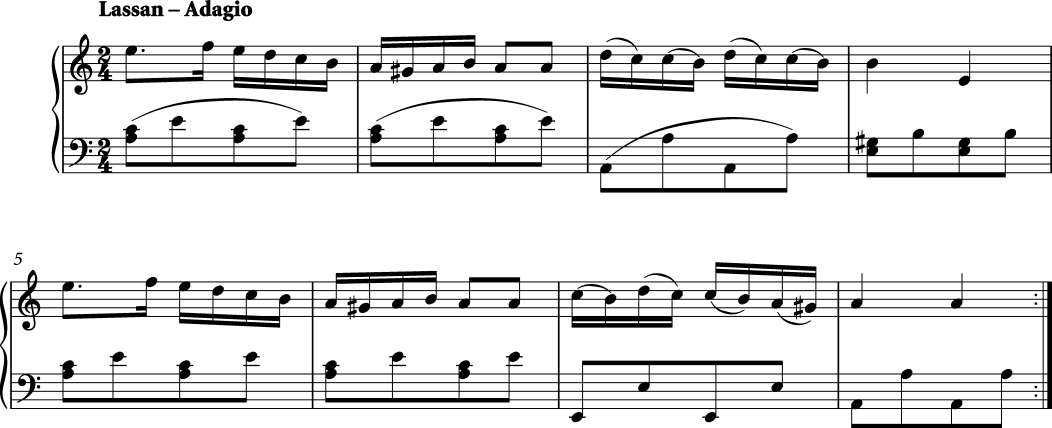
Along with such syncopations, two other rhythmic figures, typically cadential, are frequently encountered: the bokázó, as already discussed, and the spondee. Both the rhythmic and the melodic figurations in which the bokázó occurs in Example 3 (bars 8 and 16) are characteristic. While this is often used cadentially, in many of the earliest published dances the spondee (two longs; here, two crotchets) is found at least as frequently at cadences. Especially after 1800, the spondee was gradually replaced by the more colourful bokázó, but it never disappeared entirely (for an early illustration, see the cadences in bars 4 and 8 in Example 5).
Joseph Bengraf, XII Magyar tántzok klávicembalomra valók – XII Danses hongroises pour le clavecin ou piano-forte, No. 1 (1784), bars 1–8 (Hungarian Dances 1784–1810, ed. Papp). Used by permission
Although this published repertoire is not entirely without potentially exotic features, its simplicity and relative lack of stylistic exoticism in contrast to that noted in descriptions of verbunk are striking. Despite, and indeed perhaps because of, its straightforwardness, however, this music was well suited for and appealing to the Viennese amateur market for which it was published, since even those with minimal training or talent could adequately perform these dances. More accomplished amateurs could have treated them essentially as lead sheets, dotting straight semiquavers, adding ornaments and triplets and perhaps even introducing accidentals to create augmented seconds.Footnote 39 Although such an improvisatory performance practice would have more nearly suggested the alterity of verbunk, the predominance of the major mode, the lack of tempo changes, the simple harmonic frameworks and the repetitive formal structures of these dances would have remained quite distant from the exotic style noted in the original repertoire.
In the prefatory note (‘Anmerkung’) to his 12 ungarische Tänze, composed some time before his death in 1796, Franz Paul Rigler, an influential musician and teacher in Pozsony, pronounced:
Nun haben es einige in Pest und Wienn gewagt Ungarische zu schreiben; allem ihnen abwischte dabey das wahre karakteristische zu geschwinde, und man wuste am Ende nicht, ob sie einen Kosakischen oder Contretanz gemeint hatten.Footnote 40
Now some [composers] in Pest and Vienna have ventured to write Hungarian [dances]; in doing so they all overly hastily erased the truly characteristic [elements from these dances], and in the end one didn't know whether they meant [to write] a Cossack dance or a contredanse.
Rigler goes on to admit that he doesn't know if he has succeeded any better than these hapless composers, but asserts that he has made every effort to reproduce accurately the melodies and harmonies of Hungarian-Gypsy music. I suggest that the stylistic confusion to which Rigler pointed was not accidental but an inherent part of the process of adapting this foreign national music. In other words, it was not coincidental that these published dances resembled familiar contemporary social dances such as the contredanse, but rather it represented an effort to heighten their appeal. Although most published dances refer solely to their Hungarian or Gypsy origin, a few examples of Hungarian contredanses may be cited, including the anonymous Contredanses hongroises from 1788 and the Contradanza all'Ungarese, also anonymous, which appeared in the 15 July 1809 issue of the Musikalisches Wochenblatt.Footnote 41
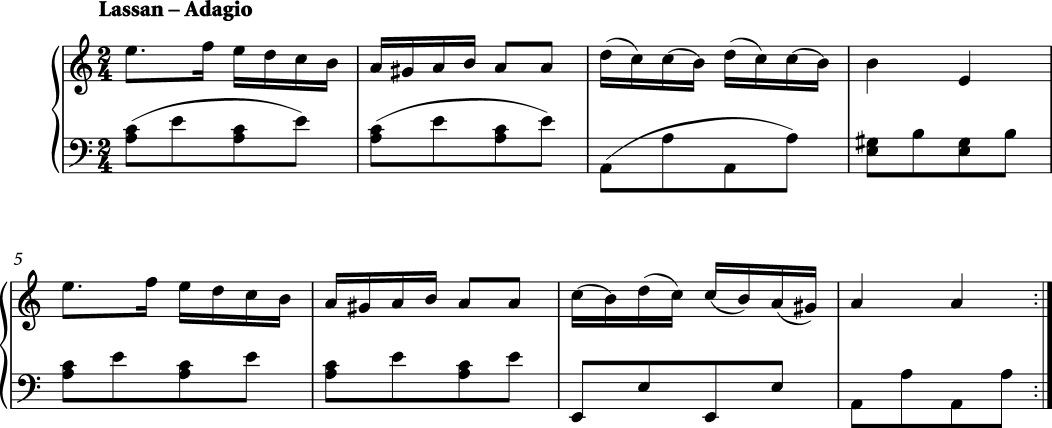
If the title of a collection could overtly point to its potential resemblance to common Hausmusik of the time, stylistic similarities may also be found in the dances themselves, for most of the features I have described as typical of published Hungarian-Gypsy dances were clearly also typical of contemporary music in general, and, more specifically, of other social dances of the period. I summarize here only a few of the most notable correspondences, as many of these features are so generic to the time as to require little further comment. Most contredanses, like published Hungarian-Gypsy dances, were in 2/4 metre, as were other dances, including the écossaise and the galop. Galops, furthermore, often featured the same prominent chains of dotted rhythms that are also characteristic of many published Hungarian-Gypsy dances,Footnote 42 and triplet figurations and plentiful syncopated rhythms were common in a variety of social dances too. Similarly, many Ländler, perhaps in acknowledgement of their rural origin, incorporated drone accompaniments, and, as Walburga Litschauer and Walter Deutsch have demonstrated, chromatic circling, or turn, figures were typical of many Viennese dances of the period.Footnote 43 Finally, prominent lower-neighbour figures decorated by grace notes were not exclusive to Westernized Hungarian-Gypsy dances; in Figure 1 these figures appear in a Ländler for solo violin by Michael Pamer.
Michael Pamer, Neue brillante Solo Ländler für Violine, Volume 4 No. 3 (1821), bars 1–5 (Walburga Litschauer and Walter Deutsch, Schubert und das Tanzvergnügen (Vienna: Holzhausen, 1997), 122). Used by permission

Without denying that the cadential bokázó figure may still have sounded distinctive and exotic when it appeared in Western adaptations of Hungarian-Gypsy music, one might hypothesize that it was retained because of its close resemblance to figures widespread in Viennese social dance music. In short, in the sphere of Hausmusik, Hungarian-Gypsy music was well assimilated into what Peter van der Merwe has described as the ‘polka family’, a ‘family of musically similar dances in lively 2/4 time’, which pre-dated the emergence of the polka itself.Footnote 44 The enormously popular dances of the polka family, which includes the contredanse, écossaise and galop, typically feature simple major-mode melodies parsed into four- and eight-bar units, supported by tonic and dominant harmony.Footnote 45
Although the possibility cannot be disregarded that the very simplicity, or even ‘primitive’ quality, of Westernized Hungarian-Gypsy dances suggests their otherness by standing in for their original exotic complexity, this possibility is undermined by a similar simplicity in a variety of popular Austro-German dances of the period. As a category of stylistic exoticism, then, simplicity is not, to use Dahlhaus's phrase, a ‘deviation from the European norm’ in this case.Footnote 46 Yet Locke's more inclusive paradigm (‘All the Music in Full Context’) suggests that Viennese Hausmusik adaptations of verbunk may still have been construed as exotic in the broader sense of the term. The titles of these dances may have sufficed to lend them an aura of exoticism, even to alter a performer's playing style, and although specific evidence of their reception is scant, the possibility that they were received as exotic, despite their tameness to our ears and to Rigler's, cannot be discounted.
Nonetheless, in light of these examples, Matthew Head's assertion that Haydn's Hungarischer National Marsch, hVIII:4 (1802) – four bars of which are reproduced in Example 6 – is ‘anomalous’ because it is largely ‘without exotic coloring’ is surprising;Footnote 47 its relative lack of stylistic exoticism is anything but anomalous. Although Tibor Istvánffy may be correct in contending that there is nothing uniquely or ‘authentically’ Hungarian about Haydn's march, his confusion about its title is unfounded: this march is a characteristic Western adaptation of Hungarian-Gypsy music.Footnote 48
Haydn, Hungarischer National Marsch, hVIII:4 (1802), bars 9–12 (Joseph Haydn Werke, series 5: Tänze und Märsche, ed. Günter Thomas (Munich: Henle, 1995)). Used by permission

Scholarship about Westernized Hungarian-Gypsy music has tended to be focused almost exclusively on the works of well-known composers, and it is partly for this reason that I have chosen in this article to consider primarily the Hausmusik of anonymous or little-known figures. This domestic repertoire, moreover, accounts for the vast majority of publications ostensibly based on Hungarian-Gypsy music appearing around 1800. Yet the example of Haydn's Hungarischer National Marsch suggests that works in other genres, including compositions by the most prominent figures of the time, were not necessarily more stylistically exotic than this lesser-known repertoire. A further case in point is Haydn's ‘Rondo, in the Gipsies’ Style', the third movement of his Keyboard Trio hXV:25.Footnote 49 In a recent article Head identifies it as ‘Haydn's best known essay in exoticism’, citing its ‘tropes of frenzy and wildness’ (‘stamping accompaniment’, ‘syncopated Gypsy anapaest and a flourish of shorter note values in a high register’) and its ‘overarching trope of irrationality’ (‘moments of grating dissonance’ created by acciaccaturas and ‘intoxicated slurred figures’). He notes the ‘verbunkos idiom’ of the episodes of the rondo, in which, he suggests, Haydn makes use of the ‘rhetorical technique’ of the ‘primitive; ideas are forcefully repeated, with or without variation’. In contrast, he writes, ‘the refrain (a contredanse) frames “the other” and puts it on show.’Footnote 50
Several scholars have previously remarked that passages from the episodes to which Head draws attention bear a noticeable resemblance to the sixth dance of the first volume of an anonymous four-part collection, 22 originelle ungarische Nationaltänze, published in Vienna by the Chemische Druckerey in 1806 or 1807. And, although Head does not mention it, the similarity of the ‘contredanse’ refrain to two anonymous dances (published in 1825 and 1826 respectively) from the monumental Hungarian collection Magyar nóták Veszprém vármegyéből (Hungarian Melodies from Veszprém County) has also been widely recognized.Footnote 51 The collection consists of fifteen volumes comprising 136 dances prepared between 1823 and 1832 by the Music Society of Veszprém County under the supervision of the society's founder, the lawyer Gábor Sebestyén, with the explicit goal of preserving verbunk-style dances for posterity.Footnote 52 As a whole, the collection constitutes the most nearly accurate notated record of this performed tradition to have been produced, and as such preserves many markers of its stylistic exoticism: abrupt shifts between modes and keys, formal units of irregular lengths, a wealth of melodic ideas and considerable ornamentation.Footnote 53 Despite the fact that Haydn's movement predates the publication of the 22 originelle ungarische Nationaltänze and of the Magyar nóták by several years, one might easily imagine that versions of the dances they contain were already performed by Hungarian-Gypsy ensembles in the late eighteenth century and published only later. Although Head emphasizes the exotic style of the episodes of the rondo, his assertion of the familiarity of the ‘contredanse’ refrain highlights the degree to which this music could be, and often was, domesticated. That is, if in the case of the refrain Haydn indeed adapted pre-existing music, the result was not a stylistically exotic evocation.Footnote 54
Many further works that do not primarily create an impression of exoticism could be cited, including Beethoven's overture to König Stephan, composed in 1811 for the opening of the German Theatre in Pest, and his short keyboard composition Alla ingharese, quasi un Capriccio, Op. 129 (1795), which suggests at best a certain rustic simplicity, perhaps reflecting contemporary notions of the ideal simplicity of the Volk.Footnote 55 For the most part, Haydn's ‘Rondo all'ungarese’, the third movement of his Keyboard Concerto in D major, hXVIII:11, also exhibits a similar affect; aside from its frequent grace notes, moments of striking stylistic exoticism are limited to a few passages within the movement, such as the sudden shift from E minor to C major in bars 89–90 and the inclusion of a descending, entirely trilled pentachord in bars 150–158.
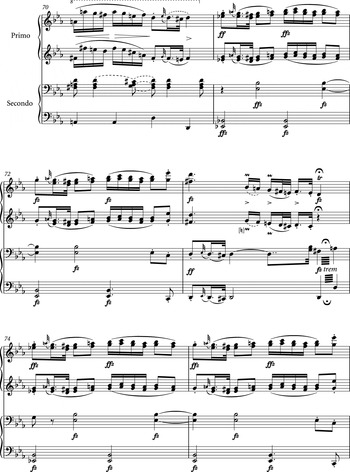
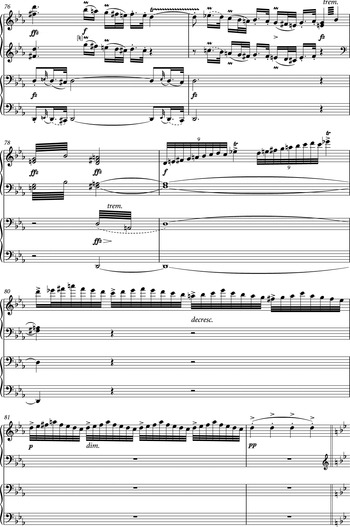
It would be misleading, however, to contend that Viennese composers at the turn of the nineteenth century never sought to imitate the alterity of Hungarian-Gypsy music. The exoticism of Hummel's Balli ongaresi, Op. 23 (1807), and, perhaps most famously, of Schubert's Divertissement à l'hongroise, d818 (1826), anticipates that of many works of the later nineteenth century. Example 7 reproduces bars 70–82 of Schubert's Divertissement, with imperfect cadences on D major juxtaposed with new phrases beginning on E flat major (♭VI in the context of G minor), a proliferation of bokázó figures, an evocation of dűvő accompaniment in the secondo part that includes typical strong off-beat accents (bars 71–72 and 74–75),Footnote 56 cimbalom-like tremolos, and, most notably, flourishes with an improvisatory and virtuosic flair, particularly in bars 79–81 of the primo part.
Schubert, Divertissement à l'hongroise, d818 (1826), bars 70–82 (Franz Schubert: Neue Ausgabe sämtlicher Werke, series 7, volume 1/2: Werke für Klavier zu vier Händen, ed. Christa Landon (Kassel: Bärenreiter, 1978)). Used by permission


Given the overt exoticism of the Divertissement, Liszt's later criticism of Schubert's approach to Hungarian-Gypsy music is surprising. In his 1859 treatise Des Bohémiens et de leur musique en Hongrie he declared:
On peut se convaincre combien peu les musiciens civilisés ont pénétré la caractéristique de l'art bohémien lorsqu'ils s'en sont occupés, en voyant deux maîtres tels que Beethoven et Schubert se méprendre sur les traits essentiellement inhérents à sa forme. Tous deux ont essayé de transporter dans la sphère de leur art quelques bribes de celui-ci …. Mais il n'est pas difficile de reconnaître que [Schubert] et Beethoven ne prêtèrent qu'une attention très-fugitive à ces productions exotiques, qu'ils ne les envisagèrent pas du tout comme des échantillons révélant la flore nouvelle d'une zone inconnue. … Il est évident, à la manière dont ils traitèrent les motifs qu'ils lui empruntèrent, qu'ils n'y virent point un art différent de tout autre, construit sur de tout autres principes, s'élevant sur un tout autre fondement. Ils prirent les fragments qui arrivèrent jusqu'à eux pour des débris égarés et défigurés par des artistes rudes et grossiers, et croyaient leur rendre de la valeur en les taillant selon nos règles et nos méthodes.Footnote 57
One can convince oneself how little civilized musicians have understood the nature of Gypsy art, when they took an interest in it, when one sees two masters such as Beethoven and Schubert misunderstand the characteristics essentially inherent in its form. Both tried to carry over to the sphere of their art a few snatches of it. … But it is not difficult to recognize that [Schubert] and Beethoven lent but very fleeting attention to these exotic productions, that they did not consider them at all as samples revealing the new flora of an unknown zone. … It is obvious from the way they treated the motives they borrowed that they did not perceive an art different from all others, constructed from completely different principles, on a completely different foundation. They took the fragments that reached them as the stray and disfigured debris of rough and crude artists, and believed they gave them value by tailoring them according to our rules and methods.
Although Liszt criticizes Beethoven and Schubert at least in part to valorize his own Hungarian-Gypsy works, his assessment of many of his predecessors' domesticating approach nonetheless has merit, for extensive stylistic exoticism in Viennese adaptations of Hungarian-Gypsy music around 1800 was the exception rather than the rule.
Even when one accepts that any encounter with the other must be mediated through one's own knowledge and expectations, and that the result, as Mary Hunter has astutely argued, is more often a ‘translation’ than an ‘imitation’ of the original, Viennese adaptations of Hungarian-Gypsy music remain striking on several levels.Footnote 58 As Ralph Locke has summarized, the distinction between ‘exotic styles that are closely derived from musical practices of the society being portrayed’ and ‘largely invented’ styles is often due to a distinction between musical cultures that either were or were not familiar to Western Europeans.Footnote 59 He cites Hungarian-Gypsy music and musicians as an example of the relatively familiar, and, as I have already indicated, this was particularly true in Vienna. Although the performance practices of Hungarian-Gypsy musicians had to be translated in order to function within the parameters of Western art music, the translation in the case of the earliest adaptations was particularly extensive. Nonetheless, the composers of many collections of dances effaced their agency almost completely through titles and in prefaces, presenting themselves as mere transcribers or collectors;Footnote 60 it is largely for this reason that I have consistently referred to these works as adaptations rather than as evocations or representations. However tongue-in-cheek it may have seemed, this repertoire was marketed as an adaptation of the original, arranged, in most cases, for domestic performance.
Yet Larry Wolff has argued that the cultural construction of Eastern Europe as other occurred during the Enlightenment, when the concept of Northern European barbarism, which had held sway throughout the Renaissance, was shifted to the east.Footnote 61 Hungary was widely understood as belonging to this less civilized sphere; Townson, for example, related the Viennese perception of Hungarian savagery in his travelogue:
I impatiently waited at Vienna for fine weather; and only in fine weather could it be prudent to travel in a country which, according to the accounts current at Vienna, was little better than in a state of nature, and its inhabitants half savage; and the weather had hitherto, ever since the breaking of the frost, been cold and gloomy. Indeed so savage was the character of this people drawn by some, that many less accustomed to travel than myself, would have given up their intended tour altogether; and I myself, had I not learned to make deductions from popular accounts, would hardly have ventured without a battalion of grenadiers for protection. If I came back alive I was told I ought to think myself fortunate.Footnote 62
Given this context, one would expect that Viennese adaptations of Hungarian-Gypsy music would contain a noticeable number of musical markers of alterity. Beyond the bokázó figure, a handful of augmented seconds and the increased use of syncopation, however, strikingly few musical markers of exoticism appear consistently in this repertoire. The adaptation of verbunk around 1800 did not ‘create a new syncretic language’ or result in ‘radical renewal’, as John MacKenzie has suggested was the effect of musical Orientalism.Footnote 63 Moreover, Hungarian-Gypsy music was not necessarily ‘represented by Austro-German composers as exotic – that is, as existing outside familiar musical, aesthetic and social boundaries’, as Head has argued.Footnote 64 Rather, verbunk was most often presented in as familiar a light as possible, subsumed as nearly as it could be into the native Western European musical idiom, possibly in an effort to satisfy normative expectations and thereby to ensure commercial success, while still offering a certain exotic thrill through evocative titles and enticing prefaces.Footnote 65 Perhaps Ludwig Speidel best summarized the situation, if in strikingly imperialistic terms, when he reflected on it in an 1888 review:
Dem Tonkünstler ist die Nationalmusik, was dem Maler die Natur ist. So haben Haydn, Beethoven und Schubert die Zigeunermusik aufgefaßt und mit ihr dem Kaiserreich der deutschen Musik einen interessante Provinz angegliedert. So ist sie kein Fremdling mehr oder doch nur insofern, als alles Romantische als fremdartig, aber in seiner Fremdartigkeit zugleich als anziehend und gefallend empfunden wird.Footnote 66
National music is to the composer what nature is to the painter. Thus Haydn, Beethoven and Schubert take up Gypsy music and annex it as an interesting province into the empire of German music. In this way, it is no longer something foreign or is so only in so far as everything romantic is foreign, but in its foreignness is felt at the same time to be attractive and pleasing.