Introduction
The Canarian Archipelago, located off the north-western coast of Africa, at 27°83′–29°82′N and 13°83′–18°10′W comprises seven main islands and a number of peripheral islets. Since its origin, at the beginning of the Miocene, this volcanic archipelago has been completely isolated from Africa. This is reflected in a typical fauna with many endemic species.
The skink, Chalcides sexlineatus Steindachner, is an endemic species from Gran Canaria, one of the two large, central islands of the archipelago. It is widespread around the island and locally abundant in some areas (Mateo, Reference Mateo, Pleguezuelos, Márquez and Lizana2002). Its altitudinal range is very wide, from coastal populations to populations living in the mountains of the centre of the island, surpassing 1850 m. Although this species shows considerable morphological (Brown & Thorpe, Reference Brown and Thorpe1991a, Reference Brown and Thorpeb) and genetic (Pestano & Brown, Reference Pestano and Brown1999) variability, it is phylogenetically related to the other skinks from the western islands of the Canary archipelago, representing the most ancient skink colonization of the archipelago (Carranza et al., Reference Carranza, Arnold, Geniez, Roca and Mateo2008).
The single study of helminths from this skink currently available barely reports the cestode Oochoristica tuberculata Rudolphi, 1819 ‘among other parasites’ (Lamas et al., Reference Lamas, López-Orge, González-Lama, Zapatero-Ramos and Martínez-Fernández1985). Some other studies on Chalcides viridanus (Gravenhorst) from other Canary islands, namely Tenerife and El Hierro islands (Solera-Puertas et al., Reference Solera-Puertas, Zapatero-Ramos, Castaño-Fernández and Carrera-Moro1987, Reference Solera-Puertas, Astasio-Arbiza, Zapatero-Ramos and Castaño-Fernández1988a, Reference Solera-Puertas, González-Santiago, Carvajal-Gallardo and Zapatero-Ramosb), described a new pharyngodonid nematode species. Consequently, the aim of this study was to investigate for the first time the helminth infracommunities of C. sexlineatus from Gran Canaria and to compare them with those reported from other Chalcides from the Canary Islands, as well as with those already described for the sympatric reptile species, namely the lacertid Gallotia stehlini (Schenkel) (Martin & Roca, Reference Martin and Roca2004a) and the gecko Tarentola boettgeri boettgeri (Steindachner) (Roca et al., Reference Roca, Martin and Carbonell1999), also endemic to Gran Canaria.
Materials and methods
Gran Canaria is a volcanic island (1560 km2; 1948 m maximum elevation) with a central position in the Canarian Archipelago at 27°57′N and 15°53′W. The island is microclimatically and ecologically heterogeneous, with large differences between the north and the south, being warmer in the latter (Fernández-Palacios & Martín, Reference Fernández-Palacios, Martín, Fernández-Palacios and Martín2001). Field sampling was carried out in one locality, Aldea Blanca, located at the south-east of the island at 27°50′N and 15°28′W with a total of 15 specimens (8 adult males and 7 adult females) of C. sexlineatus being collected by hand in June 2009.
Chalcides sexlineatus can be found in all kind of habitats on the island, being locally abundant in the ravines of the southern part. Its diet is mainly insectivore, including groups such as Diptera, Coleoptera and Heteroptera (López-Jurado, Reference López-Jurado and Böhme1998). All skinks captured were sacrificed humanely and the body cavity, digestive tract, heart, lungs and liver were removed, opened and placed in Ringer's solution for examination. Helminths were removed, washed in distilled water, fixed and mounted according to standard techniques (Roca, Reference Roca1985).
Parasites were identified, when possible, to the species level and the number and location of individual parasites of each species per host were recorded. Diversity and infection parameters described in Bush et al. (Reference Bush, Laferty, Loft and Shostak1997) were used to define the ecology of the parasites. Thus, prevalence is defined as the number of hosts parasitized divided by total number of hosts sampled; mean intensity, as total number of worms divided by number of infected hosts; mean abundance, as total number of worms divided by the total number of hosts sampled. Brillouin's index was used for calculating diversity, according to Magurran (Reference Magurran2004).
Results
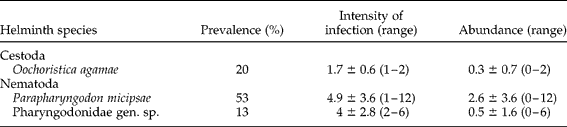
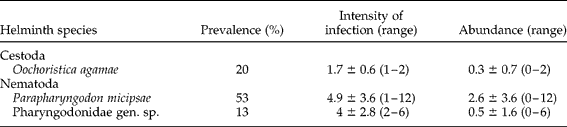
The host C. sexlineatus population was infected with three species of helminths (one cestode and two nematodes, see table 1). All helminths were found in the digestive tract, Oochoristica agamae (Cestoda) in the small intestine and the nematodes in the large intestine (caecum). Of the species found, Parapharyngodon micipsae was the most common, with 53% of all hosts infected. The other nematode species, which could not be determined at species level, was only found in 13% of the hosts. Detailed infection parameters for individual species of parasite are given in table 1. The average number of parasite species per lizard was 0.86 and the maximum number of parasite taxa found in any individual lizard never exceeded 3. Hence, the population of C. sexlineatus harboured a very impoverished parasite community consisting largely of monoxenic pharyngodonid nematodes. The helminths encountered had a global prevalence (all taxa) of 60% (9/15). While the mean intensity of infection (all taxa) was of 5.4 ± 3.3 worms/infected host (range 1–12), the abundance (all taxa) was 3.3 ± 3.7 worms/host (range 0–12). The values of species richness and abundance were, respectively, 0.9 ± 0.9 (range 0–3) and 3.3 ± 3.7 (range 0–12), and Brillouin's index diversity was 0.1 ± 0.2 (range 0–0.613). Proportion of hosts with 0 or 1 helminth species was 67%.
Levels of infection of helminths in C. sexlineatus.
Discussion
Our study confirms the presence of O. agamae in C. sexlineatus. Although a previous study by Lamas et al. (Reference Lamas, López-Orge, González-Lama, Zapatero-Ramos and Martínez-Fernández1985) identified it as O. tuberculata, diagnosis was based on a poor description. Our results show that it is more probable that those specimens belong to the species O. agamae, previously cited by Martin & Roca (Reference Martin and Roca2004a) for G. stehlini from the same island and sympatric with C. sexlineatus. Unfortunately, a proper comparison of the helminth infracommunities of C. sexlineatus from Gran Canaria with the ones found in C. viridanus from Tenerife and El Hierro islands (Solera-Puertas et al., Reference Solera-Puertas, Zapatero-Ramos, Castaño-Fernández and Carrera-Moro1987, Reference Solera-Puertas, Astasio-Arbiza, Zapatero-Ramos and Castaño-Fernández1988a, Reference Solera-Puertas, González-Santiago, Carvajal-Gallardo and Zapatero-Ramosb) was not possible because of the incomplete nature of the dataset provided for C. viridanus. However, three Pharyngodonidae nematodes were found in C. viridanus (Parathelandros canariensis and Thelandros tinerfensis from Tenerife island (Solera-Puertas et al., Reference Solera-Puertas, Zapatero-Ramos, Castaño-Fernández and Carrera-Moro1987, Reference Solera-Puertas, Astasio-Arbiza, Zapatero-Ramos and Castaño-Fernández1988a) and Pharyngodon hierrensis from El Hierro island (Solera-Puertas et al., Reference Solera-Puertas, González-Santiago, Carvajal-Gallardo and Zapatero-Ramos1988b)), which have not been found in C. sexlineatus.
Two pharyngodonid nematodes were found in the caecum of the hosts. One of them belonged to the species P. micipsae, which was the most frequent and abundant species in the helminth community. The specific identification of the other species was not possible because no males were found. However, females differed from those of P. micipsae by having a longer oesophagus and a different morphology of the caudal end.
Only a single infracommunity included all species locally available. This upper limit on species richness is not usually attained (Poulin, Reference Poulin1998). This agrees with the results from other Canarian lizards (Martin & Roca, Reference Martin and Roca2004b) and seems to be a typical pattern in many other lizards (Roca & Hornero, Reference Roca and Hornero1994; Roca, Reference Roca1999).
The low values of Brillouin's index emphasize the low diversity of the helminth infracommunities of C. sexlineatus. This agrees with the typical pattern of helminth infection observed in many carnivorous reptiles, in which few species occur frequently, few species occur with moderate prevalence and many species are rare (Roca & Hornero, Reference Roca and Hornero1994). Values of diversity found in C. sexlineatus are very similar to those found in T. b. boettgeri (Roca et al., Reference Roca, Martin and Carbonell1999) a geckonid syntopic with C. sexlineatus, but clearly differ from those found in the giant lacertid lizard G. stehlini (Martin & Roca, Reference Martin and Roca2004a), also syntopic with C. sexlineatus (and T. b. boettgeri) from Gran Canaria. As G. stehlini is an herbivorous species (Carretero et al., Reference Carretero, Roca, Martin, Llorente, Montori, Santos and Mateos2006) whereas T. b. boettgeri (Rykena et al., Reference Rykena, Hielen, Nettman and Böhme1998) and C. sexlineatus (López-Jurado, Reference López-Jurado and Böhme1998) are insectivorous, our results support previous findings suggesting that small insectivorous reptiles harbour poorer helminth communities than herbivorous ones (Roca, Reference Roca1999; Carretero et al., Reference Carretero, Roca, Larbes, Ferrero and Jorge2011). Since C. sexlineatus only consumes animal matter (López-Jurado, Reference López-Jurado and Böhme1998, pers. obs.), it is expected to harbour poor and isolationist communities (see Aho, Reference Aho, Esch, Bush and Aho1990; Martin & Roca, Reference Martin and Roca2004a; Carretero et al., Reference Carretero, Roca, Larbes, Ferrero and Jorge2011). It can then be placed near the end of carnivory in the herbivory–carnivory continuum (Roca, Reference Roca1999), and near the end of isolationism in an isolationist (poor) to interactive (rich) continuum (sensu Holmes & Price, Reference Holmes, Price, Kikkawa and Anderson1986; Roca et al., Reference Roca, Carretero, Marques, Barbosa and Galdón2006). In this context, as happens in other insectivorous lizards (Carretero et al., Reference Carretero, Roca, Larbes, Ferrero and Jorge2011), the low parasite diversity found in all the intestinal tracts must be considered more a by-product of low parasitization rather than the result of negative interactions among different parasite species. Certainly, in the future it would be extremely interesting to analyse the infracommunities harboured by related skink species inhabiting the African continent (i.e. C. mionecton, according to Carranza et al., Reference Carranza, Arnold, Geniez, Roca and Mateo2008) to determine to what extent insularity has also contributed to the impoverishment of the helminth fauna of Canarian Chalcides, as has been carried out with other lizards (Roca et al., Reference Roca, Foufopoulos, Valakos and Pafilis2009).
Comparison between helminth communities of T. b. boettgeri from the same locality (Aldea Blanca) reported previously (Roca et al., Reference Roca, Martin and Carbonell1999; Martin & Roca, Reference Martin and Roca2004a) and C. sexlineatus, showed similarity in values of diversity. However, both hosts differed in the following features. First, four cestode species (Diplopylidium acanthotetra, Diplopylidium nölleri, Dipylidium sp. and Monopylidium sp.) were found, as larval forms, in the body cavity of T. b. boettgeri (Roca et al., Reference Roca, Martin and Carbonell1999), whereas no larval forms were found in C. sexlineatus. This observation suggests that these cestodes could use the geckoes, but not the skinks, as intermediate or paratenic hosts; distinct environment, diet or physiology (immunity) may be the cause of this difference. On the other hand, an adult cestode, O. agamae, has been found in C. sexlineatus but not in T. b. boettgeri (Roca et al., Reference Roca, Martin and Carbonell1999). Since these cestodes use arthropods as intermediate hosts (see Roca, Reference Roca1985), we suggest that this is due to differences in the feeding habits between geckoes (crepuscular and nocturnal) and skinks (semi-fossorial). Tentatively, certain species of arthropod acting as the intermediate host for O. agamae, would be present in the diet of C. sexlineatus, but would not be consumed by T. b. boettgeri. Finally, as in C. sexlineatus, two Parapharyngodon species were found in T. b. boettgeri (Roca et al., Reference Roca, Martin and Carbonell1999). However another pharyngodonid, Spauligodon sp., was found in T. b. boettgeri but not in C. sexlineatus. Since Spauligodon spp. are monoxenous helminths (direct life cycle, no intermediate host utilized) the low prevalence of this nematode (1%) in T. b. boettgeri (Roca et al., Reference Roca, Martin and Carbonell1999) and the absence in C. sexlineatus, suggest that physiography and ecological conditions of the prospected area may be responsible for the scarce recruitment opportunities of these nematodes by the potential hosts.
Acknowledgements
This work has been funded through a Fundação para a Ciência e Tecnologia (FCT) grant (project number BIA-BDE/67678/2006). A.P. is supported by an FCT postdoctoral fellowship (SFRH/BPD/26546/2006). Thanks are due to James Harris for the linguistic revision of the manuscript. Collection permit number 2403 4 May 2009 was provided by the Environmental Council of the Cabildo de Gran Canaria.