

Introduction
Throughout negotiations surrounding the Transatlantic Trade and Investment Partnership (TTIP), policymakers, politicians, and interest groups have contributed to a fierce debate concerning the inclusion of an investor-state dispute settlement mechanism (ISDS) in mega-Free Trade Agreements (mega-FTAs). Following Wikileaks' decision to release a “20 January 2015” draft of the Trans-Pacific Partnership's (TPP) Investment Chapter on 25 March 2016, the New York Times reported objections from both sides of the political divide to the White House's decision to open up the U.S. government to suits from foreign companies.Footnote 2 This leak followed hard on the heels of Senator Elizabeth Warren's (D-Ma.) crusade against the inclusion of the provision in TPP negotiations in a Washington Post editorial.Footnote 3 These narratives set the stage for a U.S. presidential election in which both candidates, Hillary Clinton and Donald Trump, made clear that they would not support either TTIP or TPP—with the ISDS provision at the center of the controversy.
Aside from the concern that states risk becoming vulnerable to suits from foreign corporations, opponents of investor protection provisions claim that corporations are taking advantage of the transformed international arbitration system used by over 2,000 bilateral investment treaties (BITs). These companies, opponents of ISDS argue, bully governments that create new regulations—for public health and the environment—into providing compensation or abandoning their policies. In response to this eventuality, Bill Gates and Michael Bloomberg created a fund to support countries involved in international arbitration proceedings brought by tobacco companies that view plain packaging laws as degrading to their trademarks.Footnote 4 As states increasingly look beyond BITs to mega-FTAs to rationalize international trade, the choices concerning whether to include an ISDS provision alongside other regulatory harmonization measures will have considerable consequences for all players in the international economy.
This movement toward mega-FTAs over the past decade, demonstrated by the turn toward international trade agreements like TPP and TTIP as well as the repeated inclusion of the ISDS provision in trade negotiations, necessitates an examination of existing theories concerning trade in the discipline of international political economy.Footnote 5
In the following, I examine the origins of ISDS and outline the controversy surrounding its use in the context of TTIP. Then, I provide a theoretical discussion that outlines the exogenous and endogenous factors that contribute to the inclusion of ISDS provisions in international trade agreements. Focusing on the latter endogenous factors, I argue that contrary to their treatment in much of the existing literature, not all international trade agreements are the same. I propose a typology of international trade agreements that measures whether the number of parties and their relative power impact the inclusion of an ISDS provision. I then test this typology against the empirical record using U.S.-Ecuador, U.S.-Rwanda, CETA, NAFTA, TPP, and TTIP negotiations. Finally, I discuss potential professionalization, institutionalization, and transparency-improving innovations to the ISDS provisions and market-based mechanisms that address the dual challenges of discrimination and expropriation that ISDS was originally designed to address.
The origins of ISDS
As scholars have explained, ISDS seeks to address a straightforward political problem.Footnote 6 Companies that invest in foreign markets want protection from states that might expropriate their investment via nationalization or discriminate against their business in favor of local businesses. Companies seek protection because foreign direct investment (FDI) presents a significant risk to an investor given that capital flight is impossible once monies are spent on fixed assets that cannot be easily moved. As a result, ISDS is “designed to protect firms that invest abroad against unfair or arbitrary treatment by foreign governments” by providing private actors with a venue for arbitration where they can bring complaints against governments.Footnote 7
For governments, too, the ISDS provision has benefits insofar as it ties the hands of future regimes. While allowing investments to come into the country at present, an ISDS provision signals a commitment to investors who might channel greater FDI into the country. Indeed, the most common theoretical justification for establishing compliance mechanisms and international regimes stems from the notion that they lessen transaction costs, lessen information costs (via harmonization and making expectations clear), and abrogate the incentive to cheat among actors (via monitoring and enforcement). The actors behave cautiously or cynically when securing agreements but are said to do so for the benefit that they derive from it.Footnote 8 The argument put forward by the U.S. Trade Representative concerning TTIP that “governments put ISDS in place for three main reasons: to resolve investment conflicts without creating state-to-state conflict, to protect citizens abroad, and to encourage investment by signaling to potential investors that the rule of law will be respected” mirrors the logic above.Footnote 9
As a result, ISDS mechanisms have been included in bilateral and multilateral trade agreements to protect businesses that invest in countries with a limited or nonexistent legal system to enforce contracts, property rights and protect investors from discrimination and expropriation. Since investors cannot bring suits against states within existing institutions, ISDS provides an alternative mechanism by which investors can protect their outlays if governments change their priorities. Eminent domain, in which a government expropriates the land or property of an international firm for public use in return for a compensation payment, serves as an example of how investors envisage a mechanism to adequately protect their interests. If a compensation payment is not forthcoming, businesses file for damages to an international tribunal. Put simply, ISDS insures firms against the possibility that governments, which lack legal frameworks to protect investments, will confiscate their property or damage their business. This is true even in circumstances in which the firm has not contracted directly with the government. The process allows firms to bypass local courts and to take claims directly to international arbitration tribunals to recover costs of their investments, and discourages discriminatory behavior by governments in the first place.Footnote 10
And, according to a number of scholars, the system works with regard to attracting investment flows. While there is disagreement among scholars as to which variables related to FDI should be measured, recent scholarship in the discipline concludes that BITs that include investor protection provisions correlate with greater amounts of foreign direct investment.Footnote 11
The ISDS controversy
Given that ISDS mechanisms are designed to prevent foreign investors and companies from unfair or arbitrary treatment by foreign governments, it is puzzling why the prevalence of these provisions in international trade agreements has become increasingly controversial. In this section, I examine this controversy.
The argument against the inclusion of ISDS contends that measures taken to protect investors undermine the right of states to regulate public policy. In negotiations surrounding the Transatlantic Trade and Investment Partnership (TTIP), civil society and interest groups have been particularly concerned with the effects of ISDS provisions on government policy in the domains of health, safety, and the environment.Footnote 12 Specifically, an effort made to regulate in the public interest might leave governments open to future litigation and effectively force a change to public policy that is not in the public's interest. For example, the provincial government of New Brunswick sought to create a public auto insurance program to reduce consumer costs. In response, the Insurance Bureau of Canada, the largest, private insurers in the country, suggested that foreign insurance companies would file suit under an ISDS mechanism—in this case under the auspices of NAFTA. This threat led to the abandonment of the policy and the absence of the potential benefits to the population of a 20 percent lower insurance bill.
Indeed, Cecilia Malmström, the European Union's Commissioner for Trade, noted that among various interest groups in Europe, “there is a huge skepticism against the ISDS instrument.”Footnote 13 As a result, debates surrounding the appropriate levels of investor protection have become “one of the most dynamic and controversial areas of international law today.”Footnote 14
On a meta-theoretical level, the movement toward an ISDS mechanism represents a significant development in the application of sovereignty norms. As Mattli and others have suggested, private party standing vis à vis a foreign state represents a deviation from international norms.Footnote 15 Outside of investor protection, only states can bring disputes against other states. As such, ISDS represents a “revolutionary innovation that is now taken for granted.”Footnote 16 Indeed, the abandonment of the TTIP process in late 2016 and the outrage over the possibility of lawsuits from foreign companies in both North America and Europe are just the most recent example of the dispute over the practice.
Internal vs. external theory
Having outlined the origins and controversy of the ISDS mechanism, it is worth considering how scholars should conceptualize the set of agreements that include provisions for investor protection. Broadly speaking, I point to two baskets of theory in the existing literature: those that focus on factors endogenous and exogenous to any international trade agreement to explain why or why not to include ISDS mechanisms in international trade agreements.
Exogenous factors
Scholars focusing on exogenous variables to explain the inclusion of ISDS look to structural variables to explain the decision to sign agreements. As Van Harten notes in his account of the rise of private authority in transnational governance, “the legacy of [the] debt crisis, the collapse of the Soviet Union, and reductions in Western official aid combined to put pressures on developing countries to attract private foreign capital.”Footnote 17 The need to attract capital led to the ISDS provision acting as a concession to companies from wealthy countries seeking to hedge the risk of investment in politically volatile states. Regarding the practice of ISDS, Simmons points out that litigation is most likely when macro-economic conditions are unstable.Footnote 18
The shift to mega-FTAs over the past decade has occurred within a particular geopolitical arena in which there is a variety of moving parts—the least of which is the rise of China and its partners in BRICS, who have recently bolstered their international economic role via the BRICS Development Bank. As Griffith, Steinberg, and Zysman argue, the WTO process is at a practical standstill, while some rising powers are also seeking to reshape the global order.Footnote 19 Hence, the TPP and TTIP might be re-cast as a “single undertaking” of a “WTO+.” The WTO+ would be led primarily by the United States, who would once again set the rules for future trade treaties in a world in which the “far bigger impediment to international trade than either tariffs or transportation costs is the difference in regulatory systems between states.”Footnote 20 As Jeffrey Schott of the Peterson Institute suggests, the U.S. insistence on an arbitration clause in its deal with the European Union does not stem from any concern about the strength of property rights in Europe itself. Rather, it sets down a marker for future trade negotiations with China: “America wants to set a precedent for China by creating a world-class template for trade agreements.”Footnote 21 Scholars and policy-makers have continued to attribute the reason for including ISDS in mega-FTAs and bilateral investment treaties to structural constraints.
Other scholars point to the normative aspects of the agreement rather than the internal dynamics of the negotiation to explain why ISDS provision are included in the first place—namely, to address the challenges of discrimination and expropriation. They suggest that these provisions stem from fears that a failure to include ISDS would weaken the international trade regime and would represent a missed opportunity to set structural norms to protect investors.Footnote 22
Both approaches treat international trade agreements as like units rather than discrete solutions to specific bargaining problems. The predilection of the field to engage with international trade agreements using pooled analysis with a large number of cases over time explains this proclivity. The problem with both of these conceptualizations is that they ignore the very function that ISDS is designed to address in favor of focusing on the normative or structural implications of the provision. It is for this reason that I highlight the internal dynamics of international trade agreements. Below, I argue that the variation among agreements problematizes the notion that an ISDS provision is integral to any and all mega-FTAs. Instead, such provisions represent the response to a discrete challenge brewing from the internal dynamics of bargaining.
Endogenous factors
In contrast to those that focus upon structural variables noted above, scholars of endogenous factors instead focus on variables internal to the trade agreement and the parties that sign it. These variables include the number of parties in agreement, the relative power of the parties, and the “distance” between an existing policy and the policy related to the new agreement. Downs et al. describe this last measure as “depth,” to suggest that the more distance between two policies, the more likely that an ISDS provision is included.Footnote 23 I use the former two of these internal variables, the number of parties and relative power, to argue that not all international trade agreements look alike and that it is not appropriate or necessary to include the ISDS mechanism in all agreements.
A typology of international trade agreements
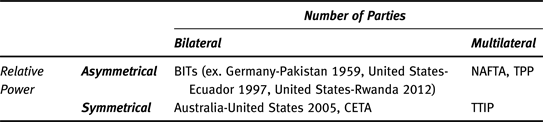
To investigate ISDS, I propose a mutually exclusive and collectively exhaustive typology that categorizes existing international trade agreements across two variables endogenous to the negotiation of the agreement: the number of parties to an agreement (bilateral or multilateral) and the relative power of the parties (symmetrical or asymmetrical). Existing theories suggest that these variables explain the inclusion of ISDS mechanisms in international trade agreements. Recent mega-FTA negotiations offer an opportunity to test them against the empirical record of international trade agreements—including the TTIP. Below, I briefly point to the variables chosen to organize the typology of international trade agreements.
The numbers of parties
With regard to the number of parties in an international trade agreement, Koremenos concludes that more parties in an agreement will lead to a greater need for investor protection.Footnote 24 Using a game theoretical model, she suggests that ISDS provisions are most likely to be included when complex cooperation problems exist. Baldwin, too, notes that increased complexity requires deeper integration.Footnote 25 The logic of both arguments is that policing an agreement across multiple jurisdictions becomes increasingly burdensome (the costs of policing compliance increase) and handing off this policing role to an ISDS provision offers benefits in the forms of a deterrent effect and a clear procedure for dealing with disputes.
Two clear hypotheses result from this extant scholarship. First, if there is a trade agreement involving multiple players, then the inclusion of an ISDS mechanism is increasingly necessary and is subsequently more likely. Second, if a trade agreement includes only two players, the inclusion of an ISDS mechanism is of diminishing utility and is subsequently less likely.
The relative power of parties
Extant work examining the relative power of two parties engaging in an agreement finds that the greater the asymmetry in power between parties, the greater the likelihood that an investor protection provision is included.Footnote 26 The logic for this phenomenon suggests that stronger states act to protect their investors by forcing weaker states to include provisions that will protect them. It is important to note that this is a dyadic conceptualization of power and not a judgment on the overall power of any party. Recent work from Allee and Peinhardt, in particular, concludes that international trade agreements are a venue in which “power politics [is] alive and well.”Footnote 27 Specifically, greater power discrepancy between two players leads to a greater push for investor protection in the form of ISDS.Footnote 28 Interestingly, industries and policies carved out of agreements by powerful parties demonstrate the importance of considering power relations while examining the inner workings of trade agreements. The agricultural sector, for example, is often exempt from policies outlined in trade agreements due to their lobbying power.Footnote 29
The privileged role of powerful states in determining the organization of trade agreements also contributes to the controversial nature of ISDS provisions noted above. Drezner, in particular, points to the relationship between power politics and the construction of international financial orders that set the rules of the game and the associated fear that the game is rigged in favor of companies from these powerful states.Footnote 30
Once again, two clear hypotheses stem from this body of scholarship. First, if the distribution of power between signatories of a trade agreement is asymmetrical, then the likelihood of including an ISDS provision increases. Second, if the distribution of power between signatories of a trade agreement is symmetrical, then the probability of including an ISDS provision decreases.
Typology
Typology of ITAs

Empirical record
Having outlined the ideal-types of international trade agreements, above, I examine each type empirically in turn with a particular focus on types I and IV.
Empirical Examination of ITAs

Type I: Bilateral, Asymmetrical
The majority of BITs fall into the category of asymmetrical, bilateral agreements. Much of the existing literature on free trade agreements contribute to theorizing why each player signs up to an agreement that constrains its ability to act autonomously.
For the relatively less powerful actor, scholars point to the “hand tying” capacity of ISDS, which signals a credible commitment to investors by the host state.Footnote 31 This is necessary because countries compete intensely for investment and use mechanisms such as ISDS to signal to investors that they will not expropriate company property or discriminate against them for fear of potential losses in arbitration.Footnote 32 As a result, having an investor protection mechanism, such as ISDS, is theorized to make the host state comparatively attractive vis à vis those that do not have such a provision. Moreover, the dependence of relatively weak states on the global economy and inward foreign investment makes them more likely to sign up for an agreement.Footnote 33 Simmons describes this phenomenon as a competitive ratification dynamic.Footnote 34
Allee and Peinhardt suggest that the power and preferences exercised by those with more bargaining power and capital influence the decision to include investor protection mechanisms.Footnote 35 However, more research is needed to investigate the micro-foundations of these demands and which actors are most important in creating them.
With the theory in hand that ISDS is included only under particular circumstances, I turn to an examination of the empirical record. Thus far, 2,200 BITs with ISDS mechanisms have been signed, beginning with an agreement between Germany and Pakistan in 1959. More recent examples of Type I BITs include the U.S. trade deal with Ecuador, signed in 1997, and the investment treaty concluded by the United States and Rwanda that entered into force in 2012.Footnote 36 The U.S.-Rwanda agreement, for example, calls for the use of the International Centre for Settlement of Investment Disputes (ICSID) as the venue for dispute settlement. The U.S.-Ecuador agreement led to the largest payout in the case of Occidental Energy v. Ecuador. The government in Quito unilaterally terminated an oil contract, leading to an award between U.S. $1.7 billion and U.S. $2.3 billion to the U.S. claimant by ICSID arbitrators following a failure of the company to meet Ecuadorian environmental standards.Footnote 37 The tribunal ruled that the government's decision to expel Occidental Energy was not “proportional” to the breach of the contract, despite the U.S.-Ecuadorian BIT lacking standards of proportionality in its text. All three cases noted above serve as illustrative examples of the power asymmetry between two signatory countries represented by Type I.
Using content analysis rather than outcomes across 140 cases, Van Harten finds that arbitrators repeatedly favor claimants (corporations) over respondent states and that rulings tend to favor parties from Western capital-producing states.Footnote 38 Simmons corroborates these findings, noting that ISDS disproportionately benefits capital exporters.Footnote 39 Further, defendants in investment cases tend to be middle or lower income states.Footnote 40 These outcomes have led some to suggest that BITs do in fact “bite.”Footnote 41 At the same time, however, others have argued that BITs attract foreign capital to relatively less powerful states because they bite.Footnote 42 The logic in this latter argument is that without the costs provided by the investment chapters of BITs, the agreements themselves would not serve their purpose.
Type II: Multilateral, Asymmetrical
As Koremenos argues, investment protection is increasingly necessary for trade arrangements with a large number of players.Footnote 43 Trade arrangements where players have asymmetrical power exacerbate this need.
The empirical cases appear to bear this out. In the following section, I provide an account of the inclusion of investor protection in the North Atlantic Free Trade Agreement (NAFTA) involving Canada, Mexico, and the United States. I then briefly discuss the negotiation process surrounding the inclusion of ISDS in the TPP agreement abandoned in early 2017 by the United States.
The relevant chapter of NAFTA for our purposes is Chapter Eleven, titled “Investments.” The second section of the agreement outlines the ISDS mechanism in the event of loss or damage to the investor. NAFTA relies on the ICSID system as well as the arbitral rules outlined by the United Nations Commission on International Trade Law (UNCITRAL).Footnote 44 By doing so, many scholars argue that NAFTA is similar to BITs. As Legum argues, the claims that NAFTA materially changes the architecture of investor protection are overblown and that the “most striking aspects of NAFTA investor-state arbitration are foreshadowed in earlier treaties.”Footnote 45 Given the hypotheses outlined above, this is unsurprising because NAFTA involves multiple parties (three) with an asymmetrical power relationship.
TPP includes an increased number of players (twelve) with asymmetrical power, similar to the case of NAFTA. State parties to the TPP negotiation include the four original signatories to the 2006 P4 agreement, Brunei, Chile, New Zealand, and Singapore, alongside Australia, Canada, Japan, Malaysia, Mexico, Peru, and Vietnam. The United States signed an executive order to formally withdraw from the negotiations on 23 January 2017.Footnote 46 Given the greater power disparity amongst members of TPP as well as a larger number of players, it is unsurprising that the draft TPP agreement first leaked by Wikileaks included an ISDS mechanism in Chapter Nine.Footnote 47
In summary, both NAFTA and TPP offer support for the theoretical claim that greater numbers of players and power asymmetry lead to the inclusion of ISDS provisions in international trade agreements. These provisions are an attempt to elicit compliance among a large number of players and to present costs for reneging upon commitments to weaker state parties.
Type III: Bilateral, Symmetrical
Dispute settlement is theorized to work best among members with trade links and relatively equal power.Footnote 48 This is because both sides have an interest in maintaining ties with one another. Both parties are dependent upon the trade that links them, and neither side views dispute settlement as being inherently likely to favor one side since neither side has an inordinate amount of power. In a study considering a U.K.-U.S. free trade agreement, Poulsen, Bonnitcha, and Yackee determined that there was little benefit to including an ISDS provision between advanced countries.Footnote 49 They suggest that foreign companies already receive fair treatment equating to the treatment received by indigenous firms and that any inclusion of an ISDS mechanism is unnecessary.
The United States-Australia Free Trade Agreement that entered into force in 2005 offers an example of the theory suggested by Poulsen et al. The agreement involves two actors with symmetrical power. This symmetry allowed Australia to force the exclusion of a mechanism for investor protection on the basis that no foreign company should receive rights beyond those provided to local investors and companies. In fact, the elimination of such a mechanism led Philip Morris—a tobacco manufacturer—to create a Hong Kong-based subsidiary (Philip Morris Asia Limited) in 2011 to file suit against Australia's plain packaging regulations on the basis that the rule constitutes expropriation under the Australia-Hong Kong bilateral investment treaty.
The recent Comprehensive Economic Trade Agreement (CETA) signed by Canada and Europe in October 2016 offers a second empirical test of this theory. This agreement set a new standard for the ISDS mechanism by outlining new definitions for contested concepts including “fair and equitable treatment” and “arbitral tribunals.”Footnote 50 It also includes provisions for the creation of an “appellate mechanism” and mechanisms designed to “stop forum shopping” on the part of private companies.Footnote 51 These new developments constitute a departure from the previous practice that left the definitions of terms pertinent to ISDS to be debated and defined by arbitrators rather than the parties to the agreement.
In sum, CETA serves as an example of a “revised ISDS” mechanism. Given the findings of Poulsen et al. that countries with symmetric power should exclude ISDS mechanisms from agreements, the CETA case appears puzzling. CETA may represent the first step toward a “revised ISDS” mechanism that symmetrical agreements, such as TTIP, ought to follow.
Type IV: Multilateral, Symmetrical
The final ideal-type of trade agreement discussed in this paper involves multiple signatories with power symmetry. Existing theory suggests that negotiators avoid creating dispute settlement mechanisms when they are not necessary, leaving them for circumstances of complex cooperation.Footnote 52 The hypotheses associated with multilateral, symmetrical agreements using our chosen variables offer mixed conclusions. On the one hand, the large number of players suggests that ISDS might help solve cooperation problems. On the other, the symmetrical nature of power between parties suggests that ISDS might be unnecessary for ensuring compliance. Moreover, ISDS mechanisms can result in high costs for both sides as any carve-outs in the agreement or cases of discrimination and expropriation will induce costs that can be readily enforced by the other side of the negotiation table.Footnote 53
Thus far, a multilateral, symmetrical trade agreement has yet to come into existence—though there is an argument to be made that the TTIP negotiations offer a first test case for this type of international trade agreement. TTIP involves all of the member-states of the European Union and the United States. That said, competency for the negotiation of an investment treaty only shifted to Brussels and the European Union with the conclusion of the Lisbon Treaty in 2009. This leaves important questions for researchers to address, concerning the behavior of the European Union as a unitary actor or an intergovernmental organization that must aggregate the preferences of its member-states.Footnote 54 Regarding the negotiations, themselves, it is useful to note the challenges associated with negotiation between “unlike” units.
Assuming that TTIP offers a useful empirical case to explore Type IV international trade agreements, it also presents an example of unusual trade politics. As Young notes, the focus during TTIP negotiations upon cross-investment and addressing non-tariff trade barriers (NTBs) means that these recent negotiations are “not your parents’ trade politics.”Footnote 55 Indeed, TTIP represents the first case of a mega-FTA in which regulatory cooperation is central to the negotiations.Footnote 56 Moreover, the alignment of industry players on both sides of the Atlantic, related to the symmetrical nature of the relationship between negotiators, has meant that other non-business parties have increasingly been required to act as the opposition to both the overall agreement and the inclusion of an ISDS mechanism in the agreement. This development mirrors Aggarwal and Fogarty's conclusion that non-business, civic interest groups have a greater role to play in enhancing standards for the environment, labor, and human rights.Footnote 57
ISDS and ITAs

In sum, variation in the inclusion and treatment of ISDS among different organizations of relative power and the number of player underscores the importance of scrutinizing these two variables and the ISDS provision itself. Existing research, too often, treats international trade agreements in monolithic terms. However, there are endogenous factors to the agreement that influence the degree to which an ISDS provision is appropriate or warranted. Moreover, it is worth considering the evolution of ISDS as international trade agreements become increasingly multilateral.
The evolution of ISDS and mega-FTAs
Having noted the exogenous and endogenous drivers affecting the inclusion of ISDS provisions in international trade agreements, I now consider the evolution of efforts to address the dual challenges of expropriation and discrimination. In this section, I describe and evaluate innovations to the contemporary ISDS framework as well as market-based mechanisms to address these.
Innovating ISDS
The lack of alternatives to the contemporary ISDS framework represents a problem.Footnote 58 Various efforts have been made to amend the current process, and a number of these innovations have already been incorporated into recent agreements—including provisions in CETA.
These innovations include professionalizing arbitrators and institutionalizing arbitration in bodies such as the ICSID, as well as providing clarity to the rules those arbitrators must follow, to increase transparency surrounding the process.Footnote 59 This innovation seeks to break the link between parties in the dispute and the arbitrators themselves. It might also lead to the creation of one permanent court across trade agreements, contributing to a level of consistency to decisions and settlements. The 2011 E.U. Parliament Resolution on International Investment Policy and the 2013 E.U. Negotiation Directives concerning TTIP also seek to create an appellate mechanism. Hufbauer notes that the absence of appellate mechanisms represents a major shortcoming of the current institutional design of investor-state dispute settlement.Footnote 60
Finally, policy-makers have also called for “fork-in-the-road” or “no U-turn” policies that would address the potential for disputants to file cases in domestic courts and via the ISDS mechanisms.Footnote 61 Domestic companies suggest that the ability of foreign firms to partake in forum shopping puts domestic players at a competitive disadvantage. Policies that make clear to disputants that filing a complaint via ISDS closes the possibility for a hearing in domestic courts, or vice versa, would address this issue.
Market-based alternatives
The “fork-in-the-road” and “no U-turn” policies, noted in the section above, necessitate examining whether an alternative market-based mechanism exists to address the problems of expropriation and discrimination, which affect foreign investors. The best example of such a mechanism comes from the world of insurance, in which a third party takes on some of the risk of investing in states that might have a proclivity towards discriminatory policies or histories of expropriation. A variety of private insurance firms including AIG, Euler Hermes, and Lloyds Market as well as public organizations including the Overseas Private Investment Corporation (OPIC), the World Bank's Multilateral Investment Guarantee Agency (MIGA), and the Asian Development Bank provide political risk insurance to companies and investors against the risk of nationalization and political unrest in host countries.
There is an argument to be made that ISDS mechanisms that allow private actors to bring cases against states manipulate the market by providing a backstop for foreign investment that otherwise would be the subject of political risk insurance. Furthermore, businesses may internalize the cost of political risk rather than lobbying states to include a unique protection regime for the investor class.
Conclusion
Above, I argue that scholars calling for the automatic inclusion of ISDS mechanisms on the basis of past practice or structural concerns fail to take into account the endogenous drivers of international trade agreements. I outline the danger of considering international trade agreements as a single, homogeneous category and make clear that endogenous factors affect agreement provisions. In particular, I highlight that the numbers of players in an agreement and the relative power of the signatories influences parties’ perceptions towards the necessity of an ISDS mechanism and its inclusion, or lack thereof, in such agreements. With regard to TTIP—the focus of this special issue—and other mega-FTAs involving relatively symmetrical powers and a large number of parties, I suggest that the requirement for an ISDS provision lessens considerably. Indeed, TTIP negotiations offer a useful test case concerning the appropriateness of ISDS given trade agreement characteristics with implications for the future of the ISDS mechanism in future negotiations.
Moreover, the paper suggests that the latter measure of relative power is especially important when considering whether an ISDS provision is signed. While this paper explores one interesting and puzzling trend in the international trade arena, future work should explore the relationship between countries with symmetrical power and examine whether being a “developed” or “underdeveloped” country affects the patterns of cooperation. Importantly, the paper also suggests that international trade agreements can be disaggregated rather than treated as like units as it is in considerable portions of the existing literature. Future research might also consider the interaction between the endogenous and exogenous factors that trade representatives and governments balance during trade negotiations.
Rather than suggesting that ISDS is a solution to all trade-related problems, I conclude that under specific conditions ISDS constitutes a solution in search of a problem.