


Introduction
Cognitive restructuring is a psychological intervention technique that includes a set of procedures oriented to teach clientsFootnote 1 how to evaluate, identify and change their maladaptive thoughts (Bados and García, Reference Bados and García2010; Clark, Reference Clark and Hofmann2013). Among all psychological intervention techniques, cognitive restructuring is one of the most used by therapists. Although it is considered a cognitive behavioural therapy (CBT) technique, it is widely used by psychologists from different orientations, backgrounds and experience (American Psychological Association, 2003; Pardo-Cebrián and Calero-Elvira, Reference Pardo-Cebrián and Calero-Elvira2017).
Despite its wide use, cognitive restructuring has a lack of clarity regarding its procedures, applications and therapeutic mechanisms that explain it (Carey and Mullan, Reference Carey and Mullan2004; Clark and Egan, Reference Clark and Egan2015). One of the most relevant components of cognitive restructuring is the Socratic method, usually understood as a verbal questioning procedure of the client’s maladaptive verbalizations.Footnote 2 This procedure is not as structured as others, although there are several proposals regarding the type of questions to be asked and how it should be done. Probably Beck’s approach is the most frequently applied. This author suggested that there are three main categories of questioning: evidence, severity and utility (O’Donohue and Fisher, Reference O’Donohue and Fisher2012).
However, there is no solid theoretical argument or empirical evidence that a specific type of question or strategy leads to better results. Moreover, not even the evidence itself about the efficacy of the debate is conclusive. Even though there are studies about the efficacy of cognitive restructuring as a technique, which supports its efficacy with different problematics (Carpenter et al., Reference Carpenter, Andrews, Witcraft, Powers, Smits and Hofmann2018; DeRubeis et al., Reference DeRubeis, Hollon, Amsterdam, Shelton, Young, Salomon, O’Reardon, Lovett, Gladis, Brown and Gallop2005; Ladouceur et al., Reference Ladouceur, Dugas, Freeston, Léger, Gagnon and Thibodeau2000), this research is often conducted on ‘treatment packages’, rather than on the effects of cognitive restructuring in isolation. So far, there is little research covering the efficacy of the Socratic method. In fact, only two studies support the importance and benefits of using the Socratic method in the results of the treatment (Braun et al., Reference Braun, Strunk, Sasso and Cooper2015; Farmer et al., Reference Farmer, Mitchell, Parker-Guilbert and Galovski2017). Nevertheless, these studies do not provide theoretical explanations, and only process research can shed light on this matter.
Among the process research literature that tries to explain the functioning of cognitive restructuring, we highlight a line of study focused on verbal interaction analysis in the clinical context from a behavioural approach. This line of study makes a scientific approach to the explanation of why clinical change occurs in therapy based on observational methodology (see Froján-Parga et al., Reference Froján-Parga, Montaño-Fidalgo and Calero-Elvira2010; Froján-Parga et al., Reference Froján-Parga, Calero-Elvira and Montaño-Fidalgo2011; among others). According to this work, the Socratic method could be understood as a procedure of verbal shaping, whereby the therapist manages to direct the client to more adaptive verbalizations through the differential verbal reinforcement of the client’s utterances that approach the therapeutic objective and the extinction or punishment of those that are moving away from it (Calero-Elvira et al., Reference Calero-Elvira, Froján-Parga, Ruiz-Sancho and Alpañés-Freitag2013). It was also found that, in the most successful debates, when therapists asked questions preceded by certain information, clients’ verbalizations approached the objective pursued. Recent research from this line of study (Froján-Parga et al., Reference Froján-Parga, Calero-Elvira, Pardo-Cebrián and Nuñez de Prado-Gordillo2018) shows the need to attend to and explain therapists’ verbalizations considering this potential informative function and focusing on specific contents of the Socratic method to know if there is a more effective way to question (Calero-Elvira, Reference Calero-Elvira2009). Although these findings were a breakthrough, there are still some aspects to be understood concerning the functioning of the Socratic method that may significantly improve the clinical outcome: what is the role of questions aimed at challenging logic? What kind of verbalizations preceding the questions discriminates better client responses? Are there more effective debate components or strategies than others?
The objective of this study was to analyse the verbal interaction between therapist and client during the Socratic method, and its relationship with the effectiveness of the questioning by examining the role that antecedent strategies have in generating more adaptive verbalizations by clients. This study also intended to enlighten whether some of the proposals suggested by classical authors regarding the Socratic method leads to greater effectiveness. Specifically, we analyse the Socratic method following a style closer to Ellis’s argumentative debate.
For this study, we considered the following hypotheses:
Hypothesis 1 Regarding the ways of questioning:
-
a. The questioning would change throughout the debate. In the first and second part of the Socratic method there would be more questions that challenge evidence and logic (questioning validity) and in the third part questions that challenge severity and/or utility (questioning severity and questioning utility).
-
b. There would be no relationship between following this specific order of questioning and the effectiveness of the Socratic method.
-
c. Debate questions preceded by other verbalizations such as explaining, motivating and using analogies would discriminate patient responses approximating the therapeutical objective (VAT) and would not discriminate patient’s responses opposing this objective (VOT) or intermediate with respect to the objective (VIT), as opposed to questioning without such verbalizations.
Hypothesis 2 Regarding the use of the aversive component by the therapist:
-
a. It would appear more frequently in total success Socratic questioning fragments.
-
b. In successful fragments, therapists would contingently use the aversive component on patients’ VOT.
-
c. Therapist’s verbalizations (questioning, explaining, using analogies, motivating) accompanied by the aversive component would discriminate patient’s VAT, and not VIT or VOT, with a higher probability than expected by chance, unlike therapist verbalizations without the aversive component.
Hypothesis 3 Regarding the different ways of explaining, clients would be more likely to produce VAT after the therapists’ technical explanations (explaining in a technical manner) and not VOT or VIT, unlike responses following non-technical explanations (explaining in a non-technical manner).
Hypothesis 4 Regarding training in reasoning rules: motivating verbalizations and reasoning rules would tend to appear together in total success Socratic questioning fragments and would discriminate patient’s VAT and not VOT or VIT.
Design
This study is a quantitative, cross-sectional study through observational methodology.
Method
Sample
We analysed 113 video recordings of Socratic questioning fragments from 18 clinical cases and 11 therapists with different levels of professional experience. All the therapists had a behavioural orientation and performed their clinical practice in a private psychological centre. Although therapists had not been trained in a specific Socratic style, the way it was applied was more similar to Ellis’ classic argumentative style. People who requested psychological help were adults and received individual psychological treatment. Regarding the sample characteristic, in total, the duration of the verbal interactions analysed was 10 hours, 6 minutes and 39 seconds. Concerning the therapists, 90.9% were women, the average number of experience years of the experts was 10.3 years and 1.3 for the inexperienced. With regard to the participant characteristics, the mean age was 28.7 years and 77.7% of the participants were women. The problems for which they came to consultation were: depression (33.3%); marital problems (16.6%); hypochondria (11.1%); workplace issues (11.1%); eating disorder and body image (11.1%); social skills (5.5%); relationship problems (5.5%); general affective problems (5.5%).
Instruments
Therapist verbal behaviour during Socratic fragments were categorized according to the Therapist System of Categories developed ad hoc for this study. In the Appendix (Supplementary material), definitions and examples for these categories are given.
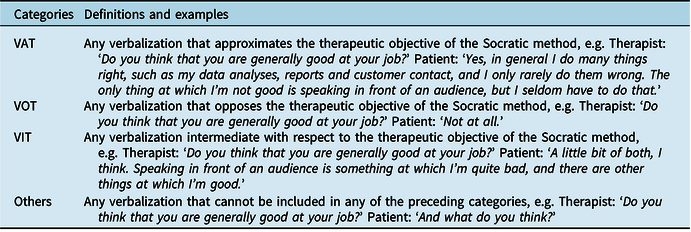
Patient utterances were coded following the Patient System of Categories developed in Calero-Elvira et al. (Reference Calero-Elvira, Froján-Parga, Ruiz-Sancho and Alpañés-Freitag2013). Table 1 shows definitions and examples for these categories (Calero-Elvira et al., Reference Calero-Elvira, Froján-Parga, Ruiz-Sancho and Alpañés-Freitag2013, p. 628).
Patient system of categories

These examples come from a case in which the therapist has previously made sure that the patient is, most of the time, good at his job, and has had it corroborated by his boss via report. This patient starts with utterances that go along the lines of ‘I’m not good at my job’, ‘I don’t do anything right in my job’. It is worth mentioning that the Socratic method exemplified here resembles more closely Ellis’s more persuasive style than the didactic approach of Beck. Reprinted from Calero-Elvira, A., Froján-Parga, M. X., Ruiz-Sancho, E. M., & Alpañés-Freitag, M. (2013). Descriptive study of the Socratic method: evidence for verbal shaping. Behavior Therapy, 44, 625–638. https://doi.org/ 10.1016/j.beth.2013.08.001
Finally, each debate fragment was categorized according to the Verbal Effectiveness Scale developed in Calero-Elvira et al. (Reference Calero-Elvira, Froján-Parga, Ruiz-Sancho and Alpañés-Freitag2013) (p. 629). A debate episode was classified as Total success on occasions when the client expressed a verbalization that approached the debate goal at least once in an emphatic way (e.g., ‘yes, definitely’), without later contradiction. The debate was classified as Partial success on occasions when the patient expressed a verbalization that approximated to the debate goal but did it without emphasis or was later contradicted. Debate Failure was classified when none of the patient’s verbalizations approximated the therapeutic debates objective, or a patient’s verbalization approximated the therapeutic objective without emphasis and was later contradicted by another verbalizations (e.g. ‘no, I do not think so’).
All session fragments were observed and coded through The Observer XT 12.5 software (Noldus). This software was also used for the calculation of percentage of agreement and inter- and intra-rater reliability index. The Generalized Sequential Querier 5.1 (GSEQ) (Bakeman and Quera, Reference Bakeman and Quera1995) was used for sequential analysis of recorded data and SPSS Statistics 22 (IBM) for other statistical analysis of the data.
Procedure
Development of the Therapist System of Categories
This study was based on previous work with the same methodology and subject: verbal interaction analysis during the Socratic method in cognitive restructuring; and more precisely on its categorization system (Calero-Elvira et al., Reference Calero-Elvira, Froján-Parga, Ruiz-Sancho and Vargas-de la Cruz2011; Calero-Elvira et al., Reference Calero-Elvira, Froján-Parga, Ruiz-Sancho and Alpañés-Freitag2013; Froján-Parga et al., Reference Froján-Parga, Calero-Elvira and Montaño-Fidalgo2011). The present study delves into some of the categories not previously explored in order to test new hypotheses. Observations and transcripts of debate fragments were initially made by three different observers: Observer 1, an expert psychologist in behaviour therapy and in verbal behaviour analysis in therapy with clinical experience; and Observers 2 and 3, graduates in psychology with clinical training. Meetings were held periodically with a fourth expert psychologist in behaviour therapy, verbal behaviour analysis in therapy and cognitive restructuring. The definitions of the categories were discussed until a preliminary categorization system was created. At that point, Observer 2 began to categorize the debate fragments that Observer 1 had registered and the percentages of agreement and the Cohen’s kappa coefficient of the fragments were calculated. The final version was achieved once the appropriate agreement levels and kappa coefficient were reached (Cohen’s κ, 0.53 to 0.92).
Training in and reliability of the Patient System of Categories and effectiveness of the Socratic method
To analyse patient’s behaviour and the effectiveness of the Socratic questioning fragments, it was not necessary to elaborate new systems of categories, as existing categorization systems were used. Instead, Observers 1 and 2 were trained in the following systems: the Patient System of Categories and the Verbal Effectiveness Scale (Calero-Elvira et al., Reference Calero-Elvira, Froján-Parga, Ruiz-Sancho and Alpañés-Freitag2013). They were trained in the use of these categorization systems until they achieved at least 10 consecutive sessions for the Patient System of Categories with a Cohen’s kappa coefficient of at least 0.60. According to Bakeman (Reference Bakeman, Reis and Judd2000) and Landis and Koch (1977), this is the minimum value to consider an agreement as good. As for the Verbal Effectiveness Scale, a concordance coefficient that was not less than 0.80 in at least six consecutive records was needed. This value was taken as criteria as the interclass coefficient correlation (ICC) values can range between 0 and 1 and those that exceed 0.80 are considered optimal (Quera, Reference Quera, Peláez and Veá1997).
Sample registration
The sample was registered once adequate levels of reliability were guaranteed for all categorization systems. Observers 1 and 2 were responsible for recording the total sample of this study and it should be noted that only Observer 2 was blind to the study’s hypotheses. Reliability analysis was submitted to more than 10% of the total study sample and records were kept as long as the level of reliability achieved was at least 0.60 (Cohen’s κ, 0.61 to 0.90). The effectiveness of the debate fragments was recorded using the Verbal Effectiveness Scale submitting the reliability analysis to more than 10% of the total study sample. The ICC was 0.947 (F =18.78, p = <0.001) for intra-rater comparisons and for inter-rater comparisons the value was 1.00 (as the determinant of the covariance matrix is 0, the statistics program SPSS does not calculate the value of the F-test or the critical value of the statistic p).
Results
Global exploratory analysis
Therapists’ most frequently used verbalizations throughout the Socratic method were explaining (mean = 57.17, SD = 49.46), questioning (mean = 36.00, SD = 60.49) and exploring (mean = 13.50, SD = 13.26). These were followed by providing target verbalization (mean = 4.94, SD = 49.46) and using analogies (mean = 4.33, SD = 5.90). In contrast, motivating (mean = 3.56, SD = 3.50) and training in reasoning rules (mean = 1.50, SD = 1.92) were the less used utterances. In terms of effectiveness of the Socratic fragments, 62.83% were total success, 24.78% partial success and 12.39% failure.
Regarding client’s verbal behaviour, dividing the debate into three parts allowed us to appreciate the evolution of client’s responses in relation to the objectives of the debate: patient’s responses approximating the therapeutic objective (VAT) increased throughout the debate (first part = 44.49%; second part = 53.14%; third part = 64.58%). In contrast, client responses opposing the therapeutic objective (VOT) decreased towards the end (first part = 24.78%; second part = 19.89%; third part = 10.12%). Similarly, client responses intermediate with respect to the therapeutic objective (VIT) decreased, but at a lower rate (first part = 30.73%; second part = 26.7%; third part = 25.30%).
Regarding the different ways of questioning (Hypothesis 1)
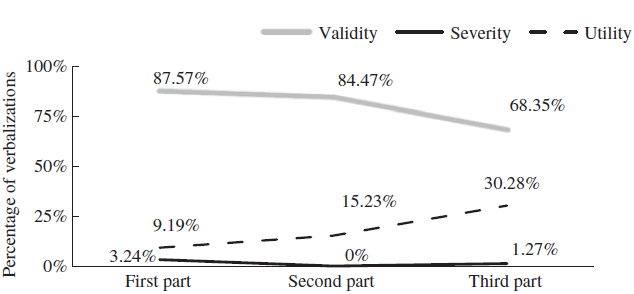
In relation to Hypothesis 1(a), questioning validity was the most used strategy in contrast to questioning severity or utility (as shown in Fig. 1). Results also showed how the questioning changes throughout the debate: questioning validity decreased, and questioning severity and utility increased towards the end. According to the Friedman test, results were statistically significant for verbalizations aimed at questioning validity (χ2 = 209.41, p = 0.000), but not for those aimed at questioning utility (χ2 = 0.347, p = 0.841) or severity (χ2 = 1.727 p = 0.422). In order to identify where the differences were, a Wilcoxon test was conducted. We found that the differences in questioning validity were between the first and third part of the Socratic method (z = −3.743, p = 0.00) and between the second and the third part (z = 2.645, p = 0.008). There were no differences between the first and the second part (z = −1.92, p = 0.55).
Types of questioning throughout the debate. On the vertical axis, the percentage that corresponds to each questioning category that the therapist uses is shown. On the horizontal axis, the use of these verbalizations throughout the debate is described.

Regarding Hypothesis 1(b), a nominal variable (order) was created. Debates in which questioning validity appeared in the first or second part (but not in the third part), and questioning severity and utility appeared in the second or third part (but not in the first part), were classified as following an order. No relationship was found between following an order in the sequencing of questions and the success of the debates (χ2 = 1.78, p = 0.411).
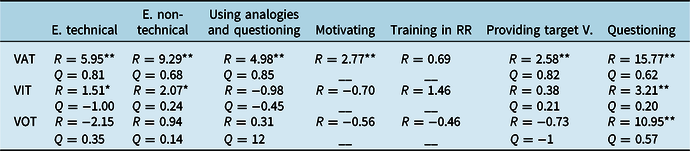
In relation to Hypothesis 1(c), results showed that using analogies, explaining in a technical manner and motivating before questioning were followed by VAT and not VIT or VOT. Explaining in a technical manner prior to questioning discriminated VAT and not VIT with a higher probability than expected by chance. In contrast, explaining in a non-technical manner before questioning discriminated both VAT and VIT. When strategies aimed at questioning were not preceded by any of these categories, the patient’s response could be followed by VAT, VOT or VIT. Table 2 shows the statistics of these results.
Verbalizations that precede questioning and that discriminate the patient’s response

Q = Yule’s Q; R = adjusted standardized residuals (significant: <–1.96; >1.96); E., explaining; RR, reasoning rules; V., verbalization. Yule’s Q could not be calculated for some series (—) due to lack of enough sequences. However, there are two indicators: adjusted residuals and p-value, which allow this result to be assessed. *p < 0.05, **p < 0.01.
Regarding the use of the aversive component by the therapist (Hypothesis 2)
In relation to Hypothesis 2(a), there were no statistically significant differences between the frequency of use of the aversive component and the success of the debate (Kruskal–Wallis; χ2 = 3.806, p = 0.15).
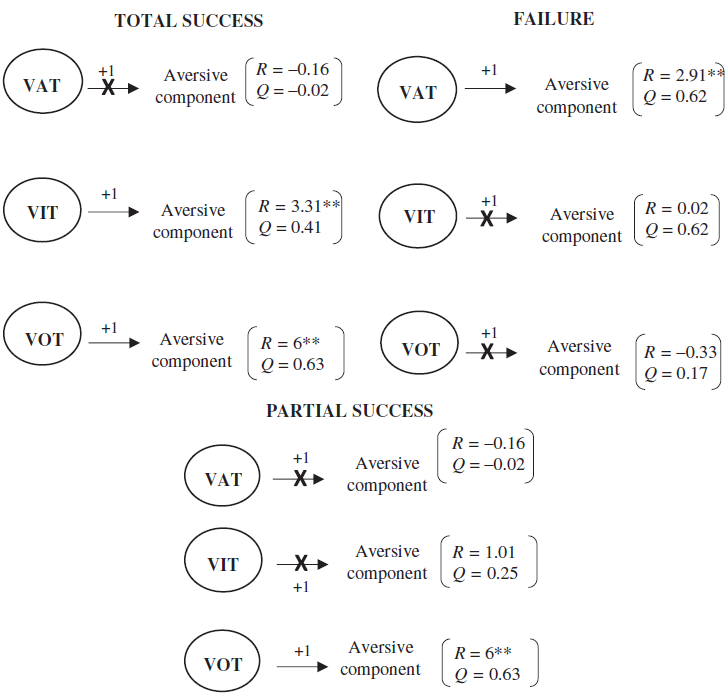
Regarding Hypothesis 2(b), results showed that in total success fragments, therapists tended to use the aversive component after patients’ VIT and VOT, and not after VAT (as shown in Fig. 2). In contrast, this pattern was inverted for failure fragments. In partial success fragments, therapists used the aversive component only after patient’s VOT.
Transition diagrams interaction of aversive component. Q = Yule’s Q; R = adjusted standardized residuals (significant: <–1.96, >1.96). **p< 0.01.

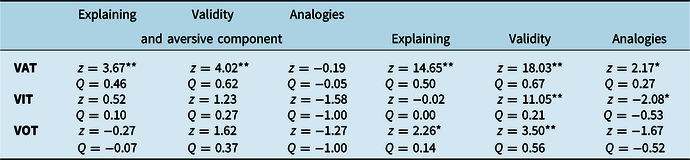
In relation to Hypothesis 2(c), the use of the aversive component was found with a higher probability than expected by chance linked to using analogies (R = 10.72, Q = 0.85, p = 0.01), explaining (R = 6.65, Q = 0.57, p = 0.01) and questioning validity (R = 4.47, Q = 0.46, p = 0.01). Among them, both questioning validity and explaining discriminated patient’s VAT and not VOT or VIT (as shown in Table 3). This was not the case when these categories were given without the aversive component. Questioning validity without the aversive component discriminated any patient’s verbalization (VAT, VOT or VIT) and explaining without this component discriminated both VAT and VOT. Finally, contrary to what it was expected, using analogies without the aversive component did discriminate VAT and not VIT or VOT. In contrast, this pattern was not found when using analogies was accompanied by the aversive component.
Therapist’s verbalizations accompanied by the aversive component

Q = Yule’s Q; z = adjusted standardized residuals (significant: <–1.96; >1.96). *p< 0.05, **p< 0.01.
Regarding the different ways of explaining (Hypothesis 3)
Sequential analysis of the verbal interaction between therapist explanations and patient responses showed that when therapist explanations were technical (explaining in a technical manner), client next responses were VAT (R = 10.13, Q = 0.54, p = 0.01) and not VOT (R = −1.62, Q = −0.20, p = 0.11) or VIT (R = 0.87, Q = −0.10, p = 0.30). In contrast, when therapist explanations were non-technical (explaining in a non-technical manner), client responses were both VAT (R = 10.28, Q = 0.40, p = 0.01) and VOT (R = 3.57, Q = 0.22, p = 0.01), but not VIT (R = 0.87, Q = 0.05, p = 0.38).
Regarding training in reasoning rules (Hypothesis 4)
In total success Socratic fragments, therapists trained in reasoning rules before motivating (delay of −1) had a higher probability than expected by chance (z = 5.68; Q = 0.88; p < 0.01), considering that adjusted standardized residuals were significant = <–1.96; >1.96. This pattern was not found in partial success fragments (= 1.52; Q = 0.63) or failure fragments (z = −0.07). However, these verbalizations did not discriminate VAT (R = 1.35, p = 0.18), VOT (R = −0.47, p = 0.64) or VIT (R = −0.64, p = 0.52). Yule’s Q statistic could not be calculated due to the lack of three-term sequences: training in reasoning rules followed by motivating and followed by client verbalizations.
Discussion
Findings from this study provide a detailed view of how therapists’ and clients’ verbal behaviour works during the Socratic method, and the most effective way to establish it when it is conducted in an argumentative style. We found: (1) a certain pattern in the sequencing of questions when questioning throughout the debate; (2) that the use of explanations, analogies and motivational verbalizations prior to questioning directs a client’s response more effectively; (3) using the aversive component when questioning and explaining discriminates patient responses approximating the therapeutic objective (VAT); (4) using technical versus non-technical explanations also discriminate patient VAT; and (5) successful Socratic fragments are characterized by linking the training in reasoning rules with motivating verbalizations and by using the aversive component contingently on client responses. Results are discussed below point by point.
Explaining and questioning are the main types of therapist verbalizations in the Socratic method. In particular, the way of questioning changes throughout the debate: questions that challenge evidence and logic (questioning validity) are most often asked at the beginning and in the middle of the Socratic method, showing statistically significant differences between the first and third part. In addition, questions that challenge utility (questioning utility) increase during the second part and even more in the third part of the debate, although these differences were not statistically significant. These results allow us to partially confirm Hypothesis 1(a) and are in line with the data found in the survey study of Pardo-Cebrián and Calero-Elvira (Reference Pardo-Cebrián and Calero-Elvira2017): 92.3% of the clinicians reported that they used these types of questions (questioning validity, severity and utility) in the debate and almost half of them began by questioning validity, and then continued by questioning severity and utility. Although this seemed to be a characteristic pattern, there is no relationship between following this order when questioning and the effectiveness of the Socratic method, which leads us to confirm Hypothesis 1(b). This shows that some authors have pointed out the relevance of question sequencing in the Socratic method without supporting evidence (e.g. James and Morse, Reference James and Morse2007). Even Beck suggests following a careful order in the sequencing of questions (Beck et al., Reference Beck, Rush, Shaw and Emery1979). The present study shows for the first time with empirical data that: (1) this pattern of question sequencing occurs in the application of the debate, but (2) such sequencing is not related to the Socratic method success. As we predicted, following an order does not have to imply a better functioning for this technique, although the use of questions that challenge the validity and consequences may be relevant.
By far the most used questions are those aimed at questioning the validity of client utterances. The Socratic method could be understood as problem-solving training, in which therapists help clients to reason effectively. This problem-solving training has an elementary content related to logic in argumentation, probably because our verbal community teaches us to think and debate in this way (Pérez Fernández et al., Reference Pérez Fernández, Gutiérrez Domínguez, García García and Gómez Bujedo2010). Therefore, it is elementary to use questions aimed at challenging validity, as this is the way we have learned to solve problems.
As the Socratic method evolves, questions about validity decrease and those aimed at questioning the utility of client utterances are more often used. Probably, therapists employ utility and severity questions after client verbalizations that have not been completely modified, or to emphasize and strengthen those who have. Therapists would do this through establishing or abolishing operations: discriminating clients’ descriptions about the consequences of maintaining or changing those responses (e.g. ‘How does thinking like that help you?’, ‘What would be the consequences of stopping thinking like this?’).
Regarding the strategies that precede questioning, we found that debate questions preceded by other verbalizations such as using analogies, explaining in a technical manner and motivating discriminate VAT and not VIT or VOT, as opposed to when questioning is used without such verbalizations. This result is in line with previous findings which showed that when therapists’ questions were accompanied by an informative or motivating verbalization, clients were more likely to respond VAT compared with cases in which they were not preceded by them (Calero-Elvira et al., Reference Calero-Elvira, Froján-Parga, Ruiz-Sancho and Alpañés-Freitag2013). Therefore, Hypothesis 1(c) is partially supported, as the expected result only occurred when they were technical explanations and not when they were non-technical. So, verbalizations that precede questioning in the Socratic method include elements that perform certain functions. These verbalizations (using analogies, explaining in a technical manner and motivating) probably have elements in common with each other: they describe appetitive or aversive contingencies, present desirable alternative verbalizations, etc. What may be fulfilling various antecedent control functions to make it more likely that the desired response will be given: establishment and abolition operations, and stimulus control.
One key element in the Socratic method is the way (or style) in which the client’s verbalizations are questioned or directed, where the use of the aversive component has a key role. Authors like Ellis (Ellis and Grieger, Reference Ellis and Grieger1977) propose a very active verbal style of confrontation in which they often used irony. Instead, other experts in this field, such as Beck or Padesky, consider confrontation as something negative that will generate unpleasant emotional reactions in clients (Kazantzis et al., Reference Kazantzis, Fairburn, Padesky, Reinecke and Teesson2014). So far, there is little evidence of the effect of the style in changing clients’ verbalizations, besides the above-mentioned studies on verbal shaping (Calero-Elvira et al., Reference Calero-Elvira, Froján-Parga, Ruiz-Sancho and Alpañés-Freitag2013). These results show that there are no differences in the success of the debate according to the frequency of use of the aversive component, which leads us to reject Hypothesis 2(a). However, by analysing the interaction there are differences in the use of the aversive component according to the success of the Socratic questioning. In total success fragments, the aversive component is used contingently on patient’s VOT and VIT, which leads us to support Hypothesis 2(b). This result is consistent with the findings of the research that preceded this study (Calero-Elvira et al., Reference Calero-Elvira, Froján-Parga, Ruiz-Sancho and Alpañés-Freitag2013). In that study, differences in the effectiveness of the debate were found in therapists’ utterances before patients’ VIT: in total success fragments therapists reinforced and punished these intermediate verbalizations, in partial success fragments therapists only reinforced them and in failure fragments they neither reinforced nor punished them. Furthermore, the present study provides an additional result: in failure fragments, therapists not only do not use the aversive component contingently on patients’ VOT or VIT, but they use it contingently on patients’ VAT. This evidence supports that the use of the aversive component in the Socratic method, in the context of this therapists’ sample and following an argumentative debate style, could be a fundamental element for its success.
Additionally, the aim of the present study was to contrast how the aversive component is used in the Socratic method with other therapist’ verbalizations, following some lines of study about the aversive control in therapy (Pereira et al., Reference Pereira, Hernández, de Pascual-Verdú and Froxán-Parga2019). In that work it was suggested that therapists use aversive associations to condition stimuli that take place in other context and temporal moments, as the processes involved in aversive control include both classical and operant conditioning principles. We found that some therapist’s utterances, such as explaining and questioning validity, when used together with an aversive component, discriminate only patient VAT and when used without such component discriminate responses of any kind (VAT, VOT or VIT). This partially confirms Hypothesis 2(b), as using analogies with the aversive component does not discriminate patient VAT but used without this component it indeed discriminates VAT or VIT.
Regarding the different ways of explaining, we found that explaining in a technical manner, in which clients are informed about functional aspects of the behaviour, seems to better direct patients’ responses (VAT), unlike when explaining in a non-technical manner. This result allows us to confirm Hypothesis 3. A fundamental objective in the debate is to ensure that clients know how to attribute causes of what is happening in a rational way. In many cases, the change to a more rational verbalization goes through understanding and explaining the functioning of the behaviour and this necessarily involves technical explanations given by the therapist. The goal of changing irrational verbalizations to more rational ones is an adjustment in the function they perform. In many cases, when clients emit irrational verbalizations, these work as an escape response from the emotional distress caused by the uncertainty of not understanding why something is happening or by avoiding issuing an aversive verbal description. When we manage that the clients issue a verbal description of the contingencies that control their behaviour based on functional analysis, it is possible that the control that the verbal contingencies exerted on their behaviour weakens because, from that moment on, each time they perform the dysfunctional behaviour, they will be exposed to the contingency of punishment or aversive stimulation that is being incongruent (Carrasco and Pardo, Reference Carrasco and Pardo2018).
Finally, in total success Socratic questioning fragments, training in reasoning rules tended to appear together with motivating verbalizations that pointed out the consequences that such verbal behaviour will have. These results are consistent with findings from other studies in which it was found that following instructions was more likely when instructions and establishment operations were given together (De Pascual Verdú and Trujillo Sánchez, Reference De Pascual Verdú and Trujillo Sánchez2018; Marchena-Giráldez et al., Reference Marchena-Giráldez, Calero-Elvira and Galván-Domínguez2013). On the other hand, in the present study it was not found that such sequencing discriminates patients’ VAT, or any other type. This is probably due to the limited sample size: the frequency of training in reasoning rules or motivating is lower than the frequency of questioning or explaining in the Socratic method. This partially confirms Hypothesis 4. So, describing the consequences of thinking rationally is an effective verbalization pattern to achieve a change in clients’ utterances. In addition, in our social context, being coherent and rational is usually appetitively associated.
The present study has certain limitations and it is important to note that this is not an experimental or controlled study, so the conclusions are based on correlational results. First, the study sample did not allow the analysis of some interaction sequences that occurred with little frequency. Another important limitation relates to the lack of control over patient compliance responses. Sometimes, clients may respond favourably in Socratic method just because an authority figure is disputing, so it would have been appropriate to assess the social desirability of clients. In addition, it would have been appropriate to verify whether changes in clients’ verbalizations also imply clients’ changes out of session. For future studies it would be desirable to extend the sample and include a greater variability of cases with clinical problems in order to generalize the conclusions of the results. It would also be interesting to analyse other debate styles, such as guided discovery, in order to know which principles are followed and the differential effectiveness of each style. On the other hand, the categories of our coding system cannot be considered functional.
Given the results of this work, the next steps that could follow this research are as follows. On the one hand, in addition to incorporating the above-mentioned improvements, the study of expert and inexperienced therapists could yield interesting data on the mastery of verbalizations and procedures used in this technique. On the other hand, it could be very interesting to incorporate more precise theoretical approaches on the role of language and the learning principles involved in analogies, theoretical explanations, or reasoning rules. More and more techniques addressing thoughts are being developed, but the clinical advance could be in finding the common learning principles underlying these treatment methods.
Despite these limitations, this study entails a contribution to the creation of guidelines for clinicians on how to apply one of the most used, but less guided psychological intervention techniques, based on empirical evidence and theoretical analysis.
Supplementary material
To view supplementary material for this article, please visit: https://doi.org/10.1017/S1352465820000880
Acknowledgements
The authors would like to thank the team of the Therapeutic Institute of Madrid (ITEMA) and the ACOVEO research group of Autonomous University of Madrid for all the facilities that made this study possible.
Financial support
This research received no specific grant from any funding agency, commercial or not-for-profit sectors.
Conflicts of interest
None.
Ethics statements
Before recording the sessions, written informed consent was obtained from all participants for their collaboration in this study. The study fully complied with the ethical requirements of the Universidad Autónoma de Madrid (Spain) Ethics Committee, approval number CEI 74-1340. The therapists and observers have abided by the Ethical Principles of Psychologists and Code of Conduct.




Comments
No Comments have been published for this article.