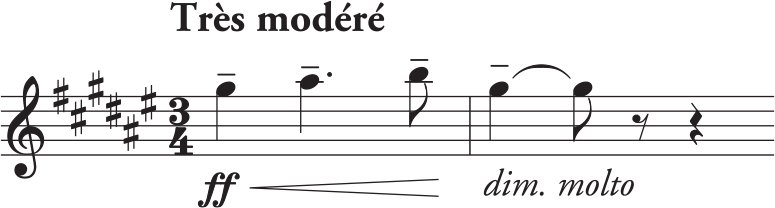
Musicians alone have the privilege of conveying all the poetry of the night and of the day, of the earth and of the sky, of recreating their atmosphere and of giving rhythm to their boundless quivering.Footnote 1
Introduction
The extent to which orchestration informs the musical substance of Debussy's Jeux is my principal concern here, and therefore necessarily at stake are aspects of the ontology of works in general. More specifically, the key issue is the degree to which a work's identity may be affirmed irrespective of ‘its’ instrumental medium. Taking, by way of example, Peter Kivy's adherence to what he calls ‘musical Platonism’ (by which he presumably means the presence of works as ‘Forms’ in sensible musical objects), it may be claimed that: ‘The era of instrumental music goes from the last quarter of the sixteenth century to 1986 and at least half the era is clearly dominated by a completely ad libitum, nonessentialist attitude toward what instruments any given piece of music is to be realized on.’Footnote 2 The instrumentation, on this basis, of ‘any given piece of music’ is a matter of instantiation and is accordingly not intrinsic – the piece, whose status as such is therefore assured in advance, is realized on the instruments.
Debussy's contemporary Ravel seems to have had a similar feeling when he defined orchestration thus: ‘When you take the music you or someone else has written and […] you give a feeling of the two pedals at the piano: that means that you are building an atmosphere of sound around the music, around the written notes – that's orchestration.’Footnote 3 At the very least, in Ravel's view, the music, written in advance, is considered to exist independently of the ‘atmosphere of sound’ of which the orchestration consists (‘around the written notes’). And in no less august a publication than the 1906 edition of Grove's Dictionary of Music and Musicians, Frederick Corder bemoaned (referring to Liszt and Strauss) that
An attempt is now being made to produce still greater emotional effects by a style of orchestral writing which defies analysis, and in which the music per se has but a weak structure and material of the utmost degree of tenuity […]. There are very few of the musical works we now allude to which will bear the simple but infallible test of being played upon the piano.Footnote 4
Evidently, then, the music ‘per se’ is to be distinguished from ‘its’ orchestration.
That a relative insignificance has often been accorded to timbre need not be disputed, though the complex of controversies through the nineteenth century as to orchestration's status should not be overlooked. Indeed, Emily Dolan draws attention to the ‘birth of the idea of tone-color’ whereby music was no longer dependent ‘on a vacuous, fleeting medium, but it was rather created through the manipulation of a complex substance’. She then avers nevertheless that ‘criticisms of orchestration […] gave rise to the notion that other aspects of music [e.g. pitch, harmony, etc.] were lasting and permanent [and] constituted the essence of the composition […]. Orchestration and timbre became secondary parameters.’Footnote 5 I will remain strategically evasive, however, as to the nature of musical substance to begin with, since what will ultimately prove to be at stake is the purported unity of Jeux's compositional and orchestrational ‘processes’.Footnote 6 A conventional definition drawn from Aristotle's categories may nonetheless be taken as an initial premiss, whereby a (primary) substanceFootnote 7 is understood as something individual and independent, and not thus an attribute (of a substance), but may yet have contrary propertiesFootnote 8 (which in this context means may be orchestrated differently). Difficulties certainly arise as regards the relationship between form and matter,Footnote 9 but a working presumption of substance as being ‘this particular’ rather than the matter of which it is composed may tentatively be borne in mind. With this in view, my analysis will more or less faithfully follow Jeux's own structure in pursuit ultimately of a somewhat elusive Hegelian substance. I will on this basis critically examine the relationship between composition and orchestration, comparing the piano score with the orchestral version and uncovering different varieties of timbral/textural significance. It is to Hegelian substance that I will nonetheless return, and on the basis of which I will seek to distinguish between unification and synthesis. I thereby argue that Jeux's immediacy is overcome through negating (orchestrational) activity, arriving this way at the objectively real (realized and posited) product.
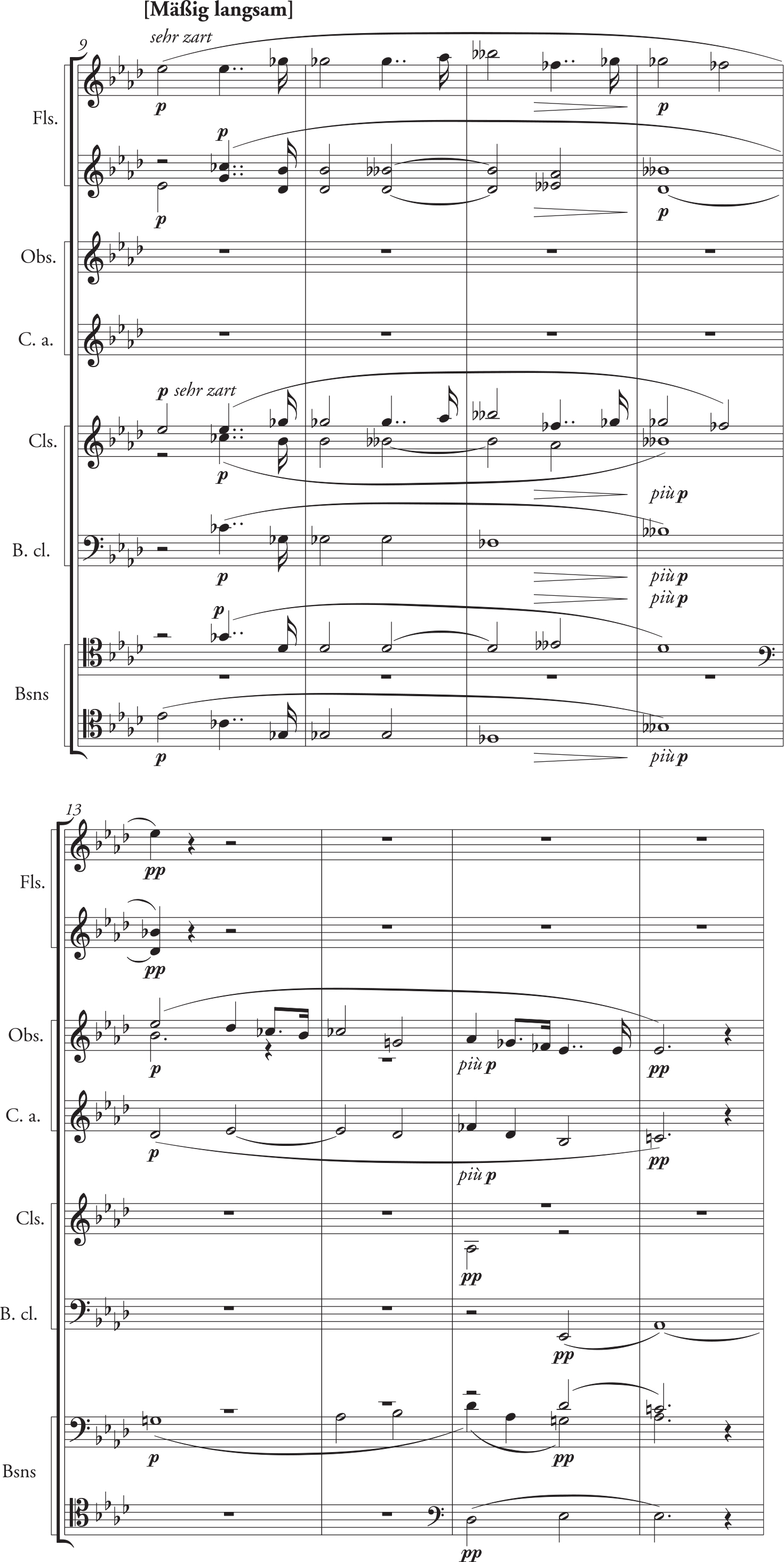
Given this orientation, it would be as well to distinguish in advance the nature of these relations from familiar Hegelian readings deriving in particular from Adorno's work,Footnote 10 or at least to highlight the differing emphases of my own reading. Adorno draws attention both to immanent, intraformal dialectical processes (within the ‘force-field of form’, such as motivic connections, tonal relations, etc.) and to more historically expansive mediations between composers, or rather their productive acts of negation, and historically constituted and inherited musical materials (including formal schemata). Thus understood, ‘objective spirit’ embodies or presents itself as artworks that are their own end. Now, this ‘sedimenting’ of history, the charting of the Subject/Object dialectic across time, necessarily incorporates timbre, and although Adorno credits Berlioz with the discovery of ‘luminous orchestral effects as well as the values of the individual colours’,Footnote 11 it is for him Wagner who is responsible for creating the ‘art of orchestration in the precise sense, as the productive share of colour in the musical process “in such a way that colour itself becomes action”’.Footnote 12 The particular example Adorno cites from Lohengrin (see Example 1) by way of illustration is suggestive in a number of respects,Footnote 13 despite the somewhat awkward discussion of ‘residues’ and ‘timbral inflexion’. Among his observations are that timbre can function structurally (and, indeed, dramatically) as a feature of the composition, and that the hermeneutic implications of the passage's orchestration are significant. In the former case, the relationship between antecedent and consequent is effected through careful dovetailing; the latter, however, is at least in part a profoundly rhetorical concern that suggests that the passage's ‘meaning’ is inextricable from its orchestration. A dynamic relationship between tutti and solo is realized through orchestral doubling and individual instruments respectively. This is itself rhetorically important, but (crucially) the indistinguishable blending of flutes and clarinets in the tutti effect disguises the origin of the sound (in Marxian terms, the relations of its production) against the solitariness of the subsequent oboe/cor anglais sonority. Tellingly, Adorno remarks that if ‘the expression of this [tutti/solo] relationship had been entrusted solely to the dynamics of playing, it would have been lost as the result of the inevitable coarsening effect of the theatre on all music. It becomes effective as a result of the instrumentation itself.’Footnote 14 It is Adorno's contention, in fact, that Wagner represents both a significant advance in technical means and a simultaneous capitulation to ideology. The reification of Wagner's music dramas – the inauthentic presentation of the Subject/Object dialectic in society and its products through static and illusorily seamless relationships within his works – constitutes both regressive qualities and aspects of their ‘truth content’.
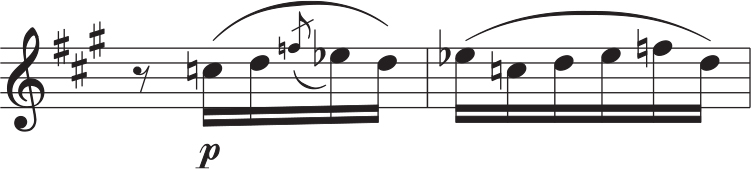
Wagner, Lohengrin, Act 1, scene ii, bars 9–16. © Schott Music Ltd. Reproduced by permission.

I will not explore Adorno's conception of timbre and its role more generally within artworks as ‘cognition without concepts’ further here. It is worth remarking, though, that my conclusions where Jeux is concerned are precariously closer to Hegel's Logic (which ontology can emerge only at the end of History, at least where the revelation of Being is concerned) than they are to the historical dialectic of revealed Being (that is, its human historicality as forms of consciousness) with which the Phenomenology predominantly occupies itself.Footnote 15 The general historical emphasis on Hegel's Phenomenology in preference to his Logic is perhaps best exemplified beyond Adorno himself (albeit to a qualified extent)Footnote 16 by Alexandre Kojève's extraordinary influence on French intellectual life through the twentieth century (in the work of Lacan, Bataille, Sartre and others).Footnote 17 Kojève's readings,Footnote 18 indeed, are very much consistent with Peter Hallward's claim that Hegel simply ‘annexed philosophy to the mediations of History and the State’.Footnote 19 Historically, at least, the materialist implications of the logics of social change through contradiction have been very much foregrounded over the totalizing Idealism into which the Logic all too readily lapses (where the logic of ‘scission’ is displaced by the circularity of becoming which, as the Absolute Idea, is always already Being).
Aspects of the Logic's rational ontology, though, can nonetheless be preserved, without aspiring to a Hegelian Absolute, against the successive ‘spirits of the age’ or ‘states of consciousness’ characteristic of the Phenomenology.Footnote 20 As Bruno Bosteels wryly notes,
The question, then, is not whether Hegel should be revived at all but which Hegel. Or else, but this question is no doubt related to the first: which of his shoes should we try to fit, the left one or the right one? The one from the Science of Logic or the one from the Phenomenology of Spirit? [… Perhaps] we should say that both of Hegel's shoes, like Van Gogh's ill-fated peasant boots, are left ones and that the painful task ahead of us is to put them on at the same time.Footnote 21
It is in this spirit, then, that I seek to assess Jeux with respect to its orchestration and its ontology since, as I will seek to demonstrate, aspects of the Logic prove remarkably insightful in this regard.
The substance of Jeux
That timbre might be part of Jeux's constitutive content, less accident than essence, is endorsed by Mark DeVoto who, following Jean Barraqué's thoughts on La mer, remarks that its ‘compositional and orchestrational processes are completely unified ’.Footnote 22 Strauss had argued that Berlioz was the first to have ‘consistently designed his works from the soul of the orchestral instruments’,Footnote 23 and it is perfectly conceivable that timbre might indeed influence the compositional process in many nineteenth-century works. It would be unwise, however, to overstate the formative role of timbre in the case of Debussy and Jeux. On this point, Debussy wrote:
I've finished Jeux […]. I'll have to find an orchestra without feet for this music. Don't think I mean an orchestra comprised exclusively of legless cripples! No! I'm thinking of that orchestral colour that seems to be illuminated from behind and of which there are such marvellous examples in Parsifal !Footnote 24
I will turn to the nature of this orchestration below, but the notion that something significant about the orchestral content had yet to be ‘found’ at this stage, despite Jeux apparently being finished, raises questions. Is it feasible that compositional and orchestrational processes can be completely unified if an indefinite proportion and the stylistic quality of the work's orchestration appear to have been conceived subsequent to the other parameters?
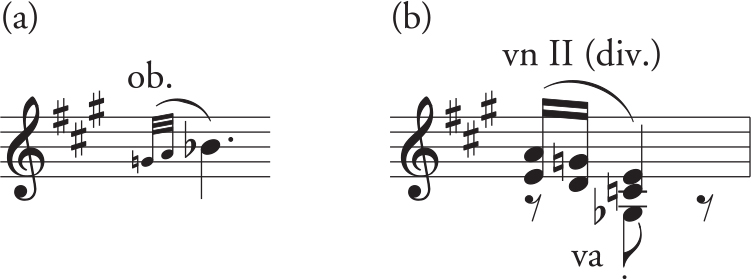
According to Robert Orledge's revised chronology, the earliest known draft of Jeux was made between 23 August and 2 September 1912. Here, ‘There are very few clues as to the instrumentation (and those that are there do not necessarily tally with the orchestral score),’ but importantly, the draft does reveal that ‘Jeux was clearly conceived in orchestral terms as a polyrhythmic score’. There are, though, ‘few dynamic indications, only one tempo marking (Più lento at bar 168), no sign of a constant quaver pulse, and (apart from the start) no indication that the percussion were to play an important role’.Footnote 25 That the piece in its initial form was conceived for orchestra, mostly on four staves, but with much of the instrumental detail to be determined (Orledge elsewhere refers to the ‘pre-orchestral stage’ of composition),Footnote 26 is neither in itself particularly distinctive nor suggestive of orchestrational and compositional unification. Indeed, in her study of Jeux's formative stages, Myriam Chimènes concludes that Debussy ‘viewed timbre as no more than a supplementary element, of decorative function, added at a later stage’Footnote 27 (what she also refers to as ‘orchestration-vêtement’).Footnote 28 She does nonetheless concede that the préparation orchestrale (an interim stage between the particelle and the full score) ‘should in fact be considered a second germ of the work [after the particelle], in the sense that it contains the major part of the creativity regarding timbre’.Footnote 29 DeVoto's claim is more immediately compelling as regards the work in its definitive state. In referring to Eimert's famous remarks concerning Jeux's organic inexactness of vegetation (‘the themes of Jeux are made up wholly of antecedents’),Footnote 30 he observes that there ‘are very few motives of obvious structural importance’.Footnote 31 Orledge counts 21 motifs which in their mosaic combinations ‘cover virtually every rhythmic permutation within a two-bar unit’,Footnote 32 while Jann Pasler, in her significant 1982 study, identifies four ideas of particular significance. She draws particular attention here to Barraqué's expression mutation poétique Footnote 33 to describe Debussy's ‘constant transformation of these tiny motives, the “thèmes-objets” which do not develop but recur, divide, and recombine in ever new ways’.Footnote 34 These thèmes-objets are presented in Examples 2a–b.Footnote 35 This fixation with the continual permutation of minimal material (‘a different motive for each section […] its quantitative aspects fixed – that is, its metric, melodic, and even harmonic shape’) generally precludes expansion into broad melodic outlines. Pasler argues that this repetition does not
serve to construct a melody or fill a formal scheme; instead it directs the listener's attention to the different instrumental and temporal contexts in which the motive appears. Because the motives in Jeux are short, usually two measures in length or built of two one-measure elements, Debussy uses them to shift interest from the level of melody to the movement of larger segments of the music.
She goes on to describe how
Debussy, Jeux (orchestral version): (a) from R1; (b) from R62. © Durand Salabert Eschig. Reproduced by permission.

each section of Jeux has its own unique quality, a characteristic motive, palette of instrumental color, and rhythmic signature. Repetition of one idea dominates each section, endowing it with its own distinct sense of time and giving rise to an expectation that it could continue indefinitely. Contrast and variety are secondary concerns within sections […] rhythmic and timbral contrast between sections [however] characterizes all of Jeux. Similarity or continuity with immediately surrounding sections is secondary to the surprise effect of metamorphosis.Footnote 36
Interestingly, she even suggests that the structural interrelation between these sections, seen from a suitably hypermensural perspective, constitutes a sort of arabesque in itself.Footnote 37
The structural significance of this boundless quivering and its rhythm cannot, of course, be divorced from the ballet scenario to which it corresponds,Footnote 38 though supposed cinematographic attributes may well be overstated. Indeed, Rebecca Leydon goes so far as to argue that the ‘enigmatic transitions [… and] disjunctive reiterations and duplications’ of Debussy's late style may be seen to be modelled on ‘cinematic editing techniques that are contemporaneous with this music’. And in particular, Jeux's ‘qualities of formal discontinuity and its disorienting over-abundance of motivic material’ correspond to ‘precisely the kinds of narrative modes that became possible and credible in the age of cinema’.Footnote 39 Be this as it may, at the very least (as Pasler suggests) the scenario of a tennis game seems to have allowed Debussy to experiment with time and form, the volleys of a tennis game coupled with the characters’ varying relationships inspiring a form in constant flux.Footnote 40
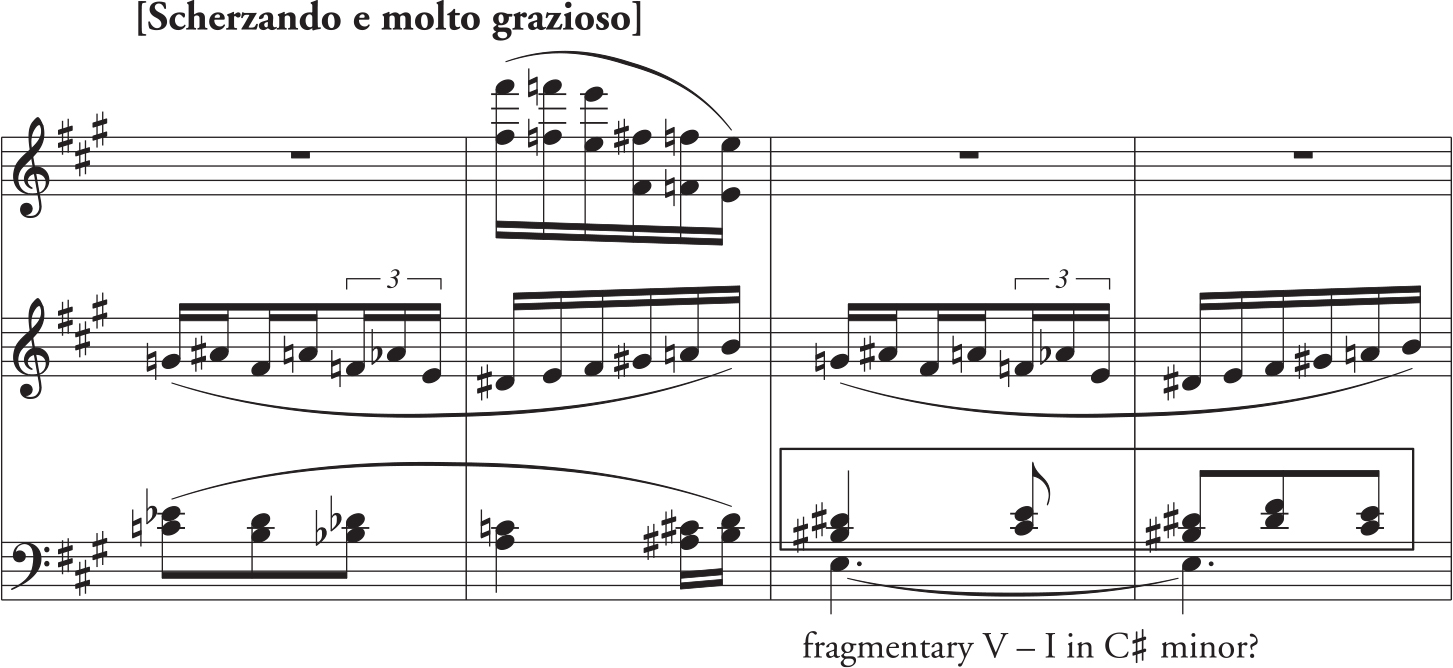
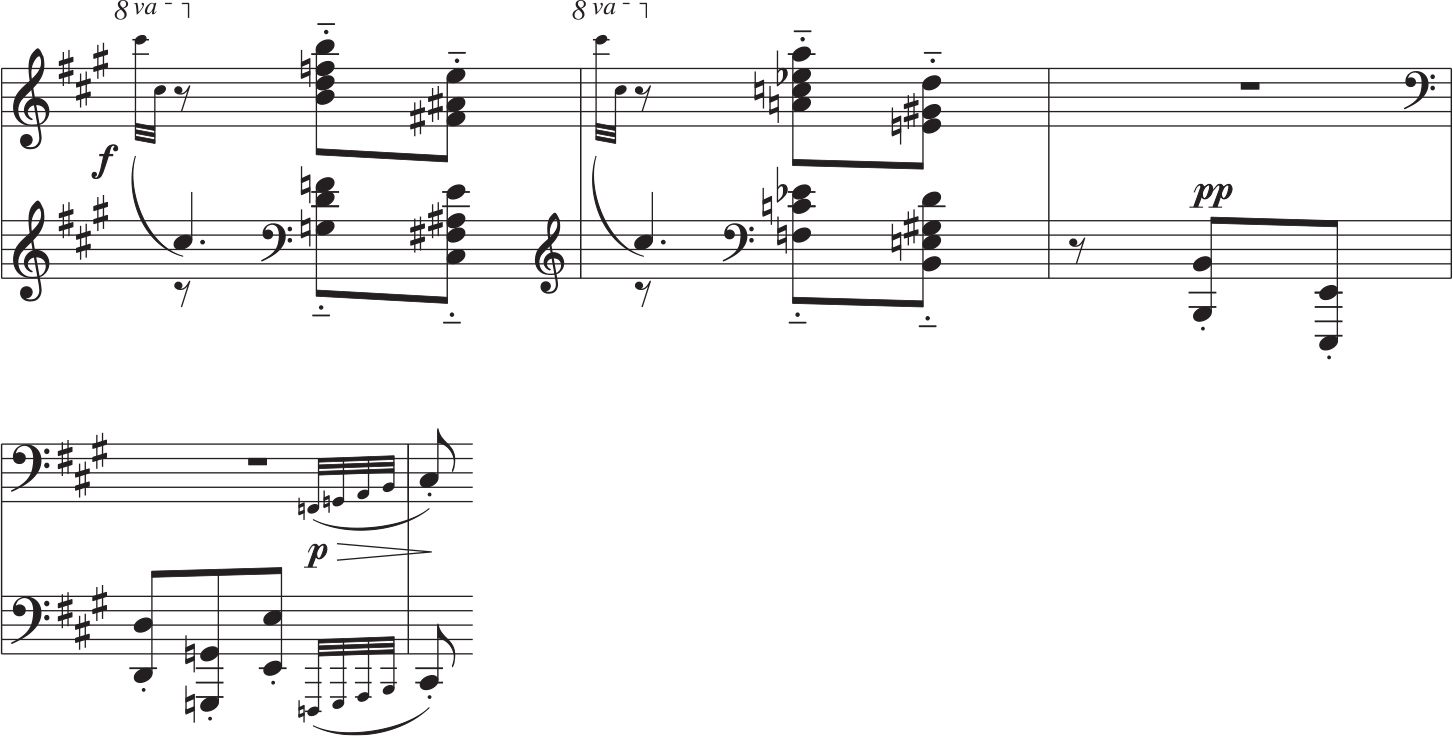
Within the score itself, a seemingly representative passage, at least in the context of the initial stages of the work (consisting of the stage-setting and the introduction of the characters/scenario – before R27), is to be found between R6 and R10. To judge from the piano version, which cannot of course be taken as wholly representative of the orchestral score but which is at least indicative, the material with which Debussy is working is certainly unprepossessing. At 3/1/3–4,Footnote 41 motifs c and d, identified in Example 2b above, are presented, their momentum being immediately interrupted by a falling octave. Subsequently, from 3/2/1, variants of motifs b and d (see Examples 2a–b) combine in various forms until ‘une balle de tennis tombe sur la scène’. It is evident, certainly, that the motivic content of this section is somewhat restricted and repetitious. The phrase structure, too, hardly fosters a sense of melodic fluency or continuity; two four-bar segments give way to three two-bar segments, which then pass over into seven one-bar segments. It may at least be noted, though, that this fragmentation allows for a sense of goal-orientatedness that thus articulates the phrase's culmination. But, harmonically, little by way of traditional formal articulation is apparent, further emphasizing this mosaic inertia. An initial orientation around a static C♯ (which Laurence Berman describes as more ‘important for [Jeux's] tonal organisation than the A’,Footnote 42 the work's ostensible tonic) leads to ambiguous thirds allied to disorientating chromaticism generally from 3/3/1. The thirds might conceivably be understood as outlining a fragmentary V chord in C♯ minor, which then resolves onto I (see Example 3). However, not only is the spelling in the right hand inconsistent with this analysis, but also the subsequent bass A (3/4/4) suggests the A major orientation of the key signature.
Debussy, Jeux (piano version), from 3/3/3.

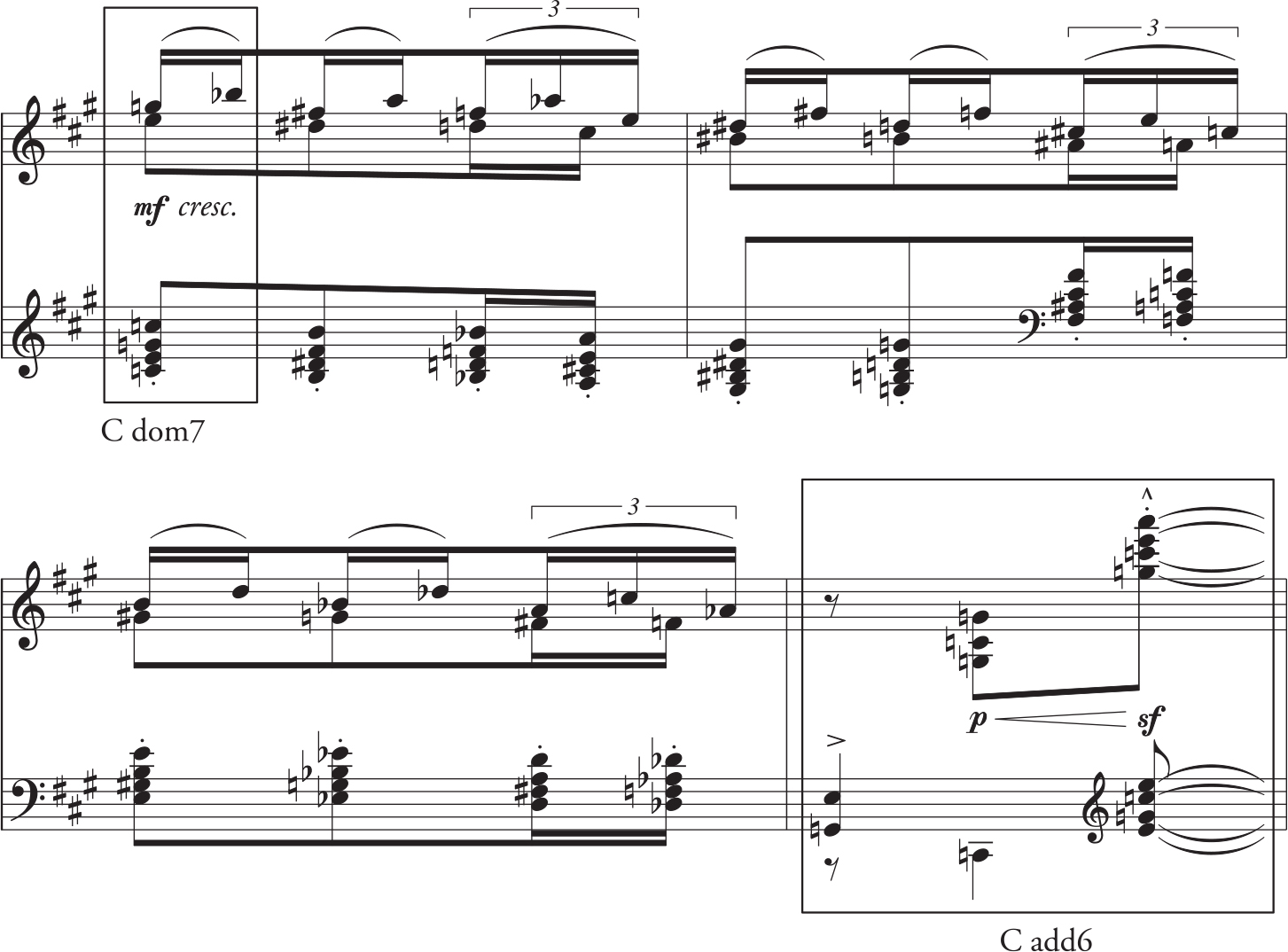
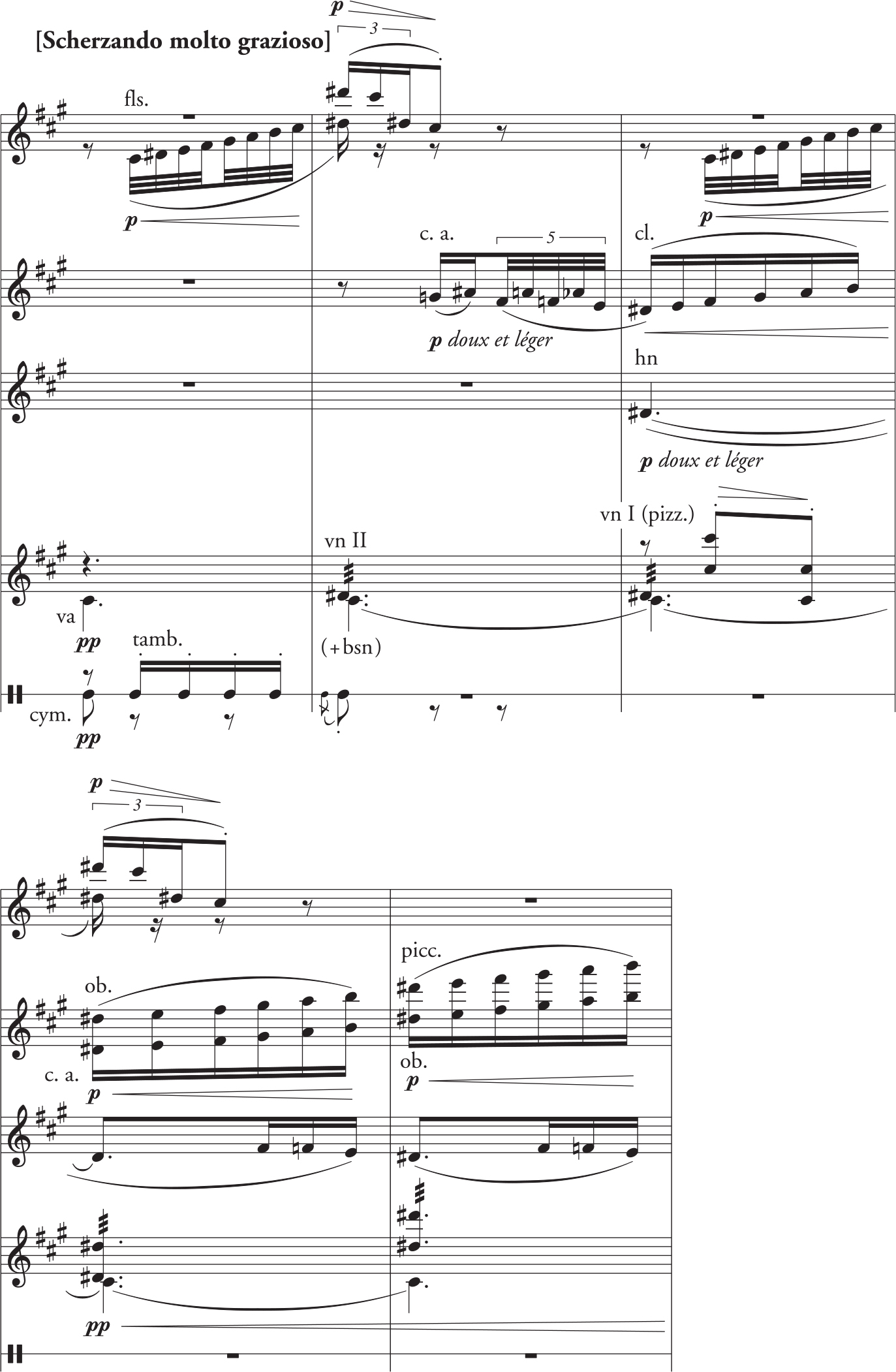
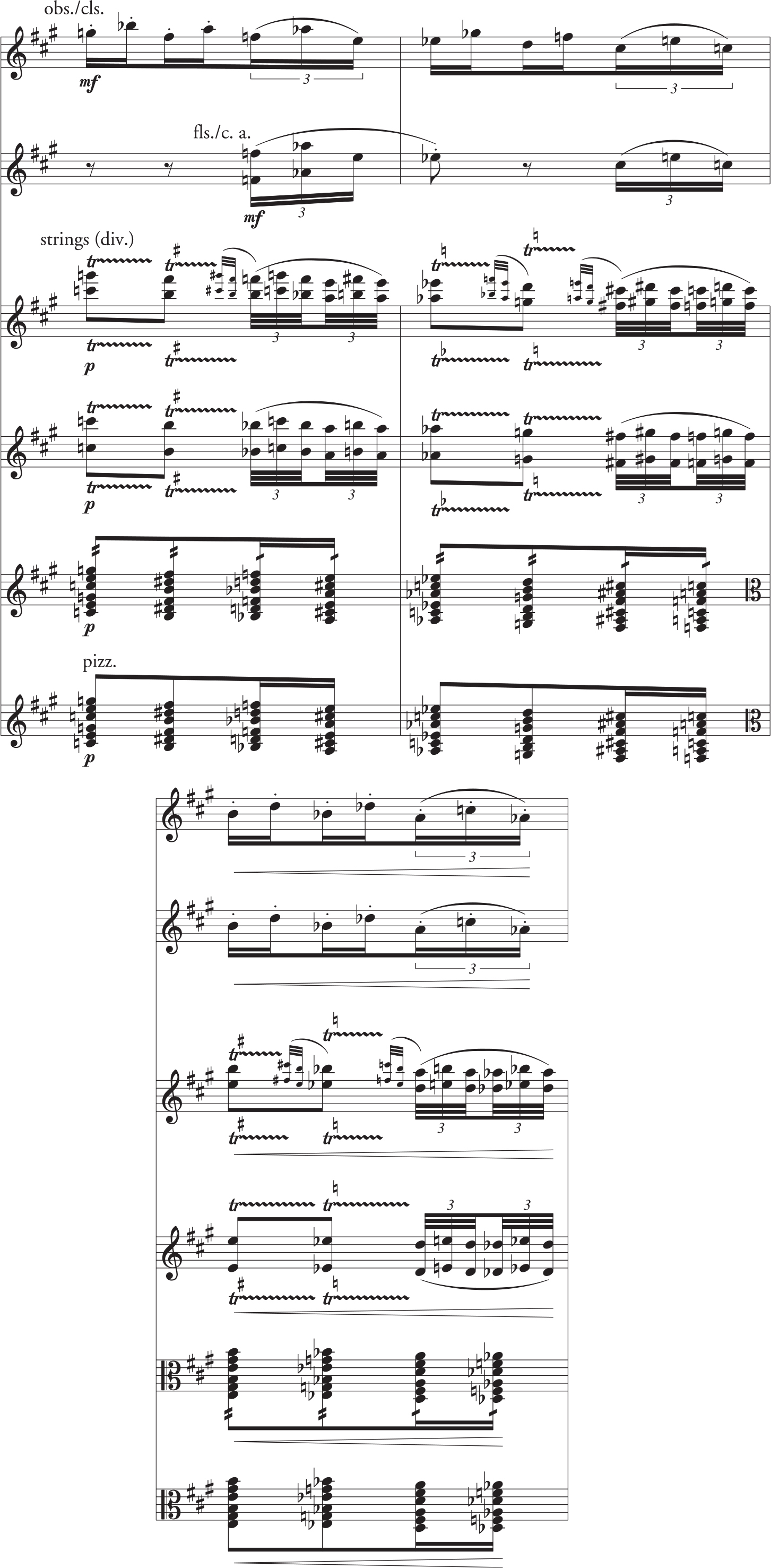
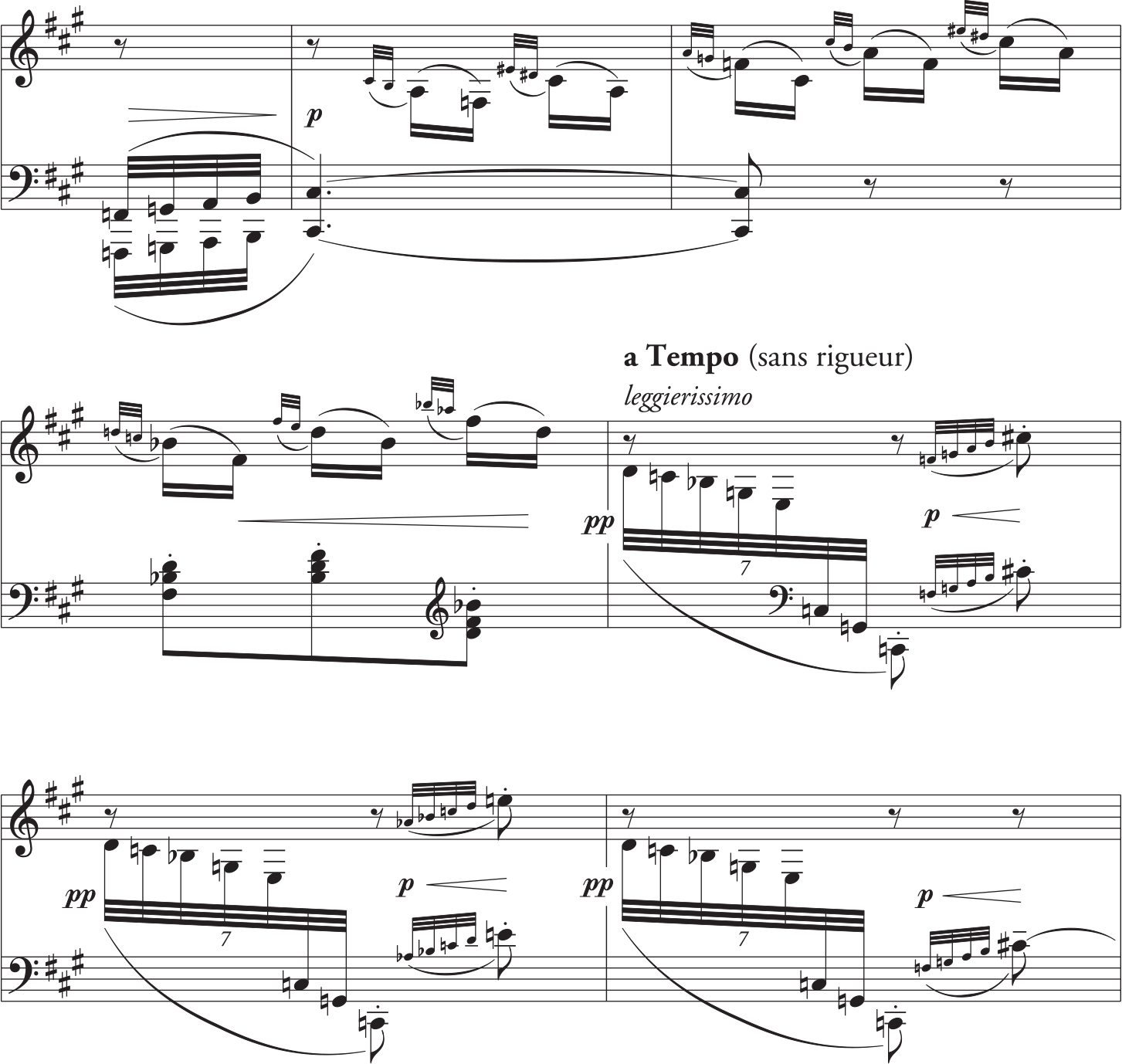
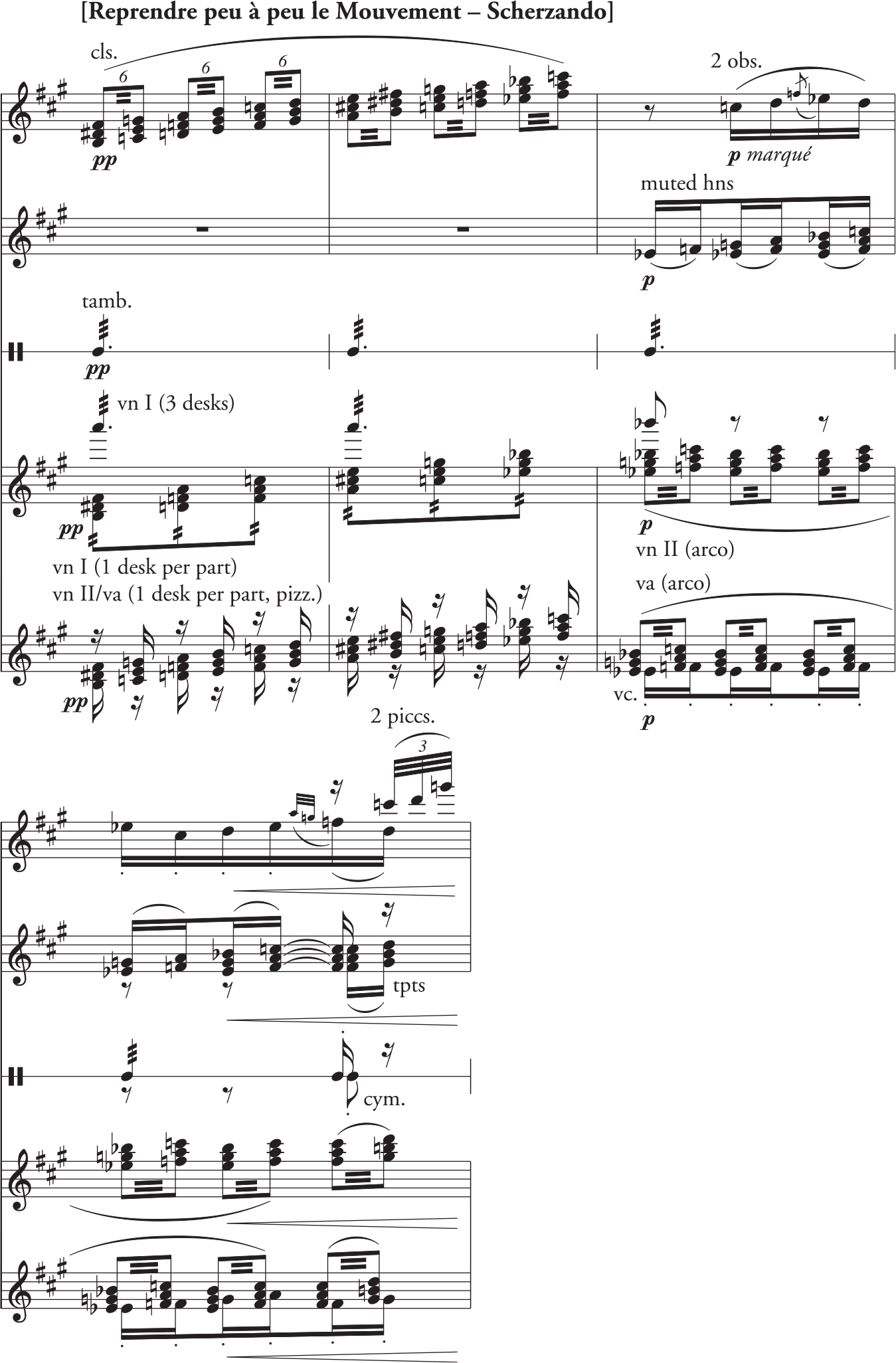
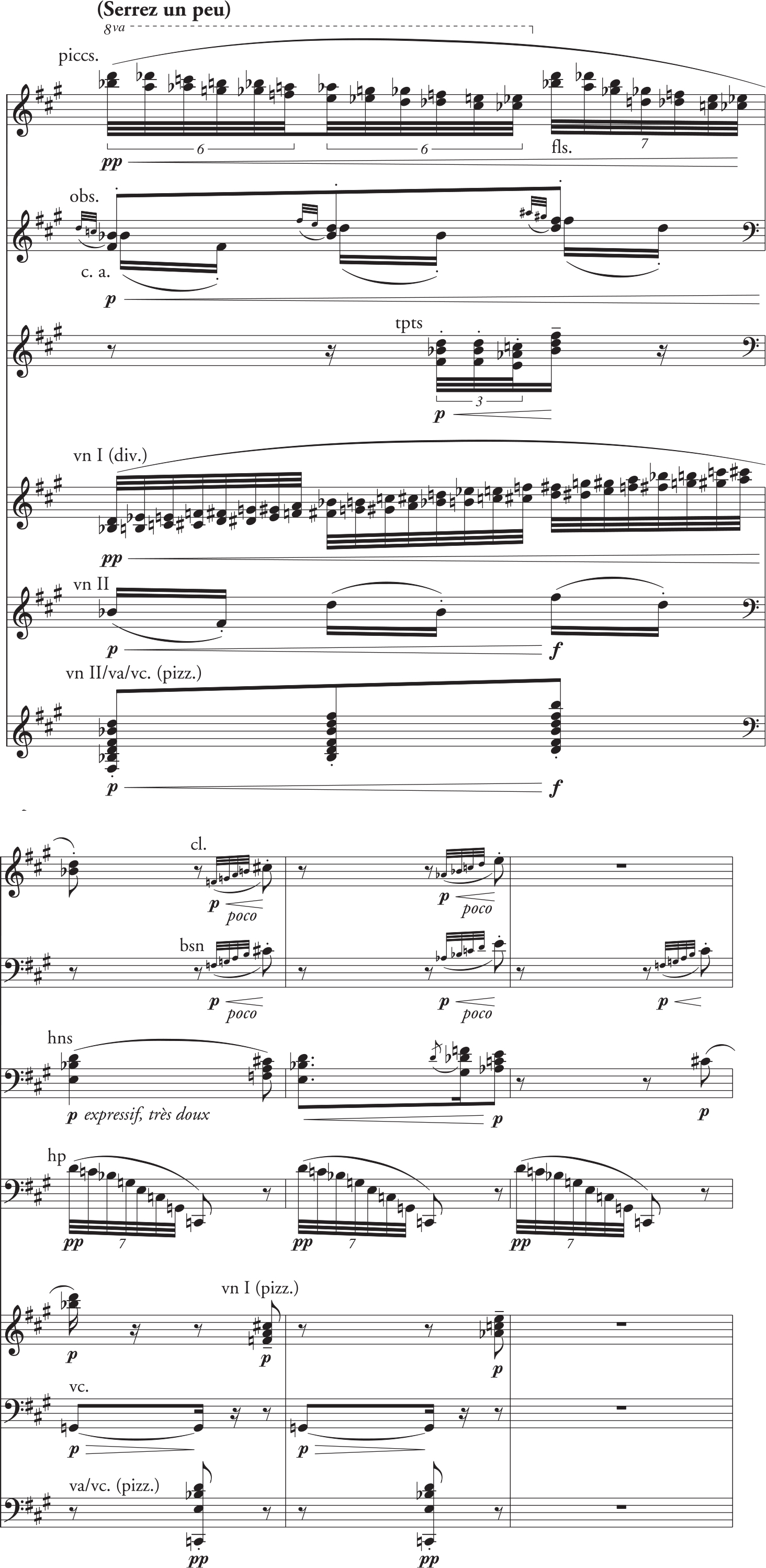
This sense of suspended, or at least unorthodox, tonal motion is further emphasized at the end of the section, where Debussy lurches, without the slightest preparation, to a string of chromatically descending dominant-seventh chords, tracing a motion from C dominant seventh to C with added sixth three bars later (see Example 4). At the very least, this material might be described as self-effacing. Indeed, so much here is vague and lacking definition that a sense of flux is inevitable, for better or worse. Among the contentions discussed above, however, was the promotion under these circumstances of timbre as a primary focus of attention. Since little by way of melodic continuity or harmonic trajectory is likely to maintain interest, the entries of various instruments and the decorative patterns of which their contributions consist become substantive in themselves. As such, the texture appears to consist of an intermingling of arabesques (see Example 5). This differs in respect of various details from the piano score, certainly, but the proliferation of detail in fact serves to render the melodic content even more indistinct. The percussion rhythm is familiar as motif a (see Example 2), and the appearances of b, c and d accord with the piano score, but the flute arches, additional falling octaves in the first violins and various ‘backlighting’ effects, coupled with the constant permutation of timbre, create a luminous as much as a linear effect.
Debussy, Jeux (piano version), from 4/1/3.

Debussy, Jeux (orchestral version), from R57. © Durand Salabert Eschig. Reproduced by permission.

In the realization for orchestra of the first three bars of the second example from the piano score above (Example 4), once again the sheer inconspicuousness of the material, seemingly so inconsequential from a wider perspective, makes it recede from view and in doing so foregrounds tantalizingly filigree textural features (see Example 6). The heterophonic nature of this passage is familiar from much of Debussy's orchestral music (examples abound, but Sirènes from the Trois nocturnes, all three movements of La mer and much of Pelléas et Mélisande – particularly scene iii of both Act 2 and Act 3 – are outstanding in this respect). Here, the woodwind typically present the ‘melodic’ content, while the strings obscure the passage's outlines through trills, grace notes, tremolo bowing and pizzicato variants (particularly subtle is the combination in the strings of trills that culminate with ornaments and those that do not). The general effect is beguiling, and of far more consequence than the rudimentary melodic and harmonic content. DeVoto likens this propensity for decoration for its own sake to the ‘style of Couperin's harpsichord pieces […] transferred to all divisions of the orchestra and greatly accelerated in tempo, like a speeded-up film, with much blurring of the musical surface’.Footnote 43
Debussy, Jeux (orchestral version), from R8. © Durand Salabert Eschig. Reproduced by permission.

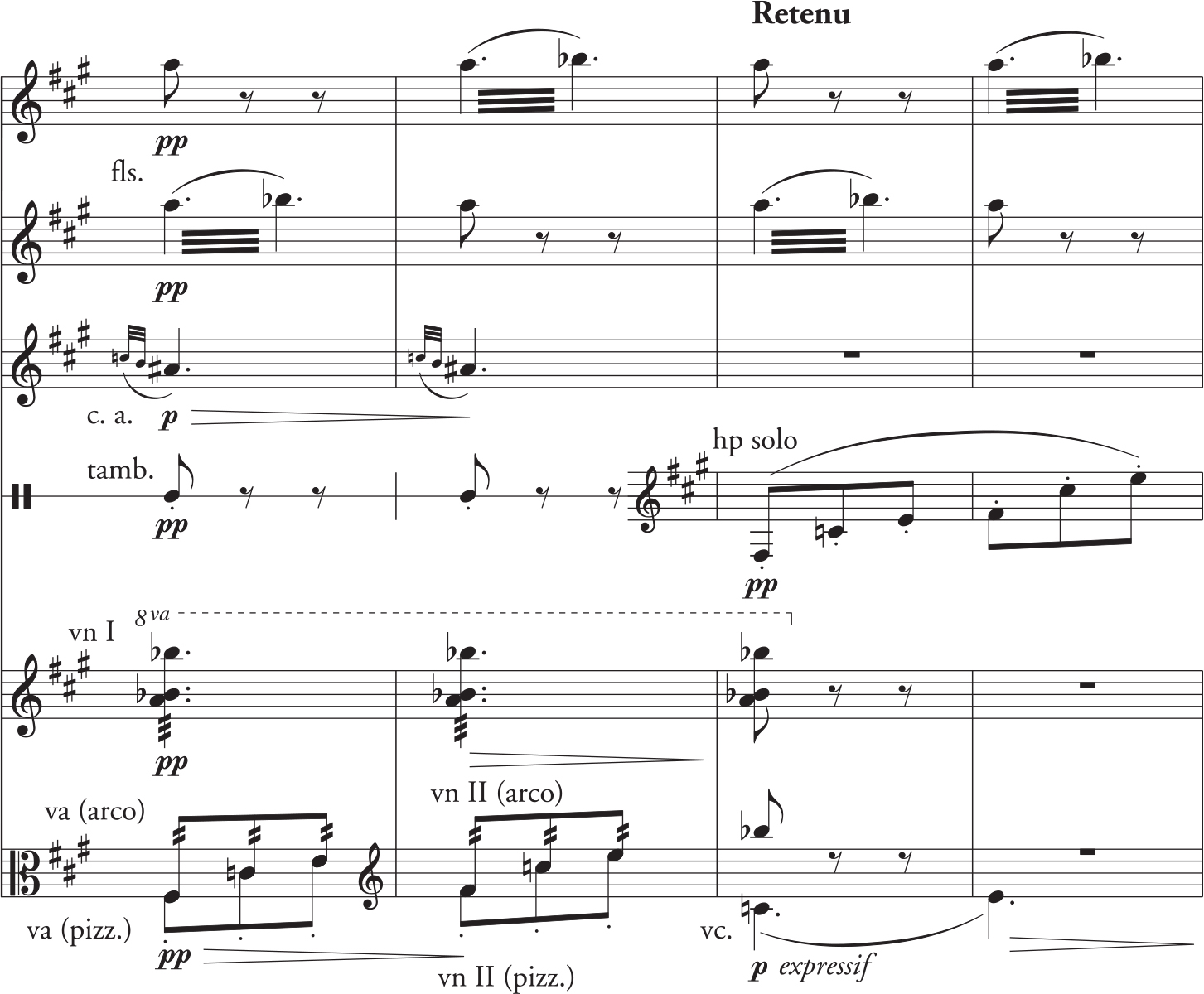
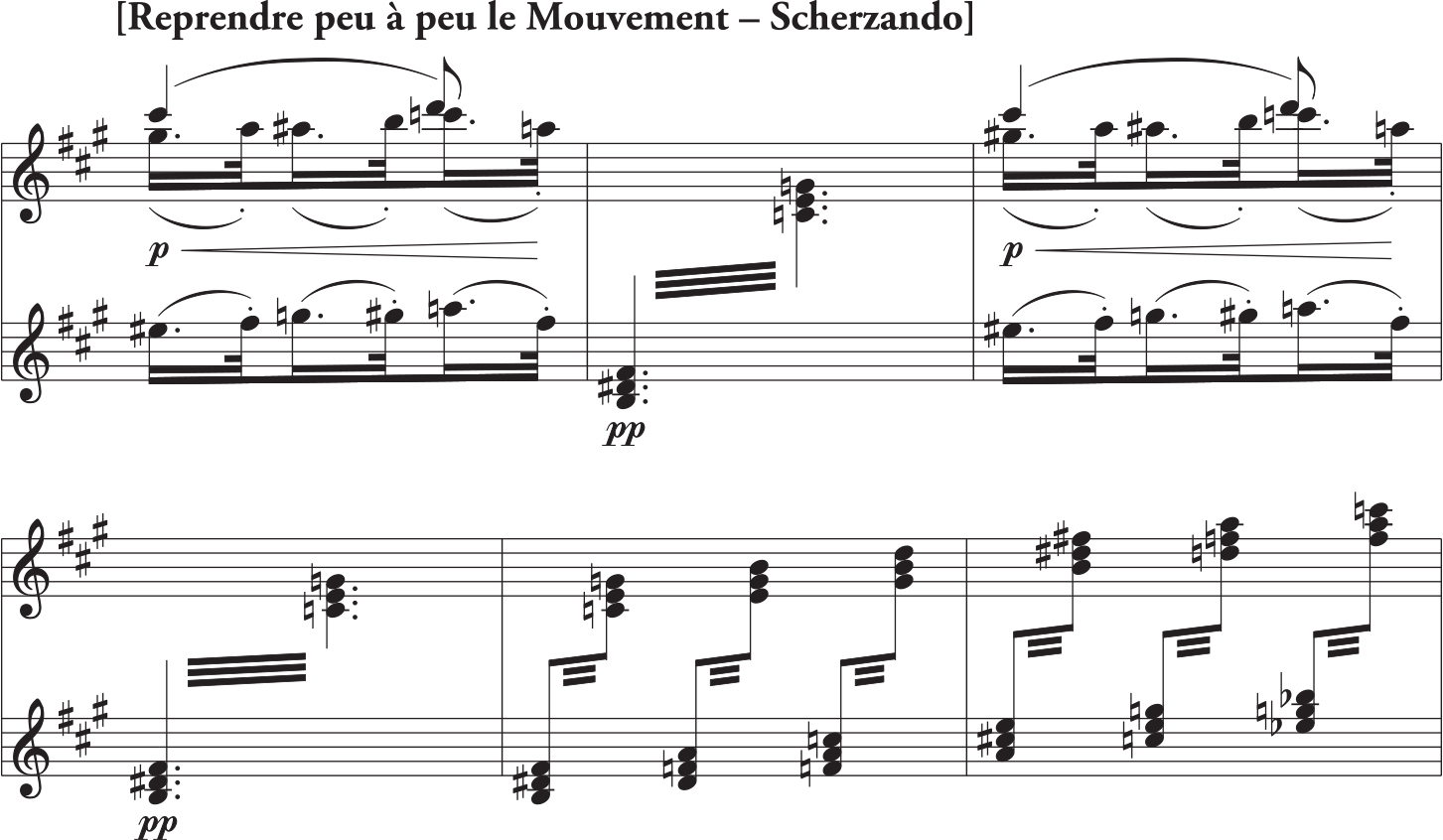
The passage that follows the tennis ball's arrival on the scene (marking the young man's first appearance) is so fragmentary that it barely registers as part of the work's ‘substance’. It gives the appearance of being little more than a connective, but under such ephemeral circumstances it only adds to the ongoing sense of transience and fluctuation. Embellished by flourishes, the melodic aspect is limited to the ornament (transposed) with which the initial scherzando section began (see Example 7a) and a descending fragment (see Example 7b). Following these slightest of entries, a heterophonic blend of wind and strings prepares for the ensuing section (see Example 8). The harmony, as ever, is formally indeterminate, as (especially given the D from the preceding melodic fragment) it seems to relate to an acoustic scale built on C (although as it persists through the following phrase it gains a C♯ in the cellos). From a larger perspective, it is the contrast and frequent incongruity of adjacent sections that creates the sense of spontaneous morphology, of perpetual reconstitution so characteristic of Jeux. I would argue, however, that the rate of textural change coupled with the limited scope of the material, even within self-contained sections, emphasizes orchestral gestures qua gestures to a striking degree. It would be easy to overstate this case and thus it is worth remembering that Debussy resented the suggestion that he had abolished melody. Of what precisely, in Debussy's mind, melody consisted, and how this melody constituted itself over larger expanses of music is certainly debatable; still, as Pasler remarks, Debussy ‘apparently wished us to remember his motives because of the many Jeux he plays with them throughout the entire piece’.Footnote 44
Debussy, Jeux (orchestral version): (a) R49; (b) R39. © Durand Salabert Eschig. Reproduced by permission.

Debussy, Jeux (orchestral version), from R93. © Durand Salabert Eschig. Reproduced by permission.

A further characteristic passage from Jeux's early exchanges, R23–R27 exemplifies rather more by way of discontinuity and disintegration. The dotted figure at 12/3/4 of the piano score is clearly drawn from the melodic features of the foregoing section, and thus the ensuing reduction to a bare tremolo is abrupt (if understated). This disjunction is then repeated, emphasizing the misalignment, before drifting upwards in gestural fashion, in this case via a series of oscillating triads – the stage directions indicate that the young girls are disconcerted by the rustling of leaves at this point (see Example 9). A melody of sorts then emerges, but one of such limited scope that it seems constitutionally averse to continuity or expansion. Indeed, it quickly fragments before being displaced entirely – the young man here hides himself, following the girls’ movements (see Example 10). This process of piecemeal abnegation intensifies at 13/2/3, where perhaps the most explicit gesture of the work thus far is made, the forte indication contrasting markedly with the previous piano. The textural clarity, too, an almost declamatory homophony, is very much distinct from almost everything that has come before; this, in turn, then dissolves into low-register, pianissimo murmurings (see Example 11). The declamation is repeated in varied form, but the sense of fragmentation in fact only further intensifies from here. The C♯ (once again) that has begun to insinuate itself in the foregoing bars reasserts itself at 13/4/2, and this ‘radial pitch’ as a ‘guiding tonal force […] seems always to go hand in hand with a feeling of heightened anticipation, of breathless excitement’.Footnote 45 As such, it prepares the way (as quasi-dominant) for the F♯ major of the structurally significant section beginning at 14/4/3 and allows for the stability that the disintegrating texture would otherwise lack.
Debussy, Jeux (piano version), from 12/3/4.

Debussy, Jeux (piano version), from 13/1/1.

Debussy, Jeux (piano version), 13/2/3.

The rather cramped melodic idea in Example 10 above returns at 13/4/2 and is immediately succeeded by the return of the low-register murmurings. This in turn displaces itself as a series of ornaments and flourishes, very much for their own sake (see Example 12). The briefest of returns of the melodic fragment then dissipates into chromatic repetitions, leading to Jeux's ostensible middle section (incongruously situated somewhat near the beginning).
Debussy, Jeux (piano version), from 14/1/2.

Now, because of its surface inconsistency, this passage should not perhaps be understood on precisely the same basis as those discussed above (see again Examples 2, 3 and 4 on pp. 145–8). Indeed, it was the basic material's seeming lack of interest on those occasions, or at least its innocuousness, that focused attention on Debussy's decorative, protean orchestral patterns. This later section, by contrast, is nothing if not eventful, and marked textural interest and variety is very much written in, regardless of its orchestral realization. The figure that begins at 12/4/3 in the piano version, for example, is presented in familiarly heterophonic orchestral guise at R234 (see Example 13). In this version, necessarily, attention is drawn to the tantalizing orchestral details which become gestures in themselves; yet the idiom of the piano version is interesting and effective in itself, and the sense of abrupt juxtaposition with its surroundings is no less apparent. Certainly, the stridency of the chords and their subsequent disintegration from R24 (13/2/3) is equally arresting in both cases.
Debussy, Jeux (orchestral version), from R234. © Durand Salabert Eschig. Reproduced by permission.

The particular resources of the orchestra are again in evidence at R126 (see Example 14). The subtlety of the various combinations is absorbing, as ever, and Debussy's predilection for infinitesimal gradations between pianissimo and piano is particularly evident here. The pianist Robert Schmitz recalled that crescendos ‘were one of Debussy's obsessions in piano playing. He liked slight crescendos, a ppp increasing into a mere pp […]. Another thing Debussy insisted upon was the proper way to strike a note at the piano.’Footnote 46 Both these attributes are very much applicable by extension to the orchestral Debussy, as Example 14 ably demonstrates, and the understated variety of articulations (particularly between staccato and tenuto) and dynamics is delicate in the extreme. When coordinated with the array of flourishes and their contrasting articulations, ornaments as against varying attacks and graded decays (particularly cellos against horns in the second and third bars), the effect is avowedly, even primarily, orchestral. This hugely nuanced sophistication undoubtedly therefore appears constitutive as content proper, or becomes so, in the orchestral Jeux. In reality, though, it is the juxtapositions, fragmentations and stark contrasts, allied to the markedly gestural nature of the figures themselves, which create this impression. These qualities are thus substantially inherent in the piece even at the ‘pre-orchestral stage’, and unlike the first section discussed, it is therefore an overabundance of interest rather than a lack of it on this occasion that emphasizes the orchestra's limitless resources and contrasts. As such, Jeux could potentially be arranged for all manner of instrumental media and exploit their capabilities equally effectively.
Debussy, Jeux (orchestral version), from R126. © Durand Salabert Eschig. Reproduced by permission.

One further observation I might make in passing concerns the final bar of Example 14. Ravel was famously derisive in his attitude towards La mer's orchestration, even claiming it to be so bad that had he the time he would reorchestrate it; and DeVoto feels that passages such as bars 5–8 and 142–52 of ‘Jeux de vagues’ were perhaps among those at fault in Ravel's eyes.Footnote 47 Indeed, many of the textures are of such a fleeting, quicksilver nature that delicacy is always in danger of slipping back into outright fragility or brittleness. Debussy's desire to find an orchestra ‘without feet’ for Jeux similarly runs the gauntlet of lapses that might at best be described as tenuous.
Following what to this point has amounted to a preamble, the section that begins at R27 intensifies the mercurial qualities of the foregoing in accordance with the scenario; no longer merely a flexibly mutable surface feature, incompatibility here rigidifies into a determinate structural feature. On this basis, the protagonists are each ascribed metric and orchestrational characteristics, and the dancers’ interaction is faithfully realized through the interplay of these features. The young man's metre, for example, is 3/4 in association with predominantly clear (often homophonic), melodic string writing (arco); the first young girl, by contrast, is represented by 3/8 and highly decorative wind writing, supported by hesitant bowed strings and rhythmic pizzicato; the second young girl's musical identity enters a little later, at R33, and is light, staccato/percussive and predominantly consisting of melodic winds (2/4).
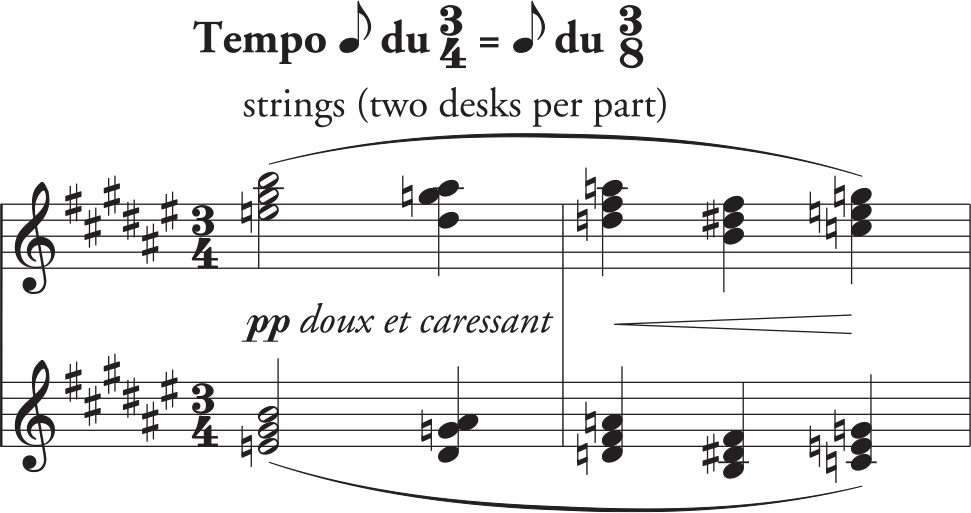
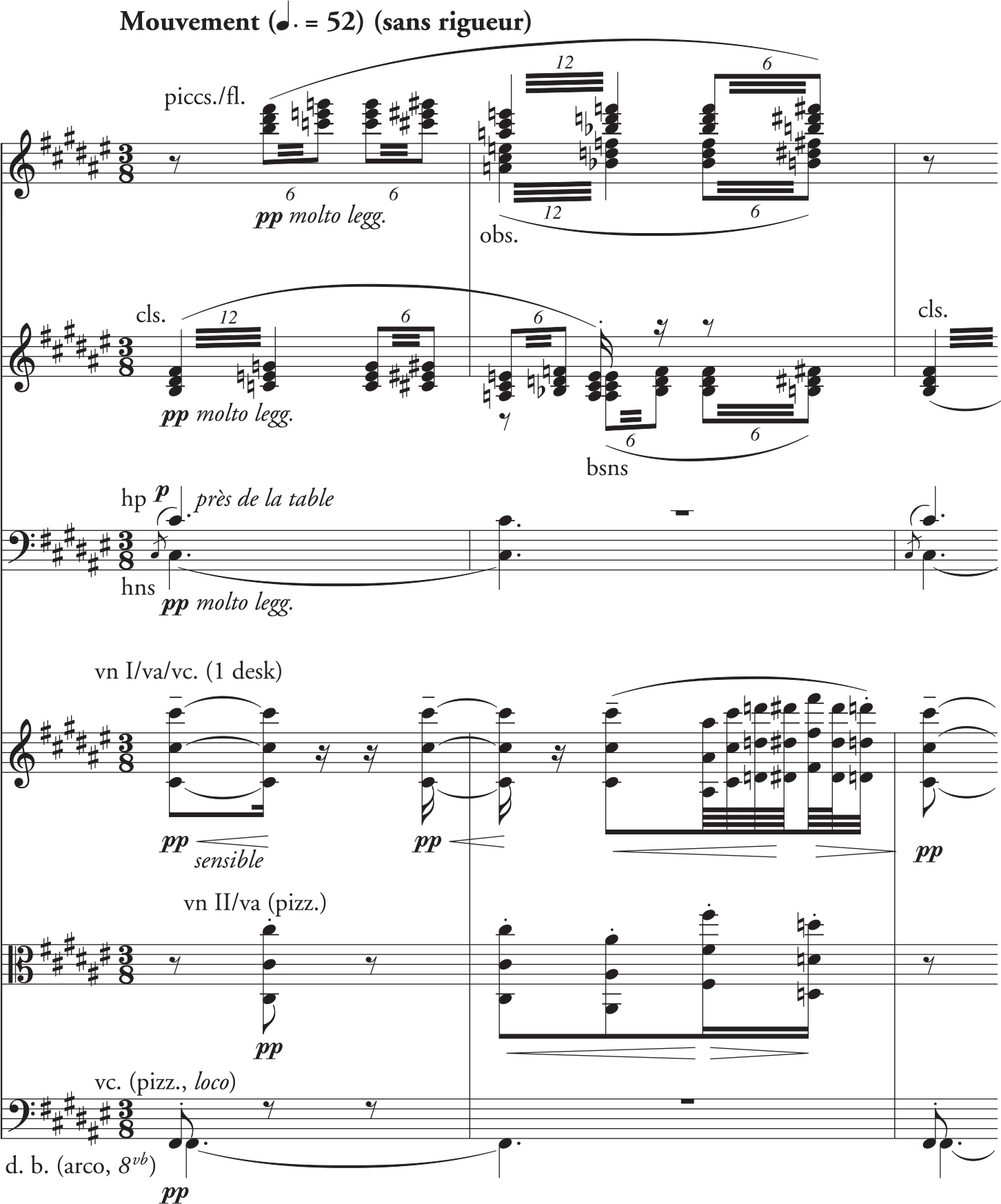
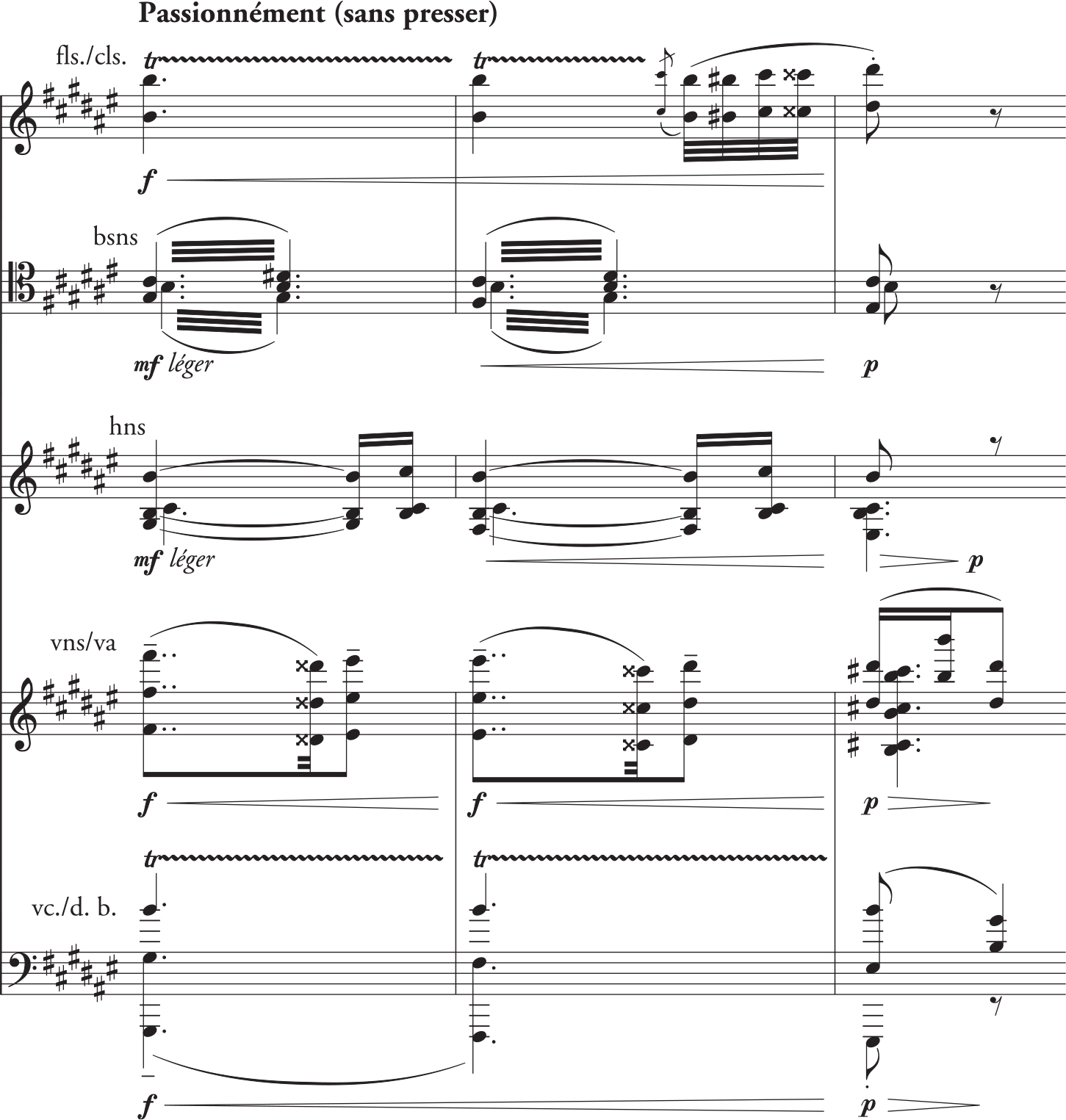
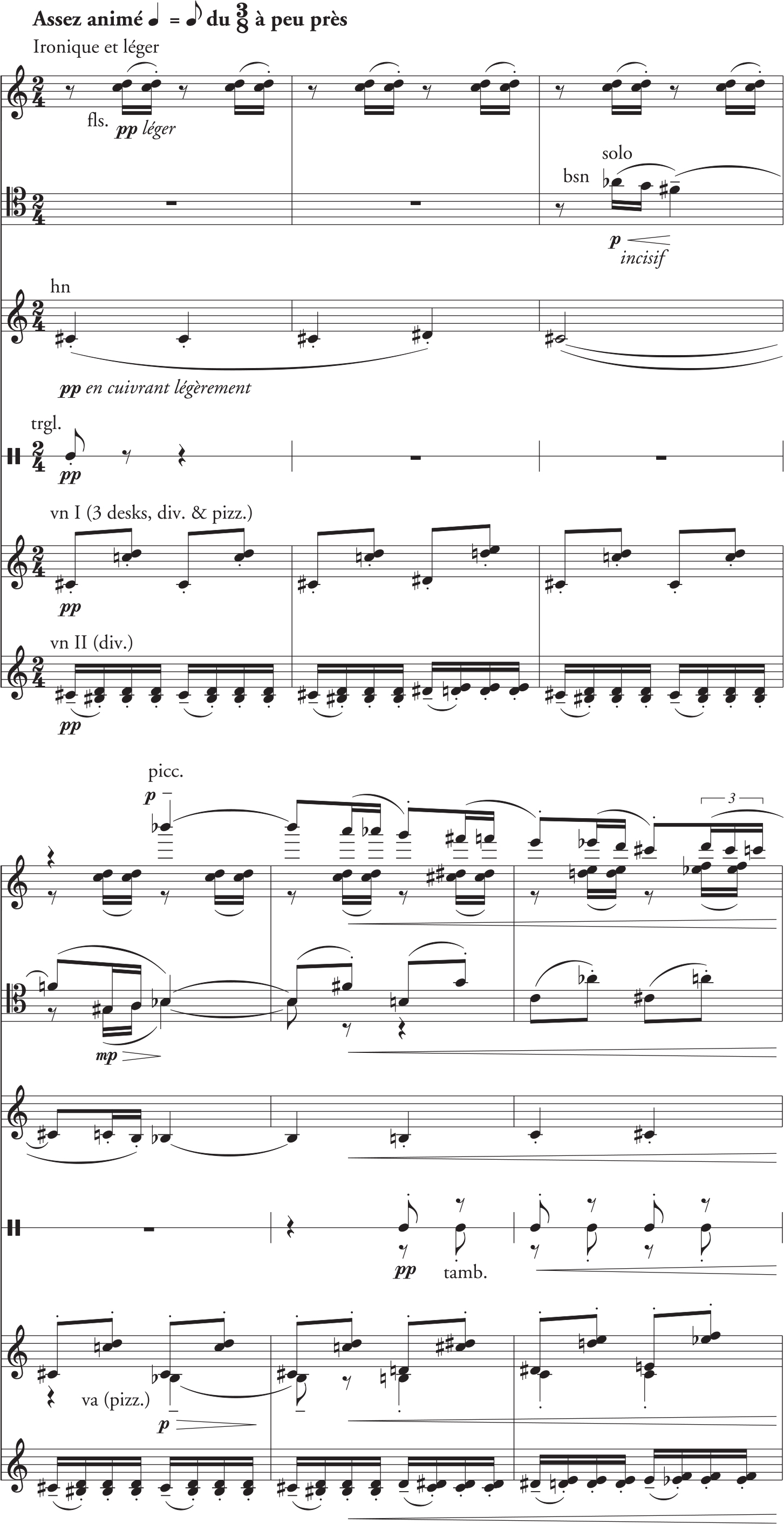
The young man's tentative dance at R27, initiating his liaison with the first girl, lasts for two bars (see Example 15). Four bars of 3/8 denoting the first young girl's anxious but excited response, the first two bars of which are given in Example 16, immediately displace this before the young man's string texture returns, now in 3/8 as his continuing attempts to persuade the girl to dance begin to reconcile the ‘conflict’. (The varied repetition of these three segments, from R29, is further decorated to particularly subtle orchestral effect.) This process culminates at R32 as the two identities merge (marked passionnément), wind trills intermingling with homophonic, melodic strings in 3/8 (see Example 17). Following this, R33 introduces the second young girl (see Example 18), interrupting the amorous exchanges of the dancing couple with a mockingly ironic dance. By design both light and clumsy, the bowed violins and mezzo-staccato horn (en cuivrant légèrement) assure discreet sonority beneath the more pointed articulations of the flutes/pizzicato violins combination. The registral incongruence of the ever comic bassoon and tin-whistle piccolo misaligning a chromatically vagrant figure, meanwhile, adds to the ungainly nature of the cluster harmony and plodding rhythm.
Debussy, Jeux (orchestral version), R27. © Durand Salabert Eschig. Reproduced by permission.

Debussy, Jeux (orchestral version), from R273. © Durand Salabert Eschig. Reproduced by permission.

Debussy, Jeux (orchestral version), from R32. © Durand Salabert Eschig. Reproduced by permission.

Debussy, Jeux (orchestral version), from R33. © Durand Salabert Eschig. Reproduced by permission.

It is not necessary here to chart each stage of this narrative (the juxtapositions and intersections of which continue to coincide with the details of the scenario in similar fashion until R51), but I would argue that the substantive nature of Jeux's orchestral and metric aspects under these circumstances is manifest. Undoubtedly, the malleable qualities of the passages discussed earlier focused attention – perhaps to an unprecedented extent – on orchestral/gestural contrasts, but this section is strictly unthinkable on any other basis. As regards orchestration, it may well be argued that certain textural and metric constituents are written in regardless of the instrumental medium (as was the case earlier). There, however, the textural comportment served to promote orchestrational interest in general, allowing for the subtleties of Debussy's orchestration to become a primary object of interest. Here, the semiotic aspects of the instrumentation (allied to metric and textural features) cannot be written out (that is, removed).
It is evident, in any case, that the piano version is inadequate at this point, especially where complex textures arise from the convergence of disparate ideas. Pages 17 and 18 (leading to the passionnément section) amply demonstrate the significance of details that cannot actually be played by the pianist, included as they are above and below the piano's staves. Even were these details practicable, a significant discontinuity would here emerge between the piano and orchestral versions, specific timbres now being ineradicably associated with the narrative in the latter. Since these timbres are now in themselves meaningful, they necessarily constitute compositional events (which is to say, they are part of the work's content) where they are introduced, events that are missing in the piano version. As such, timbre is a constitutive part (or dimension) of the orchestral Jeux (in this part of the work, at least), regardless of the relationship between the two ‘versions’.
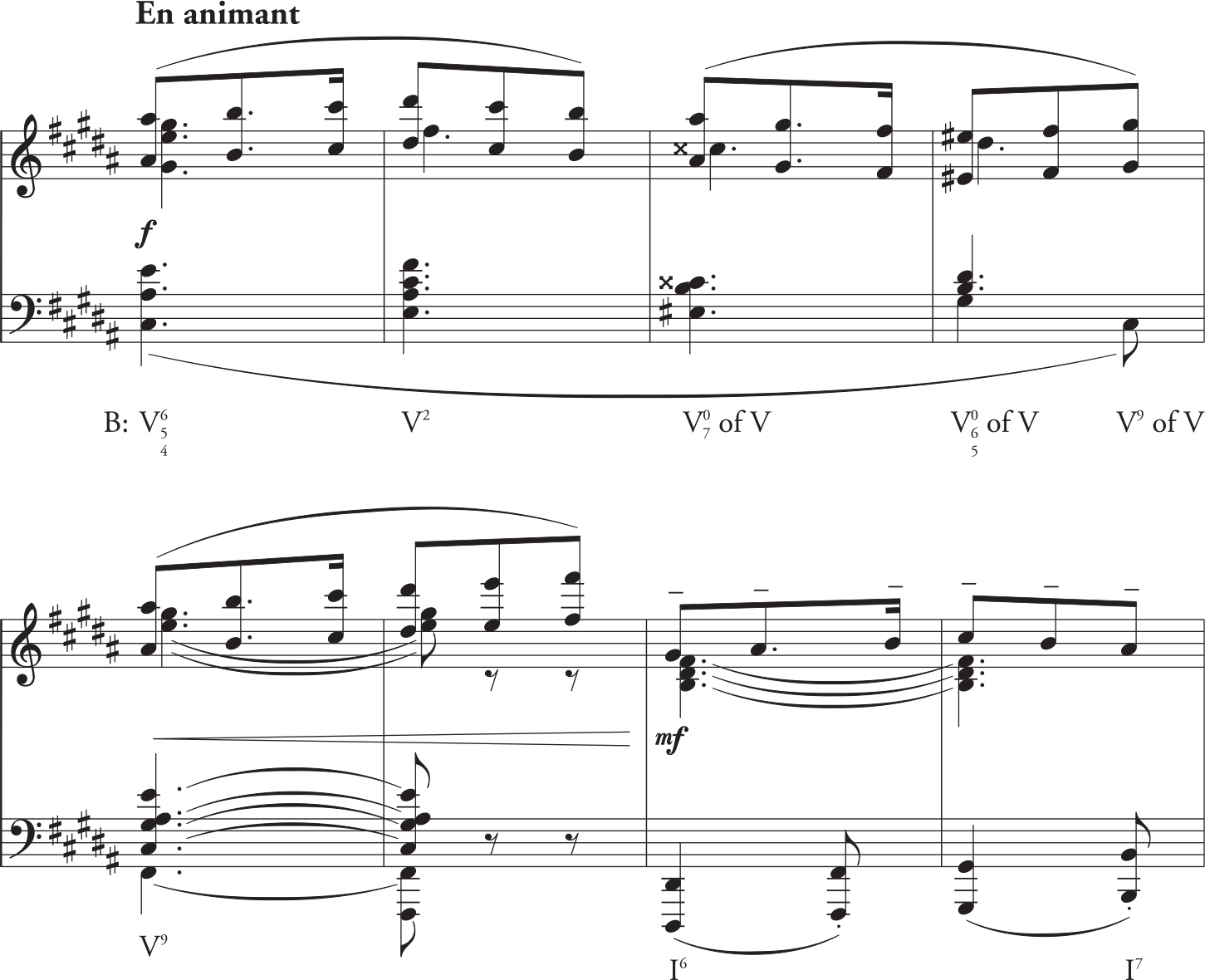
From R51 the dynamic of the ballet changes again with the resumption of a constant (if increasingly nominal) 3/8 time signature. Interestingly, from this point until the fortissimo climax at R78, there are virtually no stage directions (all of which are to be found only in the piano score) apart from an initial ‘Let them look around themselves: the beauty of the night, the joy of the light, everything encourages them to give free rein to their fancy.’Footnote 48 Pasler rightly observes that as the characters begin to follow their fantasy (leading to the pas de trois at R61 and culminating in the triple kiss at R78), the music becomes ‘the central drama’ which thus ‘create[s] a more powerful scenario and translate[s] what is happening within the three characters on stage more appropriately than if Debussy had attempted to create a musical replica of the dancers’ exact movements’.Footnote 49 This is achieved predominantly by polyrhythmic means, initially through the juxtaposition of triple- and duple-time figures and ultimately through the superimposition of 3/8, 2/4 and 3/4. To begin with, some measure of timbral contrast is still discernible, as at R53 (see Example 19), where the strings (and bass clarinet) initially feature in 3/8 while the winds superimpose 3/4 across two bars (in three 2/8 instalments). The strings then introduce a 2/4 polyrhythm in the third bar (following which the horns reintroduce 3/8 at R454). This timbral identity is, however, increasingly obfuscated so as barely to register. There are exceptions, R64 being notable for its clear melodic strings in duple time as against wind trills in triple time, but rhythmic disjunction is very much the driving impulse towards the piece's climax. As such, timbre here retains compositional interest in its characteristic fluctuations, but its significative import is somewhat reduced. Indeed, the timbral tide goes out even further at R365, where an emphatic and extended melody emerges; and this overtly melodic/harmonic orientation obtains still more obtrusively (following a series of dominant preparations and dominants in D♭ major) at R66, where the harmonic trajectory is undeniably B major (see Example 20). To be sure, the arrival at the tonic is obscured by suggestions of submediant harmony, but the tonal implications are unmistakable here and in the subsequent bars.
Debussy, Jeux (orchestral version), from R53. © Durand Salabert Eschig. Reproduced by permission.

Debussy, Jeux (orchestral version), from R66. © Durand Salabert Eschig. Reproduced by permission.

Much that has been discussed to this point regarding the effacement of traditionally constitutive musical parameters (principally tonal melody and harmony) and the consequent promotion of ‘secondary’ elements (timbre, texture and rhythm) ceases to obtain under these circumstances. However alluring the orchestral setting (and its textural refinement certainly bears comparison with much that has come before), the melodic/harmonic context is neither indifferent nor inconsequential nor so inherently filigree as to dissolve into a continuum of contrasting orchestral gestures (or arabesques). As such, it is difficult to see how these passages differ markedly from much orchestral music in a constitutive sense – the form and content can barely be described as determined or articulated by timbre, texture and rhythm (beyond local implications of harmonic rhythm) to any unusual extent. Whatever these local implications, however, the larger-scale metric relationships, the unifying quaver pulse underpinning the whole and the dazzling, dizzying contrasts between sections (an arabesque in its own right) are hardly negated by the more traditional orientation of these particular events.
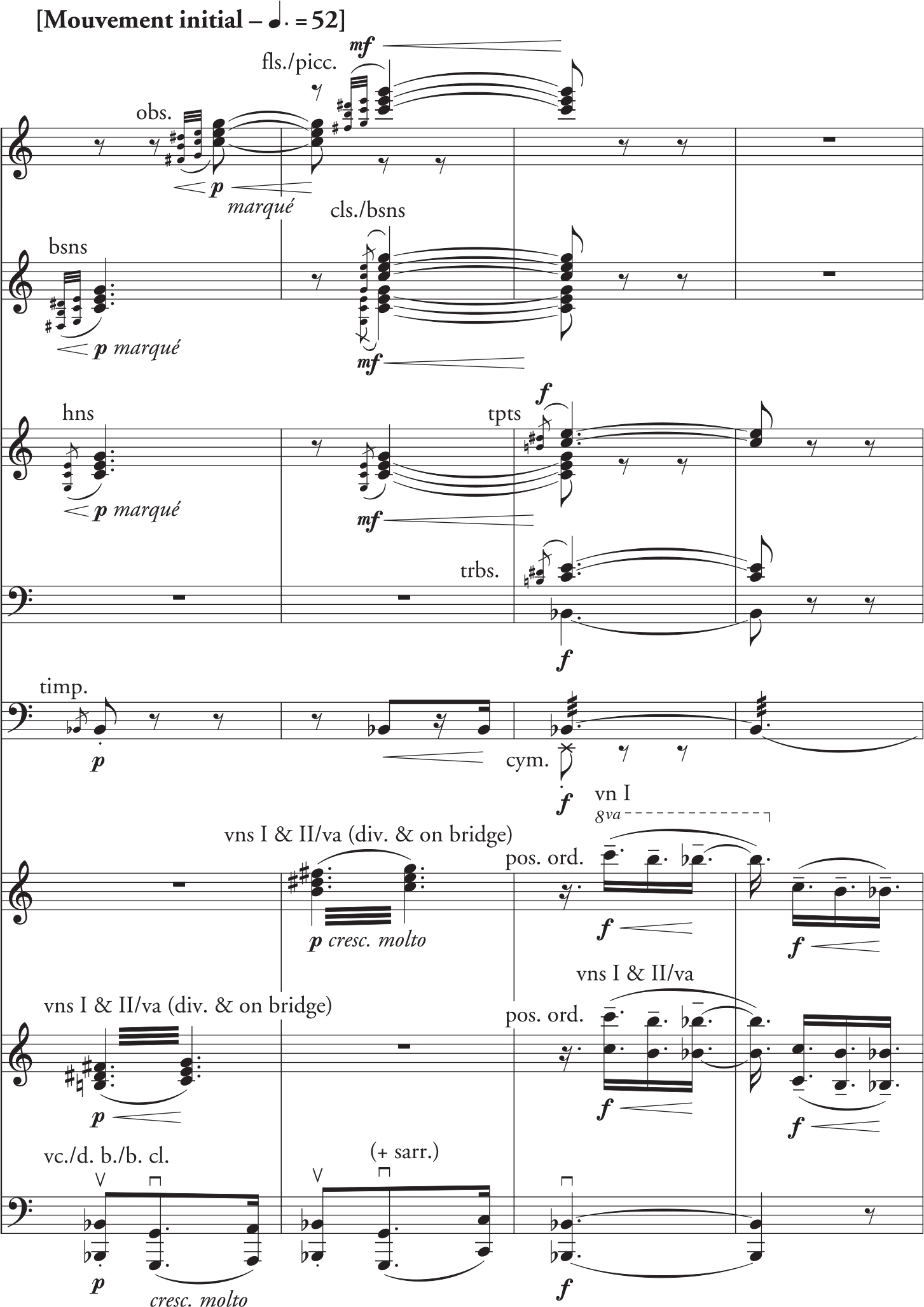
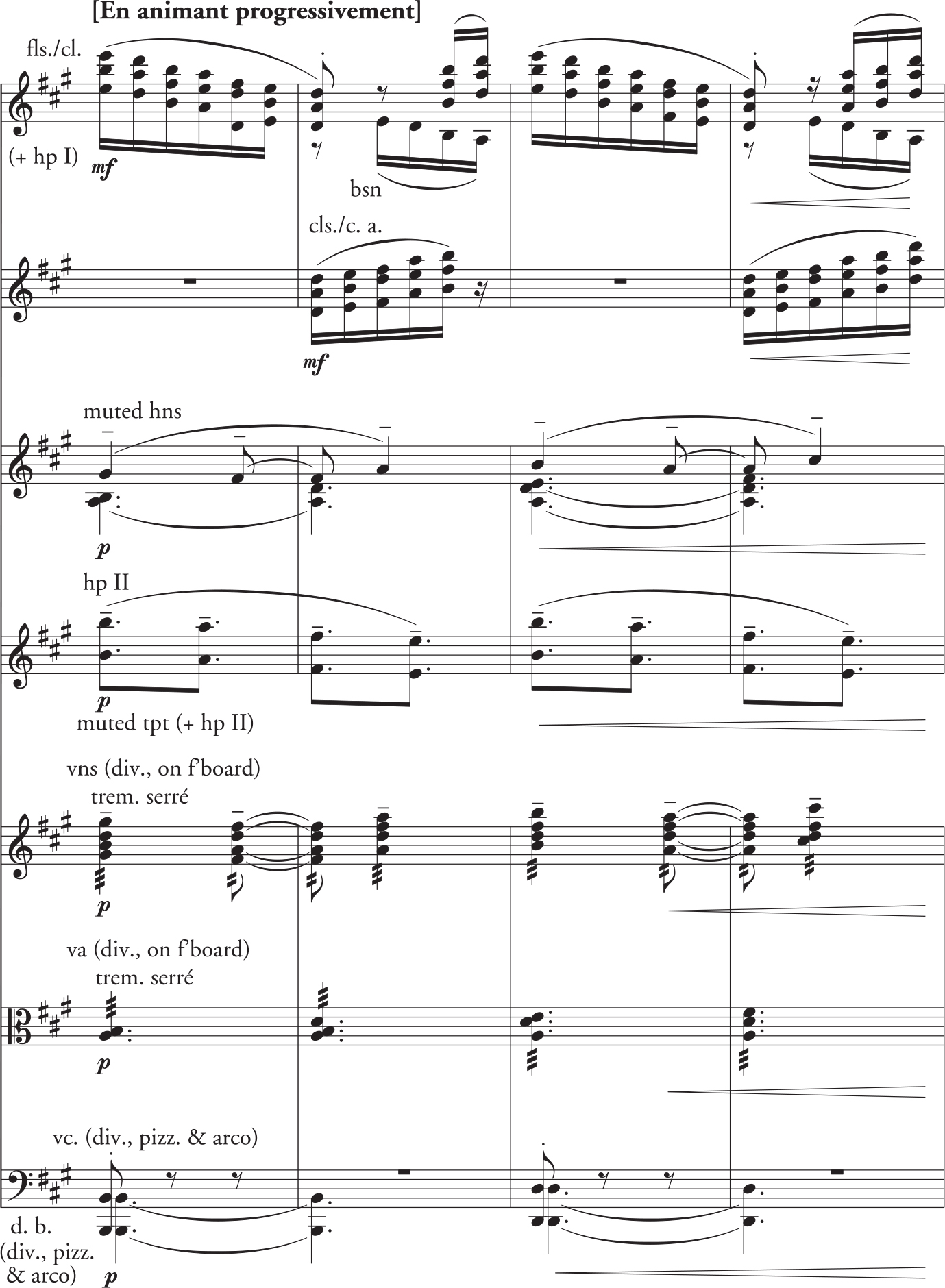
By R471, the process of polymetric (dis)integration begins to culminate, in advance of the dynamically emphatic violent sections, with the simultaneous rendering of 3/8 (predominantly in the winds and first harp), 2/4 (trumpet and second harp) and 3/4 (violins and first horn) – a further, if inconsistent, instance of timbral division (see Example 21). (Interestingly, this metric multiplicity had long been anticipated, notably as a characteristic of the initial girls’ dances and in anticipation thereof from around R16.) The triple kiss then finally ensues at R78 (see Example 22) with the long-awaited fortissimo (never explicitly indicated before this point) and a final gesture of metrical mediation, the 3/8 motif c (see Example 2b) augmented to become a 3/4 figure (within a noticeably homophonic textural context).
Debussy, Jeux (orchestral version), from R471. © Durand Salabert Eschig. Reproduced by permission.

Debussy, Jeux (orchestral version), from R78. © Durand Salabert Eschig. Reproduced by permission.

The end follows swiftly as a tennis ball falls at the dancers’ feet, startling them into dispersing into the night. Berman considers it ‘typical of Debussy's later compositional practices that a single gesture followed by a short aftermath should be responsible for resolving a significant development. This is in keeping with his avoidance of heroic statement – his preference for the effect of paroxysm or the blinding flash of clarity.’Footnote 50 Thus, the final 21 bars (from R80) are fragmentary in the extreme and symmetrically reverse the work's opening – two 3/8 sections are interrupted by a passage in 4/4, the bass line discreetly tracing motion from A to B to A. This last detail, interestingly, is by no means apparent in the piano score.
The necessity of contingency
All the above, then, demands that DeVoto's contention concerning the unification of compositional and orchestrational processes be revisited. It is evident, certainly, that the two undertakings were not simultaneous, but this does not itself necessarily preclude their being understood as a unity. That this understanding cannot be extended equally to all sections of Jeux is clear enough, too, although the predominance of orchestral gesture at various junctures may well appear convincing on this point (particularly, among those discussed, the passages beginning at R6, R23 and R27). What remains difficult, however, is to conceive the two processes as unified in any conventional sense. It would take a rather particular interpretation of ‘processes’ here for it to be concluded that two courses of events fuse indissociably (the unfolding of the music and the orchestral features, once determined, in act as performance); on this basis, it would be difficult to see how the performance of any orchestral music could fail to unify the two. Indeed, ‘compositional and orchestrational processes’ suggests the activities of composition and orchestration in any case. This is therefore surely better understood not as unification but as synthesis,Footnote 51 since the two processes serve to mediate one another.Footnote 52
At first sight this distinction may well appear pedantic, but, as suggested in several of the examples, an important distinction emerges. On the one hand, much of the ‘music’ (as melody and harmony) is self-effacing and at times unremarkable; it therefore promotes textural and timbral interest by design, a quality that in principle need not be limited to the orchestrational choices Debussy actually made. On the other hand, some sections are so inherently varied, texturally decorative and subtly nuanced (as gestures) that this principle intensifies itself to the point where almost any ensemble could be exploited to interesting effect (the interest being ‘written in’). As such, the material supplicates itself in advance to its medium, just as its medium is the empty potentiality of the material's being realized. As poles of mediation they contain each other within themselves, and thus the process is dialectical – in recursively tripartite Hegelian fashion, the ‘in-itself’ (the material as implicit, potential, inner nature) of the particelle sublates as contradictory unity (Gegensatz) its relation to timbre so as to become explicit and posited, that is, a work (a moment) for piano solo. The culmination (Aufhebung) of this movement, however, Jeux ‘for itself’, only arrives through the préparation orchestrale, at which point it becomes an entity in conformity with its nature.
Thus, texture and timbre here very much belong to Jeux's substance where mutatis mutandis this is understood in Hegel's sense – which is to say,
the totality of [its] accidents. […] Substantiality is the absolute activity-of-form […] and every content is just a moment that belongs to this process alone. [… Substance] without preceding dialectical mediation – being the universal might of negation – is only the dark, shapeless abyss, so to speak, in which all determinate content is swallowed up as radically null and void, and which produces nothing out of itself that has a positive subsistence of its own.Footnote 53
Given that it is within ‘Actuality’, as the third subsection within ‘The Doctrine of Essence’, that ‘Substance’ emerges in both versions of the Logic, what we are to understand here is that the externally real fully expresses the essence and that this is the case specifically on the basis of prior dialectical mediation. Were this not the case, Jeux and ‘its’ orchestration would remain forever external to one another.
Now, properly speaking, of course, this is to be grasped in accordance with the movement of comprehension as a whole and thus the Concept (Begriff) and its unity with fully comprehended concepts (Vorstellungen) – ‘Since each of [the Concept's] moments is the whole that it is, and is posited as inseparable unity with it, the Concept is totality; thus in its identity with itself it is what is in and for itself determinate.’Footnote 54 Hegel elsewhere – in the Greater Logic – in fact defines substance as implicitly what the Concept is explicitly.Footnote 55 Nevertheless, Hegel's (putative) ontology of being as becoming, ultimately the movement of spirit, need not be overemphasized here (which is to say the identity of subject and object, or the cosmos as the full expression of fully realized and posited, unconditioned, self-conscious subjective rationality, that is, the Idea itself and its return to Geist). The dialectic whereby ‘essence’ and ‘unessence’ (modal categories) pass over into substanceFootnote 56 is at the very least indicative of how Jeux (or moments thereof) may be understood.
And on this basis, providing we are prepared to read Hegel's Logic as simply an analogue of rationality, there is no need for us to be talked down from giddy metaphysical heights – to reiterate, the relative immediacy of the initial (implicit) instantiation of Jeux is this way mediated by the negating activity of orchestration, culminating in the overcoming of its ‘given-being’ in the actual (that is, in accordance with its concept), realized and posited product. Indeed, this can be simplified further, even in ontological terms, in saying that the initial instantiation of Jeux is inadequate given certain criterial attributes known in advance (by Debussy, since the negating activity in question is his own, and latterly by us) and that this real contradiction is overcome in the full orchestral version. Contingency – here, whether and how Jeux might be orchestrated – proves to be necessary since Jeux's inner nature is such that it must be realized if it is to be consistent with this nature.Footnote 57