Individual and environmental risk and resilience factors in infancy, childhood, and adolescence shape psychological and social development across the life span (Anderson et al., Reference Anderson, Shinn, Fullilove, Scrimshaw, Fielding and Normand2003). These exposures can have a significant impact on socioeconomic attainment in adulthood, a critical determinant of health and quality of life. Childhood factors such as socioeconomic status (SES), illness, and trauma exposure can influence the skills required for optimal performance in the workplace, earning potential, and upward social mobility (Conger & Donnellan, Reference Conger and Donnellan2007; Dubow, Boxer, & Huesmann, Reference Dubow, Boxer and Huesmann2009). Low personal income attainment, a pillar of socioeconomic status, is associated with higher risk of physical and mental health problems, including cardiovascular diseases (Diez-Roux, Link, & Northridge, Reference Diez-Roux, Link and Northridge2000); depression, anxiety, and substance use disorders (Sareen, Afifi, McMillan, & Asmundson, Reference Sareen, Afifi, McMillan and Asmundson2011); and increases all-cause mortality (Osler et al., Reference Osler, Prescott, Grønbæk, Christensen, Due and Engholm2002). Accordingly, it is important to examine individual-level factors in early life that impact income attainment.
One of the strongest predictors of income attainment in general population samples is childhood cognitive function. Decades of research have established that cognitive abilities (typically defined using IQ) in early life are associated with favorable labor and income outcomes in adulthood, even after adjustment for confounding and mediating variables such as childhood socioeconomic status and educational attainment (Strenze, Reference Strenze2007). Such studies suggest that individuals with better early cognitive abilities are more likely to be offered and pursue more prestigious educational and occupational opportunities (Ceci & Williams, Reference Ceci and Williams1997; Ng, Eby, Sorensen, & Feldman, Reference Ng, Eby, Sorensen and Feldman2005), and may be able to better capitalize on their language skills, emotional intelligence, and abstract thinking to network and gain opportunities for social mobility (Judge, Klinger, & Simon, Reference Judge, Klinger and Simon2010). However, the role of cognitive abilities on later income attainment has had little study in populations facing early life biological adversity, such as those born at low birth weight or preterm.
In populations at risk of abnormal cognitive development, such as those born at low birth weights (Kuban et al., Reference Kuban, Joseph, O'Shea, Allred, Heeren and Douglass2016), few hypotheses have been put forth to describe the association between cognition and socioeconomic attainment. In typically developing populations, it has been hypothesized that children's cognitive abilities influence development and later income and socioeconomic attainment in two ways. The first suggests that enhanced early cognitive abilities lead to better educational attainment, which in turn is associated with higher income, job security, and more prestigious occupation (Ceci & Williams, Reference Ceci and Williams1997; Strenze, Reference Strenze2007). According to this pathway, sponsored and contest mobility mechanisms provide complementary views about how individuals with greater childhood cognitive abilities have greater upward socioeconomic progressions. Sponsored mobility mechanisms suggest that more intelligent individuals are more likely to be acknowledged as candidates for better educational and socioeconomic opportunities such as pay raises and stable employment with benefits (Turner, Reference Turner1960). The contest mobility perspective suggests that those individuals with superior intellectual functioning can better capitalize on their sponsored mobility assets, gaining access to higher levels of occupational prestige and income (Judge et al., Reference Judge, Klinger and Simon2010).
The second pathway suggests that cognitive abilities may interact with early life personal and contextual factors (such as an individual's home environment, health profile, and social network) to influence an individual's personality, interests, and experiences, and as a result influence later educational aspirations and socioeconomic attainment (Dubow et al., Reference Dubow, Boxer and Huesmann2009). Compared to the first mechanism, the joint influence of early life cognition and psychosocial context on socioeconomic attainment has had less study (Conger & Donnellan, Reference Conger and Donnellan2007). As early life psychosocial disadvantage is known to place an individual at risk for poorer socioeconomic attainment (Blanden, Gregg, & Macmillan, Reference Blanden, Gregg and Macmillan2007; Dubow et al., Reference Dubow, Boxer and Huesmann2009; Johnston, Propper, Pudney, & Shields, Reference Johnston, Propper, Pudney and Shields2014; Zielinski, Reference Zielinski2009), it is important to understand if and how cognitive abilities mitigate this risk. This knowledge has the potential to provide a more holistic view of what factors in early life most influence socioeconomic trajectories, and may be used to inform child policy, as well as the development of early interventions aimed at optimizing resiliency in vulnerable children.
One framework that has been used to understand how childhood cognition and early contextual factors jointly influence socioeconomic success is cognitive reserve. The cognitive reserve hypothesis posits that human brains affected by physical and/or psychological insults can cope with and mitigate other contextual risks by activating different neural networks and cognitive processes (Cosentino & Stern, Reference Cosentino, Stern, Ravdin and Kazden2012). It has been hypothesized that this enables the maintenance of neurological functioning despite brain alterations associated with adversity, such as trauma, poverty, or illness. Cognitive reserve has been defined in a variety of ways (e.g., brain size, synapse count, or neuroplasticity markers); however, cognitive assessments (e.g., IQ tests) are considered one of the strongest representations of cognitive reserve since they more closely represent actual cognitive functioning (Deary & Batty, Reference Deary and Batty2007; Stern, Reference Stern2003). When examining links between cognitive abilities and socioeconomic attainment, childhood measures of cognition (i.e., ages 6–12) are preferred because they are less affected by one's educational experiences compared to cognitive assessments made at later ages (Strenze, Reference Strenze2007). Further, examining cognition approximately 20 years before an outcome of interest greatly increases its predictive value and reduces the likelihood of reverse causality (i.e., that other experiences could have influenced cognition and therefore bias associations; Strenze, Reference Strenze2007).
As cognitive reserve is thought to protect against psychological and physical adversities encountered throughout the life course, individuals with greater cognitive reserve may be less affected by these and be able to maintain functioning, pursue higher education, and have better productivity in the workforce, leading to socioeconomic success. Conversely, for those individuals with lower cognitive reserve, adversity may disrupt their socioeconomic trajectory, resulting in greater risk of downward social mobility. Accordingly, it is important to test this hypothesis by exploring the social and psychological adversities or life-influencing events that impose substantial stress on an individual, leading to developmental consequences (Bair-Merritt, Mandal, Garg, & Cheng, Reference Bair-Merritt, Mandal, Garg and Cheng2015) that may impact socioeconomic attainment.
The Influence of Early Life Social Adversity on Socioeconomic Attainment
It is well established that unfavorable social contexts in childhood, adolescence, and early adulthood are associated with poorer socioeconomic functioning and trajectories (Schofield et al., Reference Schofield, Martin, Conger, Neppl, Donnellan and Conger2011). For example, correlations between childhood SES and adult SES have been supported by research for several decades (Coleman, Reference Coleman1966). Work in this field suggests that children with lower parental SES receive fewer and poorer educational opportunities, leading to fewer opportunities for social mobility (through education or employment) as adults (Currie, Reference Currie2008; Walker, Greenwood, Hart, & Carta, Reference Walker, Greenwood, Hart and Carta1994).
Another significant predictor of socioeconomic attainment is exposure to sexual abuse in childhood or adolescence. Sexual victimization can alter developmental trajectories and lead to adverse long-term socioeconomic consequences. For example, data from the American National Comorbidity Survey suggest that the odds of having an income below the poverty line is 80% greater in victims of child sexual abuse (Zielinski, Reference Zielinski2009). Sexual victimization can increase the risk of physical and mental illness (Macmillan, Reference Macmillan2000, Reference Macmillan2001), which negatively impacts the educational aspirations and occupational attainment of survivors (Macmillan & Hagan, Reference Macmillan and Hagan2004). Further, victims of early life physical and sexual abuse have lower self-efficacy and may alienate themselves from growing close relationships with individuals in their social support networks (Macmillan, Reference Macmillan2001). This isolation may result in fewer opportunities to enhance verbal and language abilities, reducing the opportunity to network and build the communication abilities necessary to excel in the work place and gain occupational prestige.
The Influence of Psychological Adversity on Socioeconomic Attainment
One's propensity to psychological distress and mental illness can also powerfully influence an individual's socioeconomic attainment. For example, trait neuroticism (a sensitivity to emotional stimuli and a tendency to react strongly to these) is associated with poorer self-efficacy, loss in motivation, and less confidence in the workplace, which may result in fewer opportunities for socioeconomic gains (Judge & Ilies, Reference Judge and Ilies2002). It is also associated with lower salaries, fewer promotions, and lower career satisfaction (Ng et al., Reference Ng, Eby, Sorensen and Feldman2005).
Psychiatric problems including mood, anxiety, and attention-deficit/hyperactivity disorders have also been linked to poorer educational attainment, income, and socioeconomic mobility in adulthood (Breslau, Lane, Sampson, & Kessler, Reference Breslau, Lane, Sampson and Kessler2008; Johnston et al., Reference Johnston, Propper, Pudney and Shields2014). Although the individual pathways for different disorders may differ, individuals who suffer from psychiatric problems are more likely to have lower educational attainment and difficulty maintaining stable employment (Johnston et al., Reference Johnston, Propper, Pudney and Shields2014). These disorders may also be associated with poorer social mobility due to their strong association with previous environmental adversity, resulting in inadequate emotional skill, material disadvantage associated with poverty, and less developed or even absent social support networks (Power, Stansfeld, Matthews, Manor, & Hope, Reference Power, Stansfeld, Matthews, Manor and Hope2002).
Perinatal Adversity and Socioeconomic Attainment
In addition to these postnatal psychosocial adversities, research has begun to suggest perinatal adversity (which can be indexed by low birth weight or preterm birth) may be associated with poorer income and socioeconomic attainment in adulthood as well (Almond & Currie, Reference Almond and Currie2011). For example, data from the Helsinki Birth Cohort suggest that those born late preterm (34–36 weeks gestation) are more likely to have lower annual income and are at increased risk of downward social mobility in their 50s and 60s compared to those born at term (i.e., at 40 weeks gestation; Heinonen et al., Reference Heinonen, Eriksson, Kajantie, Pesonen, Barker, Osmond and Raikkonen2013). Moreover, a gradient effect for birth weight and gestational age has been observed, suggesting that those born the most preterm or at the lowest birth weights have the lowest earnings in adulthood (e.g., Almond & Currie, Reference Almond and Currie2011; Moster, Lie, & Markestad, Reference Moster, Lie and Markestad2008).
Individuals born at extremely low birth weight (ELBW; <1000 g) are the tiniest and most vulnerable survivors of prematurity. ELBW is generally a result of shortened gestational duration and/or intrauterine growth restriction, which is influenced by a combination of socioenvironmental and genetic factors (Kramer, Reference Kramer1987; Valero De Bernabé et al., Reference Valero De Bernabé, Soriano, Albaladejo, Juarranz, Calle, Martínez and Dominguez-Rojas2004). This group is known to be at risk for psychiatric illness, increased neuroticism, and adverse social outcomes (Allin et al., Reference Allin, Rooney, Cuddy, Wyatt, Walshe, Rifkin and Murray2006; Mathewson et al., Reference Mathewson, Chow, Dobson, Pope, Schmidt and Van Lieshout2017; Van Lieshout, Boyle, Saigal, Morrison, & Schmidt, Reference Van Lieshout, Boyle, Saigal, Morrison and Schmidt2015; Waxman, Van Lieshout, Saigal, Boyle, & Schmidt, Reference Waxman, Van Lieshout, Saigal, Boyle and Schmidt2013). It is also becoming evident that their exposure to very early adversity negatively affects their socioeconomic attainment. Data from the oldest longitudinally followed cohort of ELBW survivors suggest that at age 30–35, ELBW survivors were less likely to work full time, more frequently received social assistance, and reported annual earnings that were more than $20,000 less than their normal birth weight peers (Saigal et al., Reference Saigal, Day, Van Lieshout, Schmidt, Morrison and Boyle2016). Due to these stark differences in socioeconomic attainment and its impact on their children and families, it is critical to understand potential moderators of ELBW survivors’ social mobility.
In addition to experiencing significant perinatal adversity, one of the most common problems facing ELBW survivors is intellectual impairment. The poorer cognitive function commonly seen in individuals born at ELBW range from severe intellectual disability to more subtle deficits (Kuban et al., Reference Kuban, Joseph, O'Shea, Allred, Heeren and Douglass2016); among ELBW survivors, these deficits are known to persist at least into early adulthood (Eryigit Madzwamuse, Baumann, Jaekel, Bartmann, & Wolke, Reference Eryigit Madzwamuse, Baumann, Jaekel, Bartmann and Wolke2015).
To our knowledge, only one study has directly explored the influence of cognitive abilities on socioeconomic attainment in a preterm born group. In a study utilizing data from two British birth cohorts, childhood intelligence, reading, and mathematical abilities strongly explained wealth attainment at age 42 in individuals born before 36 weeks gestation (Basten, Jaekel, Johnson, Gilmore, & Wolke, Reference Basten, Jaekel, Johnson, Gilmore and Wolke2015). Although this study reported that preterm individuals with poorer early cognition and academic abilities may be at risk for poorer educational attainment, their study did not examine any postnatal adversities occurring in childhood or adolescence that may influence adult earnings. It is important not only to explore cognition as a direct predictor or a mediator of later socioeconomic attainment, but also to examine its ability to mute the negative impact of early adversity in a high-risk population. Such information can be used to understand risk and resilience factors, as well as potentially inform primary and secondary preventive interventions.
Based on the association between early cognition and socioeconomic attainment seen in typically developing samples, according to the cognitive reserve hypothesis, if an ELBW survivor has enhanced cognitive function, it should help protect them from the adverse psychosocial outcomes associated with postnatal adversity, as well as socioeconomic disadvantage. However, it remains unclear if adequate or superior childhood cognitive functioning is sufficient to overcome both perinatal and later postnatal adversity.
Can the Cognitive Reserve Hypothesis Explain the Socioeconomic Attainment of ELBW Survivors?
According to the cognitive reserve hypothesis, preterm survivors with higher cognitive reserve (represented by cognitive function) should be able to overcome adversity and pursue stable employment and higher incomes, while those with lower cognitive reserve will not. This was recently tested in a longitudinal sibling-pair study that examined the joint influence of neuroplasticity (the ability to overcome adversity from neurologically damaging environments) and birth weight on adult wages at age 53. Using data from the Wisconsin Longitudinal Study, Cook and Fletcher (Reference Cook and Fletcher2015) examined how genes associated with neuroplasticity (defined by the number of favorable alleles of the apolipoprotein E [APOE], brain-derived neurotrophic factor [BDNF], and catechol-O-methyltransferase [COMT] genes) interacted with birth weight (a proxy for prenatal adversity) to influence wage earnings in the sixth decade of life. Their results suggest that higher neuroplasticity (i.e., cognitive reserve) reduces the detrimental effects of lower birth weight on earnings at age 53 (Cook & Fletcher, Reference Cook and Fletcher2015).
Although Cook and Fletcher's study extends the literature exploring the mechanisms of how perinatal adversity may affect socioeconomic outcomes in later adulthood, their study has three limitations. First, although the authors argue for the validity of their “resiliency genes” (APOE, BDNF, and COMT) in indexing cognitive reserve, these biomarkers are also associated with multiple other outcomes (e.g., metabolism, chronic physical, and mental illness). Thus, it is unclear if these are markers of cognitive reserve or general health status (Jiménez-Jiménez, Alonso-Navarro, García-Martín, & Agúndez, Reference Jiménez-Jiménez, Alonso-Navarro, García-Martín and Agúndez2014; Maritim, Sanders, & Watkins, Reference Maritim, Sanders and Watkins2003). Second, the sample was mostly born at term as reflected by the mean birth weight of approximately 3370 g (SD ≈ 635 g; Cook & Fletcher, Reference Cook and Fletcher2015). Under the central limit theorem, this suggests that less than 1% of their sample was born at 1465 g or less, limiting the generalizability of their results to the majority of ELBW and very low birth weight (<1500 g) survivors. This is important to consider as these individuals generally face greater perinatal adversity and are at higher risk of poorer cognitive function and exposure to other postnatal adversities (United Nations Children's Fund and World Health Organization, 2004). Third, their final limitation is that their cohort was born between 1939 and 1948 (Herd, Carr, & Roan, Reference Herd, Carr and Roan2014), potentially limiting these findings to individuals born in later decades. This is particularly important to consider as the majority of very or extremely low birth weight infants would not have survived to hospital discharge during these decades.
Although cognitive reserve may aid in preserving cognitive function in light of exposure to postnatal adversity, the perinatal adversity associated with ELBW could reduce the usual advantages associated with cognitive reserve (Cosentino & Stern, Reference Cosentino, Stern, Ravdin and Kazden2012). The extreme perinatal adversity ELBW survivors face may make them more vulnerable to the effects of postnatal adversities such as poverty, trauma, and poor psychological health, nullifying the protective effects of cognitive reserve on socioeconomic attainment. However, this has not yet been empirically tested.
Exploring the complex links among cognitive reserve, psychosocial adversity, and socioeconomic attainment in ELBW survivors is critical to our understanding of which factors most strongly influence socioeconomic attainment and can potentially help us to predict and mitigate socioeconomic disadvantage in preterm born populations. Understanding these associations is also important at a population level in modeling the human capital (a function of the current health and its depreciation rate) of the labor force in developed countries (Almond & Currie, Reference Almond and Currie2011). Although roughly 1% of infants are born at ELBW (Murphy, Mathews, Martin, Minkovitz, & Strobino, Reference Murphy, Mathews, Martin, Minkovitz and Strobino2017), those who survive to adulthood and enter the labor force will have faced severe, early biological adversity. Studying cognitive reserve in an ELBW sample would help further the cognitive reserve field by uncovering how childhood cognitive functioning affects developmental trajectories in this vulnerable population.
Study Objective
We aimed to examine if cognitive reserve protects against postnatal psychosocial adversities that affect socioeconomic development in those who have already been exposed to significant perinatal stress. Therefore, the present study examined whether childhood cognitive function (assessed at age 8) moderated the association between psychosocial adversity and personal annual earnings in ELBW survivors at age 30–35. This study examined two social and two psychological adversities known to have significant impact on social development; we examined childhood SES and childhood sexual abuse as social/environmental adversities, and trait neuroticism and lifetime diagnosis of a psychiatric disorder as psychological adversities. Given previous literature exploring cognitive abilities, psychosocial contexts, and perinatal adversity as predictors of social mobility, we hypothesized that an antagonistic interaction would be present: the influence of childhood IQ and each adversity combined would result in a higher personal income than would be expected by their main effects alone. In other words, ELBW survivors with higher childhood IQ (i.e., greater cognitive reserve) would be more resistant to the negative effects of these adverse psychosocial contexts, resulting in higher income attainment in adulthood than otherwise would be expected, while ELBW survivors with lower childhood IQ (lower reserve) would not be resistant to adverse psychosocial contexts, resulting in lower than expected income attainment.
Method
Participants
Our study examined socioeconomic attainment in a prospective cohort of adults who were born at ELBW between 1977 and 1982. During this time, 379 ELBW infants were born between 501 and 1000 g and recruited at birth in central west Ontario, Canada. Two hundred and eighteen of these infants died before hospital discharge, resulting in a sample of 179 participants. After hospital discharge, 10 ELBW children subsequently died. At age 8, 143 survivors participated in collection of intellectual and cognitive abilities. At ages 22–26, 149 ELBW participants completed sociodemographic assessments. At ages 30–35, 100 survivors participated in collection of socioeconomic and mental health data. Of these 100 survivors, 88 had information on personal income and were included in this study.
Table 1 summarizes the demographic characteristics of the 88 ELBW participants. Their average age was 32 years. The majority (n = 81) of ELBW survivors were Caucasian. It should be noted that a small, positive correlation was seen between birth weight and childhood IQ in our cohort (r = .28, p = .01).
Participant characteristics
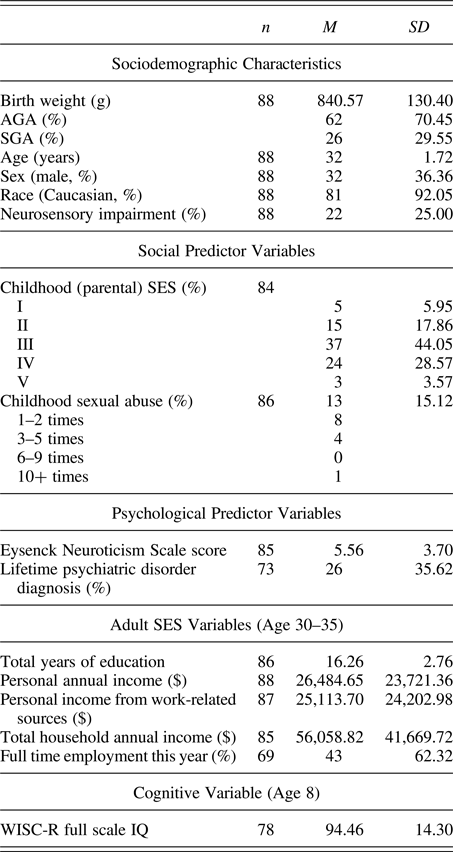
Note: AGA, average for gestational age; SGA, small for gestational age; SES, socioeconomic status; WISC-R, Wechsler Intelligence Scale for Children—Revised.
Compared to participants in the study (Table 2), nonparticipants were more likely to be male (p = .001), have a lower childhood SES (p = .002), and have a lower childhood IQ (M = 87, SD = 17, p = .01).
Characteristics of participants and nonparticipants
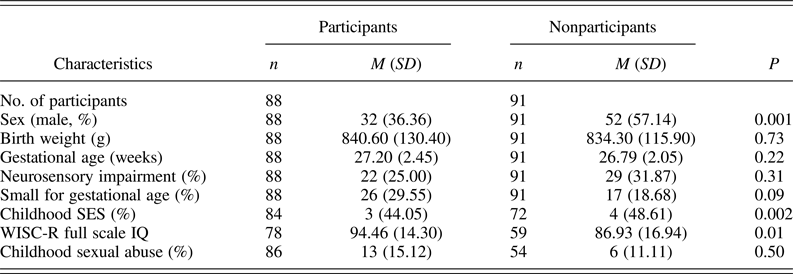
Note: SES, socioeconomic status; WISC-R, Wechsler Intelligence Scale for Children—Revised.
Outcome measure: Annual personal income
At age 30–35, all participants completed a standardized sociodemographic assessment using questions from the Ontario Child Health Study questionnaires (Boyle et al., Reference Boyle, Offord, Hofmann, Catlin, Byles, Cadman and Szatmari1987). Here, ELBW participants self-reported the dollar amount they had received over the past 12 months from seven sources: wages and salaries before deductions, self-employment, employment-insurance benefits, provincial and federal child benefits, social assistance, child and spousal support, and any other income sources such as dividends, interest, capital gains, and gratuities. Personal income was explored two ways in this study. First, the overall personal income amount was calculated by summing together the amount for each income source. Second, work-related personal income was calculated by summing together the amount of income earned solely from wages, salaries, and self-employment. The average overall annual personal income for our participants was $26,484.65 (Canadian dollars, SD = 23,721.36; Table 1), and the average personal income from work-related sources was $25,113.70 (SD = 24,202.98). Based on 2013 national estimates, the median total income of individuals in Canada was approximately $32,020 (Statistics Canada, 2015).
Moderator measure: Cognition at age 8
Childhood cognitive abilities were assessed via the Wechsler Intelligence Scale for Children—Revised (WISC-R) at age 8. Details of this assessment have been previously reported (Saigal, Szatmari, Rosenbaum, Campbell, & King, Reference Saigal, Szatmari, Rosenbaum, Campbell and King1991). The WISC-R cognitive assessment is composed of 10 subscales that examine a range of cognitive abilities, such as processing speed, alertness to detail, visuospatial abilities, fluid intelligence, verbal comprehension, reading, and language abilities (Wechsler, Reference Wechsler1974). All of these scales are combined to produce an overall IQ score (M = 100, SD = 15). The WISC-R full-scale IQ score not only has high test–retest reliability in general population samples (α = 0.98) but also has high reliability in children with learning disabilities (α = 0.85; Covin, Reference Covin1977; Irwin, Reference Irwin1966). The mean childhood IQ of participants was 95 (SD = 14; Table 1).
Postnatal adversities
We examined the influence of two social/environmental and two psychological adversity variables on personal income attainment in ELBW survivors. Childhood SES and childhood sexual abuse were selected to represent social/environmental adversities, and trait neuroticism and diagnosis of a lifetime nonsubstance psychiatric disorder were selected to represent psychological adversities.
Social/environmental adversity measures
Childhood SES was assessed at age 8 using the Hollingshead Two-Factor Index of Social Position. SES was self-reported by the parents of participants who indicated their education level and occupational prestige (Hollingshead, Reference Hollingshead1969). This index ranges from 1 (highest SES level) to 5 (lowest SES level). The majority of participants’ parents had a middle-class SES (Level 3, 44%; Table 1).
Childhood sexual abuse (CSA) was reported by participants retrospectively at age 22–26 using the abbreviated version of the Childhood Experiences of Violence Questionnaire (Tanaka et al., Reference Tanaka, Wekerle, Leung, Waechter, Gonzalez, Jamieson and MacMillan2012; Walsh, MacMillan, Trocmé, Jamieson, & Boyle, Reference Walsh, MacMillan, Trocmé, Jamieson and Boyle2008). Participants were asked, “Before age 16 when you were growing up, did anyone ever do any of the following things when you did not want them to: touch the private parts of your body or make you touch their private parts, threaten or try to have sex with you, or sexually force themselves on you?” This item has been shown to have acceptable test–retest reliability (κ = 0.91), as well as construct and criterion validity (κ = 0.69) with other abuse measures (Tanaka et al., Reference Tanaka, Wekerle, Leung, Waechter, Gonzalez, Jamieson and MacMillan2012). Participants had the option to report never, 1–2 times, 3–5 times, 6–10 times, or more than 10 times; 13 participants reported exposure to CSA (1–2 times, n = 8; 3–5 times, n = 4; and more than 10 times, n = 1). Based on the known skewness of victimization variables (Macmillan, Reference Macmillan2000), we chose to dichotomize this variable into never abused (coded 0) or previously abused (coded 1) for analyses.
Psychological adversity measures
At age 30–35, the lifetime presence of a psychiatric disorder was assessed using the Mini International Neuropsychiatric Interview (MINI). The MINI is a validated, structured psychiatric diagnostic interview (Sheehan et al., Reference Sheehan, Lecrubier, Sheehan, Amorim, Janavs, Weiller and Dunbar1998) that aligns with DSM-IV and ICD-10 psychiatric diagnoses. The MINI was administered to each ELBW participant in a private room by trained graduate students at McMaster University. Additional details of this assessment have been previously reported (Van Lieshout et al., Reference Van Lieshout, Boyle, Saigal, Morrison and Schmidt2015). This interview assessed the lifetime presence of major depressive, bipolar, dysthymic, panic, posttraumatic stress, and alcohol or substance use disorders. Given our limited sample size and since ELBW survivors are at increased risk for non–substance use disorders, but at reduced risk of substance use problems (Van Lieshout et al., Reference Van Lieshout, Boyle, Saigal, Morrison and Schmidt2015), we combined all nonsubstance disorders into a single summary estimate: presence (coded 1) or absence lifetime psychiatric disorder (coded 0). Thirty-six percent of participants were identified to have a lifetime non–substance use related psychiatric disorder (Table 1). Although lifetime psychiatric disorder presence was examined at the same time as income attainment, the MINI assessed the presence of psychiatric disorder at any point in their lives up to that point, not just in the present.
Finally, beause personality traits seen in early life are thought to be relatively stable until at least middle age (Caspi & Roberts, Reference Caspi and Roberts2001; Milojev & Sibley, Reference Milojev and Sibley2014), we examined trait neuroticism using the Eysenck Personality Inventory assessed at ages 30–35. The Eysenck Personality Inventory is a 48-item questionnaire that produces four scales of different personality factors: extraversion, psychoticism, neuroticism, and social desirability or conformity (Eysenck, Eysenck, & Barrett, Reference Eysenck, Eysenck and Barrett1985). The neuroticism scale was calculated by summing the results of 12 questions; this scale has been shown to have adequate reliability in men (α = 0.84) and women (α = .80; Eysenck et al., Reference Eysenck, Eysenck and Barrett1985). The sample had a mean score of 5.6 (SD = 3.8) on the Eysenck neuroticism scale.
Covariate measures
Within moderation models, the presence of a neurosensory impairment, current age, sex, and years of educational attainment at age 30–35 years were controlled for because these are either associated with low birth weight, attrition in the sample (Van Lieshout et al., Reference Van Lieshout, Boyle, Saigal, Morrison and Schmidt2015), or known confounding factors (Basten et al., Reference Basten, Jaekel, Johnson, Gilmore and Wolke2015; Strenze, Reference Strenze2007). Neurosensory impairment was diagnosed by pediatricians; it was defined as the presence of one or more of the following disorders: cerebral palsy, mental retardation, blindness, deafness, or microcephaly. The number of years of education each cohort member had successfully completed at age 30–35 were self-reported by participants. Childhood SES was also used as a covariate in CSA, psychiatric disorder, and trait neuroticism statistical models.
Statistical analyses
All statistical analyses were performed using SAS Version 9.4. The differences in mean childhood IQ levels among participants exposed to psychosocial adversities compared to those unexposed to adversities was examined using two-sample t tests and analyses of variance techniques where appropriate. No differences were seen in mean IQ levels among those survivors exposed and not exposed to adversities (see online-only supplementary materials).
To explore the moderating influence of childhood cognition on psychosocial context in predicting overall income attainment at 30–35, we performed hierarchal linear regression modeling. For each moderation model, three steps were performed. The first step regressed overall personal income attainment on each individual psychosocial adversity variable (i.e., childhood SES, CSA, psychiatric disorder, or neuroticism) and all covariates. The second step regressed overall personal income attainment on childhood IQ (WISC-R full-scale IQ score), each individual psychosocial variable, and all covariates. The third step regressed overall personal income attainment on all predictors from the second step and an interaction term between child IQ and the psychosocial factor. These models were then repeated using annual personal income from work-related sources as the dependent variable.
To minimize collinearity and improve the accuracy of our models, all continuous predictors were centered and childhood IQ was standardized (1 SD = 14.3 IQ points) in our models. After completing regression analyses, any significant interactions were further explored using probing techniques for multiple linear regression (Preacher, Curran, & Bauer, Reference Preacher, Curran and Bauer2006).
We performed multiple steps to assess the assumptions and fit of our models. Linearity and homoscedasticity were explored with the residual by predictor and residual by predicted value scatterplots. Normality was explored using the Q-Q scatterplot. These assumptions were explored during each stage of the model building. Given the known skewness of the personal income variable (the dependent variable), heteroscedasticity was seen in the residual by predicted value scatterplots for all models. Therefore, we performed linear regressions where the square root of income was used as the dependent variable as this transformation provided the most appropriate residual by predicted value scatterplot. In addition, we also explored our models using a Tobit regression model to account for the upper and lower ceiling values in our data. Further, if there were participants with high leverage values in our models, we performed sensitivity analyses removing these individuals. As the results from the original linear regression model did not differ from the models where the square root of income was the dependent variable, the Tobit models, or the models with outliers removed, in order to maximize the interpretability of our findings, we present the results for our original models.
To account for missing covariate data in our cohort, we also performed a 20-iteration multiple imputation analysis. As no significant differences were seen between complete case and multiple imputation models, we report results only for the participants with complete data. Results of hierarchical linear regressions are reported as regression coefficients (β) and their standard errors. All statistical tests were two tailed using an α = 0.05 significance level.
Results
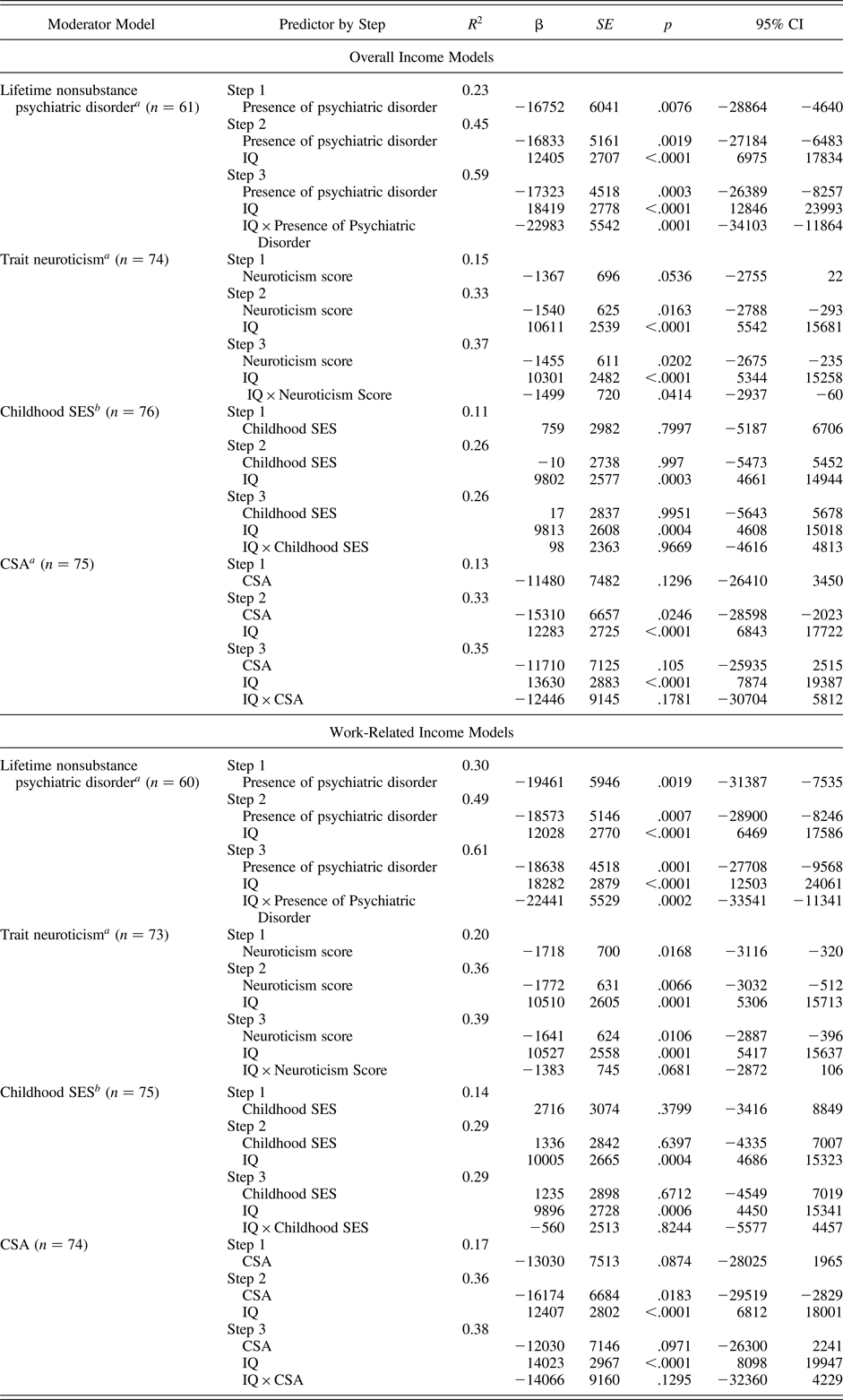
To examine the moderating influence of cognitive reserve (represented by childhood IQ) on the association between psychosocial adversity and overall and work-related adult income attainment, we explored the influence of childhood SES, CSA, lifetime psychiatric disorder diagnosis, and trait neuroticism using a three-step hierarchical regression for each predictor (Table 3). Childhood SES and CSA were considered as social/environmental adversity predictors, and psychiatric disorder and trait neuroticism were considered as psychological predictors.
Social and psychological moderation regression analyses predicting overall and work-related income attainment at ages 30–35 in extremely low birth weight survivors
Note: SES, socioeconomic status; CSA, childhood sexual abuse.
aModel covariates for all steps include childhood SES, current age, educational attainment at age 30–35, neurosensory impairment status, and sex.
bModel covariates for all steps include current age, educational attainment at age 30–35, neurosensory impairment status, and sex.
Psychological adversity models
In models examining the presence of a lifetime psychiatric disorder, the first regression step where the presence of a psychiatric disorder and covariates were regressed on overall personal income indicated that participants with a lifetime nonsubstance psychiatric disorder reported annual earnings $16,752, p = .008; 95% confidence interval (CI) [–28,864, –4,640], lower at age 30–35 compared to participants without a psychiatric disorder. In the second step where childhood IQ was added to the model, participants with the presence of a psychiatric disorder reported annual earnings $16,833, p = .002; 95% CI [–27,184, –6,483], lower at age 30–35 compared to participants without a psychiatric disorder. Childhood IQ was a significant predictor of income attainment in this model, in that every standard deviation increase in IQ was associated with a $12,405 increase in reported adult earnings, 95% CI [6,975, 17,834]. When examining the interaction of childhood IQ and presence of a psychiatric disorder (Step 3, Figure 1), participants with a psychiatric disorder who had higher childhood IQ reported a lower annual personal income, 95% CI [–34,103, –11,864]. Probing this result suggested that cognition was not predictive of later income in survivors with psychiatric disorders. For those without psychiatric disorders, cognition predicted higher reported earnings at age 30–35. These findings were replicated when using personal income from work-related sources as the dependent variable (Table 3).
Interaction of lifetime psychiatric disorder and childhood IQ on overall personal income attainment at age 30–35.

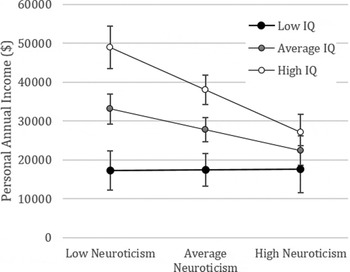
Similar main effects were seen in the trait neuroticism model. When both IQ and trait neuroticism were examined as predictors of adult income (Step 2), every standard deviation increase in IQ was associated with a $10,611 increase in annual earnings, 95% CI [5,542, 15,681], and every 1-point increase in neuroticism score was associated with a $1,540 decrease in annual earnings at age 30–35, 95% CI [–2,788, –293]. When the interaction of these two predictors was examined (Step 3, Figure 2), our model indicated that those with higher neuroticism scores and higher childhood IQ reported lower annual incomes at age 30–35, 95% CI [–2,937, –60]. Probing this result suggested that cognition was not predictive of later income in survivors with higher neuroticism scores, but it was in those survivors with lower neuroticism scores. The direction and magnitude of these findings was replicated using personal income from work-related sources as the dependent variable, although the interaction term between childhood IQ and trait neuroticism was no longer statistically significant, β = –1,383, p = .07, 95% CI [2,872, 106].
Interaction of trait neuroticism by childhood IQ on overall personal income attainment at age 30–35.

Social/environmental adversity models
To explore the moderating role of cognitive reserve on the association between social/environmental adversity and annual earnings at age 30–35, we explored the influence of familial SES in childhood and CSA. Childhood SES was not a significant predictor of personal income: Step 2, β = –10, 95% CI [–5,473, 5,452]. This did not change in Step 3 of the model, indicating that there was no statistical moderating effect of childhood cognition on SES in predicting adult income attainment within our ELBW sample. When using work-related personal income as the dependent variable, these findings did not change.
In our models examining CSA, when entered in Step 1, there was not a statistical association between CSA and later earnings, β = –11,480, 95% CI [–26,410, 3,450]. However, a statistically significant negative association, β = –15,310, 95% CI [–28,598, –2,023], was found between CSA exposure and adult annual earnings in Step 2 when childhood IQ was added to the equation. Although the coefficient of the interaction between CSA and childhood IQ was similar in magnitude to the findings of our psychological moderators (Step 3, β = –12,446), our model did not indicate the presence of a statistically significant interaction between CSA and childhood IQ on adult income, 95% CI [–30,704, 5,812].
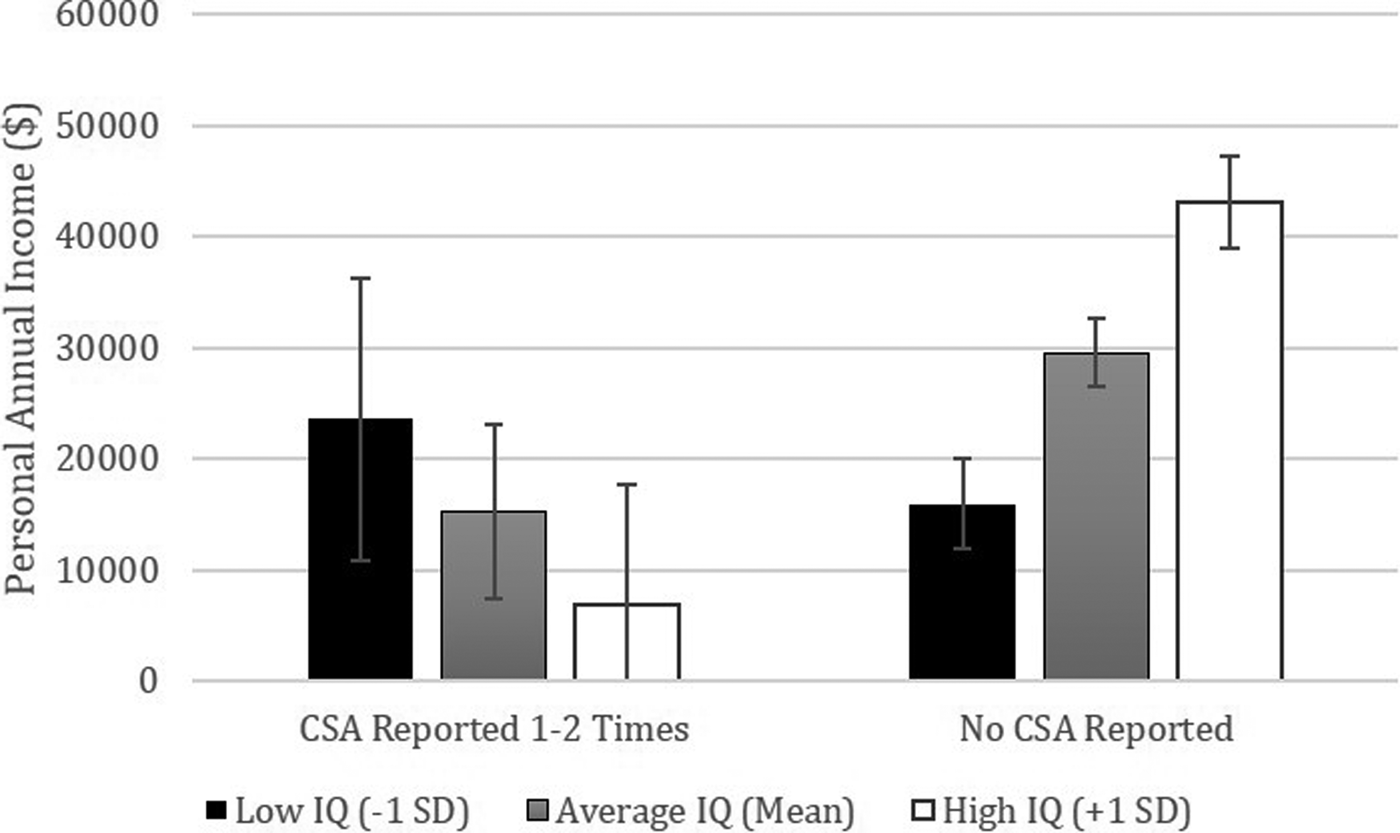
As the majority of participants who reported CSA reported being abused 1–2 times, we performed a post hoc moderation analysis using three categories of the CSA variable: those who reported CSA 1–2 times (n = 8) compared to never being abused, CSA 3–5 times versus never being abused (n = 4), and CSA more than 10 times versus never being abused (n = 1). This post hoc regression analysis indicated that the variable for CSA reported more than 10 times did not offer enough information to provide a reliable estimate of income attainment. Therefore, this individual was excluded in the model as no coefficient estimate was provided. However, when examining CSA reported 1–2 times and 3–5 times, we did find a significant main effect between CSA reported 1–2 and annual earnings, β = –17,147, 95% CI [–34,245, –50, but not for CSA reported 3–5 times, β = –6,854, 95% CI [–28,559, 14,852]. When examining the interaction between CSA and childhood IQ (Figure 3), those who reported being sexually assaulted 1–2 times and who had higher IQ reported lower incomes at age 30–35, β = –21,971, 95%CI [–40,375, –3,568]; this interaction was not present among those who reported CSA more than 3 times. When using work-related personal income as the dependent variable, again our findings did not change (Table 3); IQ × CSA, 1–2 times, β = –22,646, p = .019, 95% CI [–41,367, –3,925].
Post hoc interaction of childhood sexual abuse by childhood IQ on overall personal income attainment at age 30–35.
Discussion
We set out to explore the moderating influence of childhood cognitive functioning on the association between postnatal psychosocial adversity and personal income attainment in ELBW survivors in the fourth decade of life. Our results suggest that cognitive reserve does protect against the perinatal adversity seen in ELBW survivors, particularly among those who have not faced postnatal adversities. Contrary to our hypotheses, our results suggest that cognitive reserve may not be protective among those born ELBW and exposed to postnatal adversity (e.g., lifetime psychiatric disorder, higher trait neuroticism, and perhaps CSA) given that higher childhood IQ was not predictive of higher annual earnings in adulthood. These findings suggest that enhanced cognitive reserve in ELBW survivors may not be protective against adverse postnatal psychological factors in the prediction of socioeconomic attainment in adulthood. Finally, we did not find that childhood IQ moderated the association between early SES and income in ELBW survivors.
To our knowledge, only one study has explored the moderating role of cognitive reserve on later income in the context of low birth weight. Cook and Fletcher (Reference Cook and Fletcher2015) reported that higher neuroplasticity (i.e., cognitive reserve) mitigates the detrimental effects of lower birth weight on earnings at age 53. Our results agree with their work in that higher cognitive reserve as indexed by childhood IQ was associated with greater income attainment among ELBW survivors; however, our results disagree with their work given that this trend may not be upheld in ELBW individuals who have faced later adversities. This difference may be because our study examined a sample of individuals born solely at ELBW, rather than the general population sample employed in their study. In addition, our study utilizes a more proximal measure of cognition reserve (i.e., IQ) compared to Cook and Fletcher (Reference Cook and Fletcher2015), who examined an aggregate neuroplasticity marker. Further, our study examines annual earnings in the fourth decade of life, whereas their study examined wages in the sixth decade.
It is important that our study not only examined the direct influence of early cognitive reserve on later income attainment in ELBW survivors, but also examined how cognitive function interacts with other postnatal adversities known to influence socioeconomic attainment within this vulnerable population. This was not examined in the study by Cook and Fletcher (Reference Cook and Fletcher2015), and to date few studies among preterm samples have done so. Given that approximately 90% of infants born very preterm are surviving beyond delivery (Blencowe et al., Reference Blencowe, Cousens, Oestergaard, Chou, Moller, Narwal and Lawn2012) and 8% of individuals are born at low birth weight (Murphy et al., Reference Murphy, Mathews, Martin, Minkovitz and Strobino2017), a contemporary reality is that an increasing proportion of the population has been exposed to significant perinatal adversity. Because we are aware that these individuals are also at increased risk for poorer social and psychological development (Saigal et al., Reference Saigal, Day, Van Lieshout, Schmidt, Morrison and Boyle2016; Van Lieshout et al., Reference Van Lieshout, Boyle, Saigal, Morrison and Schmidt2015), it is important and timely to identify the modifiable mechanisms that link perinatal adversity to socioeconomic attainment, while uncovering the complex influence of known risk and protective factors underlying this association. A better understanding of the influence of different risk and protective factors can potentially lead to interventions that can help improve the socioeconomic trajectories of high-risk preterm survivors and show that no individual is “doomed from the womb.”
The moderating influence of cognitive reserve on psychological adversity
Our results suggest that cognitive reserve may not mitigate the socioeconomic consequences associated with psychological adversity among ELBW survivors in the fourth decade of life. However, given our small sample size, these results should be viewed as exploratory until they can be replicated. Our original hypothesis may not have been confirmed because the protective effects of cognitive function may be limited by the significant perinatal adversity faced by ELBW survivors. The physiological adversity associated with the risk factors of ELBW, as well as the postnatal management of ELBW may alter the functioning of cognitive networks to produce a ceiling effect, such that cognitive reserve may not function in a protective manner. According to Stern (Reference Stern2003), cognitive reserve in neurologically disrupted populations may only serve to maintain cognitive function rather than protecting against additional adversities. However, if this was truly the case, then ELBW survivors who faced adversity with lower childhood IQ should have still reported lower incomes; this is a finding that is not fully supported by our data. As such, alternative mechanisms may be contributing to our results.
Another reason why the protective effects of cognitive reserve were not seen among the ELBW survivors who had faced postnatal adversity is that the cumulative physical, social, and psychological morbidities ELBW survivors face in conjunction with their transition into adulthood may more strongly influence their earning potential and mitigate the protective influence cognitive reserve typically provides. ELBW survivors are at an increased risk for multiple physical, intellectual, and psychological morbidities, even in adulthood (Doyle & Anderson, Reference Doyle and Anderson2010) that may influence their socioeconomic attainment. Further, young adulthood (i.e., the early 20s) is thought to be a particularly stressful period for ELBW survivors (Saigal, Reference Saigal2014) since it is the first time in their lives that they are beginning to live independently with less support from their parents and childhood caregivers (Arnett, Reference Arnett2000). Perhaps the stress of this transition into adulthood, which may be perceived more strongly by those survivors with greater cognitive function, in conjunction with their other morbidities affects how well they perform at their employment, which is what truly influences their earning potential.
In addition to our data not supporting the cognitive reserve hypothesis in preterm survivors, contrary to our a priori hypotheses, our results suggest that at higher levels of childhood IQ, a negative association may exist between the presence of a lifetime psychiatric disorder, trait neuroticism, and perhaps CSA and income attainment. This may be because ELBW survivors with higher IQ perceive psychological adversities more clearly and strongly, resulting in feelings of anxiety and stress that may impact their socioeconomic attainment, or perhaps they received less support in educational and healthcare-based settings than their lower IQ peers, which may have left them more vulnerable to psychological adversity. However, there are also some methodological considerations that could have contributed to these findings. This includes our small sample size, the self-reported nature of the majority of our measures, and that some participants may not have been receiving income at 30–35 years because they were home rearing children. As a result, these exploratory findings warrant replication before they inform policy.
At odds with our psychosocial findings, we failed to observe an interaction between childhood SES and IQ in predicting later income attainment. Apart from limitations given our sample size, this may be because our socioeconomic measure was not sensitive enough. In addition, this finding may be because the influence of early SES may be represented through other variables in our model such as cognition and educational attainment. It is thought that childhood social class completely indirectly influences earning potential through other childhood factors such as social network, attitudes toward education, and cognitive function (Dubow et al., Reference Dubow, Boxer and Huesmann2009; Manley et al., Reference Manley, Roberts, Doyle, Schmidt, Anderson and Barrington2015).
Limitations
Although this study furthers our knowledge about the mechanisms by which socioeconomic attainment develops in preterm survivors, its results must be viewed in light of its limitations. First, the most prominent threat to the generalizability of our results is the sample attrition that has occurred in our cohort over the past 30 years (childhood n = 143, adulthood n = 88). However, to help mitigate the bias caused by differential attrition, in our models we controlled for predictors of attrition (i.e., sex and childhood SES). We also performed multiple imputation analyses using 20 imputed samples in which our results did not differ from those presented. Further, nonparticipants were more likely to have lower childhood IQ, potentially underestimating the impact of early life cognition and how it interacts with psychosocial contexts in our results. In addition, because the cohort studied comprises Canadian preterm survivors born in the late 1970s, there may some limitations to the generalizability of our results. For example, access to universal health care, the availability of certain medical treatments, and the high-quality public education within Canada may not be reflective of ELBW survivors from other countries. As such, additional research in more current, high-risk pediatric samples is required for replication purposes. However, in the absence of contemporary cohorts that have followed preterm survivors into the fourth decade of life, these findings remain novel and important.
Second, another limitation of our study is the self-reported nature of almost all variables (excluding neurosensory impairment and psychiatric disorder diagnosis) used in the analyses, particularly the socioeconomic outcome measures, which may overestimate the strength of our study findings (Reuben et al., Reference Reuben, Moffitt, Caspi, Belsky, Harrington, Schroeder and Danese2016). As participants self-reported their income sources, this may have been subject to recall, reporting, or social desirability biases (i.e., participants indicating values that they believed the research team wanted to see) and may result in an overestimation of their actual income. However, we attempted to minimize this reporting bias by asking participants clear questions and provided detailed definitions about multiple sources of their annual income.
Third, a threat present in our study is the potential temporal ambiguity between psychological contextual factors and our socioeconomic outcome as these were both assessed at age 30–35. For example, it is possible that psychiatric disorders and trait neuroticism may occur as a result of poor income attainment rather than because of unfavorable socioeconomic circumstances. However, we chose to examine these measures for two reasons: (a) it has been established that lifetime psychiatric disorders, even when reported in adulthood, are likely to begin in childhood (Johnston et al., Reference Johnston, Propper, Pudney and Shields2014; Kessler et al., Reference Kessler, Amminger, Aguilar-Gaziola, Alonso, Lee and Űstűn2007), and (b) evidence in general populations has suggested that psychological distress (although it may begin in childhood) has a stronger effect on socioeconomic outcomes in later adolescence and adulthood (Macmillan, Reference Macmillan2000).
Fourth, a limitation that must be considered when interpreting the results from this study is the sample size of the cohort. Moderation analyses typically require a large sample size, and so our results would benefit from replication in larger cohorts. However, it should be noted that prospective cohorts of ELBW survivors from the 1970s and 1980s are generally quite small, ranging from 73 to 125 ELBW/extremely premature participants (Hack et al., Reference Hack, Taylor, Klein, Eiben, Schatschneider and Mercuri-Minich1994; Whitfield, Grunau, & Holsti, Reference Whitfield, Grunau and Holsti1997).
Fifth, another limitation regarding the sample of our study is that we did not specifically account for participants who were raising children and how this might affect their income attainment. Eighteen participants reported having children and 14 participants reported receiving income from child benefits; however, only 3 of these 14 participants did not receive income from salaries or self-employment, suggesting the majority of individuals with children in the cohort were working. Only 5 participants with children reported receiving no income from employment; of these 5 participants, 1 was reported to have a psychiatric disorder, 1 reported being sexually abused 1–2 times, neuroticism scores were generally around the average (~5.6), and IQs ranged from 81 to 109.
Given the associations among CSA, neuroticism, and psychiatric disorders (Roy, Reference Roy2002), it is possible that the consistencies observed in our findings are due to their similarities rather than being generalizable across multiple adversities. As a result, replication of our findings is required, as well as further testing of the interaction of cognition with less closely related adversities in order to validate our findings. Finally, as the cohort was born in the late 1970s, our cohort was not privy to many of the recent medical advances in neonatal care. As such, our results may be less generalizable to more recent generations of ELBW survivors. Nevertheless, it has been established that ELBW survivors born in the 1990s face similar cognitive challenges to our cohort (Kuban et al., Reference Kuban, Joseph, O'Shea, Allred, Heeren and Douglass2016); therefore, we feel our results are important and may be used to guide cognitive intervention and policy for ELBW survivors at any age.
Conclusions and future directions
To our knowledge, this is the first study that has attempted to test the cognitive reserve hypothesis in preterm survivors and examined how childhood IQ moderates the association between early social and psychological adversities and income in adulthood in a sample exposed to perinatal adversity. Our measure of childhood IQ is both reliable and valid (Deary & Batty, Reference Deary and Batty2007), and in keeping with previous recommendations in the field, we assess outcomes more than 20 years after our cognitive assessments, which provides more robust findings and reduces bias (Strenze, Reference Strenze2007). Finally, our cohort includes both men and women with a range of early SES and range of cognitive abilities, which increases the generalizability of our results.
Our study suggests that the protective effect of cognitive reserve on income attainment in ELBW survivors is evident among those who do not face postnatal adversity; however, the protective effect of cognitive reserve may be diminished by early psychological adversity resulting in lower income attainment in adulthood. In hopes to further this area of research and provide evidence for interventions and policies to improve the cognitive functioning of low birth weight survivors, we recommend that future research replicates this exploratory study, as well as exploring similar associations using other moderators and socioeconomic outcomes during different developmental epochs; examines different cognitive predictors apart from general intelligence; and replicates findings in other atypically developing or high risk populations. By doing so, we may help individuals exposed to perinatal adversity lead the most fulfilling and productive lives possible.
Supplementary Material
To view the supplementary material for this article, please visit https://doi.org/10.1017/S0954579417001651.