With rapid globalization, footloose investors and the rise of new technology and robotization, human labour has become increasingly dispensable. This has led to the emergence of an expanding precarious workforce.Footnote 1 China is no exception. Precarious labour is a nebulous umbrella term that encompasses a range of employees who are variously known as contingency workers, temps, dispatched workers, agency workers, casuals, interns, student interns, part-time workers, flexible labour force, informal labour, peripheral labour, irregular workforce, and migrant labour.Footnote 2 One of the fastest growing of these types is agency workers.
An agency worker enters a contractual relationship with a labour supply company which then signs a contract with a client company that uses the worker's labour. The advantage for the user enterprise in hiring an agency workforce is that this indirect employment relationship allows the user to shift its legal responsibilities to the agency company. This includes hiring and firing, and paying government-mandated social insurance contributions, and, in the event of a labour dispute between workers and employer, the manufacturing enterprise will not be legally involved. This arrangement also allows the enterprise to better adjust its labour use and costs to suit the vagaries of the global market, particularly during economic downturns. Around the world, agency workers almost always are only partially protected by law and work under inferior conditions and uncertain job security.
The Emergence of Agency Workers in China
China has an unusually large share of agency workers (paiqian gong 派遣工 in Chinese, often translated as dispatch workers).Footnote 3 There are about 60 million Chinese agency workers according to one count, making them by far the biggest contingent in the world.Footnote 4 The labour agencies grew out of employment placement centres set up by state enterprises in the 1990s, when the latter downsized and had to find employment for millions of laid-off workers. Since then, employment agencies have multiplied under the market economy as demand for flexible labour has increased.Footnote 5 The central government did attempt to control the growing number of agency workers and abusive work practices by passing the Labour Contract Law in 2007Footnote 6 in the face of strong opposition from both domestic and international capital.Footnote 7 The new law clarifies the rights and obligations of both parties to the advantage of the employees. It restricts the length of the work probation period, makes signing individual labour contracts mandatory, regulates severance pay, and gives tenure to workers who have signed two fixed-term contracts and then sign a third contract. However, enforcement has been difficult and a more stringent amendment to the law was passed in 2012, which again has not seemed to have had much impact.Footnote 8
In the past decade, especially since 2010, strikes in China have become more frequent, bigger, better organized, of a longer duration and more militant. The majority are staged by migrant workers in the labour-intensive export sector in south China. A number of labour scholars have focused their attention on these strikes, but there have been fewer studies of strikes in the capital-intensive industrial sector. Lu Zhang has pioneered a study of labour resistance in China's auto industry.Footnote 9 Based on fieldwork research in the mid-2000s at seven auto assembly plants, she argues that the industry's many agency workers and student interns are second-class industrial citizens and that the regular worker/agency worker system of labour dualism causes agency workers to harbour “intense grievances.”Footnote 10 They reportedly feel discriminated against for being assigned to difficult and heavy tasks, for doing the same work as regular workers but for less pay and fewer benefits, and for being denied the same training and learning opportunities, with few chances for career advancement and no job security.Footnote 11 Based on anecdotal incidents of work stoppages, Zhang concludes that “the new generation of temporary workers in the Chinese auto industry has begun to show its capacity and potential to act collectively and to struggle for change for the better.” In a co-authored article in 2009, she and Beverly Silver proclaimed that China is “an emerging epicentre of world labour unrest,”Footnote 12 and that China's auto workers will be at the epicentre of a new wave of autoworker labour unrest and the torch bearers of China's labour movement.Footnote 13 This prediction has not borne fruit. It has been a decade since Zhang conducted her research and more than half a decade since her and Silver's prediction, yet no major strikes in China's auto assembly plants have been reported.Footnote 14
We conducted a large-scale survey of workers in major Chinese auto assembly plants in 2011. Piqued by Zhang's line of argument and using our statistical data collected from five joint auto ventures that hired agency workers, we wanted to explore the reasons why there have been no major industrial actions in the auto assembly plants.
The next section of the paper examines the organizational structure of China's joint venture automobile assembly plants. The section following that presents our survey data comparing work conditions and workers’ attitudes towards their work, management, the company and the workplace union, workers' expectations, their levels of satisfaction or dissatisfaction, and their willingness to take industrial action. The findings compare agency and regular workers at these car factories in order to assess the extent of discriminatory practices and disgruntlement among agency workers that might culminate in collective protest actions. The final section analyses the reasons why Chinese auto workers, particularly agency workers, do not engage in protests and why they are unlikely to do so in the near future.
China's Automotive Joint Ventures
China today is the largest producer of passenger cars in the world. In 2015, China manufactured 21 million cars, as many automobiles as the combined production of the world's other major producers – Japan, Germany, the US and Korea.Footnote 15 China's industrial policy strategically requires all foreign car companies that manufacture within China to set up equity joint ventures with provincial- or city-level state-owned enterprises on a 49/51 per cent or 50/50 per cent basis.Footnote 16 This not only provides the state-owned firms with a share in the profits but also facilitates technological transfer, as well as ensuring some control over the foreign partner and Chinese workers. Joint venture cars have enjoyed roaring sales in the past decade and have garnered big profits.
There is a division of responsibility between the two joint venture partners. The foreign partner takes charge of technology and production, while the Chinese counterpart takes charge of administration and personnel. The organizational structure and mode of operations of the Chinese partner bear some resemblance to the state-owned enterprises. Top Chinese managers are akin to political appointees: the Party branch secretary holds the top administrative position in the Chinese partnership; the Party branch committee is the ultimate authority; and the workplace trade union chair, who is appointed by the Party, is a member of management and enjoys the status, salary and benefits of a deputy manager.Footnote 17 The foreign partner is happy to cooperate with the Chinese partner to cap wages and set work conditions, terms which can only be attained in their home countries after hard bargaining with trade unions.Footnote 18
Research Methodology
In all, we conducted surveys among workers from 12 auto assembly plants. For this journal article, we will present the data from the five joint venture factories that regularly hire agency workers so that the data are comparable. The foreign partners of these five plants are German, American, and Japanese, and they have a significant market share internationally and in China. They are Guangzhou Toyota (GZ-TY), Shanghai General Motors (SH-GM), Shanghai Volkswagen (SH-VW), Tianjin Toyota (TJ-TY) and Yantai General Motors (YT-GM). They are all large modern assembly plants that hire 3,000 to 5,000 employees each.
We were unable to obtain permission from the top management at these factories to conduct a random sample survey of their regular and agency workers’ work conditions and attitudes. We therefore devised an alternative method for our survey. As workers departed work at their end of their shift, we and our assistants (who were Masters students in labour studies) waited near factory gates, at bus stops, subway stations and workers’ communities, locations that were free from management interference. We surveyed approximately 100 blue-collar workers outside each of the five plants, a sample size that, when carefully implemented, is sufficient to reduce potential biases. To minimize any bias, we used various means to ensure that the sample covered all types of shop-floor workers in all the major departments of a plant and also included each of the different shifts of shop-floor workers. Guarantees were made to the respondents that they would remain anonymous. From the five joint ventures, 483 valid questionnaires were collected, of which 243 were agency workers and 240 regular workers. To the best of our knowledge, the sample size of this survey is the largest on this type of topic undertaken in China. We also followed up the survey with a number of in-depth interviews with workers from each of the plants. In addition, we were able to interview several Chinese managers at two of the five factories, although these interviews were conducted in formal settings where two or three other officials were also present.
Our survey findings are presented in nine tables. The first four cover demographic data, objective work conditions, and material compensation in the five joint ventures. The remaining five tables cover the regular and agency workers’ attitudes towards management, levels of job satisfaction, awareness of legal rights, and willingness to take protest actions.
General Demographic Data
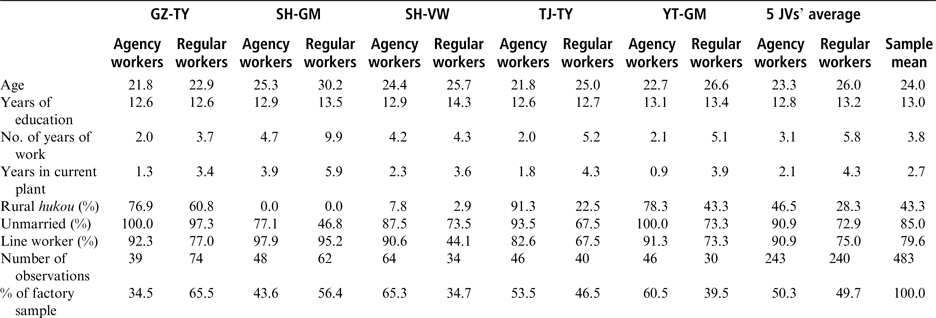
Table 1 shows that the average age of the workforce is 24, which is very young compared to the 40-years-old plus workforce in the plants of advanced countries. Young workers are preferred for their ability to tolerate intensive work and long hours on the assembly line. The older workers who had transferred from the parent Chinese state-owned auto enterprises had either been promoted to supervisory positions or else had retired. All of the current workers, be they regular or agency, had at least 12 years of education, and many also had a couple of years of vocational, technical or college education. On average, the regular workers in our sample had only one year of education more than agency workers.
Basic Information about Workers in the Five Auto Joint Ventures
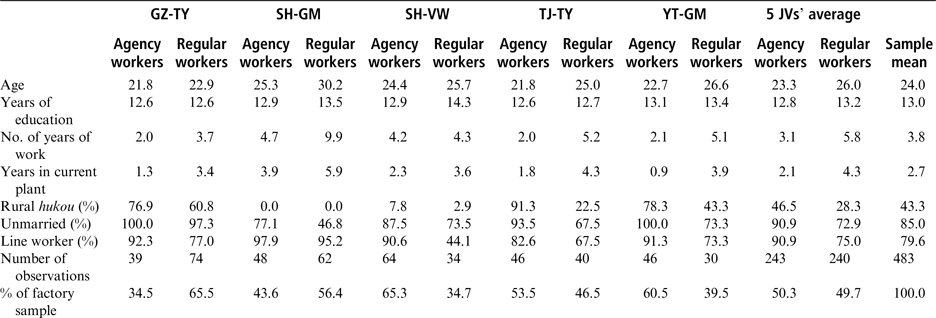
City governments are keen to reserve “good” jobs for their own populace, and jobs in auto joint ventures are considered to be good. Some cities impose a discriminatory hiring policy in the auto plants to give preference to local young people when hiring regular workers. As a result, only 28.3 per cent of regular workers had a rural household registration (hukou 户口), compared to 46.5 per cent of agency workers. It seems Shanghai has a stricter policy of giving auto jobs to locals than other cities because both Shanghai-GM and Shanghai-VW either had no workers with rural registrations or just a tiny number and the agency workers were almost all from urban-registered households. These two auto factories provide a corrective to the popular image that agency workers are almost synonymous to migrant workers. In the other three plants, a high percentage of the agency workers had rural registrations.
Employment Contracts and Chances of Changing Worker Status
The Labour Contract Law of 2007 was not able to constrain the expansion of agency workers in China. Our survey was conducted in 2011, a year of sustained high demand for cars in China, at the tail end of the central government's stimulus package introduced at the beginning of the global recession of 2008.Footnote 19 At a time of soaring sales and plant expansions, a couple of the plants increased the proportion of their agency workers. An agency worker in 2012 told us that in his work group there were seven agency workers and only two regular workers.
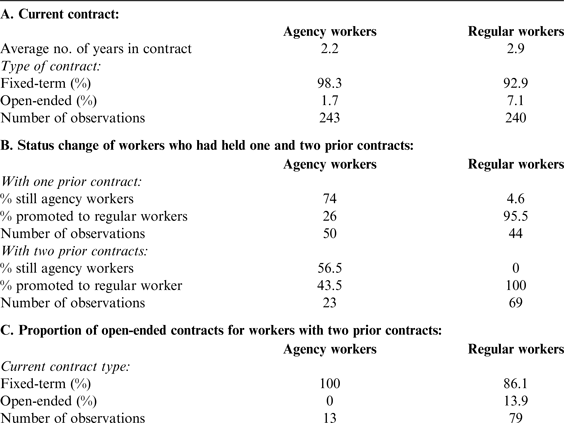
At these plants, agency workers often work side by side with regular workers. The contracts the agency workers sign with the employment agencies are of shorter duration than the regular workers’ contracts with the auto companies, but the difference tends to be small. Of the agency workers we surveyed, 76.5 per cent had two-year contracts, averaging 2.2 years, whereas 70 per cent of the regular workers had contracts for three years or more, averaging 2.9 years (Table 2), a difference of slightly more than half a year. What were the agency workers’ chances of having their contracts renewed? What was the likelihood of an agency worker becoming a regular worker? What possibilities were there for regular workers to sign longer-term contracts as they climbed the internal career ladder? To explore these questions, we asked respondents about their past contracts and their subjective assessment of their chances when the current one expired. Because not everyone was interested in continuing to work in an auto plant, we also asked respondents about their willingness to continue if offered a renewal of their contracts. Table 2 presents the findings in three sections.
Contracts and Promotion Prospects
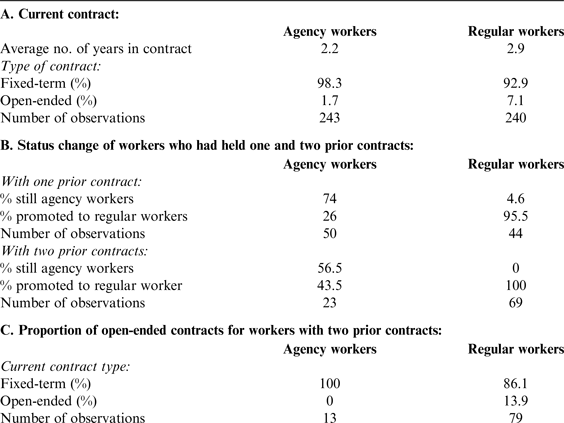
Table 2A shows that the majority of workers, regardless of their work status, had fixed-term contracts. Of the 240 regular workers, 44 (18.3 per cent) had had one prior contract, 69 (28.8 per cent) had two prior contracts, and 127 (52.9 per cent) were newly recruited and had only a current contract. Among the 243 agency workers, 50 (20.5 per cent) had one prior contact and 23 (9.5 per cent) had two prior contracts, while 160 (65.8 per cent) were newly recruited. Table 2B shows the current status of the workers who had signed one prior contract. A quarter of the agency workers (26 per cent) had a chance to be selected to join the regular worker stream, whereas of the 44 regular workers who had held a previous contract, the large majority (95.4 per cent) continued to be regular workers. Table 2C shows the current status of workers who had signed two earlier contracts. Among these, 23 had been agency workers; 56.5 per cent of them still remained as agency workers, while 43.48 per cent had become regular workers. All of the 69 regular workers who had signed two earlier contracts remained regular workers.
The three sections of Table 2 show that the status of regular workers was relatively stable, while agency workers had a chance to be promoted to regular worker if they could secure a new contract after the first one. Table 2C shows that none of the agency workers in the survey had obtained an open-ended contract after having signed two contracts; only 13.9 per cent of regular workers had successfully obtained open-ended contracts. This is a violation of the Labour Contract Law, which states that after having signed two fixed-term contracts with the same company, a worker is entitled to sign an open-ended contract. This means that managers normally are only willing to renew contracts on a short-term basis in order to maintain a flexible labour force. From the agency workers’ perspective, the chance of becoming a regular worker is close to half if they remain at the factory; however, the chance of getting an open-ended contract is close to zero.
Our data also show that the chances for an agency worker having a long-term career in the plant are worse than for regular workers, but workers in both categories have left the plants. Is this because many workers are not given an opportunity to sign more than the first contract, or is it because they themselves quit during the first contract or decide not to take up further contracts? The general assumption is that once workers have landed a job in an auto assembly plant, they are eager to stay. But is this really the case? To find out, we asked workers the following three questions about their perceptions of the likelihood of having their contracts renewed and their willingness to stay after the current contract expired: 1) After your contract expires, do you think the company or the agency company will sign another contract with you?; 2) After your contact expires, do you want to continue working in this company?; and 3) If you want to continue, do you think you will have a good chance of staying in the company?
The answers show that more than 70 per cent of both types of workers thought that their contracts would be renewed, reaching almost 80 per cent among regular workers. The chance to continue working in the plant was high, but would they like to continue after their current contract expired? Only around 60 per cent of all workers answered in the positive (agency = 63 per cent; regular = 60 per cent). About 90 per cent of those who wanted to stay (agency = 86.9 per cent; regular = 90.1 per cent) were confident that they would be offered a new contract. In other words, the three answers indicate that about 40 per cent of both types of workers wanted to quit, and among the workers who wanted to stay, almost all believed that they would be offered a new contract. What is interesting is that agency workers believed that they had about the same chance of staying as regular workers. There was no obvious discriminatory policy targeted at getting rid of and replacing agency workers with a batch of new recruits. A further interesting finding is that the gap in expectations between agency and regular workers was small and consistent, in that agency workers’ responses were, for all three questions, only a few percentage points lower than those of the regular workers. In fact, even regular workers were aware that in times of recession, no job is secure. One regular worker told us he had done well and was expecting to be promoted to be a group leader soon, but “when the economic situation is not good and orders are low, they will kick us out.”Footnote 20
Wages, Bonuses and Benefits
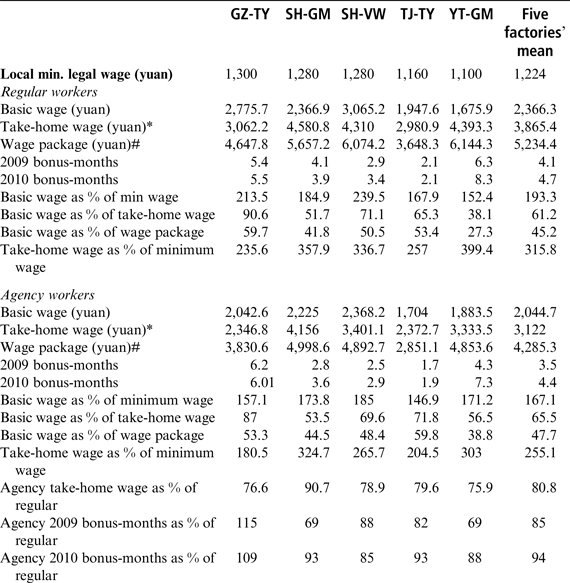
Table 3 shows that in most workshops and workstations, the difference in the monthly take-home pay of regular and agency workers was not large. On average, in the five assembly plants agency workers’ wage was 80.8 per cent of the regular workers’ wage. The average basic wage for all five Chinese plants was about double the local legal minimum wage, and the take-home pay for both types of workers ranged from two to four times more than the minimum legal wage in the cities where they were located (Table 3: Row 9 of the respective sections), albeit their pay included a large amount of overtime work.
Comparing Regular and Agency Workers’ Monthly Wage (2010) and Bonus-months (2009 and 2010)
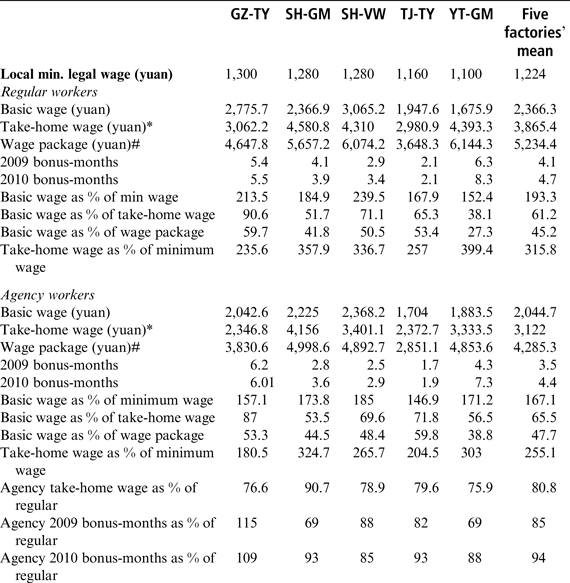
Notes: *Take-home wage = average monthly net income that includes basic wage, monthly attendance bonuses and awards, and overtime wage, excluding insurance and social security fees, and any bonuses/awards that were not distributed monthly; #wage package = take-home wage + the monthly average of the sum of annual bonuses + other bonuses + gifts. A bonus-month is the annual bonus based on a multiple of a worker's monthly basic wage. To avoid sample size biases, instead of the simple mean calculated from the whole sample directly, we use the average of the five factories’ means to represent the average outcomes at the last row. Five factories’ means = sum of the five factories’ means/five.
But, the monthly take-home pay only tells half the story about compensation. There is also a bonus, which is paid in multiples of a worker's monthly basic wage. We have labelled this “bonus-months” in Table 3. It is paid in instalments spread out during the year and can be almost as substantial as a worker's wage when the company makes a good profit and is generous. In the questionnaire, we asked workers about the number of “bonus-months” they received for 2009 and 2010. In 2010, which was a good year for auto sales, the workers in the five plants received an average of 3.8 bonus-months, and in 2009, which was not as good a year, the average was 2.9 months, fluctuating with company profits. Workers at auto joint ventures share quite a generous slice of an expanding pie compared to migrant workers in China's labour-intensive export sector. Notably, too, variations among the five plants were huge. The company that gave the lowest number of bonus-months was Tianjin-Toyota, where even regular workers only received 2 bonus-months in 2009. Of the five companies, the highest that year was Yantai-GM, paying out 6.25 bonus-months to regular workers and 4.3 bonus-months to agency workers. The highest for agency workers was Guangzhou-Toyota, which in 2009 gave them 6.19 bonus-months (regular workers, 5.4 months). Yantai-GM ranked the highest of all for both types of workers in 2010 (regular = 8.3; agency = 7.3). All in all, in 2009, the year after the global financial crisis erupted, the agency workers’ bonuses were 85 per cent of those of the regular workers; in 2010, a more profitable year, the gap was narrower, at 94 per cent.
Examined closely, there is a relationship between wages and bonuses. When the monthly wage is low, the number of bonus-months is high. Guangzhou Toyota's basic wage was the lowest of the five joint ventures in relation to each of their locales’ minimum legal wage, yet it distributed the highest number of bonus-month payments (in 2010, regular workers = 6.04 months; agency workers = 5.53) and the company provided excellent shared apartments in landscaped middle-class gated communities.
Shanghai GM and Shanghai VW devised other strategies. Both enjoyed the highest sales and set monthly wages very high for both kinds of workers (see Table 3), but compared to Guangzhou Toyota, they only awarded a moderate number of bonus-months (in 2010, Shanghai-GM regular workers = 3.9 bonus-months; SH-VW regular workers = 3.4 months). The anomaly was Yantai-GM, which set both wages and bonuses higher than the other four plants. In addition, the company had a generous company car purchase scheme for regular employees, which was topped up by a handsome monthly petrol voucher worth 1,000 yuan, a benefit that no other companies provided. When we interviewed workers outside the plant, a few of the regular line workers drove to meet us in their own cars and treated us to coffee. In interviews, the workers joked that they had no difficulty finding wives.
From these figures it is possible to conclude that these companies use bonuses to narrow the compensation gap between the two categories of workers. Presumably, this enables management to more easily gain the compliance of agency workers during busy seasons when the factories speed up the production line and impose lengthy overtime and extended night shifts. Such bonuses also presumably reduce labour turn-over.
We had not expected agency workers to receive any form of bonus; the fact that they did defies the common assumption that labour agencies in developing countries normally are not law-abiding and are often exploitative. Even when Chinese auto companies make a windfall profit, because agencies and client factories are unrelated independent business entities, there is no logical reason why the agencies should distribute bonuses to workers. In a competitive business world of profit maximization, how can we explain the generosity of the labour agencies? Could it be that the “agency companies” are de facto subsidiaries of these auto assemblers? For instance, the employment agency of one of the factories is located inside the plant. This indicates that they work extremely closely with one another, as in the disbursement of bonuses. We suspect that this has much to do with the intention of the auto companies and agencies to keep the agency workers satisfied when production volume is expanding. Training requires time and money. Keeping the turn-over rate down guarantees steady production. Keeping a sizeable agency workforce also makes downsizing the workforce easier during any future business recessions.
Work Hours and Work Conditions
Table 4 shows the work hours and rest days per week for both types of workers for the month before the survey. The Chinese Labour Law stipulates a 40-hour working week, two rest days per week, and an overtime cap of 36 hours a month. This amounts roughly to a maximum of 48 hours a week, or a maximum of 9.7 hours per weekday.Footnote 21 Our sample shows that all five plants assign overtime work. On average, agency workers worked 9.5 hours a day and regular workers 9.4 hours. Both were within the legal limit. Factoring in lunch hours, preparations before work, briefings and meetings, and after work cleaning up, workers generally had to stay at the plant for about 10 hours a day. Fortunately, they all tended to have about two days of rest every week.
Comparing Average Working Hours and Average Days of Rest in a Week

Note: N = number of observations; A = agency workers; R = regular workers.
The two types of workers worked about the same number of hours because they work side by side on the assembly line. When the line stops, everyone has to stop. There are hidden aspects that do not show up in the work-hours table – the shift systems and overtime premium systems. These varied from plant to plant and even among departments within plants. While conducting the survey, we discovered that there were many different shift arrangements. Some plants had two shifts and some had three shifts, or a mix of both depending on the departments. Some had three eight-hour shifts in a day, with the workers working for four days and resting for two. When there were night shifts, these were usually rotated every two weeks. Workers in interviews and in blogs complained bitterly about both the night shifts, which disrupted their sleep patterns, and the 11-hour shifts, which were exhausting as they had to work almost non-stop. The complicated shift systems made it difficult for workers to keep track of their overtime hours and overtime pay. One plant did not itemize hours worked on the payslip. At the other plants, calculating a wage was so complicated that a good proportion of the workers responded that they did not know how to read their payslips.
On the whole, though, these auto workers work shorter work hours than migrant workers in South China, where 12-hour days and one day off – or even no days off – a week is common.Footnote 22 Nonetheless, working 11 hours a day on an auto production line is very physically demanding, and a large number of respondents reported that they had experienced occupational health problems, suffering mainly from repetitive stress injuries (RSI). As we have shown in a previous paper, RSI is not officially recognized in China as an occupational disorder, even though it can be extremely debilitating,Footnote 23 Thus, in the survey, when asked about their ideal work and rest regime, both types of workers gave very similar answers: an eight-hour workday and two days of rest per week. When asked whether, under the present work regime, they could work until 40 years of age, only 43 per cent of regular workers and 32.6 per cent of agency workers thought that they could. Despite the comparatively high pay for manual work, good benefits, and the possibility of a career ladder that can land a regular worker with seniority in an off-line work station or even a supervisory position, less than half of the workers thought that they would last until the age of 40. RSI is one way auto companies can get rid of the “old” and the infirm through “natural attrition.”Footnote 24 It is a disorder that can shorten the work life of regular workers, and has an unintended consequence of reducing the precarity gap with agency workers.
Workers’ Loyalty to Their Company and Job Satisfaction
Have management strategies to narrow the gap between the two types of workers succeeded in mollifying agency workers’ sense of injustice and attaining workplace harmony? Survey questions explored workers’ perceptions and attitudes towards management, their levels of job satisfaction and whether they have a proclivity to express their grievances through protest actions.
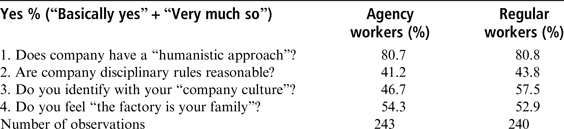
To examine workers’ attitudes towards their companies, we asked four questions (Table 5). Responses show that the two categories of workers had almost the same neutral to positive attitudes towards management. Their very high positive response to whether the company had “humanistic management” (renxinghua guanli 人性化管理), an expression widely used in China that is equivalent in English to a “people-oriented management style,” was unexpected, and the closeness of the two sets of responses was particularly surprising in light of the agency workers’ somewhat inferior conditions and low chance of life-time employment in the company.
Agency and Regular Workers’ Attitudes towards Their Companies
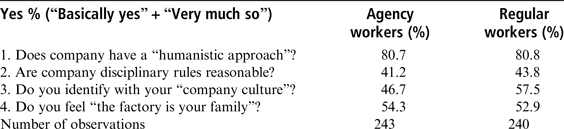
Note: There are five standardized answers for these questions: “absolutely no,” “basically no,” “so-so,” “basically yes,” and “very much so.” The “Yes %” here is the sum of % for “Basically yes” + “Very much so.”
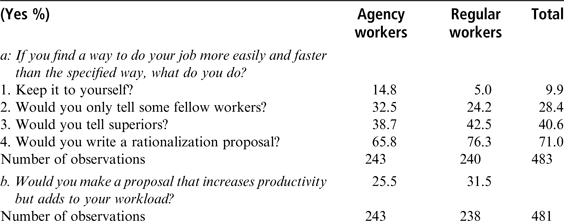
But what are their attitudes on issues that are likely to elicit a conflict of interest between labour and management? This was tested by asking a question related to the employee suggestion programme. All auto plants today have devised a programme based on the Toyota Production System (TPS) to solicit new ideas from workers on how to improve production. The aim is to instil in the workers a sense of inclusion and participation and a feeling of having some control over their work. This programme is not new; similar programmes had existed in the US and in China before the TPS was introduced. In the Maoist period, workers were encouraged to submit what were known as “rationalization suggestions” (helihua jianyi 合理化建议) as an individual's contribution to socialism, to the nation, and to the Chinese Communist Party and Chairman Mao. Mao believed that workers knew best how to raise efficiency and reorganize the production system. Thousands of such suggestions were collected at large state enterprises every year, and with time the exact number often became a quantitative measurement of workers’ political devotion and enterprise management proficiency. The original utilitarian purpose and moral incentive were lost to the counting of numbers.Footnote 25 In Chinese joint ventures today the programme still goes by the same Chinese name, but the ostensible purpose of the programme is to maintain and improve the company's quality and efficiency in a competitive market economy (instead of to serve the nation and Party, as in the Mao period), and to raise company profitability. The programme is portrayed as a win-win initiative for management and labour.
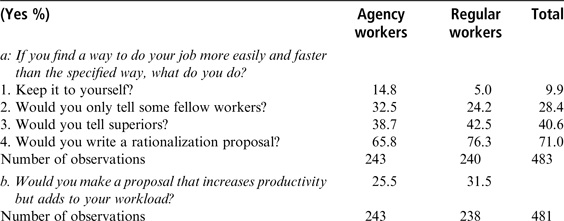
In our survey, 45 per cent of all sampled workers responded that submitting suggestions was mandatory (for instance, one or two suggestions a month); 42 per cent responded that they were encouraged to submit suggestions, and 13 per cent said it was left up to them. There was an overall feeling of being pressured to follow a programme that was touted as voluntary and participatory. When it was mandatory, workers had to wrack their brains to fulfil the month's quota. Trivial suggestions ensued: for instance, that a rubbish bin should be put here rather than there. Workers were automatically awarded a few yuan for each suggestion. Among 450 survey responses, the number of submissions of suggestions averaged at 13.7 per person per year. However, the real question is, did the workers really want to make a suggestion to their company that could help to increase productivity? To find out the extent of workers’ loyalty, we asked them a question for which they had a choice of four answers (see Table 6).
Suggestion Programmes and Company Loyalty
Note: Workers can give multiple answers; the standardized answers include: “yes,” “no,” and “don't know”. Yes % = the proportion of workers who responded “Yes”.
Choices #1 and #2 for Question 6a represent a labour-oriented attitude and choices #3 and #4 represent an attitude of loyalty to company and management. For over 50 per cent of both types of workers the most popular option was to submit a suggestion, which means their oppositional attitude towards management was not strong. Agency workers, however, were more likely (though still a minority of responses) than regular workers to either keep the suggestion to themselves or share it with co-workers. Of note is that on the whole, regular workers identify more with management.
What if a new idea results in increasing workers’ workloads and benefits only the company? Question 6b shows that in these circumstances respondents who remained willing to submit a suggestion dropped to 25.5 per cent for agency workers and 31.5 per cent for regular workers. This means that the majority of both types of worker would not want to benefit the company at the expense of themselves. Regular workers, though, were more likely to view their own interests as being in line with the company's interests. In addition, if the suggestion was really useful to the company, it might merit a promotion or a monetary award.
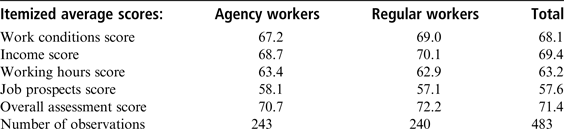
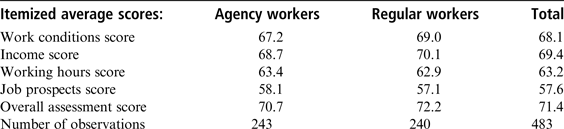
How satisfied are the workers? Table 7 breaks down their job satisfaction into four component parts. It is important to note that in China, a score of 60 is the conventional pass mark. The most interesting result is that the scores of agency and regular workers were quite similar. The other interesting finding is that although incomes were high in 2011 for both types of worker, neither group gave their income a high score. This indicates that they thought their labour was worth more than their monetary compensation. “Job prospects” was the only item that received a failed mark from both sets of workers, scoring 57–58. As discussed earlier, both groups of workers had high expectations of being offered new labour contracts. But the reason behind this failed score is understandable, since fewer than half of the workers (agency workers = 32.6 per cent; regular workers = 43 per cent) thought that they could work till the age of 40, and the prospect of obtaining open-ended contracts was low. However, the similarity of the scores reflects a situation where agency workers did not feel particularly discriminated against in terms of work conditions, income, work hours, and job prospects.
Job Satisfaction: How Would You Assess (from 0 to 100) the Following?
Note: 100 is maximum score and 60 is the conventional Chinese pass mark.
Workers’ Attitudes towards the Trade Union
Trade union officers in a joint venture are an integral part of the Chinese partner's managerial staff. Their function is much the same as in state enterprise unions, whose main responsibilities involve organizing social activities, providing welfare benefits and attending to personal problems. The five auto joint ventures in our study all have a collective agreement signed by the union and management. But do workers think that their union responds to their needs, and do they go to the union for help?
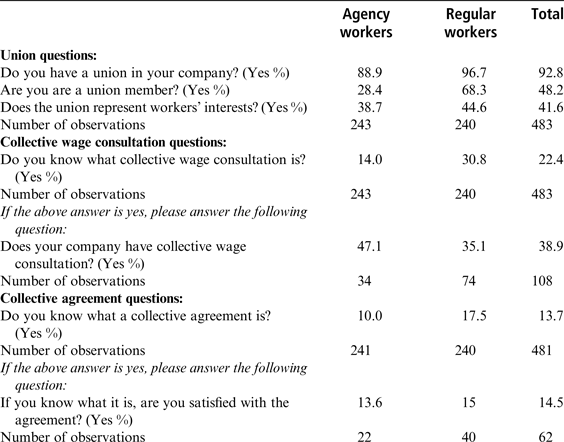
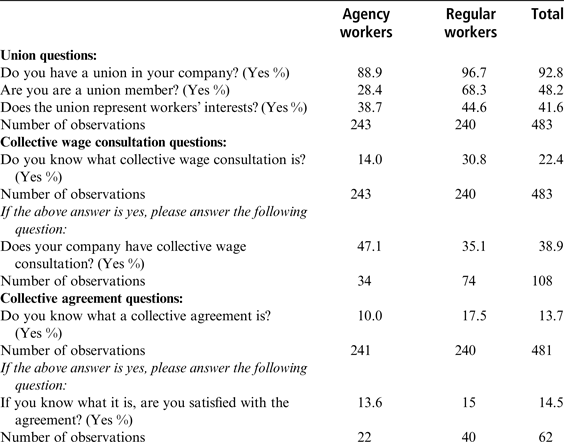
In China, workplace trade-union finances in all enterprises are supposed to derive from the payment of 2 per cent of the total payroll by management and 0.5 per cent from each member's wage. Membership fees are automatically deducted each month and itemized in payslips. In large joint ventures such as auto plants, all workers automatically become a union member after working for a few months. We asked workers whether they were aware of their membership status. Table 8 shows that only 68 per cent of the regular workers responded that they were members; about one-third said they were not. These workers were unaware of their membership either because their membership fee was not itemized in the payslip or because the union kept such a low profile that workers were barely aware of its existence.Footnote 26 The percentage of agency workers who said that they were union members was much lower, at 28.4 per cent. They were not eligible to join the auto plant's union and were instead supposed to be members of a union branch set up by the employment agency. Not many agencies have union branches, and when they do, the distance between these union branches and their members presumably would be more remote than that between the regular workers and their own company's union branch.
Workers’ Attitudes towards the Workplace Union and Collective Bargaining
Note: The standardized answers include: “Yes,” “No,” and “Don't know.” Yes % = the proportion of workers who responded “Yes”
However, when we asked if they thought that the trade union represented workers’ interests, 201 (41.6 per cent) of the sampled workers answered “yes” (agency workers = 38.7 per cent; regular workers = 44.6 per cent). How to interpret this rather positive evaluation? Interviews revealed that the workers’ evaluation was not based on whether the union bargained with management to raise wages and improve work conditions; instead, their evaluation was mainly based on the union's paternalist functions – that is, whether it performed the traditional type of Maoist trade union activities found in big state enterprises, such as helping individual workers resolve personal problems, organizing social events, sports meets and entertainment, distributing gifts and money during national festivals, visiting the sick, going to funerals, distributing relief to families in financial difficulty, and so forth. The unions use such programmes to cultivate an environment in which workers are supposed to “regard the factory as their family” (yichang weijia 以厂为家).Footnote 27 This paternalistic project appears to be quite effective.
It is clear that the workers do not regard a workplace union in terms similar to how it is understood in the West. In the second section of Table 8, the last column reveals that only 22.4 per cent (108 out of 483 workers) claimed to understand the term “collective consultation” (jitixieshang 集体协商), which is the Chinese term for collective bargaining (jititanpan 集体谈判). And, of these, only 14 per cent of agency workers (34 out of 243) and 30.8 per cent of regular workers (74 out of 240) knew the term. And, of the 108 workers who responded that they understood the term, only 38.9 per cent (agency workers = 16, regular workers = 26) were aware that there had been a collective consultative process at their factory. In sum, only about 8.7 per cent (42 out of 483) of all workers knew that a collective agreement existed. Finally, in the last section of Table 8, only 13.7 per cent (66 out of 481) of all workers believed that they understood what a collective agreement was. Out of these 66, 62 responded to a further question about whether they were satisfied with the agreement. Only 9 out of the 62 responded in the positive (regular = 6; agency = 3). In short, only 9 out of 483 workers said that they were satisfied with the collective agreement at their workplace. This figure reflects that these workplace trade union branches have kept the workers ignorant of the formalistic collective consultation process and the result of the process.
Resolving Grievances: Exit or Protest?
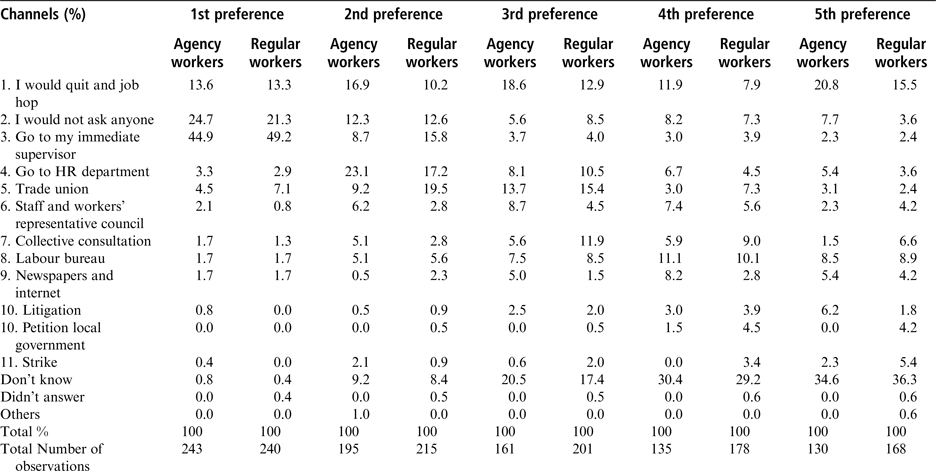
How do workers resolve their grievances? Do they use legal institutional channels or alternative channels? We presented respondents with 11 possible actions they would take, in order of five preferences. The 11 choices are grouped under three categories:
-
Category 1: #1, #2, #3 – resolving dissatisfaction at a personal level or within a small group;
-
Category 2: #4, #5, #6, #7 – resolving problems at the factory level;
-
Category 3: #8, #9, #10, #11 – taking the problems beyond the company into the public realm, listed in an order that progressively exhibits militancy.
Again, as in other tables, Table 9 shows quite a similar distribution of yes/no answers between regular and agency workers. The most popular first preference for both types of workers was Choice #3, “going to my immediate supervisor.” Just under half of all workers chose this route (agency workers = 44.9 per cent; regular workers = 49.2 per cent). The next most prevalent was “I do not ask anyone,” followed by “job hopping.” These are choices of inaction or exit (agency workers: 24.7 per cent + 13.6 per cent = 38.3 per cent; regular workers: 21.3 per cent + 13.3 per cent = 34.6 per cent).
If You Were Unhappy with Your Wage and Benefits, Who Would You Go to for Help? (Five choices, in order of preference)
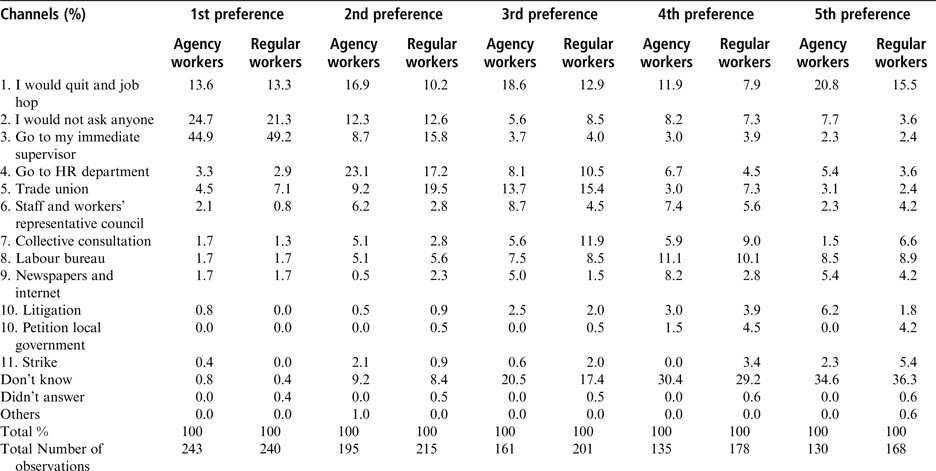
Choices #4, #5, #6 and #7 relate to the institutional channels within the factory for resolving grievances. In choosing these, workers were willing to make their grievances known beyond their immediate work circle, although still confined them to within the workplace. When grievances remained unresolved within the shop floor, the next step was to go to the human resources department (as a second preference: agency workers = 23 per cent; regular workers = 17 per cent). The third preference was to go to the trade union (agency workers = 13 per cent; regular workers = 15 per cent). The union came very low as a first preference (agency workers = 4.5 per cent: regular workers = 7 per cent).
The last four choices (#8, #9, #10 and #11) entail publicizing their grievances beyond the workplace and soliciting external help. These choices constituted only 4.4 per cent of the first preference choices. Of these four channels, the most officially sanctioned and most moderate action was to go to the local labour bureau for help, which for quite a number of workers was a third and fourth preference choice.
The most militant choice – to strike – was the first preference choice of only 0.4 per cent of more than 400 workers. Adding all five preferences together, going on strike was mentioned only 21 times by regular workers and nine times by agency workers. In other words, only a very small number of workers would consider a strike as an option, and only after all other options had been exhausted. There is no sign that agency workers are more restive or militant in this respect. The majority of workers preferred either to use internal institutional channels or to quit their job.
Conclusion
The empirical findings that emerged from this study go against our original assumption, which is the popular assumption, that auto agency workers harbour deep grievances to the point of taking resistant actions to improve their own conditions. The survey data reveal that the treatment agency workers receive and their attitudes and aspirations are not decidedly different from those of the regular workers and certainly do not provoke a strong sense of injustice and anger. In fact, the attitudes of agency and regular workers towards the company are very similar. The task that confronts us is to analyse why they are similar, not why they are different.
The timing of the survey, conducted in 2011, provides the global economic context as a backdrop. It coincided with a peak in passenger car sales in China. Many joint venture auto companies were expanding either in situ or constructing new plants in other Chinese cities and were actively recruiting assembly-line workers. To both companies and workers, the future looked bright. Companies were willing to pay high bonuses to keep down the turn-over rate and to induce workers to work overtime willingly and loyally. In these circumstances, even agency workers were given a share of the pie.
One might ask why profitable garment, toy and shoe companies set their basic wage near the level of the minimum legal wage and offer no bonuses, whereas auto manufacturing companies offer considerably higher than the local minimum legal wage and top up with generous bonuses. The value and the nature of the product helps to explain these differences. In the car-manufacturing industry, any defect can be extremely costly. A worker related a telling incident. One day, it was discovered that the bodies of a dozen or so ready-to-ship cars were marred with scratches. The whole batch had to be sent for repainting. The culprit was never found. But, according to the worker, they had a wage rise after the incident. An act of everyday resistance was enough to alert management to offer such an inducement. From management's vantage point, satisfying workers’ material needs and keeping a stable and motivated workforce are of paramount importance.Footnote 28 Both foreign and Chinese partners have an interest in ensuring that both regular and agency workers are kept reasonably satisfied.
Management's second priority is to be mindful that the differences in the reward structures and treatment of regular and agency workers are not obvious enough to foment a tense relationship between them. Agency workers have to be made to feel that they are getting a fair if not equal deal compared to regular workers, and the companies can easily afford this. Labour costs constitute only a small percentage of the total costs of auto production. Consider the big difference in take-home pay between American auto workers and Chinese workers. A lower-tier American auto worker in 2011 made roughly US$14 an hour,Footnote 29 whereas a Chinese regular worker's average monthly take-home pay, including overtime, was about US$500 (see Table 4), less than what a lower-tier American worker, without overtime hours, earned in a week. Even the yearly bonus-months in China barely make a dent in company profits. By paying agency workers about US$4,000 a year, plus a bonus, a company can keep both types of Chinese workers reasonably satisfied.
Another managerial ploy is to cultivate workers’ loyalty to the company by adopting a human touch (renqingwei 人情味) through a paternalistic style. The companies’ success in this is illustrated by the fact that 80 per cent of both types of workers in our survey thought that their companies had a humanitarian management approach (Table 7). For instance, distributing festive giftsFootnote 30 and/or money through the trade union is an important gesture that has been practised for decades in Chinese state enterprises. This tradition lives on in today's auto joint ventures. In our sample, 70 per cent of the agency workers and a slightly higher percentage of regular workers felt let down if they did not receive such gifts and money. Agency workers appreciate the inclusive gesture. The feeling that the company cares for one's well-being can buy loyalty and a willingness to share good ideas with the company, as well as compliance when extra hours of meticulous work are required.
Overall, agency workers do not feel particularly discriminated against when compared to the regular workers, as seen in their overall scores regarding job satisfaction (Table 9). In fact, one could question why the regular workers’ scores are all under 70 and not higher. Despite earning wages that are above the average for China, these workers are not entirely satisfied with their situation. It is noteworthy that their score on job security is just two points higher than that given by agency workers, meaning that they too feel that their jobs may be precarious in an economic downturn. Only by lowering the standards offered for regular workers has the gap between the two workers been narrowed. Regular workers may not be conscious of any dissatisfaction, but it is evident in the low score they give to their “high” wage. All the same, neither the objective conditions of their work environment, their livelihood or their state of emotionality are driving both groups of workers to a state of animosity and open resistance towards management. There is an overwhelming lack of interest in seeking collective representation, and less still in taking militant action.
For reasons of political sensitivity, we were not able to ask straight forward questions in our survey about whether the respondents had gone on strike or whether there had been a strike in their assembly plant. In her study, Lu Zhang records a few instances of agency workers and student interns participating in collective protests.Footnote 31 She notes that these were “short-lived, small scale, and did not go beyond economic demands.”Footnote 32 Such minor work stoppages are numerous in China's manufacturing workplaces. Compared to the large number of strikes that have broken out elsewhere among Chinese migrant workers, including demands for the election of workplace unions,Footnote 33 the small protests documented by Zhang are insignificant.
Given the nature of car manufacturing, auto workers possess more structural bargaining power owing to their position in the world's industrial system. Any sustained work stoppage costs companies many millions of dollars. But, our survey shows that these workers have not developed the agency and associational power (the power to organize themselves) to harness their structural advantage. The paternalistic and “humanistic” management system that prevails in the auto joint ventures has mitigated both regular and agency workers’ frustrations. To expect these auto agency workers to take the lead in a resistance movement would constitute what Burawoy characterizes as “false optimism.”Footnote 34
Acknowledgement
We would like to thank Zhao Wei, He Gaochao, Xie Yuhua and their students for their help in conducting the survey, and Jonathan Unger for editing a draft of the paper. The project was funded by an Australian Research Council Discovery Grant.
Biographical notes
Yiu Por (Vincent) Chen is currently a visiting professor at the School of Global Policy and Strategy, University of California, San Diego. He specializes in the political economy of development, economic geography, and labour studies. Dr Chen has been the recipient of research awards and research grants such as the Gregory Chow Best Paper Competition at the Chinese Economists Society (2008), and the Labor and Employment Relations Association Best Paper Session (2011), among others. He has also provided consultancy for development projects and evaluations for international organizations such as the World Bank. His most recent works appear in Regional Studies and Working USA.
Anita Chan is currently a visiting fellow at the Coral Bell School of Asia Pacific Affairs, Australian National University, and co-editor of The China Journal. Her present research interest focuses on comparing Chinese and Vietnam industrial relations systems. Her latest edited volumes include Walmart in China (ILR/Cornell University Press, 2011), Labor in Vietnam (Institute of Southeast Asian Studies Books, 2011) and Chinese Workers in Comparative Perspective (ILR/Cornell University Press, 2015).