Early-life stress is associated with negative physical and mental health outcomes, such as cardiovascular disease and depression (Cicchetti & Toth, Reference Cicchetti and Toth2005; Edwards, Holden, Felitti, & Anda, Reference Edwards, Holden, Felitti and Anda2003; Melchior, Moffitt, Milne, Poulton, & Caspi, Reference Melchior, Moffitt, Milne, Poulton and Caspi2007). Researchers have turned their attention to identifying biological mechanisms that explain how early adversity (e.g., maltreatment, poverty, and exposure to violence) increases risk for pathology later in life (Heim, Shugart, Craighead, & Nemeroff, Reference Heim, Shugart, Craighead and Nemeroff2010; Juster, McEwen, & Lupien, Reference Juster, McEwen and Lupien2010; McCrory, De Brito, & Viding, Reference McCrory, De Brito and Viding2010; Neigh, Gillespie, & Nemeroff, Reference Neigh, Gillespie and Nemeroff2009). Several key biological systems, including the hypothalamic–pituitary–adrenal (HPA) axis and the immune system, appear to play major roles in pathways leading from early adversity to disease (Heim, Newport, Mletzko, Miller, & Nemeroff, Reference Heim, Newport, Mletzko, Miller and Nemeroff2008; McEwen, Reference McEwen1998, Reference McEwen2008). More recent studies show that early-life stress can also cause changes at the cellular level, in the form of accelerated telomere shortening (Price, Kao, Burgers, Carpenter, & Tyrka, Reference Price, Kao, Burgers, Carpenter and Tyrka2013; Shalev, Reference Shalev2012; Tyrka et al., Reference Tyrka, Price, Kao, Porton, Marsella and Carpenter2010). In addition to identifying biomarkers of early adversity, there is a need to examine how environmental factors, such as responsive parenting, can protect children from the negative effects of early-life stress by preventing biological changes. In the current study, we examined telomere shortening in children identified as at high-risk for maltreatment following involvement in the Child Welfare System. In addition, we examined the potential role of parental responsiveness in buffering the association between early-life stress and telomere shortening.
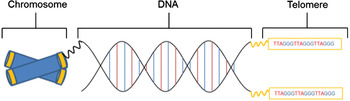
Telomeres are TTAGGG nucleotide repeats located at the ends of the chromosome (Figure 1; Blackburn, Reference Blackburn2001). Telomeres function primarily to protect genomic DNA from damage during replication; however, they progressively shorten with each replication cycle and, thus, have been proposed as a marker for biological aging (McEachern, Krauskopf, & Blackburn, Reference McEachern, Krauskopf and Blackburn2000). In normal cell lines, telomere shortening can progress to a critical point (e.g., the Hayflick limit), which triggers cellular senescence (Harley, Reference Harley1990; Hayflick & Moorhead, Reference Hayflick and Moorhead1961). Many factors can influence telomere attrition, including oxidative stress. Of particular interest, oxidative stress can induce telomere shortening in somatic cells, or cells that do not exhibit cellular replication (von Zglinicki, Reference von Zglinicki2002). Whereas telomerase, a ribonucleoprotein enzyme that adds TTAGGG repeats, aids in actively replenishing telomeric repeats during replication in germline and stem cells, this protein complex is not active in somatic cells. Thus, within somatic cell lines, telomere length and accelerated attrition induced by oxidative stress may represent a cumulative marker of chronic stress and provide a link between stress and age-related psychological disorders (O'Donovan et al., Reference O'Donovan, Tomiyama, Lin, Puterman, Adler and Kemeny2012; You et al., Reference You, Yun, Nam, Kang, Won and Lee2009).
A simplified illustration of the telomere sequences located at the end of chromosomes. [A color version of the figure can be viewed online at http://journals.cambridge.org/dpp]

Stress or adversity experienced in childhood has been linked to reduced telomere length across several studies (for a review, see Price et al., Reference Price, Kao, Burgers, Carpenter and Tyrka2013). Most of these reports have examined associations between telomere length measured in adulthood and retrospective reports of childhood stressors (e.g., maltreatment, trauma, parental death, familial mental illness, and parental unemployment; Kananen et al., Reference Kananen, Surakka, Pirkola, Suvisaari, Lonnqvist and Peltonen2010; Kiecolt-Glaser et al., Reference Kiecolt-Glaser, Gouin, Weng, Malarkey, Beversdorf and Glaser2011; O'Donovan et al., 2011; Surtees et al., Reference Surtees, Wainwright, Pooley, Luben, Khaw and Easton2011; Tyrka et al., Reference Tyrka, Price, Kao, Porton, Marsella and Carpenter2010). However, only two studies to date have investigated the association between early adversity and telomere length measured during childhood. In the Bucharest Early Intervention Project, a randomized control trial of foster care versus continued institutional care, Romanian children's telomere length in middle childhood was inversely correlated with the amount of time spent living in an institution in early childhood (Drury et al., Reference Drury, Theall, Gleason, Smyke, De Vivo and Wong2012). In another study, exposure to violence during childhood (i.e., witnessing domestic violence, experiencing frequent bullying, or experiencing physical maltreatment) was associated with the erosion of telomere length between 5 and 10 years of age (Shalev, Reference Shalev2012; Shalev et al., Reference Shalev, Moffitt, Sugden, Williams, Houts and Danese2012). Children who experienced two or more types of exposure to violence showed a significantly greater rate of telomere attrition compared to children with no exposure or one type of exposure. Taken together, these findings suggest a dose-dependent association between early-life stress and telomere shortening, with an increased number of adverse experiences or a greater duration of adversity associated with accelerated telomere shortening (Price et al., Reference Price, Kao, Burgers, Carpenter and Tyrka2013).
Even in the face of early adversity, some children show remarkable resilience across socioemotional, behavioral, and physical health domains (Cicchetti, Reference Cicchetti2010; Masten, Best, & Garmezy, Reference Masten, Best and Garmezy1990). Responsive parenting has been implicated as a key protective factor for children who experience early-life stress (Afifi & Macmillan, Reference Afifi and Macmillan2011; Laucht, Esser, & Schmidt, Reference Laucht, Esser and Schmidt2001) and may serve as a buffer from physiological changes to the body's stress systems (Gunnar, Fisher, & the Early Experience, Stress, and Prevention Network, Reference Gunnar and Fisher2006). In one study, for example, children's exposure to a greater number of psychosocial (e.g., poverty) and physical (e.g., crowding) risk factors was associated with higher levels of allostatic load (Evans, Kim, Ting, Tesher, & Shannis, Reference Evans, Kim, Ting, Tesher and Shannis2007), a measure of multiple physiological indicators of stress (McEwen, Reference McEwen2000). The association between risk exposure and allostatic load was found only among children with mothers low in responsiveness, as measured from youth reports of mothers' instrumental and emotional support, as well as observed sensitivity (i.e., appropriate responses to children's cues) during a cooperative game. Another study found that maternal responsiveness moderated the associations between early-life risk (i.e., psychosocial disadvantage and low birth weight) and childhood behavioral problems (Laucht et al., Reference Laucht, Esser and Schmidt2001). Overall, infants born to psychosocially disadvantaged families showed more internalizing and externalizing problems throughout childhood than children without psychosocial risk. However, high-quality early caregiving, rated through microlevel coding of mother and infant interactive behaviors, attenuated the effect of family adversity on children's behavior problems. For children from psychosocially disadvantaged families, higher maternal responsiveness was associated with fewer behavior problems. For children without family adversity, however, maternal responsiveness did not have an effect on children's behavior. In the same study, maternal responsiveness similarly moderated the effect of biological risk (i.e., low birth weight) on behavior problems. Very low birth weight children with high responsive mothers showed a decline in internalizing problems over time, whereas very low birth weight children with low responsive mothers showed an increase in internalizing problems over time. In the absence of this biological risk (i.e., very low birth weight), however, variability in maternal responsiveness showed no analogous effect on children's behavior problems. Together these studies offer a model for examining the protective role of parental responsiveness in preventing negative biological and behavioral sequalae for children who experience early adversity.
In the current study, we examined the role of parental responsiveness in protecting children from the damaging effects of early-life stress on telomere length measured in early childhood. Telomere length was compared between high-risk children, who were identified by the Child Welfare System as being at elevated risk for maltreatment, and low-risk comparison children. Parental responsiveness, coded from observed parent–child interactions, was examined as a moderator of the association between risk and telomere length. We focused specifically on parental responsiveness characterized by synchronous, or “serve and return,” interactions. Synchronous interactions, in which a parent contingently responds to his or her child's cues, behaviors, and expressions, are thought to play an especially important role during early childhood in shaping brain circuitry, enhancing behavioral self-control, and maintaining physiological regulation (Feldman, Reference Feldman2007; Shonkoff & Bales, Reference Shonkoff and Bales2011).
Method
Participants
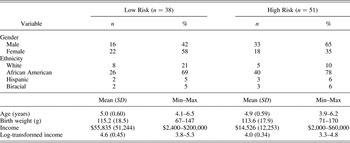
Participants included 100 children and 96 parents (4 parents had 2 children enrolled in the study). Of these participants, 89 were included in analyses (4 high-risk children and 7 low-risk children were excluded due to outlying telomere values, as described below). At the time of the present study, children ranged in age from 3.9 to 6.5 years old (M = 4.9, SD = 0.59). High-risk children (n = 51) were recruited from an ongoing longitudinal study examining the efficacy of an attachment-based intervention for infants involved in the Child Welfare System. High-risk children and their parents were initially referred to the program as infants (under 20 months old) following involvement in the Child Welfare System. The participating birth parent was the primary caregiver identified by the referring agency. Although children were identified by agencies as at risk for being maltreated, children remained in their homes with their birth parents as part of the city's diversion from foster care program. It is important to note that the children in the high-risk group did not necessarily experience maltreatment at the time of referral or subsequently. Limited access to families' records prevented detailed characterization of children's history of early adversity; however, the conditions noted most often included child neglect, domestic violence, parental substance use, and inadequate housing. Low-risk comparison children (n = 38) were recruited from local childcare centers, through flyers distributed throughout the community, and through announcements posted on a university website. Parents in the low-risk group denied involvement with the Child Welfare System, as assessed through an initial screening question. All parents were mothers, with the exception of two fathers in the low-risk comparison group. See Table 1 for demographic characteristics of each group.
Child demographic characteristics

Procedure
At the time of the present study, high-risk participants were already enrolled in a longitudinal study and had previously expressed interest in being contacted about additional research opportunities. Low-risk participants expressed interest via a phone call or an email after receiving information from the recruitment sources described above. Research staff contacted parents by phone to describe the research protocol and scheduled a home visit if parents were interested in participating. At the home visit, parent consent and child assent were obtained. Parents completed a demographic questionnaire to obtain information about parents' and children's race/ethnicity and age, household income, and children's birth weight. Parents and children were videotaped during a 20-min standardized parent–child interaction task to assess parental responsiveness. The research staff collected children's DNA by brushing each side of the child's cheeks for 20 s using SK-1 buccal swabs (Boca Scientific, Boca Raton, FL). Buccal swabs were temporarily stored in a small cooler with ice packs during transport to the laboratory. Parents received $50 and children received a small toy for their participation.
Measures
Telomere length
Buccal swabs were stored at –20°C until DNA was extracted. DNA was extracted via manufacturer's instructions with Puregene Buccal Cell Kit (Qiagen, Valencia, CA) with the only modification being incubation in Protinease K solution for 1.5 hr. The extracted DNA was quantified and assessed for purity via nanodrop spectrophotometry. Subsequently, aliquots of extracted DNA samples were diluted to 10 ng/μL and placed in –20°C for short-term storage. Relative telomere length was measured using a standard curve based quantitative polymerase chain reaction (qPCR) reaction as previously reported (Cawthon, Reference Cawthon2002; O'Callaghan & Fenech, Reference O'Callaghan and Fenech2011) on a Bio-Rad CFX96 real-time PCR system. A 20-ng sample of DNA was assayed via primers specific to telomeres (T; ForwardTEL: 5′-CGGTTTGTTTGGGTTTGGGTTTGGGTTTGGGTTTGGGTT-3′ and ReverseTEL: 5′-GGCTTGCCTTACCCTTACCCTTACCCTTACCCTTACCCT-3′) and in a separate PCR plate against a single copy gene (S), acidic ribosomal phosphoprotein 36B4 (Forward36B4: 5′-CAGCAAGTGGGAAGGTGTAATCC-3′ and Reverse36B4: 5′-CCCATTCTATCATCAACGGGTACAA-3′). For each participant, the T and S qPCR assays were carried out in triplicate on different 96-well plates. A participant's DNA was pipetted into the same well positions for the separate plates (T and S) to reduce well to well variability (36). Triplicate measurements outside of a 1 threshold cycle (Ct) deviation were excluded from the calculation of the sample average similar to O'Callaghan (37). Six dilutions of a reference DNA spanning 2 × concentrations from 2.5 to 80 ng/μl were used to construct a standard curve similar to Cawthon (Reference Cawthon2002).
A T/S ratio was constructed for each sample by (a) subtracting the average of the triplicate telomere samples Ct from the whole plate Ct average (ΔCtel), (b) subtracting the average triplicate 36B4 samples Ct from the whole plate Ct average (ΔC36B4), and (c) taking the ratio of T to S (2ΔCtel)/(2ΔC36B4). Efficiency for qPCR reactions was well within accepted ranges between plates for both telomere (SD = 5.8%) and single copy gene (SD = 1.3%). The interassay coefficient of was 0.73% for the standards in telomere PCR and 0.44% for the 36BR PCR, demonstrating very low measurement error. The intraassay coefficient of variation was 0.71% for the individual triplicate samples analyzed for telomeres and 0.46% for 36B4. Each plate contained a representative sample of high-risk and low-risk children of which individual sample identity was blind to the researcher. After the T/S ratio was calculated, T/S ratios for each plate beyond 2 SD were excluded from further analysis before collapsing across all T/S ratios. Any sample that was excluded from analysis (e.g., the T/S ratio was beyond 2 SD or amplified beyond the range of the standards) was reassayed to confirm the Ct measurements obtained were replicable (n = 11). The Pearson correlation coefficient between the first and second triplicate measurements was r = .94 for the telomere PCR and r = .92 for 36B4 (p < .001 for both), indicating a high correlation between remeasurement of excluded samples and a low probability of experimenter error in the biochemical analysis.
Parental responsiveness
Parents and children were videotaped during a 20-min semistructured interaction task (National Institute of Child Health and Human Development Early Child Care Research Network, 1999, 2003). Parent–child dyads were asked to play with toys from three boxes in a set order. The first box contained a set of markers, construction paper, stickers, and stencils; the second box contained a cash register toy and dress-up clothes; and the third box contained a set of Duplo Legos. Parents were instructed to play with their children as they normally would, to present the boxes in the specified order, and to spend some time on each box. Undergraduate coders were blind to participants' group and other information about the families. Parental responsiveness to nondistress was coded on a 5-point Likert scale, based on procedures used in previous studies (National Institute of Child Health and Human Development Early Child Care Research Network, 1999). At high levels of responsiveness, parents “follow the child's lead” by responding contingently to the child's signals, expressions, and behaviors in ways that are well timed and child centered. At low levels, parents engage in nonsynchronous interactions, in which they might appear detached and unresponsive, or overstimulating and intrusive. All coders met acceptable levels of interrater reliability on practice videos. Twenty-five percent of the videotapes were double coded and the Spearman correlation between coder scores was 0.80. Mean scores for double-coded videotapes were used for primary analyses. Parent responsiveness ranged from 1 to 5 (M = 3.03, SD = 1.01).
Results
Preliminary analyses
Preliminary analyses examined between-group differences in demographic characteristics (i.e., child age, child gender [dummy coded as 0 for male, 1 for female], minority status [dummy coded as 0 for nonminority, 1 for minority], and household income), as well as associations between demographic characteristics and variables of interest (i.e., telomere length and parental responsiveness). As mentioned above, high-risk children were recruited from an ongoing longitudinal study examining the effectiveness of an attachment-based parenting intervention through a randomized clinical trial. Given that there were no intervention effects on children's telomere length (p > .05), high-risk children from the experimental and control intervention groups were grouped together for primary analyses. A chi-square test revealed no significant group difference in the distribution of children by minority status, and a t test showed no group difference in children's age (p > .05). A chi-square test revealed that the high-risk group had a higher male-to-female ratio than the low-risk group, χ2 (1, 89) = 4.50, p < .05. On average, low-risk participants reported higher household income (log-transformed due to positive skew) than high-risk participants, t (1, 87) = –6.39, p < .01. Telomere length was correlated with children's birth weight (r = .22, p < .05) but was not associated with child age, gender, minority status, or household income. Parental responsiveness was correlated with log-transformed household income (r = .23, p < .05). On average, parents of minority children demonstrated lower parental responsiveness than parents of nonminority children, t (1, 87) = 1.98, p < .05. Parental responsiveness did not differ between low-risk and high-risk groups, and was not associated with child gender or age. Given the significant group differences and/or associations with primary variables of interest, log-transformed household income, birth weight, gender, and minority status were included as covariates in primary analyses.
Primary analyses
Group differences in relative telomere length
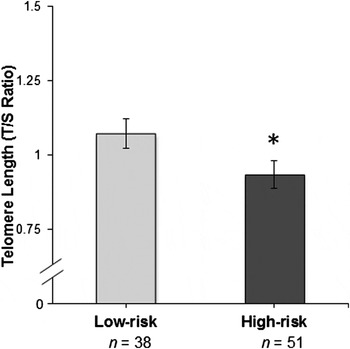
An analysis of covariance was conducted to examine group differences in telomere length, controlling for log-transformed household income, children's birth weight, gender, and minority status. Telomere length was shorter in high-risk children compared to low-risk children, F (1, 83) = 4.37, p < .05 (see Figure 2). Due to concerns about the nonindependence of data collected from siblings, analyses were also conducted excluding one child from each sibling pair. There were four sets of siblings in the full data set, but two sets of siblings had one child with outlying telomere data. Thus, only two children were excluded in this secondary analysis. The results remained significant when excluding one child from each sibling pair, F (1, 81) = 4.79, p < .05.
The relative telomere length in low-risk versus high-risk children. Error bars are ± standard error of the mean. *p < .05.

Parental responsiveness and telomere length
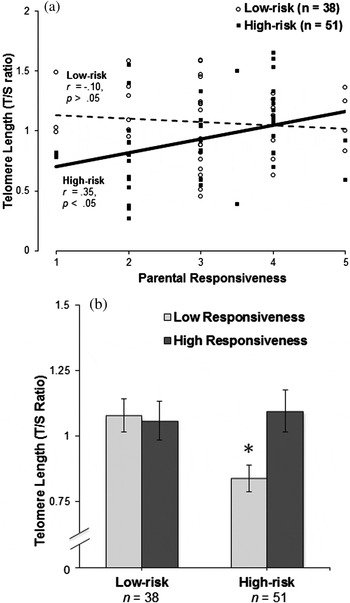
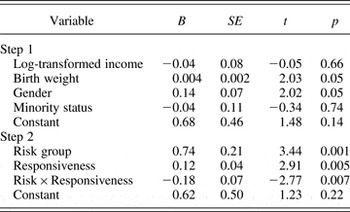
Multiple linear regression analyses were conducted to examine the association between parental responsiveness and telomere length. Covariates (i.e., log-transformed household income, children's birth weight, children's gender, and children's minority status) were entered into Step 1 of the model. Risk group (low risk vs. high risk), parental responsiveness, and a Risk × Responsiveness interaction term were added in at Step 2, with telomere length as the dependent variable. The results are presented in Table 2. Step 1 accounted for 3.8% of the variance in telomere length and was not statistically significant. Step 2 accounted for 19.8% of the variance, representing a significant change in R 2, F (3, 82) = 5.44, p < .01. The Risk × Responsiveness interaction was significant (standardized β = −0.94, p < .01), indicating that parental responsiveness moderated the association between risk group and telomere length (see Figure 3a and b). To further examine this interaction, analyses were conducted separately for the high- and low-risk groups. Parental responsiveness predicted telomere length among high-risk children, with more responsive parenting associated with longer telomeres (r = .35, p < .05) but not among low-risk children (r = –.10, p > .05). The results remained significant when excluding the second child of the two sibling pairs.
(a) The moderating role of parental responsiveness (graphed continuously) on the association between early-life risk and telomere length. Trend lines show that parental responsiveness predicted telomere length in high-risk children but not in low-risk children. Data points represent individual participant's relative telomere length (along the y axis) by parental responsiveness score (along the x axis). For the 25% of participants with double-coded parental responsiveness data, plotted data points reflect the average of both coders' scores, which is why two scores fall between major scale points. (b) The moderating role of parental responsiveness on the association between early-life risk and telomere length (graphed as the median split for illustrative purposes). Error bars are ± standard error of the mean. *p < .05.

Linear regression model for telomere length

Note: R 2 = .08 for Block 1 (p > .05); ΔR 2 = .14 for Block 2 (p < .01).
Discussion
Telomere length was significantly shorter in high-risk children with previous involvement in the Child Welfare System, relative to low-risk comparison children. Further, parental responsiveness moderated the association between early adversity and telomere length, with higher parental responsiveness predicting longer telomeres only among high-risk children. These findings remained significant after controlling for household income, birth weight, gender, and minority status. Taken together, these findings support the critical role of high-quality parenting behavior in modifying the biological impact of early-life stress.
Early-life stress appears to affect telomere biology very early in childhood, by 4 to 6 years of age, suggesting that changes in telomere length may manifest at a much earlier age than has been typically assessed. In peripheral blood mononuclear cells, telomeres are thought to shorten at an accelerated rate in early life (e.g., approximately 170 base pairs per year) when compared to adult life (e.g., approximately 30–50 base pairs per year; Zeichner et al., Reference Zeichner, Palumbo, Feng, Xiao, Gee and Sleasman1999). However, the actual rate of loss and the factors governing interindividual variability in the rate of loss in similarly aged persons are still unclear (Benetos et al., Reference Benetos, Okuda, Lajemi, Kimura, Thomas and Skurnick2001; Frenck, Blackburn, & Shannon, Reference Frenck, Blackburn and Shannon1998; Hewakapuge, van Oorschot, Lewandowski, & Baindur-Hudson, Reference Hewakapuge, van Oorschot, Lewandowski and Baindur-Hudson2008). In the current study, we found no association between age and telomere length, perhaps due to the intentionally restricted age range or developmental period studied. Prospective longitudinal studies that include multiple repeated measurements of telomere length from infancy through childhood are needed to more systematically characterize normative and deviant patterns of telomere shortening.
Because increasing evidence continues to support the association between various forms of childhood stress and telomere shortening at the group level, more work is needed to understand individual-level factors that offer protective benefits or contribute to risk. Here, we find that responsive parenting plays a major role in buffering high-risk children from the negative effects of early adversity on telomere length. Our findings complement previous studies, which have showed that the adverse effects of psychosocial, biological, and physical risk experienced in childhood are attenuated in the context of an available and supportive caregiver (Evans et al., Reference Evans, Kim, Ting, Tesher and Shannis2007; Laucht et al., Reference Laucht, Esser and Schmidt2001). A number of studies support the role of synchronous parent–child interactions as a key factor in children's development of biological and behavioral self-regulation (Feldman, Reference Feldman2007; Raver, Reference Raver1996; Rocissano, Lynch, & Slade, Reference Rocissano, Lynch and Slade1987; Winberg, Reference Winberg2005). However, further research is needed to examine whether other aspects of responsive parenting (e.g., sensitivity to distress), or just positive caregiving more generally, offer the same buffering effects.
These findings highlight that intervention programs for high-risk children should be implemented early and should aim to enhance positive parenting behaviors, specifically parent–child synchrony. Early parenting interventions have been shown to prevent biological dysregulation, as assessed through diurnal cortisol production, among children who experience early adversity. For example, Cicchetti, Rogosch, Toth, and Sturge-Apple (Reference Cicchetti, Rogosch, Toth and Sturge-Apple2011) found that maltreated children who received early preventative interventions, including child–parent psychotherapy or a psychoeducational parenting intervention, maintained morning levels of cortisol that were similar to nonmaltreated comparison children. Maltreated children who received care as usual, however, showed increasingly lower morning cortisol levels over time. These results parallel those found by Fisher, Stoolmiller, Gunnar, and Burraston (Reference Fisher, Stoolmiller, Gunnar and Burraston2007), in which a family-based intervention (i.e., Multidimensional Treatment Foster Care for Preschoolers) prevented the blunting of the diurnal cortisol rhythm typically seen among foster children. Future studies can examine whether similar interventions designed to improve parental responsiveness have an effect on stabilizing or even increasing telomere length. By incorporating multiple assessments of telomere length (i.e., before the intervention, after the intervention, and at follow-up intervals), these studies can characterize intervention effects on telomere length over time.
Currently, the mechanisms regulating reduced telomere length following early-life stress are not well understood (Shalev, Reference Shalev2012). Dysregulation of the HPA axis may represent one mechanism through which stress leads to telomere attrition. The HPA axis mounts a response to acute stressors, resulting in increased circulating levels of glucocorticoids (i.e., cortisol in humans; Gunnar & Quevedo, Reference Gunnar and Quevedo2007). Increased circulating levels of glucocorticoids result in increased production of free reactive oxygen species, which can yield single-strand breaks in telomeres that are unable to be repaired (Houben, Moonen, van Schooten, & Hageman, Reference Houben, Moonen, van Schooten and Hageman2008; Petersen, Saretzki, & von Zglinicki, Reference Petersen, Saretzki and von Zglinicki1998; You et al., Reference You, Yun, Nam, Kang, Won and Lee2009). Repeated exposure to oxidative stress increases the frequency of these breaks in telomeres (Petersen et al., Reference Petersen, Saretzki and von Zglinicki1998). Recent evidence supports this association among acute psychosocial stress, cortisol, and telomere length. For example, greater cortisol reactivity, following exposure to an acute stressor, is found to predict shorter telomere length in postmenopausal women (Tomiyama et al., Reference Tomiyama, O'Donovan, Lin, Puterman, Lazaro and Chan2012). However, in early childhood, most children appear to go through a stress hyporesponsive period, during which cortisol does not increase following stressors (for a review, see Gunnar, Talge, & Herrera, Reference Gunnar, Talge and Herrera2009). This period of cortisol hyporesponsivity may be similar to that observed in rodents from postnatal day 4 to day 14 (Moriceau, Roth, & Sullivan, Reference Moriceau, Roth and Sullivan2010; Sapolsky & Meaney, Reference Sapolsky and Meaney1986), and presumably protects the developing brain from the deleterious effects of elevated cortisol (Gunnar et al., Reference Gunnar and Fisher2006). However, for children without a responsive caregiver, particularly those with disorganized attachments, cortisol continues to increase to stressors in early childhood (Bernard & Dozier, Reference Bernard and Dozier2010; Hertsgaard, Gunnar, Erickson, & Nachmias, Reference Hertsgaard, Gunnar, Erickson and Nachmias1995; Spangler & Grossmann, Reference Spangler and Grossmann1993). This repeated exposure to cortisol in childhood via increased reactivity of the HPA axis may contribute to telomere shortening in children from high-risk environments, particularly in the absence of responsive caregivers.
In addition to mounting a stress response, the HPA axis regulates circadian patterns of activity by maintaining a diurnal rhythm of cortisol production (Gunnar & Cheatham, Reference Gunnar and Cheatham2003). Typically, cortisol peaks approximately 30 min after a person wakes up and decreases across the day to a bedtime nadir (Gunnar & Donzella, Reference Gunnar and Donzella2002; Larson, White, Cochran, Donzella, & Gunnar, Reference Larson, White, Cochran, Donzella and Gunnar1998). Children who experience early-life stress have perturbed patterns of diurnal cortisol production, often marked by lower wake-up levels and blunted wake-up to bedtime slopes. Although this blunted diurnal pattern has been observed in foster children and previously institutionalized children (Bruce, Fisher, Pears, & Levine, Reference Bruce, Fisher, Pears and Levine2009; Bruce, Kroupina, Parker, & Gunnar, Reference Bruce, Kroupina, Parker and Gunnar2000; Carlson & Earls, Reference Carlson and Earls1997; Dozier et al., Reference Dozier, Manni, Gordon, Peloso, Gunnar and Stovall-McClough2006; Fisher, Gunnar, Dozier, Bruce, & Pears, Reference Fisher, Gunnar, Dozier, Bruce and Pears2006), it is especially evident in maltreated children who continue to live with their high-risk birth parents (Bernard, Butzin-Dozier, Rittenhouse, & Dozier, Reference Bernard, Butzin-Dozier, Rittenhouse and Dozier2010). In a study of postmenopausal women, flatter diurnal cortisol slopes were associated with shorter telomere length (Tomiyama et al., Reference Tomiyama, O'Donovan, Lin, Puterman, Lazaro and Chan2012). Thus, telomere shortening may be associated with dysregulation of both the stress reactivity and the diurnal functions of the HPA system.
Another possible mechanism through which early-life stress may lead to telomere shortening is via changes to markers of immune functioning. In addition to being associated with glucocorticoids, production of reactive oxygen species is associated with increased production of proinflammatory cytokines (Floyd et al., Reference Floyd, Hensley, Jaffery, Maidt, Robinson and Pye1999). Research has shown an inverse relationship between telomerase activity and the increased production of proinflammatory cytokines, which may also influence telomere biology in relation to psychosocial stress in early life (Beyne-Rauzy et al., Reference Beyne-Rauzy, Prade-Houdellier, Demur, Recher, Ayel and Laurent2005; Danese, Pariante, Caspi, Taylor, & Poulton, Reference Danese, Pariante, Caspi, Taylor and Poulton2007). Multimethod studies, in which biological samples across systems (i.e., cortisol, proinflammatory cytokines, and telomeres) are collected, can further inform our understanding of the mechanisms by which glucocorticoids and proinflammatory cytokines may influence telomere length (e.g., via changes in telomerase, the human telomerase reverse transcriptase gene, telomeric repeat binding factor 1/2 genes, or tumor necrosis factor-α gene activity).
The present research benefits from a number of methodological strengths. For example, reports of risk exposure and parental responsiveness were not contingent on parent report or self-report. Agencies within the Child Welfare System identified and referred the high-risk children due to risk of neglect and maltreatment suspected during infancy. In addition, parental responsiveness was measured observationally through psychometrically sound and well-validated procedures (National Institute of Child Health and Human Development Early Child Care Research Network, 1999, 2003). This study also had limitations as described by other research examining telomere length (Drury et al., Reference Drury, Theall, Gleason, Smyke, De Vivo and Wong2012; Shalev et al., Reference Shalev, Moffitt, Sugden, Williams, Houts and Danese2012). First, the use of a cross-sectional versus a longitudinal design presents a limitation in examining the stress-related reduction of telomere length over time. Second, the use of qPCR to measure relative telomere length can produce high variability, although variation in the measurement of our samples was low. However, relative telomere length measurement using qPCR has several advantages in that it requires a small amount of the participant's DNA, is specific to only telomeric regions (vs. subtelomeric regions as measured through the terminal restriction fragment method), and offers a high-throughput method for measuring many samples in a short period of time (Hewakapuge et al., Reference Hewakapuge, van Oorschot, Lewandowski and Baindur-Hudson2008). Third, limited information regarding the type, severity, and chronicity of adverse experiences of the high-risk children in our study prevented examination of the possible dose-dependent associations between early-life stress and telomere length, as well as the examination of maltreatment subtype on telomere reduction. Limited information about the timing of participants' experiences of early adversity also prevents the identification of possible sensitive periods in development, during which telomeres may be particularly susceptible to stress.
Despite these limitations, our research highlights the buffering role of parenting behavior on telomere biology following early-life stress. This study has important implications for preventative interventions that are implemented early and specifically target parental responsiveness, and also suggests that changes to telomere biology may be an additional way to measure the efficacy of early interventions for high-risk children.