INTRODUCTION
Laws mandating formal gender equality at work have had mixed success combating gender stereotypes associated with work and family. These stereotypes include beliefs that mothers are and should be homemakers and caregivers and that fathers are and should be breadwinners (Equal Employment Opportunity Commission 2007; Williams and Bornstein Reference Williams and Bornstein2007). Although “we are beyond the day when an employer could evaluate employees by assuming or insisting that they matched the stereotype associated with their group” (Price Waterhouse v. Hopkins 1989), Title VII of the 1964 Civil Rights Act only requires gender equality within the existing structure of work.Footnote 1 It does not require employers to provide even short-term family leave (Albiston Reference Albiston2009). Even after Congress enacted Title VII, employers remained reluctant to provide family leave voluntarily, continued to take a dim view of fathers who asked for time off to care for their families, and preferred to hire men rather than women on the assumption that women would put family before work. Congress enacted the 1993 Family and Medical Leave Act (FMLA), which requires certain employers to provide family leave to eligible employees regardless of gender to address how these gendered beliefs perpetuate inequality.Footnote 2 Nevertheless, research indicates that gender beliefs and stereotypes associated with work and family continue to undermine legal rights to family leave and gender equality at work (Albiston Reference Albiston2005; Albiston and O’Connor Reference Albiston and Trimble O’Connor2016). Although a few states have enacted family-leave policies, nearly thirty years after its enactment, the FMLA remains the only national policy on family leave. Accordingly, understanding the circumstances under which the FMLA may counteract gender stereotypes related to work and family is essential to reducing gender inequality at work.
How do parenthood and taking leave affect employees’ evaluations and outcomes at work, and are these effects the same for women and men? To what extent do widely shared beliefs and stereotypes about gender, work, and family affect these outcomes? Under what conditions can law improve outcomes for workers who have family responsibilities? In this study, we consider whether the expressive effects of family-leave laws can counter the well-documented stereotypical beliefs about gender, work, and family that disadvantage mothers who work and mothers and fathers who take time off work to care for family (Allen and Russell Reference Allen and Russell1999; Wayne and Cordeiro Reference Wayne and Cordeiro2003; Correll, Benard, and Paik Reference Correll, Benard and Paik2007; Benard and Correll Reference Benard and Correll2010; Coleman and Franiuk Reference Coleman and Franiuk2011). These beliefs include assumptions that mothers (whether or not they take leave) and fathers who take leave are less competent and committed than other, identical workers (Allen and Russell Reference Allen and Russell1999; Wayne and Cordeiro Reference Wayne and Cordeiro2003; Cuddy, Fiske, and Glick Reference Cuddy, Fiske and Glick2004; Correll, Bernard, and Paik Reference Correll, Benard and Paik2007; Bernard and Correll Reference Benard and Correll2010; Coleman and Franiuk Reference Coleman and Franiuk2011). These stereotypes help perpetuate an “ideal worker” norm that requires unwavering work devotion and no obligations outside of work (J. Williams Reference Williams2000; Blair-Loy Reference Blair-Loy2003). More subtly, these stereotypes devalue workers who fail to conform to traditional gender roles and undermine a more gender-egalitarian allocation of caregiving responsibilities between men and women (Glick et al. Reference Glick, Diebold, Bailey-Werner and Zhu1997; Glick and Fiske Reference Glick and Fiske2001; Moya et al. Reference Moya, Peter Glick, De Lemus and Hart2007; Coleman and Franiuk Reference Coleman and Franiuk2011).
Gender stereotypes such as these are cognitive structures, or schemas, that people use to perceive and evaluate the social world (Ridgeway and Correll Reference Ridgeway and Correll2004b; Ridgeway Reference Ridgeway2009). People rely on schemas to group people into categories and to develop abstract representations of the characteristics of category members (Krieger Reference Krieger1995; Fiske Reference Fiske, Gilbert, Fiske and Lindzey1998; Ridgeway Reference Ridgeway2009). These schemas are cultural beliefs shared at the societal level, including descriptive gender stereotypes (describing what women and men are like) and prescriptive gender stereotypes (proscribing what women and men should be like) (Fiske Reference Fiske, Gilbert, Fiske and Lindzey1998; Ridgeway Reference Ridgeway2009; Benard and Correll Reference Benard and Correll2010; Heilman Reference Heilman2012). For example, stereotypes of women as homemakers suggest that women will put family before work and that they should make caring for children their first priority. These stereotypes put working mothers in a double bind because either they are assumed to put family ahead of work or, if they do not, they are disliked and penalized because they should put family first (Benard and Correll Reference Benard and Correll2010; Okimoto and Heilman Reference Okimoto and Heilman2012). By contrast, stereotypes of men as breadwinners suggest that men will put work before family and that they should make work their first priority. Masculine stereotypes and the breadwinner/worker role are intertwined, such that the culturally defined ideal worker is always available and implicitly free from domestic responsibilities such as caring for children (J. Williams Reference Williams2000; Fuegen et al. Reference Fuegen, Biernat, Haines and Deaux2004; Ridgeway and Correll Reference Ridgeway and Correll2004a). Cecilia Ridgeway (Reference Ridgeway2009) argues that we cannot understand how gender will operate in specific institutional settings, such as work, until we take into account the background effects of these schemas on perceptions and behavior.
A significant obstacle to reducing inequality generated by schemas is that stereotypical evaluations and judgments are largely unconscious and implicit (Banaji, Hardin, and Rothman Reference Banaji, Hardin and Rothman1993). They are not driven by overt bias toward the workers being evaluated but, instead, by implicit understandings of how the social world is and should be organized (Heilman Reference Heilman2001; Ridgeway Reference Ridgeway2011). These understandings may have nothing to do with the workplace, but they come along with an employee’s identity as a woman or man, mother or father, and the associated cultural schemas that affect how we perceive their identity and interpret their social behavior (Ridgeway and Correll Reference Ridgeway and Correll2004b; Ridgeway Reference Ridgeway2011). Moreover, research suggests that overt attempts to counteract implicit bias run into resistance and that they may even activate the biases they attempt to change (Tinkler, Li, and Mollborn Reference Tinkler, Li and Mollborn2007; Kaiser et al. Reference Kaiser, Brenda Major, Dover, Brady and Shapiro2013). For this reason, it has been difficult to identify effective interventions to address gender bias and inequality at work (Kalev, Dobbin, and Kelly Reference Kalev, Dobbin and Kelly2006).
Congress intended the FMLA, which requires certain employers to provide family leave to all employees regardless of gender, to address the effects of these gender schemas and associated stereotypes. As Justice William Rehnquist states in Nevada v. Hibbs,
[s]tereotypes about women’s domestic roles are reinforced by parallel stereotypes presuming a lack of domestic responsibilities for men. Because employers continued to regard the family as the woman’s domain, they often denied men similar accommodations or discouraged them from taking leave. These mutually reinforcing stereotypes created a self-fulfilling cycle of discrimination that forced women to continue to assume the role of primary family caregiver, and fostered employers’ stereotypical views about women’s commitment to work and their value as employees. Those perceptions, in turn, Congress reasoned, lead to subtle discrimination that may be difficult to detect on a case-by-case basis.Footnote 3
In addition to creating a gender-neutral leave benefit, the FMLA prohibits discrimination against workers who take family leave. This provision makes it illegal for employers to base decisions on stereotypical reasoning that mothers are and should be homemakers and caregivers and that fathers are and should be breadwinners (Equal Employment Opportunity Commission 2007; Williams and Bornstein Reference Williams and Bornstein2007). As Justice Rehnquist recognized in Hibbs, by creating “a minimum standard of family leave for all eligible employees, the FMLA attacks the formerly state-sanctioned stereotype that only women are responsible for family caregiving, thereby reducing employers’ incentives to engage in discrimination by basing hiring and promotion decisions on stereotypes.”Footnote 4
Hibbs presents an optimistic view of what the FMLA can accomplish: changing norms and reworking long-standing assumptions about the organization of work, gender, and family. Whether laws can change norms and beliefs about work and family is a timely and important question because countless workers have struggled with overwhelming care demands as the result of the COVID-19 pandemic. Many of these workers took leave to cope with these challenges when Congress temporarily expanded the scope of the FMLA in pandemic-responsive legislation (Ewing-Nelson Reference Ewing-Nelson2020; Albiston and Fisk Reference Albiston and Fisk2021). We know very little, however, about how stereotypes about gender, work, and family will affect these workers’ prospects after they take family leave or whether law will protect them from the negative effects of gendered stereotypes about taking leave. Using an experimental approach, we develop and evaluate a theory about the conditions under which the FMLA can counteract gender stereotypes about appropriate behavior for men and women around work and family. Building on research that finds that law influences the social meaning of behavior, we argue that making law salient in workplace evaluations will diminish sex stereotyping of, and workplace penalties for, these workers (Berkowitz and Walker Reference Berkowitz and Walker1967; MacCoun Reference MacCoun1993; Suchman Reference Suchman1997; Bilz and Nadler Reference Bilz and Nadler2009; Feldman Reference Feldman2009; Ryo Reference Ryo2013). We contend that law counteracts gendered schemas by conveying a social consensus that combining work and family is legitimate and that the law normalizes caregiving for all workers.
Although law and society scholars have vigorously debated the role of law in bringing about social change, few experimental studies address this important question directly. Qualitative studies that examine how law operates as a cultural discourse in social settings outside the courts find that laws can change the way people think about their relationships, their identities, and how they interact with each other (Engle and Munger Reference Engel and Munger1996, Reference Engel and Munger2003; Albiston Reference Albiston2005, Reference Albiston2010; Hull Reference Hull2006) but that the law is not always the most salient system of meaning in social interactions (Macaulay Reference Macaulay1963; Ellickson Reference Ellickson1985; Edelman, Erlanger, and Lande Reference Edelman, Erlanger and Lande1993; Levine and Mellema Reference Levine and Mellema2001; Albiston Reference Albiston2005; Edelman Reference Edelman2016). We know from prior research that when very little information is available about employees or about standards for decisions, evaluators tend to rely on stereotypes associated with status characteristics such as race and gender (Bertrand and Mullainathan Reference Bertrand and Mullainathan2004; Heilman and Haynes Reference Heilman and Haynes2005; Ridgeway Reference Ridgeway2009; Sterling and Fernandez Reference Sterling and Fernandez2018). Building on these studies, we focus on interventions that make law salient in workplace evaluations.
By focusing on the conditions under which law may change social meaning in the workplace, this study’s primary contribution is to develop and test theory about individual and interactional-level mechanisms of social change in the workplace (West and Zimmerman Reference West and Zimmerman1987; Acker Reference Acker1990; Risman Reference Risman1998; Ridgeway Reference Ridgeway2009). This approach complements organizational- and societal-level studies of whether, and under what conditions, civil rights law can bring about social change (McCann Reference McCann1994; Andersen Reference Andersen2006; Kalev, Dobbin, and Kelly Reference Kalev, Dobbin and Kelly2006; Rosenberg Reference Rosenberg2008; Kelly Reference Kelly2010; Edelman Reference Edelman2016; Flores and Barclay Reference Flores and Barclay2016). It contributes to the literature regarding how implicit biases and stereotypes produce negative outcomes for disfavored groups (Banaji, Hardin, and Rothman Reference Banaji, Hardin and Rothman1993; Kang et al. Reference Kang, Mark Bennett, Casey and Levinson2011; Wynn and Correll Reference Wynn, Correll, Risman, Froyum and Scarborough2018) and extends the literature about the cultural influence of the law (see Tankard and Paluck Reference Tankard and Paluck2016). Finally, by comparing the effect of law to the effect of organizational policies, this study contributes to the delegated governance literature on the relative merits of legal regulation and voluntary organizational policies (see Lobel Reference Lobel2004; Edelman and Talesh Reference Edelman and Talesh2011).
In the sections that follow, we first develop our argument about the expressive or symbolic effects of law on social change and situate it within the literature in this area. Next, we review the extensive empirical evidence that mothers (whether or not they take leave) and fathers who take family leave experience material penalties and negative evaluations at work. We discuss recent theory and research about the social psychological mechanisms contributing to these inequalities. We then present results from a laboratory experiment designed to evaluate our argument that making law salient at the point of evaluation can mitigate penalties for these workers, finding strong support for our argument. We conclude by discussing the implications of our findings for law’s role in reducing gender inequality.
LAW, SOCIAL CHANGE, AND PREVAILING NORMS
Law and society scholars have long been interested in the role of law in social change, especially whether the law on the books improves social conditions on the ground (Handler Reference Handler1979; McCann Reference McCann1994; Rosenberg Reference Rosenberg2008). Research about this question often focuses on the societal or organizational level of analysis, examining the effects of test case litigation, landmark US Supreme Court decisions, and civil rights legislation (McCann Reference McCann1994; Kelly and Dobbin Reference Kelly and Dobbin1999; Nielsen and Nelson Reference Nielsen and Nelson2005; Andersen Reference Andersen2006; Rosenberg Reference Rosenberg2008; Flores and Barclay Reference Flores and Barclay2016; Ofosu et al. Reference Ofosu, Chambers, Chen and Hehman2019). Existing research at this level suggests that laws that contradict entrenched cultural beliefs often face backlash (Krieger Reference Krieger2000; Rosenberg Reference Rosenberg2008; but see Kelly and Dobbin Reference Kelly and Dobbin1999; Flores and Barclay Reference Flores and Barclay2016; Ofosu et al. Reference Ofosu, Chambers, Chen and Hehman2019) and that civil rights laws are difficult to implement and enforce in specific institutional settings (Edelman Reference Edelman1992; Edelman, Erlanger, and Lande Reference Edelman, Erlanger and Lande1993; McCann Reference McCann1994; Nelson and Bridges Reference Nelson and Bridges1999; Estlund Reference Estlund2005, Reference Estlund2008; Kalev, Dobbin, and Kelly Reference Kalev, Dobbin and Kelly2006; Kelly Reference Kelly2010; Edelman Reference Edelman2016). In organizations, managerial norms can displace legal norms (Edelman, Erlanger, and Lande Reference Edelman, Erlanger and Lande1993; Edelman Reference Edelman2016), and even organizations’ well-intentioned efforts to implement civil rights laws do not always change behavior (Edelman, Erlanger, and Lande Reference Edelman, Erlanger and Lande1993; Kalev, Dobbin, and Kelly Reference Kalev, Dobbin and Kelly2006; Tinkler, Li, and Mollborn Reference Tinkler, Li and Mollborn2007).
Alongside organizational and societal level studies of law and social change, some scholars focus instead on the interactional and cultural effects of law (Engel and Munger Reference Engel and Munger1996, Reference Engel and Munger2003; Albiston Reference Albiston2005, Reference Albiston2010; Hull Reference Hull2006). These studies examine how law constitutes social categories to influence meaning and behavior through new frames of interpretation (Engel and Munger Reference Engel and Munger2003; Hull Reference Hull2006; Abrego Reference Abrego2008; Albiston Reference Albiston2010). These scholars argue that civil rights laws shape social meaning in everyday interactions to name otherwise inchoate injustices and change how individuals perceive the social world. As a result, even when no one sues, law can change behavior and shape the meaning of identity (P. Williams Reference Williams1991; Engel and Munger Reference Engel and Munger1996, Reference Engel and Munger2003; Albiston Reference Albiston2005, Reference Albiston2010; Abrego Reference Abrego2008; Hull Reference Hull2006). This research suggests that, despite implementation and enforcement challenges, law may still change behavior and social meaning at the individual and interactional level.
Conveying social norms is one potential mechanism of social change through law. Social norms exert a strong influence on perceptions and behaviors (Tankard and Paluck Reference Tankard and Paluck2016; Ofosu et al. Reference Ofosu, Chambers, Chen and Hehman2019). People modify their views and behavior to be consistent with the perceived consensus about prevailing norms (Tankard and Paluck Reference Tankard and Paluck2016). Government action, specifically legislation, is one means of conveying that social consensus (Suchman Reference Suchman1997; Ofosu et al. Reference Ofosu, Chambers, Chen and Hehman2019). People in a democratic system may generally perceive enacted legislation to represent the will of the people and thus be consistent with the beliefs and values of the majority (Ofosu et al. Reference Ofosu, Chambers, Chen and Hehman2019). When new norms become salient, people update their perceptions of prevailing social norms based on environmental cues (Paluck and Shepherd Reference Paluck and Shepherd2012). Addressing the expansive and venerable debate about whether law can change social norms is beyond the scope of this article (for a discussion, see Suchman Reference Suchman1997; Nadler Reference Nadler2017); nevertheless, growing evidence indicates that, under some conditions, law changes perceptions and behavior at the individual and interactional level through the construction of meaning.
Consistent with this view, expressive theories of law pay particular attention to how law affects beliefs about the conduct regulated by law (Suchman Reference Suchman1997; Bilz and Nadler Reference Bilz and Nadler2009; Feldman Reference Feldman2009; Ryo Reference Ryo2013). Early work in this area argues that law implies a social consensus that the prohibited conduct is wrong. This implied consensus influences moral judgments of that conduct and, with it, people’s behavior and response to law (Berkowitz and Walker Reference Berkowitz and Walker1967; see also MacCoun Reference MacCoun1993; Bilz and Nadler Reference Bilz and Nadler2009; Feldman Reference Feldman2009). Experimental studies find that, when legal standards are expressly communicated, individuals shift their moral views to be consistent with the law and say that they are more likely to comply with its commands (Berkowitz and Walker Reference Berkowitz and Walker1967; Bilz and Nadler Reference Bilz and Nadler2009; Feldman Reference Feldman2009; see also MacCoun Reference MacCoun1993; Tyler Reference Tyler2006; Ryo Reference Ryo2013). For example, Leonard Berkowitz and Nigel Walker (Reference Berkowitz and Walker1967) found that, after being informed of the legality of a behavior, participants altered their prior judgments of the morality of the behavior in the direction of the law. Yuval Feldman (Reference Feldman2009) found that hi-tech employees who were informed of laws against disclosing trade secrets perceived disclosure to be less moral and reported that they were less likely to disclose trade secrets, compared to those who did not learn about the law. Similarly, legal scholarship about law’s symbolic effects argues that law can change the meaning of a given behavior and, with it, how individuals evaluate that behavior (Lessig Reference Lessig1995; Sunstein Reference Sunstein1996a, Reference Sunstein1996b; Kahan Reference Kahan1997; McAdams Reference McAdams1997, Reference McAdams2015; Geisinger Reference Geisinger2002).
At the same time, other research suggests that organizational policies may not shift normative judgments as effectively as law. Justine Tinkler, Yan Li, and Stefanie Mollborn (Reference Tinkler, Li and Mollborn2007) found that men who were exposed to a university sexual harassment policy exhibited more entrenched male-advantaged gender beliefs than those who were not, suggesting that sexual harassment policies may have unintentionally activated unequal gender beliefs. Alexandra Kalev, Frank Dobbin, and Erin Kelly (Reference Kalev, Dobbin and Kelly2006) found that many organizational interventions that were intended to reduce inequality, including diversity training and mentoring for women and underrepresented minorities, had modest to no effects. In a series of experimental studies, Cheryl Kaiser and colleagues (Reference Kaiser, Brenda Major, Dover, Brady and Shapiro2013, 516; emphasis in original) found that organizational policies promoting diversity, such as diversity statements, diversity training, and diversity awards, had “the ironic consequence of reducing perceptions of discrimination and undermining support for those who claim to be its victims,” even in the presence of demonstrably unequal treatment. Together, these studies suggest that law and organizational policies may not convey the same democratic social consensus as law (Tankard and Paluck Reference Tankard and Paluck2016, Reference Tankard and Paluck2017), although organizational policies with significant accountability and support may be more effective (Kalev, Dobbin, and Kelly Reference Kalev, Dobbin and Kelly2006; Petts, Mize, and Kaufman Reference Petts, Mize and Kaufman2022; Thébaud and Pedulla Reference Thébaud and Pedulla2022).
Expressive theories of law are consistent with the well-established finding in social psychology that majority opinion influences judgments, beliefs, and behaviors (Sherif Reference Sherif1935; Asch Reference Asch1955; Deutsch and Gerard Reference Deutsch and Gerard1955). Along these lines, Margaret Tankard and Elizabeth Paluck (Reference Tankard and Paluck2017) provide evidence that communications from an authoritative institution, such as a court or democratic legislature, about a legal rule can change perceptions of collective social norms. They argue that, because individuals use perceptions of prevailing social norms to guide their behavior, shifts in perceptions of social norms can also change behavior and, in some instances, encourage shifts in personal attitudes (Tankard and Paluck Reference Tankard and Paluck2017; see also Stangor, Sechrist, and Jost Reference Stangor, Sechrist and Jost2001; Cialdini and Goldstein Reference Cialdini and Goldstein2004; Tankard and Paluck Reference Tankard and Paluck2016; Ofosu et al. Reference Ofosu, Chambers, Chen and Hehman2019). This approach is also somewhat consistent with the justification-suppression model of expression, which predicts that, even when stereotypes are automatically evoked, individuals’ awareness of contrary norms and values may motivate them to not express that bias (Crandall and Eshleman Reference Crandall and Eshleman2003). It posits a different mechanism than rational actor models, however, which predict that individuals will change their behavior to avoid sanctions but do not address changes in underlying beliefs and norms (Suchman Reference Suchman1997). Although collectively these studies suggest that law influences social norms and public opinion, they tell us less about how law shifts perceptions in specific social settings such as the workplace or about the mechanisms that lead to change.
Our study makes a significant contribution to the literature on law and social change by developing and testing theories about the social mechanisms through which law affects judgments in workplace evaluations. Specifically, we examine whether making the FMLA salient counteracts implicit stereotypes about gender, work, and family and reduces perceptions that mothers (whether or not they take leave) and fathers who take leave are less competent and committed workers. The FMLA allows employees to combine caregiving and work by providing eligible workers with up to twelve weeks of unpaid, job-protected leave to care for family members, including new children, on a gender-neutral basis, although only about 60 percent of workers are covered by the law. The statute protects workers who use leave from retaliatory harassment, termination, and discrimination. It requires employers to provide leave even if they do not allow time off for any other reason, and it does not allow employers discretion to deny leave. In short, this gender-neutral entitlement to leave challenges stereotypes that mothers should be caregivers and fathers should be breadwinners. Accordingly, this normatively laden area of employment law provides a good test of law’s expressive effects on gender schemas about work and family.
Importantly, ours is not a study of the ambient social effect of the FMLA for all time and in all places. The FMLA has been in place for nearly three decades, yet gender stereotypes about work and family are routinely reported in connection with discriminatory treatment of mothers and leave takers. They include “notions that mothers are insufficiently devoted to their work, and that work and motherhood are incompatible,”Footnote 5 telling a mother to “do the right thing” and stay home with her children,Footnote 6 assuming a woman should not be promoted after she has had children,Footnote 7 and presuming that “there is no way [a father] could be primary caregiver [unless] his wife [was] in a coma or dead.”Footnote 8 Similarly, several studies have found that mothers and fathers who take leave are disadvantaged by gender stereotypes at work (Albiston Reference Albiston2005, Reference Albiston2010; Albiston and O’Connor Reference Albiston and Trimble O’Connor2016).
Our study is designed to investigate whether making the FMLA salient to evaluators at the point of evaluation reduces the effects of these gendered stereotypes on employee assessments and outcomes. By salient, we mean that the evaluator is reminded of the law’s provisions so that information is current in her mind when she engages in the evaluation task. This approach could be thought of as a “nudge” or “a small change made in the context surrounding a decision, intended to remove or alter biases” (O’Meara, Culpepper, and Templeton Reference O’Meara, Culpepper and Templeton2020, 3). Changing the “architecture of evaluation” in this way allows family-leave laws to counteract stereotypical perceptions that mothers (whether or not they take leave) and fathers who take leave are less competent, committed, and congenial than other workers (see Rivera and Tilcsik Reference Rivera and Tilcsik2019; Rivera Reference Rivera2020). If we are correct that these laws express a social consensus that it is inappropriate to penalize workers with family responsibilities, then making family-leave laws salient should shift the social meaning of taking family leave (Berkowitz and Walker Reference Berkowitz and Walker1967; Albiston Reference Albiston2005, Reference Albiston2010; Bilz and Nadler Reference Bilz and Nadler2009; Feldman Reference Feldman2009). We turn now to discussing the literature documenting workplace penalties for mothers and caregivers and identifying the mechanisms driving those penalties.
THE EFFECTS OF GENDER STEREOTYPES ABOUT WORK AND FAMILY
Sociological research using laboratory experiments to investigate bias has revealed how working parents, especially those who take family leave, are evaluated through the lens of cultural schemas about gender, work, and family responsibilities (Allen and Russell Reference Allen and Russell1999; Wayne and Cordeiro Reference Wayne and Cordeiro2003; Correll, Benard, and Paik Reference Correll, Benard and Paik2007; Benard and Correll Reference Benard and Correll2010). These schemas include stereotypes that mothers should not work, fathers should not take leave, and caregivers of either gender are less reliable, committed, and desirable workers. In this section, we explain below how gender theory identifies the mechanisms that result in fewer organizational rewards and negative judgments of these workers. This theory provides some insight into how law’s expressive effects might improve outcomes for these employees.
We know from prior research that there is a significant wage penalty associated with motherhood. Mothers earn less than men, whether or not those men have children, and mothers also earn less than women without children (Waldfogel Reference Waldfogel1997; Budig and England Reference Budig and England2001; Anderson, Binder, and Krause Reference Anderson, Binder and Krause2003; Glass Reference Glass2004). Scholars argue that these penalties reflect assumptions that mothers are less committed and competent workers rather than any differences between mothers and other workers. Controlling for differences between mothers and other workers in human capital investments, in the characteristics of their jobs, or in their work commitment and effort does not eliminate these wage disparities (Waldfogel Reference Waldfogel1997; Budig and England Reference Budig and England2001; Anderson, Binder, and Krause Reference Anderson, Binder and Krause2003). Controlling for so-called mother-friendly job characteristics also does not eliminate the wage penalty (Budig and England Reference Budig and England2001), nor does controlling for hours worked and for measures designed to capture motivation or commitment to paid work (Waldfogel Reference Waldfogel1997; Anderson, Binder, and Krause Reference Anderson, Binder and Krause2003).
Another possible explanation for the motherhood wage penalty is that workers who engage in caregiving, who are often mothers, are disadvantaged at work because they take time off. Here, it becomes important to separate status as a mother or a father from behavior as a family caregiver. With regard to status, whereas mothers experience a wage penalty solely for their status as parents, fathers typically experience a wage bonus from their status as parents (Glauber Reference Glauber2008; Killewald and Gough Reference Killewald and Gough2013). Scholars argue that this bonus reflects stereotypical perceptions that fathers are better bets for advancement and long-term loyalty to the firm because fathers are motivated to excel as breadwinners for their families (Hodges and Budig Reference Hodges and Budig2010; Coltrane et al. Reference Coltrane, Miller, DeHaan and Stewart2013).
With regard to behavior, however, fathers and mothers who take on caregiving responsibility tend to be penalized equally at work (Coltrane et al. Reference Coltrane, Miller, DeHaan and Stewart2013). Both men and women who take family leave earn lower salaries and have lower likelihood of promotion and lower performance evaluations than workers who do not take leave (Judiesch and Lyness Reference Judiesch and Lyness1999). It is not just time away from work, but also time away from work specifically for family caregiving reasons, that produces these penalties. For example, both men and women experience larger wage penalties and diminished hiring prospects when they stop work for family reasons than when they stop work for non-family reasons (Manchester, Leslie, and Kramer Reference Manchester, Leslie and Kramer2010; Coltrane et al. Reference Coltrane, Miller, DeHaan and Stewart2013; Weisshaar Reference Weisshaar2018). Also, women who change jobs after taking family leave do not suffer as great a wage penalty as women who take leave and return to the same job (Glass Reference Glass2004). These studies indicate that it is something about the meaning of taking family leave, rather than merely lost human capital from time away from work, that leads to lower wages.
We know from existing experimental research that, in ambiguous situations with minimal information, employers make judgments on the basis of cultural beliefs and stereotypes associated with status characteristics gleaned from job materials, such as gender, race, and motherhood (Neumark Reference Neumark1996; Pager Reference Pager2003; Bertrand and Mullainathan Reference Bertrand and Mullainathan2004; Correll, Benard, and Paik Reference Correll, Benard and Paik2007; Wynn and Correll Reference Wynn, Correll, Risman, Froyum and Scarborough2018). Social norms and social role expectations are common culprits that generate bias on the basis of gender in particular (O’Meara, Culpepper, and Templeton Reference O’Meara, Culpepper and Templeton2020). Laboratory experiments, audit studies, and qualitative research indicate that gender stereotypes permeate evaluations of mothers (whether or not they take leave) and fathers who take leave (Schultz Reference Schultz1990; Albiston Reference Albiston2005, Reference Albiston2010; Correll, Benard, and Paik Reference Correll, Benard and Paik2007). Social psychological research has identified two specific mechanisms in this area: status discrimination and normative discrimination (Correll, Benard, and Paik Reference Correll, Benard and Paik2007; Benard and Correll Reference Benard and Correll2010).
Status discrimination involves descriptive stereotypes, which are widely shared beliefs about the nature of groups of people. For example, mothers are believed to be less committed to paid work than are childless women (Blair-Loy Reference Blair-Loy2003; Correll, Benard, and Paik Reference Correll, Benard and Paik2007). Status discrimination occurs to the extent that motherhood and leave taking operate as devalued status characteristics, meaning that employers have lower expectations of the workplace competence and commitment of mothers or leave takers as a group, compared with other types of workers. When they do take leave, the theory predicts that workers with the devalued characteristic will be judged by harsher performance standards and consequently be offered fewer organizational rewards (Correll, Benard, and Paik Reference Correll, Benard and Paik2007).
Scholars study status discrimination by asking study participants to evaluate job applicants of different status while holding their qualifications, productivity, and employment backgrounds constant by experimental design. These studies find that mothers are judged to be less competent and less committed to their jobs than other identical workers (Cuddy, Fiske, and Glick Reference Cuddy, Fiske and Glick2004; Correll, Benard, and Paik Reference Correll, Benard and Paik2007), which leads mothers to be offered lower starting salaries and be less likely to be recommended for hire and promotion (Correll, Benard, and Paik Reference Correll, Benard and Paik2007). Consistent with the breadwinner bonus theory, fathers, by contrast, are seen as more committed to their jobs and receive higher starting salaries than other identical workers. Similarly, experimental studies find that participants view men and women who take family leave to be less committed to work than workers who do not take leave (Allen and Russell Reference Allen and Russell1999). Interestingly, men who step out of the breadwinner role by taking leave are especially disfavored. In a study by Tammy Allen and Joyce Russell (Reference Allen and Russell1999), participants rated leave-taking fathers as less committed to work and less promotable than mothers who take leave. Similarly, Julie Wayne and Bryanne Cordeiro (Reference Wayne and Cordeiro2003) found that study participants rated men who take family leave as less likely to help their coworkers, be punctual, work overtime, or have good attendance than other workers, including women who take family leave.
The second mechanism—normative discrimination—highlights the role of prescriptive stereotypes, which are widely shared beliefs about how groups of people should be. Normative discrimination typically occurs when workers violate stereotypes, for example, that mothers should be warm and nurturing and prioritize family over work or that fathers should be breadwinners who prioritize work over caregiving (J. Williams Reference Williams2000; Okimoto and Heilman Reference Okimoto and Heilman2012). When individuals comply with prescriptive stereotypes, others find them to be warmer and more likeable (Heilman Reference Heilman2001; Brescoll and Uhlmann Reference Brescoll and Luis Uhlmann2005). In contrast, when individuals violate prescriptive stereotypes, they are seen as less warm, likeable, and congenial and more interpersonally hostile (for example, selfish, cold, devious), leading to fewer organizational rewards (Benard and Correll Reference Benard and Correll2010). For example, when mothers are highly competent, they are viewed as less warm and likeable, whereas highly competent fathers are not penalized in this way (Benard and Correll Reference Benard and Correll2010). Similarly, when fathers violate prescriptive breadwinner stereotypes by taking leave, they are seen as less likeable and receive fewer organizational rewards (Allen and Russell Reference Allen and Russell1999; Wayne and Cordeiro Reference Wayne and Cordeiro2003).
The combined effect of status and normative discrimination creates a collision between two norms that help explain why working mothers (whether or not they take leave) and fathers who take leave are penalized in the workplace. To the extent that these employees are stereotyped as less committed to paid work, they appear to violate the ideal worker norm that good workers prioritize work above competing demands such as family and are always there for their employers (J. Williams Reference Williams2000; Blair-Loy Reference Blair-Loy2003). Yet mothers who display especially high levels of commitment to work are penalized for violating the prescriptive stereotype that mothers should prioritize family over paid work (Benard and Correll Reference Benard and Correll2010; Okimoto and Heilman Reference Okimoto and Heilman2012). Fathers do not typically experience the same collision between ideal worker norms and gender norms. It is only when fathers take on caregiving responsibilities, thereby violating both the ideal worker norm and the prescriptive stereotype that fathers should prioritize breadwinning, that they receive fewer organizational rewards. Only fathers who do not take leave reap the benefits of their higher status as fathers and of behavior conforming to prescriptive stereotypes. All other employed parents are disadvantaged in some way by the combined effects of status and normative discrimination. Thus, it is not just gender alone, but the interaction of gender with descriptive and prescriptive stereotypes that produce workplace penalties for mothers and leave takers. This study evaluates whether the expressive effects of law can counteract these descriptive and prescriptive stereotypes.
HYPOTHESES
We use an experimental design to investigate how parenthood and taking family leave affect evaluations of employees and whether these effects were the same for men and women. We asked study participants to evaluate the characteristics of fictitious employees while holding constant employees’ qualifications and performance. We expected that, in the absence of any other information, evaluators would give mothers (whether or not they take family leave) and fathers who take family leave fewer organizational rewards, rate them as less competent and committed workers, and rate them as less warm and likeable than other employees when they step outside of traditional gender roles. We also included two experimental conditions in which either the FMLA’s provisions or an organizational family-leave policy were made salient to participants before their evaluations. If we are correct that the expressive effect of the FMLA counteracts gender stereotypes, making the FMLA salient should reduce the effects of parenthood and taking leave on employee evaluations. We also investigated whether organizational family-leave policies had the same effect as law. Our organizational policy condition is intended only as a direct contrast to our FMLA condition and consists of a basic policy allowing twelve weeks of time off with no other details or variations. Although other research focuses on the conditions under which generous organizational policies may encourage leave taking and reduce bias against leave takers (see Petts, Mize, and Kaufman Reference Petts, Mize and Kaufman2022; Thébaud and Pedulla Reference Thébaud and Pedulla2022), this is not our focus here.
Organizational Rewards
Prior research indicates that, in situations with very little information or guidance, evaluators tend to rely on stereotypes associated with status characteristics—in this case, that mothers put family before work and that caregivers of either gender are less reliable, committed, and desirable workers. Accordingly, we expected that evaluators would give fewer organization rewards (for example, pay and promotion) to mothers and to leave takers of either gender when the law was not salient. When the FMLA is made salient, however, we expected that evaluators would treat these workers the same as nonparent employees. We made no prediction regarding the effects of organizational family-leave policies. Thus, our first two hypotheses are the following:
Hypothesis 1: When law is not salient, evaluators will give mothers (whether or not they take family leave) and fathers who take family leave fewer organizational rewards than nonparent workers.
Hypothesis 2: When law is salient, evaluators will give mothers (whether or not they take family leave) and fathers who take family leave organizational rewards that are not significantly different than those given to nonparent workers.
Evaluations of the Characteristics of Workers
We were also interested in whether evaluators formed subjective impressions of workers that are consistent with descriptive stereotypes (status discrimination) and prescriptive stereotypes (normative discrimination). Status discrimination theory suggests that, when law is not salient, evaluators will rate mothers (whether or not they take leave) and fathers who take leave as less competent and committed than other workers. Normative discrimination theory suggests that evaluators will rate parents who violate prescriptive gender stereotypes (that is, mothers who do not take family leave and fathers who do) as less likeable than other employees. According, we made our third, fourth, and fifth hypotheses:
Hypothesis 3: When law is not salient, evaluators will rate mothers (whether or not they take leave) and fathers who take family leave as less competent and less committed than nonparent workers.
Hypothesis 4: When law is not salient, evaluators will rate mothers who do not take leave as less warm and more interpersonally hostile than nonparent workers because these mothers violate prescriptive stereotypes that mothers should prioritize caretaking.
Hypothesis 5: When the law is not salient, evaluators will rate fathers who do take leave as less warm and more interpersonally hostile than nonparent workers because these fathers violate prescriptive stereotypes that fathers should prioritize breadwinning.
Expressive theories of law contend that law conveys a social consensus that can change how people perceive behavior and personal characteristics. By conveying that it is normal for parents of both genders to combine work and family, the FMLA displaces prescriptive gender stereotypes that fathers should be breadwinners and mothers should be caregivers. Accordingly, we expected that making the FMLA salient in work-related evaluations would reduce negative perceptions of mothers (whether or not they take leave) and fathers who take leave. Note that the FMLA does not legally protect mothers who do not take leave. Nevertheless, if the FMLA has an expressive effect, then evaluators should rate all mothers as just as competent, committed, and likable as nonparent workers because the FMLA communicates that it is legitimate and normal for women to combine parenthood and work. Thus, we made our sixth and seventh hypotheses:
Hypothesis 6: When law is salient, evaluators will rate mothers (whether or not they take family leave) and fathers who take family leave as not significantly different than nonparent workers in competence and commitment.
Hypothesis 7: When law is salient, evaluators will rate mothers who do not take leave and fathers who do take leave as not significantly different than nonparent workers in warmth and likeability even though they violate prescriptive stereotypes for their gender.
Again, we make no prediction regarding our organizational policy condition. Although we do not have strong theoretically informed expectations regarding organizational policies, simple organizational leave policies like the one presented in this experiment may be less likely than democratically enacted law to communicate a broad social consensus that combining work and family responsibilities, including taking leave, is normal and expected. We leave to future research to investigate whether more robust organizational policies in a supportive organization context would be as effective as law.
RESEARCH DESIGN
Drawing on the experimental protocols of several prior studies of status and normative discrimination, we designed a laboratory experiment that asked participants to evaluate the files of three fictitious employees, presented as real, who worked for a fictitious company called CommTech. The participants comprised 131 undergraduate students who participated in the study in exchange for pay.Footnote 9 All employee files presented an employee who held a marketing position at CommTech, which was described as being in “integrated communications.” Participants were informed (falsely) that the researchers were studying 360-degree performance evaluation systems, where “employees are evaluated by a ‘circle’ of four to eight co-workers, including their peers, subordinates, and supervisors.” Because 360-degree evaluations are becoming more common and since workers in a wide variety of positions in a firm are now asked to make evaluations of their peers, supervisors, and the like, participants were told that the researchers hoped to learn how individuals of different ages and educational backgrounds made judgments about workers based on very little information. After learning about 360-degree evaluations and reading a brief description of CommTech’s history and focus, participants were given three files, one for each employee. Each file contained worker-specific information, including a resume, a strong performance evaluation, and a description of the company and its benefits.
Experimental Conditions and Independent Variable
Our experimental design operationalized our independent variable of interest, the expressive effect of law or of organizational policies, through three experimental conditions that varied the salience of law and organizational policy. In the No Policy Condition, the description of CommTech contained no mention of a leave policy but instead discussed the company’s program for health maintenance and stress reduction. In the main experimental condition, the FMLA Condition, the description of CommTech’s benefits contained a paragraph stating that the company was covered by the FMLA and described the provisions of the law, thereby making the law salient to participants. As an additional comparison, we included a Voluntary Organizational Policy Condition, in which the description of CommTech explained that it had a family-leave policy that allowed new mothers and fathers up to twelve weeks to be at home with their child to help with the transition to a larger family. In this way, we could determine whether any effects we found were the result of policies implementing laws or simply the result of having any policy at all. Neither the FMLA description nor the description of the organizational family-leave policy included pay as part of the benefit.
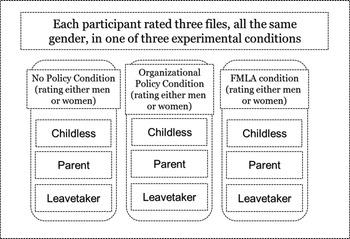
Participants were randomly assigned to one of these three experimental conditions. There were no significant differences among conditions in the number of women or people of color in each cell, indicating that randomization was successful. After reading the description of the company, participants evaluated three equally qualified, fictitious employees based on paper files that were pretested to be equivalent (see Figure 1).
Study design.

The three employees evaluated by the participants were the same gender, either all men or women. One employee was not a parent, a second was a parent who was not identified as taking family leave, and the third was a parent who had taken family leave. For ease of reading, we will refer to the parent who was not identified as taking leave as the “non-leave parent.” Following Shelley Correll, Stephen Benard, and In Paik (Reference Correll, Benard and Paik2007), we varied the gender of the employees between, rather than within, the subject to avoid suspicion on the part of the participants that the study was about gender and caregiving. The order of the presentation of the three employees was counterbalanced. We manipulated gender by first name. We manipulated parental status, as has been done successfully in past research, by indicating on the resumé for the non-leave parent that they were an officer in an elementary school parent-teacher association (Correll, Benard, and Paik Reference Correll, Benard and Paik2007). The leave-taking employee’s file contained a form requesting and approving a twelve-week family leave. The files of the nonparent employee and the non-leave parent instead contained an ergonomic worksheet to ensure that participants read equivalent amounts of material across the type of employee. We standardized time on the job so that workers who took leave and workers who did not had equivalent lengths of service. This experimental design thus consists of three experimental conditions that cross the type of policy (none, legal, or organizational policy) with the gender of the three employees (female or male) (see Figure 1). The type of policy and the gender of the employee were manipulated between subject, and the type of employee (nonparent, non-leave parent, or parent leave taker) was manipulated within the subject.
To ensure that participants noticed the manipulation for type of policy, participants completed a comprehension check before receiving employee files to evaluate. They were told that, to give an accurate evaluation of employees, it is “important to understand company culture.” They were then asked a series of questions including questions that were irrelevant to the study hypotheses such as: “what type of business is CommTech?” To ensure that the type of policy was salient, they were asked about the type of benefits that CommTech offers and the laws that apply to CommTech. Since the study materials remained available to participants, they were able to go back to the materials to look up answers if need be. At the conclusion of the study, after responding to all measures, they were then asked questions that served as manipulation checks. For example, they were given a list of laws and asked which laws apply to CommTech. All participants passed the manipulation check.
We chose an experimental laboratory design for this study because we asked evaluators to do more than simply read a resume for an employee. Instead, evaluators read and referred to a file that included information about each of three employees, about the company for which the employees worked, and the relevant law or policy that applied to the situation. Laboratory experiments are conducted in person, giving the researcher more control over the experimental setting than is possible with an online survey experiment. To evaluate our theoretical argument, it was essential that law was salient when participants were making evaluations in our main experimental condition. A laboratory experiment allowed us to carefully monitor participants as they read experimental materials, and it allowed participants to reread experimental materials. Because it is impractical to convince more than one hundred actual employers to participate in a controlled laboratory experiment, we relied on undergraduate participants for this study.
We recognize that there are inevitable trade-offs between the internal validity of a laboratory experiment and the external validity of an audit study or, to a lesser extent, a survey experiment. We chose a laboratory experiment that featured a highly controlled setting with a diverse set of measures to allow us to generate data best suited for evaluating our theoretical argument, including measures of perceptions of employees’ characteristics. While audit studies that send resumés to actual employers can enhance external validity, the trade-off is that audit studies can only evaluate outcomes such as call backs and hiring (see, for example, Correll, Benard, and Paik Reference Correll, Benard and Paik2007). They cannot provide data about employers’ perceptions of applicants, nor can this approach manipulate the policy environment of the employers as we did in this study. Online survey experiments present similar challenges for manipulating both the status of employees and the policy environment of employers. Our experience attempting to design an online experiment with similar materials produced order effects driven by the online format and did not allow subjects the same ability to review the materials regarding both the employee and the company. For this reason, a laboratory experiment that allows a more realistic environment for reviewing information about the employee in the context of information about the company presented the optimal design to investigate our research questions.
Dependent Measures
Organizational Rewards: Pay and Promotion
We use measures of pay and likelihood of promotion adapted from Correll, Benard, and Paik (Reference Correll, Benard and Paik2007) to estimate the effects of status and normative discrimination on organizational rewards for mothers and leave takers.
Pay
We asked participants to recommend an annual salary increase, in dollars, for each employee in a range between zero and ten thousand dollars. Participants were told that salary increases averaged between three thousand and five thousand dollars at this company.
Promotion
We also asked participants to assess how likely each employee was to be promoted within the next five years on a four-point scale ranging from “most certainly will not be promoted” to “most certainly will be promoted.” Since we constructed our fictitious employees as being highly qualified, it is perhaps not surprising that 54.5 percent of ratings fell into the top category of this variable, “highly promotable.” Another 37.4 percent fell into the next highest category, “might be promoted,” and only 8.1 percent fell into either of the bottom two categories. We recoded this variable into a dichotomous variable, coded as one if the employee “most certainly will be promoted” and as zero if they fell into one of the three other categories.
Status Discrimination: Competence and Commitment
To estimate the effects of status discrimination on perceptions and evaluations of employees, we used items adapted from prior research to measure the perceived competence and commitment of employees (Correll, Benard, and Paik Reference Correll, Benard and Paik2007).
Competence
We asked participants to rate each employee’s competence using items drawn from prior studies of status discrimination. The competence scale is the average rating of each employee on a series of seven-point items ranging from “not at all” to “extremely” capable, efficient, skilled, self-confident, independent, and intelligent (alpha = 0.853).
Commitment
We also asked subjects to estimate how committed each employee was to the company relative to other employees in similar positions. The commitment variable comes from a single item ranging from zero to ninety-nine, as participants rate the employees as being more committed than “0 percent of other employees” to more committed than “99 percent of other employees.” This item has been successfully used in other similar studies (Correll, Benard, and Paik Reference Correll, Benard and Paik2007; Benard and Correll Reference Benard and Correll2010) and has been shown to mediate the relationship between motherhood and lower organizational rewards.
Normative Discrimination: Warmth and Interpersonal Hostility
To estimate the expected effects of normative discrimination, we measured both warmth and interpersonal hostility using items adapted from prior studies that have been shown to mediate the relationship between motherhood and lower organizational rewards (see Correll, Benard, and Paik Reference Correll, Benard and Paik2007; Benard and Correll Reference Benard and Correll2010).
Warmth
Our measure of warmth is the average of participants’ ratings of each employee on seven-point scales ranging from “not at all” to “extremely” warm, aware of others’ feelings, cooperative, and likeable (alpha = 0.826).
Interpersonal hostility
Our measure of interpersonal hostility is the average of participants’ ratings on seven-point scales ranging from “not at all” to “extremely” aggressive, selfish, ambitious, intimidating, and arrogant (alpha = 0.797).
RESULTS
We present results for our three experimental conditions across our outcome measures. Conceptually, we first evaluate how becoming a parent and also taking family leave as a parent affect how participants evaluate employees in the absence of any family-leave law or policy. Next, we evaluate how the effects of becoming a parent and also taking leave as a parent vary when either the FMLA or an organizational leave policy is made salient to participants before they evaluate employees. To facilitate comparisons, in the discussion below, we group results by outcome measure across all three experimental conditions.
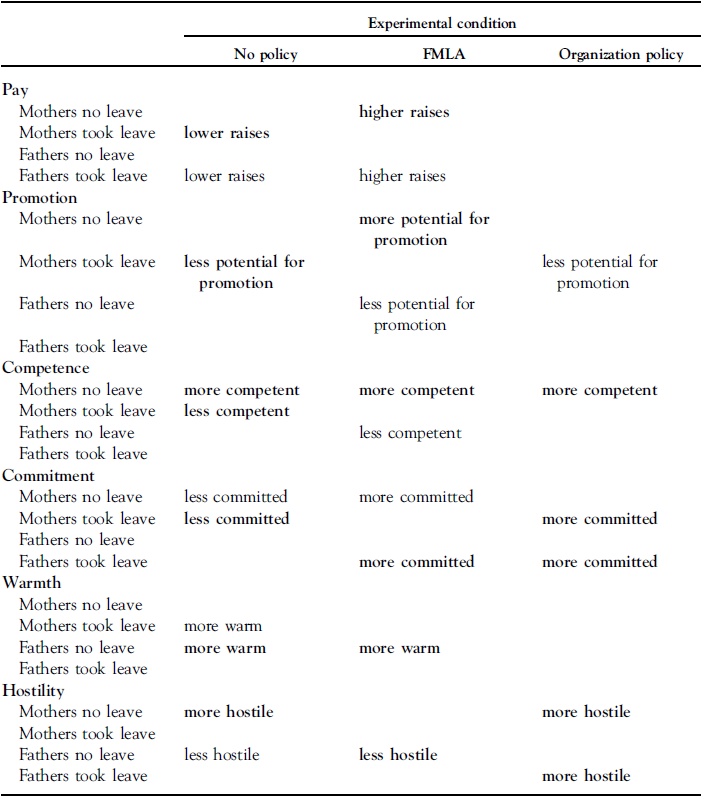
We estimated a series of ordinary least squares (OLS) and logistic regression models that evaluate the effect of employee status (parent, leave taker, and nonparent employee) on each of our six dependent variables (pay, promotion, competence, commitment, warmth, and interpersonal hostility). Consistent with prior research (Correll, Benard, and Paik Reference Correll, Benard and Paik2007), nonparent employees are the omitted category in all models. Because participants rated three employees who were all the same gender, we present separate regressions for ratings of male and female employees, with standard errors clustered by participant identification to account for the non-independence of observations that results from having participants evaluate three employees. Our results do not differ by gender of participant, so we pool data across participant gender for all models. Table 1 provides a conceptual summary of our findings; more detail from the analysis is available in the Appendix.
Summary of findings across dependent measures

Notes: Bold = p < 0.05; regular text = p < 0.10.
We estimate separate models for each policy condition and for male and female applicants, which allows for an easier comparison of the magnitude of effects across policy condition and between male and female applications. This “separate models” approach is preferred by feminist quantitative researchers over models with interaction terms since this modeling approach allows for all factors in a model to vary across gender groups (for a discussion, see Sprague Reference Sprague2016, 96). Since our sample size is small, we will mention results that are marginally significant and note when estimates do not reach the conventional level of significance. We feel it is better to transparently present the level of significance rather than to simple dismiss these results.
Organizational Rewards: Pay and Promotion
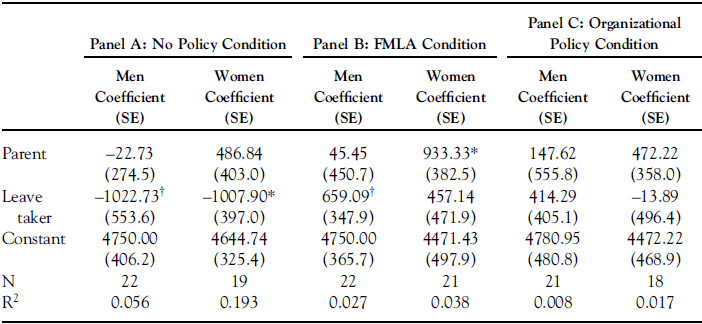
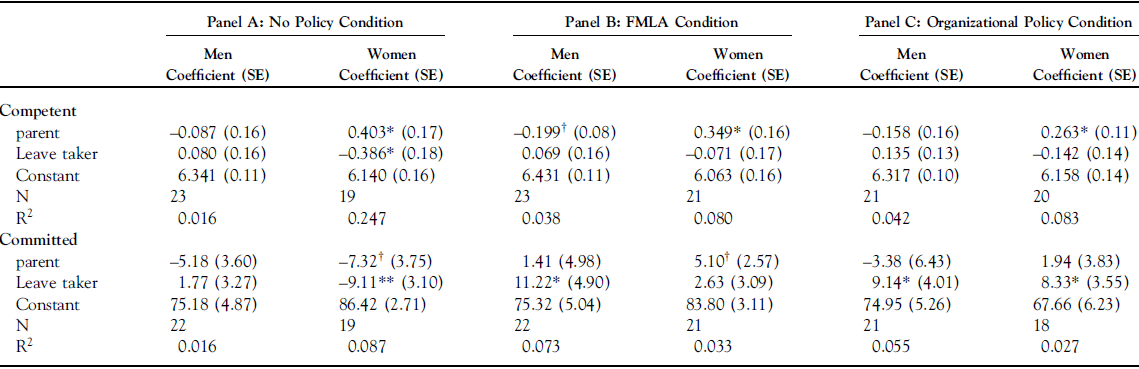
How does parenthood and taking family leave affect employees’ pay and promotion, and are these effects the same for women and men? We found that in the No Policy Condition when no parental leave policy is mentioned, mothers who take leave and fathers who take leave receive fewer organizational rewards than their nonparent counterparts. Evaluators gave mothers who took family leave significantly lower raises (about one thousand dollars less) than the raises recommended for nonparent women (see Table 1; see also Table A1 in the Appendix). Evaluators also gave fathers who took leave smaller raises (about one thousand dollars less) compared to nonparent men, but this difference was only marginally significant (p = 0.079). Contrary to our expectation, non-leave mothers received similar raises to nonparent women; we discuss this lack of expected effect below. Finally, the explained variance is greater in the models for evaluations of women employees, which suggests that, when participants allocated raises, they relied more heavily on parent and leave-taker status for women than they did for men.
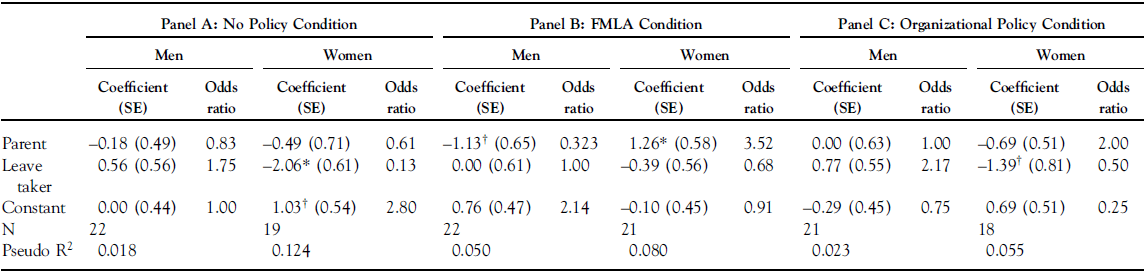
Now we turn to a second form of organizational reward: long-term employment prospects (that is, promotion). Recall that Hypothesis 1 predicted that in the No Policy Condition, participants would rate mothers (whether or not they take leave) and fathers who take leave as less promotable than their nonparent, same-gender counterparts. We use a binary logistic regression model to estimate the effect of employee status (non-leave parent, parent leave taker, and nonparent employee) on the odds of being seen as “certainly promotable.” Consistent with our prediction, when no family policy or law is mentioned, the odds of promotion for mothers who took leave were almost eight times lower than the odds of promotion for nonparent women (see Table 1; see also Table A2 in the Appendix). By comparison, participants rate fathers who took leave as no different in promotion potential than nonparent men. In other words, while we saw in the previous model that participants gave fathers who took leave lower raises, we see here that they did not seem to think that taking leave affected fathers’ long-term promotion potential. Finally, participants rated non-leave mothers as no different in their promotion potential than nonparent women.
What do these results from the No Policy Condition tell us about how parenthood and taking family leave affect employees’ pay and promotion and whether these effects are the same for women and men? Our findings provide partial support for Hypothesis 1. For fathers, taking leave resulted in smaller raises than their nonparent counterparts but no negative effect on their long-term promotion potential. For mothers, however, taking leave resulted in smaller raises and a negative effect on their long-term promotion potential. Unexpectedly, we did not find a pay or promotion penalty for non-leave mothers compared to nonparent women. While we cannot be certain why we did not find a motherhood penalty, it may be because our participants compared three types of women employees (nonparent women, non-leave mothers, and mothers who took leave). By contrast, prior experimental studies asked participants to compare only mothers and childless women (Correll, Benard, and Paik Reference Correll, Benard and Paik2007; Okimoto and Heilman Reference Okimoto and Heilman2012).
We now turn to our primary research question: how does making the FMLA salient to evaluators affect pay and promotion penalties for parenthood and leave taking, and are these effects the same for men and women? Recall that Hypothesis 2 predicted that, when the law is salient, mothers (whether or not they take leave) and fathers who take leave will receive organizational rewards that are not significantly different than those given to their nonparent counterparts. Consistent with this prediction, in the FMLA Condition, we do not find any significant pay or promotion penalties for parents who take family leave compared with their nonparent counterparts (see Table 1; see also Tables A1 and A2 in the Appendix). Participants gave fathers who took leave higher salaries, although this difference was marginally significant (p = 0.072). In addition, in the FMLA Condition, participants gave non-leave mothers significantly higher salaries and evaluated these mothers to be more promotable than nonparent women. Non-leave fathers, however, were seen as less promotable than men without children, although, again, this difference was marginally significant (p = 0.084). Taken together, these results are consistent with Hypothesis 2 that making the FMLA salient would mitigate pay and promotion penalties for mothers (whether or not they take leave) and fathers who take leave.
Finally, we turn to our remaining question: how does making an organizational family-leave policy salient to evaluators affect pay and promotion penalties for parenthood and leave taking, and are these effects the same for men and women? We included the Voluntary Organizational Policy Condition in this study to evaluate whether our findings were the result of the expressive effects of law or simply the result of having any family-leave policy at all. In the the Voluntary Organizational Policy Condition, we find that organizational policies mitigate some penalties for mothers and fathers who take family leave (see Table 1, see also Tables A1 and A2 in the Appendix). Much like the FMLA Condition, when an organizational policy allowing family leave is made salient, participants gave fathers who took leave and mothers who took leave similar raises to their nonparent, same-gender counterparts. Also, in the Voluntary Organizational Policy Condition, we find no significant promotion differences between fathers who take family leave and nonparent men. However, in this condition, the odds of promotion for mothers who took leave were about four times lower (1/0.25 = 4) than those for nonparent women; this difference was marginally statistically significant (p = 0.088).
Status Discrimination: Perceptions of Competence and Commitment
We now turn to evaluating the effects of status discrimination. How does parenthood and taking family leave affect evaluations of employees’ competence and commitment, and are these effects the same for women and men? We expect that, when no law or policy is mentioned, participants will rely on descriptive stereotypes that mothers put family before work and that caregivers of either gender are less competent and less committed than other workers. Accordingly, Hypothesis 3 predicted that participants will rate mothers (whether or not they take leave) and fathers who take leave as less competent and less committed than nonparent workers. We found a gendered effect regarding participants’ ratings of competence and commitment. Participants rated mothers who took leave as significantly less competent and less committed than nonparent women (see Table 1; see also Table A3 in the Appendix). In addition, participants rated non-leave mothers as marginally significantly less committed than nonparent women (p = 0.067) but significantly more competent than nonparent women. By contrast, participants’ ratings of the competence and commitment of fathers (whether or not they take leave) did not significantly differ from their ratings of nonparent men. Taken together, these results provide partial support for Hypothesis 3. The lower ratings of commitment for mothers suggest that, for mothers (whether or not they take leave), participants relied on descriptive stereotypes that mothers put family before work. Participants did not seem to draw the same conclusion about competence and commitment for fathers who took leave or about competence for non-leave mothers, indicating that a combination of gender and leave taking drives status discrimination.
We turn again to our primary research question: how does making the FMLA salient to evaluators affect their ratings of employees’ competence and commitment, and are these effects the same for women and men? Hypothesis 6 predicted that, when the FMLA is made salient, participants will no longer rate mothers (whether or not they take leave) and fathers who take leave as significantly different than their nonparent counterparts in competence and commitment. In other words, we expected that the expressive effect of the FMLA will counteract descriptive stereotypes that mothers put family before work and that caregivers are less competent and less committed than other workers. An advantage of our laboratory experimental design is that we can measure evaluators’ perceptions of workers as well as evaluators’ allocation of organizational rewards; this approach allowed us to see whether making the law salient changes the social meaning of taking leave. If we are correct that the FMLA counteracts stereotypes, the participants will no longer rate parents legally protected by the FMLA (that is, leave takers of either gender), or non-leave mothers who are not legally protected by the FMLA, as less competent and committed their nonparent counterparts. If these results obtain, then we contend that the expressive effect of the FMLA not only deters violations through actors’ attempts to avoid legal sanctions, but it also changes what parenthood, leave taking, and gender convey about an employee’s competence and commitment at work.
Consistent with our prediction in Hypothesis 6, making the FMLA salient seemed to counteract descriptive stereotypes about gender, work, and family (see Table 1; see also Table A3 in the Appendix). With regard to mothers, in the FMLA Condition, participants rated mothers who took leave as not significantly different than nonparent women in competence. Participants rated non-leave mothers as significantly more competent and marginally significantly more committed (p = 0.061) than nonparent women. With regard to fathers, participants rated fathers who took leave as not significantly different in competence and as significantly more committed than nonparent men. Participants rated non-leave fathers as less competent than nonparent men, although this finding was marginally significantly (p = 0.057). Taken together, these results indicate that in the FMLA Condition, participants avoided relying on descriptive stereotypes that mothers put family before work and that caregivers are less competent and less committed than other workers. Based on these findings, we argue that making the FMLA salient affected how participants evaluated the meaning of parenthood, caregiving, and gender for workers’ competence and commitment.
We turn now to the effects of the Voluntary Organizational Policy Condition: how does making an organizational family-leave policy salient to evaluators affect their ratings of employees’ competence and commitment, and are these effects the same for men and women? In the Voluntary Organizational Policy Condition, participants rated mothers who took leave and fathers who took leave as significantly more committed than their nonparent counterparts; we reported a similar finding, but for fathers only, in the FMLA Condition (see Table 1; Table A3 in the Appendix). Participants also rated non-leave mothers as significantly more competent than nonparent women, just as they did in the other two experimental conditions. Although organizational policies are not democratically enacted laws, they may nevertheless communicate an organizational consensus that taking family leave is acceptable. Under these conditions, taking leave may not necessarily communicate a lack of competence or commitment. In addition, parents who return to work after taking leave may convey a commitment to their job.
Normative Discrimination: Perceptions of Warmth and Interpersonal Hostility
Finally, we turn to evaluating the effects of the prescriptive stereotypes associated with normative discrimination. How does parenthood and taking family leave affect perceptions of employees’ warmth and interpersonal hostility, and are these effects the same for women and men? Prescriptive stereotypes regarding work and family include beliefs that fathers should be breadwinners and mothers should put family caregiving before work. Prescriptive stereotypes also include the implicitly gendered ideal worker norm, one who is always available and prioritizes work above other commitments. Normative discrimination theories contend that individuals who comply with prescriptive gender stereotypes will be seen as more warm and less interpersonally hostile than those who do not. Accordingly, we predicted that in the No Policy Condition, participants will rate employees who violate prescriptive breadwinner/caretaker gender roles (that is, mothers who do not take leave and fathers who do) as less warm and more interpersonally hostile than other employees (Hypotheses 4 and 5).
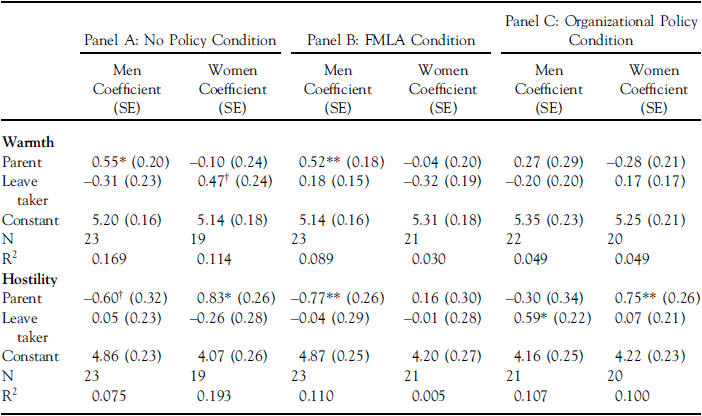
Our results are consistent with these hypotheses and with the inverse theoretical prediction that those who conform to prescriptive stereotypes are viewed positively (see Table 1; see also Table A4 in the Appendix). In the No Policy Condition, participants rated non-leave mothers (who violate the prescriptive gender stereotype that mothers should put family first) as significantly more interpersonally hostile than nonparent women, even though these mothers complied with the ideal worker norm. By contrast, participants rated non-leave fathers (who conform to the prescriptive stereotype that fathers should be breadwinners) as less interpersonally hostile than nonparent men, although this difference was marginally statistically significant (p = 0.072). In addition, participants rated employees who conformed to prescriptive breadwinner/caretaker gender roles (that is, non-leave fathers and leave-taking mothers) as significantly warmer than their nonparent counterparts, although this difference was marginally statistically significant for mothers (p = 0.071). We found no significant differences in participants’ ratings of warmth and interpersonal hostility between fathers who took leave and nonparent men, however.
These findings provide partial support for Hypothesis 4. Although participants rated non-leave mothers as more interpersonally hostile than nonparent women, we did not find the predicted negative effect on ratings of their warmth. We also did not find the predicted negative effect on participants’ ratings of warmth and interpersonal hostility for fathers who took leave (Hypothesis 5). We note that expectations about motherhood and fatherhood are in flux as younger generations seek more equitable sharing of both work and family responsibilities (Gerson Reference Gerson2010). Perhaps for fathers who take leave, the nurturing image of caretaking softened negative responses to violating prescriptive gender norms. In addition, the fact that these fathers were also employees may have protected them from the negative responses to stay-at-home fathers seen in other studies (Brescoll and Uhlmann Reference Brescoll and Luis Uhlmann2005).
We stress that prescriptive stereotypes are not absent from our findings but that they operate more as rewards for workers who conform to stereotypes than as penalties for those who do not. For example, participants rated non-leave fathers as significantly warmer than nonparent men; this could be thought of as a breadwinner bonus (see Table 1; see also Table A4 in the Appendix). Conversely, participants rated mothers who conformed to gender stereotypes by taking leave as warmer than nonparent women. These findings are consistent with prior work indicating that individuals who conform to prescriptive gender stereotypes receive social approval that encourages gender stereotypical behavior (Glick et al. Reference Glick, Diebold, Bailey-Werner and Zhu1997; Glick and Fiske Reference Glick and Fiske2001; Moya et al. Reference Moya, Peter Glick, De Lemus and Hart2007).
We turn once more to our primary research question regarding this final set of dependent measures: how does making the FMLA salient to evaluators affect their ratings of employees’ warmth and interpersonal hostility, and are these effects the same for women and men? In the FMLA Condition, we find no significant differences in participants’ ratings of warmth and interpersonal hostility between non-leave mothers and nonparent women (see Table 1; see also Table A4 in the Appendix). Since the FMLA speaks most directly to the rights of workers who take leave, we found it significant that in the FMLA Condition, participants no longer viewed mothers who did not take family leave as more interpersonally hostile than their nonparent counterparts. Our findings thus suggest that making the FMLA salient counteracted negative perceptions of women who transgress traditional work and family gender roles. Nevertheless, consistent with the theory that individuals who conform to gender stereotypes receive social approval, in the FMLA Condition, participants rated “breadwinner” (that is, non-leave) fathers as significantly more warm and less hostile than their nonparent counterparts. It may be that the FMLA introduces a new schema about appropriate gender roles that protects non-leave mothers from disapproval, but the law does not displace strong cultural approval for fathers who are breadwinners.
Turning finally to how voluntary family-leave policies affect perceptions of mothers, we find that in the Voluntary Organizational Policy Condition, prescriptive gender stereotypes remained prevalent. Participants rated non-leave mothers as more interpersonally hostile than nonparent women, just as they did in the No Policy Condition (see Table 1; see also Table A4 in the Appendix). In addition, participants rated fathers who took leave as significantly more hostile than nonparent men. We did not see this effect in the other two experimental conditions. An available organizational family-leave policy seems to activate negative judgments of both men and women who step out of traditional breadwinner/caretaker roles. Mothers who do not take leave when it is available and fathers who take leave are seen as more hostile than other workers. It is even more interesting then, that in the FMLA Condition, where family leave is not only available but also legally protected, we do not see this same stereotype-reinforcing effect. Perhaps because family-leave laws convey a democratic consensus that combining work and family is not only permitted but also legitimate, these laws affect beliefs about gender, work, and family in a way that voluntary organizational leave policies do not.
While we cannot be certain why a voluntary organizational leave policy would activate negative perceptions of fathers who take leave, some research indicates that employers rely on prescriptive stereotypes that men should not take extended family leave and actively discourage them from doing so (Albiston Reference Albiston2005, Reference Albiston2010). Tinkler, Li, and Mollborn (Reference Tinkler, Li and Mollborn2007) also found that exposure to an organizational sexual harassment policy may have activated unequal gender beliefs; we may be observing a similar effect here with respect to fathers. Thus, the existence of a voluntary organizational policy, at least in this configuration, does not necessarily change the social meaning of taking family leave. The social meaning that persists is gendered.
DISCUSSION
This study developed and evaluated a theory about how the expressive effects of law diminish gender stereotyping around work and family. It argued that the FMLA conveys a social consensus that counteracts descriptive and prescriptive stereotypes that mothers should not work, fathers should not take leave, and caregivers of either gender are less reliable, committed, and desirable workers. Following status and normative discrimination theories, we evaluated three dependent measures: organizational rewards, evaluations of employee competence and commitment, and perceptions of employees’ warmth and interpersonal hostility. We asked how parenthood and taking leave affect employees’ evaluations and outcomes at work and whether these effects are the same for women and men? To what extent do widely shared beliefs and stereotypes about gender, work, and family affect these outcomes? Under what circumstances can law counteract those stereotypes and improve outcomes for workers who shoulder family responsibilities?
Consistent with our hypotheses, we found that when the FMLA was not salient to evaluators, parenthood and taking leave negatively affected outcomes and perceptions of workers. We also found that the negative consequences for parents who took leave varied with gender. Leave takers of either gender fared badly, but outcomes were worse for women. Participants gave mothers who took leave lower raises, diminished prospects for promotion, and saw them as less committed and competent than their nonparent counterparts. Even mothers who were not identified as leave takers were rated as less committed than women without children as status discrimination theory would predict. By contrast, for men, becoming a father did not affect their status and rewards at work unless they took family leave, and the consequences for fathers were not as damaging in the long term. Although participants rated mothers who took leave as poor prospects for promotion, they rated fathers who took leave as just as promotable as other employees. Participants may have assumed that fathers who took family leave would eventually relinquish day-to-day care to their (presumptively female) partners but that mothers who took leave would prioritize family over work over the long term.
When law was not salient, prescriptive gender stereotypes shaped participants’ evaluations of workers as well as outcomes. Participants reacted positively toward workers who conformed to traditional breadwinner/caretaker gender roles, but they took a dim view of those who did not. Participants viewed parents who conformed to traditional gender roles as more warm and less interpersonally hostile than their nonparent counterparts. By contrast, participants rated non-leave mothers as more interpersonally hostile than nonparent women. Taken together, our findings show a familiar double bind for mothers who do not take leave: even if they benefit from conforming to prescriptive ideal worker norms, they are still penalized for violating prescriptive gender norms that women should put family first. These results are consistent with prior research that finds that working mothers are seen as less likeable because they violate prescriptive norms that mothers should put family before work (Benard and Correll Reference Benard and Correll2010; Okimoto and Heilman Reference Okimoto and Heilman2012; see also Rudman and Glick Reference Rudman and Glick2001). Our findings also suggest that positive perceptions of competence are not enough to overcome stereotypical assumptions that mothers are less committed to work. These subtle effects tend to discourage behavior that violates traditional gender roles and encourage gender stereotypical behavior for men and women (see Glick et al. Reference Glick, Diebold, Bailey-Werner and Zhu1997; Glick and Fiske Reference Glick and Fiske2001; Moya et al. Reference Moya, Peter Glick, De Lemus and Hart2007).
The primary contribution of this study, however, was to provide the first evidence that the law’s expressive effects mitigate gender stereotyping about work and family responsibilities. Consistent with our hypotheses, we find that making the FMLA salient to evaluators reduced negative outcomes and negative perceptions of competence, commitment, and collegiality for parents who took family leave and for mothers who were not identified as leave takers.Footnote 10 Based on these findings, we contend that the FMLA’s expressive effects counteract descriptive and prescriptive stereotypes that penalize mothers regardless of whether they take leave and fathers who take family leave. Our findings support our argument that the FMLA communicates a social consensus that employees can legitimately be both workers and caregivers and, in this way, counteracts gender stereotypical judgments that perpetuate inequality at work.
Making organizational policies salient also reduced pay disparities and negative perceptions of competence and commitment for mothers (whether or not they took leave) and fathers who took leave. This finding is consistent with other studies that find that generous organizational policies in terms of pay and time off increase perceptions of employee commitment and can help make leave taking more normative (Petts, Mize, and Kaufman Reference Petts, Mize and Kaufman2022; Thébaud and Pedulla Reference Thébaud and Pedulla2022). Although making organizational family-leave polices salient mitigated some negative outcomes, in this study, voluntary organizational policies were less effective than the FMLA in this regard. Negative perceptions of leave-taking mothers’ promotion potential remained, and negative stereotypes that workers who step outside traditional gender roles are less likeable were activated in the organizational policy condition. These findings suggest some caution about calls for organizational self-regulation or “delegated governance” in the antidiscrimination realm (see also Edelman and Talesh Reference Edelman and Talesh2011). Other research suggests, however, that organizational policies may be more effective when top management supports them and they are deeply embedded in the organizational culture (Kalev, Dobbin, and Kelly Reference Kalev, Dobbin and Kelly2006; Kelly et al. Reference Kelly, Ammons, Chermack and Moen2010; Kelly, Moen, and Tranby Reference Kelly, Moen and Tranby2011; Kelly et al. Reference Kelly, Moen, Michael Oakes, Wen Fan, Davis, Hammer, Ellen Ernst Kossek, Hanson, Mierzwa and Casper.2014; Perlow and Kelly Reference Perlow and Kelly2014).
CONCLUSION
The challenges of managing work and family could not be more salient after the COVID-19 pandemic decimated the public education and caretaking infrastructure that enables parents to work. In part to cope with caregiving responsibilities, women left the workforce in record numbers. In September 2020 alone, as remote public schooling began for the fall, four times as many women (865,000) than men (216,000) left the workforce (Ewing-Nelson Reference Ewing-Nelson2020). In addition, nearly four hundred thousand childcare jobs have disappeared, and as many as 4.5 million childcare slots could be permanently lost because of the pandemic (Jessen-Howard and Workman Reference Jessen-Howard and Workman2020). Working parents now struggle with a vastly diminished childcare infrastructure on which to rely to help them meet the ideal worker norm and perform as devoted workers with no outside responsibilities (J. Williams Reference Williams2000; Blair-Loy Reference Blair-Loy2003). These diminished resources leave family leave as one of the few options available to working parents, and even this option remains largely unpaid at the federal level and covers only 60 percent of the workforce. Moreover, as the economy reopens, the gendered stereotypes we examine in this study may undermine reemployment prospects for both men and women who took on substantial caregiving responsibilities during the pandemic.
Pandemic legislative developments make it even more important to investigate how family-leave laws affect evaluations of workers, especially when considering future legislation about paid family leave (Albiston and O’Connor Reference Albiston and Trimble O’Connor2016). During the pandemic, many workers relied on temporary pandemic extensions to the FMLA’s leave in the Families First Coronavirus Relief Act and the Coronavirus Aid, Relief and Economic Security Act (Albiston and Fisk Reference Albiston and Fisk2021).Footnote 11 This legislation recreated and reinforced the implicit, gendered divide between workers and caregivers in its provisions. Although it provided up to $511 per day for sick leave taken for COVID-19 quarantine, testing, or symptoms, it allowed only $200 or two-thirds pay (whichever is smaller) for leave taken to care for others with COVID-19, even though lost wages do not vary with the reason a worker needs leave. Moreover, the temporary legislation provided pay only for COVID-related caregiving and illness; all other leaves under the FMLA, including leave to care for seriously ill family members, remained unpaid. This differential pay structure for different forms of leave devalues workers who are caregivers (mostly women) and exacerbates care-based inequality at work (Albiston and Fisk Reference Albiston and Fisk2021). This is an undesirable characteristic for any permanent form of paid family leave, especially if, as we argue, law conveys social meanings that influence cultural beliefs and stereotypes. Policy makers should carefully consider the potential expressive effects of legislative proposals for paid family leave to ensure that they do not reinforce gender stereotypes that devalue caregivers who work (compare Kelly and Dobbin Reference Kelly and Dobbin1999).Footnote 12
The primary contribution of our study is to provide the first evidence that the FMLA mitigates gender stereotyping about work and family responsibilities through its expressive effects, which communicate that all employees, regardless of gender, can legitimately be both workers and caregivers. To our knowledge, ours is the first study to identify and provide empirical evidence for the expressive effect of law as a mechanism for reducing gender inequality in the workplace. This study develops and evaluates a theory of law as a mechanism at the level of workplace interactions in employee evaluations, examining how law can counteract gender stereotypical judgments (Rivera Reference Rivera2020). By focusing on interactional and individual mechanisms, our study complements and extends the more common macro-level studies of the effect of strategic test litigation and landmark US Supreme Court decisions (Rosenberg Reference Rosenberg2008; Flores and Barclay Reference Flores and Barclay2016; Ofosu et al. Reference Ofosu, Chambers, Chen and Hehman2019). We have no reason to believe that the law’s expressive effect is limited to work and family policy, and, indeed, the expressive effect of the law has been evaluated in at least one other employment-related context of which we are aware (Feldman Reference Feldman2009). Accordingly, this theoretical advance provides an important foundation for examining the conditions under which law’s expressive effects can encourage social change. To be clear, we are not claiming that making the law salient at the point of evaluation will entirely eradicate workplace gender inequality related to caregiving and stereotypes. Our findings do indicate, however, that incorporating law into the architecture of evaluation can help law penetrate specific institutional settings to make a meaningful difference in outcomes for workers (O’Meara, Culpepper, and Templeton Reference O’Meara, Culpepper and Templeton2020; Rivera Reference Rivera2020).
Although our study provides encouraging initial evidence for law’s expressive effects regarding family leave, questions for future research remain. First, we know from prior research that stereotypes about motherhood and work vary with race and class, a factor that we did not investigate in this initial study (Cuddy and Wolf Reference Cuddy and Wolf2013; Dow Reference Dow2015, Reference Dow2016). Future research should consider how the effects of family-leave legislation may vary with intersecting status characteristics and their associated stereotypes. Second, we measured participants’ perceptions of employees at the moment of evaluation, and, thus, we do not know the long-term effects of law on perceptions and judgments. Future research should investigate whether making the FMLA salient on a long-term basis in workplace environments produces concomitant long-term shifts in perceptions of caregivers (see Markus and Kitayama Reference Markus and Kitayama2010). Third, because of the constraints of our experimental design, our results are based on laboratory participants. Although this warrants some caution about generalizing beyond this context, we take comfort in the fact that our study materials were adapted from a previous audit study that found that undergraduate students and actual employers responded very similarly to these same fictitious employees (Correll, Benard, and Paik Reference Correll, Benard and Paik2007). Moreover, although undergraduates typically have little training in how to make workplace evaluations, this is also true of many people in workplaces who make evaluations about whom to hire or promote, including managers of technology companies and faculty in universities (Correll Reference Correll2017). In addition, employers and undergraduates all operate in the same cultural space that generates the stereotypes examined in this study.
This study focused on the US FMLA, and it is important to remember that the social meaning of motherhood, caretaking behavior, and family-leave legislation may vary across cultures (Morgan and Zippel Reference Morgan and Zippel2003; Budig, Misra, and Boeckmann Reference Budig, Misra and Boeckmann2012). For example, comparative research based on data from twenty-two countries indicates that laws that provide for very long leaves result in worse outcomes for working mothers than do laws allowing for moderate-length leaves (Budig, Misra, and Boeckmann Reference Budig, Misra and Boeckmann2012). Laws that provide for long leaves may reinforce rather than counter prescriptive stereotypes that mothers with small children belong at home. By contrast, laws that provide for state-supported childcare, which reflect support for maternal employment, appear to reduce the motherhood penalty (Budig, Misra, and Boeckmann Reference Budig, Misra and Boeckmann2012). Future research should consider cross-cultural differences in the social meaning of different leave laws when evaluating how social policy affects mothers and leave takers at work.
Our study makes several contributions to broader research. First, our study contributes to research about how norms institutionalized in welfare policies shape individual belief systems about work and family (Orloff Reference Orloff1996, Reference Orloff2009; Albiston Reference Albiston2005, Reference Albiston2010; Ferree Reference Ferree2010; Levitsky Reference Levitsky2014). Sociologists have long been aware that family policy constructs social understandings of work and family responsibilities, including how the availability and length of parental leave policies affect women’s wages (Ruhm Reference Ruhm1998; Stier, Lewin-Epstein, and Braun Reference Stier, Lewin-Epstein and Braun2001; Mandel and Semyonov Reference Mandel and Semyonov2005; Misra, Budig, and Boeckmann Reference Misra, Budig and Boeckmann2011). Much of this research, however, focuses on how public policy shapes women’s subjective beliefs and behavioral choices, including women’s labor force participation (Sundström and Stafford Reference Sundström and Stafford1992; Ruhm Reference Ruhm1998; Waldfogel Reference Waldfogel1998; Pettit and Hook Reference Pettit and Hook2005; Misra, Budig, and Boeckmann Reference Misra, Budig and Boeckmann2011), fertility (Sundström and Stafford Reference Sundström and Stafford1992; Gauthier Reference Gauthier2007; Neyer and Andersson Reference Neyer and Andersson2008), and attitudes toward work (Waldfogel, Higuchi, and Abe Reference Waldfogel, Higuchi and Abe1999; Gangl and Ziefle Reference Gangl and Ziefle2015). By contrast, in this article, we examine how family-leave policy shapes the subjective beliefs of evaluators (that is, employers) about parents and leave takers and thus address one mechanism through which employers’ decisions contribute to gender inequality in the labor market (Rivera Reference Rivera2020).Footnote 13
Second, by focusing on the conditions under which law may change social meaning in the workplace, this study also complements organizational studies of whether, and under what conditions, civil rights law can reduce workplace inequality (McCann Reference McCann1994; Kaiser et al. Reference Kaiser, Brenda Major, Dover, Brady and Shapiro2013; Kalev, Dobbin, and Kelly Reference Kalev, Dobbin and Kelly2006; Kelly Reference Kelly2010; Edelman Reference Edelman2016). It extends beyond strategies such as anti-bias training or organizational policy formation to suggest that making law salient at the point of evaluation may be an effective organizational strategy for mitigating stereotypical biases that reinforce inequality at work. In addition, this study contributes to the delegated governance literature on the relative merits of legal regulation and voluntary organizational policies by finding that law may be more effective than basic organizational policies in the antidiscrimination context (see Lobel Reference Lobel2004; Edelman and Talesh Reference Edelman and Talesh2011).
Our findings also contribute to the literature about how implicit biases produce negative outcomes for disfavored groups by documenting how gendered stereotypes about work and family affect worker evaluations and outcomes (Banaji, Hardin, and Rothman Reference Banaji, Hardin and Rothman1993; Kang et al. Reference Kang, Mark Bennett, Casey and Levinson2011; Wynn and Correll Reference Wynn, Correll, Risman, Froyum and Scarborough2018) and by providing important experimental evidence that law can mitigate bias through its effects on social meaning (Berkowitz and Walker Reference Berkowitz and Walker1967; MacCoun Reference MacCoun1993; Suchman Reference Suchman1997; Bilz and Nadler Reference Bilz and Nadler2009; Feldman Reference Feldman2009; Ryo Reference Ryo2013). This latter contribution is important because there is much more research providing evidence of bias than there is on interventions, or “nudges,” that reduce bias (O’Meara, Culpepper, and Templeton Reference O’Meara, Culpepper and Templeton2020; Rivera Reference Rivera2020). Because we focus on social meaning rather than focusing solely on law’s deterrent effects, this study also extends the literature about the cultural influence of law (see Tankard and Paluck Reference Tankard and Paluck2016). Consistent with other evidence that law is one of many cultural schemas operating in workplace social interactions, we show how making the law salient can counteract gender stereotypical schemas and improve outcomes for disfavored workers (Edelman, Erlanger, and Lande Reference Edelman, Erlanger and Lande1993; Albiston Reference Albiston2005; Edelman Reference Edelman2016). Our study suggests that family-friendly laws not only reflect social norms but also may change those norms to the extent that they communicate a social consensus that combining work and caregiving is appropriate and legitimate for both men and women.
Now is a critical juncture when policy makers and employers are rethinking the structure and organization of work with employees’ caregiving challenges in mind. The choices they make will have profound implications for inequality driven by caregiving. The pandemic amplified women’s existing labor market disadvantage as the result of their disproportionate role in caregiving. As the economy reopens, gender stereotypes threaten to compound that injury by inflicting gendered penalties for parenthood and caregiving. Our results suggest that family-leave laws may help counteract that effect. Unfortunately, however, the United States lags far behind other countries in even its pre-pandemic baseline of legislative protection for parents and family leave (Albiston and Fisk Reference Albiston and Fisk2021), and it remains uncertain whether Congress will enact legislative proposals for universal paid family leave. In this study, we provide evidence for the expressive power of law, with the key claim being that law signals a broad social consensus that influences social norms about parenthood and taking family leave. The hopeful implication of our findings is that enacting more robust family-leave legislation and making that law salient at work has the potential to promote gender equality through these expressive effects.
Appendix
Estimated OLS coefficients: recommended salary increase

Notes: † p < 0.10; * p < 0.05.
Estimated logistic regression coefficients: perceived likelihood of promotion

Notes: † p < 0.10; * p < 0.05.
Estimated OLS coefficients: competence and commitment

Notes: † p < 0.10; * p < 0.05; ** p < 0.01.
Estimated OLS coefficients: warmth and interpersonal hostility

Notes: † p < 0.10; * p < 0.05; ** p < 0.01.