Implications
Manure is the central environmental issue in intensive livestock farming and a driving force on European legislation. Controversial results have previously been reported on the benefits of diet supplementation with probiotics concerning manure emissions in fattening pigs, which hamper its recognition as a best available technique (BAT) in pig production. Here, a standardized, accurate and relatively simple methodology has been used for assessing greenhouse and acidifying gases emitted from pig slurries under different dietary conditions. Support is also provided on the positive effects of supplementing high-fibre diets with Bacillus spp. in lowering methane and ammonia emission.
Introduction
Pig farming is responsible for about 15% of the total ammonia atmospheric emissions associated to livestock (Olivier et al., Reference Olivier, Bouwman, van der Hoek and Berdowski1998), 50% of which occurs within the animal housing. Ammonia emission and deposition leads to progressive soil acidification and, together with hydrogen sulphide, is also responsible for significant odour impact (Ndegwa et al., Reference Ndegwa, Hristov, Arogo and Sheffield2008). Indoors, ammonia is a notorious irritating gas that results in adverse effects on production, health and welfare. Concerning greenhouse gases, it has been estimated that 10% (in terms of carbon dioxide equivalents) of all livestock-related emissions arise from pig supply chains. About 30% of these emissions takes place in the farm, where methane is the primary greenhouse gas with a contribution of the 22% of the overall emissions at farm level (Gerber et al., Reference Gerber, Steinfeld, Henderson, Mottet, Opio, Dijkman, Falcucci and Tempio2013).
Reducing waste and emissions from intensive farming is currently tackled by the precautionary principle of defining the most favourable methods for preventing waste and emissions, known as the best available techniques (BAT), in environmental permitting regulations (Loyon et al., Reference Loyon, Burton, Misselbrook, Webb, Philippe, Aguilar, Doreau, Hassouna, Veldkamp, Dourmad, Bonmati, Grimm and Sommer2016). The BAT reference document for pig production describes housing systems, slurry storage facilities and management techniques that minimize emissions and environmental impact (International Panel on Climate Control (IPCC), 2003). More recently, animal nutrition control has been identified as a strategy to further reduce such impacts. The use of probiotic agents in livestock resulted from a demand for alternative strategies to improve animal production and health without the need for antibiotics. Moreover, probiotic supplements containing spores of Bacillus subtilis and Bacillus licheniformis have been reported to decrease ammonia emissions by about 50% (Wang et al., Reference Wang, Cho, Chen, Yoo, Huang, Kim and Kim2009). Yet, a previous study by Han and Shin (Reference Han and Shin2005) failed to show such beneficial effects on ammonia emissions. These contradictory results between studies are likely due to the bacterial strains used, feed, environment, length of study and age of host, but also because of the lack of sufficiently robust methodologies for determining gaseous emissions. In addition, combined studies on the effect of probiotic feed supplementation to the microbial community dynamics in manure are scarce.
The present work focusses on the effect of an experimental additive containing Bacillus spp. on the potential emissions of methane, ammonia and hydrogen sulphide from pig slurries. The positive effect of this additive on growth performance has been validated in an earlier study (Owusu-Asiedu et al., Reference Owusu-Asiedu, Jaworski, Awati and Stein2014). Here, a standardized laboratory protocol for determining the biochemical methane potential production, as defined by the IPCC (2006), was implemented for this purpose. A culture-independent molecular approach was also used for characterizing the microbial community structure of manure. Special attention was given to the interrelations between dietary supplementation, gaseous emissions and the underlying microbial populations.
Material and methods
The Institutional Animal Care and Use Committee at the Institute of Agrifood Research and Technology (IRTA) reviewed and approved the protocol for the trial.
Animal trial and slurry collection
The influence of a Bacillus spp. direct-fed microbial (DFM) from Danisco Animal Nutrition-DuPont Industrial Biosciences (Marlborough, UK), was evaluated on pig slurry characteristics. Dietary treatments consisted of a control high-fibre diet based on corn-soya bean meal (T1), and the same diet supplemented with either 250 mg/kg (T2) and 500 mg/kg (T3) of three strains of Bacillus spp. (to a total concentration of 3×10⁸ colony-forming unit/g). The basal diet used for the study is shown in the Supplementary Table S1. A total of 24 Pietrain×(Landrace×Duroc) pigs (20.0 kg initial BW) were group-housed in three pens (eight pigs per pen) located in the corners of a grow-finish room to avoid cross-contamination during 19 days of adaptation to dietary treatments. Each pen corresponded to one specific dietary treatment. Thereafter, the 18 most homogeneous pigs were selected (six per treatment), transferred to the digestibility room, and allocated into nine metabolism crates (three crates per treatment, two pigs per cage). Following 4 days of adaptation to the crates, trays were cleaned and replaced and total manure and urine was collected for 3 subsequent days. All pigs were fed ad libitum with the assigned experimental diet and leftover feed was weighed and recorded.
Slurry sampling and physicochemical characterization
Slurry from each of the crates was collected in individual drums. After the 3-day collection period, each drum contained ~25 kg of pig slurry. The collected slurry was then homogenized and sample aliquots were frozen (−20°C) for subsequent physicochemical characterization, microbial molecular analysis and for the anaerobic biodegradability assays. Pig slurry samples were characterized in terms of the chemical oxygen demand (COD), total solids, volatile solids, sulphates, volatile fatty acids (VFA), total nitrogen and total ammonia nitrogen (TAN), which were determined according to the Standard Methods for Wastewater from the American Public Health Association, the American Water Works Association, and the Water Pollution Control Federation (APHA, AWA, WEF, 2005). Inorganic solids were calculated as the difference between total and volatile solids. Based on nitrogen determinations, the protein content was estimated by multiplying the organic nitrogen (difference between total nitrogen and TAN) by the ratio of 5.91 (Association of Analytical Communities, 2003). The amount of fibre was estimated by subtracting the protein content from volatile solids, while fat was assumed to be irrelevant in all samples.
The COD was divided into proteins (CODpro), fibres (CODfib), VFA (CODVFA) and other organic compounds (CODoth). All VFA were expressed as equivalents of acetic acid (g-C2eq/kg) for COD balance purposes. The CODpro was determined from the ratio 1.42 gCOD/gProtein, and the CODfib was estimated as the protein content multiplied by the factor 1.07 gCOD/gFibre (Angelidaki and Sanders, Reference Angelidaki and Sanders2004). The CODoth content was estimated by subtracting CODpro and CODfib from the total COD content, and primarily comprised soluble compounds such as polysaccharides, sugars, alcohols, etc. (Girault et al., Reference Girault, Bridoux, Nauleau, Poullain, Buffet, Steyer, Sadowski and Béline2012).
Gaseous emissions
Methane emissions from pig slurries were determined by the standardized biochemical methane potential tests (IPCC, 2006). These assays were performed at 25°C, to mimic the storage conditions in pig slurry ponds and pits, in 1.2 l glass vials with 0.7 l of liquid medium. Each vial contained initially 5 gCOD/l of pig slurry. Methanogenic conditions were prompted by adding an external inoculum collected from a mesophilic anaerobic digester of a centralized pig manure facility, and by incubation under anoxic conditions after flushing with N2 (2 min) for removing the oxygen. This external inoculum was characterized in terms of total suspended solids and volatile suspended solids, as well as on the microbial composition. The initial content of the external inoculum was adjusted to 5 gVSS/l per vial.
During biochemical methane potential assays, temperature, pH, TAN and VFA were monitored in the liquid phase, while methane and carbon dioxide were followed in the gas phase. The volume of the net accumulated methane, calculated as the difference between test vials (pig slurry and inoculum) and control vials for the endogenous activity (inoculum but no substrate), was expressed in terms of COD for closing the mass balance. The content of hydrogen sulphide in the gas phase was also measured at the end of the assay. The above-mentioned biogas compounds were determined by gas chromatography using a CP-3800 (Varian, Walnut Creek, CA, USA) fitted with Hayesep Q 80/100 Mesh (2 m×1/800×2.0 mSS) packed column (Varian) and thermal conductivity detector detection. TAN adsorbed onto the solid fraction was also measured at the end of the assay. Digested samples were centrifuged at 6000 r.p.m. for 30 min to separate solid and liquid fractions. Each fraction was also used to analyse its total solids and nitrogen. Cumulative N–NH3 emissions were calculated taking into account the ammonium/ammonia equilibrium, according to the expression of Hansen et al. (Reference Hansen, Angelidaki and Ahring1999), which includes the effect of the temperature, pH and TAN. These parameters were measured at the end of the trial, after 36 days of incubation under anaerobic conditions. Emissions of ammonia, methane and hydrogen sulphide were expressed per kg of volatile solids and per tonne of fresh manure.
Microbial molecular characterization
Total DNA was extracted from ~0.25 g of each sample (fresh and digested pig manure) by using the PowerSoilTM DNA Isolation kit (MoBio Laboratories Inc., Carlsbad, CA, USA), following manufacturer’s instructions. The quality of the total DNA extracts was verified both electrophoretically and by Nanodrop ND1000 (ThermoScientific, Wilmington, DE, USA). No further purification steps were required to prevent PCR inhibition. The ratio between eubacterial and methanogenic archaea population were performed by quantifying the 16S ribosomal RNA gene (16S rRNA) and the gene encoding for the α subunit of the methyl-coenzyme M reductase (mcrA), which is an enzyme universally involved in the microbial methane biosynthesis. Samples of freshly collected and digested pig manure from each dietary treatment replicate were also analysed in triplicate (three independent DNA extracts per treatment). Analysis was conducted by using Brilliant II SYBR ®Green qPCR Master Mix (Stratagene, La Jolla, San Diego, CA, USA) in a real-time PCR System MX3000P (Stratagene) with the following protocol: 10 min at 95°C, followed by 40 cycles of denaturation at 95°C for 30 s; annealing for 30 s at 50°C and 54°C (for 16S rRNA and mcrA gene, respectively); extension at 72°C for 45 s. The specificity of PCR amplification was determined by observation on the melting curve and gel electrophoresis profile. A melting curve analysis in order to detect the presence of primer dimers was performed after the final extension by increasing the temperature from 55°C to 95°C in 0.5°C increments every 10 s. Fluorescence was captured at 82°C to exclude interferences from the amplification of primer dimers. Each reaction was performed in a 5 µl volume containing 0.5 µl of DNA template, 200 and 600 nM of each couple of primers (16S rRNA and mcrA gene, respectively), 2.5 µl of the ready reaction mix and 30 nM of ROX reference dye. The primer sequences used for 16S rRNA eubacterial population were 519F: 5′-GCCAGCAGCCGCGGTAAT-3′ (Lane, Reference Lane1991) and 907R: 5′-CCGTCAATTCCTTTGAGTT-3′ (Muyzer et al., Reference Muyzer, Teske, Wirsen and Jannasch1995), and for the mcrA gene were ME1F: 5′-GCMATGCARATHGGWATGTC-3′ and ME3R: 5′-TGTGTGAASCCKACDCCACC-3′ (Wilms et al., Reference Wilms, Sass, Köpke, Cypionka and Engelen2007). The standard curves were performed with the following reference genes: 16S rRNA gene from Desulfovibrio vulgaris subsp. vulgaris ATCC 29579, inserted in a TOPO TA vector (Invitrogen, Carlsbad, CA, USA); and a mcrA gene fragment obtained from Methanosarcina barkeri DSM 800 cloned a TOPO TA vector as well. The quantitative PCR (qPCR) efficiencies of amplification were 92% and 94%, the Pearson correlation coefficients of the standard curves ranged between 0.999 and 0.971 and the slopes were between −3524 and −3575 for 16S rRNA and mcrA genes, respectively. All primers were purified by HPLC and reference genes were quantified by Nanodrop ND1000 (ThermoScientific). To generate every single standard curve, 10-fold serial dilutions of the known copy number of each plasmid DNA were subjected to a qPCR assay in duplicate. All the analyses were optimized previously by performing inhibition assays on the basis of sample dilution at 1 : 1, 1 : 10 and 1 : 100. All results were processed by MxProTM QPCR Software (Stratagene).
DNA extracts were quantified using Quant-iT Picogreen dsDNA Kit (Invitrogen, Carlsbad, CA, USA). A diluted DNA extract (1 : 10) in ultra-pure water was used as a template for PCR. Each DNA sample was amplified separately by using fusion primers containing adapters-barcode-forward primers (5′-3′ direction) and bead adapter+reverse primer (5′-3′ direction). Reverse primers were binded to the beads by means of a specific bead adapter. Hence, 28 PCR reactions (14 for the eubacteria and 14 for the archaea) were performed with a Mastercycler PCR equipment (Eppendorf, Hamburg, Germany). Each reaction mix (25 μl mix/reaction) contained 1.25 U of ExTaq DNA polymerase (Takara Bio, Otsu, Shiga, Japan), 12.5 mM deoxynucleotides, 0.25 μM of each fusion primer and 100 ng of DNA. A single-step 30 cycle PCR programme was set under the following conditions: 94°C for 3 min, followed by 28 cycles of 94°C for 30 s; 53°C 40 s and 72°C for 1 min, after which a final elongation step at 72°C for 5 min was performed. Following PCR, eubacterial and archaeal massive libraries were generated by pooling the amplicons from different samples in equal concentrations and further purified by agarose gel excision, and cleaned up with Wizard SV Gel and PCR Clean Up kit (Promega, Madison, WI, USA). Massive eubacterial 16S rRNA gene libraries targeting V3 region were sequenced on a Ion Torrent PGM equipment (Life Technologies, La Jolla, San Diego, CA, USA), whereas massive archaeal 16S rRNA gene libraries targeting V3–V5 region were sequenced utilizing 454 FLX Titanium equipment (Roche Diagnostics, Branford, CT, USA). Sequencing protocols and reagents were as detailed by the manufacturer’s guidelines. Two 314 chips were used for the sequencing of eubacterial populations by using the Ion Torrent Sequencing kit of 200 bp. In all, 1/8 of 454 picotiter plate was used for archaea 16S rRNA gene library 454-pyrotag sequencing. The obtained DNA reads were compiled in FASTq files for further bioinformatic processing. Trimming of the 16S rRNA barcoded sequences into libraries was carried out using QIIME software version 1.7.0. (Caporaso et al., Reference Caporaso, Kuczynski, Stombaugh, Bittinger, Bushman, Costello, Fierer, Gonzalez-Pena, Goodrich, Gordon, Huttley, Kelley, Knights, Koenig, Ley, Lozupone, McDonald, Muegge, Pirrung, Reeder, Sevinsky, Turnbaugh, Walters, Widmann, Yatsunenko, Zaneveld and Knight2010). Quality filtering of the reads was performed at Q25, before the grouping into operational taxonomic units (OTUs) at a 97% sequence homology cut-off. The following steps were performed using QIIME: denoising using Denoiser, reference sequences for each OTU (OTU picking up) were obtained via the first method of UCLUST algorithm, sequence alignment using PyNAST, chimera detection using ChimeraSlayer and taxonomic assignment of individual data sets (OTUs) using the RDP Bayesian Classifier 2.2 with a bootstrap cut-off of 80%. The number of species, defined as OTUs that are expected in each sample was calculated as the Chao1 estimator. The obtained DNA sequence libraries have been deposited into the NCBI database under the study accession number SRP044510 (BioProject PRJNA255413).
Statistical analysis
Data on chemical characteristics of fresh pig slurry samples collected during the feeding trial and on gaseous emissions from biochemical methane potential assays were analysed by ANOVA as a randomized complete block design with dietary treatment as the main effect. Experimental units were individual cages containing two pigs and treatments were set in triplicate. Data were analysed using SAS (SAS Institute Inc., Cary, NC, USA). Multivariate analysis was performed on the relative abundance of microbial OTUs in relation to each replicate sample for characterizing the overall microbial community structure (CANOCO v4.5; Biometrics, Wageningen, the Netherlands).
Results
Animal performance and chemical characterization of pig slurries
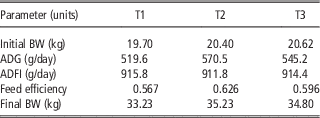
The results on animal performance are summarized in Table 1. Pigs weighed 20 and 35 kg approximately at start of the adaptation period and at the end of the slurry collection, respectively. The average daily gain, average daily feed intake and gain : feed ratio were 548.4, 912.4 and 0.601 g/day, respectively.
Pig performance observed during feeding trial and slurry collection for the different dietary treatmentsFootnote 1

ADG=average daily gain; ADFI=average daily feed intake.
Data correspond to a mean of eight pigs penned together during 19 days, and of two pigs/cage and three cages per treatment for an additional week.
1 T1: control diet; T2: inclusion diet (250 mg/kg DFM); T3: inclusion diet (500 mg/kg DFM).
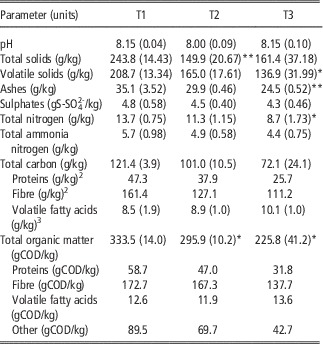
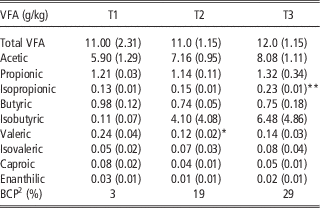
An apparent dose-related negative effect was consistently observed upon dietary DFM supplementation on the amount of organic matter (volatile solids, total carbon and COD content) in the dejections, but statistical significance among treatments could not be substantiated (Table 2). Treatment diets also resulted in a reduction of the total nitrogen and, to a lesser extent, of ammonia (TAN); neither nitrite nor nitrate was detected. Conversely, VFA tended to be higher for treatments with DFM inclusion (Table 3). The most abundant VFA were acetic acid (53% to 67%), propionic acid (11% to 17%) and n-butyric acid (6% to 11%). Minor quantities (2% to 5%) of isobutyric acid, as well as isocaproic and caproic acid were detected in all samples. Branched chain proportion (BCP), an indication of the extent of protein fermentation, determined as the sum of isobutyric and isovaleric acids in relation to the total VFA (Awati et al., Reference Awati, Williams, Bosch, Gerrits and Verstegen2006) decreased upon Bacillus DFM supplementation. In relation to the non-organic species, the ash fraction was also reduced upon DFM supplementation.
Average and standard error of physicochemical parameters from freshly collected pig slurries (n=3) for the different dietary treatmentsFootnote 1

ANOVA level of confidence between non-inclusion control (T1) and dietary treatments (T2 and T3) are indicated by asterisks (*P<0.10, **P<0.05).
1 T1: control; T2: inclusion (250 mg/kg DFM); T3: inclusion (500 mg/kg DFM).
2 Calculated as described in the ‘Material and methods’ section.
3 Expressed as acetic acid equivalents.
Average and standard error on the concentration of volatile fatty acids (VFA) in freshly collected pig slurries (n=3) for the different dietary treatmentsFootnote 1

BCP=branched chain proportion; DFM=diet-fed microbial.
ANOVA level of confidence between non-inclusion control (T1) and dietary treatments (T2 and T3) are indicated by asterisks (*P<0.10, **P<0.05).
1 T1=control; T2=inclusion (250 mg/kg DFM); T3=inclusion (500 mg/kg DFM).
2 BCP calculated as the percentage of isobutyric+isovaleric in relation to the total VFA.
Potential gaseous emissions
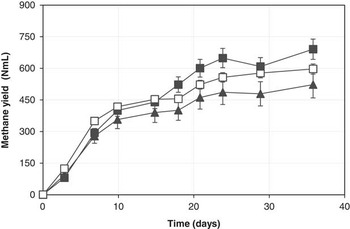
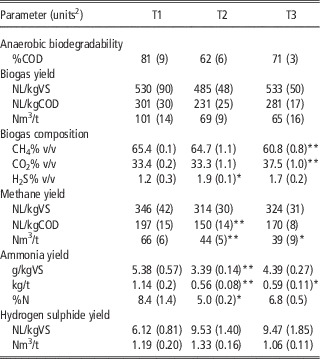
The observed methane accumulation patterns demonstrated that the maximum production was already achieved after 36 days of incubation (Figure 1). At that point, most of the biodegradable organic carbon from the pig slurry was mineralized into methane and carbon dioxide. It was interesting to observe that biogas production reached a first plateau after 20 to 25 days, and then it recovered again until the definitive saturation. Such phenomenon might be attributed to preferential substrate utilization, or diauxic growth. The organic matter was fractionated into methane, VFA, other biodegradable soluble substrates and non-biodegradable organic matter, being the anaerobic biodegradability of pig slurries determined upon the COD mass balance (Table 4). From these results, it appears that the dietary supplementation with the assayed additive resulted in a reduced biodegradability of pig slurries.
Time-course methane accumulation on the head-space of biochemical methane potential assays on pig slurry samples obtained from different feeding additivation assays. T1: non-supplemented control (■), T2=inclusion (250 mg/kg) (▲) and T3=inclusion (500 mg/kg) (□). Represented values and error bars correspond to the average and standard deviation of three independent experiments.

Biodegradability and potential emissions of methane, hydrogen sulphide and ammonia from pig slurries for the different dietary treatmentsFootnote 1

DFM=diet-fed microbial.
Given values correspond to the average and standard error (in brackets) of three independent experiments. ANOVA level of confidence between non-inclusion control (T1) and dietary treatments (T2 and T3) are indicated by asterisks (*P⩽0.10, **P⩽0.05).
1 T1=control; T2=inclusion (250 mg/kg DFM); T3=inclusion (500 mg/kg DFM).
2 Volumetric emission rates expressed in normal conditions (25°C, 1 atm).
No significant differences were observed on biogas yield between non-inclusion controls (basal diet) and inclusion dietary treatments, but lower methane yield were obtained with the latter (Table 4). Such differences were significant (P<0.05) for diet T2 (low additive doses) when expressed in specific terms for both slurry COD content and fresh weight, and are the result of the biogas from the controls being richer in methane. Transient accumulation of VFA was observed during the biochemical methane potential assays, with an average concentration of 2.29, 1.25 and 0.19 g/l in acetate equivalents for treatments T1, T2 and T3, respectively, after 6 days of incubation. In general, acetic acid was always the most abundant VFA (75%, 77% and 37% VFA for T1, T2 and T3, respectively. At day 36, by the end of the assays, all VFA were depleted. This transient VFA accumulation might be associated to the observed diauxic methane accumulation pattern (Figure 1).
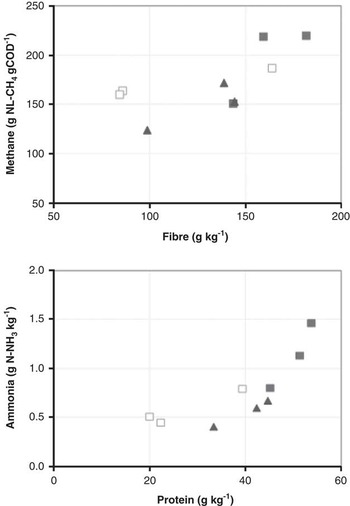
In the case of nitrogen, build-up of TAN pointed to the fermentation of organic nitrogen compounds. Ammonia accumulation in the liquid fraction was evidenced during the first 3 days of the biochemical methane potential assays but no increment was observed thereafter. These values were calculated from the nitrogen distribution between organic and inorganic nitrogen. The biodegradation of organic nitrogen compounds in the controls (T1) was 86% of the initial protein, which was converted into TAN. Biodegradation of organic nitrogen in inclusion treatments T2 and T3 was 21% and 75%, respectively. Considering the ammonia content estimated from the equilibrium at 25°C and pH 8.2, the potential ammonia volatilization was considerably lower, about 50%, upon supplementation with the Bacillus spp. DFM (Table 4). Methane and ammonia yields appear to be correlated to the content of fibres and proteins in the fresh pig slurry, respectively (Figure 2). On the other hand, no correlation was found between concentration of sulphate in the pig slurry and hydrogen sulphide in the resulting biogas.
Correlation between the potential gaseous emissions of methane and ammonia, in relation to the pig slurry content of fibre and protein, respectively. T1: non-supplemented control (■), T2: inclusion (250 mg/kg) (▲) and T3: inclusion (500 mg/kg) (□).

Microbial community characterization
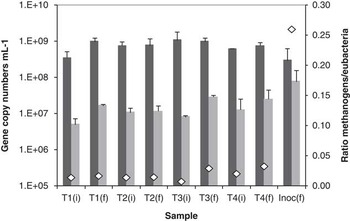
As the sole agents of biological methane production in pig slurry, the abundance of methanogenic archaeobacteria was determined in relation to the total eubacterial population (Figure 3). The results demonstrated that counts of bacterial and methanogenic species were slightly lower in the non-DFM supplemented control treatment (T1). The anaerobic digestion of pig slurries did not result in very significant changes in the balance between these two microbial groups, but the methanogenic biomass that was used as inoculum for the biochemical methane potential assays displayed a significantly higher ratio between methanogenic archaeobacteria and eubacteria.
Copy number of archaeal functional mrcA and eubacterial ribosomal 16S rRNA partial genes. Measurements correspond to the average of three independent DNA extracts from each pig slurry sample (standard deviations have been represented as error bars). Samples correspond to the fresh (i) and digested (f) pig slurry obtained from non-supplemented (T1) and supplemented dietary treatments with the Bacillus spp. direct-fed microbial (T2 and T3). The methanogenic biomass (inoc) used as inoculum has also been included in the analysis. The gene ratio between the two microbial groups has been indicated with an empty diamond.

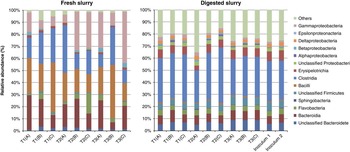
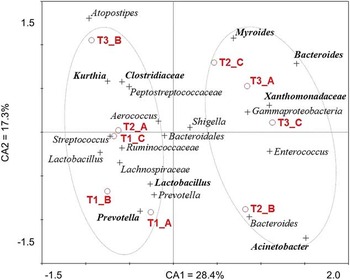
The microbial community structure of fresh and digested pig slurries was also studied by using high-throughput sequencing techniques of barcoded amplicons on 16S rRNA partial eubacterial and archaeobacterial genes. The number of valid DNA reads per sample ranged from 25 265 to 52 894, and from 10 604 to 209 456, for eubacteria in fresh manure and digested manure, respectively (not shown). Histograms on the eubacterial community structure at class phylogenetic level are displayed in Figure 4. An important variability was observed in relation to the distribution of assigned taxa among treatment replicates, particularly, in fresh pig slurry samples. Digested slurry displayed a more conserved biodiversity profile, which was in fact relatively similar to that of the methanogenic biomass that was used as inoculum. Microbial heterogeneity of the fresh slurry was further confirmed by determining the OTU. A criterion commonly established in the literature as a crude approximation to define which DNA reads might belong to the same, or very close, bacterial species (Caporaso et al., Reference Caporaso, Kuczynski, Stombaugh, Bittinger, Bushman, Costello, Fierer, Gonzalez-Pena, Goodrich, Gordon, Huttley, Kelley, Knights, Koenig, Ley, Lozupone, McDonald, Muegge, Pirrung, Reeder, Sevinsky, Turnbaugh, Walters, Widmann, Yatsunenko, Zaneveld and Knight2010). On basis of OTU incidence values, the number of total expected ‘species’ was calculated for each sample by means of the Chao1 estimate (not shown). This number was relatively similar in all studied samples for the Eubacteria (around 3000 OTU), though it was more variable among replicates of T3 (from 2084 to 3217 OTU). The number of OTU in Archaeobacteria were two orders of magnitude lower than those of the Eubacteria, with only about 25 distinct species. Interestingly, the number of observed OTU was in all cases more than the half of the expected OTU richness, thus showing that an important part of microbial community was collected by the massive sequencing analysis. Multivariate correspondence analysis on the sample’s eubacterial OTU relative abundance matrix was depicted in a two-dimensional plot that accounted for 45.7% of the total data variance (Figure 5).
Eubacterial biodiversity composition, in relative abundance (%), of different taxa (operational taxonomic units phylogenetically assigned to class level using RDP classifier) on fresh and digested pig slurry duplicate samples collected from non-supplemented (T1) and supplemented dietary treatments with the Bacillus spp. direct-fed microbial (T2 and T3). The methanogenic biomass used as inoculum has also been included in the analysis.

Correspondence analysis on the operational taxonomic unit (OTU) relative abundance matrix on fresh pig slurry triplicate samples (A, B and C) collected from non-supplemented (T1) and supplemented dietary treatments with the Bacillus spp. direct-fed microbial (T2 and T3). Depicted taxa correspond to the phylogenetic assignment of OTUs that are present with an average abundance >0.5%. Bold names (blue color) account for OTUs with a maximum sample abundance >5%. The percentage of variance represented by each axes has also been indicated.

Discussion
DFM products based on bacteria specifically selected to increase manure decomposition has been proposed as a suitable strategy for reducing undesirable environmental emissions from manure (Loyon et al., Reference Loyon, Burton, Misselbrook, Webb, Philippe, Aguilar, Doreau, Hassouna, Veldkamp, Dourmad, Bonmati, Grimm and Sommer2016). Bacillus species are ideally suited for this purpose because of their stability as spore-forming bacteria and ability to produce a variety of hydrolytic enzymes (Schreier, Reference Schreier1993). There are growing numbers of reports which document survival and germination of Bacillus spores within the digestive tract (Nicholson, Reference Nicholson2002). Due to enhanced enzyme contact, less incidence of foaming and lower accumulation of solids, fibre-bound nitrogen, total protein and fats are expected in the manure pit (Davis et al., Reference Davis, Parrott, Brown, de Rodas, Johnson, Maxwell and Rehberger2008). Bacillus spp. supplementation also resulted in enhanced digestibility (Owusu-Asiedu et al., Reference Owusu-Asiedu, Jaworski, Awati and Stein2014) and alteration of microbiota favouring lactic acid bacteria that consequently reduce the slurry pH (Wang et al., Reference Wang, Cho, Chen, Yoo, Huang, Kim and Kim2009). In addition, B. subtilis generates subtilin, which may diminish urease generating microbiota in the gastrointestinal lumen thereby attenuating NH3 releases. However, these effects have also been disputed by some studies that failed to show beneficial effects on NH3 emissions (Han and Shin, Reference Han and Shin2005). Enhanced biodegradation of the organic matter in the slurry pit might result in the emission of methane due to the prevailing anoxic conditions (Barret et al., Reference Barret, Gagnon, Topp, Masse, Massé and Talbot2013).
In this study, a novel Bacillus spp. DFM was assayed under experimental farm conditions. The strain combination was designed for an optimized expression of multiple hydrolytic enzymes, in order to maximize fibre decomposition. We have previously demonstrated that the assayed DFM had a beneficial effect on feed efficiency in growing pigs (Owusu-Asiedu et al., Reference Owusu-Asiedu, Jaworski, Awati and Stein2014). Here, the effects of this probiotic on the physicochemical characteristics of pig slurries have been shown. Particularly, total and volatile solids in pig slurry were lower in the DFM-supplemented treatments than in the control. A clear dose-effect was observed in the reduction of organic matter from 17% to 41% in mass terms (11% to 32% in COD units), when the additive was supplemented at 250 mg/kg (T2) and 500 mg/kg (T3), respectively. These results are in agreement with a previous study, in which dietary supplementation with a combination of B. lichenformis and B. subtilis strains improved feed efficiency in growing pigs and decreased the swine manure viscosity and content of solids (Davis et al., Reference Davis, Parrott, Brown, de Rodas, Johnson, Maxwell and Rehberger2008). Here, the most important reduction in pig slurry organic matter concerns proteins, from 20% in T2 to 46% in T3, either in mass and COD units, when compared with the control T1 (Table 2). Protein degradation was also coupled with lower amounts of total nitrogen in pig slurry, from 18% in T2 to a 36% in T3. Protein biodegradation was also confirmed by an increase in the BCP index (Table 3), as a higher relative amount of branched chain VFA indicates a more intense fermentative activity of the caecal microbial population in the DFM-supplemented pigs (Awati et al., Reference Awati, Williams, Bosch, Gerrits and Verstegen2006). The content of fibres in pig slurry also decreased upon DFM supplementations by 21% and 31% (3% and 20% in COD units) for T2 and T3, while VFA concentration tended to increase, thus pointing to the fact that Bacillus addition resulted in enhanced fibre degradation in the animals’ gut.
In an innovative approach, the potential emission of harmful acidification and/or greenhouse promoting gases were evaluated by standardized biochemical methane potential tests, according to the IPCC guidelines, in order to simulate pig slurry decomposition in anoxic conditions (Table 4). DFM inclusion resulted in a reduction of the pig slurry anaerobic biodegradability and subsequent biogas production, but not in a dose response manner. Methane production dropped by about 30% to 40% in fresh slurry, but yield values were similar when expressed in specific terms, either in relation to the volatile solids or COD units. Emission reduction was particularly significant for ammonia, with drops of about 50% in the fresh pig slurry weight (wet basis) upon DFM supplementation. However, in specific terms of volatile solids, ammonia emission reduction was 37% and 19% for T1 and T2, when compared with control.
The observed direct correlation between methane and ammonia yields and the content of polymeric materials in the fresh pig slurry (Figure 2) indicates that substrate availability for microbial biodegradation was the main bottle-neck for the process. Molecular quantification of methane producing microbes in the Archaeobacteria domain revealed that they were very abundant in the pig slurry (around 107 gene copy numbers/ml) while no clear distribution patterns along dietary treatments were apparent (Figure 3). Methanogenic archaea present in the inoculum were about one order of magnitude higher (108 gene copy numbers/ml). Phylogenetic assignment of archaeal sequences showed a strong shift from the hydrogenotrophic genus Methanobrevibacter, predominant in the fresh pig slurry, towards the obligate aceticlastic Methanosaeta from the end of the biochemical methane potential assays. Methanosaeta spp. are found ubiquitously in anaerobic digesters (Demirel and Scherer, Reference Demirel and Scherer2008) and might therefore have been introduced with the inoculum. Yet, replacement of Methanobrevibacter spp. by other archaeal species such as Methanosarcina, and Methanoculleus representatives has been demonstrated to occur spontaneously in swine manure storage tanks (Peu et al., Reference Peu, Brugère, Pourcher, Kérourédan, Godon, Delgenès and Dabert2006; Barret et al., Reference Barret, Gagnon, Topp, Masse, Massé and Talbot2013).
Microbial populations of the Eubacteria domain present in fresh and digested pig slurry were quite complex and the effect of inclusion of Bacillus spp. DFM on microbial interactions was difficult to analyse (Figure 4). The main identified microbial groups, for example Bacteroidetes, Bacilli, Clostridia encompass most of known fermentative bacteria in pig manure (Peu et al., Reference Peu, Brugère, Pourcher, Kérourédan, Godon, Delgenès and Dabert2006) as well as in anaerobic digesters (Liu et al., Reference Liu, Wang, Zhang, Zhang, Yan, Zhou, Zhao and Zhou2009; Riviere et al., Reference Riviere, Desvignes, Pelletier, Chaussonnerie, Guermazi, Weissenbach, Li, Camacho and Sghir2009). As with the methanogenic archaeobacteria, some predominant eubacteria were exclusive of the digested pig slurry and the effect of inoculation with methanogenic biomass on the final microbial community composition was evident. With this respect, the predominance of ribotype sequences that are associated to the genus Cloacomonas (>10% of OTU counts) in the methanogenic inoculum and the digested slurry is quite remarkable. Representatives of this group have been described previously as syntrophic fermenters of amino acids that are common in anaerobic digesters (Pelletier et al., Reference Pelletier, Kreimeyer, Bocs, Rouy, Gyapay, Chouari, Rivière, Ganesan, Daegelen, Sghir, Cohen, Médigue, Weissenbach and Le Paslier2008).
Interestingly, the number of OTU that belonged to the Bacillaceae family amounted two to three in 1000, regardless of the slurry sample, while only two to five in 100 000 could be effectively assigned to the genus Bacillus. Hence, dietary supplemented Bacillus spp. has a minor effect on the microbial composition of manure. Multivariate correspondence analysis on the relative abundance of bacteria from fresh pig slurry revealed that sample scores were arranged in two principal clusters, which were not fully consistent with the different dietary treatment replicates (Figure 5). Non-inclusion control treatment replicates (T1) were relatively similar in that predominant bacteria (relative abundance >10%) included representatives of Lactobacillus, a genus that has been linked to a large number of benefits for gut function and health in human and pigs (de Angelis et al., Reference de Angelis, Siragusa, Berloco, Caputo, Settanni, Alfonsi, Amerio, Grandi, Ragni and Gobbetti2006), and Prevotella which tends to dominate in long-term diets rich in carbohydrates (Wu et al., Reference Wu, Chen, Hoffmann, Bittinger, Chen, Keilbaugh, Bewtra, Knights, Walters, Knight, Sinha, Gilroy, Gupta, Baldassano, Nessel, Li, Bushman and Lewis2011). In relation to the dietary treatments T2 and T3, there were single replicates, T2 (A) and T3 (B), that were somewhat grouped in a second cluster that was defined by a higher prevalence of Kurthia spp. and representatives of the Clostridiaceae family. Species from the genus Kurthia have commonly been isolated from manure of farm animals, especially chickens and pigs (Boone et al., Reference Boone, Garrity, Castenholz, Brenner, Krieg and Staley2009). These species have also been isolated from the faeces of patients suffering from diarrheoa, but there is no clear evidence of pathogenicity (Stackebrandt et al., Reference Stackebrandt, Keddie and Jones2006). Members belonging to the Clostridiaceae comprise the genus Clostridium as the most diverse taxon, with >100 species that include common environmental bacteria as well as important pathogens. They are obligate anaerobes capable of producing endospores. Some species are characteristic from the gut and from anaerobic digesters, where they are responsible for fermentative processes.
Similar to our results, significant variability in enteric microflora has recently been reported in pig for closely related individuals despite similar environmental conditions and genetics (Arnal et al., Reference Arnal, Zhang, Messori, Bosi, Smidt and Lallès2014). This phenomenon has been related to neonatal disturbances on the gut colonization process which could then have long-lasting impact on the established enteric microorganisms. Hence, the effects of a Bacillus spp. DFM on enteric microbial populations at the animal’s fattening stage might be by far more intricate than those suggested by univocal models. Yet, the current study demonstrates that the administration of a Bacillus spp. DFM specifically designed for fibre and protein biodegradation decreases the potential emission of methane and ammonia during the decomposition of the generated pig slurries. This effect is likely due to enhanced digestibility in the animals’ gut, rather than to biodegradation processes taking place during storage of pig slurry or pH modification.
Considering the current rise of pathogenic microorganisms resistant to traditional antibiotics, the research and use of Bacillus spp. as probiotic replacements might become a strategy with a promising future in pig farming. In addition to this, dietary supplementation with selected strains for enhanced digestibility must also be considered as BAT in preventing or minimizing adverse effects on the environment from emissions linked to the management of animal manure. Yet, accurate techniques are needed for a proper evaluation on the effectively of such additives. We proposed and successfully tested a standardized methodology for assessing the potential emission of greenhouse and acidifying gases generated pig slurries under different nutritional options.
Acknowledgements
The authors kindly acknowledge Miriam Guivernau and Laura Tey, from GIRO–IRTA, as well as Judith Alos, from the University of Barcelona, for their support on the molecular and analytical laboratory work, respectively. This research has been funded by, Danisco Animal Nutrition-DuPont Industrial Biosciences (Marlborough, UK Ltd.).
Supplementary Material
For supplementary material/s referred to in this article, please visit http://dx.doi.org/10.1017/S1751731116001415