“Get out of the way, the new alphabet's coming”Footnote 1
In the period between the second half of the nineteenth and the first half of twentieth centuries, most ‘national’ languages in use today passed through different reforms as a result of “various social needs which emerged in the period of rapid social changes”.Footnote 2 However, the most radical language reforms which took place in the Turkic-speaking countries went beyond linguistic and communicative reformations and modifications; in 1928 they ceased using Arabic script and adopted Roman-based systems.
Alphabet shift is the most critical phase in language reform due to its cultural and financial costs. Moreover, compared to other measures that can be undertaken during reform processes – such as orthography regulations, terminology modernisation, purism, and determining the dialect for the base of the written language – switching script is the hardest task to propose, to implement, to follow through, to control, to monitor, and to maintain. That is why most of countries that have embarked on change to a new script failed in transition while other countries did not dare to try, even though they considered romanisation as an option, because of its cultural implications.Footnote 3
Turkic peoples, however, have provided the most remarkable examples of organising alphabet shift, both historically and in recent times. They have had comparatively more experience in this matter, and have made the most important contributions to the history of romanisation. An identity problem and the strong wish for transformation have played a propulsive role in their success in this regard. Their overall approach to language has been one of perceiving it as an important element not only for development and progress, but also for identity construction.
Uzbekistan adopted and abandoned four different alphabets within 80 years, and during this time the Uzbek language underwent huge changes and transformations. All of these radical changes took place in different social, cultural, political and economic milieux and under different conditions, which linked closely with those language reform processes. Alphabet shift was clearly seen as an option during the first initiatives to reform language in Uzbekistan. At each consultative meeting it was firmly on the agenda.
In the First Uzbek Language and Orthography Congress, held in 1921 in Tashkent, romanisation was proposed as a viable alternative to the reformation of the Arabic-based Uzbek alphabet. In the following congresses held in 1922Footnote 4 and 1923Footnote 5, plans for romanisation were put on the table again and again. According to the minutes of these meetings, proposals for romanisation did not meet with strict opposition, nevertheless, they were all rejected on each occasion on the grounds that the matter was very difficult and it was not the right time to do it.
During the early 1920s, conservative authorities and officials were in power, and they were against any change that would break the ties between Uzbeks and the rest of the Muslim and Turkic world. Furthermore conservative officials and intellectuals also opposed any kind of modification of Arabic-based orthography and letters. In a regulation published by the Ministry of Education of Bukhara in 1922, it was declared that:
In Bukhara region Turkish language is written with the Arabic letters. The Arabic letters will never be changed.Footnote 6
This rejection was justified by implying the arbitrary, human-made nature of the letters:
Our aim is progress, the free and enlightened world. If we go on the right way, we can reach our purpose with the Arabic alphabet, as well.Footnote 7
Nevertheless, the reformed Arabic-based Uzbek alphabet was approved in 1923 after a congress held in BukharaFootnote 8 as, by the end of 1922, the conservatives had lost their grip over Uzbek politics and most of them had even been sacked from office.
Until the First Turcological Congress held in Baku in February 1926, the public call for romanisation was not strong. For example, in the meeting of the Uzbek Scientific Center, held in November 1925, just three months before the Turcological Congress, a proposal that the Arabic alphabet be discarded to be replaced by the Roman was defeated. It was resolved that such a change was not necessary and that the reformed Uzbek alphabet was perfectly suitable in spite of some of its shortcomings.Footnote 9 According to the resolution of the meeting, “the majority of the Turkish world has used the Arabic alphabet for centuries and the majority of the writings of the Turks and their history is connected with it”.Footnote 10 Crucially important, however, was that at this meeting the Uzbek delegates to the then forthcoming Baku meeting were selected.Footnote 11
The Baku Turkological Congress of 1926 could be said to be the most important event in paving the way for the adoption of the Roman alphabet, not only in Uzbekistan, but also in other Turkic republics in the USSR. In the resolution of the Congress it was accordingly stated:
The Congress ascertains the superiority and advantage of the new Turkic Roman alphabet vis-à-vis the Arabic and reformed Arabic alphabets, and the importance of the new alphabet from the point of civilization and progress, in comparison with the Arabic one. The Congress also considers that the transition to, instruction and implementation of the new alphabet is the duty for every republic and people in each and every Turkic republic.Footnote 12
It is possible to argue that romanisation was not a decision that the Uzbek authorities and intellectuals made freely on their own. On the contrary, there were two major motivations for the Uzbek leadership to adopt the new alphabet, and both of them were absolutely external: first, the wish to go along with other Turkic peoples, and, second, Moscow's push for romanisation. Moscow, from the beginning, supported romanisation in the USSR as part of its nationality and language policies. Contrary to the Armenian and Georgian languages, whose historical alphabets were never changed, the Turkic languages had connected the Turkic peoples to other powers, both inside and outside of the USSR: in the linguistic context to the Turkish-speaking peoples, and by association of its alphabet to the Muslim world. As Fierman puts it:
The adoption of the Latin alphabet for Uzbek and other Turkic languages of the USSR was the most tangible way in which the Bolsheviks attempted to undermine the Uzbek language's tie with Islam in the 1920s. Symbolically, the abandonment of Arabic letters broke a tie linking Soviet Muslims with fellow-believers abroad. It also undermined the Islamic identity by isolating literate people from their cultural heritage.Footnote 13
Following the Baku Congress, language reform in Uzbekistan took a new course. While it had a regional character prior to the congress, it became a Union-wide process afterwards especially with respect to alphabet change. In the aftermath of the Baku Congress, the All-Union Central Committee of the New Turkic Alphabet (VTsKNTA) was established in order to coordinate the shift to the new alphabet for Uzbek and other Turkic languages in the USSR.
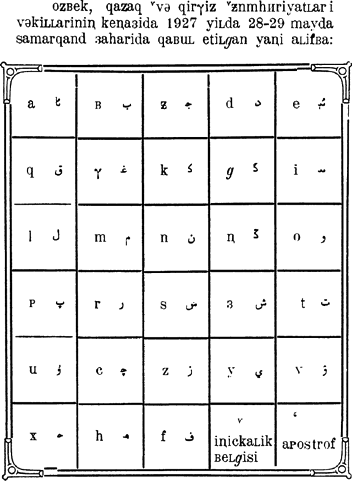
The first steps to carry out the plan for romanisation in Uzbekistan started with the “Meeting of First Regional Committee”, organised by the ‘Uzbek New Alphabeters’ on 19–21 May 1926. At this meeting the letters of the alphabet were determined for the Roman-based new Uzbek writing system. In June of the same year, the fourth session of the Central Executive Committee of the Uzbek Soviet Socialist Republic passed a resolution ordering abandonment of the Arab alphabet in favour of Roman. In this session the Uzbek New Alphabet Committee, consisting of 42 members, was appointed to supervise the alphabet change.Footnote 14 When the Uzbek Scientific Center (İlmi Merkez) met on 11 August, the letters were revised and the number of vowels increased from ten to twelve. It was asserted that ten vowels could not reflect the vowel harmony exactly as it should.Footnote 15 On 28 May 1927, the Public Education Commissariat of UzSSR (Uzbek Socialist Soviet Republic) organised a Central Asian Congress devoted to the question of the new alphabet. In this joint meeting, Uzbek, Kazakh, and Kirgiz delegates agreed on adopting a shared standard alphabet, a ‘unified alphabet’.Footnote 16 It contained 23 consonant and five vowel symbols (“a”, “e”, “i”, “o”, and “u”), and all words which contain “soft” forms of these vowels were to begin with a small “v” sign (ingickelik belgisi);Footnote 17 there were to be no capitals (this will be discussed below).
The ‘unified’ alphabet for Uzbek, Kyrgyz and Turkmen languages adopted in Central Asian Congress on 28 May 1927.Footnote 18

This early preparatory period continued until the beginning of 1928, and during this time there was no attempt to implement of the new alphabet. The second plenum of the All-Union Central Committee of the New Turkic Alphabet (VTsKNTA), which was held in Tashkent on 7 January 1928, speeded up the process in Uzbekistan and marked the start of the implementation stage. Following the plenum, local authorities began to undertake additional measures to promote romanisation. The first issue of the Journal of the Uzbek Committee of the New Alphabet, Elenge, was published entirely in the new Roman-based alphabet on January 1928.Footnote 19 At the end of January, the Uzbek Central Executive Committee (UzCEC) decided to introduce the new Uzbek Roman alphabet in educational institutions beginning from the third grade of primary schools upwards. From 31 January 1928, all new textbooks were to be printed in the new alphabet.Footnote 20 The old books, however, were going to be used temporarily, because of the lack of textbooks in the Roman alphabet. From 1 January 1929, all laws and orders of the Uzbek government and its offices were also to be published in the new Uzbek alphabet.Footnote 21 In its 7 March meeting, the UzCEC fixed the final deadline for romanisation as 1932. Within these five years the transition would be completed.Footnote 22
The alphabet change in Uzbekistan had a profound impact on education, and this was the reason often mooted for romanisation. The literacy and re-literacy campaigns increased the percentage of literate people within the population. According to a report on this question, from 1926 to 1931, the number of literate citizens in Uzbekistan rose from 164,000 to 2 million, and the number of copies of printed materials with the Roman characters increased to 17 million.Footnote 23 According to one source, by the end of 1930 all Uzbek literature was published in the Roman script.Footnote 24 After 1930, publication of Uzbek language books and other printed material in the Arabic alphabet was no longer allowed. At the fifth congress of VTsKNTA in June 1931, the full switch to the new alphabet in Uzbekistan was declared and celebrated.Footnote 25
During the process of preparing a new Uzbek alphabet, the debates focused on the following topics: the question of capital letters, the number of vowels, and alphabet ‘unification’ with other Turkic speaking peoples.
Capital letters
Principally, Uzbek language reformers did not want to adopt capital letters. In the Central Asian Congress held in Samarkand in May 1927, the participants from Kyrgyzstan, Uzbekistan and Kazakhstan had come to the conclusion that they did not see capital letters as indispensable to their new alphabets. As alphabet shift took an All-Union course after 1927, this issue had mostly been discussed in the plenums of VTsKNTA. There were three different opinions on the matter: 1) complete rejection of capital letters, 2) adoption of capital letters using the same form in their upper case as in their lower, for example Cc, 3) adoption of capital letters as in their original forms in the Roman alphabet.
The rejection of capital letters was for the sake of simplicity and economy of writing. According to the opponents, it would be easier and quicker to teach and learn an alphabet without capital letters; moreover, it would reduce the expenses in typography and printing businesses, as well. They further argued that there were no capital letters in the former, Arabic alphabet which had been in continuous use for many years without any need for them. Some opponents pointed out that if the capital letters were to be accepted it would be necessary to re-teach people who had already been literate in the alphabet without capital letters, and books would have to be reprinted with capital letters.
The advocates of capital letters, however, argued that without capital letters, the principle of the Roman alphabet would be spoiled and the ties which bound Uzbekistan to developed countries would be disrupted. The third opinion propounded a compromise. It was proposed that capital letters should be derived from lower-case forms. It was argued that this followed the logic used in the Russian alphabet: all the upper cases were derived from lower cases except for the letter “a”.
However, Uzbekistan did adopt capital letters in 1929, but their extensive usage came a few years later.Footnote 26
Roman alphabet introduced 1927–1934 (capital letters were adopted by 1929).

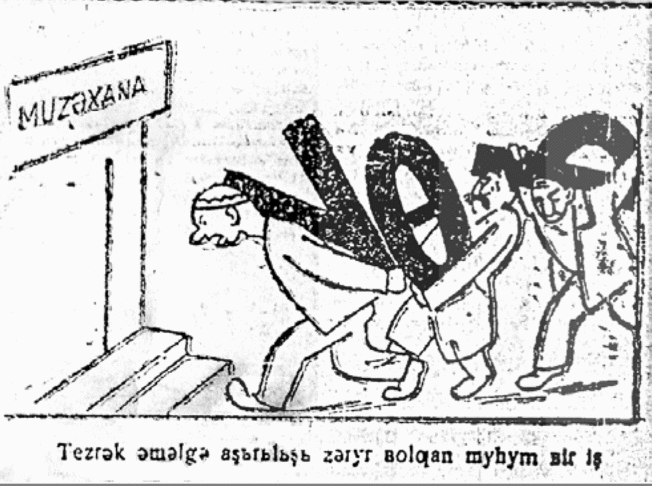
An Uzbek cartoon showing the eliminated vowels being taken to the museum.Footnote 27

The number of vowels
The representation of vowels in the writing system had always been a crucial problem for Turkic languages. One of the main complaints about the former Arabic-based alphabet was the lack of characters for vowels. With regard to the Uzbek language, this problem came to the fore one more time during the switch to the Roman alphabet. The vowel problem became particularly pertinent during the process of romanisation since it became mixed up with other weighty issues such as status planning. Before it was possible to determine the vowels in romanised Uzbek the reformers first had to decide which Uzbek dialect should be adopted as the standard language. Until the 1930s, the dominant opinion was that the rural dialects should have been the base for modern written language. According to this opinion, these dialects had preserved the authentic Turkic character of the language. One of the major Turkic features is “vowel harmony” which is possible only with vowel pairs, front and back. Some of the urban dialects such as that of Tashkent and Samarkand did not distinguish all of the paired vowels because of a Persian influence. These vowels are the typical Turkic “ı”, “ü”, “ö”. Contrary to the urban dialects on the other hand, most of the rural dialects had retained the full set of eight or nine Turkic vowels as well as the Turkic system of vowel harmony. In the Language and Orthography Congress of 1929, the number of vowels was fixed as nine.Footnote 28
The 1930s in the USSR were dominated by the protagonists of
progress. In the early 1930s, parallel to an increasing
revolutionary discourse and a changing intellectual
profile, the advocates for urban dialects raised their
voice. The cities were very important to socialists and
socialism because they were the heart of industrialism and
the proletariat. In addition Russian settlers had settled
in the cities, and it would have been difficult for them
to learn a rural variant of the Uzbek language. Thus it
was not easy for rural dialects to be the base for written
language in the shade of socialism. From the beginning of
1930 onwards, the number of vowels was the primary
language problem discussed in Uzbekistan. Finally, in
January 1933, at a congress in Moscow, elimination of
several vowel characters from the Uzbek alphabet was
recommended.Footnote 29 This recommendation was
discussed throughout that year in a number of meetings in
the UzSSR. As a result, in the Orthography and Terminology
Congress of January 1934, the vowel letters
“ ”, “θ”, and “y” were totally
eliminated from the Roman-based Uzbek alphabet, and the
usage of “ᵊ” letter was restricted. This modification has
remained permanent in the Uzbek written language.
Another consequence of the debates on the reduction of vowels was a suggestion by the Marxists linguists.Footnote 30 They proposed that short “i” in such words as biz (we), bilen (with), til (language) should be written without “i”: hence bz, blen, tl. According to them, this was a progressive tendency in Uzbek language.Footnote 31 But this proposal remained on paper.
Roman alphabet introduced 1934–1940

Alphabet unification (or attempts to establish a shared alphabet)
During the first stage of romanisation in Uzbekistan from 1926 to 1940, the other matter at issue was alphabet ‘unification’ with the other Turkic speaking peoples. This was the initiative of Uzbekistan. At a meeting, organised by the Uzbekistan Public Education Commissariat in May 1927 in Samarkand, delegates from Uzbekistan, Kazakhstan and Kirgizstan agreed on the ‘unification’, or the sharing of alphabets of these republics. However, after the Central Committee on New Turkish Alphabet (VTsKNTA) was entrusted with the responsibility to supervise alphabet issues of Turkic peoples in the USSR in 1928, the ‘unification’ question gained a different dimension. Although this matter had been discussed in five important plenums organised by the VTsKNTA, delegates from the republics could not agree on a uniform alphabet. A similar situation occurred after the disintegration of the USSR in 1991 and a common solution was not to be found then either.
In the mid-1930s, Marxist intellectuals started to argue that the Roman-based alphabets had fulfilled their roles by effecting the ‘nationalisation’ of peoples who had used this alphabet. According to this view, all societies have to pass through inevitable evolutional stages to reach the final communist stage. The ‘Nationalism’ stage precedes that of communism, and all societies have to experience nationalism in order to reach the final destination. They alleged that non-Russian societies had, therefore, experienced their nationalist stage by constructing their written languages via the Roman-based alphabets. Following a series of modifications on the Uzbek Roman-based alphabet during the 1930s, thus, a version of the Cyrillic script was adopted in Uzbekistan in 1940 under the Joseph Stalin dictatorship.Footnote 32 Even though this alphabet has been used for the Uzbek language up until today, the Uzbek authorities made a decision in 1993 to replace the Uzbek Cyrillic alphabet with a Roman version. This was the beginning of the second phase of romanisation in Uzbekistan.
The Second Romanisation
The second romanisation, as a part of language reform, in Uzbekistan was implemented after the disintegration of the USSR. The contemporary Uzbek language reform was launched in 1989 with a language law and it illustrates how the Uzbeks started to regain status and positions lost under the rule of the USSR. For instance, the Supreme Soviet of Uzbekistan adopted a law in October 1989, about two years before the disintegration, to promote the status of the Uzbek language against Russian. In the law the Uzbek language was declared as the “state language” in Uzbekistan. This was the resumption of the status given to the Uzbek language at the 12th Congress of All-Union Soviet in 1924.Footnote 33 The reference in the 1993 alphabet law to the Roman alphabet experience in Uzbekistan between 1929 and 1940 and regulations in the Uzbek language vocabulary all point at a rehabilitation of the pre-1940 atmosphere.
The second romanisation also received a boost following a congress bringing together representatives from the Turkic peoples of the ex-USSR with academics from Turkey. This congress, held in Istanbul in November 1991, was devoted to negotiating and determining a unified Roman-based alphabet for the languages of the ex-USSR Turkic republics. The congress recommended the adoption of a 34-character Common Turkic Alphabet for all Turkic languages, 29 letters of which were from the current alphabet of Turkey with additional five letters for the needs of other Turkic languages.Footnote 34 In the last meeting of this conference series on the creation of a Roman-based Turkic alphabet, held in Ankara in September 1993, representatives of Azerbaijan, Turkmenistan and Uzbekistan decided to shift to the Roman alphabet.Footnote 35
Common Turkic Roman alphabet

Roman alphabet adopted in 1993

On 2 September 1993, the Uzbek Parliament passed the first law on romanisation which stipulated the introduction of a Roman-based alphabet for the Uzbek language. According to the prescribed timetable in the 1993 law, first graders in elementary schools were going to learn how to read and write in the new alphabet beginning at the start of the next school year. For the rest of the population and changes in publishing the shift would be gradual and was to be completed by 1 September 2000.Footnote 36 In the second article of the law, the instruction of former Uzbek writings, Arabic and Cyrillic, was guaranteed.Footnote 37
However, before reaching the deadline for a complete switch to the new alphabet, in May 1995 with a new law of the Uzbekistan Parliament the deadline for complete transition was extended to 1 September 2005. In this law, the changes in the alphabet were outlined in three articles.Footnote 38 In August 1995 the Ministerial Cabinet of Uzbekistan approved the revised version of the new Uzbek Roman alphabet with the new orthographic rules.Footnote 39 On top of this, it was announced one more time in 2002 that the new deadline for romanisation in all fields of life would be postponed still further to 2010, proving the difficulties the authorities are facing in Uzbekistan.Footnote 40
Roman alphabet for Uzbek (1995 revised version)

This modification departed in a significant way both from the common Turkic alphabet and the former Uzbek Latin alphabet in use during the 1930s. A major source of criticism has been that the new alphabet was obtained by adding some characters to the English alphabet like o’, g’, she, ch, ng, and apostrophe. Access to worldwide web and the internet was also said to be a decisive factor in this last revision.Footnote 41
When a radical alphabet reform is being considered it would be useful to take into account the following principles:Footnote 41a
1. The letters must be taken as much as possible from one single writing system.
2. The letters from one writing system must be taken with their original phonetic equivalents.
3. The letters must not be similar to each other in shape.
4. The letters must be without punctuation marks, on top or below.
5. The letters must not be diagraphs as much as possible.
In this regard the major defect of the revised alphabet Uzbekistan (1995) comes from the fifth clause above. The diagraphs “sh” and “ch” are not good choices for the Uzbek language. Contrary to English and most other European languages, these combined letters stand for relevant sounds which are used in every position of the word: at the beginning, in the middle and at the end, as in other Turkic languages. That is why we encounter some strange combinations: achchiq (bitter), bichiqchi (pattern-cutter), kushcha (little bird), ishchen (hard-worker).
The apostrophe is also problematic, because it is used both in two letters o’, g’ and in Arabic origin words: Is'hoq (Isaac), as'hob (interlocutor), la'l (ruby), fe'l (disposition).
Conclusion
During the contemporary Uzbek language reform, three language areas – status, writing system, and vocabulary – received comparatively more attention as being problematic. Other knotty issues and areas in the reform process such as standardisation and modernisation of terminology are not currently on the agenda.
Comparing past and present experiences with respect to changes in the Uzbek writing system, one of the most prominent differences seems to be that the current transition process is extended over a longer term. The deadline for complete transition has been extended twice and according to the last decision the completion date was predicted as 2010 – barring any future extensions. One of the main reasons for this delay is that, contrary to the first episode of romanisation, the current bout of alphabet shift possesses no urgency. In the first episode, alphabet reform had been perceived as a facilitating device in economic development and education. Today the standard of education in Uzbekistan is quite high however, and experience has shown that alphabet change alone is not enough for socio-economic development. Moreover acceleration of the transition process would increase the economic cost of reform to an unbearable level,Footnote 42 and the Uzbek government has other political and social priorities. Thus, extension of the process over a long term seems to be the more rational way to go. One other reason for the slow pace of reform is the influential presence of Russian, a prestigious and active language, which is written in the former, Cyrillic, alphabet. At this critical juncture in history, further delays in the reform process may jeopardise the entire project and put at risk those steps successfully implemented so far. However, it is too early to predict failure. Due to the absence of implicit or explicit opposition to the regulations and reforms the failure of romanisation is far from being a foregone conclusion. The new Roman-based writing system has already permeated Uzbek society, and the government has, so far, maintained its resolve on the decisions already taken for the Uzbek language and the new alphabet.
Timetable of Romanisation in Uzbekistan
First Romanisation phase
-
1921 Regional Uzbek Language and Orthography Congress, Tashkent.
-
1923 Approval of Reformed Uzbek Alphabet (Arabic-based).
-
1926 First Turkological Congress, Baku, February.
-
1926 “First Meeting of Regional Committee” organised by Uzbek New Alphabet, May.
-
1926 Meeting of the Scientific Centre, August; revision of the new alphabet.
-
1927 Central Asian Congress on Roman alphabet, May; resolution on unification of Roman-based alphabet of Kirgiz, Kazakh and Uzbek Republics.
-
1927 Session of the Central Executive Committee of the UzSSR, June; abandonment of the Arabic alphabet.
-
1928 Plenum of All-Union Central Committee of the New Turkic Alphabet, Tashkent, January.
-
1928 Resolution of Uzbek Central Executive Committee on the introduction of the Uzbek Roman alphabet in the education institutions, January.
-
1929 Uzbek Language and Orthography Conference, Samarkand; capital letters adopted.
-
1933 Plenum of Scientific Council on Language and Writing of the Nations of the USSR, Moscow; proposed elimination of several vowel letters from the Uzbek alphabet.
-
1934 Orthography and Terminology Congress, 3 vowels (
 , θ, y) eliminated.
Second Phase of Romanisation
-
1991 International Symposium on Modern Turkish Alphabets, Istanbul.
-
1993 Alphabet and Orthography Congress, Ankara, March.
-
1993 Uzbek Parliament passed a law for romanisation, September.
-
1995 Uzbek Parliament approved revised version of the Uzbek Roman alphabet.