Introduction
Life tables are important and widely used tools for analysing arthropod population dynamics. Traditional life tables primarily focus on females and their age-related characteristics (Hutchison and Hogg, Reference Hutchison and Hogg1984), which can lead to a distorted understanding of life history attributes (Huang and Chi, Reference Huang and Chi2012). However, recent developments in age-stage-specific life tables focus on the significance of including age-stage two-sex data and offer an accurate depiction of life table characteristics in species having varied developmental stages (Chi, Reference Chi1988). The age-stage two-sex life table analysis utilises a detailed timetable – often with daily granularity – to monitor the survival rates of females and males throughout their life cycle. This analysis enables the estimation of key biological and demographic traits of the life cycle (Chi, Reference Chi2025). Such traits can be evaluated in relation to varied environmental conditions, including stable or fluctuating temperatures, resistance to pesticides, and the interactions between insects and pathogens for biological control purposes.
Cyamophila willeti (Hemiptera: Psyllidae) is a serious insect pest (Bo, Reference Bo2024; He et al., Reference He, Guang, Zhao, Zhang and Guan2005; Yang et al., Reference Yang, Wang and Lv2002) commonly found in regions such as Liaoning, Beijing, Shaanxi, Shanxi, Gansu, Ningxia, Hunan, Hubei, Guizhou, and Xinjiang (Qiang and Ma, Reference Qiang and Ma2007; Wang and Wang, Reference Wang and Wang1996; Yang et al., Reference Yang, Zheng and Chen2014). Both nymphs and adults feed on the nectar from the young stems and flower clusters of deciduous Styphnolobium japonicum, secreting a waxy substance that coats the branches (Liang et al., Reference Liang, Wu, Yang, Sun, Zhao, Yang, Ren, Xiao and Yang2024; Song et al., Reference Song, He, Wang and Gu2019). This secretion negatively affects photosynthesis, leading to early leaf yellowing and drop, reduced flowering in clusters, and stunted growth of new shoots (Yang et al., Reference Yang, Wang and Lv2002). The S. japonicum is a deciduous tree belonging to the genus Styphnolobium in the Fabaceae family. Mature trees can reach heights of 15–25 meters, with grayish-brown bark and green, glabrous current-year branches (Wang, Reference Wang2023). It is characterised by its large, dense crown, straight trunk, and resistance to drought and cold. As a native Chinese species, it provides ecological and aesthetic benefits (Xu et al., Reference Xu, Yan, Lin, Zhen, Liu and Duan2021; Madden et al., Reference Madden, McLachlan, Oketch Rabah and Calderón2022). However, the waxy substances secreted by C. willeti nymphs and adults can cause sooty mould, which results in dark, sticky residues on branches that eventually fall to the ground. This not only detracts from the aesthetic value of roadways but also inconveniences pedestrians.
Recent research has highlighted various aspects of the existence and biological characteristics of C. willeti in China (Shen et al., Reference Shen, Chang, Zhang, Han, Wang, Zhu and Tian2008a, Reference Shen, Chang, Zhang, Han, Wang, Zhu and Tian2008b; Yang et al., Reference Yang, Wang and Lv2002; Zhang and Wang Reference Zhang and Wang2012). However, there is still limited knowledge regarding the population ecology of C. willeti. To develop an age-stage two-sex life table, C. willeti insects were collected from the Aksu region of Xinjiang and were reared under laboratory conditions (Chi and Liu, Reference Chi and Liu1985; Feng et al., Reference Feng, Wang and Gong2014). The objective of this study is to clarify the population ecology of C. willdeti using the two-sex life table theory. Understanding the dynamics of C. willeti populations is essential, as it provides valuable information about the reproductive rates, survival rates, and growth patterns. These factors are critical for developing effective pest management and conservation strategies.
Population ecology is an essential field of study because it allows us to predict population trends and evaluate the ecological effects of species within their habitats. By constructing a two-sex life table for C. willeti, we aim to gain a deeper understanding of the interactions between males and females throughout their life cycles, which will facilitate more accurate forecasts of population dynamics. This study addresses key issues in population ecology, including the mechanisms that drive population growth and the role of sex-specific characteristics in the survival and reproduction of the species.
Materials and methods
Experimental insects and host plant
Adults of C. willeti were collected from S. japonicum trees, located near the Plant Protection Station, Tarim University, Xinjiang, Aral 843300, China (N 40°32’46.3”, E 81°16’41.2”). Young S. japonicum seedlings were used as the host plant population, and they were seeded in 40 cm × 25 cm × 25 cm planting pots. The insects were reared for more than two generations under laboratory conditions (25℃ ± 1℃, 75% ± 5% RH, and 16 L: 8 D). When the plants were 15 cm tall, they were moved to rearing cages that were 50 cm × 45 cm × 40 cm and had a 200-mesh size so that the C. willeti population could feed on them. Identification and distinction of the first-, second-, third-, fourth-, and fifth-instar larvae (Fig. 1) and the adult stage (Fig. 2) were conducted through meticulous studies of moulting frequency and morphological features.
Different developmental stages of C. willeti: (a) First-instar nymph; (b) second-instar nymph, (c) third-instar nymph, (d) fourth-instar nymph, and (e) fifth-instar nymph.

Adult morphology of C. willeti: (A) female, (B) male.

Mating experiment
Experimental conditions
A photoperiod of 14L:10D (corresponding to local time 08:00–22:00) was set up with illumination consisting of diffused natural daylight, and temperature was maintained at 20°C–26°C, along with 40%–60% relative humidity.
Newly emerging adults of C. willeti (50 individuals per cage) were placed into three separate rearing cages (40 cm × 40 cm × 45 cm) with a sex ratio of 1:1 (female: male). The mating behaviour of C. willeti adults was observed in rearing cages for seven consecutive days, throughout a 24-hour cycle. Observations were conducted at 1-hour intervals, with each session lasting 15 minutes. During these sessions, the number of mating events and the duration of each copulatory event were recorded.
Oviposition selectivity of C. willeti to different plant parts
To assess the oviposition selectivity of C. willeti on different parts of S. japonicum, seeds were sown individually in 5 cm pots to standardise seedling phenotypes. Custom plastic rearing containers (180 mm height, 55 mm lower diameter, and 90 mm upper diameter) were prepared by removing the base, sealing it with 200-mesh nylon mesh, and inverting it with the mesh opening at the top. Each container was placed over a potted seedling with nymphs, and the wider end was sealed with a plastic lid. Oviposition preference assays were performed on 10–15 cm S. japonicum seedlings, stratified-randomised into two groups: (A) apical tender shoots excised 24 h before the assay, and (B) intact shoots. Tender shoots were defined as non-lignified apical growth ≤10 mm in length and ≤2 mm in basal diameter (measured 1 mm above the node). Twenty-four healthy, uniform seedlings (leaf expansion ≥4 pairs, no visible damage) were used.
Twenty-four pairs of 4–6-day-old C. willeti (♀: ♂ = 1:1) were introduced into rearing cups (Groups A and B). After three days, adults were removed, and egg number and distribution across plant parts were recorded under a stereomicroscope (Zeiss Stemi 2000-C). Oviposition assays were conducted in a polyhouse under controlled conditions (25°C ± 2°C, 60% ± 10% RH, 16:8 h L:D) using a completely randomised design.
Study on development, growth, and reproduction of C. willeti
The experiment was performed at three constant temperatures (25℃ ± 1℃, 29℃ ± 1℃, and 33℃ ± 1℃) with 75% ± 5% RH and a 16:8 h: D). Potted S. japonicum seedlings (pot size: 5.3 cm × 5.3 cm × 5.0 cm) were exposed to a stock colony of C. willeti for oviposition and removed after 12 h. Egg hatch was checked twice daily (10:00 and 22:00), and first-instar nymphs were transferred to fresh seedlings with a fine paintbrush. To maintain balanced sex ratios, synchronised backup colonies were reared.
Groups of fifty-five first instars were placed in rearing cups, and survival and development were recorded twice daily. The moult to the next instar was confirmed by the presence of exuviae. Upon adult emergence, males and females were paired (1:1), with imbalances adjusted from backup colonies. Adults were monitored daily for survival and oviposition. Once oviposition began, seedlings were replaced daily, and eggs were counted under a stereomicroscope (Zeiss Stemi2000-C). Observations continued until adult death. Developmental parameters recorded were: egg duration (oviposition to hatching), nymphal duration (first instar to adult), total pre-oviposition period (oviposition to first oviposition), and adult pre-oviposition period (adult emergence to first oviposition).
Construction of C. willeti life table
The developmental periods of diverse stages of the C. willeti population, along with the daily oviposition data obtained from the section Materials and methods: Study on the development, growth, and reproduction of C. willeti, were utilised to establish a two-sex life table based on age-stage theory (Chi, Reference Chi1988; Chi and Su, Reference Chi and Su2006; Chi et al., Reference Chi, You, Atlıhan, Smith, Kavousi, Özgökçe, Güncan, Tuan, Fu, Xu, Zheng, Ye, Chu, Yu, Gharekhani, Saska, Gotoh, Schneider, Bussaman and Gökçe2020; Tuan et al., Reference Tuan, Lee and Chi2014). The TWOSEX-MS-Chart (Chi, Reference Chi1988) was employed for data analysis and processing. This analysis included the calculations of various biological and demographic parameters.
The intrinsic rate of natural increase (r) represents the population’s maximum growth capacity under unrestricted food and space conditions, excluding adverse conditions. The age is initiated from zero using the Euler–Lotka equation (Goodman, Reference Goodman1982), and calculations are based on the bisection iteration method (Chi and Liu, Reference Chi and Liu1985):
 \begin{equation*}\mathop \sum \limits_{x = 0}^\infty {{\text{e}}^{ - r\left( {x + 1} \right)}}{l_x}{m_x} = 1\end{equation*}
The finite rate of increase (λ) denotes the average daily growth rate when the population touches a stable age-stage distribution, calculated as:
 \begin{equation*}\lambda = {e^r}\end{equation*}
The net reproductive rate (R 0) signifies the total number of offspring produced by an individual throughout its lifetime, calculated with the formula (Chi and Liu, Reference Chi and Liu1985):
 \begin{equation*}{R_0} = \mathop \sum \limits_{x = 0}^\infty {l_x}{m_x}\end{equation*}
The mean generation time (T) is the time required from the start of egg laying or the hatching of the first nymph to the production of the next generation, and it is the time needed for the population to increase R 0 times (Chi and Liu, Reference Chi and Liu1985), calculated as:
 \begin{equation*}T = \frac{{{\text{ln}}{R_0}}}{{\text{r}}}\end{equation*}
The gross reproduction rate (GRR) is the sum of age-stage specific fecundity of the total population (mx) when survival rates are ignored and calculated as:
 \begin{equation*}GRR = \mathop \sum \limits_{{\text{x}} = 0}^\infty {m_x}\end{equation*}
Population growth prediction of C. willeti
The TIMING-MS-Chart program was used to predict the population growth, population structure, and age-stage composition of C. willeti for 60 days, starting with an initial 10 eggs.
Data analysis
The data on mating frequency and oviposition preference were processed and analysed using Microsoft Excel 2021 and IBM SPSS Statistics 23.0.
For mating frequency
Mating frequency data across different time periods were analysed using one-way analysis of variance. Where significant differences were indicated (P < 0.05), the least significant difference test was used for post hoc multiple comparisons.
Oviposition selectivity
The differences in oviposition number between two groups of adults under different treatments were analysed using an independent samples t-test.
The TWOSEX-MS-Chart was employed to calculate population life parameters, and all means with standard errors were computed using the bootstrap method with 100,000 repetitions. Additionally, the TIMING-MSChart program was utilised for population dynamic predictions. All graphs were plotted using Origin 21.
Results
Circadian mating rhythm of C. willeti
The mating rhythm of C. willeti was strongly age- and stage-dependent, was restricted to the photo-phase (Fig. 3). No mating behaviour was observed in adults ≤3 days post-emergence, while consistent mating occurred in adults aged 4–7 days. Activity began around 08:00, increased steadily, and reached two pronounced peaks at 12:00 and 17:00, after which it declined sharply. Mating frequencies during these peak periods were significantly higher than those observed in other time intervals (P < 0.05), with the lowest activity occurring again at 08:00.
Circadian rhythm of mating of C. willeti adults in the laboratory.

Oviposition selectivity of C. willeti on different treatments
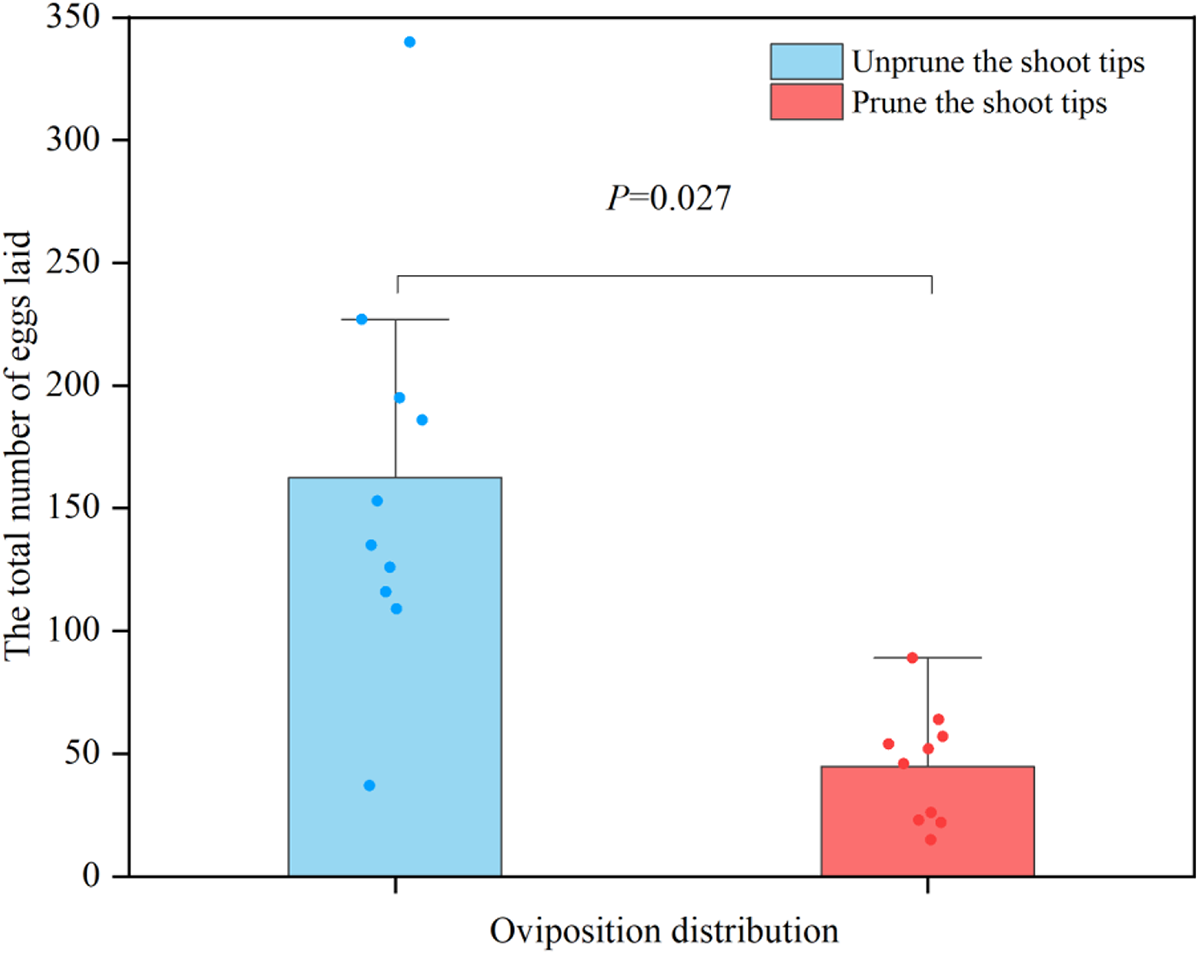
Oviposition preference of C. willeti differed significantly between unpruned and pruned shoots (Figs. 4 and 5). Total egg production was much higher on unpruned shoot tips (340 eggs) compared with pruned tips (89 eggs) (F = 5.834, df = 10.439, P = 0.027). In the unpruned treatment, oviposition was almost entirely confined to shoot tips (87.64%), with minimal deposition on branch axils (10.18%), stems (1.85%), and callus tissue (0.32%). In contrast, shoot pruning caused a marked shift in oviposition, with the majority of eggs deposited on branch axils (53.91%), followed by stems (39.35%) and callus tissue (6.74%). Egg deposition on callus tissue did not differ significantly between treatments (P > 0.05). These findings demonstrate that C. willeti strongly prefers unpruned shoot tips for oviposition, but shifts preference to branch axils when shoot tips are removed.
Differential oviposition preferences of C. willeti on pruned versus unpruned shoots across plant parts. P indicates significant differences between two treatments of the same plant parts based on an independent sample t-test (P < 0.05).

Oviposition distribution of C. willeti across four plant parts under differential treatments. Different lowercase letters above the bars indicate significant differences by Duncan’s test (P < 0.05).

Developmental periods and lifespan of C. willeti
Life table parameters of C. willeti under constant temperatures are summarised in Table 1. Development from egg to fourth instar was completed across all tested regimes, though survival declined at 33°C. Fifth instar nymphs and adults developed successfully only at 25°C and 29°C, but failed at 33°C due to high mortality. Egg development was slowest at 33°C (7.42 ± 0.49 days) and fastest at 29°C (3.69 ± 0.34 days). At 25°C, C. willeti completed its full life cycle with the highest fecundity (647.75 ± 52.94 eggs/female) and longer adult longevity, with males (46.71 ± 1.69 days) outliving females (39.88 ± 0.93 days). Although the life cycle was completed at 29°C, both survival and fecundity were reduced (47.63 ± 4.26 eggs/female), and sex-based longevity differences were minimal. Pre-oviposition periods were comparable at 25°C (APOP 5.60 ± 0.24 days; TPOP 24.6 ± 0.48 days) and 29°C (APOP 5.20 ± 1.48 days; TPOP 25.4 ± 2.53 days). In contrast, no adults emerged at 33°C, confirming the lethal effects of high temperature on later developmental stages.
Life history parameters of the experimental population of C. willeti at different constant temperatures

Note: Initial cohorts were composed of 60 eggs laid in a restricted time range. Synthetic data at different temperatures involves the mean development time of each life stage and the corresponding standard deviation (SD).
Reproduction and population parameters of C. willeti
The intrinsic rate of increase (r), finite rate of increase (λ), and GRR of C. willeti were highest at 25°C (r = 0.1885 day−1, λ = 1.2075 day−1, GRR = 303.88) and declined sharply at 29°C (r = 0.0639 day−1, λ = 1.0660 day−1, GRR = 30.56) (Table 2). The reduced fecundity at 29°C, coupled with an extremely low net reproductive rate (R₀ = 6.35 ± 2.79), indicated a severe constraint on population growth, approaching the threshold of replacement. Although mean generation time (T) decreased slightly with increasing temperature, the differences were not significant, suggesting that temperature rise primarily affected reproductive output rather than generation turnover. These results demonstrate that the population growth potential of C. willeti is maximised at 25°C but collapses at 29°C due to reproductive failure.
Population parameters of C. willeti at different temperatures

Note: Values are means ± standard errors.
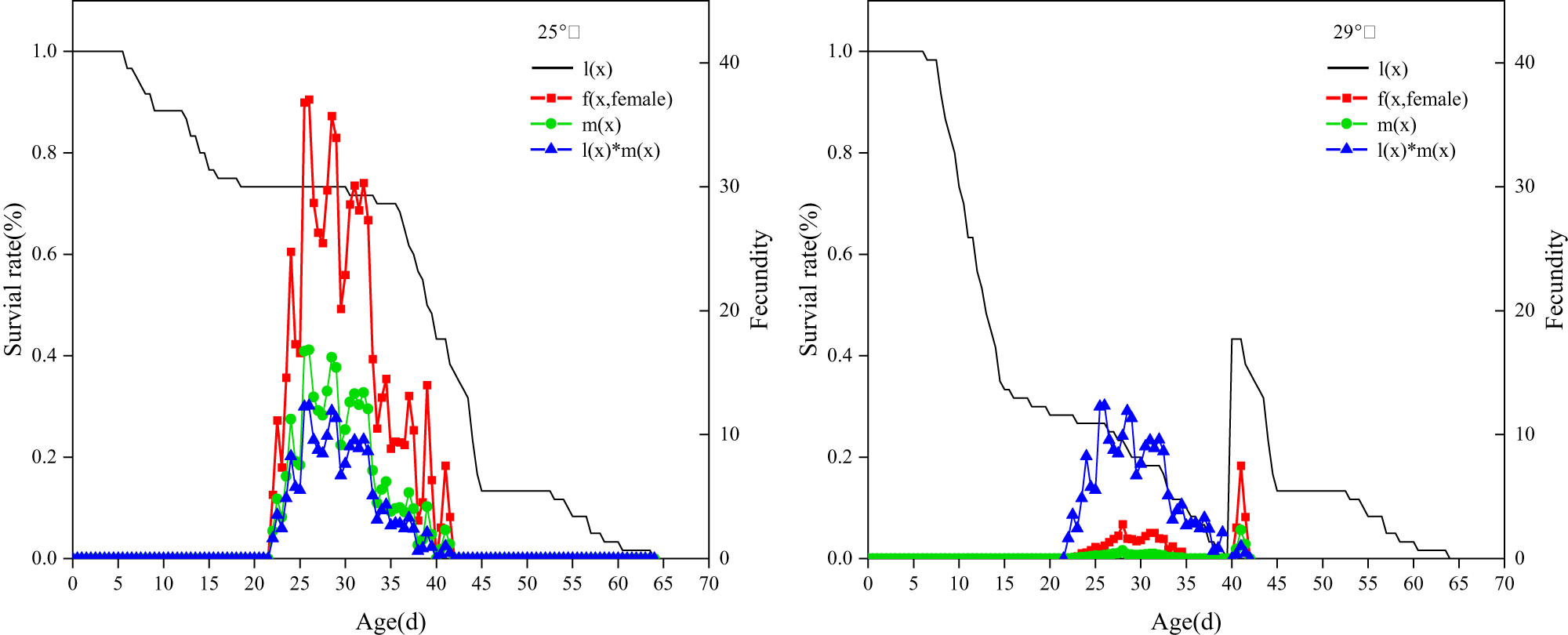
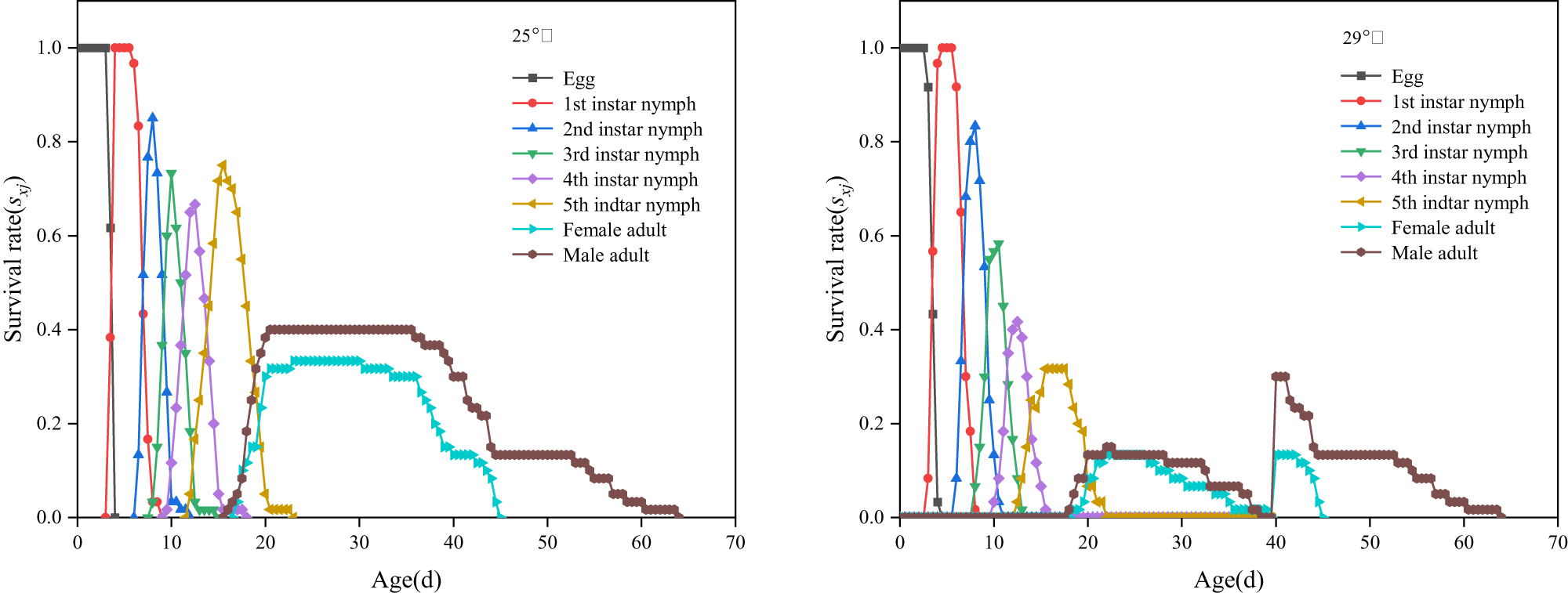
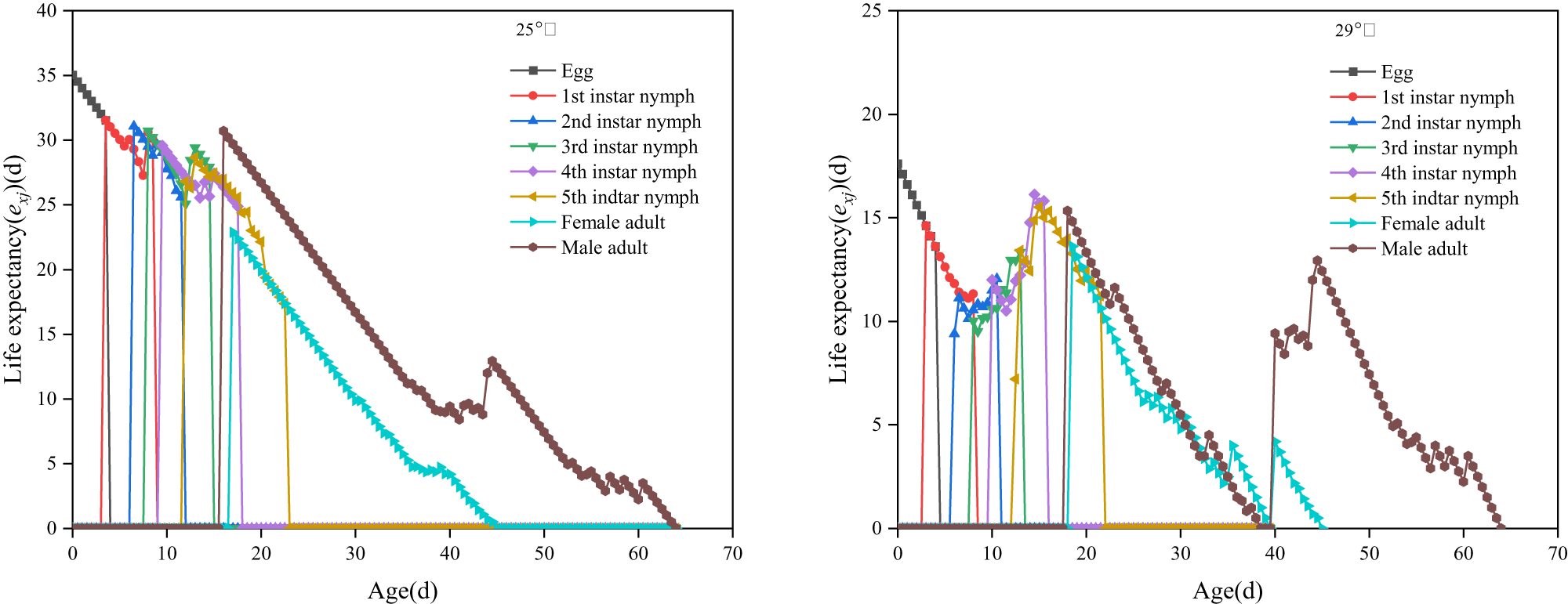
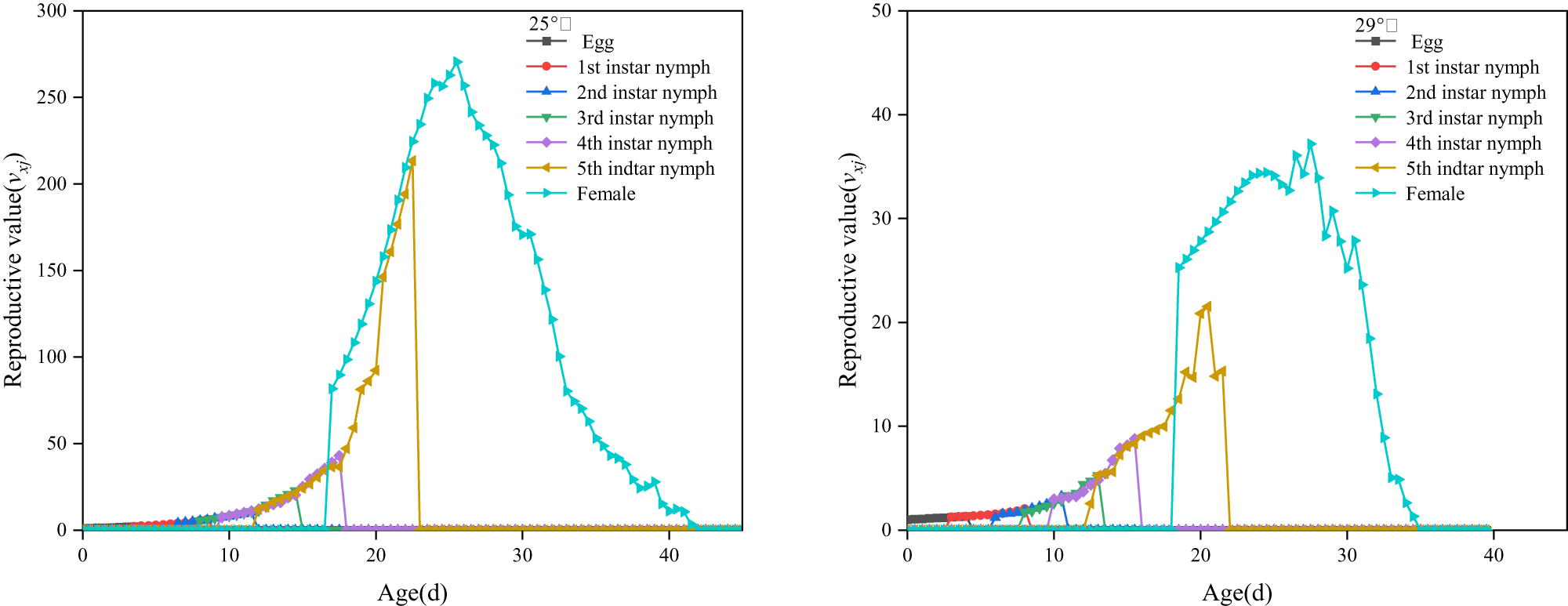
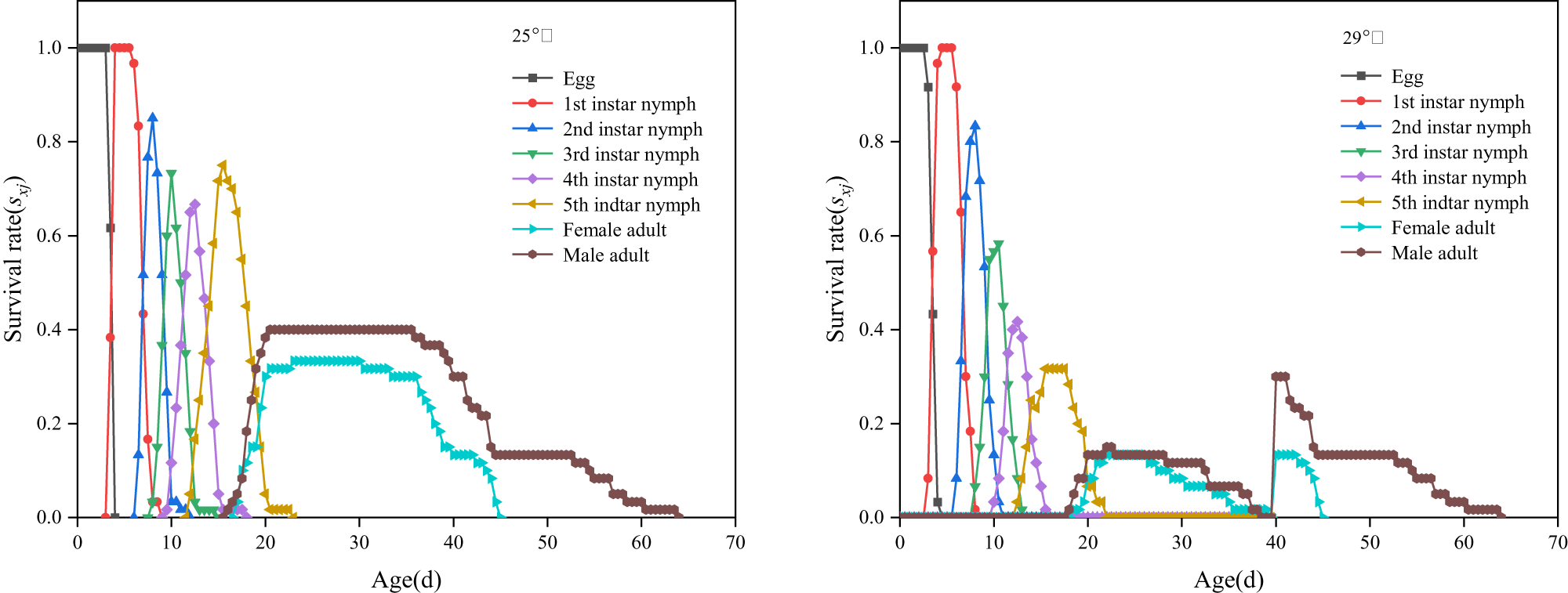
Age-specific survival (lx), fecundity (mx), and net maternity (lxmx) of C. willeti varied significantly across temperatures. At 25°C, survival declined to 0.733 by 18.5 days in the larval stage, whereas reproductive output (lxmx) peaked at 16.60 on day 25.0. At 29°C, the lxmx peak was reduced to 12.26 on day 25.5, while no reproductive peak occurred at 33°C due to complete mortality before adulthood. (Fig. 6.) The age-stage specific survival rate (sxj) of C. willieti exhibited distinct stage overlapping across all tested temperatures. At 25°C, the population showed a notably higher early-stage survival rate and a gradual decline, with 75% of individuals successfully reaching the fifth instar (L5), whereas at 29°C, high initial mortality led to a sharp decline, with only 31.67% of individuals attaining the L5 stage and the combined peak survival rate for adults summing to only 0.266 (Fig. 7). Life expectancy (exj) also declined with increasing temperature, from 22 days (females) and 29 days (males) at 25°C to 14 and 15 days, respectively, at 29°C, and was absent at 33°C (Fig. 8). Age-stage specific reproductive value (vxj) further reflected these trends, with peak female contributions to population growth observed on day 25.5 at 25°C and day 27.5 at 29°C (Fig. 9).
Influence of two different temperatures on the age-specific survival rate (lx), age-stage specific fecundity (fxj), age-specific fecundity (mx) and age-specific maternity (lxmx) of C. willeti.

The age-stage specific survival rate (sxj) of C. willeti at different temperatures.

Age-stage specific life expectancy (exj) of C. willeti at different temperatures.

The age-stage specific reproductive value (vxj) of C. willeti at different temperatures.

Population dynamics prediction
A population simulation initiated with 10 eggs predicted the dynamics of C. willeti over 60 days under varying temperatures (Fig. 10). At 25°C, the population completed two generations within this period, reaching the adult stage of the F2 generation alongside the appearance of F3 eggs and all five nymphal instars. This progression reflected rapid egg hatching and a pronounced outbreak of nymphs, indicating favourable population expansion. In contrast, at 29°C, adult abundance peaked at only ∼5.3 individuals without further increase, highlighting limited survival and the absence of sustained population growth.
Population projection of C. willeti at different temperatures (all stages) (log + 1).

Discussion
Mating frequency, which refers to the number of mating events per unit of time, is a key parameter for evaluating insect mating systems and reproductive behaviours, directly impacting an individual’s reproductive success (Kong et al., Reference Kong, Wang, Guo, Chai, Li and Ma2021; Zhao et al., Reference Zhao, Qiu, Shi, Wang and Liu2019). The results demonstrate that the mating activity of adult C. willeti exhibits a clear daily rhythmicity, with a pronounced peak at a specific time. Mating behaviour in 4–6-day-old adults was primarily concentrated in the mid-morning and mid-afternoon periods.
It is noteworthy that this temporal distribution pattern closely aligns with the peak mating periods observed in Grapholita molesta (Busck), Sirex noctilio, Sirex nitobei, and Hermetia illucens L. (Kong et al., Reference Kong, Wang, Guo, Chai, Li and Ma2021; Lu et al., Reference Lu, Hao, Bao, Liu, Gao and Qiao2022; Schneider, Reference Schneider2020). This timing of mating activity suggests that daily fluctuations in light and temperature are a primary driver synchronising their reproductive behaviour (Chahad-Ehlers et al., Reference Chahad-Ehlers, Tagliatela, de Oliveira, Arthur and de Brito2025; Chiabotto et al., Reference Chiabotto, Grosso, Doretto and Meneguz2024).
Many insect species exhibit post-mating behaviours that are vital for population reproductivity, such as oviposition site selection, which entails assessing the specific micro-location and environmental conditions for egg deposition (Cury et al., Reference Cury, Prud Homme and Gompel2019; Zhang et al., Reference Zhang, Zhang, Quandahor, Gou, Li, Zhang and Liu2023).
In this study, adult C. willeti exhibited a distinct preference for ovipositing on tender shoots. We hypothesise that this behaviour is associated with larval feeding and damage habits. As the most metabolically active tissues, young shoots contain sap with higher concentrations of free amino acids and soluble sugars, which are crucial for the initial feeding of newly hatched nymphs (Dos Santos et al., Reference Dos Santos, Da Silva Santana, Schulz, Cabral, Dos Santos, Lourenção and Baldin2023; Yu et al., Reference Yu, Huang, Ren, Fernández-Grandon, Li, Hafeez and Lu2021). Furthermore, the phloem tissues within young shoots are relatively soft and more easily penetrated by the piercing-sucking mouthparts of C. willeti. The structural softness allows the psyllids to efficiently access nutrients, thereby enhancing their survival and reproductive success (Johnston et al., Reference Johnston, Stansly and Stelinski2019). This finding is also consistent with numerous previous studies (Dos Santos et al., Reference Dos Santos, Da Silva Santana, Schulz, Cabral, Dos Santos, Lourenção and Baldin2023; Johnston et al., Reference Johnston, Stansly and Stelinski2019; Yao et al., Reference Yao, Wang and Chen2022; Yu et al., Reference Yu, Huang, Ren, Fernández-Grandon, Li, Hafeez and Lu2021).
An individual’s potential to survive and reproduce in a particular area is limited to its specific thermal window (Xu et al., Reference Xu, Zeng, Quan, Yao, Chen and Dong2023). According to Nuray Baser et al., exposure to extremely high temperatures (such as 33°C) leads to egg mortality rates as high as 94% in Drosophila suzukii, and even though development time is shortened, survival rates remain dramatically low (Baser et al., Reference Baser, Rossini, Anfora, Temel, Gualano, Garone and Santoro2025). Ren et al. demonstrated that exposure to 33°C significantly reduced the longevity of Orius strigicollis, with mean adult lifespan decreasing from 42.55 days at 18.5°C to merely 4.75 days (Ren et al., Reference Ren, Li, Huang, Zhang, Hafeez, Zhang, Chen, Zhou, Zhang and Lu2022). According to the findings of Ahn et al., the population growth rate of the pea aphid at 30°C was negative (r = −0.03), indicating that the population cannot be sustained and will gradually decline under this temperature. Moreover, the probability of survival to adulthood was only 15%, which is considerably lower than that observed at lower temperatures (e.g. 95% at 15°C) (Ahn et al., Reference Ahn, Cho, Kim and Seo2020). Wang et al. reported that exposure to 40 °C and 42 °C resulted in a marked decline in the survival of adult Asian citrus psyllids. After 6 hours of heat treatment, survival rates dropped to 42.5% and 20.0%, respectively, and further decreased to 26.7% and 7.5% after 12 hours (Ahn et al., Reference Ahn, Cho, Kim and Seo2020).
The population growth parameters, namely the finite rate of increase (λ), intrinsic rate of increase (r), mean generation time (T), and net reproductive rate (R0), are fundamental metrics vital for assessing temperature-dependent effects on survival, developmental processes, and reproductive output in populations (Chi et al., Reference Chi, Kavousi, Gharekhani, Atlihan, Salih Özgökçe, Güncan, Gökçe, Smith, Benelli, Guedes and Amir Maafi2023). Our study revealed that when the temperature increased from 25 °C to 29 °C, both the intrinsic rate of increase (r) and the finite rate of increase (λ) declined sharply, with values falling to r = 0.0639 and λ = 1.0660, respectively. Additionally, at 33 °C, these parameters could not be determined. These results confirm that high temperatures adversely impact psyllid population growth, in agreement with established literature (Hussain et al., Reference Hussain, Bano, Qasim and Rizwan2022; Milosavljević et al., Reference Milosavljević, McCalla, Bistline-East and Hoddle2020; Ramos Aguila et al., Reference Ramos Aguila, Hussain, Huang, Lei, Bamisile, Wang, Chi and Wang2020).
Our results offer key insights into the thermal adaptation, reproductive ecology (including mating and oviposition), and population growth patterns of C. willeti. The psyllid species exhibits distinct mating peaks during the mid-morning and mid-afternoon periods, and shows a preference for laying eggs on shoot tips. At 25 °C, the population growth rate of this species surpassed that under other temperature conditions, owing to the fact that both its intrinsic rate of increase (r) and finite rate of increase (λ) reached their peak values at this temperature. In addition, individuals fail to complete their generational development under elevated temperatures. Analysing the population parameters and projecting the growth trends of C. willeti via life table construction serves as a valuable tool for anticipating population fluctuations in agricultural settings and designing evidence-based management protocols. Future studies should incorporate a broader range of environmental variables, food resources, and interactions with natural enemies to achieve a more accurate understanding of population ecology, ultimately aiding in the development of effective control strategies against C. willeti.
Acknowledgements
This research was supported by Xinjiang Uygur Autonomous Region Finance Forestry and Grassland Special Project, grant funded by the Chinese government (No. 65000022P00789110010X).
Competing interests
The authors declare no conflicts of interest.