The Life And Death Of Princess Katherine
Katherine was the third daughter of Henry iii and Eleanor of Provence. With two elder sisters and two healthy brothers living to ensure the continuation of the line and the Crown, she was of comparatively little dynastic importance. Unlike some of Henry's other children, Katherine's life and death are relatively well documented.Footnote 1 Contemporary records indicate that Katherine was born at Westminster on 25 November 1253 and baptized that same day, being named after St Katherine, whose feast day that was.Footnote 2 According to Matthew Paris, Henry iii was in Gascony at the time of Katherine's birth and he received the news of the birth of a filiam speciosam (‘beautiful daughter’) from the queen's valet, William de Valers.Footnote 3
Much has been made of Matthew Paris's description of Katherine in the Chronica Majora at the time of her death: muta et inutilis, sed facie pulcherrima (‘speechless and helpless, but very beautiful in appearance’).Footnote 4 Although muta et inutilis has been interpreted as an indication that she was born deaf and dumb, a more recent explanation proposes that she could have been suffering from a degenerative disease such as Rett Syndrome, the symptoms of which only start to appear later, after an apparently normal birth and early development. The lavish scale of the queen's purification feast and the subsequent offering to Westminster Abbey by the king of five lengths of gold cloth embroidered with the royal arms, a gift he had been accustomed to make for each of his children,Footnote 5 may suggest that there was no suspicion of the newborn's state of health at the time:
It was commanded to Philip Lovel, treasurer, and Edward of Westminster, that without delay they should acquire five handsome swaddling bands, of [cloth of] gold, and have them sewn together, and a handsome border fastened around them, with shields of the King's arms, so that the King may find them ready the next time the King comes to London. They are to be offered at Westminster for Katherine, the King's daughter, in the manner in which he has formerly been accustomed to offer for each of his children. Witnessed by the King at Merton, 2nd April.Footnote 6
More can be gleaned from other accounts. In August 1255 the little princess was not with the other royal children at Windsor but instead some miles away at Swallowfield in Berkshire – therefore being looked after at additional cost to the royal household; this separation from her siblings has been tentatively related to her health.Footnote 7 Certainly, by the spring of 1256 she was so severely ill as to cause grave concern. Thus in March of that year:
it was commanded of Edward of Westminster that he should have a silver image made in the form of a woman, for Katherine the king's daughter who has recently been ill, to be the same size as the two images one of which stands in front of the old feretory of Blessed Edward at Westminster and the other at the side of the same feretory.Footnote 8
The subjects of the figures adorning the shrine of St Edward at Westminster Abbey are not recorded; they might have been votive figures representing St Katherine, her patron saint.Footnote 9
A messenger from the queen who brought Henry news of Katherine's improved health was rewarded with a robe, again indicating the parents’ mutual interest in the well-being of their young children.Footnote 10 However, no offerings could halt the decline in Katherine's health and she died at Windsor on 3 May 1257. Matthew Paris described the queen's grief: ‘the queen, her mother, as a result of her anguish, was seized of a grievous illness that neither physician nor human consolation could alleviate’.Footnote 11 Although the couple had lost other children soon after birth, the king's own sorrow appears more vivid and real than the customary image of medieval parents’ resigned regret at the death of a young child. Distressed at the serious illness of the queen and the death of Katherine, Henry is recorded as having been plunged into such sorrow that he fell ill of the tertian fever that had afflicted him for some time.Footnote 12
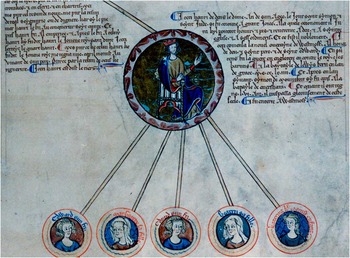
Tellingly, unlike her deceased siblings, whose existence and dates remain a matter for debate, Katherine makes an appearance in chronicle rolls. The fact that Matthew Paris featured her in his genealogical diagram, which was subsequently included in John of Wallingford's collection of St Albans writings, may have been due to the fact that Katherine could still have been alive at that time.Footnote 13 Yet she was still included some fifteen years later in the Chronicle Roll of Kings of England, along with her four living siblings, as the only deceased child of Henry iii (fig 1).Footnote 14 Katherine's roundel shows her with her hair unbound, unlike her veiled married sisters, Margaret and Beatrice, while the text surrounding her image – Katerine ki morust enfant (‘Katherine who died as a infant’) – makes it clear that she died young.
Chronicle Roll of Kings of England, showing Katherine with her four living siblings as the only five children of Henry iii: Bodleian, ms Broxbourne 112.3, fol 1 (1). Photograph: reproduced by courtesy of the University of Oxford

Katherine's Burial And Monument
After Katherine's death the king showed appropriate concern for her soul by appointing a chaplain in the chapel of the hermitage at Charing (London) to say daily prayers, paying to Brother Richard (the hermit there) 50s yearly during his life.Footnote 15 Her nurses Avice and Agnes were dismissed with the royal gift of 10 marks (£6 13s 4d) each.Footnote 16 At a cost of £51 12s 4d paid to John, the chaplain and the king's almoner, Katherine's funeral must also have been impressive; unfortunately no breakdown of this sum is provided.Footnote 17
Katherine was perhaps the first member of Henry's family to have been buried at Westminster; her death occurred soon after he apparently formed an intention to make it the royal mausoleum, following his decision to rebuild the abbey church.Footnote 18 In a writ of 1246 Henry had announced his intention to be buried at Westminster, rather than in his previous choice of the Temple Church, a decision confirmed in his will of 1253.Footnote 19 In pursuit of this plan, the bodies of Edward the Confessor, his wife, Edith, and Henry i's first wife, Matilda, were translated in 1269 and, between 1266 and 1271, at least three of Edward i's children and the heart of one of his nephews were buried in the Confessor's Chapel.Footnote 20
That Katherine might have been buried in the Confessor's Chapel too cannot be dismissed, but she died nine years before the first documented burial there.Footnote 21 Lethaby claims, albeit without apparent supporting evidence, that she was buried in the nave or perhaps in St Katherine's Chapel.Footnote 22 Many previous commentators have instead placed her burial in the south ambulatory, although no contemporary evidence for this appears to exist and the tradition may have arisen as a result of the long association of her burial with the Cosmatesque tomb chest now located there.Footnote 23 Another possibility, not previously considered to our knowledge, is Henry's Lady Chapel, at the east end of the abbey, which was completed by c 1245. Such a location would make sense as, at the time of Katherine's burial, the Lady Chapel had recently received a new vault and roof, while the remainder of the fabric of the abbey church, including the Confessor's Chapel where family members would later be buried, remained under construction and was not completed until 1259; fitting out the chapel and the construction of the shrine complete with its Cosmati work took another ten years, culminating in the translation of Edward the Confessor's body on 13 October 1269.Footnote 24
Henry's next plan was to commemorate his young daughter with a costly tomb monument. To this purpose he summoned Simon de Welles to Westminster to construct a gilded cast copper-alloy effigy. The initial discussions had evidently been concluded satisfactorily, for the following order was given to the Treasurer on 28 May 1257:
To the sheriff of Somerset. To let Master Simon de Welles have 2 marks [£1 6s 8d] out of the issues of the county for his expenses in going to Westminster at the king's command, and for his future expenses in coming to Westminster to dwell there and make a tomb over the body of Katherine the king's daughter, which has been delivered for burial in the church of Westminster; and to carry to Westminster his tools necessary for the work of the said tomb by the same writ.
Liberate to Master Simon of Welles 80 marks [£53 6s 8d] to complete an image of gilt bronze as enjoined to place on the said tomb, and for his expenses in all things, to be paid by successive instalments as he shall be seen to labour on the despatch thereof.Footnote 25
However, just six weeks later, on 11 July, the Treasurer was instructed to make a final payment of 5½ marks (£3 13s 4d) to Simon:
Liberate without delay to Master Simon of Welles, who should have made a copper-alloy image over the tomb of Katherine the king's daughter in the church of Westminster, 5½ marks [£3 13s 4d] for his expenses in coming to London on that business and returning home.Footnote 26
Despite this false start, Katherine was provided with a splendid tomb monument, including a silver effigy provided by William of Gloucester, the king's goldsmith. On 11 July 1257, the same day that Simon de Welles was dismissed, an order was made to: ‘Liberate by instalments to William of Gloucester, king's goldsmith, 70 marks [£48 6s 8d] to make a silver image over the same tomb.’Footnote 27 It was completed within a year, for, on 18 May 1258, Edward of Westminster was instructed: ‘Let him make a tomb for Katherine, deceased daughter of the King, in a due and competent manner, and to cover the same tomb let him provide a suitable cloth.’Footnote 28 In the event the silver image cost marginally less than allowed for. On 14 December 1272 an order was made to audit the account of the executors of William of Gloucester, including for the ‘silver image over the tomb of Katherine’.Footnote 29 William's accounts presented in 1272 record:
And for a certain wooden effigy for the tomb of Katherine, the king's daughter, in the church of Westminster, 15s. And for silver placed above and on the said tomb, in total, £11 12s 8d. And for the making of the aforesaid silver image, £12. And for gold to gild it with, £11 3s 4d. And for stones, specifically to the number of 180, as many pearls as amethysts, to adorn the said image, 1s.Footnote 30
The total cost incurred by William was £35 11s, less than the planned cost of the copper-alloy effigy, although, as explained below, the sum given here did not cover all elements of the monument.Footnote 31
The account is not without its ambiguities. The loosely worded phrase et in argento posito ultra predictam tumbam de super per totum probably just refers to the silver for plating the effigy and the effigy slab, but this is not definite. Certainly, the commissioning order refers to a ‘silver image’. That the effigy had a wooden core on which silver plate was fixed is indicated by the phrase et in quadam ymagine lignea ad tumbam Katerine.Footnote 32 The silver was gilded, as shown by the phrase Et in auro et eandem deaurandam. The formula used to specify the number of precious stones is open to misinterpretation; however, the total was probably 180.Footnote 33 Whatever the number, the use of real stones rather than fictive jewels appears exceptional.
The wording of these documents has led some authorities to suggest that the image was not a tomb monument with an effigy, but a standing votive image on a bracket near the tomb. This was first suggested by Gough, who referred to ‘the tradition of the vergers, that three silver images were affixt over the tomb by the irons now remaining’.Footnote 34 Further confusion has arisen through suggestions that both effigies were produced, in one case with the silver image being interpreted as representing St Katherine and the copper-alloy figure being the princess herself.Footnote 35 However, this is undermined by the evidence of the account given above, as well as the fact that Simon de Welles's dismissal and the commissioning of a ‘silver image’ occurred on the same day in adjacent entries. The most obvious interpretation is thus that these two entries were paired parts of a single decision and that the silver image was a replacement for the copper-alloy one.
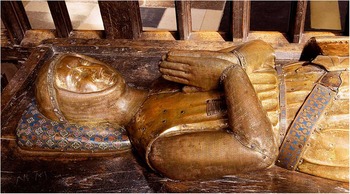
Katherine's effigy, apparently comprising a wooden figure plated with gilt silver and set with pearls and amethysts, does not survive, but there are broadly comparable, if less elaborate, precious-metal effigies at Westminster and formerly elsewhere. The most commonly cited examplar is the monument to William de Valence (d 1296) now in the chapel dedicated to SS Edmund and Thomas, although it probably stood originally in the Confessor's Chapel (fig 2).Footnote 36 The sumptuous gilt copper-alloy and Limoges enamel-plated effigy around a wooden core, inlaid with fictive jewels, presents a glittering and colourful impression; it also had a brass inscription, a rare feature at this date.Footnote 37 This was not the earliest such tomb in England: Walter de Merton (d 1277), Chancellor of England, Bishop of Rochester and founder of Merton College, Oxford, was commemorated in his cathedral by an enamel tomb made by Jean of Limoges at a cost of £40 5s 6d.Footnote 38
Tomb monument with gilt copper-alloy and Limoges enamel-plated effigy to William de Valence (d 1296), now in the chapel dedicated to SS Edmund and Thomas, but originally probably in the Confessor's Chapel at Westminster Abbey. Photograph: © Dean and Chapter of Westminster

Silver and silver-plated monuments appear to have been much rarer, particularly in the thirteenth century. Katherine's lost monument is the earliest recorded monument of this type in England, although the lost tomb of Henry i, Count of Champagne (d 1181), in his collegiate foundation at Troyes (France) included an effigy covered with silver beneath an open arcade set with enamel ornament.Footnote 39 Richard ii de Clare (1262) was buried on the right-hand side of his father in the presbytery at Tewkesbury Abbey; his wife commissioned a tomb ornamented with silver, gold and jewels, which the Monasticon Anglicanum describes thus:
This Richard ii [de Clare, earl of Gloucester and Hertford] […] died on the 14th day of July, 1262 […] and was reverently and honourably buried in the presbytery at Tewkesbury [Abbey] to the right of his father, where [referring to the funeral], among those present, were the bishops of Llandaff and Worcester, twelve abbots, and a great multitude of barons, knights and magnates. And afterwards his wife [Matilda, a daughter of the earl of Lincoln] ornamented his tomb with gold and silver and precious stones, [and] with the sword and spurs he used when alive.Footnote 40
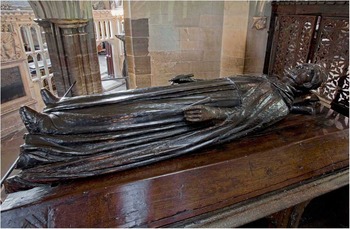
The word ornavit may possibly imply removable objects, such as candlesticks, rather than an integral part of the monument, but Leland refers to Richard as having had an ‘image yn sylver’, which supports the interpretation as a metal tomb.Footnote 41 Could the exemplar for it have been Katherine's tomb monument of bejewelled silver gilt? At Lincoln, Bishop John Dalderby (d 1320) was provided with a silver shrine.Footnote 42 The tomb of Henry v (d 1422), in his chantry chapel above the east end of the Confessor's Chapel, comprised silver plates over a wooden core with some solid silver components, although of the effigy only the wooden core remains (fig 3).Footnote 43 This last monument is probably the best surviving parallel for what was commissioned for Katherine at Westminster Abbey nearly two centuries earlier.
Effigy of Henry v (d 1422) in his chantry chapel above the east end of the Confessor's Chapel, originally comprising silver plates over a wooden core, with some solid silver components, although now only the wooden core remains: the head and hands are modern replacements. Photograph: © Dean and Chapter of Westminster

No specific account remains of the making of the tomb chest on which Katherine's effigy would have rested. We know that there was an altar with a reredos attached to the tomb and a lectern associated with it. On 14 January 1259 Aubrey de Fécamp and Peter de Winchester, king's clerks, were paid 500 marks (£333 6s 8d): ‘To acquire a certain fabric with pearls for an altar frontal, a certain lectern, and the tomb of Katherine our daughter deceased, and certain pictures which our lord the King has had made for the altar of Blessed Mary at Westminster.’Footnote 44 This cloth was the one ordered in 1258 and the entry reads as if the remainder of the items also related to Katherine's monument. How much exactly the cloth cost is not specified but in 1258 William of Gloucester, the king's goldsmith, had been paid 20 marks (£14 6s 8d) for working a precious cloth for the altar of the Blessed Edward (the Confessor).Footnote 45 The whole ensemble would probably have been more costly than the gilt copper-alloy effigy that was originally planned, as well as even more splendid.
Does any part of katherine's tomb monument survive?
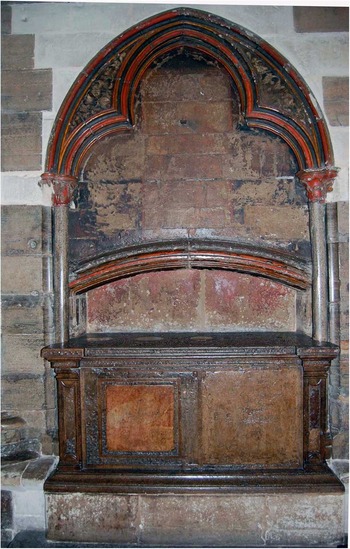
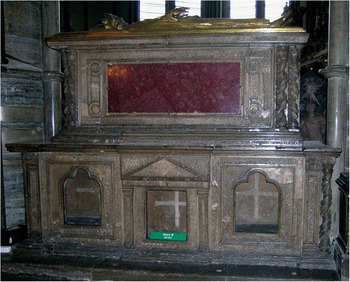
Although, as explained above, there is no firm evidence for the original location of Katherine's tomb monument, there is a persistent tradition that the Cosmatesque chest in the south ambulatory of the abbey church housed the bones of Katherine and up to eight other royal infants as well as the older children of Henry iii and Edward i (fig 4).Footnote 46 Given the size of the chest – 165cm long, 76cm wide and 73.5cm high (though internally only about 60cm deep) – the tradition that it housed so many royal infants and children appears inherently flawed. Moreover, the evidence for the burial in this tomb chest of the children of either Henry iii or Edward i is questionable; the accounts of the abbey's early historians, such as Camden, Dart and Strype, are confused and, in places, contradictory.Footnote 47
Cosmatesque chest in the south ambulatory of Westminster Abbey, now positioned in the wall linking the chapels of SS Edmund and Thomas and of St Benedict, which is traditionally said to have housed the bones of Katherine and up to eight other royal infants and older children of Henry iii and Edward i. Photograph: © Dean and Chapter of Westminster

The uncertainty arose as a result of attempting to reconcile two conflicting traditions in the burial accounts.Footnote 48 The earliest accounts associating the burial of the children with the south ambulatory pre-date the Reformation, all having been copied in the sixteenth century from a lost late fifteenth-century original and thus possibly being subject to errors of transcription.Footnote 49 The manuscript notes of Stow, and one of the lists of abbey burials, say that nine children, including Katherine, were buried in the chapel dedicated to SS Edmund and Thomas.Footnote 50 Yet the Cosmatesque tomb is outside this chapel. A variation is given in an anonymous treatise on royal progeny dated 1595, which states that the bones of Henry iii's children, Richard (d 1250) and John (d 1252), as well as Katherine are said to lie on the south side of the choir under the pavement ‘in the space of the passage lying between the Chapels of King Edward the Confessor and St Benet’.Footnote 51 Again, this does not provide evidence that the Cosmatesque tomb held the bones of these children; indeed, it militates against such an explanation.
The use of the word ‘bones’ rather than ‘bodies’ in the 1595 treatise and in Speed's account suggests that the remains of three of Henry iii's infant children – Richard, John and Katherine – were actually translated to the south ambulatory rather than necessarily being buried here originally.Footnote 52 The Cosmatesque tomb chest could not have been made for Katherine.Footnote 53 The provision in 1258 of a cloth for the tomb shows that the tomb was complete by that time; yet it was not until a decade later that there is documented evidence of the employment of the Roman Cosmati specialists at Westminster.Footnote 54
Was simon de welles incapable of producing a cast copper-alloy effigy?
Henry's change of mind about his daughter's effigy has often been interpreted as a failure on Simon de Welles's part to produce a cast copper-alloy effigy. The choice of copper alloy as allegedly a royal material par excellence in England has been described by various authors. Coldstream quotes Henry iii's preference, at the advice of his clerk of works, for the ‘more magnificent’ cast bronze to marble for the leopards that were intended for his throne in Westminster Hall.Footnote 55 This would therefore chime with the claims made by Binski regarding the ‘aesthetic and symbolic significance of materials and their implications for image formation’; he saw a clear ‘link between gold and bronze and sovereign burial’, as evidenced by William Torel's gilt copper-alloy effigies of Henry iii (fig 5) and Eleanor of Castile provided after Henry's death by Edward i, and the later monuments of Edward iii, Richard ii and Anne of Bohemia, Henry vii and Elizabeth of York, and Margaret Beaufort.Footnote 56 Gardner has also observed that the use of this metal was ‘an English royal predilection’.Footnote 57 Yet, if this link had already been clear in Henry iii's mind by 1257, what was the reason for ultimately opting for another material for Katherine's tomb?
Tomb with gilt copper-alloy effigy of Henry iii (d 1272), produced by William Torel, Westminster Abbey. Photograph: Sally Badham

Various theories have been presented. The key issue regarding the dismissal of Simon de Welles was summarized by Tanner:
had he, presumably a sculptor, failed to master the technique of brass casting, an art not perfected at Westminster until the end of the century when William Torel produced his masterpieces of the effigies of Henry iii and Queen Eleanor, or did the king alter his mind and feel that a more precious metal should be used for his little child's image?Footnote 58
John Harvey offered the explanation that Simon's design was not accepted, but this seems highly unlikely in view of the order of 28 May 1257 that he was to be paid 40 marks for the work, implying that a contract had been signed.Footnote 59 However, most commentators have followed the view of Colvin, who opined that ‘the technical difficulties were too much for [Welles]’.Footnote 60
This last conclusion is open to challenge. On the continent cast copper-alloy effigies had been produced since the eleventh century, the earliest known example being that in Merseburg Cathedral to Rudolph of Swabia (d 1080).Footnote 61 There is also much evidence for their use in France, which was culturally close to England at this time. Cast copper-alloy effigies were in vogue among French bishops and royalty; two survive at Amiens to bishops Evrard de Fouilloy (d 1222) and Geoffroi d'Eu (d 1236), while twelve such monuments were apparently melted down in Troyes in 1778, eight of them being episcopal tombs.Footnote 62 Other lost examples include that formerly in Angers Cathedral to Guillaume de Beaumont (d 1240), one at Aiguebelle to Peter de Aquablanca, bishop of Hereford (d 1268), and another at Hautecombes to Boniface, archbishop of Canterbury (d 1270).Footnote 63 The last two were Savoyard clerics; Boniface was a relative of the English queen Eleanor of Provence, and Aquablanca was also part of her circle, demonstrating the close relationship in patterns of patronage between the French and English courts, to which we will return.
Some years before the creation of Katherine's tomb in Westminster, a cast copper-alloy effigy was set up at the abbey of Saint-Denis as a retrospective monument for Charles the Bald (d 877). In the mid-thirteenth century the chronicler Richer de Senones (d 1267) left a detailed eyewitness account of this large tomb, which was placed on four short supporting pillars with lions and an additional sculpted lion at the emperor's feet: ‘Upon which tomb let him have a cast bronze sarcophagus, eight feet long and three wide, upon which is carved a lion as large as the sarcophagus, which I have seen with my own eyes.’Footnote 64 Moreover, despite a lack of drawings or detailed contemporary descriptions, there is strong evidence that Philip ii Augustus (d 1223), Louis ix himself (d 1270) and his father, Louis viii (d 1226), were commemorated with tombs made of gilt copper alloy and silver gilt combined with other rich materials.Footnote 65 In addition, Louis ix's mother, Blanche of Castile (d 1252), was apparently commemorated at Maubuisson with an effigy in high relief supported on colonettes, all made of solid metal (cuivre).Footnote 66
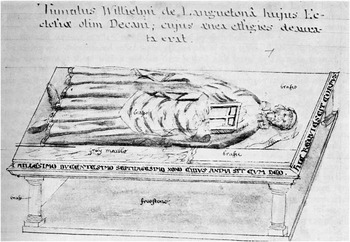
Given this evidence for the manufacture from copper alloy of large and complex tomb monuments on the continent, it seems inherently unlikely that these could not have been produced in England. Indeed, there is clear evidence for their production elsewhere in England several decades before Torel made those for Henry iii and Queen Eleanor. Such effigies were not regarded as the exclusive prerogative of royalty; it was the higher clergy who were the trendsetters in this regard, as they later proved to be for effigial monumental brasses.Footnote 67 The best-documented example is the effigy formerly in York Minster to Dean William de Langton (d 1279).Footnote 68 The metal was stripped off and sold in 1645, but Dugdale had visited York Minster four years earlier and had a drawing made of the monument with annotations to indicate the materials used for its various elements (fig 6). Bishop Grosseteste of Lincoln (d 1253) was commemorated by a tomb chest with an ‘image made of brasse’, which was removed by 1641, but Rogers has suggested that marks recorded on the surface of the tomb were probably left by a cast metal effigy resting on a sheet of brass.Footnote 69
Drawing with annotations by William Dugdale (1641) of the monument to Dean William de Langton (d 1279) formerly in York Minster. Source: College of Arms of London

There is no known documentary evidence showing that Simon de Welles worked in metal. He evidently came from the city of that name in Somerset and was described as a carver, presumably working on the cathedral there. Harvey has speculated that he was probably engaged on figure sculptures on the west front.Footnote 70 He also identifies Welles as the man known as Simon le Peyntour, probably a maker or designer of images, who witnessed documents of the Dean and Chapter of Wells during the latter part of Henry iii's reign.Footnote 71 Yet if Simon was merely a stone carver, why would he have been chosen to journey to Westminster to make a cast copper-alloy effigy, however skilled a workman he was?
It is quite conceivable that Simon de Welles was experienced in making cast copper-alloy effigies. Leland, writing c 1540, described having seen ‘Jocelyn, buried in the middle of the choir of Wells Cathedral, on a high tomb with a bronze image’.Footnote 72 Half a century later Francis Godwin recorded Jocelin's monument thus: ‘His marble tomb is visited today, which forty years ago was beautifully adorned with bronze plates’.Footnote 73 The most obvious interpretation of this passage is that Bishop Jocelin (d 1242) was commemorated by a figure brass, but – forty years after its loss – Godwin's memory may have been faulty. Two factors argue in support of Jocelin's lost monument being a cast copper-alloy figure. First, the earliest figure brasses known to have been made in England are dated to the 1270s, thirty years after Jocelin's monument was presumably made.Footnote 74 Secondly, the Fabric Receipts for 1549/50 include the sale of ‘72 shillings and a penny for the price of two images of bishops in bronze which were in the choir, weighing 310 pounds, at 2d a pound, sold to Cuthbert Bulman’.Footnote 75
One of these images was undoubtedly Jocelin's and the most likely candidate for the second is William Bitton i (d 1264): although he was apparently buried in the Lady Chapel at the east end of the church, all other episcopal tombs at Wells can be accounted for and ruled out of contention.Footnote 76 Leland's description of Bitton's monument says: ‘he lies with a bronze image in the Chapel of St Mary at the east end of Wells Cathedral’, which is again ambiguous, although at this date a cast copper-alloy figure is more likely.Footnote 77 Rogers has pointed out that 310lb is very much greater than the likely weight of two figure brasses, basing his assessment on Cameron's calculation that the average weight of an early brass military figure was 72½lb (33kg), even if extra is allowed for the weight of canopy work.Footnote 78 This is considerably less than the 1,500kg (3,307lb) weight of the monument commemorating Blanche of Castile (d 1252), but that was of solid metal (so not a cast shell) and included more than just an effigy.Footnote 79 Hence, one, or possibly both, of the Wells monuments may have been cast copper-alloy effigies. Such prestigious monuments could well have been regarded as appropriate for Jocelin and William Bitton i as both men were regarded as saints at Wells.
Admittedly, it is not certain that Simon de Welles made these monuments at Wells, but the circumstantial evidence is strong. Henry iii could well have been familiar with developments at Wells and known of Simon's expertise, as Bishop William Bitton i was well known to the king and trusted by him; in 1253 he was employed by Henry iii to negotiate the marriage of his son to the daughter of King Ferdinand of Spain.Footnote 80 Moreover, such an important commission as Katherine's tomb monument would surely not have been entrusted to a novice in the craft.
Henry III's Cultural Patronage Of Material Culture
We have argued above that the silver-plated image made by William of Gloucester was most probably an effigy representing the deceased princess. Moreover, we have made a case that Simon was probably more than capable of producing a cast copper-alloy effigy as initially required. This suggests that Henry iii deliberately relinquished the idea of having his daughter's effigy made of gilt copper alloy in favour of an even more glittering ensemble of silver gilt embellished with pearls and amethysts. Various aspects of his patronage of material culture are consistent with such a hypothesis.
It would not have been out of character for Henry iii to have changed his mind part of the way through a project to provide something even more splendid, as Binski has argued.Footnote 81 Henry's Lady Chapel at the east end of Westminster Abbey, begun in 1220, was completed c 1245, yet in 1256 an order was given to replace the vault and roof by ones which matched the ambulatory in style and height.Footnote 82 The magnificent retable that graced the high altar of the abbey church was lengthened during manufacture (but prior to painting) by the addition of two end panels of Baltic oak, different from the English oak used for the main body of the work; Binski has hypothesized that this was triggered by a decision to widen the high altar, and thus make it all the more impressive.Footnote 83 Finally, the new ceiling installed in the king's chamber at Westminster Palace after a fire in 1263 was rejected soon after its completion in favour of a more elaborate pattern of star-like ceiling bosses.Footnote 84 Admittedly, we cannot be sure that these were Henry's personal decisions, but previous authorities, including most recently Binski, have assumed this to have been the case.Footnote 85 That Henry had a change of mind regarding the form of Katherine's monument is entirely possible and even, it might be argued, in character.
Furthermore, that Henry should prefer for his much-loved daughter a silver-gilt effigy encrusted with gems to the type of cast copper-alloy effigy favoured by at least some of the higher clergy in England is also consistent with his known tastes. The offerings made to St Edward the Confessor's shrine by Henry and other donors included cameos and gold statues with jewels and cameos incorporated.Footnote 86 He clearly had a discerning eye and a love of luxurious artefacts made from precious metals and jewels; the jewel accounts for Henry's reign and other related documents reveal the extent of his holdings and the sumptuous nature of many of his treasures.Footnote 87 Interestingly, as shown by Wild, Henry used gifts of precious objects to enhance his political and personal authority.Footnote 88 Commenting on the trousseau Henry provided for his sister Isabella in 1235, Matthew Paris recorded that: ‘it was said that the treasures about to be taken out of England seemed almost priceless and not just abundant but excessive’.Footnote 89
His patronage at Westminster Abbey demonstrates a lavish – even profligate – use of high-status materials, as exemplified by the deployment of Purbeck marble even in places where it cannot easily be seen. The completed sanctuary and Confessor's Chapel at the heart of ‘the most important project of the most art-oriented ruler of his day’ must have inspired wonder and awe in contemporaries who saw it.Footnote 90 The two Cosmati pavements and the shrine were decorated with inlays of precious stones – some, such as porphyry, with imperial connotations. That nobody should doubt who had been responsible for this great work, the inscription on the shrine records: ‘Man, if you want to know the cause [of the shrine], it was King Henry, friend of this present saint’.Footnote 91
The retable that once graced the high altar is a magnificent exercise in artifice: it has the appearance of being constructed from precious metals and jewels, but is in fact made of wood, decorated with paint, metal leaf and glass gems, imitation cameos and fictive enamels. Although it cost no more than £7 5s, the retable was not a product of deliberate economizing, for the use of gold leaf and expensive pigments was exceptionally liberal.Footnote 92 Even more lavish was the lost altar frontal commissioned from Henry iii's goldsmith, William of Gloucester, at a cost of £310; the high cost was accounted for by the amount of gold and jewels, although about £36 was spent on sewing, a labour-intensive task involving four women over three years.Footnote 93
Undoubtedly Henry's Lady Chapel was also lavishly fitted out, for in 1258 he paid an extraordinary 120 marks (£80) to the painter Peter of Spain for two panels incorporating precious materials, which he gave as a retable to adorn the Lady Chapel ante altare Beatae Marie (‘before the altar of the Blessed Mary’).Footnote 94 Cost was evidently a secondary consideration for Henry iii.Footnote 95 Hence, the eventual form of Katherine's tomb monument was very much to Henry's personal decorative taste and the expense involved in commemorating a deceased daughter would not have weighed heavily with him.
Finally, it is significant that, as Binski has noted, ‘Henry iii had an ambitious and competitive view of kingship’.Footnote 96 His love for jewels, gems and cameos was a taste he shared with his brother-in-law, Louis ix (St Louis) of France, who was married to Margaret of Provence, older sister of Henry's wife Eleanor.Footnote 97 His close links with Louis ix resulted in visits to Paris where Henry could not help being impressed by his brother-in-law's building projects in the new Rayonnant style.Footnote 98 Since before 1245 Henry had employed Henry de Reyns as his master mason, a man who knew not only Reims Cathedral but also the important Parisian buildings being built under the patronage of Louis ix.Footnote 99 Reflecting Westminster's use as the coronation church, Reyns's plans for the abbey were based on its French counterpart of Reims Cathedral. The influence of the building that Louis regarded as his private chapel – Sainte-Chapelle in Paris, started around 1241 and seen by Henry iii in 1254 – can also be observed in the detail and finishing of the new abbey church at Westminster.Footnote 100
Henry himself led expeditions into France in 1230 and 1242–3 in attempts to recover his father's former French territories, and again travelled around parts of France in the 1250s and 1260s with friendlier intentions, starting in late 1254 with visits to Fontevraud, Pontigny, Chartres and Paris.Footnote 101 He was thus able to see at first hand the fruits of Louis ix's patronage. Equally, what Bony calls Henry's ‘wide curiosity of taste’ attracted him to the best of contemporary Italian work, as exemplified by his patronage of Cosmati marblers.Footnote 102
However, Henry iii's patronage at Westminster Abbey was by no means derivative; it has been aptly characterized by Wilson as having ‘a unique blend of French monumentality and English ornamental inventiveness’.Footnote 103 Wilson goes on to describe the abbey's chapter house as ‘a structurally daring and aesthetically compelling building … [that] was justifiably declared in the inscription on its tiled floor – in which the arms of England appear sixty-two times – ut rosa flos florum sic est domus ista domorum (‘as the rose is the flower of flowers, so is this the house of houses’).Footnote 104 The inscription continues Henricus sancte Trinitatis amicus (‘Henry, friend of the Trinity’); as with the Confessor's shrine, Henry was keen to declare his patronage of this building.Footnote 105
All of this was consistent with Henry's building work elsewhere: in addition to his patronage of Westminster Abbey, he redecorated many of his great halls with ‘lavish displays of figural and heraldic displays of glittering kingship’.Footnote 106 Clarendon Palace is typical of this striving for the best and most innovative works: part of a tile roundel, excavated in the 1930s and associated with an order by Henry for a new pavement in his chapel there in 1244, has been shown by Norton to have been the earliest and most technically proficient of its kind in Europe.Footnote 107
Henry and the Design of Tomb Monuments
Henry's interest in tomb design is evident from the number of monuments he had already commissioned by the time of Katherine's death. By 1232 he had had his father – the unpopular King John (d 1216) – commemorated at the newly completed east end of Worcester Cathedral by means of a splendid Purbeck marble effigy with inlays of real and fictive gems. He chose the same stone when, in 1238, he commissioned Master Elias de Dereham, a secular clerk and later canon of Salisbury whom Harvey considered to have been ‘an amateur artist of some distinction in work of a decorative character’, to make a tomb, now lost, for his sister Joan, Queen of Scotland, for the nunnery at Tarrant Keynston (Dorset).Footnote 108
Henry also provided tombs for some of those who served him. In 1243 he ordered a monument to be made for Gerald fitz Maurice, Justice of Ireland. All that is recorded is that this was made of stone and had his shield with his arms on it; the cost is not given, but it was probably a modest monument, such as an incised slab.Footnote 109 Another lost tomb paid for through the Exchequer was ordered from Master Richard of Paris in 1245 for the king's almoner. Again no details were given, but the cost was only 5 marks (£5 3s 4d), so this was probably another relatively modest memorial.Footnote 110 In late 1254, prior to an eight-day stay with Louis ix in Paris where he personally inspected the Sainte-Chapelle, Henry had visited Fontevraud, where he had his mother's body moved from the cemetery to the church and commissioned an effigy for her like those already in place for Henry ii, Richard i and Eleanor of Aquitaine; he also bequeathed his own heart to the monastery.Footnote 111
It is probably significant to Henry's plans that Louis ix of France had succeeded in making a clear dynastic statement by having his Capetian royal predecessors and ancestors commemorated by a series of tomb effigies at the abbey of Saint-Denis, where they merged seamlessly with those of their Carolingian and Merovingian predecessors.Footnote 112 Moreover, many other members of his family who had not received the royal unction were to be buried and commemorated with monuments at the royal abbey of Royaumont. Whether Henry went to Royaumont during his visit in 1254 is unrecorded, and therefore unlikely; even so, the knowledge of what Louis xi intended at Royaumont may well have planted in Henry's mind the idea of a similar dynastic tomb programme, and we know that Henry did go to Saint-Denis on 28 and 29 December to celebrate the vigil and feast of Becket's martyrdom, where he would have had ample opportunity to see at first hand the most recent tomb monuments provided by his brother-in-law for the French monarchy.Footnote 113
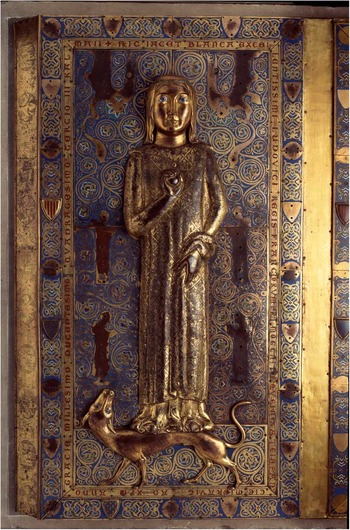
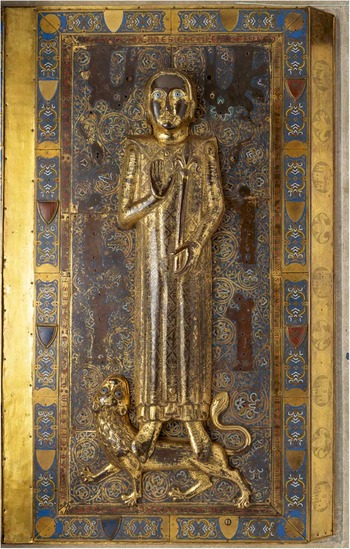
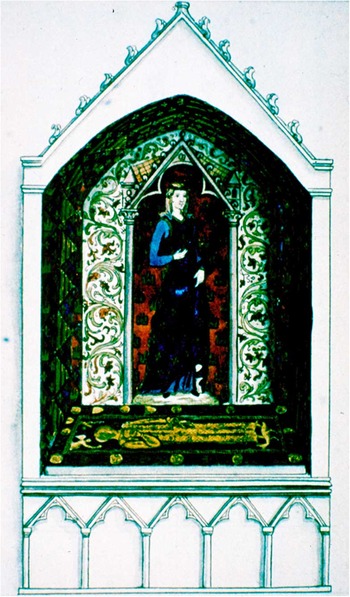
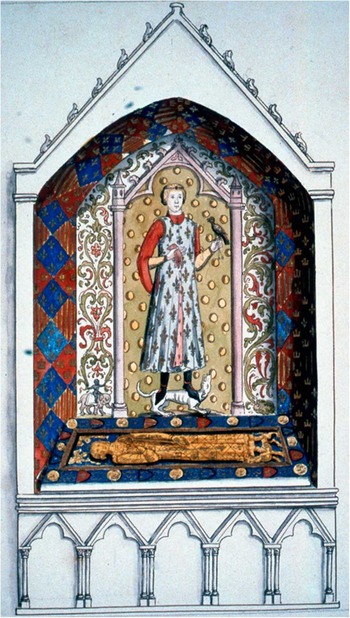
It is also possible that some elements of Katherine's tomb were influenced by French royal tombs, specifically those to two of Louis's children who died in infancy: Blanche (born 1240/1), who had died on 29 April 1243, and Jean, who, according to the inscription on his slab, had died in etate Infantie on 10 March 1248, probably soon after birth. These royal children were provided with monuments at Royaumont that were both costly and iconographically exceptional.Footnote 114 They are also among the earliest surviving monuments to children known in Europe, and, as such, provide our best exemplars for Katherine's lost monument and an insight in to how even young children could be commemorated. They originally consisted of copper-alloy slabs with Limoges enamel, featuring stylized effigies in high relief; these were placed on top of their tombs inside canopied niches with mural ‘portraits’ of the deceased on the back wall. Although the enamelled plaques now remain (figs 7 and 8), the settings of the monuments are known only from drawings made by Louis Boudain for François Roger de Gaignières (figs 9 and 10).
Limoges enamel tomb effigy of Blanche (d 1243), infant daughter of Louis ix, originally at the abbey of Royaumont, now at Saint-Denis Abbey. Photograph: © Pascal Lemaître – Centre des monuments nationaux

Limoges enamel tomb effigy of Jean (d 1248), infant son of Louis ix, originally at the abbey of Royaumont, now at Saint-Denis Abbey. Photograph: © Pascal Lemaître – Centre des monuments nationaux

Tomb of Blanche (d 1243), infant daughter of Louis ix, originally at the abbey of Royaumont: Bodleian, ms Gough drawings, Gaignières, ii, fol 29. Photograph: reproduced by courtesy of the University of Oxford

Tomb of Jean (d 1248), infant son of Louis ix, originally at the abbey of Royaumont: ms Gough drawings, Gaignières, ii, fol 26. Photograph: reproduced by courtesy of the University of Oxford

Whether the patron was actually Louis himself, who was on crusade from 1248 to 1254, is debatable. Nolan has argued that they were commissioned by Louis xi's mother, Blanche of Castile, who acted as his regent during his absence abroad.Footnote 115 This type of enamelled metal plaque can in essence be traced back in type to that commemorating Geoffrey, count of Anjou (d 1151; tomb in place by 1155), at Le Mans and a broadly contemporary example at Angers to Ulger, bishop of Angers (d 1148), of which only the stonework now survives.Footnote 116 Hence, although the tombs to Blanche and Jean of France were prestigious, they were not innovative, unlike that provided by Henry iii for his daughter Katherine.
Conclusion
We do not know precisely what form Katherine's lost monument took, but the tomb that William of Gloucester produced was unquestionably an example of English ornamental inventiveness at its most impressive. It was intended as a highly prestigious object that fully reflected the important role played by display and material culture in Henrician politics. It would undoubtedly have had an inscription identifying Katherine as Henry's daughter and, in common with the other embellishments he commissioned for Westminster Abbey, it may well have recorded Henry's role as patron – for, as Carpenter has observed, ‘few kings were more sensitive to their name and fame’.Footnote 117
A competitive quest for ultimate splendour may well have led to his decision to change the form of Princess Katherine's tomb monument from gilt copper alloy to an even more sumptuous effigy of silver, amethyst and pearl. The change of plan perhaps signalled Henry's growing ambition to be seen as an innovator at the forefront of tomb monument design as well as in the other artistic and architectural developments of his age.
ABBREVIATIONS AND BIBLIOGRAPHY
- Abbreviations
- BL
-
British Library, London
- Bodleian
-
Bodleian Library, Oxford
- CCR
-
Calendar of Close Rolls
- CLR
-
Calendar of Liberate Rolls
- CPR
-
Calendar of Patent Rolls
- TNA
-
The National Archives
Acknowledgements
We are grateful to Richard Cassidy and to Fellows Jerome Bertram, John Blair, Brian and Moira Gittos, Robert Hutchinson, Julian Luxford, Nicholas Rogers and Nigel Saul for help with various aspects of this paper. Nicholas Rogers has transcribed various documents and Jerome Bertram has provided many of the translations. The anonymous referees made most helpful suggestions for improvements to an earlier version of this paper. We would also like to acknowledge a grant from the A V B Norman Research Trust for photographic and reproduction costs.