Introduction
The genus Neoechinorhynchus Hamann 1892 represents a hyper-diverse group of endoparasites of freshwater and brackish water fish, and freshwater turtles, with approximately 116 described species; for some authors, congeneric species are included in two subgenera, Neoechinorhynchus and Hebesoma Van Cleave 1928 (Amin, Reference Amin2013; Smales, Reference Smales2013), although their validity is still controversial because such classification lacks phylogenetic support. In the Americas, 49 species of Neoechinorhynchus have been described: 33 in North America and 16 in Central and South America (Amin, Reference Amin2002; Barger et al., Reference Barger, Thatcher and Nickol2004; Amin and Heckmann, Reference Amin and Heckmann2009; Monks et al., Reference Monks, Pulido-Flores and Violante-Gonzalez2011; Pinacho-Pinacho et al., Reference Pinacho-Pinacho, Pérez-Ponce de León and García-Varela2012, Reference Pinacho-Pinacho, Sereno-Uribe and García-Varela2014, Reference Pinacho-Pinacho2015; Salgado-Maldonado, Reference Salgado-Maldonado2013). In Middle America (herein used following Choudhury et al., Reference Choudhury, García-Varela and Pérez-Ponce de León2017), the genus contains nine nominal species, seven in fish (N. roseum Salgado-Maldonado, 1978; N. golvani Salgado-Maldonado, 1978; N. chimalapasensis Salgado-Maldonado, Caspeta-Mandujano & Martínez-Ramírez, 2010; N. brentnickoli Monks, Pulido-Flores & Violante-González, 2011; N. mamesi Pinacho-Pinacho, Pérez-Ponce de León & García-Varela 2012; N. panucensis Salgado-Maldonado, 2013; and N. mexicoensis Pinacho-Pinacho, Sereno-Uribe & García-Varela, 2014) and two in turtles (N. emyditoides Fisher, 1960; and N. schmidti Barger, Thatcher & Nickol, 2004). All nine species have been validated morphologically and through molecular phylogenetic analyses using the 28S rRNA gene (see Pinacho-Pinacho et al., Reference Pinacho-Pinacho2015).
In a recent study, one mitochondrial (cox1) and two nuclear genes (28S rRNA and ITS1-5.8-ITS2) were sequenced for a large number of specimens of Neoechinorhynchus (420) sampled in brackish and freshwater fish in 57 locations across Middle America, with the aim of describing in more detail the species diversity of the genus in that geographical region (Pinacho-Pinacho et al., Reference Pinacho-Pinacho2018); a multispecies coalescent model (MSC) for species delimitation of the aforementioned genes was performed; analyses were useful to further validate the nine nominal species, however 10 additional genetic lineages were recognized and considered as cryptic species. A canonical discriminant analysis of some morphological traits was also performed by Pinacho-Pinacho et al. (Reference Pinacho-Pinacho2018), and revealed an overlap in most traits among the candidate species, with the sole exception of one of the lineages; the analysis of variance revealed that the length of the apical hooks of the proboscis of Neoechinorhynchus Lineage 8 was significantly different from all the other candidate species (P < 0.05). The use of molecular tools in the description of parasite diversity has led to the discovery of cryptic species complexes in different groups of helminths (Pérez-Ponce de León and Poulin, Reference Pérez-Ponce de León and Poulin2018). In some cases, species are recognized in reference to the genetic variation, although no morphological characters are found to distinguish them (e.g. Razo-Mendivil et al., Reference Razo-Mendivil2010; Rosas-Valdez et al., Reference Rosas-Valdez, Choudhury and Pérez-Ponce de León2011; Pérez-Ponce de León et al., Reference Pérez-Ponce de León2016). In this study, a closer look at the morphology of specimens of three genetic lineages of the N. golvani species complex, i.e. Neoechinorhynchus Lineages 8, 9 and 10 from the study by Pinacho-Pinacho et al. (Reference Pinacho-Pinacho2018) was undertaken to search for potential and reliable characters to distinguish them, in order to provide a formal description. New morphometric and molecular analyses were conducted. We found no distinguishing characters among Neoechinorhynchus Lineages 9 and 10 and N. golvani, although morphometric and molecular analyses further corroborated that Neoechinorhynchus Lineage 8 represented a new species. The new species is described herein.
Materials and methods
Samples collected
Specimens were the same ones used by Pinacho-Pinacho et al. (Reference Pinacho-Pinacho2018). Those representing the new species were collected from the intestine of eight species of cichlids, i.e. Herotilapia multispinosa (Günther, 1867), Parachromis managuensis (Günther, 1867), Parachromis loisellei (Bussing, 1989), Cribroheros longimanus (Günther, 1867), Archocentrus centrarchus (Gill, 1877), Amatitlania nigrofasciata (Günther, 1867), Amatitlania siquia Schmitter-Soto, 2007 and Cribroheros alfari (Meek, 1907), in three localities of Costa Rica, i.e. Lago Jalapa (10°31′52″N, 84°1′50″W), Quebrada Puercos (10°51′0″N, 85°34′0″W) and Río Orosí (11°02′50″N, 85°22′45″W). Fish were captured by cast netting and electrofishing, maintained alive and transported to the laboratory, pith sacrificed and examined immediately. Acanthocephalans were placed in distilled water for 10–12 hours at 4°C and subsequently preserved in 100% ethanol. Specimens of N. golvani, N. panucensis, Neoechinorhynchus Lineage 9 and Neoechinorhynchus Lineage 10 were also collected in cichlids in localities across southern Mexico (Pinacho-Pinacho et al., Reference Pinacho-Pinacho2018).
Morphological study
For the morphological study, acanthocephalans were punctured with a fine needle and stained with Mayer´s paracarmine and eosin yellow wash following the procedure outlined by Hernández-Orts et al. (Reference Hernández-Orts2012), dehydrated in a graded ethanol series, cleared with methyl salicylate, and mounted on permanent slides in Canada balsam. Drawings were made with the aid of a drawing tube. Specimens were examined using a bright field Leica DM 1000 LED microscope (Leica, Wetzlar, Germany); measurements were taken using the Leica Application Suite microscope software, and are presented in micrometers, with the range followed by the mean in parentheses. Measurements of the eggs were taken from fully developed eggs in situ. Some individuals were dehydrated through a graded series of ethyl alcohol, and then critical-point dried with carbon dioxide. These specimens were mounted on metal stubs with silver paste, coated with gold, and examined in a Hitachi Stereoscan model SU1510 (Hitachi High-Technologies Mexico S.A.de C.V, Mexico) at 15 kV. Finally, specimens were deposited at the CNHE (Colección Nacional de Helmintos), Mexico City, Mexico.
Morphometric analysis
Specimens mounted on permanent slides were studied morphometrically and analysed separately. The lengths of proboscis hooks and morphometric data from the body of both male and female were obtained. Micrographs of all specimens were taken with a camera attached to a Leica DM 1000 LED compound microscope, and measurements were obtained using the Leica Application Suite microscope software. We selected three apical, three middle and three distal hooks from the proboscis of each individual specimen to obtain measurements. The lengths of the apical, middle and distal hooks were analysed separately for males and females. We used proboscis hook measurements to assess the morphological distinction between N. panucensis, N. golvani, Neoechinorhynchus Lineage 9, Neoechinorhynchus Lineage 10, and the new species we describe herein (Neoechinorhynchus Lineage 8). The three genetic lineages were previously delimited as potential separate species using molecular data (Pinacho-Pinacho et al., Reference Pinacho-Pinacho2018). Equality of variances among groups was examined using an F test. We performed a multivariate analysis of variance (MANOVA) using Scheffé’s F procedure for post hoc comparisons because it is robust enough to avoid violations of assumptions inherent to multiple comparison procedures (e.g. the assumption of homogeneity of variances). The MANOVA analysis was conducted with the software STATISTICA version 7.1 (StatSoft, 2005).
Molecular analysis
Sequences of three molecular markers, ITS1-5.8S-ITS2, the D2 + D3 domains of the large subunit (LSU) from ribosomal DNA (rDNA) and the cytochrome oxidase c subunit 1 (cox1) of the mitochondrial DNA, generated by Pinacho-Pinacho et al. (Reference Pinacho-Pinacho2018) for N. panucensis, N. golvani, and Lineages 8, 9 and 10 were re-analysed in this study. Matrices with all sequences of the three genes were aligned separately using the software ClustalW (Thompson et al., Reference Thompson, Higgins and Gibson1994) with default parameters implemented in MEGA version 7.0 (Kumar et al., Reference Kumar, Stecher and Tamura2016). The cox1 sequences were adjusted manually in Mesquite v. 3.04 (Maddison and Maddison, Reference Maddison and Maddison2015) and checked for correct amino acid translation. As the information contained in the three alignments was partly incongruent, we decided to perform a total evidence analysis (cox1+ITS+28S). Nucleotide substitution models were selected for each gene separately using jModelTest 0.1.1. (Posada, Reference Posada2008) and applying Akaike's Information Criterion for each dataset. The concatenated dataset (cox1+ITS+28S) was analysed using Bayesian inference. Trees under Bayesian analyses were inferred in MrBayes v3.2 (Ronquist et al., Reference Ronquist2012), the Metropolis-coupled Markov chain Monte Carlo (MC3) simulations were run for 50 million generations and sampled every 1000 generations, and the first 12,500 samples were discarded as burn-in (25%). To search for the convergence of different parameters, to estimate the approximate number of generations at which log likelihood values stabilized, to recognize the effective sample size (EES > 200) for each parameter, and to estimate the magnitude of model parameters in individual and combined runs, the outputs were examined with Tracer v1.4 (Rambaut and Drummond, Reference Rambaut and Drummond2007). The initial 25% of MC3 was verified to include all the generations before stationarity was achieved. We obtained posterior probabilities of clades from the 50% majority rule consensus of sampled trees after we excluded the initial 25% as burn-in. The genetic divergences among species and/or lineages were estimated using uncorrected p-distances with the program MEGA version 7.0 (Kumar et al., Reference Kumar, Stecher and Tamura2016).
Results
Neoechinorhynchus costarricense n. sp.
Synonym: Neoechinorhynchus Lineage 8 (after Pinacho-Pinacho et al., Reference Pinacho-Pinacho2018).
Description
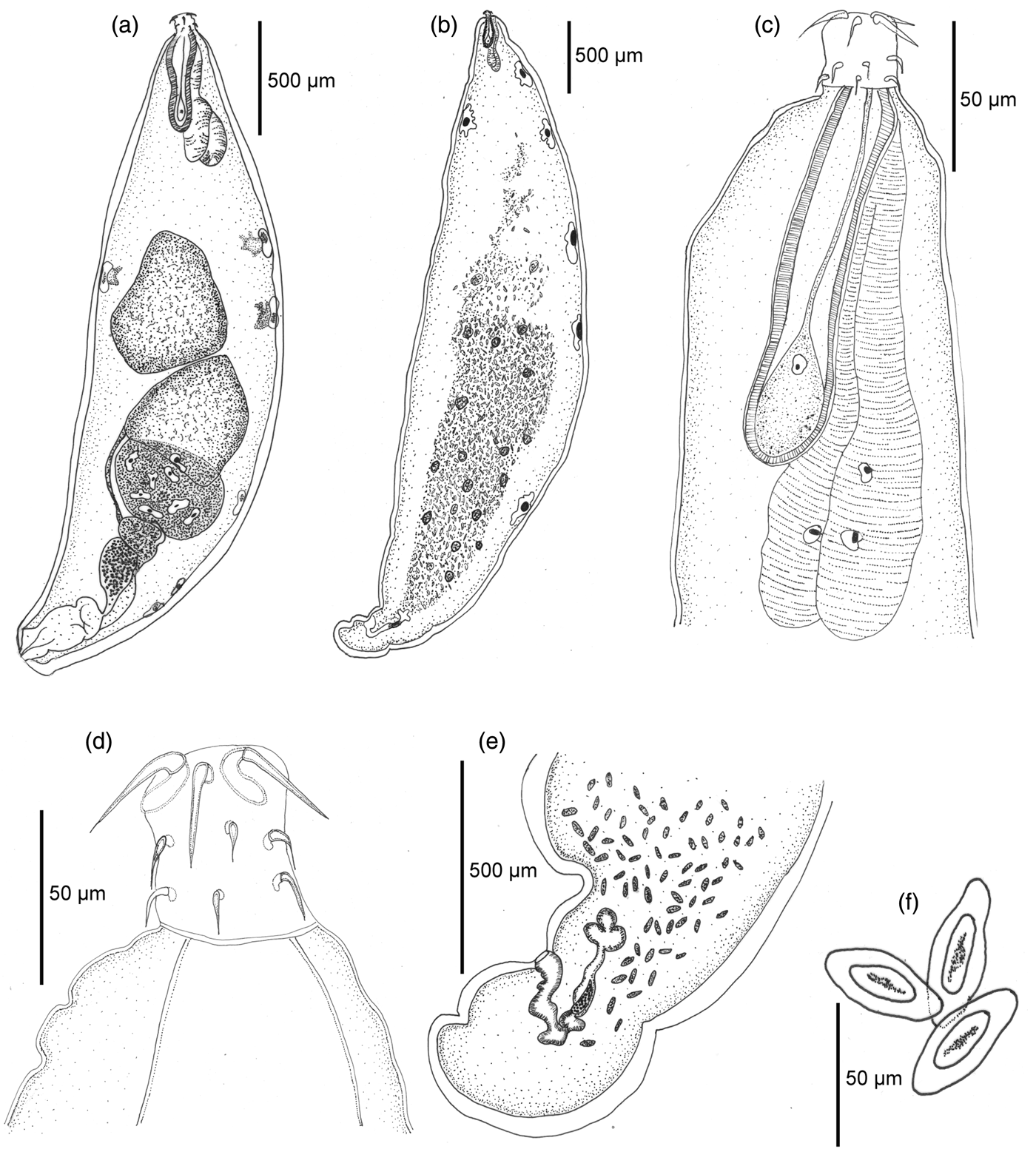
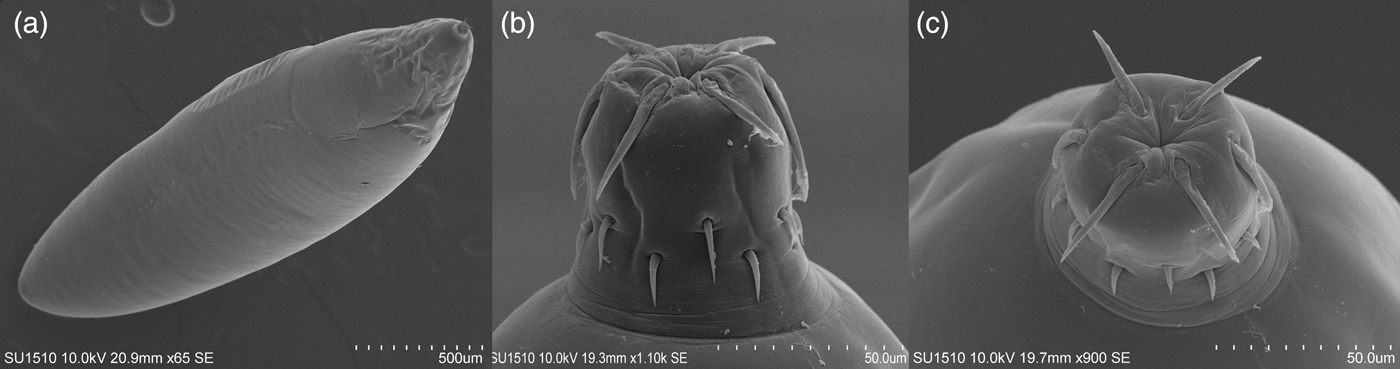
Neoechinorhynchidae, with characters of Neoechinorhynchus. Trunk cylindrical, swollen in anterior region, slender in posterior region (figs 1a, b and 2a). Trunk wall thin dorsally and ventrally, with five dorsal giant subcuticular nuclei and one ventral nucleus (fig. 1a, b). Proboscis short, globular, with three circles of six hooks each. Proboscis hooks in all circles with roots. Middle and distal hooks of similar size. Apical hooks longer than other hooks, extending to the base of the middle hooks (figs 1d and 2b, c). Sensory papillae small, slightly posterior to proboscis–neck junction. Neck wider than long. Proboscis receptacle attached to proboscis base. Cerebral ganglion large, oval, placed at base of receptacle. Binucleate lemniscus and uninucleate lemniscus of similar size. Lemnisci with ovoid nuclei extending beyond proboscis receptacle (fig. 1c).
Males (based on 10 mature specimens with sperm). Body 542–3284 (1957) long, 173–804 (524) wide. Trunk 486–3229 (1891) long, 173–804 (524) wide. Proboscis 39–58 (47) long, 44–60 (55) wide. Proboscis hooks in apical circle 33–43 (37) long, 6–9 (7) wide at base. Hooks of middle circle 11–19 (15) long, 3–6 (5) wide; distal circle 11–18 (14) long, 3–6 (5) wide. Neck 11–24 (20) long, 52–63 (58) wide. Proboscis receptacle 160–294 (249) long, 47–85 (69) wide. Longer lemniscus 316–459 (394) long, 51–80 (62) wide; shorter lemniscus 291–433 (365) long, 41–82 (59) wide. Reproductive system occupies posterior 2/3 of body length. Testes oval to circular, tandem, overlapping cement gland. Efferent ducts connect each testis with seminal vesicle (fig. 1a). Anterior testis 199–640 (421) long, 151–424 (293) wide. Posterior testis 189–498 (313) long, 181–519 (337) wide. Cement gland single, with eight unfragmented nuclei, 215–393 (314) long, 208–499 (343) wide. Cement gland reservoir contiguous, 117–216 (157) long, 96–157 (127) wide. Saefftingen's pouch immediately posterior to cement gland. Seminal vesicle oval, possessing an ejaculatory duct, 157–367 (226) long, 63–129 (102) wide. Copulatory bursa opens terminally (fig. 1a).
Females (based on one gravid and four immature specimens). Gravid female 6906 long, 1771 wide; immature specimens 391–789 (564) long, 97–266 (152) wide. Trunk 6839 long, 1771 wide; trunk of immature specimens 344–739 (509) long, 97–266 (152) wide. Proboscis 60 long, 61 wide; proboscis of immature specimens 37–46 (41) long, 33–53 (43) wide. Proboscis hooks in the apical circle 39–42 (41) long, 9 wide at the base; proboscis hooks in the apical circle of immature specimens 37–45 (40) long, 7–10 (8) wide at the base. Hooks of middle circle 11–18 (14) long, 5 wide; hooks of the middle circle of immature specimens 11–20 (16) long, 4–6 (5) wide at base. Hooks of the distal circle 12–16 (14) long, 5 wide; hooks of the distal circle of immature specimens 12–19 (16) long, 5 wide at base. Neck 24 long, 75 wide; neck of immature specimens 17–23 (21) long, 45–61 (52) wide. Proboscis receptacle 264 long, 77 wide; proboscis receptacle of immature specimens 93–149 (121) long, 32–53 (43) wide. Longer lemniscus 557 long, 91 wide; shorter lemniscus 522 long, 91 wide. Uterine bell 378 long, 131 wide; uterine bell of immature specimens 46 long, 30 wide. Uterus 179 long, 59 wide (fig. 1e); uterus of immature specimens 39 long, 26 wide. Eggs elliptical, with no polar prolongation, 29–34 (31) long, 10–11 (11) wide (fig. 1f).
Neoechinorhynchus costarricense n. sp. (a) Male (holotype); (b) female (allotype); (c) anterior region of the male (holotype); (d) proboscis of the male (holotype); (e) posterior region of the female (allotype); (f) eggs (allotype).

Scanning electron micrographs of Neoechinorhynchus costarricense n. sp. (a) Male body; (b) lateral view of the male proboscis; (c) apical view of the male proboscis.

Taxonomic summary
Type host. Herotilapia multispinosa (Günther, 1867).
Other hosts. Amatitlania nigrofasciata (Günther, 1867), A. siquia Schmitter-Soto, 2007, Archocentrus centrarchus (Gill, 1877), Cribroheros alfari (Meek, 1907), C. longimanus (Günther, 1867), Parachromis loisellei (Bussing, 1989) and P. managuensis (Günther, 1867).
Type locality. Lago Jalapa (10°31′52″N, 84°1′50″W), Costa Rica.
Other localities. Quebrada Puercos (10°51′0″N, 85°34′0″W) and Río Orosí (11°02′50″N, 85°22′45″W), Costa Rica.
Site of infection. Intestine.
Specimen deposition. Holotype CNHE: 8592; allotype CNHE: 8593; paratype CNHE: 8594–8596.
Representative DNA sequences. MG870983–MG871000 (cox1); MG870741–MG870753 (ITS1-5.8S-ITS2); and KR086239–KR086246 (28S).
Etymology. The new species is named for Costa Rica, the country where the specimens were collected.
Remarks
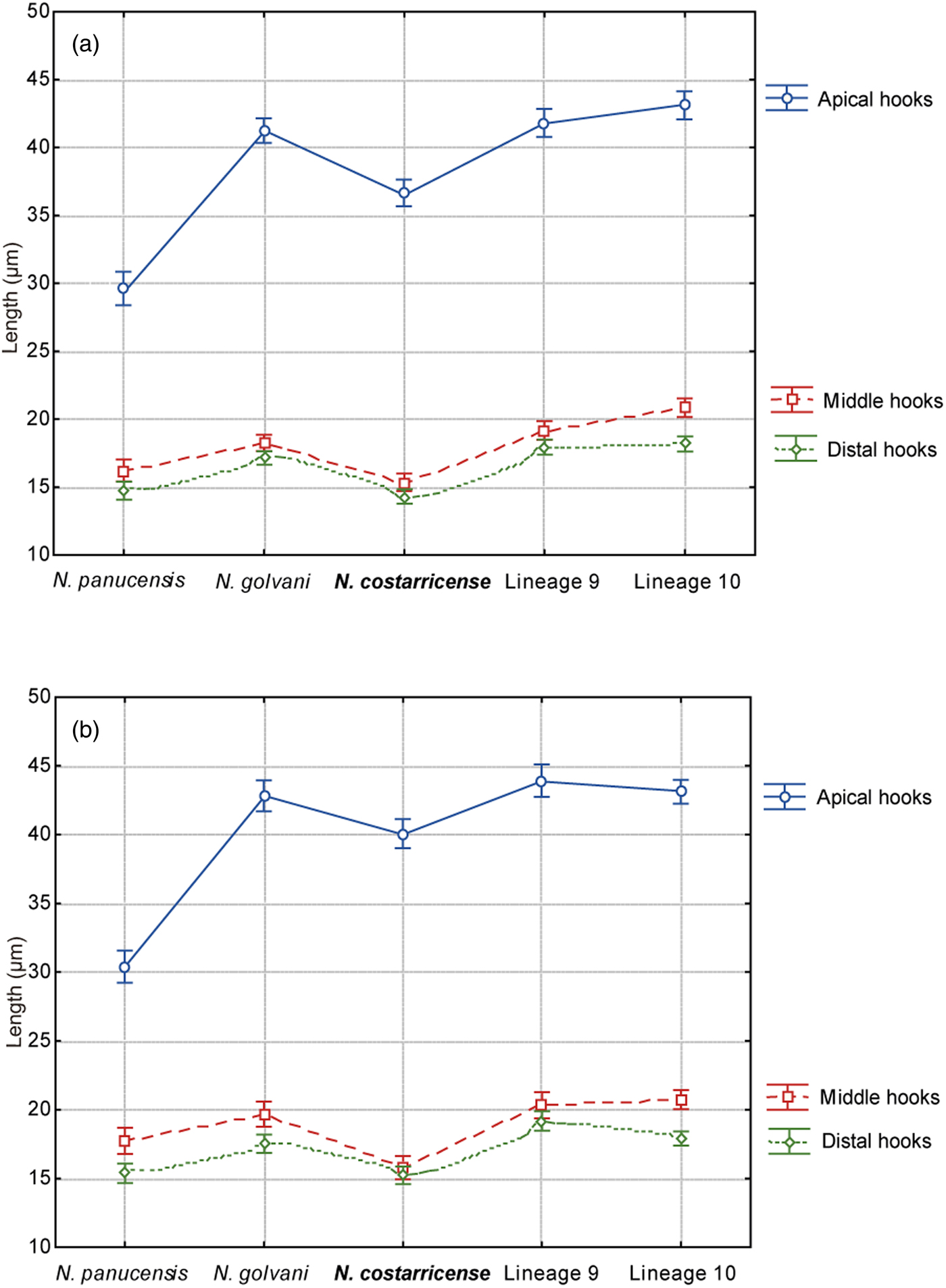
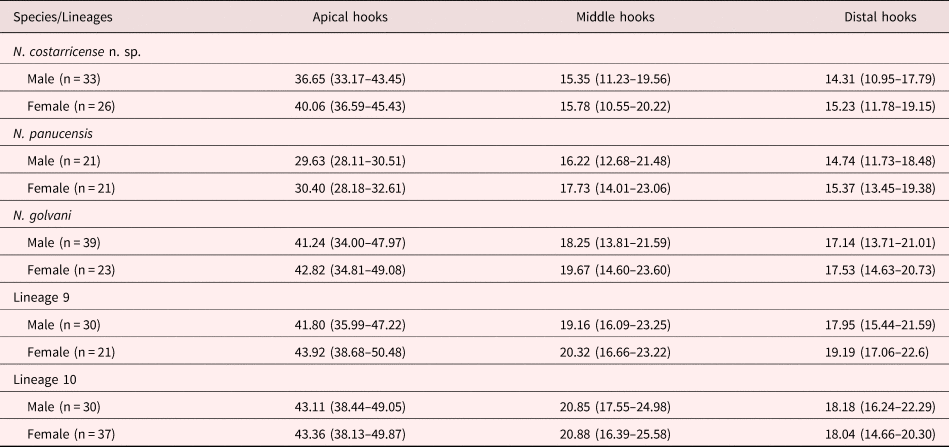
Up to the present, in addition to the new species we describe herein, two nominal species of Neoechinorhynchus (N. golvani and N. panucensis) and two genetic lineages (Neoechinorhynchus Lineages 9 and 10) have been described from Middle American cichlids (Pinacho-Pinacho et al., Reference Pinacho-Pinacho2018). Neoechinorhynchus costarricense n. sp. is distinguished from N. golvani, Lineage 9 and Lineage 10 by having slightly smaller apical hooks (table 1). Morphologically, specimens are very similar in comparison to the other species and lineages of Neoechinorhynchus infecting cichlids; however, the multivariate analysis of variance (MANOVA) clearly shows that the apical row of hooks of the proboscis is different (fig. 3a, b). Neoechinorhynchus costarricense n. sp. can be readily distinguished from N. panucensis by having longer anterior hooks, 33–43 (37) in males and 36–45 (40) in females vs 28–31 (30) in males and 28–33 (30) in females. The smaller size of the proboscis and anterior hooks of N. panucensis sets the species apart from other species of Neoechinorhynchus (see Salgado-Maldonado, Reference Salgado-Maldonado2013).
Morphometric data of Neoechinorhynchus found in cichlids. (a) Analysis of variance of the length of apical, middle and distal hooks in males. (b) Analysis of variance of the length of apical, middle and distal hooks in females. Vertical bars denote the range and the mean, with 0.95 confidence intervals.

Comparative measurements of the hooks of five species/lineages of Neoechinorhynchus in Middle American cichlids. Sizes are given as the mean value, with the range in parentheses.

Molecular characterization
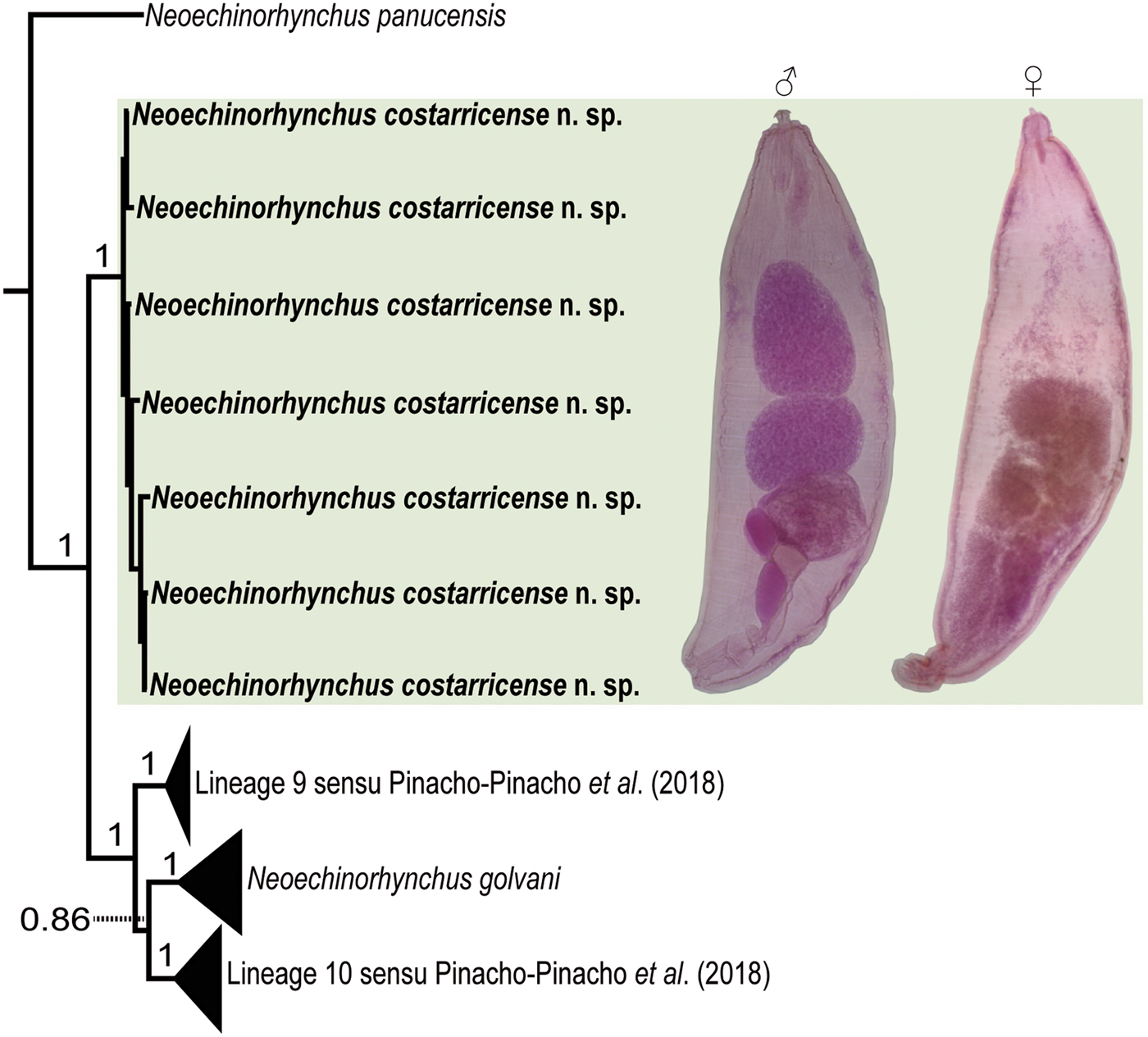
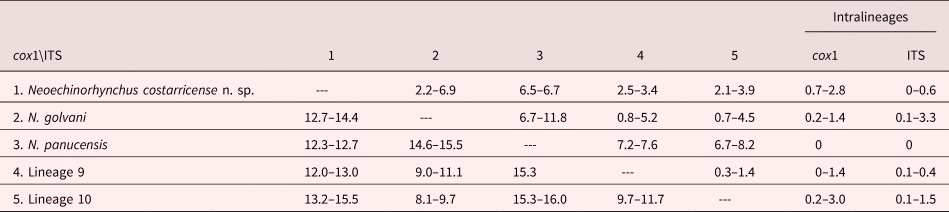
The new concatenated phylogenetic analysis of three genes (cox1 + ITS + 28S) for species and genetic lineages of Neoechinorhynchus parasitizing cichlids included a total of 65 isolates (one of N. panucensis, 10 of N. golvani, 16 of Neoechinorhynchus Lineage 9, 31 of Neoechinorhynchus Lineage 10, and seven of the new species) (fig. 4). The Bayesian majority-rule consensus tree recovered all isolates of species/lineages as reciprocally monophyletic assemblages, with high posterior probability support values. The tree yielded the new species as the sister taxon of a clade containing Neoechinorhynchus Lineage 9 and N. golvani plus Neoechinorhynchus Lineage 10. The genetic divergence for LSU among Neoechinorhynchus costarricense n. sp., N. golvani, Lineages 9 and 10 was relatively low, ranging between 0.1 and 1.4%. The divergence of the new species with respect to N. panucensis was 5.8%. Values of genetic distance among N. costarricense n. sp. and the four species and/or lineages varied from 0.3 to 11.8% for ITS, and from 8.1 to 16.0% for cox1 (table 2). The intra-specific variation of isolates of the new species ranged between 0 and 0.6% for ITS, and between 0.7 and 2.8% for cox1.
Consensus Bayesian inference tree inferred with cox1 + ITS + 28S. Numbers near internal nodes show posterior probabilities (BI).

Genetic divergence estimated among five species/lineages and intralineages, with the cox1 gene (cox1; lower matrix) and ITS gene (ITS; upper matrix). Uncorrected p-distances are expressed as percentages.

Discussion
The new species is morphologically very similar to the other nine candidate species uncovered by Pinacho-Pinacho et al. (Reference Pinacho-Pinacho2018) and is part of a cryptic species complex within N. golvani, a species exhibiting a large intraspecific morphological variability (Salgado-Maldonado, Reference Salgado-Maldonado2013). Neoechinorhynchus costarricense n. sp. along with N. panucensis, N. golvani and Neoechinorhynchus Lineages 9 and 10 can be regarded as members of the core helminth parasite fauna of cichlids (Pérez-Ponce de León and Choudhury, Reference Pérez-Ponce de León and Choudhury2005). All of them are part of a well-supported and reciprocally monophyletic group within the phylogenetic analysis of the Middle American members of the genus Neoechinorhynchus. Geographical distribution of the new species further supports its distinction from the N. golvani species complex. The new species herein described is distributed exclusively in Costa Rican cichlids. Conversely, the remaining four species/lineages are found parasitizing cichlids in Mexico; N. golvani was originally described as a parasite of Paraneetroplus fenestratus (Günther, 1860) (= Vieja fenestrata) in Catemaco Lake by Salgado-Maldonado (Reference Salgado-Maldonado1978). This species was considered to be generalist and widely distributed. According to García-Prieto et al. (Reference García-Prieto2010), N. golvani has been found in at least 20 species of cichlids in Mexico, and apparently it has been recorded in 10 other genera of unrelated freshwater and brackish water fishes, although Martínez-Aquino et al. (Reference Martínez-Aquino2009) demonstrated that specimens in eleotrids constituted at least two separate species, and the recent analyses by Pinacho-Pinacho et al. (Reference Pinacho-Pinacho2018) uncovered another five genetic lineages of Neoechinorhynchus in members of the family Eleotridae. In terms of geographical distribution, N. golvani has been also reported from cichlids in Costa Rica and Nicaragua (Aguirre-Macedo et al., Reference Aguirre-Macedo2001; Sandlund et al., Reference Sandlund2010). This species of Neoechinorhynchus was considered to possess a high intraspecific morphological variability (Salgado-Maldonado, Reference Salgado-Maldonado2013), although such analysis was based solely on morphology even though Pérez-Ponce de León and Choudhury (Reference Pérez-Ponce de León and Choudhury2010) had discussed that an accurate determination of the helminth diversity of freshwater fishes requires the use of DNA sequences. Our study further demonstrates that contention, and the importance of conducting molecular prospecting analyses (sensu Blouin, Reference Blouin2002) to uncover cryptic species complexes in allegedly generalist species such as N. golvani.
Neoechinorhynchus panucensis is the species with the most northern distributional range among this group of acanthocephalans, and is found in species of the genus Herichthys Baird and Girard, 1854, a monophyletic group of cichlids occurring in north-eastern Mexico and southern Texas (De la Maza-Benignos et al., Reference De la Maza-Benignos2015). The two genetic lineages (Neoechinorhynchus Lineages 9 and 10) are found only in southern Mexico. Neoechinorhynchus Lineage 9 is a parasite of Vieja pearsei (Hubbs, 1936) (= Cincelichthys pearsei) in Chiapas, whereas Neoechinorhynchus Lineage 10 is found in six species of cichlids in the states of Campeche, Tabasco and Chiapas. Unfortunately, our study revealed no morphological or morphometrical differences to properly describe these two genetic lineages, and both remain cryptic species. Cryptic species are commonly found among parasitic helminths (Pérez-Ponce de León and Poulin, Reference Pérez-Ponce de León and Poulin2018); even though trematodes seem to be the group with the larger number of studies in which genetically different but morphologically indistinguishable species are found, the search for cryptic species complexes in acanthocephalans is recommended, especially when a species is allegedly widely distributed, or when the species is found in several unrelated host species, as in the case of N. golvani.
Author ORCIDs
C.D. Pinacho-Pinacho https://orcid.org/0000-0002-2590-5055
Acknowledgements
We are grateful to Jesus Hernández for his help conducting fieldwork. Hosts were obtained through the collecting permit issued by the Costa Rican government to Arturo Angulo from the Universidad de Costa Rica. We thank Berenit Mendoza for processing specimens for SEM micrographs, and Laura Márquez for her help obtaining DNA sequences in the automatic sequencer.
Financial support
This research was supported by Programa de Apoyo a Proyectos de Investigación e Inovación Tecnológica (PAPIIT-UNAM) IN206716 to MGV.
Conflict of interest
None.
Ethical standards
All applicable national and international guidelines for the use and care of animals were followed.