Introduction
In 2013, there were 202 million adults of 60 years and above living in China (Wu and Dang Reference Wu and Dang2013). Population ageing in rural areas has been more pronounced than in urban areas (Cai et al. Reference Cai, Giles, O'Keefe and Wang2012). China is experiencing a demographic transition with an increase in rural-to-urban migration, particularly of young people. This has caused dramatic changes in rural population pyramids and has led to a greater number of older people living alone in rural areas without younger generations to provide late-life care and support.
The social resources embedded in traditional rural social networks play an important role in the life and health of older people living in rural areas in China (He Reference He2002; Wei Reference Wei2009). Common problems faced by this group include labour burdens, economic difficulties, lack of care and support, strong feelings of loneliness because of isolation caused by farming and looking after grandchildren, insufficient pension support and migration of adult children.
A growing body of literature has demonstrated that higher social capital is associated with improved health (Elgar et al. Reference Elgar, Davis, Wohl, Trites, Zelenski and Martin2011; Kawachi et al. Reference Kawachi, Kennedy, Lochner and Prothrow Stith1997; Lomas Reference Lomas1998; Rocco, Fumagalli and Suhrcke Reference Rocco, Fumagalli and Suhrcke2014; Whitehead and Diderichsen Reference Whitehead and Diderichsen2001). Social capital is defined in many ways, but there are two broad approaches. From a communitarian perspective, Putnam defined social capital as ‘features of social organization, such as trust, norms, and networks that can improve the efficiency of society by facilitating coordinated actions' (Reference Putnam1993: 167). Another approach is the social network perspective of individual social capital (ISC) which, arguably, originated in the writing of Bourdieu. He regarded social capital as ‘the aggregate of the actual or potential resources which are linked to possession of a durable network’ (Bourdieu Reference Bourdieu and Richardson1986: 248). Similarly, Lin defined social capital as ‘resources embedded in a social structure that are accessed and/or mobilized in purposive actions’ (2001: 29). Based on the social network perspective, three main measurement instruments for ISC have been described and applied in public health research: Name Generator (NG; Marsden Reference Marsden1987), Position Generator (PG; Lin and Dumin Reference Lin and Dumin1986) and Resource Generator (RG; Van der Gaag and Snijders Reference Van der Gaag and Snijders2005).
The RG method combines the economy of the PG with the content validity of the NG method, because of its vivid measurement of social resources (Webber and Huxley Reference Webber and Huxley2007). However, as social resources are culture and context dependent, different versions of the RG need to be validated for different populations which may produce some incomparability problems (Van der Gaag and Snijders Reference Van der Gaag and Snijders2005). Before the Resource Generator-United Kingdom (RG-UK) was created, resource generators had been used in the Netherlands, Canada, Bolivia and Belarus (Webber and Huxley Reference Webber and Huxley2007). The development of the RG-UK involved a thorough content validation process, testing of its reliability and validity, and an examination of its internal scales (Webber and Huxley Reference Webber and Huxley2007). The sub-domains of the RG-UK are of particular relevance for health research as they can be used to test hypotheses about connections between access to social resources and health status with more precision than the PG, which measures access to occupational prestige (Van der Gaag, Snijders and Flap Reference Van der Gaag, Snijders, Flap, Lin and Erickson2008).
ISC, as measured by the RG-UK, has an inverse relationship with common mental disorder (Webber and Huxley Reference Webber and Huxley2007). Another recent study based on RG-Japan found that ISC was related to improved self-rated health (Kobayashi et al. Reference Kobayashi, Kawachi, Iwase, Suzuki and Takao2013). Although RG-UK and RG-Japan have both been used in the general population, none of the existing RG studies have focused specifically on older adults, and none of the existing RG scales have fully considered the differences between rural and urban residents, and between older adults and others.
The association of social capital with health outcomes in older adults has been explored in a number of studies. Ichida et al. (Reference Ichida, Kondo, Hirai, Hanibuchi, Yoshikawa and Murata2009) found that social capital mediated the relationship between income inequality and health among older adults from 25 Japanese communities. Another Japanese study showed that bonding and bridging social capital had beneficial effects on the health of older Japanese (Murayama et al. Reference Murayama, Nishi, Matsuo, Nofuji, Shimizu, Taniguchi, Fujiwara and Shinkai2013). A recent review of 11 studies exploring the relationship between social capital and mental wellbeing in older people found positive associations between components of social capital and aspects of mental wellbeing (Nyqvist et al. Reference Nyqvist, Forsman, Giuntoli and Cattan2013). A Finnish study found that individual-level social participation and trust had a positive association with self-rated health (Nyqvist, Nygard and Steenbeek Reference Nyqvist, Nygard and Steenbeek2014). In terms of health-related quality of life (HRQOL), measured by the quality of life inventory of the World Health Organization, institutional social capital was shown to be significantly more important for the health of older people than for younger people (Muckenhuber, Stronegger and Freidl Reference Muckenhuber, Stronegger and Freidl2013). Nilsson, Rana and Kabir (Reference Nilsson, Rana and Kabir2006) found that social capital at the individual level was associated with quality of life of older people in rural Bangladesh. A study in the United States of America identified the protective effects of state-level social capital on individual HRQOL (Kim and Kawachi Reference Kim and Kawachi2007). However, no study based on the RG has explored the association between ISC and HRQOL among older adults, although some scholars have used RG among other population groups (Dutt and Webber Reference Dutt and Webber2010; Kobayashi et al. Reference Kobayashi, Kawachi, Iwase, Suzuki and Takao2013; Webber, Huxley and Harris Reference Webber, Huxley and Harris2011; Webber et al. Reference Webber, Corker, Hamilton, Weeks, Pinfold, Rose, Thornicroft and Henderson2014). These studies analysed correlations of ISC with health indicators such as presence of a common mental disorder, self-rated health measured by a single item ‘How would you describe your overall state of health’ and the Hospital Anxiety and Depression scale (Zigmond and Snaith Reference Zigmond and Snaith1983).
In the context of Chinese society, ‘investments’ in social capital to develop and maintain social networks may provide individuals with access to resources and supports. Lin's social capital theory has featured in sociology research in China (Zhang Reference Zhang2011a , Reference Zhang2011b ), but only the NG or PG has been used to measure ISC in China (Bian Reference Bian2004; Ruan et al. Reference Ruan, Zhou, Blau and Walder1990). A good RG tool based on the Chinese context is needed to capture access to and mobilisation of social resources in China. Furthermore, the majority of studies on associations between social capital and the health of older rural Chinese people have been based on Putnam's theory, and have focused on mental health (Wang et al. Reference Wang, Ma, Meng, Wei, Zhao, Chen, Tang, Hu and Qin2013). The populations of ‘left-behind’ and ‘empty-nested’ older rural people are growing and pose a great challenge for China as to how to mobilise comprehensive social resources to promote their quality of life.
Kobayashi et al. observed a differential pattern by gender in the sub-domains of the RG-Japan scale, and they argued that it is important to examine gender difference in the effects of social capital as measured using the RG (Kobayashi et al. Reference Kobayashi, Kawachi, Iwase, Suzuki and Takao2013). A study in Sweden also found gender differences in the associations between social capital and self-rated health due to cultural expectations influencing the behaviour of men and women (Eriksson et al. Reference Eriksson, Ng, Weinehall and Emmelin2011). Therefore, the main aim of this study is to examine the associations of ISC measured by the adapted RG-China scale with HRQOL of older rural Chinese by gender.
Methods
Study site and sampling method of participants
This study was based on the health and social capital survey of rural-dwelling adults aged 60–75 years in Shandong Province of China in April and May 2013. Shandong Province is located in the country's eastern coastal area and is one of China's more economically developed regions. Three counties (Junan, Liangshan, Pingyin) from different geographic areas, representing different social economic status, were selected as study sites. Junan, located in the south-east of Shandong, had a population of 822,415, and the per capita Gross Domestic Product (GDP) was 27,963 Yuan (US $4,448.81) in 2012. Liangshan, located in the west of Shandong, had a population of 776,299, and the per capita GDP was 26,292 Yuan (US $4,182.96) in 2012. Pingyin, located in the middle of Shandong, had a population of 370,900, and the per capita GDP was 60,498 Yuan (US $9,625.04) in 2012. In each county one town was selected which closely represented the economic development, geography and social culture of the whole county. In each of these towns four villages were selected at random. Adults aged 60–75 years in each village, who were at home during the survey, were invited to participate. If there were two or more adults aged 60–75 in one family, one was selected at random to participate in the study. A total of 975 older people providing full data, including the RG-China items, were included in the analysis.
Measures
The Resource Generator-Netherlands (RG-NL) was the first resource generator scale and included 17 items in four different sub-scales (prestige and education-related social capital, political and financial skills social capital, personal skills social capital, and personal support social capital) (Van der Gaag and Snijders Reference Van der Gaag and Snijders2005). Later versions, including the RG-UK scale, were based on the RG-NL (Webber and Huxley Reference Webber and Huxley2007). However, the RG-UK scale was the first to be created using a thorough content validation process and to be fully tested for its reliability and validity using a non-parametric item response theory method (Webber and Huxley Reference Webber and Huxley2007)
To measure social capital for older rural-dwelling adults in China, we adapted the RG-UK scale to create the RG-China scale. The RG-UK scale was divided into four empirically defined internal sub-scales: domestic resources, expert advice, personal skills and problem-solving resources.
To create the RG-China for rural-dwelling older adults, a research team member translated the RG-UK into Chinese. This was then back-translated into English by another non-team member. The back-translated RG-UK was compared with the original RG-UK by the whole research team to examine the accuracy of the translation. No major differences between the two editions were found, so only one-round back translation was done.
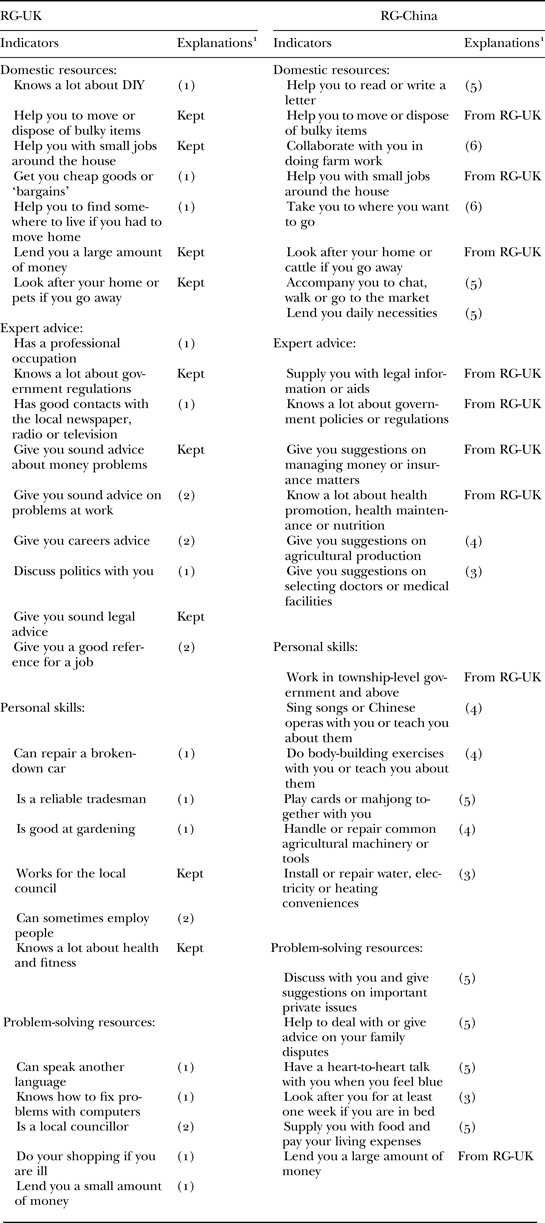
Secondly, the research team reviewed the RG-UK items and agreed that some items were not suitable for rural-dwelling older adults in China (see Table 1). Therefore, the team developed a new RG scale appropriate for use in rural China which drew on Chinese social resource and social support tools. Following the RG-UK sub-scale classifications, and influenced by a literature review (He Reference He2002) and focus group discussions, we designed a 30-item RG-China scale, and responses to individual items were dichotomised (0 = no, 1 = yes).
Comparison between Resource Generator-UK (RG-UK) and Resource Generator-China (RG-China) (for older rural-dwelling Chinese people)

Notes: 1. Explanations: (1) regarded as unsuitable by experts; (2) regarded as unsuitable by research team members; (3) recommended by research team members; (4) recommended by experts; (5) referring to other survey tools; (6) suggestions from rural residents in the pilot survey. DIY: do-it-yourself.
Thirdly, nine experts whose fields included social medicine, health policy, epidemiology and social security, and three local rural health officials, were consulted about the suitability of the 30-item RG-China scale. This consultation led to some items being discarded and new ones being included. A final 29-item RG-China scale was then produced.
Finally, the 29-item RG-China scale was tested in a pilot survey involving 27 rural-dwelling older adults. A 26-item scale (domestic resources (eight items), expert advice (six items), personal skills (six items) and problem-solving resources (six items)) was created on the basis of the findings of this pilot. Compared with the original RG-UK scale, nine items were retained in the new scale and 17 new items were added (see Table 1). However, one item in the sub-scale of problem-solving resources (‘lend you a large amount of money’) was subsequently deleted according to preliminary homogeneity test results (cut-off value of 0.3). Therefore, the final RG-China scale included 25 items. We calculated scores for the total scale and each of the sub-scales.
We assessed the convergent validity of the RG-China against a PG that was developed for the purpose of this study. The PG measures access to occupational prestige, a construct similar to social resources accessible through social networks. A similar validity test was used in the development and validation of the RG-UK (Webber and Huxley Reference Webber and Huxley2007). The set of 40 PG items suitable for older rural-dwelling Chinese people was based on the occupation classifications and prestige valuations in earlier research in China (Li Reference Li2005). The general question for the PG was whether the respondent ‘knew anyone in each of these occupations’. Five deductive PG measures were used based on existing studies (Burt Reference Burt1992; Campbell, Marsden and Hurlbert Reference Campbell, Marsden and Hurlbert1986; Erickson Reference Erickson1996, Reference Erickson2003; Lin Reference Lin1999, 2001). Highest accessed prestige is a regularly used social capital measure referring to specific social resource quality, and is based on the hypothesis that positive social capital results from accessing network members with high prestige (Lin Reference Lin2001). Range in accessed prestige is calculated as the difference between highest and lowest accessed prestige, while number of different positions accessed is the total number of occupations in which a respondent knows anyone. The average accessed prestige is calculated as the mean of the prestige of all occupations in which the respondent knows anyone. Total accessed prestige is calculated as the cumulative prestige of all accessed occupations.
Our outcome measure was HRQOL measured by the Chinese version of the SF-36. The Chinese version of SF-36 was translated from the SF-36 Standard UK version 1.0 by the Institute of Social Medicine and General Practice of Zhejiang University, China (Li, Wang and Shen Reference Li, Wang and Shen2003). This version of SF-36 has previously been used in surveys to assess the quality of life of both the general population and people with specific chronic diseases (Liang, Xue and Jing Reference Liang, Xue and Jing2005; Wang et al. Reference Wang, Wu, Zhao, Yan, Ma, Wu, Liu, Gu, Zhao and He2008). The Chinese version of SF-36 yields eight scale profiles measuring eight domains of quality of life targeting physical functioning, role – physical, role – emotion, bodily pain, general health, vitality, social functioning and mental health. The eight SF-36 domains hypothetically formed two categories: Physical Component Summary (PCS) and Mental Component Summary (MCS), respectively. The scores of PCS and MCS were obtained using the standard scoring algorithms (Lam et al. Reference Lam, Tse, Gandek and Fong2005).
We included the following variables as potential confounders in the generalised linear regression models: age (continuous), gender, education (illiterate/primary school/junior secondary school/high school and above), occupation before 60 years old (farmer versus non-farmers), annual family income per capita (continuous), living arrangement (living alone/living with spouse/living with spouse and others/living with others), county (Junan/Liangshan/Pingyin) and presence/absence of chronic illness.
Statistical analysis
Since RG data are typically of an ordinal nature, factor-analytic models such as Principal Components Analysis (designed for use with normally distributed data of at least five categories) are generally not suitable to accomplish such dimensional reductions. Instead, models from Item Response Theory are more appropriate (Van der Linden and Hambleton Reference Van der Linden and Hambleton1997). To analyse the homogeneity and reliability of the RG-China scale, cumulative scale analyses were performed using MSP5 for Windows (Molenaar and Sijtsma Reference Molenaar and Sijtsma2000). Mokken scales use Loevinger's coefficient of homogeneity at the item (H i) and scale (H) levels to test whether the number of departures from a strictly hierarchical response pattern is low enough that persons and items can be consistently ordered (Molenaar and Sijtsma Reference Molenaar and Sijtsma2000). Loevinger's H coefficients (Loevinger Reference Loevinger1947) were used to express the fit of specific items within a scale and for the homogeneity of the scale as a whole. Uncorrelated items produced values of H = 0, whereas perfectly homogenous scales produced values of H = 1. Conventionally, scales with H ⩾ 0.3 are useful, H ⩾ 0.4 are medium strong and H ⩾ 0.5 are strong scales (Mokken Reference Mokken1997). We eliminated items if their item homogeneity H coefficients (H i) fell below a set value, conventionally H i = 0.3 (Mokken Reference Mokken1997). Further, a reliability coefficient ρ was calculated for the total scale and each sub-scale. Values above 0.6 are conventionally taken as indications of sufficient reliability (Molenaar and Sijtsma Reference Molenaar and Sijtsma2000).
Pearson correlation analysis was used to analyse the correlation relationships between different RG sub-scales, and between RG and PG measures. Following the analytical approach of Kobayashi et al. (Reference Kobayashi, Kawachi, Iwase, Suzuki and Takao2013) to separate the analysis by gender, we constructed four generalised linear regression models by gender to examine the associations of social capital status based on RG scale with HRQOL (PCS and MCS) among older rural-dwelling Chinese people, after controlling for other confounders. In Models 1 and 2, we introduced the RG total scale score (the models based on continuous and categorical total RG were both tried); in Models 3 and 4, we introduced four RG sub-scale scores. In this study, p values of less than 0.05 (two-sided test) were considered statistically significant. These analyses were performed using Stata 12.0 (StataCorp 2011).
Results
Sample descriptions
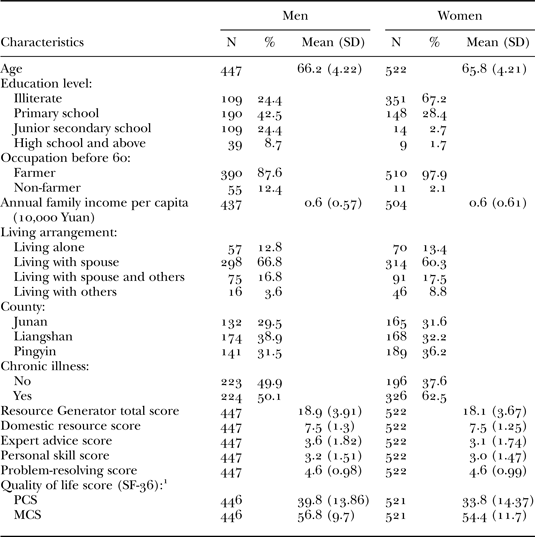
Characteristics of the study participants aged 60–75 years (447 men and 522 women) are shown in Table 2. The mean ages for men and women were 66.2 and 65.8 years, respectively; 33.1 per cent of men had education levels of junior secondary school and above, which was 7.5 times as much as that (4.4%) among women. The majority of study participants (87.8% for men; 97.9% for women) were farmers when they were aged less than 60 years old. The average annual family income per capita for men and women were 5,800 and 5,600 Yuan, respectively; 12.8 per cent of men and 13.4 per cent of women lived alone; 50.1 per cent of men reported having chronic illnesses, which was 12.4 per cent lower than that of women. The proportion of high RG scores among men was 10.2 per cent higher than that among women. The average total RG scores of men and women were 18.8 and 18.1, respectively. The average expert advice sub-scale and personal skill sub-scale scores among men were 0.5 and 0.2 points higher, respectively, than those among women. In terms of HRQOL, the average PCS and MCS scores among men were 39.8 and 56.8 points, which were 6.0 and 2.4 points higher, respectively, than those among women.
Characteristics of the study participants

Notes: 1. The eight 36-Item Short Form Health Survey (SF-36) domains hypothetically formed two categories: Physical Component Summary (PCS) and Mental Component Summary (MCS), respectively. SD: standard deviation.
Homogeneity and reliability of RG-China for rural-dwelling older adults
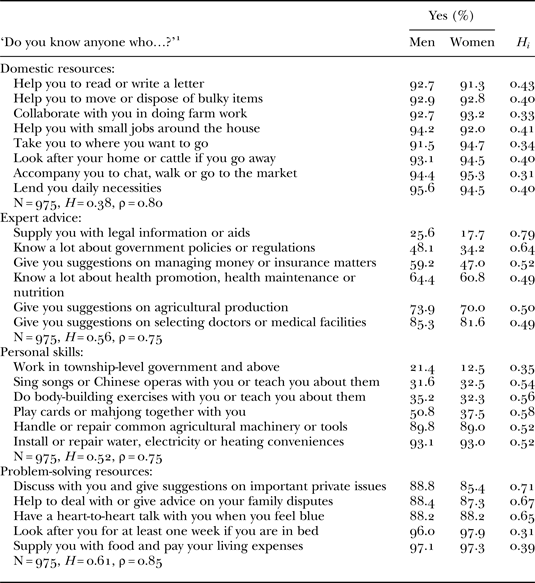
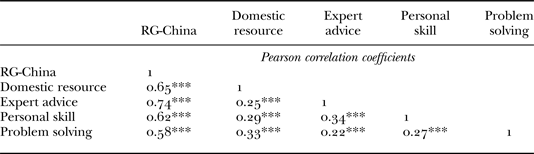
We used MSP5 to test whether the 25 items of the four sub-scales formed one homogenous scale. From Table 3, men in our sample had better access to resources in the expert advice and personal skills sub-scales. Homogeneity indices of the four sub-scales were between 0.38 and 0.61, and their reliability coefficients were between 0.75 and 0.85. The homogeneity of the 25-item RG-China for older adults was sufficient to form one scale (H = 0.36) with high reliability (ρ = 0.85). The RG-China scale had very strong positive correlations with its four sub-scales (Table 4). However, the inter-scale correlations among the four sub-scales were only moderate although statistically significant.
The homogeneity and reliability of the Resource Generator-China scale (26 items)

Notes: 1. ‘Do you know anyone who…?’: ‘Do you personally know anyone with the skill or resource listed below that you are able to gain access to within one week if you needed it?’
H i and H: Loevinger's homogeneity index indicating individual item fit in scale (H i) and scale homogeneity (H). ρ: Scale reliability index as calculated by the software MSP5 for Windows.
Correlation matrix of Resource Generator (RG)-China sub-scales

Significance level: *** p < 0.001.
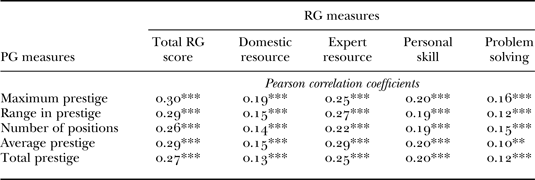
As shown in Table 5, there were statistically significant, though weak, correlations (all p values are less than 0.01) between the five PG deductive measures and five RG measures (total score and four sub-scale scores). Social networks of older rural-dwelling Chinese people in which occupation positions with higher prestige were accessed also provided them with access to more diverse social resources. However, there was variation in the extent to which such social networks gave access to various kinds of domain-specific social capital. PG measures were most related to expert advice resources and least to problem-solving resources (Table 5).
Correlations between social capital measures from Position Generator (PG) items and Resource Generator (RG)-China items

Significance levels: ** p < 0.01, *** p < 0.001.
Associations with HRQOL (PCS and MCS) by gender
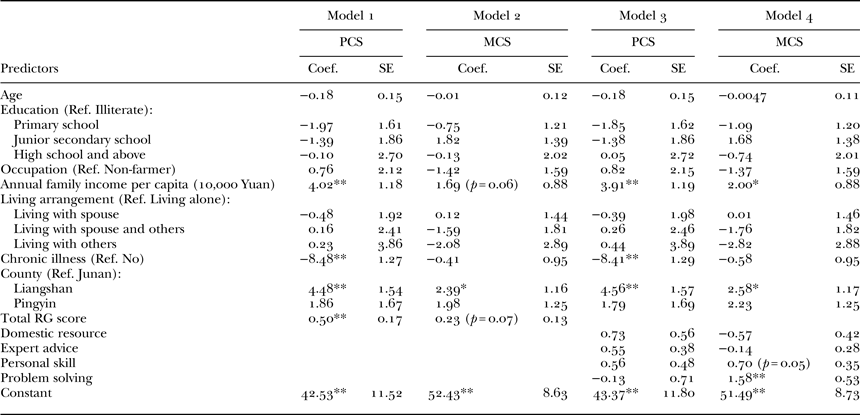
Table 6 shows the generalised linear regression models for HRQOL (PCS and MCS) among rural-dwelling Chinese older men. When introducing the total social capital score (RG total scale) in Model 1, higher annual family income per capita, having no chronic illness and living in Liangshan were associated with higher PCS score (p < 0.01); each increased RG scale point was associated with an increase of 0.5 points of PCS (p < 0.01). In Model 2, only living in Liangshan (p = 0.04) was statistically significantly associated with higher MCS score. The total RG score had a smaller association with MCS than PCS among men in our sample.
Generalised linear models for quality of life among rural older men

Notes: N = 434. Coef.: regression coefficients. SE: standard error. PCS: Physical Component Summary. MCS: Mental Component Summary. Ref.: reference category. Variables included in Models 1 and 2 were age, education, annual family income per capita, living arrangement, chronic illness, county and total Resource Generator (RG) score; four RG sub-scale variables (domestic resource, expert advice, personal skill and problem solving) replaced total RG score in Models 3 and 4.
Significance levels: * p < 0.05, ** p < 0.01.
When introducing four sub-scale scores instead of total RG score in Model 3, similarly, higher annual family income per capita, having no chronic illness and living in Liangshan were associated with higher PCS score (p < 0.01). However, no sub-scale scores were statistically associated with the PCS score. In Model 4, higher annual family income per capita (p = 0.02) and living in Liangshan (p = 0.03) were also associated with higher MCS score. Each increased point in problem-solving resources was associated with an increase of 1.58 (p < 0.01) points of MCS.
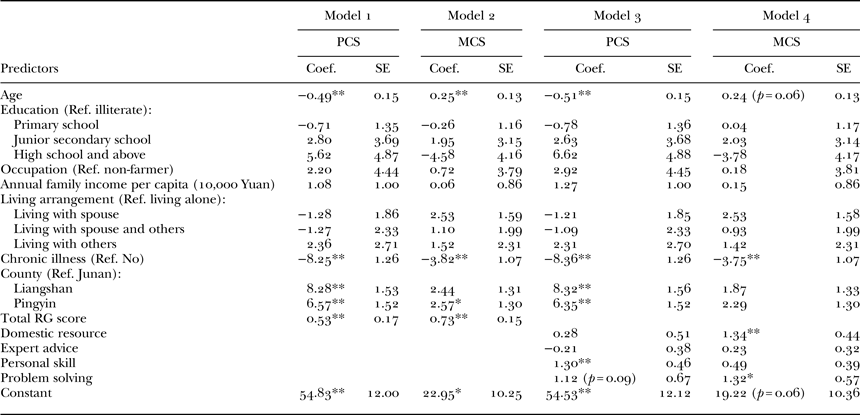
Table 7 shows the generalised linear regression models for HRQOL (PCS and MCS) among rural-dwelling Chinese older women. When introducing the total RG score in Model 1, lower age, having no chronic illness, and living in Liangshan and Pingyin were associated with higher PCS score (p < 0.01). Each increased RG scale point was associated with an increase of 0.53 points of PCS (p < 0.01). In Model 2, higher age (p < 0.01), having chronic illness (p < 0.01), living in Pingyin (p = 0.048) and higher total RG score (p < 0.01) were associated with higher MCS score. Each increased RG point was associated with an increase of 0.73 points of MCS (p < 0.01).
Generalised linear models for quality of life among rural older women

Notes: N = 501. Coef.: regression coefficients. SE: standard error. PCS: Physical Component Summary. MCS: Mental Component Summary. Ref.: reference category. Variables included in Models 1 and 2 were age, education, annual family income per capita, living arrangement, chronic illness, county and total Resource Generator (RG) score; four RG sub-scale variables (domestic resource, expert advice, personal skill and problem solving) replaced total RG score in Models 3 and 4.
Significance levels: * p < 0.05, ** p < 0.01.
When introducing four sub-scale scores instead of the total RG score in Model 3, similarly, lower age, having no chronic illness, and living in Liangshan and Pingyin were associated with higher PCS score (p < 0.01). Each increased point in personal skills was associated with an increase of 1.3 points (p < 0.01) of PCS. In Model 4, having no chronic illness (p < 0.01) was associated with higher MCS score. Each increased point in domestic resources and problem-solving resources were associated with an increase of 1.34 points (p < 0.01) and 1.32 (p < 0.01) points of MCS, respectively.
Discussion and limitations
This is the first study utilising a RG ISC measurement tool in China. Our findings suggest that the RG-China can be a reliable and valid measure of access to ISC for older rural-dwelling Chinese people. The measures of RG total scale and four sub-scales had statistically significant but moderate correlations with five PG measures. The present study found positive associations between ISC (RG total scores and sub-scale scores) and HRQOL (SF-36 PCS and MCS scores). ISC measured by the RG total scale had a stronger association with MCS among older women than among older men. In RG sub-scales, we found differential patterns for older Chinese men and women. For men, only the problem-solving resources sub-scale had a significant association with MCS. However, for women, the personal skill sub-scale had a significant association with PCS, and both domestic resources and problem-solving resources sub-scales had significant associations with MCS.
The construction of RG scales can be challenging as they are frequently only valid within the specific population they were validated within (Van der Gaag and Snijders Reference Van der Gaag and Snijders2005). In this study, following the design of RG-UK, a suitable RG scale specific to older adults in a rural China context was developed. RG-UK items related to job finding were not meaningful for older adults and some resources which are of greater importance for older adults were not present in the RG-UK. As a result, we made some adjustments by deleting those items not suitable to rural-dwelling Chinese older adults and introducing some more relevant items in each sub-scale, based on a literature review, expert consultations and the pilot study. The final 25-item RG-China for rural-dwelling older adults appears to be a strong scale because the homogeneity and reliability results were quite close to those of RG-UK (Webber and Huxley Reference Webber and Huxley2007). The homogeneity indices of its four sub-scales were between 0.38 and 0.61, while correlation coefficients between them were just between 0.22 and 0.34, which suggested that they each represent different sub-collections of social resources.
The traditional assessment of criterion validity against a ‘gold standard’ measure of social capital is impossible because such an instrument does not exist. Instead, we assessed the convergent validity of the RG-China against a Chinese PG. Although RG scale measures had statistically significant but moderate correlation relationships with PG measures, there are some reasonable explanations. While PG and RG instruments operate from the same theoretical perspective of social network-based resources, each instrument emphasises different aspects of social capital (Van der Gaag and Snijders Reference Van der Gaag and Snijders2003). Lin (Reference Lin2001) suggested that individual actions accomplished with the help of social capital can be classified into instrumental actions (gaining resources) and expressive actions (maintaining resources), which are both important for older adults. The PG measures are traditionally designed to measure access to higher occupational prestige and access to diverse networks. However, expressive actions (expected returns from social capital such as the reception of personal support and the sharing of sentiments; Lin Reference Lin2001), are less dependent on access to prestige-rich positions. The PG also under-represents network members who have positions that are traditionally not associated with occupational prestige (e.g. home-makers, the unemployed, retired people and younger people still in education), who all contribute attention, care, accompaniment, love and various other resources associated with their human and cultural capital (Gaag, Snijders and Flap Reference Gaag, Snijders and Flap2004). The RG measures in this study included many ‘maintaining’ resources not closely related with occupational prestige, which also helps to explain their moderate correlations with PG measures.
This study found positive associations between ISC and HRQOL (PCS and MCS), in terms of both the total RG scale and its sub-scales, which was consistent with the findings of He's (2002) study in Shanxi, China. This study also found different associations of ISC with HRQOL between older rural-dwelling Chinese men and women. When introducing the RG total scale, its score had a stronger association with mental health among older women than among older men. Other studies had similar findings. For example, a study in Spain among those of 65–85 years without a paid job showed that affective social support was only negatively related to poor mental health among women (Rueda and Artazcoz Reference Rueda and Artazcoz2009). Using data from the Survey of Health, Ageing and Retirement in Europe, Gibney and McGovern (Reference Gibney and McGovern2011) found that being in a social network characterised by low levels of support and social engagement was associated with higher levels of mental distress but only for women. When introducing RG sub-scales, the associations with physical and mental health across the four sub-scales also differed with gender. In terms of physical health, personal skills had a significant association only for older women. As for mental health, problem-solving resources had a significant association for both men and women, while the significant association of domestic resources was only found among women. Similarly, a study of the association between ISC (also measured by RG) and self-rated health among a general population in Japan showed that, among women, dose–response relationships were found in all domains, whereas among men a dose–response relationship was only significant for expert advice (Kobayashi et al. Reference Kobayashi, Kawachi, Iwase, Suzuki and Takao2013).
In this study, opposite to the more obvious associations of ISC with HRQOL among women, average family income per capita was only positively associated with HRQOL among men. Similarly, another study among older adults in Beirut also found that social support was more salient to women's self-rated health and economic security was more salient to men's self-rated health (Chemaitelly et al. Reference Chemaitelly, Kanaan, Beydoun, Chaaya, Kanaan and Sibai2013). A possible explanation of the above gender differences is that women tend to access or mobilise more support than men even during periods of stress (Kawachi and Berkman Reference Kawachi and Berkman2001), while men may depend more on their family economic resources. In this study, older rural-dwelling Chinese men had similar access to domestic and problem-resolving resources as women, and they had better access to expert advice and personal skills. To be examined in future studies, we hypothesise that rural-dwelling Chinese older men mobilised less support resources than older women, which provided fewer physical or mental health benefits.
Findings in this study contribute to the literature on the application of RG tools in a context of rural China, which has an accelerated rural ageing population with insufficient pension support and the migration of working-age populations. Furthermore, this study has important policy implications by raising awareness of the effects of different resources embedded into social networks on the HRQOL of older rural-dwelling Chinese people.
Limitations
Several limitations should be noted with this study. First, the relatively small sample size covering only three counties in one province of China and the non-strict randomisation design may limit the generalisation of findings in this study to vast rural areas in the whole country. However, the socio-economic area differences within Shandong, which has the second largest population among all provinces, are the differences of the whole country in miniature. Although a larger sample size and more rigorous sampling design are needed in the future, this study still provides a good reference point for rural Chinese areas.
Second, the high proportion of individuals who answered ‘yes’ to the items related to domestic resources and the problem-solving resources showed that there was limited variability in these two groups of resources in rural-dwelling older Chinese people. So, more suitable items with relatively high variability should be explored in future studies.
Third, we cannot confirm the exact causal relationships between ISC and HRQOL due to the cross-sectional design, and it may be possible that reverse causation could account for the differential patterns of subscale-specific findings. In the future, longitudinal follow-up studies will be required to confirm causality.
Fourth, the study participants did not include rural-dwelling older adults above 75 years old because some self-reported items were difficult to understand and answer for many of them, due to poorer cognitive abilities and lower education levels. We are cautious to generalise our findings to all age groups of rural-dwelling Chinese older adults. In addition, compared with rural-dwelling older Chinese people, urban-dwelling older Chinese people live in a quite different social environment and the RG-China scale cannot be directly used to measure their access to social capital. Our findings are not generalisable to this group.
Fifth, existing RG studies focused on the general population, and our study is the first study to use an RG scale adapted to rural older adults, so it is difficult to find a suitable study for direct comparison.
Conclusions
This study found that the RG-China is a reliable and valid measure of access to ISC for older rural-dwelling Chinese people. Our findings provide positive evidence of the associations between ISC and HRQOL, in terms of both total RG scale and sub-scales. Future studies should use a longitudinal design with a larger and random sample covering larger geographical rural areas in China. In addition, the gender differences of the health benefits from access to various resources should be further tested.
Acknowledgements
This study was funded by the National Nature Science Foundation of China (NSFC #71103112). The funder had no role in the design of the study, the analysis and interpretation of data, or the writing of the study. We wish particularly to acknowledge the support of Prof. Chongqi Jia, Dr Hui Li, Mr Xiaokang Ji and other participants from Shandong University during the field survey. All named authors meet the criteria for authorship. The authors declare no conflict of interest.