



Introduction
When the cultivation of millet moved westwards into Central Asia, did traditional East Asian culinary practices travel with it? In this article, we use ancient DNA (aDNA) to determine the phenotypes of archaeological plant samples from Bronze Age sites in modern-day Xinjiang, and hence to establish the cooking properties of broomcorn millet (Panicum miliaceum) in a region far from its centre of domestication on the Loess Plateau.
Accumulating evidence suggests that staple cereals were the earliest commodities exchanged between East Asia and western Eurasia (Liu et al. Reference Liu2016, Reference Liu2017, Reference Liu, Motuzaite Matuzeviciute, Hunt, Lightfoot, Liu and Fuller2018; Spengler et al. Reference Spengler, Ryabogina, Tarasov and Wagner2016; Zhang et al. Reference Zhang, Wang, Ferguson, Yang, Liu and Jiang2017; Tian et al. Reference Tian, Ma, Wang, Pilgram, Zhao and Liu2018; Y. Li Reference Li2021). In Xinjiang, wheat (from Southwest Asia) and broomcorn and/or foxtail millet (from China) appear together in the same contexts from the first half of the second millennium BC, at the sites of Xiaohe (2000–1500 cal BC) and Xintala (1900–1500 BC; Zhao et al. Reference Zhao, Li, Zhou, Dodson and Ji2013; Yang et al. Reference Yang, Yang, Li, Abuduresule, Hu, Wang and Jiang2014). These sites postdate, by a few hundred years, the co-occurrence of wheat and millets both to the west, at Begash in eastern Kazakhstan (Frachetti et al. Reference Frachetti, Spengler, Fritz and Maryashev2010) and to the east, in the Hexi corridor (Dong et al. Reference Dong, Yang, Han, Wang and Chen2017). Carbon stable isotope evidence from Xinjiang human skeletal remains, dated between 1500 BC and AD 220, is also consistent with the dietary consumption of millet (Liu & Reid Reference Liu and Reid2020). However, the identification of macrofossils and isotopic evidence for millet consumption cannot alone elucidate the cooking practices used to prepare these grains. To achieve this, it is necessary to combine these approaches with others, specifically aDNA analysis and material cultural studies.
Fuller and Rowlands (Reference Fuller, Rowlands, Wilkinson, Sherratt and Bennet2011) have argued for a deep-rooted and enduring contrast between the culinary traditions of eastern and western Eurasia, reflected both in the material cultural and archaeobotanical evidence. The persistence of these culinary geographies is striking; with roots pre-dating the beginnings of agriculture and persisting into recent times, traces remain discernible in contemporary Eurasian cuisines. In the west, where pottery production post-dates cereal domestication, the prevalence of grinding technologies is consistent with a ‘dry cuisine’ and dough-baking tradition, whereas in the east, the early prevalence of pottery use, pre-dating agriculture, is consistent with a ‘wet cuisine,’ and whole-grain boiling and steaming tradition (Fuller & Rowlands Reference Fuller, Rowlands, Wilkinson, Sherratt and Bennet2011: fig. 5.3)
As novel crops dispersed across Eurasia, they did not necessarily disrupt these established culinary traditions; newly introduced grains were instead incorporated into existing local practices. This is visible, for example, in the reduced size of wheat grains integrated into the established small whole-grain cooking tradition of East Asia (Liu et al. Reference Liu2016; Liu & Reid Reference Liu and Reid2020). The distinction between a wet, ‘sticky’ cuisine in the east, and a dry, ‘non-sticky’ cuisine in the west, as described by Fuller & Rowlands (Reference Fuller and Rowlands2009, Reference Fuller, Rowlands, Wilkinson, Sherratt and Bennet2011) is central to the research presented in this article. Here, we explore the culinary evidence in relation to the inferred boundary of the eastern ‘sticky’ cuisine and draw upon two types of evidence to enable comparison of the movement of cereal crops and their processing traditions: the material cultural remains associated with food preparation, and the biomolecular evidence of the food plants themselves. We focus upon a region to the west of the inferred culinary boundary, corresponding to modern-day Xinjiang, and a crop originating from east of that boundary—broomcorn millet (Figure 1).
Map of locations of sites from which broomcorn millet samples were collected for this study (blue circles) and other sites mentioned in the text (black circles), with relevant geographical features labelled. Key to site numbers: 1. Xiaohe, 2. Shengjingdian, 3. Yingpan, 4. Yanghai, 5. Yuergou, 6. Astana, 7. Keriya, 8. Gumugou, 9. Begash, 10. Shajing, 11. Tuhulu (figure by X. Liu; map generated using ArcMap v10.2 and NASA Blue Marble with data obtained from NASA Earth Observatory (public domain)).

Material culture evidence for the culinary boundary
The principal evidence for culinary traditions comes from cooking vessels. Makibayashi (Reference Makibayashi2008) and Han (Reference Han2015) independently associate the distributions of pots for boiling and steaming with East Asian Neolithic cultures such as Jiahu, Peiligang, Yangshao, Longshan, Songze and Majiabang. Three prominent categories of such vessels are Ding 鼎, Li 鬲 (tripods suited to boiling) and Yan 甗 (perforated ceramics suited to steaming; Figure 2). The earliest examples of Ding and Yan are documented at Jiahu, dating to 7000–6000 BC. Both types subsequently spread to the middle Yangtze and middle Yellow River regions via independent routes (Makibayashi Reference Makibayashi2008). The predominantly northern distribution of Li first appears in association with the Longshan culture c. 2500 BC in the Loess Plateau (Yang Reference Yang2014).
Examples of Longshan ceramic cooking vessels: a) Li (鬲); b) Yan (甗); c) Ding (鼎) (reproduced from National Cultural Heritage Administration 2007. Atlas of Chinese Cultural Relics in Shandong Province. Beijing: Sino Maps: p. 375, with permission).

Prior to 2000 BC, Ding, Li and Yan are found no further west than the Wei River valley. Subsequently, their ranges extend westwards to the Huangshui River where they are attested at Qijia and Siwa culture sites. With a few exceptions, such as the Li pots recovered from Shajing (Minqin county) and Tuhulu (Anxi county), these vessels are absent from the Hexi Corridor; Tuhulu marks the most westerly appearance of pottery tripods (Li Reference Li2009). This distribution endures into the first millennium BC, when the same vessel shapes were reproduced in both clay and bronze (von Falkenhausen Reference Von Falkenhausen2006; Fuller & Rowlands Reference Fuller, Rowlands, Wilkinson, Sherratt and Bennet2011; Rawson Reference Rawson2017).
This western limit of tripod use coincides with the approximate modern western boundary of sticky-type cereal varieties, including sticky broomcorn millet (Sakamoto Reference Sakamoto, Ellen and Fukui1996; Hunt et al. Reference Hunt, Rudzinski, Jiang, Wang, Thomas and Jones2018). A recurrent finding of archaeogenetic research is that modern-day spatial patterning in genetic diversity retains much historical information; the geographical concurrence of the boundaries between distinct material cultural assemblages and sticky or non-sticky traits in contemporary cereal landraces may be an example of this. While modern DNA sequences from extant landraces provide the richest body of evidence for the origins and dispersals of crops in the past, aDNA from archaeological specimens serves to refine those patterns in two principal respects. First, in the provision of more precise timelines and second, in aiding the distinction between primary patterns of dispersal and the ‘noise’ of secondary movements that may overlie and blur the earlier picture. In this article, we draw upon well-preserved archaeological cereal specimens to refine our understanding of the emergence of the spatial distribution of sticky/non-sticky traits. We address the hypothesis that there is a direct connection, in time and space, between the material cultural evidence for wet and dry cuisines, and the prevalence of sticky or non-sticky forms of millet.
The Central Asian crop evidence from Xinjiang
Xinjiang's arid climate makes the region ideal for archaeological preservation and hence biomolecular analyses. Low annual rainfall (<200mm per annum) results in exceptional preservation of organic materials, both of morphological features and of biomolecules, providing excellent opportunities to track crop types through time. We explore these archaeobotanical remains in relation to the genetic control of grain ‘stickiness’—a feature associated with eastern ‘wet’ cuisine—in broomcorn millet.
Methods
Thirteen samples of desiccated caryopses (grains) of broomcorn millet were obtained from seven archaeological contexts in Xinjiang (Table 1, Figures 1, 3 & 4). These contexts span 2400 years from the Bronze Age (c. 1700 BC) to the early Tang dynasty period (c. AD 700; Table 1). Broomcorn millet has a duplicated (tetraploid) genome arising from a pre-domestication hybridisation (Hunt et al. Reference Hunt, Badakshi, Howe, Jones and Heslop-Harrison2014), with the consequence that the sticky-starch trait is controlled by two diverged copies of the GBSSI gene: GBSSI-L and GBSSI-S (Hunt et al. Reference Hunt, Denyer, Packman, Jones and Howe2010). Plants with mutations in both genes have the sticky-starch phenotype. Under the microscope, a visual (though not chemical) similarity has been noted between these amylopectin-rich sticky starches and wax, leading to the usage of ‘waxy’ to denote the associated alleles and genotypes.
Contexts and radiocarbon dates for archaeobotanical samples discussed in this article. References: 1) Chen et al. Reference Chen, Wu, Zhang, Wang, Hu, Wang and Jiang2012; 2) Chen et al. Reference Chen, Wang, Dai, Li and Jiang2016; Xinjiang Institute of Cultural Relics and Archaeology 2002; 3) Jiang et al. Reference Jiang, Zhang, Lu and Wang2015; 4) Jiang et al. Reference Jiang, Wu, Wang, Ferguson and Li2013; 5) Jiang et al. Reference Jiang, Li, Ferguson, Wang, Liu and Li2007; 6) Yang et al. Reference Yang, Yang, Li, Abuduresule, Hu, Wang and Jiang2014; 7) Zhang Reference Zhang2009.

Cemeteries mentioned in the text: a) Xiaohe; b) grains of common millet and bread wheat exposed beneath one of the Xiaohe bodies; c) the Yanghai cemeteries; d) the Shengjindian cemeteries during excavation (photographs by W. Li (a & b) and H. Jiang (c & d)).

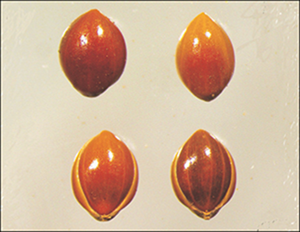
Desiccated grains of common millet recovered from archaeological sites in Xinjiang at: a) Keriya; b) Xiaohe; c) Yingpan; and d) Astana. Scale bar = 2mm (figure by H. Jiang).

A total of three loss-of-function mutations have been characterised that reduce the production of amylose. The resultant amylopectin-rich starch leads to a sticky consistency when cooked. The major gene controlling endosperm starch composition, GBSSI-S, has a mutant allele (S-15) characterised by a 15-basepair deletion in exon 10 (“delALNKE”), resulting in a deletion of five amino acids from the glucosyl transferase domain GTD1. The GBSSI-L gene, which has a reduced capacity for amylose synthesis relative to GBSSI-S, has two mutant alleles. The LY mutant allele differs from wild-type by a single G→A substitution in exon 7 (“C160Y”), which results in a tyrosine residue in the resulting polypeptide in place of cysteine. The Lf mutant allele has an adenine insertion in exon 9 (“Ex9A”), resulting in a reading frame shift which blocks protein expression (Hunt et al. Reference Hunt, Denyer, Packman, Jones and Howe2010, Reference Hunt2013). The phenotypes resulting from the six possible combinations of the wild-type and mutant alleles are summarised in Table 2.
Summary of known functional variants in the two homologous GBSSI loci of P. miliaceum, showing relationships between variant genotypes, allele names, and resulting grain starch phenotype.

DNA extractions were performed in a clean room at the University of Warwick, and DNA sample handling and polymerase chain reaction (PCR) setup were undertaken in a lab free of modern millet samples or DNA. Two DNA extraction blanks were run for the sample set, as well as negative (water) controls for all PCRs and Kompetitive Allele Specific PCR (KASP) assays. Fresh reagents, including fresh primer stocks were used for PCRs and KASP assays on aDNA samples. DNA was extracted from desiccated grain as follows. Six grains per sample were ground to a fine powder using a pestle and mortar. Powder was transferred to 2ml Eppendorf tubes and incubated for seven days at 35°C in 1ml cetyltrimethyl ammonium bromide buffer (2% w/v CTAB [hexadecyltrimethylammonium bromide], 0.1M Tris-HCl pH 8.0, 20mM EDTA, 1.4M NaCl, 1% PVP). Following incubation, samples were centrifuged at 14000g for 10 minutes, and the supernatant transferred to new 2ml Eppendorf tubes. An equal volume of chloroform: isoamyl alcohol (24:1) was added, and samples shaken vigorously for 10 minutes before centrifugation for 10 minutes at 14000g. The resulting aqueous phase was transferred to a new tube, mixed with 3× the volume of Buffer AP3/E from the DNeasy Plant Mini Kit (Qiagen), and incubated at room temperature for 1 hour. Thereafter, the solution was transferred to Qiagen DNeasy Mini Spin columns and extractions completed following the manufacturer's protocol from this step, with elution in a total final volume of 200μl H2O. DNA concentrations were measured using a Qubit 2.0 (Life Technologies) and extracts stored at –20°C.
We attempted genotyping of the GBSSI loci for these aDNA samples using both conventional PCR and Sanger sequencing, and KASP assays. For conventional PCR, novel primers were designed for the three fragments whose sequence determines the endosperm starch phenotype, in order to minimise fragment size and thus maximise the likelihood of successful amplifications. PCR across the five amino acid indel site in the GBSSI-S locus used the primers delALNKEf (5’-AAGGAAGCATTTCAGGCCAT-3’) and delALNKEr (5’-GCCCTTCTGCTCCTCCA-3’). The primer pairs M12b (5’-TATATAGCTCACGCTTCACGG-3’) and R12b (5’-GCTCACGGTGAGGACCCT-3’), and int5new (5’-GCTCACGGTGAGGACCCT-3’) and R3 (5’-TGGTAGTTGCTCTTGAGGTA-3’) were used to amplify the fragments spanning the adenine insertion site and G/A substitution site respectively in the GBSSI-L locus. PCRs were carried out in 25μl volumes containing 1× AmpliTaq Gold® 360 Master Mix (Applied Biosystems), 3% (w/v) bovine serum albumin (BSA), 400nM each forward and reverse primer, supplementary MgCl2 to final concentration 2mM (int5new-R3 fragment only), and 3μl template DNA. The thermocycler programme was as follows: 9 minutes at 95°C, then 40 cycles of 30 seconds at 95°C, 30 seconds at 56°C, 45 seconds at 72°C, then 7 mins at 72°C. Where PCR products were very faint, or not visible, on agarose gels following the first amplification, a second-round PCR was carried out as above but using 1μl of the primary PCR product as the template, with 25 cycles. PCR products were Sanger-sequenced for both forward and reverse strands using the respective PCR primers. Forward and reverse strands were assembled into a single contig (where data permitted) and contigs were aligned with one another and with reference sequences from modern samples (Hunt et al. Reference Hunt, Denyer, Packman, Jones and Howe2010) in MEGA version 6 (Tamura et al. Reference Tamura, Stecher, Peterson, Filipski and Kumar2013).
KASP assays were developed using 95 modern landrace samples previously genotyped using other approaches (Hunt et al. Reference Hunt, Rudzinski, Jiang, Wang, Thomas and Jones2018). The samples were selected to represent all genotype combinations that are found at the two GBSSI loci and were genotyped using KASP (www.lgcgroup.com/products/kasp-genotyping-chemistry). KASP has a number of advantages over conventional PCR and sequencing for the analysis of aDNA: it uses very short DNA templates, avoids the problems associated with direct sequencing of short amplicons, and requires only a single-step, closed tube reaction for the detection of single nucleotide polymorphisms (SNPs)—genomic variants that differ by only one base in the DNA sequence (Lister et al. Reference Lister, Jones, Jones, O'Sullivan and Cockram2013). KASP was recently found to outperform conventional sequencing for genotyping ancient DNA from herbarium samples of barley grain (Lister et al. Reference Lister, Jones, Jones, O'Sullivan and Cockram2013); here we extend the validation of this platform to aDNA from desiccated archaeological plant material. The 95 modern samples were used as a validation panel for the KASP markers, which were developed for the three previously identified functional polymorphisms (Hunt et al. Reference Hunt, Denyer, Packman, Jones and Howe2010) by submitting the surrounding sequence to LGC Genomics. KASP assays were carried out on the validation panel by LGC Genomics and the returned .csv files were viewed using SNP viewer v1.99 (www.lgcgroup.com/products/genotyping-software/snpviewer, last accessed 3 May 2018). The three functionally polymorphic sites successfully converted to KASP markers and the KASP data for the validation panel agree with the data obtained for these samples by PCR and size quantification/SNaPshotTM. The genomic DNA from the aDNA extractions and controls was used as a template for KASP genotyping, arrayed into half a 96-well plate (6 columns × 8 rows) with negative water controls around samples in a chequerboard pattern to control for cross-contamination. SNP typing of aDNA was performed using the KASP genotyping system for the three markers, and the returned data were viewed as above.
We also checked the endosperm starch phenotype directly by crushing grains on a microscope slide and staining starch with a 1:100 dilution of Lugol's solution (Figure 5). A single grain was phenotyped for all samples except 2007TSM20 and 2007TSM8, for which no material remained.
Starch granules from sample M14 of archaeological millet stained with Lugol's solution. The blue-black colour indicates the presence of amylose, which is found in non-sticky millet variants (figure by H. Hunt).

Results
The results of the genetic analysis of the archaeological grain samples are shown in Table 3. From conventional PCR and sequencing, full GBSSI genotypes were obtained for three of the 13 samples: S1 (Shengjindian cemeteries), M20 and M28 (Xiaohe cemeteries). Another six samples were successfully sequenced for one or two of the three loci. Sequencing success appears to correlate with the DNA concentration measured in the extract. Alignment of sequences with reference data from modern samples shows sporadic variants, away from the functionally polymorphic sites, that most likely represent nucleotide misincorporations typical of aDNA sequence analysis. In the delALNKEf – delALNKEr fragment (alignment length 131 bp), three instances of a G to A transition were found among the overall set of sequences. In the int5Lfnew – R3 fragment (alignment length 184 bp), two instances occurred where an expected cytosine residue was called as a Y, that is, as a cytosine on one strand and a thymine on the complementary strand. In the M12b–R12b fragment (alignment length 121 bp), two instances were found of a G to A transition. Two of these three samples (2007TSM20 and M20) for which sequencing returned fully determined GBSSI genotypes also gave results with all three KASP markers. A further five samples (M11 and M14 – Xiaohe cemeteries; K – Keriya cemeteries; 72TAM173:10 – Astana cemeteries; and 2007TSM8 – Shengjindian cemeteries) were also successful for all three KASP markers. Two samples (M28 and 06IM4) worked for two of the three KASP markers. KASP therefore showed a greater success rate than PCR and Sanger sequencing, especially for those samples where the measured concentration of DNA in the extract was lower. Combining results from both genotyping technologies reveals the full GBSSI genotype for nine of the 13 samples, and a partial genotype for one further sample (72TAM155:22, Astana cemeteries). The alleles for all three loci, for all samples, are ‘wild-type’, that is, the non-waxy (non-mutant) alleles.
Results of aDNA analysis of archaeobotanical samples. Key to waxy genotyping results: WT/G/- = wild type; NR- no result (for further details on genetic notation and S0/LC/LY see Table 2)

The genotype information agrees with the results of the direct phenotyping of the archaeobotanical grains: all samples stained a blue-black colour with iodine, indicate non-sticky starch (Figure 5). Grains from the same contexts were submitted to the 14CHRONO centre at Queen's University Belfast, for AMS radiocarbon dating. Radiocarbon ages were calibrated with OxCal v4.2.2 (Bronk Ramsey Reference Bronk Ramsey2009) using the IntCal13 calibration curve (Reimer et al. Reference Reimer2013). The calibrated 95.4 per cent probability ranges for the date are reported in Table 1.
Discussion
Present and past distributions of GBSSI alleles and starch phenotypes in broomcorn millet
Patterns of diversity in microsatellite and GBSSI markers support a population origin of cultivated broomcorn millet in the western Loess Plateau of north-central China (Hunt et al. Reference Hunt, Rudzinski, Jiang, Wang, Thomas and Jones2018). Archaeological evidence suggests that broomcorn millet was cultivated as a staple grain by at least 8000 years ago in a series of piedmont locations across the Loess Plateau (Liu et al. Reference Liu, Motuzaite Matuzeviciute, Hunt, Lightfoot, Liu and Fuller2018). The ancestral state in wild cereals is non-sticky endosperm starch, with sticky types having arisen independently among different species, through diverse mutations in the GBSSI gene. It is assumed, therefore, that the earliest domesticated broomcorn millet populations were monomorphic for the wild (non-sticky) starch phenotype. Across the broad region of central/eastern north China today, broomcorn millet landraces show a mix of sticky and non-sticky types but with a strong geographical cline. Sticky landrace varieties of modern broomcorn millet occur as far west as the eastern parts of Qinghai and Gansu provinces, corresponding with the western extent of eastern cuisine pottery types (Ding, Li and Yan, see above), but the majority of varieties in this region are non-sticky. The frequency of sticky varieties increases to the north and east of China, with particularly high proportions in eastern Inner Mongolia, Jilin and Heilongjiang provinces. The time-depth of sticky forms is unknown; L. Li (Reference Li2021) implies their presence in the Yellow River by the Yangshao period (c. 5000–3000 BC), but this is speculative. In Figure 6, the projections of material culture evidence used by Fuller and Rowlands (Reference Fuller, Rowlands, Wilkinson, Sherratt and Bennet2011) to map the culinary geography of East Asia are superimposed over the landrace data from Hunt and colleagues (Reference Hunt, Rudzinski, Jiang, Wang, Thomas and Jones2018) to convey the spatial relationship between culinary regions and the millet genotypes.
Landrace genotypes for broomcorn millet in the context of culinary traditions inferred from material culture. Coloured dots indicate the distribution of waxy (sticky) and non-waxy genotypes (after Hunt et al. Reference Hunt, Rudzinski, Jiang, Wang, Thomas and Jones2018: fig. 5a). Broken line indicates the greater distribution area of late Pleistocene to Initial Holocene ceramics in eastern Asia with probable tree-nut use (redrawn from Fuller & Rowlands Reference Fuller, Rowlands, Wilkinson, Sherratt and Bennet2011: fig. 5.3).

The reconstruction of ancient phenotypes from aDNA genotyping is an emerging theme in recent aDNA studies but it is largely limited to the relatively small number of traits under simple genetic control. Our genotyping of functional GBSSI variants represents one of the first aDNA analyses of phenotype in plants, comparable to the inference of coat colour in domesticated animals (Orlando et al. Reference Orlando2021). In this first molecular evaluation of starch type in archaeological cereal remains, we show that none of the archaeobotanical broomcorn millet grains from Xinjiang, confirmed by direct AMS dating to 1700 BC–AD 700, was sticky. Inferences from the GBSSI genotypes are fully supported by direct phenotyping of starch granules from the archaeological samples. The authenticity of the aDNA sequence data is supported by the observation of a low rate of nucleotide misincorporations, specifically transitions, which result from deamination lesions to the original DNA sequence (Stiller et al. Reference Stiller2006).
Epigraphic evidence from Shang-period oracle bones suggests that sticky forms of broomcorn and foxtail millet were known in northern China by c. 1500 BC (Bray Reference Bray1984). Our data indicate that sticky varieties of broomcorn millet had not reached into China's arid north-west at this time. The three modern landraces from Xinjiang we analysed previously (Hunt et al. Reference Hunt, Rudzinski, Jiang, Wang, Thomas and Jones2018) were also non-sticky. It is notable, however, that each of the eight or nine archaeological samples successfully genotyped at the GBSSI-L locus had the wild-type LC allele, whereas the three modern landrace samples had the mutant (waxy) GBSSI-LY or Lf allele. In the absence of the GBSSI-S-15 mutant allele, the mutant GBSSI-LY and Lf alleles have no phenotypic effect (Hunt et al. Reference Hunt2013). This suggests that more recent movement of broomcorn millet varieties into Xinjiang, perhaps from multiple directions, has overwritten the earliest genetic patterns.
Both the material culture and the biomolecular evidence thus reflect the same broad western limits to the extent of the eastern culinary tradition. East Asian crops, including broomcorn millet, continued to spread further west; in Xinjiang, over 700km beyond the culinary boundary, our analyses of well-preserved archaeobotanical samples confirm the absence of sticky forms. In short, the crops spread further west than the culinary practices with which they were first associated.
Broomcorn millet in the prehistoric cuisine of Central Asia: future directions
From the grain starch genotype and phenotype data, we can postulate that, as early as the Bronze Age, millet cooking practices in Xinjiang were distinct from the wet-cuisine techniques of boiling and steaming practised in the central plain of northern China. This leads us to question how millet was cooked further west. Fuller and Rowlands (Reference Fuller and Rowlands2009, Reference Fuller, Rowlands, Wilkinson, Sherratt and Bennet2011) place Central Asia, including Xinjiang, within the grinding-baking zone, where ceramic vessels for boiling are recurrently recovered alongside mudbrick ovens and worked grinding stones, as, for example, at Ojakly in the Murghab and Tasbas in the Dzhungar Mountains (Spengler et al. Reference Spengler, Frachetti and Doumani2014; Rouse et al. Reference Rouse, Grillo, Piermartiri, Rotondaro, Cogo-Moreira, Bargossi and Cerasetti2019). This might suggest a cuisine in which boiling was integrated with grinding and baking (Ritchey et al. Reference Ritchey2021). Archaeological evidence of ovens and stone querns during third and second millennia BC spans the Hexi Corridor and the Inner Asian Mountain Corridor (IAMC, sensu Frachetti Reference Frachetti2012: fig.5, broadly corresponding to the Pamir, Tianshan, Dzhungar and Altai ranges and associated foothills), clearly suggesting a western origin. It is also likely that the boiling vessels in the IAMC had their origins further north and emerged from a tradition distinct from the tripod-boiling vessels of Neolithic China (Han Reference Han2017). The bases of ceramic vessels for boiling found in the IAMC typically have a rounded (or round-and-pointed) form. This shape first emerged in northern Altai, Siberia and Kazakhstan. During the third and second millennia BC, it was prevalent in three areas: 1) the Altai Mountains, southern Siberia and northern Kazakhstan, 2) Tianshan and 3) Gansu (the Hexi Corridor; Han Reference Han2017). In the same broad region of Central Asia, a boiled stew, incorporating meat, dairy and grains is well documented in the more recent ethnographical record (McLean Reference Mclean2012). We can speculate that, if millet was cooked in such vessels in Xinjiang, it could have been as one component of such a stew, in contrast to the separately cooked whole grains of the eastern tradition. In this case, the texture of the starch component would not be a focus for selection. It is also possible that broomcorn millet was ground and used to make both cakes and noodles as demonstrated by archaeological finds from Iron Age Xinjiang (Gong et al. Reference Gong, Yang, Ferguson, Tao, Li, Wang, Lü and Jiang2011) and Han-dynasty Ningxia (Ren et al. Reference Ren, Wang and Yang2022).
Conclusions
The absence of sticky-starch and tripod vessels for boiling and steaming in Xinjiang enables an insight that the Western movements of millet were not accompanied by the Eastern Neolithic cooking practices. This conclusion is further supported by a recent morphological study, showing an East-to-West increase in millet-grain size along the same dispersal route, which can be explained by the incorporation of Eastern cereals into local Central Asian cuisines (Sun et al. Reference Sunin press). As elaborated, the nature of such local cuisine is unclear. Recent developments in organic residue analysis (Heron et al. Reference Heron2016; Standall et al. Reference Standall, Craig, Heron, Kirleis, dal Corso and Filipović2022) pave the way to explore whether millet was used in Xinjiang in a broad spectrum of cooking techniques across the boiling-grinding-baking spectrum. This will help to clarify why the north Chinese Neolithic ‘culinary package’ disaggregated in the course of its westward spread, such that millet travelled along the Hexi Corridor to Xinjiang and beyond, but the waxy genotypes that generate forms and the tripod pottery vessels did not. Results presented in this article, together with previously published data, constitute a new knowledge of prehistoric food globalisation, showing the dynamic between the deep-seated and geographically stable culinary practices and globally dispersed crop movements.
Acknowledgements
Our thanks to Robin Allaby and Oliver Smith (University of Warwick, UK) and to Chris Howe (University of Cambridge, UK) for providing lab facilities and advice for aDNA work. We thank Yong Wu, Yongbing Zhang and Bo Wang for providing archaeobotanical broomcorn millet samples.
Data availability
All novel data supporting the conclusions reached in this article are included in the main text.
Funding Statement
HVH, DLL, XL and MKJ were supported by a European Research Council Advanced Investigator award (ref. 249642, “Food Globalisation in Prehistory”) to MKJ and by Leverhulme Trust Research Project Grants (refs. F/09717/C, “Pioneers of Pan-Asian Contact” and RPG-2017-196, “Crops, Pollinators and People”). HJ was supported by a Special Programme: Central Asia Scholarship from the Gerka-Henkel Stiftung (AZ 05/ZA/12) and NSFC (42377443). XL was supported by a National Science Foundation grant (no. 1826727, “The Origins and Spread of Millet Cultivation”).



