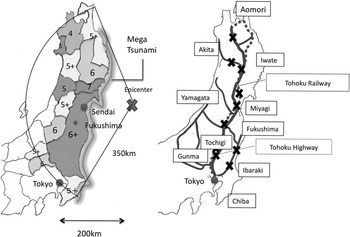
The Great East Japan Earthquake, with a magnitude of 9, occurred on March 11, 2011. This earthquake was the fifth largest earthquake recorded in the world since 1900.Reference Miyama 1 The damage it produced extended over wide areas of the Tohoku and Kanto regions. Because the epicenter was located in the Pacific Ocean, approximately 130 km east of the Oshika Peninsula of Tohoku, the earthquake created a megatsunami, which inundated a wide area of northeastern Japan (Figure 1).
A. Distribution of Shaking Intensity. B. Damage to Major Transportation Routes in the Tohoku–Kanto Region.

Although several reports have described disaster medical care for victims of the earthquake and hospital evacuation after the earthquake,Reference Schultz, Koenig and Lewis 2 – Reference Peek-Asa, Kraus, Dushyanthi, Yu and Abrams 4 to our knowledge, no reports have assessed the effect of the earthquake on operations and operating departments (ODs) in hospitals. To evaluate the effect of the earthquake on OD management, we surveyed the hospitals within this region. An analysis of these factors should aid in preparation for future disasters.
Methods
This study was approved by the Hirosaki University School of Medicine Institutional Review Board under a waiver of consent from individual respondents of the questionnaire survey.
A 33-item questionnaire was sent to 415 acute care hospitals in 10 prefectures of the Tohoku and east Kanto areas. The questionnaire included a survey of structural and nonstructural damage in the OD and opportunities for OD head surgeons, chief nurses, and hospital presidents to comment freely about the situation. Hospitals that were directly damaged by the tsunami were excluded from this study. The questionnaire elicited the number of perioperative patients when the earthquake struck the hospital, obstacles that prevented continuation of surgical procedures, structural and nonstructural damage to the OD, and the effect on routine operations after the earthquake (Appendix 1).
Surgeons completed multiple-choice questions regarding the disruption of operations. To evaluate infrastructural damage to the OD quantitatively, each hospital rated 9 types of damage on the infrastructure disorder score (IDS) scale (Appendix 1); the highest possible IDS was 9 points. Relationships between IDS and factors affecting OD management and supply shortages and OD management were analyzed statistically.
Statistical Analysis
Categorical variables were analyzed in this study and were presented as n (%). A χ2 test was used to detect associations of “feeling difficulty in continuing an operation,” “ending an operation,” and “disorder of routine operations” with problems in the OD and with infrastructure. Logistic-regression analysis was conducted using problems with the OD and infrastructure as explanatory factors to estimate plausible threats to performance and management of operations. All P values were 2-tailed and considered statistically significant when less than .05. Data analyses were performed using SPSS statistics version 17 (SPSS Inc).
Results
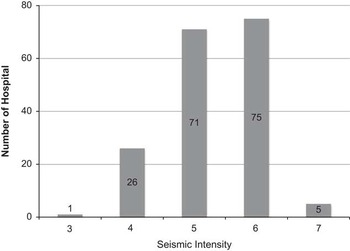
Of the 415 hospitals sent questionnaires, 213 hospitals, representing 1032 operating rooms, responded (response rate=51%). Among these hospitals, 1338 operations were scheduled on the day of the earthquake; 474 patients were undergoing some type of operation during the earthquake; and 222 scheduled operations were canceled after the earthquake. Severe seismic tremors greater than a Japan Meteorological Agency (JMA) scale 6 struck 80 hospitals (Figure 2) (Appendix 2).
Distribution of Tremors by Seismic Intensity (Japan Meteorological Agency Scale) Reported by Hospitals.

The OD staff experienced life-threatening tremors in 76 hospitals. In 96 hospitals, it was difficult for OD staff to remain standing because of the strong shaking. During the earthquake, some materials dropped from shelves in 90 hospitals and medical instruments fell in 25 hospitals. The OD wall or ceiling collapsed in 8 hospitals, which made it impossible to maintain a sterile operative field.
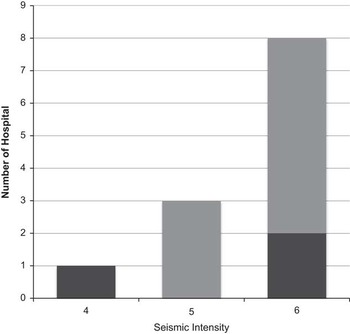
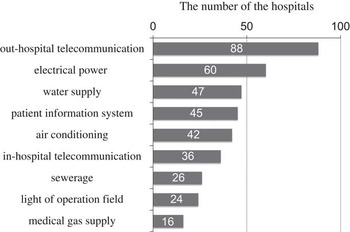
Of the 213 hospitals, 153 (71.8%) were built using a quakeproof structure or quake-absorbing structure, and 48 hospitals were not. Electrical blackouts occurred across a wide area of the Tohoku region, with 133 hospitals (63.4%) reporting the loss of power. Emergency electric power plants worked immediately in 121 of the 133 hospitals (91.0%) but failed to work at all in 12 hospitals. Three of the 12 hospitals in which the emergency electric power plant did not work were not built using a quakeproof structure; however, 9 of these hospitals were constructed using a quakeproof structure (Figure 3). The distribution of ODs with nonstructural damage is shown in Figure 4.
Seismic Intensity and Electrical Power Loss in Hospitals. In 12 hospitals, the emergency electric power plant did not work. Black bars indicate hospitals built with non-quakeproof structures; gray bars, hospitals built with quakeproof structures.

Distribution of Operating Departments With Nonstructural Damage.

Although surgeons found it difficult to continue operations during the earthquake in 102 hospitals (48%), they did complete them. However, some operations were cancelled partway through in 17 hospitals. Multivariate analysis revealed that the tremors and subsequent blackouts (OR 79.3 and 110.5, respectively; P < .01) were independent risk factors for difficulty in continuing operations (Table). A quakeproof structure was not a risk factor. The malfunction of equipment (OR 7.43, P = .03) was identified as a risk factor for canceling elective operations after the earthquake (Table).
Analysis of Earthquake Effect on Hospital Operations and Operating Rooms

Some difficulties in performing routine operations in the days after the earthquake were reported in 154 hospitals. Routine activities in the OD were particularly impossible in all hospitals located in Miyagi and Fukushima prefectures, which underwent severe shaking by the earthquake. In 96 hospitals, medical product supplies for surgical procedures were deficient. The supplies were lacking predominantly in areas that were highly damaged by the earthquake and tsunami, such as Aomori, Akita, Yamagata, and Ibaraki prefectures. Univariate analysis showed that significant factors for disruption of routine operations after the earthquake were characterized by damage to out-of-hospital telecommunication, high IDS, seismic intensity, and disruption of electrical power and air conditioning. Multivariate analysis disclosed that damage to out-of-hospital telecommunication (OR 0.46, P = .04) was a risk factor for disruption of routine operations after the earthquake (Table). Correlation between the JMA scale and the IDS were also significant.
Our findings showed that 129 hospitals had a disaster prevention manual, while 75 hospitals did not. Among the hospitals that had a manual, only 41% (53 hospitals) reported that it was useful at the time of the earthquake. In addition, disaster prevention training in the OD was carried out regularly in 86 hospitals. Prevention training programs were performed in 78 hospitals for fires, in 48 hospitals for earthquakes, in 14 hospitals for blackouts, and in 2 hospitals for flooding. Disaster prevention training for tsunamis was performed in only 1 hospital.
Moreover, the emergency exit in the OD was secured at the time of a disaster in 166 hospitals, while 28 hospitals reported that it was not secured. Also, members of the OD staff in 137 hospitals knew the location of the emergency exit in the OD, but OD staff members in 16 hospitals did not know the location of the emergency exit.
Discussion
Several reports have been published about the structural or nonstructural damage of hospitals and hospital evacuation after the Great East Japan Earthquake.Reference Ling, Zhou and Zhu 5 , Reference Zhang, Liu and Li 6 Even a moderate earthquake will put hospitals at risk for both immediate nonstructural damage and the later discovery of structural damage, resulting in permanent closure.Reference Schultz, Koenig and Lewis 7 Modern hospitals rely on vital equipment powered by electricity, including highly advanced intelligent technology, computerized patient information systems, and even air conditioning. Therefore, achieving an ordinary surgical environment in an electrical blackout is impossible without an emergency backup system. In addition, severe recurrent aftershocks prevent the continuation of fine surgical procedures. To our knowledge, this report represents the first description of the effect of earthquakes on surgical operations and the OD in hospitals.
Damage caused by an earthquake depends not only on the intensity of the earthquake but also on environmental factors, such as the intensity of shaking; distance from the epicenter; time of day; day of the week; landslides; fires; structural strength of hospital buildings; population; and weather.Reference Peleg, Reuveni and Stein 8 , Reference Lu-Ping, Rodriguez-Llanes and Qi 9 The time and date when an earthquake occurs are important factors for management of hospital operations. The 1994 Northridge earthquake in southern California occurred very early in the morning of a national holiday. The 1995 Great Hanshin earthquake in Kobe, Japan, took place before daybreak on a Tuesday. In contrast, the Great East Japan Earthquake occurred at 2:46 pm on a Friday. This may have been the first time in which modern hospitals in a developed country were struck by a severe earthquake in midafternoon.
Structural Risk Factors
Our survey findings demonstrated that regardless of having a quakeproof structure, some objects dropped from shelves and medical instruments fell in many hospitals struck by tremors greater than 6 on the JMA scale. Also, the OD wall or ceiling collapsed in some hospitals, making it impossible to maintain a sterile operative field. Several lessons can be learned from these findings: the casters of medical instrument tables should always be locked, unless the tables are being moved; doors of shelves in the OD should always be closed; and monitors or medical instruments on high shelves should be tightly secured at all times. During very strong shaking, an operation in process should be temporarily stopped, and the operative field covered with a sterile drape to prevent contamination. If the hospital was not built using a quakeproof structure, it is important that the entrance of the OD be open to secure an evacuation route in case the OD collapses.
Many surgeons found it difficult to continue operations during the earthquake, and operations were discontinued in 17 hospitals. An independent risk factor for canceling elective operations after the earthquake was the malfunction of equipment. Another important problem after a severe disaster was hospital logistics. Modern hospitals require various kinds of disposable medical products, drugs, hygiene materials, and implantable devices. As the supply of these goods depends on a continuous supply chain, damage to the transportation system will disrupt hospital operations. Although deficiencies of medical products in this study did not have a statistically significant effect on achievement of operations after the earthquake, shortages of surgical supplies could be disastrous in hospitals of developed countries.
Nonstructural Risk Factors
From an economic perspective, many hospitals in Japan do not keep a stock of surplus medical supplies. Usually, medical supplies are transported from warehouses by distributors, as based on hospital demand. The distribution of medical supplies in Japan can be envisioned as a hub and spoke structure. The first hub exists in the Kanto area around Tokyo, and materials are transported to the second, local hubs. In the Tohoku area, the second hub is Sendai in Miyagi prefecture. Medical supply warehouses in Sendai were damaged by the earthquake, which consequently disrupted the distribution of the supplies to the surrounding area. In addition, severe damage to harbors in the Tohoku area by the tsunami made it difficult to use oceanic routes. Although hospitals in the surrounding area must be disaster responders, problems with logistics following the Great East Japan Earthquake made this difficult, if not impossible.
Thermal and nuclear electric power plants in Sendai and Fukushima stopped immediately due to severe shaking from the Great East Japan Earthquake and subsequent inundation by the tsunami. Electrical substations were also overturned by severe shaking.Reference Fukuda, Hashimoto and Suzuki 10 As a result, a wide area of the Tohoku region suffered from a blackout for several days, and both water and gas supplies were stopped for 1 to 2 months in Sendai. The IDS for the OD and seismic intensity were significant risk factors for management of surgical operations after the earthquake. In the case of an inland earthquake, the damage to buildings and ODs will likely be more severe.Reference Fukuda, Hashimoto and Suzuki 10 In several hospitals, an emergency electrical power plant did not work, leaving ODs completely without power. It is critically important that electrical power stations be reinforced as earthquake-proof structures.
Out-of-hospital telecommunication was only identified as a risk factor for the disruption of routine operations after the earthquake by multivariate analysis. After the earthquake, landline and mobile telephones were totally disconnected for several days. The blackout also made it difficult to obtain an Internet connection. Although the only available telephones after the earthquake were satellite telephones, not many hospitals had these available at this time. Thus, it was difficult to schedule operations without being able to contact surgeons, OD staff, and office workers. Moreover, information from outside the hospital, such as the transportation of medical supplies, was unavailable because out-of-hospital telecommunications were severed.
The ODs struck by the Great East Japan Earthquake faced many problems. Therefore, training drills and preparation for disasters such as earthquakes, fires, floods, tsunamis, hurricanes, and tornados are important. In the findings of the survey, it was notable that in a country that is likely to experience natural disasters few hospitals found their existing disaster manuals useful and that some hospital OD staff did not know the location of the emergency exit in the OD. Hospitals may be both responders to and victims of disasters; therefore, simultaneous planning for disaster medical care and evacuation from damaged buildings is important.Reference Fukuda, Hashimoto and Suzuki 10
Conclusions
The Great East Japan Earthquake affected management of ODs in many areas of northeastern Japan. The severity of shaking, electrical blackouts, and malfunction of equipment were important factors in the discontinuation of operations in affected hospitals. Nonstructural damage, including blackouts, disruption to the water supply, and especially loss of out-of-hospital telecommunications affected management of the ODs. Appropriate preparation for disaster management must consider hospital logistics.
Acknowledgments
Members of the Tohoku Surgical Society and Japan Surgical Society supported the performance of the survey. Mihoko Sagawa and Eriko Arazeki assisted with data collection and input.
Appendix I. Questionnaires
The Survey Questionnaire about the damage situation of the Operation room in the Great East Japan Earthquake
Q1 – Q5:
Questions for the head doctor or the head nurse in operation room (OR)
1. How many elective operations were scheduled on March 11?
2. How many operations were undertaken when the earthquake happened at 2:46 pm on March 11?
3. How many scheduled operations (on March 11) were canceled because of the earthquake?
4. Please describe the level of shaking in the OR when the earthquake happened. Please check in the box below. (Multiple choices allowed).  □There were moments to fear of life
 □It was difficult to stand
 □Scream was heard from the staff in OR
 □Everyone in OR felt the shake and knew the major earthquake was happening somewhere
 □Some of the OR staff felt the shake but the routine work in OR was not interfered
 □Most of the OR staff did not recognize the shake
 □Others (Please describe)
5. What happened in the OR when the earthquake happened? Please check in the box below. (Multiple choices allowed).
 □There was a blackout but emergency power supply was available
 □There was a blackout but emergency power supply was NOT available
 □Equipment and books fell from the shelves
 □Medical equipment, e.g. IV drip stands, fell down
 □The walls in the OR fell down or the ceiling dropped
 □The walls in the OR cracked
 □The staff in the OR got injured
 □Others (Please describe)
Q6-Q8
Questions for the surgeons who were performing operation when the earthquake happened
6. Did you feel the difficulty continuing the surgical procedure?
 Yes
 No
 Do not know
7. If your answer is YES to Q6, what was the obstacle to continuing the operation? (Multiple choices allowed)
□ □Shake
□ □Power outage
□ □Structural damage in the OR
□ □Contamination in the field of operation
□ □Problem with the medical equipment (including anesthesia apparatus)
□ □Sense of fear of the OR staff
□ □Anxiety worrying about the safety of OR staff's family
□ □Anxiety of the patients
□ □Others (Please describe)
8. For those of you who were performing the operation during the earthquake, what did you do when the earthquake stroked? (Multiple choices allowed)
 □Continued operation to the end
 □Stopped operation
 □Stopped and re-operated on patient at the same place later
 □Stopped operation. And the patient was transferred and operated later in the other hospital
 Others (Please describe)
Q9-Q20
Questions for all the hospitals
9. Which of the following infrastructure in the OR did the earthquake damage? (Multiple choices allowed)
 □Shadowless light
 □Electricity
 □Water supply
 □Sewerage
 □Medical gases (oxygen, compressed air, suction)
 □Air conditioning
 □In-hospital telecommunication system
 □Out of hospital telecommunication system
 □Patient information system
 □Others (Please describe)
10. How did you deal with operations that were scheduled from the days after the earthquake?
 □Operations were performed as scheduled
 □Only operations that needed to be performed urgently were performed
 □Cancelled all the scheduled operations and only emergency operations were performed
 □Saved an OR for emergency operations for patients coming from outside
 □Operations could not be carried out because of the structural damage
 □Patients, who needed to be surgically treated immediately, were transferred to the other hospitals in the non-affected area
 □Others (Please describe)
11. Did you have a shortage of surgical supplies after the earthquake?
 Yes
 No
 Do not know
12. If your answer is YES to Q11, please specify the item that was short
 □Specific medical equipment
 □Disposable materials (e.g. suture, surgical drape)
 □Surgical gowns, masks etc.
 □Blood products
 □Anesthetic drugs
 Others (Please describe)
13. In order to resume operations, did you have meetings with the staff members in your hospital?
 Yes
 No
 Each department decided their own operation schedule
 Others (Please describe)
14. Is your OR equipped with the manual for handling disaster?
 Yes
 No
 Do not know
15. If your answer is YES to Q14, was the manual useful at the time of earthquake?
 Yes
 No
 Neither
 Do not know
16. In your OR, is the disaster prevention training carried out regularly?
 Yes
 No
 Do not know
17. If your answer is YES to Q16, what type of training program do you have? (Multiple choices allowed)
 □Earthquake
 □Fire
 □Blackout
 □Flood
 □Tsunami
 □Typhoon
 □Others (Please specify)
18. Is the emergency exit in your OR secured at the time of disaster?
 Yes
 No
 Do not know
19. Does everyone in the OR know where the emergency exit is?
 Yes
 No
 Do not know
20. How did you transport patients from OR to their room in the ward at the time of disaster?
 □Usual manner
 □Used a stretcher because the elevator was not in use
 □Had to wait for a while in OR
 □Others (Please describe)
21. If you have additional comments regarding the difficulty that you faced with in OR during the disaster, please describe (e.g. food supply for the staff, commute etc.)
Questions for the Chief of Secretariat
1. Where is your hospital located? (Please check in the box below)
 □Fukushima
 □Miyagi
 □Iwate
 □Aomori
 □Yamagata
 □Akita
 □Chiba
 □Ibaragi
 □Tochigi
 □Gunma
2. How many stories does your hospital building have?
3. How many beds do you have in your hospital?
4. Which floor is the OR located?
5. How many operation rooms do you have?
6. Is your OR structured with seismic force-resisting or is it seismically isolated?
 □Yes
 □No
 □Do not know
7. What was the level of seismic intensity in your area? Please check in the box below. And if you do not know, please provide the name of your city.
□0 □1 □2 □3 □4 □5 □6 □7
□Do not know → What is the name of your city?
8. Is your hospital equipped with disaster prevention manual?
 □Yes
 □No
 □Do not know
9. Was the prevention manual useful at the time of earthquake?
 □Yes
 □No
 □Do not know
10. Which department is in charge of crisis management?
 □Disaster prevention committee
 □Medical safety promotion office
 □Administration office
 □Crisis management committee
 □Headquarters for disaster control
 □Other organizations that are created in case of emergency
11. Who calls the above organization?
 □Manager or the chairman
 □President
 □Chief of Secretariat
 □Head of administration and self-government
 □Others
12. Was the above committee effectively functioned during the disaster?
 □Yes, it was very effective
 □Somewhat effective
 □It was not effective at all
If you have other comments on hospital management during the earthquake, please share your comments.
Appendix II
Relationship between JMA scale and Modified Mercalli intensity scale.

From: U.S. Geological Survey homepage http://earthquake.usgs.gov/learn/topics/mercalli.php