Introduction
One of the sources of writing in the Near East was recording systems – small objects with geometric shapes that served to support the memory of calculations associated with mutual obligations between people. Recording systems, however, shed light on the early stages of mathematical cognition; in brief, the source of writing in the Near East was accounting (Nissen Reference Nissen1988, 85–89; Schmandt–Besserat Reference Schmandt-Besserat1978; Reference Schmandt-Besserat1992).
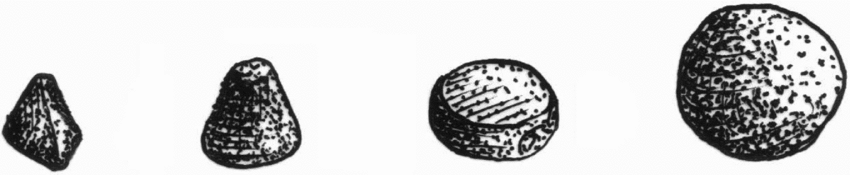
It has been demonstrated that tokens were found even at some early pre-pottery Neolithic sites geographically connected with areas of wild crops. The oldest examples date from 9000–8000 B.C. from five sites in Syria and Iran, and soon after they spread over almost all of the Near East (Lieberman Reference Lieberman1980; Schmandt-Besserat Reference Schmandt-Besserat1982; Reference Schmandt-Besserat1992). Perhaps at the beginning there were only ten basic shapes which came in different sizes. These shapes survived in an almost unchanged state for almost 4,000 years as they were still used in the fourth millennium B.C. (figure 1). These systems met the needs of calculating and memorizing a greater number of tasks and resources connected with farming activities and the household economy. It seems likely that this new phenomenon was connected in some way with developing evidence for social inequality.
Early Neolithic tokens from the Near East (drawing by Dobrawa Jaracz).

Along with the development of farming, settlements became larger. In its early stages (c.9000 B.C.), the settlement at Mureybet was mostly centered on a hunter-gatherer economy, and no tokens have so far been found dating to that period. At that time the settlement covered an area of approximately half a hectare. However, in its third stage (c.8000 B.C.), in which it grew to a village covering about three hectares, the first tokens were found (Schmandt-Besserat Reference Schmandt-Besserat1992; Reference Schmandt-Besserat2007). In other Near Eastern Neolithic sites, similar relationships have been noted (Jasim and Oates Reference Jasim and Oates1986). In Tepe Asiab, Ganj Dareh, Tell Aswad and Cheikh Hassan the appearance of tokens was always connected with traces of farming, more specifically the cultivation of crops (Smith Reference Smith1978).
Tokens and counting
Tokens of different shapes used to record different goods are a sign of concrete counting, the most archaic technique, which lasted for a very long time and is even used to this day in far corners of the world (Diakonof Reference Diakonof1983). What does such a system look like? It is quite hard to imagine. Concrete counting is characterized by using different sets of numerals, so-called digits, in order to count different things. On the language level, this system was probably quite limited; therefore it was supported by tokens. Some relics of the system have survived to this day in the form of everyday expressions, when we use terms such as twins, triplets, quadruplets or solo, duet, trio, quartet. So the word ‘triplet’ represents the number 3 as well as three children newborn to the same mother, although the word cannot be separated from its meanings. A quartet is a way to describe a musical group comprising four musicians. As Barrow, a mathematician, suggests, we only need to acknowledge that this was the way counting was performed in the beginning (Barrow Reference Barrow1999). Similarly, in the case of tokens, one oval token meant one jug of olive oil, not allowing the possibility of separating the jug and the oil. As these two pieces of information could not be separated from each other, the value was expressed in a one-to-one correspondence.
Near Eastern tokens are extremely important for determining the evolution of mathematical thinking as they show the whole process. It is from their example that we may trace the history of the development of mathematical abstract thought. This schema may be presented as follows:
1. 8000 B.C.–3500 B.C. During this long period of time, tokens were used in concrete counting systems. Each category of objects required a special type of token, e.g. ovoids represented jugs of olive oil, while cones represented measures of grain. In this period the concept of number did not exist without a connection to the object. We may perceive tokens as a metaphorization of counting on fingers, but still they did not represent numbers.
2. 4000 B.C.–3100 B.C. Marks imprinted on envelopes and the first clay tablets were still used in one-to-one correspondence and this is evidence of a strong connection between an object and the concept of number. Hence concrete counting dominated. In the same period the existence of two methods of using tokens has been noted. The first one was based on enclosing them in clay envelopes. The second was threading them on a string like bead necklaces. Both methods were used to identify efficiently the transactions or arrangements which were additionally confirmed by a special stamp imprinted on an envelope or added to a string with tokens.
3. It was probably around 3100 B.C. in the ancient city of Uruk that digits were invented. The division of the concept of number depending on the type of the objects counted probably occurred among specialized administrators/accountants. Each of the concepts was represented by a different sign: the types of good were represented by pictogram engravings and the numbers of units were represented by symbols, which were digits. For the first time symbols began to represent numbers in an abstract way. Digits were created as a result of a change in the meaning of symbols which were used earlier for marking measures of grain and animals – most often by the use of tokens. Hence this was an innovation based on making a conceptual turn in understanding mathematical rules. The likelihood that this innovation was created among specialists may mean that the rest of society was intellectually separated from this development.
4. 3100 B.C.–2500 B.C. In this period archaic methods of counting were diminishing in some areas. There is evidence that the transition from concrete counting to abstract counting lasted for several centuries (Schmandt-Besserat Reference Schmandt-Besserat2007).
Theoretical background
The model presented by Schmandt-Besserat can be usefully combined with Peter Damerow's (Reference Damerow1999) theoretical approach. Damerow summarized the development of numeracy from the perspective of cognitive evolution in the following stages:
Stage 0: pre-arithmetical quantification
Stage 1: proto-arithmetic
Stage 2: symbol-based arithmetic
Stage 2a: level of context-dependent symbol systems
Stage 2b: level of abstract symbol systems
Stage 3: theoretical arithmetic
Stage 3a: level of deduction in natural language
Stage 3b: level of formal deduction
The theoretical model of the historical development of logico-mathematical thought presented by Damerow is based on the findings of the developmental psychology of Piaget. Instead of accepting Piaget's psychologically defined developmental stages, however, the stages of historical development were redefined in a specific, historical manner. Damerow's model is essentially based on two assumptions. First, it is assumed, following Piaget's genetic epistemology, that logico-mathematical concepts are abstracted not directly from the objects of cognition, but from the coordination of the actions that they are applied to and by which they are somehow transformed. According to this, the emergence of mental operations of mathematical thought is based on the internalization of real actions. Second, differing from Piaget's theory, it is presumed that the basic structures of mathematical thought are not determined epigenetically, but are developed by the individual growing up in confrontation with culture-specific challenges and constraints under which systems of action have to be internalized. The challenges are embodied by the material means of goal-oriented or symbolic actions that are shared external representations of the logico-mathematical structures. Thus, according to this assumption, the cognitive structures according to which logico-mathematical competence is defined are, in ontogenesis, not construed independently from processes of socialization, but have as their constitutive condition the co-construction of cognitive structures by means of interaction and communication.
In this way, Damerow presents a model of the historical development of arithmetical thought, in which four distinguishable phases in the history of the number concept can be defined:
1. Before the development of the concept of number, there must have been a period characterized by the complete lack of arithmetical activities in the above-defined sense.
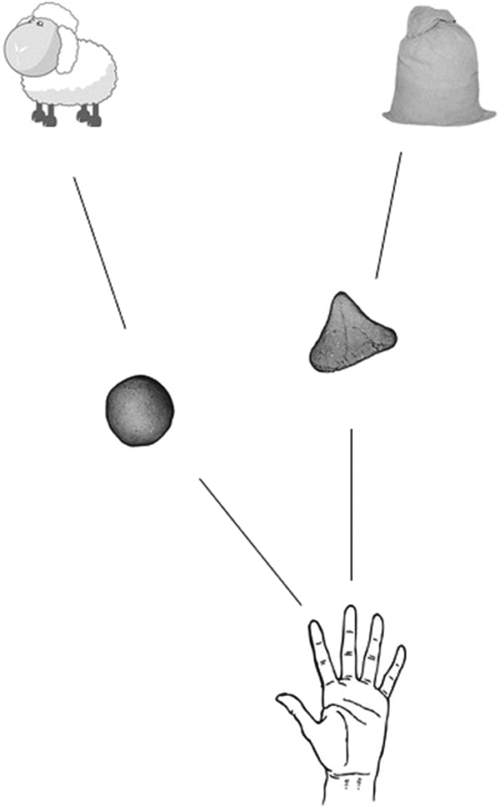
2. In the first stage of the development of the concept of number, the real actions of fundamental arithmetical activities were created and became part of culturally transmitted techniques. Their symbolic representation resulted in first-order representations of these arithmetical activities in the form of concrete tools for the control of quantities (figure 2).
3. A second stage of development was reached when cognitive constructs that originated from the reflection of the real and symbolic actions of the first stage were represented by symbols, and culturally transmitted by means of those representations. With regard to the original arithmetical activities, the resulting symbol systems were thus second-order representations. The transformations performed with the symbols no longer represented the fundamental arithmetical activities by means of real objects directly; rather, they now represented mental operations and the concepts are reflectively abstracted from them.
4. A third stage of development was finally achieved by coding, in written language, these concepts and the mental operations that constituted them, i.e. they were submitted to formal rules for logical transformation in a form specified in writing (Damerow Reference Damerow1999).
A model of early accounting in one-to-one correspondence. The proto-mathematical concepts of tokens were internalized between the human body and the elements of reality.
All systems of counting were originally first-order representations. First-order external representations (or, briefly, first-order representations) are material representations of real objects by symbols or by models composed of symbols and rules of transformation, with which essentially the same actions can be performed as with the real objects themselves. For example, counters and similar symbolic counting aids that can be simultaneously configured in space are first-order representations of the cardinal structure of sets of objects. When they are linked with real objects in one-to-one correspondences, for example with the animals of a herd of cattle, the same cardinal transformations (increase, decrease, joining, distribution) can be performed with them on a symbolic level as can occur directly with the objects represented.
They mainly represented ordinal structures, as a rule by the temporal succession of a conventionally determined counting sequence. Primarily, they represented cardinal structures only insofar as, with a one-to-one correspondence of real objects with names of numbers in the process of counting, they also served in the identification of cardinal numbers. With the development of the number concept, abstract numerical qualities were attributed to their meaning, so that they became second-order representations of numbers with all their arithmetic rules; that is to say, they now also represented structures like multiplication which have no parallels in the symbolic action of counting.
Damerow states that in the historical development of cognition, the transitions from one stage of development to the next higher one can occur in two fundamentally different forms, namely either by cultural exchange or by a culture-immanent process. A determinative for defining historical stages of development in the processes of the culture-historical genesis of cognitive structures is, however, not this first form of development by cultural exchange, but rather the second form, the development of cognitive structures by culture-immanent constructions. This form of development is based on individual cognitive achievements that lead to the modification of existing representations and to the construction of new ones. These representations become part of a culture by being embedded in existing paths of tradition, so that they can be integrated into the process of reproduction in this culture (Damerow Reference Damerow1999).
To summarize, we can generally outline the development of mathematical abilities as the transformation from the concrete to the abstract. This is not enough said, however. There was material culture involved in this process that determined the sort of communication (exchange of goods and information) between people. In fact I think that the sphere of material production, which accelerated the mathematical development process, has been until now a somewhat unappreciated and inadequately discussed sphere of human activity. The thesis stating that the development of mathematics would be impossible without the intensification of production, which is generally present in the Neolithic period, is even more interesting if we are aware of the above statement. The relationship between people and their own made creations became so complicated that it was necessary to create a new means of expression, a new language and vocabulary which would describe the relationship between people and objects, including the metaphoric view of the world of objects (Lakoff and Núñez Reference Lakoff and Núñez2000).
The path of the development of recording systems in Near Eastern farming communities shows the serious influence of material culture in creating the concept of number in human culture. This story underlines the process of going from material counters to immaterial symbols imprinted in clay, from manipulating material objects to manipulating symbols, and finally from a specific system of counting to an abstract concept of number. Moreover, it appears that the system of clay tokens was somewhat like outer scaffolding, yet a dynamic and constructive one for creating mathematical competence (Malafouris Reference Malafouris, Morley and Renfrew2010). As a consequence, the proto-mathematical concepts of tokens were internalized between the human body and elements of reality which were the subject of records (figure 2). Tokens, which were not yet numbers sensu stricto, prepared human minds for the introduction of the concept of number. They were a visualization and manipulation of numerical concepts. In this way, the process of counting became full of social meaning and social relations were filled with mathematical rules. Elements of the material world which took part in social relations were required for humans to learn its rules. The counting process involving tokens may be seen as a specific interface between genetically based pre-arithmetic abilities, coded in the human mind and inherited from our animal ancestors, and the material world. Connecting these two elements enabled the understanding of the laws of mathematics. The use of tokens shaped and enhanced certain neural connections in the human brain.
The work of Malafouris (Reference Malafouris, Morley and Renfrew2010) supports this claim. According to him, the functional and anatomic relation may also be connected to the important role of counting on fingers in the early stages of ontogenetic development. However, these observations suggest that hand manipulations (fingers) could not have been phylogenetically sufficient for humans to acquire mathematical abilities. Moreover, the above-mentioned research also shows the limitations of the role of language in understanding the first and most basic mathematical rules. In other words, Neolithic tokens did not have to have names to function properly and to be understood; they could have been tipped, used and stored unwittingly. As Malafouris writes, objects may represent themselves, thus becoming a sort of missing link between the flexibility of the brain and the flexibility of culture. Traditional methods of description were not sufficient for the growing number of gathered objects along with increasingly complex social relations. And that is why Neolithic tokens could have driven the human mind beyond approximation (ibid., 41).
It is not difficult to guess that tokens constituted a specific extension of the human body in metaphor. Proto-mathematical concepts found their vent in the digit metaphor among almost all cultures in the early stages of perceiving numbers. Expressing numbers was performed through touching and assigning an appropriate number of digits – parts of the body (most often fingers and toes). In many languages which had only a few words representing numbers, a distinct preference for counting on fingers rather than using words, as well as the ability to operate greater numbers than the lexical dictionary would permit, can be noted (Justenson Reference Justenson, Morley and Renfrew2010). It may be said that the system of tokens was the first stage of getting rid of the bodily aspect and expanding the digit metaphor, which was the source of the beginnings of the basis of mathematics. Tokens did not actually represent the objects to which they corresponded on a one-to-one basis as such. They were a material link between the body and the counted object (figure 2). Tokens are an obvious illustration of the object-collection metaphor, which Lakoff and Núñez (Reference Lakoff and Núñez2000) describe as one of the most important metaphors of human cognition. The context of the counted object disappeared when tokens transformed into symbols imprinted in clay appearing along with other goods, and the bodily aspect crumbled with it, thus opening the way to full number abstraction.
Finally, according to a model proposed some time ago, changes in the operating mechanisms of communication and exchange systems, which include counting and recording, can be seen as being evolutionary (Dzbyński Reference Dzbyński2008a). Human culture in its early stages relied for a very long time on the narrative model of communication and exchange in which the quality and value of each material element of culture was described in the course of narration and storytelling. Then, in the Neolithic period we can assume the next narrative-metrological stage when the emphasis in the recognition of some objects shifted to their constitutive properties, such as outer dimensions or shape. The manipulation of these properties gained in significance as Neolithic and Eneolithic socio-economic structures became increasingly complex, thanks to their integration into exchange systems. Important information could in this way be communicated in a more rationalized way between groups and individuals, thus promoting social complexity (ibid., 231). A very interesting example of the two features of objects (dimensions and shape) becoming part of a single integral communication system is provided by Eneolithic communities in the Carpathian Basin exchanging macrolithic blades (ibid., 107–41; Dzbyński Reference Dzbyński2011). And so this is the right moment to consider European developments at this time.
What about Europe?
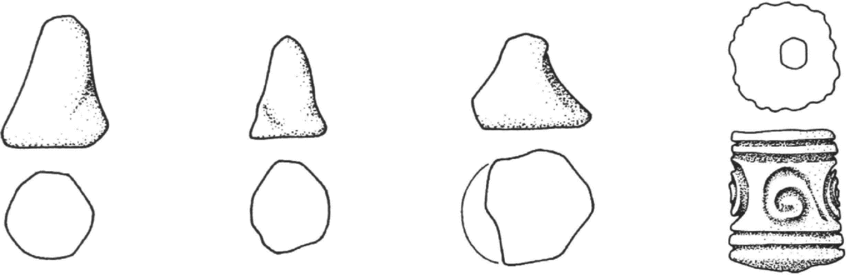
Among many other things adopted from the Near East, the European Neolithic also received tokens (figure 3). But this notion alone would lead to a conclusion of no substantial differences between these areas. Did these small objects play the same role in Europe as they did in their homeland?
European Neolithic tokens (after Budja Reference Budja1998).
The appearance of European tokens is limited to south-east Europe, areas culturally connected with direct colonization from Anatolia. They are not numerous, however, in the most important stages of the Neolithic period. Only about a dozen pieces have been found in the early phases of such sites as Argissa, Nesosis, Sesklo and Pyrasos. They appeared sometime later, for example in layers dated from 6800 to 5800 B.C., in Thessaly, where they can be identified with the Sesklo culture. At this stage the development of settlements occurred, houses became larger, and megaron-shaped constructions with two or three rooms appeared. The size of the settlements increased to two hectares. At first sight it seems that the introduction of tokens to south-east Europe was connected with the spread of Neolithic people. However, they did not appear at the stage of the spread of Neolithic culture, at the stage of experimenting in the new environment, but only during the stage of consolidation and rise (Budja Reference Budja1998). The context of European discoveries is also different and deviates from that of those made in the Near East. Budja points to three examples (Nea Nikomedea, Rakitovo and Donja Branjevina) in which European tokens appeared in almost identical sets: anthropomorphic figures, small clay altars and zoomorphic plates (ibid., 229). This may suggest that European counting tokens were strongly connected to ceremonial functions. Chapman probably would wish to share this interpretation. In his book about the fragmentation of objects in prehistoric Europe, he states that the fragmentation of anthropomorphic figures was related to the practice of binding human relations (including relations with ancestors) by material means – the tokens of significance – such as, inter alia, anthropomorphic figures, their fragments and other objects (Chapman Reference Chapman2000).
In northern Europe, no material evidence for counting/measuring has been identified to date, but this fact is not, in my opinion, connected with the lack thereof. Rather we should focus on reinterpretation of some artefacts. I think that in Europe we should rather search for another material background of cognitive development of mathematical abilities. In the Near East the object-collection metaphor, represented by recording systems in the form of small tokens, was determined by social conditions of living in fast-growing settlements where mutual obligations concerning agricultural products were a priority. In Europe, on the other hand, the impact of long-lasting Mesolithic traditions must be included. Taking into consideration those differences and the proposed theoretical background outlined above we can surely ask where to search for the common path of cognitive development of mathematics. The answer is, in my opinion, technology, and first of all metallurgy. Therefore we should focus on some key examples from one of the metallurgical production centres in the Eneolithic.
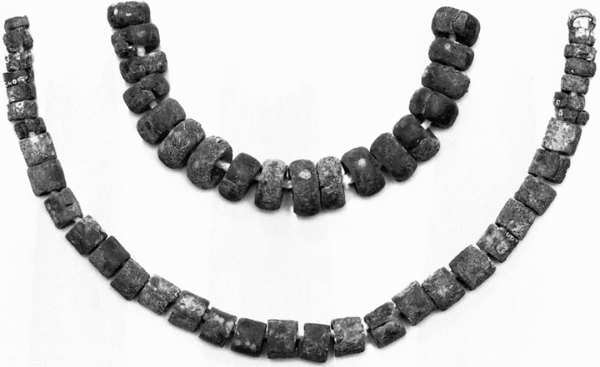
The original discovery I will discuss here was made in 1967 in the course of excavations of the Cortaillod culture settlement at Seeberg, Burgäschisee-Süd (Sangmeister and Strahm Reference Sangmeister and Strahm1974), where two strings of copper beads were recovered from a shallow pit close to one of the dwelling structures. The leather strings had small knots on both ends preventing the beads from slipping off. All the beads were well preserved, displaying various degrees of oxidation, suggesting that they had not always been together as two strings (Ottaway and Strahm Reference Ottaway and Strahm1975, 311). It was an interesting and provoking discovery indeed. Beads of this type are usually found singly in the settlements of the Cortaillod culture in Switzerland.
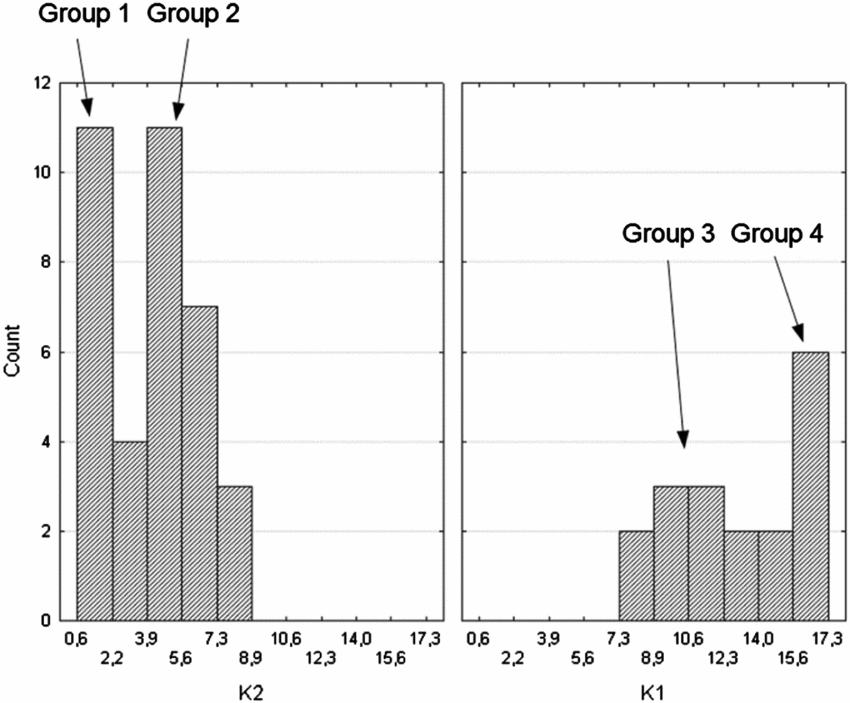
The two strings, designated K1 and K2, are composed of 54 beads (figure 4) carrying wear traces, although their interpretation as ornaments has already been rejected by their excavators (Sangmeister and Strahm Reference Sangmeister and Strahm1974). Ottaway and Strahm (Reference Ottaway and Strahm1975) stressed also two aspects of the find. First, the numbers of beads on the two strings represent a straightforward mathematical proportion (36 + 18). Second, the two strings clearly differ in terms of bead weights, there being twice as many light beads as there are heavy beads (figure 5). String K2 consists of 36 beads weighing between 0.6 gram and 8.8 grams, while the shorter string K1 consists of 18 beads weighing 8.1–17.3 grams.
The copper beads from Seeberg, Burgäschisee-Süd (after Strahm Reference Strahm1994).
Distribution of the weight variable for beads recovered from Seeberg, Burgäschisee-Süd. K2: longer string of 36 beads; K1: shorter string of 18 beads.
The different weights and shapes of the beads also rule out the possibility that they were objects of a standardized value. Sangmeister and Strahm (Reference Sangmeister and Strahm1974, 255) distinguished six types of bead. Typological and metallographic analyses of the beads would suggest that they originate from different metal workshops (different types and chemical compositions) but from a single source. The analyses show the Seeberg finds to be very much like Mondsee-culture copper objects (Strahm Reference Strahm1994, 20).
Some other very important insights have also been made. Looking closely at the method of production of the beads it was found that they were made from three or four metal bars. Bars were divided into a certain number of beads and folded, making them easier to transport. In this way, as Sangmeister and Strahm (Reference Sangmeister and Strahm1974) suggested, we are dealing with an early form of convenient exchange medium. Both the beads and their output shape were in the form of bars, which were then manipulated, as we shall see below, in a rather complicated way. In consequence, Ottaway and Strahm (Reference Ottaway and Strahm1975) proposed an interpretation according to which the beads from Seeberg were a special-purpose currency. The most important question, though, remained unanswered: since we are dealing with something like money, how would it be used, valued and counted?
Analyses
It turns out, however, that the beads from Seeberg, Burgäschisee-Süd, only seemingly lack standardization. A more detailed analysis revealed a hitherto overlooked characteristic of this deposit, namely that the bead weight distributions for both the strings are bimodal, which is to say that two weight categories can be distinguished for each of the strings, viz. 0.7–3.0 grams and 3.0–7.0 grams for string K2, and 8.0–14.0 grams and 14.0–17.0 grams for string K1. Not all of these weight categories can be distinguished with equal precision, this being probably due in part to post-depositional phenomena and the already mentioned differences in wear degree (which in turn probably result from the different ‘biographies’ of the various beads). All this notwithstanding, the different weight categories can be discerned even today without any serious problems (cf. Dzbyński Reference Dzbyński2008b).
Although we are dealing with approximate figures (for a detailed analysis see Dzbyński Reference Dzbyński2014), it is clear that the entire range of variability has a common denominator – approximately5.5 grams (Group 2). We have groups of beads which double and triple that value (Groups 3 and 4 respectively). The least distinct Group 1 should represent half the common denominator and the fact that it fails to fit the suggested pattern may be due to various reasons, most probably to wear or to post-depositional processes which was most severe in the case of the smallest beads. Therefore what we see in the Seeberg beads is a simple metrological structure involving manipulations of the basic value of approximately 5.5 grams. We must not be discouraged by the fact that by today's standards these are not precisely defined weight categories. Given the rules of ancient metrology, measurement units may be identified only according to their distribution, which should be close to normal for the individual variable peaks (Broadbent Reference Broadbent1955, 46). We know why some of the distributions of ancient variables differ from the classical bell curves (Petruso Reference Petruso1992, 70). We also have mathematical models which provide good descriptions of these phenomena (Broadbent Reference Broadbent1955; Dzbyński Reference Dzbyński2004).
The deposit from Seeberg remained isolated for a long time and therefore for some archaeologists the hypothesis of its metrological structure seemed unbelievable. It should be noted, however, that beads of this type are a fairly common phenomenon in the Cortaillod culture in Switzerland. Unfortunately, most of them were found without an explicit context, which makes a comprehensive analysis harder. But in 2008 a breakthrough discovery was made (Lefranc et al. Reference Lefranc, Arbogast, Chenal, Clerc, Thomas, Wuttmann, Lefranc, Chenal and Arbogast2009). During excavations in Colmar, a site in Alsace, an Eneolithic grave was encountered, equipped with copper beads of the type characteristic of the Cortaillod culture. The distribution of these objects in the tomb, as we shall see below, finally removed doubts as to how the beads were valued (figure 6).
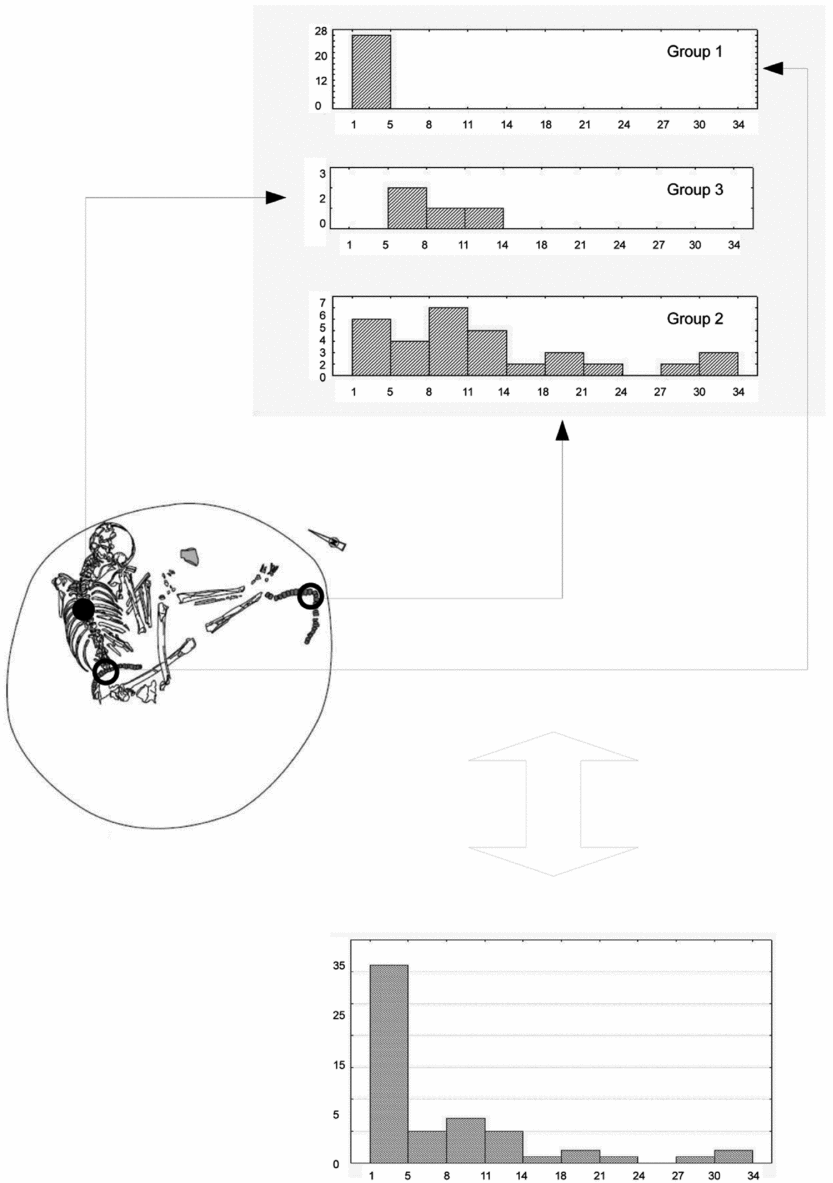
The placement and the analysis of copper beads in Colmar. Certain values (revealing weight categories) have been attached to particular parts of the body (after Dzbyński Reference Dzbyński2014; with kind permission from Philippe Lefranc).
A necklace containing 25 beads was found near the foot of the deceased. The second necklace was found on his waist, while the third group of four beads was discovered under the skeleton, at the chest level. The placement of these three groups suggests that the beads were fastened to strings, like those of Seeberg, and in some way attached to the body. The excavators expressed the opinion that this burial, both in its unusual arrangement, which may have been manipulated, and in the presence of 400 grams of copper in the form of 56 beads, must be assumed as exceptional (ibid.).
In the diagrams we can see histograms of their weight in three groups. Group 1 contains the lightest pieces, which encircled the body of the deceased. Their weight is low and varies between 1 and 4 grams. The light weight also explains the small dispersion of the variable where the beads seem to have an equal weight. Another group (2) is much more diffuse and contains the whole spectrum of the variable. This group was placed by the feet of the deceased. The third group (3) from the chest contains four pieces ranging from 6 to more than 12 grams. Comparing this group with the histogram of the whole variable in the bottom we can easily discover the following. The deceased was girdled with beads of the first type-weight group (1). On the chest, there were four beads of the second type-weight group (3), while the third group of beads, containing the whole spectrum of the variable, was placed by his feet (2).
Equally important is the observation that the weight distribution of the beads from Colmar is not the same as that of the beads from Seeberg. Does this not disqualify the entire hypothesis? Not at all. In both cases a very similar amount of material has been used (382 grams in Seeberg and 400 grams in Colmar), but in Colmar the weight spectrum of the beads is almost twice as large, as shown by the three heaviest pieces weighing about 30 grams, whereas the heaviest pieces from Seeberg weighed only about 16 grams. This means that in the case of Colmar the copper rod was differently manipulated in order to prepare the beads. In both deposits, however, there are four metrological groups which can be observed.
Discussion
Why am I writing about quasi-weight categories? The beads can be perceived and analysed through their weight today, but they were, most probably, not perceived this way by their makers and users. The beads were made from a copper rod which was divided into specific fragments. This rod was subject to malleable processing, the final effects being characteristic small bars, which were subsequently knotted to form a bead. In other words the production of such objects was a case of the appropriate manipulation of a metal rod by following simple rules of mathematical proportion.
The beads from Seeberg and Colmar present an early stage in the measuring and counting of metal in Europe. This stage was very strange indeed. The metal was not weighed yet but measured according to a line measure – a measuring stick. Hence, as far as the Cortaillod beads are concerned, we are faced with material evidence of an ongoing discourse connected with the value of metal in Eneolithic societies. More specifically they are a conceptual bond of old Neolithic concepts and vocabularies with the newly developing concepts and vocabularies of the Metal Age. The formed sticks and bars are a realization of communication processes which also took place in the case of flint objects, as I have argued elsewhere (Dzbyński Reference Dzbyński2011).
Furthermore, looking at the basic statement made in the theoretical section above, we can see some kind of equivalency, roughly speaking, to the Near Eastern recording systems: the beads are first-order representations. That is why these beads are so important. They are something like the Rosetta stone for our divagations. They merge the traditional approach of more archaic and less abstract measuring methods, which were made by using the idea of the measuring stick, and the new one, based on taking advantage of the malleability of metal to make a specific number of beads.
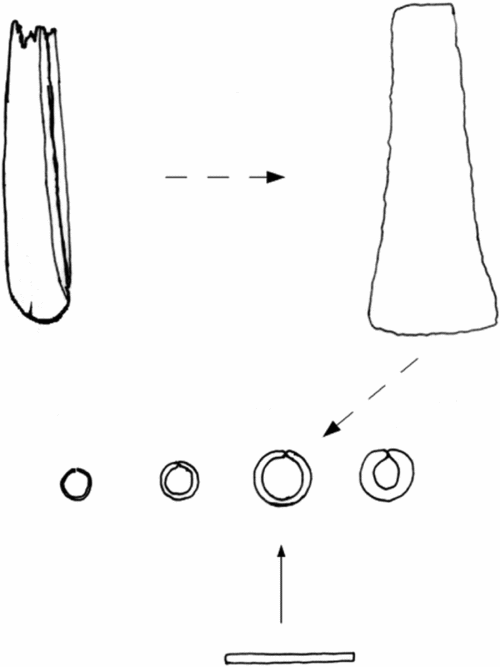
In this respect, as the researchers at the Colmar site noticed, both necklaces – in Seeberg and in Colmar – bear a very similar amount of metal, which is about 400 grams (Lefranc et al. Reference Lefranc, Arbogast, Chenal, Hildbrand, Merkl, Strahm, van Willingen and Wörle2012). This weight is quite typical, more or less, of course, for an average, non-broken copper axe of this period in the Alpine region. Taking the notion as well as the fact that copper axes are the most popular copper artefact within the European Eneolithic/Copper Age, we are confronted with a situation where a copper axe could be ‘counted’. It is worth noting, however, that this ‘counting’ was still based on a linear measure and not on the concept of weight. But we should not forget that we are dealing with a period of time where copper only gradually came into use. This situation is all the more striking when we recall the wooden axes that are found in the Alpine region and interpreted as models. For Strahm (Reference Strahm1994) the truly remarkable uniformity of these tools in the Alpine region is intriguing. He believes that their form was to a large extent determined by the idea of the key dimensions that an axe should have. The wooden models seem to confirm the assumption that a copper axe was not perceived through the weight concept yet. Nevertheless it could be, theoretically, measured/counted, and perceived in a piggy-bank manner with the help of copper beads (figure 7).
Counting/measuring of metal in Copper Age Europe was based on a linear measure and not on the concept of weight (drawing by A. Dzbyński; upper part after Strahm Reference Strahm1994).
When considering copper axes, their fragmentation – a phenomenon that has been analysed by researchers – should be not disregarded. Bearing in mind Klassen's (Reference Klassen2001) interpretations of the ritual destruction of copper axes in southern Scandinavia in the Eneolithic, we can reappraise such actions in the theoretical model sketched above. Klassen himself gives examples of axes which were not so much destroyed as fragmented and of traces on the axe fragments which he sees as suggestive of a form of ‘payment’. How are we to understand this? Klassen refers to discoveries of numerous axes in settlements of the Altheim and Mondsee cultures which also yielded considerable quantities of copper axe fragments (ibid., 278). Although Klassen interprets these mainly as ritual destruction, the practice of fragmenting axes may have acquired a new significance in the context of narrative-metrological methods of communication and exchange in which fragmentation became a form of communication already partly unburdened of narrative (mythological–ritual) contents (Dzbyński Reference Dzbyński2008a, 238). It would be altogether natural if fragmentation were performed as part of some ritual acts for, as we know, even today's commercial transactions are not devoid of ritualistic elements. Nevertheless those fragments could have been also small portions of metal to be perceived by not very abstract measures.
Archaeological materials probably contain much more evidence of fragmentation of copper axes of various kinds than may be suggested by the small numbers of recovered fragments of axe cutting edges or heads. There are at least as many copper axes which were broken in half or which had other fragments broken off. Most of the broken-off small axes were subsequently processed to smooth out the irregularities arising in the course of fragmentation. We know of axes bearing signs in the form of dots or dashes, with some even given a kind of ribbed design halfway down their length. A very telling example is a copper axe from Manhardsgegend in Austria which was divided into three tightly fitting fragments (Mayer Reference Mayer1977, Taf. 12).
Taken together, the fragmentation processes (apart from the ritual-destruction hypothesis) and the evolution of copper axes could illustrate an increasingly rationalized attitude toward metal. Over time these implements clearly acquired the form (and probably also the function) of standard-size bars of copper as raw material. The peak of this transition is represented by axe-shaped bars of the Vradiste, Salzburg-Reinberg and Niederosterwitz types dated to the Late Neolithic. Mayer (ibid., 157–62) published one such bar which was snapped exactly in half, suggestive of the earlier fragmentation traditions. However, more than 90 per cent of the known axe-shaped bars are already standardized forms of copper material functioning in different communicative and exchange systems. Their weight became a standardized measure of the raw material, just as in the case of the slightly younger ring bars (Lenerz-de Wilde Reference Lenerz-de Wilde1995), which means that the Vradiste, Salzburg-Reinberg and Niederosterwitz axes were already perceived also by their weight.
Fragmented axes are not numerous, however. In regions where the production of copper took place, 10–30 per cent of axes bear traces of fragmentation. Equally we can ask whether enough beads of the Cortaillod type have been found so far. In both cases it depends on what we decide to be ‘enough’. As for the beads, the two most informative findings are Seeberg, Burgäschisee-Süd and Colmar, both containing exactly 110 pieces, each of which has been described in this text. Both were found in the course of archaeological investigations on a professional level, and both within a context that allowed a detailed analysis. There are about 60 other beads, found mostly in the 19th century or during small archaeological excavations for which no contextual information exists. From a later period there are copper beads of the Vinelz type, of which about 70 pieces are known (Löffler Reference Löffler2010). They differ a little in form but were made by the same means as their predecessors, and were found in the same archaeological layers. One can assume that 230 beads are a scarce basis for such far-reaching speculations but one can also say quite the opposite.
There are not only beads, though, that should be taken into consideration in future research to make the claim presented more credible or to re-examine it. One characteristic feature of the sheet and wire industries of the later Copper Age is artefacts that, actually, fit well into this argument.
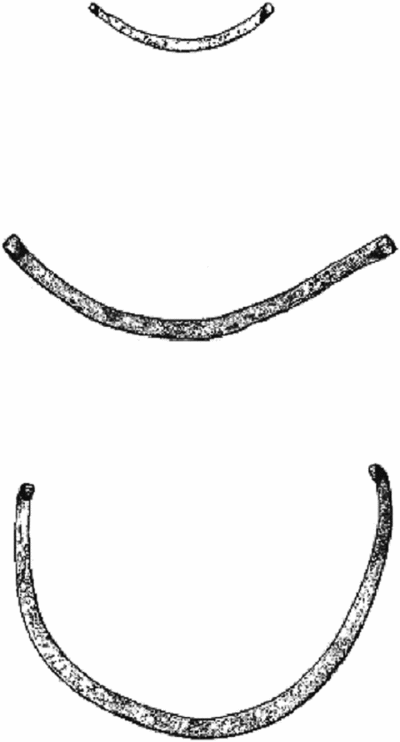
Some copper finds point to a particular method of measuring early metal artefacts. Let us begin with the Baden material where we find the copper rings mentioned by Lenerz-de Wilde as being the model for later bronze ring bars (Lenerz-de Wilde Reference Lenerz-de Wilde1995, 298). A couple of copper rings of this sort were placed in one grave in Leobersdorf, one as a whole ring and the other as a half (Sachße Reference Sachße2010, Taf. 86). Graves with copper rings in the Baden culture are unfortunately rare, but there are other examples. Similar artefacts and findings are known from the Alps, where they are called Ösenhalsband. A juxtaposition of some examples from different places shows that they can be reduced to a segment or to a length which was divided into a half and a quarter (figure 8; Löffler Reference Löffler2010, Taf. 23). They are dated to the end of the 4th millennium and belong, together with the Baden copper rings and the copper beads from the Cortaillod culture, to the same period of time.
Examples of necklaces (Ösenhalsband) from the Alpine region dated to the end of 4th millennium (after Löffler Reference Löffler2010).
This process exemplifies the characteristic detachment of the measure concept from the object that is to be measured which is also to be observed in Near Eastern measurement systems (Damerow Reference Damerow1999). Given that the axe bars formally belonged to the axe category, we can imagine the possible nature of some of the rationalization processes and the emergence of increasingly distinct messages, which in this particular case were metrological messages. Already the earlier Vinča-type flat axes could not really be seen just as tools given that their cutting edges had all but disappeared and they resemble ordinary, thin copper plates (Mayer Reference Mayer1977, Taf. 13).
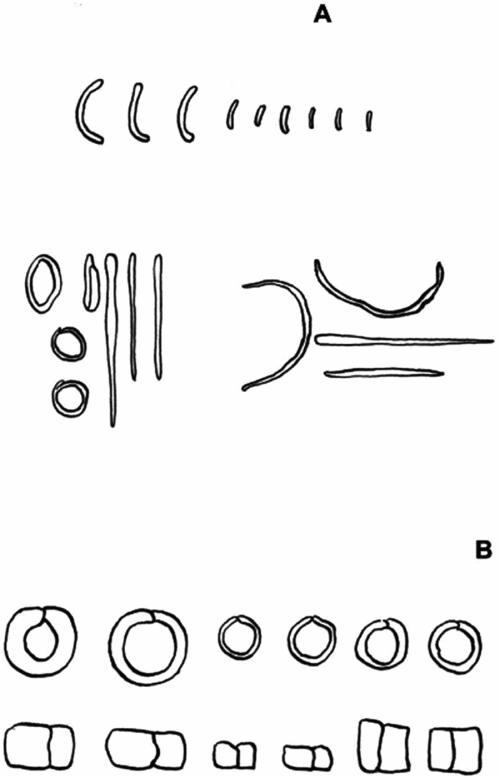
If we accept these arguments, we can surely ask whether weight in itself (as opposed to use of/reference to a measuring stick) at the time of such copper artefacts as the Cortaillod copper beads, concurrent axes, copper wires etc. was not important to quantification. This is an important question. My conclusion here is actually based on the absence of direct evidence for weighing (like scales or other tools) from that period (4th millennium B.C.). If (as suggested by the theoretical assessment from the above) we are to think in terms of a very long, gradual development, like in the Near East, the coexistence of several means of quantification for some time could be a plausible scenario. Despite the extreme scarcity of the evidence, we can actually point to some equivalent findings supporting this argument. Whereas in the core area of Bronze Age Europe the processes of weighing, of measuring individual wealth, were already very advanced (so that some researchers think that comparable metrological systems functioned in most areas, the latest ones beginning from the middle of the epoch, as part of the framework of the ‘weighed-money’ economy: Lenerz-de Wilde Reference Lenerz-de Wilde1995; Pare Reference Pare1999; Peroni Reference Peroni and Hänsel1998; Sommerfeld Reference Sommerfeld1994), in the periphery copper sheet and wire objects continued to be used by the Epi-Corded Ware societies as possible rationalized measures of the metrological–narrative kind (Dzbyński Reference Dzbyński2008a, 247). Here, we could make formal comparisons with the copper beads of the Cortaillod culture, for example (figure 9). In this respect we could say that weight/weighing and stick measuring were not mutually exclusive and could have been practised, broadly speaking, in the same cultural context – in Bronze Age societies.
Manipulations of some copper objects on the peripheries of the civilized world could for a long time have been performed on the same cognitive level. Simple copper objects in the Eneolithic (beads from Seeberg, Burgäschisee-Süd (B), as well as wire artefacts of the Early Bronze Age Mierzanowice culture (A)), may have served similar purposes as metrological–narrative messages (after Sangmeister and Strahm Reference Sangmeister and Strahm1974; Kadrow and Machnik Reference Kadrow and Machnik1992; Baczyńska Reference Baczyńska1993).
What is common to both Europe and the Near East, however, is the same path of development of mathematic abilities. We can see this path with the help of the following arguments, looking both at the theoretical assumptions and at the material evidence gathered so far in archaeological research. We can argue that the development of mathematical abilities went:
1. from concrete thinking to abstract thinking;
2. from counting with one-to-one correspondence to counting with a counting base;
3. from verbal, non-numeric or proto-numeric expressions to numeric expressions.
When looking for a more general explanation for the proposed development, it is important to remember that European metallurgy has been argued to have had a special status since the work of Renfrew (Reference Renfrew1973). He offered a processual explanation for the origins of European metallurgy, which has been widely accepted since. More recently some researchers, seeking to understand recycling mechanisms in metallurgical production in Europe, also formulated interesting suggestions. So, for example, Taylor (Reference Taylor, Yong, Pollard, Budd and Ixer1999) takes a new look focusing particularly on the nature of the evidence for a hiatus and reasonably argues that a vast amount of metal is missing from the archaeological records. In his opinion it is rather evidence of direct metal activity. After his analyses, Taylor (ibid., 29) comes to the conclusion that ‘the relative absence of metal is rather a sign of its developing worth and its growing association with . . . funding and prosecuting warfare’, and does not indicate a crisis or hiatus in the Eneolithic period. ‘Metal use developed within communities in an embedded way, not as a secular, economic add-on’, writes Taylor, and comes to summing up that ‘metal was good for thinking’ (ibid., 30). His efforts are supported by Staaf (Reference Staaf1996), who also suggested that by the end of the Eneolithic period some new norms of perception towards metal appeared, which he called ‘a general common understanding of metallurgy’, something close to forming a ‘new mind’ in the cultural discourse (ibid., 152). So we can ask, what is this ‘general understanding of metallurgy’, this ‘new mind’ formulated by Staaf? And, finally, what does it mean that metal was ‘good for thinking’ in the context of its developing value, as Taylor states? Were stone artefacts not good enough for thinking? In order to answer this clearly I will add only one word to refine this statement: the metal was good for thinking in measure. It was good for thinking in measure and number because metal actually has to be perceived only this way if it has to be used more rationally within growing social complexity (in exchange, in the production of tools, etc.). At the beginning, however, as several materials from the Eneolithic suggest, metal could have been perceived as a less abstract linear measure and conceptualized in a more concrete manner, whereas the concept of weight was still something for the future.
Summary
It seems to me that the equivalent of the Near Eastern tokens in Europe could be the measuring stick, the number-line, the metaphor of the line, etc., which were already in use in the Neolithic. This measure has many names: megalithic yard, Neolithic length or fathom, although there are many misunderstandings and false interpretations concerning it (Dzbyński Reference Dzbyński2013, 95). Nevertheless I take it for granted that a linear measure was in use in Europe in the Neolithic and later.
Thus, from the stage of the beads described above to the later weight systems of the Bronze Age in Europe, we can observe some kind of evolution, in which the form of a stick, later a rod of metal defined by its length, turned out to be a portion of metal defined by its weight. In other words the idea of the measuring stick was finally internalized, transformed and acknowledged as a human creation – weight. This transformation was burdened, of course, with an appropriate cognitive turn. A concrete, non-abstract system of counting (equal to one-to-one correspondence) was turned into abstract weight systems of ‘counting’ metal. In Bronze Age weight systems the counting sequence is hidden, whereas in the case of Seeberg and Colmar it is not fully visible yet. It is a four-counting sequence (Dzbyński Reference Dzbyński2004, 21; 2008a, 205).
Concluding the arguments above, I would at the present time suggest distinguishing two development paths of mathematization and numerosity in Europe and the Near East – the birthplace of farming. These two categories may be perceived as being opposites: the measuring-stick metaphor versus the object-collection metaphor. As is known, underlined in the European path is the wealth or prestige economy, which stands in opposition to the Near Eastern subsistence economy – a dichotomy which has been described by archaeologists (Kristiansen Reference Kristiansen and Earle1991). No doubt there are many unanswered questions, so there is a need for further research concerning the issue presented. For instance, were recording systems the only source of the number concept in the Near East? How was metal conceptualized in the early stages of metallurgy in the Near East and when was the concept of weight created? In the case of Europe, we can obviously ask whether the development path ‘from the measuring stick to the weight of metal’ is just a local phenomenon in certain early metal production centres such as the Alpine region or whether it is universal for Europe. Or is it maybe an individual creation of the author's mind?