Introduction
Respiratory distress syndrome (RDS) affects about 1% of newborn infants and is a leading cause of neonatal morbidity and mortality in preterm infants Reference Fanaroff, Wright and Stevenson1,Reference Nkadi, Merritt and Pillers2 . RDS is a consequence of lung immaturity due to an inability to produce essential pulmonary surfactant at birth Reference Burri3 . Pulmonary surfactant is a complex mixture of lipids and proteins secreted by Type II alveolar epithelial cells (AEC); it reduces the surface tension at the air–liquid interface and therefore protects the alveoli from collapse Reference Poulain and Clements4–Reference Orgeig, Morrison and Daniels6 . Antenatal glucocorticoids, which stimulate surfactant synthesis, are commonly administered to prevent, or decrease the severity of, RDS Reference Liggins and Howie7,Reference Bonanno and Wapner8 . However, not every infant responds to this treatment, and uncertainties remain regarding the best type of corticosteroid, dose, duration of effectiveness, and need for repeat courses Reference Bonanno and Wapner8,Reference McGillick, Orgeig, Williams and Morrison9 . Surfactant replacement therapy is another treatment for RDS and dramatically increases the probability of survival without chronic lung disease Reference Polin and Carlo10 . However, there are risks of hypoxemia and bradycardia during treatment, as well as pulmonary hemorrhage following the surfactant treatment, especially in extremely low birth weight infants Reference Stuart and McMillan11,Reference Raju and Langenberg12 . Therefore, additional mechanisms for promoting surfactant production should be investigated.
Peroxisome proliferator-activated receptor γ (PPARγ) is a member of the nuclear hormone receptor superfamily and functions as a transcription factor regulating various biological processes, including adipocyte differentiation, glucose homeostasis, lipid storage, and metabolism Reference Ferré13–Reference Tyagi, Gupta, Saini, Kaushal and Sharma16 . PPARγ is also expressed in the lung, where it plays an important role in normal lung development by activating parathyroid hormone-related protein (PTHrP)–PPARγ signaling pathway between alveolar epithelium and mesenchyme Reference Rehan and Torday17 . Upregulation of PPARγ stimulates differentiation of lipofibroblasts (LIFs) and activates leptin secretion from the LIF, which stimulates surfactant production by Type II AECs Reference Rehan and Torday17–Reference Rehan, Wang, Patel, Santos and Torday19 . This paracrine signaling pathway is essential for regulating surfactant synthesis, maintaining the LIF phenotype through neutral lipid uptake, and protecting the lung from oxidant injury Reference Rehan and Torday17,Reference Torday and Rehan20,Reference Torday, Torday, Gutnick, Qin and Rehan21 . Transdifferentiation of LIF into myofibroblasts (MYO) results in the failure of alveolarization, which contributes to the pathogenesis of bronchopulmonary dysplasia (BPD), a form of chronic lung disease Reference Rehan and Torday17,Reference Torday, Torres and Rehan22,Reference Lecarpentier, Gourrier, Gobert and Vallée23 . Thus, increasing PPARγ activation/expression has the potential to enhance pulmonary surfactant production and potentially protect the neonatal lung from chronic lung disease.
Several studies have suggested that rosiglitazone (RGZ), a PPARγ agonist, could play an important role in treating BPD Reference Rehan, Wang, Patel, Santos and Torday19,Reference Lecarpentier, Gourrier, Gobert and Vallée23–Reference Morales, Sakurai and Husain25 . As a PPARγ agonist, RGZ is a member of the family of thiazolidinedione derivatives. We have previously demonstrated that fetal administration of RGZ in late gestation sheep increased the expression of PPARγ target genes within fetal adipose tissue, muscle, and liver, suggesting that RGZ has the capacity to activate PPARγ before birth Reference Muhlhausler, Morrison and McMillen26 . RGZ administration has also been shown to prevent hyperoxia-induced acute lung injury in newborn rats by preventing the transdifferentiation of pulmonary LIFs to MYOs, with an associated increase in PPARγ, SFTP-B, and SFTP-C protein expression Reference Rehan, Wang, Patel, Santos and Torday19,Reference Morales, Sakurai and Husain25 . Further to this, administering RGZ in a newborn rat model of BPD, induced by intra-amniotic lipopolysaccharide and postnatal hyperoxia, restored alveolar and pulmonary vascular development and alleviated pulmonary hypertension Reference Lee, Lee and Choi24 . These data suggest that RGZ may promote normal fetal lung development.
In the fetal lung, leptin functions as a signaling molecule involved in the paracrine interaction between LIFs and Type II AECs Reference Torday, Sun, Wang and Torres27 . Antenatal leptin administration increases the number and maturation of Type II AEC and expression of surfactant proteins (SFTP)-A, -B, and -C in the lungs of fetal rats Reference Kirwin, Bhandari and Dimatteo28,Reference Chen, Zhang, Huang, Wang, Cheng and Cai29 . In a sheep model, infusion of leptin for 5 d starting at ~125 d gestation resulted in the upregulation of SFTP-B expression in the fetal lung Reference De Blasio, Boije and Kempster30 , suggesting a role for leptin in fetal lung development. However, this precedes the prepartum surge in cortisol, and thus we aimed to understand the effect of leptin infusion on surfactant maturation later in gestation at ~140 d gestation. We hypothesized that targeting the mechanistic pathway through leptin administration may decrease the risk of RDS in preterm infants born <37 weeks of pregnancy.
Therefore, the aim of this study was to examine the effect of late gestation fetal administration of RGZ or leptin infusion on the mRNA expression of markers of surfactant synthesis and angiogenesis, as well as the expression of PPARγ-dependent molecules that regulate surfactant production in the fetal lung.
Methods
Ethics approvals
All procedures were approved by the Institute for Medical and Veterinary Science Animal Ethics Committee (Study 1: RGZ administration) and University of Adelaide Animal Ethics Committee (Study 2: LEP infusion) and comply with the Australian code of practice for the care and use of animals for scientific purposes. The authors understood and followed the principles laid out by Grundy et al Reference Grundy31 and the principles of the 3Rs Reference Russell and Burch32 .
Animals and surgery
Pregnant Merino ewes (Study 1: RGZ, n = 15; Study 2: LEP n = 19) and their fetuses were sourced from Turretfield Research Centre, South Australia Research and Development Industries and housed in individual pens in animal holding rooms maintained at a constant ambient temperature of 20–22°C and a 12 h:12 h light/dark cycle. The ewes were fed daily between 0900 h and 1100 h at a standard maintenance diet as previously described Reference Mühlhäusler, Roberts, McFarlane, Kauter and McMillen33 . Between 123 d and 126 d gestation (RGZ infusion; term, 150 ± 3 d) or 110–124 d gestation (Leptin infusion), fetal surgery was performed. General anesthesia was induced by intravenous injection of sodium thiopentone (1.25 g i.v., Pentothal, Rhone Merieux, Pinkenba, Qld, Australia) and maintained with 2.5%–4% halothane (Fluothane, ICI, Melbourne, Vic, Australia) in oxygen. Vascular catheters were implanted in a maternal jugular vein, fetal jugular vein, carotid artery, and in the amniotic cavity as previously described Reference Muhlhausler, Morrison and McMillen26,Reference Edwards and McMillen34 . All catheters were filled with heparinized saline, and the fetal catheters were exteriorized through an incision in the ewe’s flank. During surgery, antibiotics were administered intramuscularly (procaine penicillin 250 mg/mL, dihydrostreptomycin 250 mg/mL, procaine hydrochloride 20 mg/mL (Lyppards, Adelaide, Australia), and norocillin) to each ewe and fetus.
Study 1: Rosiglitazone administration
Water and ethanol were each sterilized by filtration (0.25-μm filter, Micropore, Madison, WI). Ethanol was then diluted in water to make a sterile 15% ethanol (vol/vol) solution. RGZ (30 mg, GlaxoSmithKline, Brentford, UK) was dissolved in sterile 15% ethanol solution (15 mg/mL) and then injected into each of the four 2-mL Alzet osmotic pumps (DURECT Corp., Cupertino, CA) under sterile conditions. At the time of the catheterization surgery, four osmotic pumps were implanted subcutaneously over the scapula of fetuses assigned to the RGZ group (RGZ; n = 7) as previously described Reference Muhlhausler, Morrison and McMillen26 . Fetuses assigned to the vehicle group (VEH; n = 8) also had four osmotic mini pumps implanted that contained 15% ethanol alone. After implantation, the osmotic pumps released the solution at an average rate of 10 μL/h (2.5 μL/h from each pump, n = 4 pumps per animal) for both treatment groups. This provided a RGZ dose rate of 2.7 mg/fetus/d (113 μg/h) Reference Bazargan, Foster, Muhlhausler, Morrison, McMillen and Davey35 . The average duration of RGZ infusion was 16 ± 1 d.
Study 2: Leptin infusion
At 136–137 d gestation, fetuses were randomly assigned to the saline (VEH; n = 12) or leptin (LEP; n = 7) infusion group. On the day of infusion, a bolus of sterile saline (0.5 mL) or recombinant ovine leptin (250 μg in 0.5 mL sterile saline) was infused into the fetal jugular vein at 0 h (1300 h), immediately followed by a continuous infusion of either sterile saline (0.16 mL/h) or leptin (0.48 mg/kg/d), respectively, for 96 h Reference Yuen, Owens and Muhlhausler36 .
Post-mortem tissue collection
At 138–142 d gestation, following ~2 weeks of RGZ infusion or 96 h after leptin infusion, pregnant ewes were humanely killed with an intravenous overdose of sodium pentobarbitone (Virbac Pty Ltd., Peakhurst, New South Wales, Australia) and fetuses were delivered by hysterotomy. Fetal body weight was determined, and samples from major organs, including lungs, were dissected and weighed. Samples were then frozen in liquid nitrogen and stored at −80 °C for subsequent molecular analyses or immersion fixed in 4% paraformaldehyde for histological and immunohistochemical analyses.
Quantification of mRNA transcripts within the fetal lung
All essential information regarding our procedure is included according to the MIQE guidelines Reference Bustin, Benes and Garson37 . Total RNA was extracted from ~50 mg frozen lung tissue from each fetus (Study 1: VEH, n = 8, RGZ, n = 7; Study 2: VEH, n = 12, LEP, n = 7) using QIAzol Lysis Reagent Solution and Qiagen miRNeasy purification columns according to the manufacturer’s instructions (Qiagen, Hilden, Germany) as previously described Reference McGillick, Orgeig and Morrison38,Reference Lock, McGillick and Orgeig39 . Total RNA was quantified by spectrophotometric measurement at 260 and 280 nm using a Nanodrop spectrophotometer (Thermo Fisher Scientific, Australia), and the 260/280 nm ratio was checked for protein and DNA contamination in each sample. RNA integrity was verified by assessment of RNA bands run on a 1% agarose gel. cDNA was then synthesized using Superscript III (Invitrogen, Carlsbad, CA, USA) reverse transcription as previously described Reference McGillick, Orgeig, Caroline McMillen and Morrison40 . A negative control containing no RNA transcript (No Template Control) and a negative control containing no Superscript III (No Amplification Control) were used to test reagent contamination and genomic DNA contamination, respectively Reference McGillick, Orgeig, Caroline McMillen and Morrison40 .
Quantitative real-time RT-PCR (qRT-PCR)
The geNorm component of qbaseplus 2.0 software (Biogazelle, Zwijnaarde, Belgium) was used to determine the most stable reference genes from a panel of 8 candidates Reference Vandesompele, De Preter and Pattyn41 and the minimum number of reference genes required to calculate a stable normalization factor, as previously described Reference McGillick, Orgeig, Caroline McMillen and Morrison40,Reference Soo, Hiscock, Botting, Roberts, Davey and Morrison42 . Three stable reference genes chosen for Study 1 were beta-actin (ACTB Reference Passmore, Nataatmadja and Fraser43 ), peptidylprolyl isomerase A (PPIA Reference Passmore, Nataatmadja and Fraser43 ) and tyrosine 3-monooxygenase (YWHAZ Reference McGillick, Orgeig, Caroline McMillen and Morrison40 ) and for Study 2 were hypoxanthine phosphoribosyltransferase (HPRT Reference Passmore, Nataatmadja and Fraser43 ), TATA-box binding protein (TBP; XM 004011459), and ribosomal protein P0 (RPP0 Reference Muhlhausler, Morrison and McMillen26 ). The primers used in this study (Table 1) have been validated and optimized previously Reference McGillick, Orgeig, Caroline McMillen and Morrison40,Reference Orgeig, Crittenden, Marchant, McMillen and Morrison44 . All primers had an efficiency of at least 90%. The expression of genes involved in surfactant maturation (SFTP-A, SFTP-B, SFTP-C Reference Orgeig, Crittenden, Marchant, McMillen and Morrison44 , SFTP-D Reference McGillick, Orgeig, Caroline McMillen and Morrison40 , PCYT1A, ABCA3, LPCAT Reference McGillick, Orgeig and Morrison38 , LAMP3 Reference Orgeig, McGillick, Botting, Zhang, McMillen and Morrison45 ), PTHrP/PPARγ signaling pathway (PPARγ Reference Muhlhausler, Duffield and McMillen46 , PTH1R, LEPR, PLIN2 (Table 1)), PPARγ target genes (SPHK1, PAI-1 Reference Soo, Orgeig, McGillick, Zhang, McMillen and Morrison47 , PGC1α, PPARα Reference Muhlhausler, Morrison and McMillen26 ), fatty acid metabolism (FAS Reference Lock, McGillick and Orgeig39 , FATP1 Reference Wang, Lim, McMillen, Duffield, Brooks and Morrison48 , FABP5 Reference Zhang, Barker and Botting49 ), transcription and growth factors (RXRa Reference Wang, Lim, McMillen, Duffield, Brooks and Morrison48 , IGF1, IGF1R, IGF2 Reference Gentili, Morrison and McMillen50 ), and angiogenesis (VEGF, VEGFR1, VEGFR2 Reference Botting, Caroline McMillen, Forbes, Nyengaard and Morrison51 , FGF2 Reference Wang, Brooks and Summers-Pearce52 , ANGPT1 Reference McGillick, Orgeig, Caroline McMillen and Morrison40 ) was assessed by qRT-PCR using KiCqStart® SYBR® Green qPCR ReadyMix™ (Sigma-Aldrich, Castle Hill, Australia) in a final volume of 6 μL on a ViiA7 Fast Real-time PCR system (Applied Biosystems, California, USA). Subsequently, the abundance of each gene transcript (delta-delta Ct) relative to the geometric mean of the abundance of stable reference genes was calculated using DataAssist 3.0 analysis software (Thermo Fisher Scientific) and expressed as mean normalized expression ± standard error of the mean (SEM) Reference McGillick, Orgeig, Caroline McMillen and Morrison40,Reference Morrison, Botting and Soo53 . Samples were run in triplicate for each target gene. Outliers were defined as values that were ±2 standard deviations from the mean values for each group and were eliminated from analysis.
qRT-PCR design primer list

Fwd, forward primer; Rev, reverse primer.
Quantification of SFTP-B positive cells within the fetal lung
Immunohistochemistry was performed to identify SFTP-B positive cells within the alveolar epithelium for Study 1 only because tissue was not available for Study 2. Paraffin-embedded fetal lung tissue slides were baked at 60°C for 1 h, deparaffinized, and rehydrated. Endogenous peroxide solution activity was then blocked with 3% hydrogen peroxide (Sigma-Aldrich), followed by heat-induced antigen retrieval in citrate buffer (pH 6.0). Slides were incubated overnight with a rabbit anti-human mature SFTP-B antibody at 4°C (1:1000, WRAB-48604, Seven Hills Bioreagents, Cincinnati, OH, USA) as previously described Reference McGillick, Orgeig and Morrison38,Reference Lock, McGillick, Orgeig, Zhang, McMillen and Morrison54,Reference McGillick, Orgeig and Morrison55 . A Histostain-Plus broad-spectrum kit (Zymed Laboratories Inc., San Francisco, CA, USA) was used with horseradish peroxidase and 3,3-diaminobenzidine chromagen (Metal Enhanced DAB Substrate Kit; Pierce Biotechnology, Rockford, IL, USA) for visualization of SFTP-B positive cells. All sections were counterstained with Mayer’s hematoxylin (Sigma-Aldrich, St Louis, MO, USA).
Stained slides were scanned on a Nanozoomer XR (Hamamatsu Japan) and were examined using Visiopharm new Computer Assisted Stereological Toolbox (NewCAST) software (Visiopharm, Hoersholm, Denmark) as previously described Reference McGillick, Orgeig and Morrison38,Reference Lock, McGillick, Orgeig, Zhang, McMillen and Morrison54,Reference McGillick, Orgeig and Morrison55 . Briefly, 55 counting frames (600× magnification) of the alveolar epithelium were randomly selected per tissue section. SFTP-B positive cells were identified as those presenting as cuboidal-shaped cells exhibiting cytoplasmic staining within the alveolar epithelium. Point counting using an unbiased counting frame with an area of 20,000 μm2 was used on the fixed lung tissue section to estimate the numerical density of SFTP-B positive cells within the alveolar epithelium Reference McGillick, Orgeig and Morrison38,Reference Lock, McGillick, Orgeig, Zhang, McMillen and Morrison54,Reference McGillick, Orgeig and Morrison55 . The numerical density of SFTP-B positive cells was obtained using the following equation and expressed as SFTP-B positive cells per mm2 of lung tissue Reference McGillick, Orgeig, Caroline McMillen and Morrison40,Reference Lock, McGillick, Orgeig, Zhang, McMillen and Morrison54,Reference Brüel, Oxlund and Nyengaard56,Reference McGillick, Morrison, McMillen and Orgeig57 :
 $$\scale 93%\eqalign{{SFTP - B\;positive\;cells\;per\;m{m^2}\;of\;lung\;tissue} \cr= {\;\frac{{\sum {Q^ - }( {Surfactant\;positive} )}}\over{{\sum P( {Lung\;tissue})}}{{{\times \;\left[ {\frac{{a\left( {frame} \right)}}\over{P}} \right]}}}} \times {10^6}$$
∑Q− (Surfactant positive) represents the total number of SFTP-B positive cells counted in all counting frames of one fetal lung tissue section; ΣP (Lung Tissue) represents the total number of points falling on lung tissue in each field of view. P is the number of points that were used to count the points included within the reference space (four corners per counting frame), and a is the total area of the counting frame (20,000 μm2).
Statistical analyses
Data are presented as mean ± SEM. The effect of RGZ or leptin administration on gene expression or density of Type II AECs was determined using an unpaired Student’s two-tailed t-test. P = 0.05 was considered statistically significant.
Results
Impact of RGZ and leptin on fetal body and lung weights
There were no significant differences in body weight, crown-rump length, abdominal circumference, lung weight, or relative lung weight as a result of either RGZ (Study 1) or leptin (Study 2) infusion (Table 2).
Comparison of fetal parameters following RGZ and LEP infusion

VEH, vehicle; RGZ, rosiglitazone; LEP, leptin.
Data presented as mean ± SEM and analyzed by unpaired Student’s two-tailed t-test. *P < 0.05 was considered significant.
Effect of RGZ on numerical density of SFTP-B positive cells in the alveolar epithelium
There was no significant change in the numerical density of SFTP-B positive staining cells in the RGZ group (Fig. 1).
Numerical density of surfactant proteins (SFTP-B) positive cells in lung tissues from VEH and RGZ groups. There was no significant difference between the numerical density of SFTP-B positive cells in fetal lung tissues between VEH and RGZ groups. Data presented as mean ± SEM and analyzed by unpaired Student’s t-test. VEH, vehicle; RGZ, rosiglitazone.

Effect of RGZ and leptin on mRNA expression of genes involved in surfactant synthesis
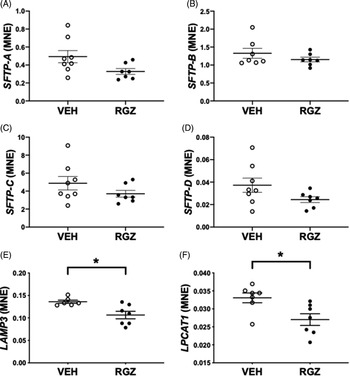
The mRNA expression of an enzyme involved in surfactant synthesis (LPCAT1) and marker of lamellar bodies (LAMP3) was reduced in the RGZ group compared to the VEH group (P < 0.05; Fig. 2). However, there were no significant differences in the mRNA expression of SFTP-A, -B, -C, and -D (Fig. 2), the rate-limiting enzyme in surfactant phospholipid synthesis (PCYT1A), or phospholipid transportation (ABCA3) in the fetal lungs between the VEH and RGZ groups (Table 3).
mRNA expression of surfactant proteins (SFTP)-A, -B, -C, and -D, LAMP3 and LPCAT in the fetal lung of VEH and RGZ groups. There was no change in the mRNA expression of SFTP-A (A), SFTP-B (B), SFTP-C (C), and SFTP-D (D). Mean normalized mRNA expression of LAMP3 (E) and LPCAT (F) is significantly decreased in the RGZ group. Data shown were delta-delta Ct values and presented as mean ± SEM. *P < 0.05 was considered significant. MNE, mean normalized expression; VEH, vehicle; RGZ, rosiglitazone.

Mean normalized mRNA expression of target genes in the fetal lung following RGZ and LEP infusion

MNE, mean normalized expression; VEH, vehicle; RGZ, rosiglitazone; LEP, leptin.
Data presented as mean ± SEM and analyzed by unpaired Student’s two-tailed t-test. *P < 0.05 was considered significant. “-” means gene expression was not measured.
In response to leptin infusion (Study 2), there was a significant decrease in mRNA expression of SFTP-B in the LEP group (P < 0.05; Fig. 3). However, mRNA expression of SFTP-A, SFTP-C, SFTP-D, PCYT1A, ABCA3, LAMP3, and LPCAT1 was not different between the LEP and VEH groups (Fig. 3 and Table 3).
mRNA expression of surfactant proteins (SFTP)-A, -B, -C, and -D in the fetal lung of VEH and LEP groups. There was no change in the mRNA expression of SFTP-A (A), SFTP-C (C), and SFTP-D (D). Mean normalized mRNA expression of SFTP-B (B) is significantly decreased in the LEP group. Data shown were delta-delta Ct values and presented as mean ± SEM. *P < 0.05 was considered significant. MNE, mean normalized expression; VEH, vehicle; LEP, leptin.

Effect of RGZ and leptin on mRNA expression of PPARγ target genes
There were no significant differences in mRNA expression of PPARγ, PPARα, PAI-1, SPHK1, or PGC1a in the fetal lungs between the VEH and RGZ groups (Fig. 4 and Table 3). However, leptin infusion resulted in a significant increase in mRNA expression of PPARγ (P < 0.05; Fig. 4), with no effect on mRNA expression of target genes SPHK1, PAI-1, and PGC1α (Fig. 4 and Table 3).
mRNA expression of PPARγ and PPARγ target genes in the fetal lung following RGZ and leptin infusion. RGZ administration did not change in the mRNA expression of PPARγ (A), SPHK1 (B), and PAI-1 (C). Mean normalized mRNA expression of PPARγ (D) was significantly increased after leptin infusion. There was no change in the mRNA expression of SPHK1 (E) and PAI-1 (F) following leptin infusion. Data shown were delta-delta Ct values and presented as mean ± SEM. *P < 0.05 was considered significant. MNE, mean normalized expression; VEH, vehicle; RGZ, rosiglitazone; LEP, leptin.

Effect of RGZ and leptin on mRNA expression of genes involved in the PTHrP/PPARγ signaling pathway and growth factors
There were no significant differences in mRNA expression of PTH1R, LEPR, or PLIN2 in the fetal lungs following either RGZ or leptin infusion (Table 3). RGZ infusion did not change mRNA expression of RXRa, IGF1, IGF1R, or IGF2 in the fetal lungs (Table 3). Leptin infusion resulted in a significant increase in mRNA expression of IGF2 (P < 0.05; Fig. 5). However, mRNA expression of IGF1, IGF1R (Fig. 5), and RXRα (Table 3) remained unchanged after leptin infusion.
mRNA expression of IGF1, IGF1R, and IGF2 in the fetal lung of VEH and LEP groups. Leptin infusion did not affect the mRNA expression of IGF1 (A) and IGF1R (B). Mean normalized mRNA expression of IGF2 (C) was significantly increased following leptin infusion. Data shown were delta-delta Ct values and presented as mean ± SEM. *P < 0.05 was considered significant. MNE, mean normalized expression; VEH, vehicle; LEP, leptin.

Effect of RGZ on mRNA expression of molecules involved in fatty acid metabolism and angiogenesis
There was a significant decrease in the mRNA expression of FATP1 and FAS after RGZ administration (Fig. 6). However, the mRNA expression of FABP5 was not different between the VEH and RGZ groups (Table 3). RGZ infusion did not change mRNA expression of VEGF, VEGFR2, ANGPT1, or FGF2 (Fig. 7 and Table 3). However, there was a significant increase in VEGFR1 mRNA expression in the fetal lung following RGZ infusion (P < 0.05; Fig. 7).
mRNA expression of FAS and FATP1 in the fetal lung of VEH and RGZ groups. Mean normalized mRNA expression of FATP1 (A) and FAS (B) were significantly decreased in the RGZ group. Data shown were delta-delta Ct values and presented as mean ± SEM. *P < 0.05 was considered significant. MNE, mean normalized expression; VEH, vehicle; RGZ, rosiglitazone.

mRNA expression of VEGF, VEGFR1, and VEGFR2 in the fetal lung of VEH and RGZ groups. There was no change in the mRNA expression of VEGF (A) and VEGFR2 (C). Mean normalized mRNA expression of VEGFR1 (B) is significantly increased in the RGZ-treated group. Data shown were delta-delta Ct values and presented as mean ± SEM. *P < 0.05 was considered significant. MNE, mean normalized expression; VEH, vehicle; RGZ, rosiglitazone.

Discussion
The paracrine interaction between the pulmonary LIFs and Type II AECs is important for surfactant maturation and normal lung development Reference Rehan and Torday17–Reference Torday and Rehan20 . Our group has previously reported that RGZ administration in late gestation results in increased expression of PPARγ target genes in adipose tissue, liver, and skeletal muscle in the sheep fetus (Fig. 8). In this study, we have demonstrated that RGZ infusion had a significant impact on surfactant phospholipid synthesis but no effect on either paracrine signaling or mRNA expression of key PPARγ target genes in the late gestation fetal lung (Fig. 9).
Differential effects of RGZ infusion on PPARγ target genes in fetal skeletal muscle and adipose tissue, genes involved in surfactant maturation and angiogenesis in fetal lung. Normalized mRNA expression ratio (fold change ± SEM) of PGC1α in skeletal muscle, LPL and adiponectin in perirenal adipose tissue 26. The mean normalized mRNA expression of LAMP3, LPCAT1, SFTP-B, PPARγ, and VEGFR1 in fetal lung tissue. Data presented as mean ± SEM. Positive and negative mean values indicate an increase or decrease of gene expression after RGZ administration, respectively. *P < 0.05.

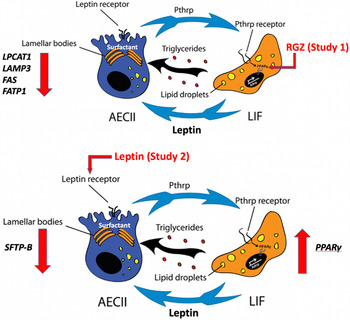
The effects of RGZ and leptin infusion on PTHrP-PPARγ signaling pathway between Type II AECs and LIFs. PTHrP secreted by Type II AECs binds to its receptor, parathyroid hormone (PTH)-1 receptor on LIF. This upregulates the expression of PPARγ via protein kinase A activation and its downstream target regulatory gene leptin and adipocyte-differentiation-related protein (ADRP) Reference Rehan and Torday87,Reference Torday and Rehan88 . The effects of RGZ and leptin infusion are shown by red arrows. Figure modified from Chao et al. Reference Chao, El Agha, Tiozzo, Minoo and Bellusci89 .

The lack of change in PPARγ mRNA expression in the lung is in line with findings from a previous study, where RGZ treatment in late gestation did not affect PPARγ expression in fetal adipose tissue Reference Muhlhausler, Morrison and McMillen26 . However, in this previous study, RGZ infusion resulted in increased mRNA expression of PPARγ target genes in adipose tissue, lipoprotein lipase (LPL) and adiponectin, suggesting PPARγ activation. Similarly, RGZ administration was shown to result in increased mRNA expression of PPARα in liver and PGC1α in skeletal muscles in this previous study, which is different to the results of the current study, where we found no change in the expression of these genes in the fetal lung following RGZ administration. PPARα is a transcription factor involved in regulating energy homeostasis and fatty acid oxidation Reference Braissant, Foufelle, Scotto, Dauça and Wahli58–Reference Van Raalte, Li, Pritchard and Wasan61 . PGC1α is a PPARγ coactivator regulating genes involved in cellular energy metabolism Reference Liang and Ward62 . The different effects of RGZ infusion on the expression of these target genes in these two tissues may be due to the much lower expression of PPARα and PGC1α in the lung compared to the liver or skeletal muscle. While treatment with RGZ was not associated with increased PPARγ mRNA expression in the lung, it is possible that it increased PPARγ activation, although this was not measured directly in our study. However, since we saw no change in the mRNA expression of PPARγ target genes, SPHK-1 and PAI-1, in the lung following RGZ administration, it would appear that RGZ treatment did not activate PPARγ in the fetal lung or not to an extent that we could measure. This may be due to the low expression of PPARγ in the fetal lung compared with the other tissues in these fetuses in which PPARγ target gene expression was increased by RGZ (Fig. 8).
We found no effects of RGZ infusion on the mRNA expression of any of the genes involved in the PTHrP–PPARγ paracrine signaling pathway in the lung, which plays a critical role in surfactant synthesis. This suggests that fetal administration of RGZ was unable to activate paracrine-induced surfactant maturation (Fig. 10). This finding was mirrored in the immunohistochemistry data, where RGZ administration had no effect on the numerical density of Type II AECs. This was unexpected, since previous studies have shown that RGZ treatment for either 1 or 7 d after birth, enhanced lung maturation by increasing the expression of SFTP-B and SFTP-C, and surfactant phospholipid synthesis in newborn rat pups Reference Wang, Santos and Sakurai63 . It is possible that these unexpected findings may be due to species differences in the timing of lung development. There are five phases of fetal lung development, namely embryonic, pseudoglandular, canalicular, saccular, and alveolar Reference Joshi and Kotecha64,Reference Lock, McGillick, Orgeig, McMillen and Morrison65 . The most important stages for successful transition to the air-breathing environment are the saccular and alveolar stages, during which the maturation of surfactant occurs Reference Joshi and Kotecha64 . In fetal sheep, the saccular phase occurs between 110 d and 140 d gestation and the alveolar phase begins around 120 d gestation and continues after birth, whereas in rodents, the saccular phase starts at 17.5 d gestation and alveolarization occurs between 4 d and 21 d after birth Reference Schittny66 . In our study, RGZ treatment coincided with the late saccular/early alveolar phase and thus the surfactant system was more mature compared to the rodent study, where RGZ was given in the late saccular phase prior to the alveolar phase. It is therefore possible that RGZ treatment in the current study was applied too late in the developmental process to alter surfactant maturation. Additionally, RGZ is cleared from the fetal sheep through placental transfer Reference Bazargan, Foster, Muhlhausler, Morrison, McMillen and Davey35 , and it is continuously eliminated from the fetal compartment. Therefore, the concentration of RGZ in the fetus may not have reached the threshold to cause a significant effect on lung development.
Fold change in mean normalized mRNA expression of PPARγ and SFTP-B in the lung of fetuses infused with RGZ or leptin compared to their respective controls. A 4 d intrafetal infusion of leptin increased PPARγ mRNA expression in the lung but 16 d exposure to RGZ did not. Leptin infusion also resulted in a decreased mRNA expression of SFTP-B, but RGZ infusion did not have any effect on SFTP-B mRNA expression. Data presented as mean ± SEM. *P < 0.05 was considered significant compared to their respective controls. RGZ, rosiglitazone; LEP, leptin.

While RGZ treatment did not appear to affect the expression of surfactant proteins, it did result in reduced expression of LAMP3 and LPCAT1, two proteins that play a role in surfactant production. LAMP3 is expressed in the lamellar bodies of Type II AECs, where surfactant is stored before secretion into the alveolar hypophase, while LPCAT1 is an enzyme that regulates the synthesis of the major surfactant phospholipid dipalmitoyl phosphatidylcholine Reference Agassandian and Mallampalli67,Reference McGillick, Orgeig and Allison68 . In addition, RGZ treatment caused a reduction in the expression of FAS and FATP1 mRNA, two proteins that play an important role in the production of palmitate, a major component for phospholipid synthesis and fatty acid transport Reference Schiller and Bensch69 . Thus, the findings from our study suggest a potential decrease in the capacity for surfactant phospholipid production, indicating RGZ administration may in fact be detrimental to late gestational lung maturation and development.
Our finding that RGZ treatment was associated with increased expression of VEGFR1 in the late gestation fetal lung may have functional relevance, since VEGF and its receptors play crucial roles in alveolar and pulmonary vascular development and in surfactant production Reference Kasahara, Tuder and Taraseviciene-Stewart70–Reference Zeng, Wert, Federici, Peters and Whitsett72 . Several studies have shown that VEGF administration promotes both surfactant protein and lipid production in human and rat fetuses Reference Brown, England, Goss, Snyder and Acarregui73–Reference Raoul, Chailley-Heu, Barlier-Mur, Delacourt, Maître and Bourbon75 . VEGF treatment during the saccular and alveolar phases of lung development in the late gestation fetal sheep has also previously been shown to increase the density of SFTP-B positive cells in the alveolar epithelium Reference McGillick, Orgeig and Morrison38 . However, the positive effects of VEGF on lung vascularization are predominantly mediated by the VEGFR2 receptor, while the role of the alternate (VEGFR1) receptor is less well defined Reference Rahimi76 . Compared to VEGFR2, VEGFR1 has a lower kinase activity but higher affinity for VEGF Reference Hiratsuka, Minowa, Kuno, Noda and Shibuya77 and this receptor has been reported to have both stimulatory and inhibitory roles in regulating angiogenesis in previous studies Reference Rahimi76–Reference McCarthy, Drewlo and English78 . Taken together, RGZ administration may be negatively regulating angiogenesis via an increase in levels of VEGFR1, which acts as a VEGF scavenger, and this may contribute to the potential decrease in surfactant phospholipid synthesis in the fetal sheep lung in this study.
Based on the established mechanistic pathway regulating surfactant maturation, we hypothesized that PPARγ activation could act on the Type II AECs by increasing leptin release from LIFs. Our data suggest that RGZ did not have this effect and thus prompted us to ask if direct leptin infusion into the fetus could impact lung development through activation of PPARγ. The mechanistic basis for this is that a positive feedback loop forms between Type II AECs and LIFs; the activation of PTHrP induces leptin secretion from LIFs, which further increases the release of PTHrP from Type II AECs Reference Oruqaj, Forst and Schreckenberg18,Reference Torday and Rehan20,Reference Torday, Sun, Wang and Torres27 . Despite no change in the mRNA expression of PTH1R, PLIN2, and LEPR following leptin infusion, we found an increased expression of PPARγ mRNA in the lung of leptin-infused fetuses, suggesting that the known positive feedback loop between LIFs and Type II AECs was activated. However, this paracrine loop did not result in surfactant maturation; on the contrary, there was decreased mRNA expression of SFTP-B after leptin infusion (Figs. 9 and 10). These findings are in contrast to those reported by De Blasio et al. Reference De Blasio, Boije and Kempster30 , who found that a 0.5 mg/kg/d i.v. intrafetal leptin infusion for 5 d at 125 d gestation increased lung maturation by increasing the expression of SFTP-B and reducing alveolar wall thickness in the sheep fetus Reference De Blasio, Boije and Kempster30 . Since the infusion period corresponded to the alveolar phase of lung development in both studies Reference Darby, Varcoe, Orgeig and Morrison79,Reference Morrison80 , the observed differences in surfactant maturation may be due to the different gestational ages at which tissue collection was performed. The De Blasio study collected fetal lung tissue at 130 d versus 140 d gestation in our study. The prepartum surge in plasma cortisol, which has a significant effect on lung maturation, occurs from 133 d gestation Reference Dekowski and Snyder81,Reference Phillips, Simonetta, Owens, Robinson, Clarke and McMillen82 , and the effect of cortisol may well be greater than the effect of leptin on surfactant production. Other possible explanations for the different outcomes between the two studies include differences in the duration of leptin infusion (5 d in the study by De Blasio et al vs ~4 d in the current study) and/or the fetal leptin concentrations attained (5- to 7-fold increase in fetal leptin concentrations by De Blasio and colleagues vs a 4- to 5-fold increase in the current study) Reference De Blasio, Boije and Kempster30,Reference Yuen, Owens and Muhlhausler36 . It is therefore possible that the leptin concentration in our study may have been insufficient for activation of surfactant gene expression or promotion of fetal lung maturation, despite having effects on adipose tissue Reference Yuen, Owens and Muhlhausler36 .
Interestingly, in this study, we found an increased expression of IGF2 in the leptin infusion group despite no changes in IGF1 and IGF1R mRNA expression. In addition to paracrine signaling, IGF2 also plays an important role in normal fetal lung development and cellular proliferation Reference Silva, Venihaki, Guo and Lopez83 . Alteration of the IGF genes is associated with respiratory complications, such as RDS and BPD Reference McGillick, Morrison, McMillen and Orgeig57 . Within the lung, IGF2 is mainly expressed in the epithelial cells lining the large conducting airways Reference Retsch-Bogart, Moats-Staats, Howard, D’Ercole and Stiles84 . IGF2 knockout mice have reduced lung maturation with morphological changes at term Reference Silva, Venihaki, Guo and Lopez83 . Additionally, in a fetal rat model of hypoplastic lungs, IGF2 treatment has been shown to improve lung development Reference Esumi, Masumoto and Teshiba85 . The increased IGF2 mRNA expression observed in our study may suggest alterations in cellular proliferation and airway development in the fetal lung following leptin infusion. Insulin is known to delay surfactant maturation by inhibiting SFTP expression in the fetal lung, and its effect is mediated by IGF signaling Reference McGillick, Morrison, McMillen and Orgeig57,Reference Dekowski and Snyder86 . However, the fetal plasma insulin concentration was not significantly different between the VEH and LEP groups Reference Yuen, Owens and Muhlhausler36 . Thus, the altered IGF signaling may be due to other stimuli and it is possible that, similar to insulin, IGF2 may also downregulate SFTP-B expression in the fetal lung.
We acknowledge that there are several limitations to our study. First, we did not have tissue available to perform immunohistochemistry for determining the effect of leptin infusion on the numerical density of SFTP-B positive cells. Second, some of the fixed tissue sections in the RGZ infusion study were excluded from counting due to staining issues because the fetal lungs were not installation fixed. Nevertheless, based on our previous work Reference Lock, McGillick and Orgeig39 , our current study was sufficiently powered to detect a difference, even with a 25% reduced effect size, if it was present. In other studies from our group, we have found similar changes in SFTP-B mRNA expression and protein expression by immunohistochemistry Reference McGillick, Orgeig, Caroline McMillen and Morrison40 and Western blotting Reference Orgeig, Crittenden, Marchant, McMillen and Morrison44 . Therefore, the lack of change in mRNA expression in this study meant that there was no rationale to follow up with Western blotting, particularly when there was also no difference in the immunohistochemistry data. Last, our inclusion of the leptin infusion study was simply to test the mechanistic pathway and to show that as per the literature leptin could increase expression of PPARγ and its target genes in the lung; therefore, not all genes were studied.
Overall, the findings from both the RGZ and leptin infusion studies identify a potential decreased capacity for surfactant maturation following attempts to activate PPARγ. However, the majority of genes involved in surfactant synthesis were unaffected. Thus, our results do not support the approach of targeting PPARγ to promote surfactant maturation during fetal lung development to mitigate the risk of neonatal RDS. The differential effects of levels of PPARγ activation combined with timing relative to stage of lung development on surfactant maturation may warrant further investigation.
Acknowledgements
We acknowledge GlaxoSmithKline for their donation of rosiglitazone of this study. We also thank Sarah M. Jesse for assistance with immunohistochemistry.
Financial support
This work was supported by a Project Grant awarded by the National Health and Medical Research Council of Australia (NHMRC) to I.C.M. and B.S.M. J.R.T.D. and M.C.L. were supported by a Research Training Scholarship from the Government of Australia. B.S.M. was supported by a NHMRC Early Career Fellowship. J.L.M. was supported by an ARC Future Fellowship (Level 3; FT170100431).
Conflicts of interest
None.
Author contributions
J.L.M., I.C.M., and B.S.M. were responsible for the conception, design, and performed the experiments. J.R., M.C.L., and J.R.T.D., S.O., S.L.H., M.Q., M.S., I.C.M., B.S.M., and J.L.M. were involved in data acquisition, analysis, and interpretation of the data. J.R., M.C.L., J.R.T.D., and J.L.M. drafted the article and all authors contributed to the final version.