The delivery of healthcare services is one of the most information-intense enterprises in the United States. In the past, healthcare providers relied on ad hoc disorganized processes to support information collection, processing, and management. It is now recognized, however, that the volume and complexity of information that must be managed routinely exceeds the bounds of unaided human cognition (3). Although the use of information technology (IT) to manage healthcare information has compelling benefits, the healthcare industry remains decades behind other relatively information-intense industries in its use and adoption of electronic IT (9).
Fewer than 10 percent of civilian healthcare facilities in the United States use comprehensive IT systems to support the process of providing clinical care (10). The relatively high cost of investment in IT systems may be one of the biggest barriers to adopting technology in U.S. hospitals (11). The capital requirements and logistical challenges associated with applying IT to healthcare are substantial, and hospital leaders are challenged to make more informed decisions when investing large amounts of resources in capital assets (8). To date, the high cost of investing in IT has limited the number of early adopters to larger, financially robust health centers, yet the potential benefits of adopting such technologies could be realized by a much wider range of facilities.
Diabetes Population Management IT for Quality Improvement
In this report, we study the costs associated with a disease management intervention that uses a Web-based software program for management of a registry of patients with type 2 diabetes. This intervention is representative of many of the challenges faced in healthcare IT investment decision making. These challenges include responding to national imperatives to improve quality, the need to integrate and manage patient level data, the need to aggregate information in a manner that facilitates physician action while minimizing physician effort, the need to develop and maintain the new IT system, and the need to consider the cost of training and implementation as part of an IT intervention.
Improving diabetes is a national quality improvement priority that is shared by all healthcare organizations (12). It is widely recognized that many patients with diabetes are not optimally managed, despite the availability and efficacy of interventions to control glycemia, blood pressure, and hyperlipidemia (1;4;13–18). The gap between optimal and actual care constitutes a wide “quality chasm” and underscores the need for innovative approaches to change the current practice of diabetes care (2;7;19).
Because much of the challenge in managing diabetes involves having accurate and timely information available to physicians and patients, a comprehensive population-based information management system represents an ideal paradigm for an IT-based intervention. Population management provides an “overview” approach to diabetes care that uses patient registries to identify outliers within a defined population (7;20). A key element of this population perspective is that patient “outliers” in need of particular management interventions can be easily identified by the clinical “population manager.” To achieve this identification, Web-based registry population management software (“POPMAN”) was developed by a group of clinical investigators in the IT group within a large U.S. academic health center. POPMAN served as the IT platform for organizing and continuously updating the clinical information for a large (n = 1,250) registry of patients with diabetes. Once developed and implemented, the POPMAN software application was used by a clinical nurse practitioner for weekly population review. The effectiveness of the POPMAN intervention was tested in a 2-year controlled clinical trial that demonstrated significant improvements in quality metrics for diabetes care (5). This documentation of clinical efficacy is important, but dissemination of beneficial healthcare IT also requires documentation of the costs of developing and operating the IT intervention. The experiences of early adopters can facilitate wise investment decisions by other healthcare facilities less able to risk their limited resources without careful financial planning. The objective of this study is to document the costs of using an informatics-based registry and disease management system to manage type 2 diabetes in a primary care setting. Our data provide evidence that the quality of diabetes care can be improved through use of a sophisticated IT intervention at a minimal net cost to the health care facility.
METHODS
The financial cost of POPMAN consists of the direct and indirect costs incurred by the hospital to develop and implement the program. Many of the costs are one-time expenditures, but many would be incurred again if the program were replicated, expanded, applied to a different disease, or operated using a different information technology platform. As a result, identification of the various cost components of the program and their potential sensitivity to change if the program was recreated or modified in the future was necessary.
The various cost components of POPMAN were systematically identified using a case study approach by creating a framework that assigned labor, materials, and other costs associated to the various components of the design and development stage through to the support and operation phases of the program. The framework is displayed in Figure 1. We collected the costs of the intervention's development and operation as part of a controlled trial of population-based diabetes management (5).

Framework for analysis of POPMAN costs. IT, information technology.
RESULTS
Design and Development Costs
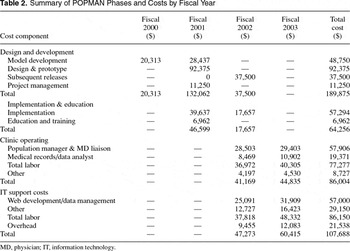
Design work for POPMAN began in April 2000 with the first release taking place in July 2001 and with subsequent releases through December 2002. The Design and Development phase consisted of four cost components:
- Model Development—The clinical, technological, and data needs required to survey and monitor a population over time were identified and discussed by a team of medical informaticists, research physicians, and IT staff for a 6-month period in both fiscal years 2000 and 2001.
- Design of Prototype, Programming, and Technical Support—The POPMAN prototype was designed and screened, the technical architecture of the program was developed and programmed, and the initial release of POPMAN occurred in July 2001. Prerelease costs include support costs for systems management, initial database management, and network management incurred throughout the programming and design processes.
- Subsequent Releases of POPMAN—Labor and overhead costs associated with developing and programming subsequent releases of POPMAN over the first few months of fiscal year 2002 were included here.
- Project Management—Beginning April 2001, the development of POPMAN was managed by a project manager whose labor time was estimated at 0.25 of a full-time equivalent during the entire Development and Design phase of the program through the end of fiscal year 2003. Project management (PM) costs through fiscal year 2001 were reported as Design and Development costs, whereas PM costs during fiscal years 2002 and 2003 were included in the Operations Support Phase.
Implementation and Education Costs
Implementation and education costs were the costs associated with populating and establishing the Diabetes Registry at the community-based health center and teaching the population manager and the physicians to use the system. These costs were primarily labor costs and included a data analyst, nonpopulation manager nurse (implementation), temporary nursing staff, the population manager, physicians at the health center using the system, and Library of Computer Science (LCS) staff to educate the former. There were no additional capital costs or supplies associated with this cost component.
Clinical Operating Costs
The costs to run POPMAN at the community-based health center consisted of labor costs for the population manager, medical records review nurse, data analyst, physician coordinator and physician users, as well as overhead and supply costs. Because POPMAN is a Web-based program, it did not require additional hardware or other assets at the community-based health center.
IT Support Costs
During the design and development phases of POPMAN, the staff in the LCS provided project management and production environment support services that ensured the software and the POPMAN prototype were protected and backed up daily, the data were preserved and monitored, and the development process took place. Since the revisions of POPMAN have been released, ongoing support services that include project management, data monitoring, tape backups, network support service, updates, and modifications have been provided by the LCS.
Patient Utilization Costs
One of the clinical objectives for using POPMAN was to improve patient care by more closely managing patients' diabetes. To most accurately assess the costs of POPMAN, increased healthcare utilization costs as well as the expected future savings must be estimated. For purposes of this study, only short-term increased utilization costs have been modeled. Future savings must be modeled independently and are not included here. The change in the number of tests and visits for study patients at the community-based health center before and after the intervention was compared with the change noted in control site clinics within the parent academic health system. Part of the increase in tests noted in the community-based health center may be due to factors other than POPMAN. To account for this, the increase in utilization noted in the test clinic was compared with the increase in utilization in the control clinics and the difference was attributed to the intervention. Results are shown in Table 1.

Summary of Costs
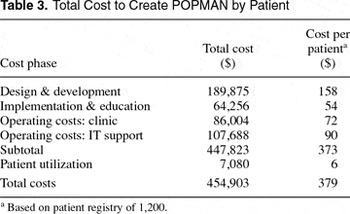
The various costs associated with the creation of POPMAN are summarized in Tables 2 and 3 by fiscal year and cost phase, respectively. It required 2.5 years to get POPMAN from initial development to implementation. Most of the costs associated with this time period are costs that may be considered one-time sunk costs and account for slightly more than $250,000. Educational costs were very minimal due to the “user friendly” design of software. Implementation costs are dependent on the size of the initial patient registry. Fiscal year 2002 is a transition year, with both Design and Development costs and operating costs being incurred. The Design and Development costs in this year consist primarily of programming costs for modifications and new releases of POPMAN. Operating IT support costs appear higher in fiscal year 2003 than 2002 due to the allocation of costs between design and development and support in fiscal 2002. Once the final version of POPMAN was released, the LCS costs were accounted for as support costs.


Fiscal year 2003 costs reflect only operating costs, which will continue to be incurred as POPMAN is used. These ongoing operating costs may fluctuate somewhat as the registry and volume of patients change. The average annual operating cost per patient to run POPMAN was approximately $90 per patient, which includes both clinical and IT support costs for a diabetes registry with approximately 1,200 patients enrolled. The clinic operating costs will vary as the patient registry changes to reflect the data analyst and medical record review nurse's time. However, as currently designed, the population manager's time should not change substantially as the patient volume increases. IT support costs, although loosely dependent on the volume of patients, are relatively fixed, assuming new versions of the software are not released and the patient volume remains within 10-fold of its current state.
Clinical Impact of POPMAN
Clinical results of the POPMAN intervention compared with three control clinics have been reported elsewhere (5,6). Briefly, physicians in the POPMAN clinic followed a significantly greater proportion of evidence-based guideline recommendations compared with physicians in a control clinic practicing “usual care” (59 versus 45 percent of recommendations followed within 3 months, p=.02) (5). In the intervention cohort, primary care physicians followed testing recommendations more often (78 percent) than therapeutic change recommendations (36 percent; p<.001). The POPMAN intervention resulted in significantly improved overall testing rates for Hba1c (+1.4 percent versus −1.4 percent change in population with annual testing, p=.004) and LDL cholesterol (+14.7 percent versus +4.0 percent change in population with annual testing, p<.001) compared with control clinics. HbA1c levels also decreased in the POPMAN clinic (from 7.9 percent to 7.6 percent), with 10.5 percent of the cohort moving into goal (HbA1c<7.0) range. This improvement compared with 4.8 percent of patients moving into range in the 3 control clinics (p=0.08). These data show the potential of IT registry-based interventions to improve widely accepted diabetes quality-of-care metrics at a very modest cost per patient.
DISCUSSION
In this analysis, we have estimated that an IT-based diabetes registry disease management demonstrated in a clinical trial to improve widely accepted diabetes quality metrics cost $450,000 to develop and operate over 3.5 years. Approximately $250,000 of these costs were sunk costs. Annual operating costs were estimated to range from $90,000 to $110,000, or approximately $90 per patient in a 1,200 patient registry.
A key issue in the development of any healthcare intervention is its transportability to other settings. The Web-based POPMAN was designed be a “reusable rocket” for diabetes management in other settings, or for management of other chronic diseases. The initial investment incurred in the Design and Development phases (the sunk costs) can be leveraged for future redesigns of POPMAN for use in population management of other chronic conditions, or for adaptation to other electronic medical record systems. Other conditions amenable to disease management include congestive heart failure, secondary cardiovascular disease prevention, asthma, rheumatic disorders, and hypertension. The evidence base for care of these diseases is strong, with well-developed guidelines and variable, often substandard care. We would expect that the initial investment of resources to transport this novel IT to other settings should not be as high as $250,000. An estimate of the range of anticipated expenses to recreate or modify POPMAN for a different chronic disease or for use in another setting include Design & Development of $50K–$150K, Implementation and Education of $30K–$50K, Clinic Operations of $40K for a registry of 1,200 patients, and IT Support of $60–$70K. These latter ongoing costs would be incurred on an annual basis and may diminish over time as familiarity with the system increases efficiency.
Although not considered when initially designed, POPMAN provides an avenue for added financial benefits to the hospital. Recent “pay for performance” contracts include incentives for optimizing care of patients with diabetes. POPMAN provides a means of tracking progress against negotiated quality targets, providing a cost-effective means of ensuring that patient panels meet negotiated quality standards. The financial benefits of this IT to hospitals and providers by means of pay for performance incentives with insurers has the strong potential to exceed the annual operating cost of POPMAN. As a result, the quality of care of patients with diabetes through use of POPMAN can potentially come at minimal net cost to the hospital. In summary, we provide cost estimates to build and operate a registry-based diabetes disease management program. Despite relatively high initial sunk costs, overall, the cost to develop and operate the registry was very modest on a per-patient basis and could even be cost saving in the setting of competitive pay for performance incentives where the data contained in the registry can help providers and hospitals meet quality targets.
CONTACT INFORMATION
Bonnie B. Blanchfield, CPA, ScD (bblanchfield@partners.org), Senior Scientist, Institute of Technology Assessment, Massachusetts General Hospital, 101 Merrimac Street, 10th Floor, Boston, Massachusetts 02114
Richard W. Grant, MD, MPH (rgrant@partners.org), Instructor, Department of Medicine, Harvard Medical School, 25 Shattuck Street, Boston, Massachusetts 02115; Senior Scientist, Institute of Technology Assessment, Massachusetts General Hospital, 101 Merrimac Street, 10th Floor, Boston, Massachusetts 02114
Greg A. Estey, EdM (getsey@partners.org), Senior Project Manager, Laboratory of Computer Science, Massachusetts General Hospital, 55 Fruit Street, Boston, Massachusetts 02114
Henry C. Chueh, MD (hchueh@partners.org), Assistant Professor, Department of Medicine, Harvard Medical School, 25 Shattuck Street, Boston, Massachusetts 02115; Director, Laboratory of Computer Science, Massachusetts General Hospital, 55 Fruit Street, Boston, Massachusetts 02114
G. Scott Gazelle, MD, MPH, PhD (scott@mgh-ita.org), Associate Professor, Department of Radiology, Harvard Medical School, 25 Shattuck Street, Boston, Massachusetts 02115; Director, Institute for Technology Assessment, Massachusetts General Hospital, 101 Merrimac Street, 10th Floor, Boston, Massachusetts 02114
James B. Meigs, MD, MPH (jmeigs@partners.org), Assistant Professor, Department of Medicine, Harvard Medical School, 25 Shattuck Street, Boston, Massachusetts 02115; Senior Scientist, Institute for Technology Assessment, Massachusetts General Hospital, 101 Merrimac Street, 10th Floor, Boston, Massachusetts 02114
Supported by a grant from the Aetna Quality Care Research Fund, an unrestricted research grant from Aventis Pharmaceuticals, and the MGH Clinical Research Program. Dr. Meigs is supported by an American Diabetes Association Career Development Award.