INTRODUCTION
During the last two decades, psychologists have become increasingly interested in representational and processing differences between nouns and verbs. There is now a large volume of literature that shows that verbs are acquired later than nouns (e.g. Bates et al., Reference Bates, Marchman, Thal, Fenson, Dale, Reznick, Reilly and Hartung1994; Fenson, Dale, Reznick, Bates, Thal & Pethick, Reference Fenson, Dale, Reznick, Bates, Thal and Pethick1994; Gentner, Reference Gentner1981, Reference Gentner and Kuczaj1982), and that they tend to be more impaired in developmental language disorders (e.g. Conti-Ramsden & Jones, Reference Conti-Ramsden and Jones1997), and there are many more cases of verb impaired than noun impaired aphasic patients (e.g. Maetzig, Druks, Masterson & Vigliocco, under review). There is also evidence that young (e.g. Bogka, Masterson, Druks, Fragioudaki, Chatziprokopiou & Economou, Reference Bogka, Masterson, Druks, Fragioudaki, Chatziprokopiou and Economou2003; Szekely et al., Reference Szekely, D'Amico, Devescovi, Federmeier, Herron, Iyer, Jacobsen and Bates2003) and elderly adults (Druks, Masterson, Kopelman, Clare, Rose & Rai, Reference Druks, Masterson, Kopelman, Clare, Rose and Rai2006) perform somewhat less well in action naming (producing verbs) than in object naming (producing nouns). These empirical findings have led researchers to consider the conceptual and linguistic differences between these two major lexical categories. This Introduction will elaborate on some of these differences.
Verbs have been argued to be more difficult than nouns on the majority of parameters, in line with the empirical findings from all populations, with the exception of brain damaged patients. In aphasia (and dementia) there is evidence for a double dissociationFootnote 1 between nouns and verbs that is linked to the constellation of the lesions. Thus, patients with lesions in the anterior part of the brain are more impaired on verbs, and patients with posterior lesions are more impaired on nouns (see Druks (Reference Druks2002) for a review; Druks et al. (Reference Druks, Masterson, Kopelman, Clare, Rose and Rai2006), Masterson, Druks, Kopelman, Clare, Garley & Hayes (Reference Masterson, Druks, Kopelman, Clare, Garley and Hayes2007) for noun–verb differences in dementia). The double dissociation is, possibly, the outcome of conceptual differences between nouns and verbs. Motor features that have anterior anatomical substrate contribute predominantly to the conceptual representation of (concrete) verbs, and sensory features that have posterior anatomical substrate to that of (concrete) nouns. The double dissociation suggests that the loci of brain damage may override the relative processing complexity of verbs. However, while this is the classical view on noun–verb differences, it remains true that there are many more patients with verb deficits and this includes not only patients with anterior, but also patients with posterior lesions (see Maetzig et al., under review), emphasising the relative difficulty of verbs.
Some reasons for verbs being more difficult than nouns
The semantic representations of verbs have traditionally been considered to be more complex than those of nouns. Huttenlocher & Lui (Reference Huttenlocher and Lui1979) argue that (concrete) nouns are categorised in hierarchies of several levels in which members of a category share many common features. For example, features that are relevant for the meaning of animals will be shared by mammals, fish and birds and by their exemplars. In such a system, basic level categories within a domain consist of clusters of shared features, while categories between domains share only a few. Different birds, for example, share features such as flying, having feathers, etc., but none with tools, such as hammer and screwdriver. In contrast to the deep hierarchical organisation of nouns, the semantic organisation of verbs is considered to be shallower and matrix-like: verbs are first classified into semantic fields, such as verbs of travel, possession and vision, and these in turn are further classified on the basis of other principles of meaning such as direction, presence or absence of an instrument, intent, etc. (Engelkamp, Zimmer & Mohr, Reference Engelkamp, Zimmer and Mohr1990). This second set of organising principles, unlike in the case of nouns, is shared by verbs belonging to different semantic fields (Miller & Johnson-Laird, 1976, cited in Huttenlocher & Lui, Reference Huttenlocher and Lui1979). Consequently, the ratio of shared features within and between categories/semantic fields is different in the case of nouns and verbs; larger for nouns and smaller for verbs, and thus the division between categories is better defined in the case of concrete nouns than concrete verbs.
It has also been suggested that the internal organisation of nouns and verbs within the lexicon is different. Concrete nouns, being labels of objects in the world, exist independently of other word categories, and they are, therefore, organised predominantly in relation to one another. Verbs, on the other hand, by virtue of their argument structure, always entail reference to related nouns (i.e. actor and the acted upon, instrument, location, etc.) and have, therefore, always an implicit syntactic context even when the noun(s) is not materialised as, for example, in imperatives.
Verbs determine the number and type of arguments around them. Different verbs have different argument structures (e.g. verbs such as knee and, yawn have only one argument; love and kick have two arguments, put and give have three arguments) and some verbs (e.g. eat, write, believe) have more than one argument structure (e.g. yesterday I did not eat much; yesterday I ate three meals; John believes that …; John believes Mary; John believes in God). In contrast, concrete nouns which appear early in the child's language do not have an argument structure and, being usually count nouns, they tend to behave grammatically similarly to each other (e.g. they pluralise by adding -s, in the majority of cases). From the point of view of the child acquiring language, therefore, generalising from one noun to another is relatively easy. Verbs, however, have numerous subcategories that are defined by the number of arguments they have. The earliest stages of language acquisition are bound to be affected by this variability since very early verbs such as read, write, dream, drink, eat, open are often used with different constellations of arguments. Thus learning one verb does not necessarily allow generalising to another, imposing a great burden on their acquisition (Gleitman, Reference Gleitman and Bloom1994).
Verbs also tend to be associated with more inflections than nouns. This may result in greater difficulties in verb use, because, in addition to lexical retrieval, decisions have to be made about which form of the verb has to be used in a particular context.
Finally, there are also frequency differences between nouns and verbs in their distribution in the vocabularies of different languages. While the vocabulary of English contains many more nouns than verbs, their token frequency is in the opposite direction. Most concrete nouns are infrequent in language use while many verbs are frequent and some of them belong to the class of the most frequent words in English, and, probably, of other languages. While the lower type frequency of verbs is unlikely to have a detrimental effect on their acquisition or availability, the expectation is that their higher token frequency should facilitate their early acquisition. However, it is interesting to note that verbs' higher token frequency does not compensate for their relative difficulty. Verbs remain disadvantaged despite being more frequent than nouns.
Differences in noun and verb acquisition
Until relatively recently there has been general agreement among researchers that nouns are acquired earlier than verbs. The conceptual saliency of objects as opposed to actions and the more compact and hierarchical semantic organisation of nouns have been singled out as the main reasons for a noun advantage in early language acquisition by Gentner, who proposed the Natural Partitions Hypothesis (Gentner, Reference Gentner and Kuczaj1982). Grammatical complexities (such as the variable argument structure of different verbs and the inflectional morphology associated with verbs) involved in verb production have also been cited as a contributing factor (e.g. Gleitman, Reference Gleitman and Bloom1994; Goldberg, Reference Goldberg and MacWhinney1998), though evidence for their role in language acquisition is more difficult to find. Other researchers argue that the amount and nature of caregiver input has the most significant influence on vocabulary acquisition (e.g. Huttenlocher, Haight, Bryk, Seltzer & Lyons, Reference Huttenlocher, Haight, Bryk, Seltzer and Lyons1991). According to these authors, the preoccupation of caregivers in the Western world with object labelling and, therefore, noun production (e.g. Goldfield, Reference Goldfield2000; Sandhofer, Smith & Luo, Reference Sandhofer, Smith and Luo2000) is the main reason for the noun advantage evidenced.
The noun advantage in language acquisition has been challenged by studies in Mandarin and Korean (e.g. Choi, Reference Choi1998; Kim, McGregor & Thompson, Reference Kim, McGregor and Thompson2000; Sandhofer et al., Reference Sandhofer, Smith and Luo2000; Tardif, Reference Tardif1996; Tardif, Gelman & Xu, Reference Tardif, Gelman and Xu1999). In Mandarin, neither nouns nor verbs are inflected, so both are (similarly) morphologically transparent, and Korean, being a pro-drop SOV language, positions verbs in salient sentence-final position. Both of these surface language factors are believed to promote verb production. There are also input factors that should additionally promote verb production. Mandarin- and Korean-speaking parents use more verbs in their speech than English-speaking parents when talking to their children (e.g. Kim et al., Reference Kim, McGregor and Thompson2000; Tardif et al., Reference Tardif, Gelman and Xu1999) and there is less emphasis on object naming in play and in other forms of social interaction (Gopnik, Choi & Baumberger, Reference Gopnik, Choi and Baumberger1996). Nevertheless, despite favourable linguistic and input factors, even Chinese and Korean children seem to use more nouns than verbs in their early utterances, though the noun advantage in these languages is greatly reduced.
The study of lexical acquisition is complex and the methods used are not entirely reliable, with different methods yielding somewhat different results. For example, the proportion of nouns in checklist data is higher than in observational data and Tardif et al. (Reference Tardif, Gelman and Xu1999) found that the proportion of nouns and verbs found in children's vocabularies depended on the context in which speech was sampled. In order to avoid problems of data collection, in the present study, the picture naming paradigm was employed. The advantage in using picture naming is that the investigator has a high degree of control over the target word to be produced.
Previous picture naming studies
Timed picture naming has been widely used in adult psycholinguistic research in order to determine the processes involved in naming and to learn about the organisation of the internal lexicon. In relation to children, the paradigm has been used to explore lexical retrieval difficulties in children with reading disabilities (e.g. Nation, Marshall & Snowling, Reference Nation, Marshall and Snowling2001) and language impairment (e.g. Dockrell, Messer & George, Reference Dockrell, Messer and George2001). However, developmental studies of picture naming with non-clinical populations are rare, and especially those comparable to the adult regression-based studies, where a range of variables that might affect picture naming performance are studied (e.g. Ellis & Morrison, Reference Ellis and Morrison1998; Snodgrass & Yuditsky, Reference Snodgrass and Yuditsky1996; Szekely et al., Reference Szekely, D'Amico, Devescovi, Federmeier, Herron, Iyer, Jacobsen and Bates2003). In particular, there are very few studies that have recorded naming latencies, and no up-to-date study has compared object and action naming in young children (but see Davidoff & Masterson, Reference Davidoff and Masterson1996, and DeBleser & Kauschke, Reference DeBleser and Kauschke2003).
Cycowicz, Friedman, Rothstein & Snodgrass (Reference Cycowicz, Friedman, Rothstein and Snodgrass1997) and D'Amico, Devescovi & Bates (Reference D'Amico, Devescovi and Bates2001) are among the very few object picture naming studies of young children. Cycowicz et al. provide normative data on a large number of object pictures and their verbal labels. Twenty-one five-year-old, 7 six-year-old and 2 seven-year-old children, as well as a group of 30 adults, participated in the study. Naming latencies were collected using an indirect method whereby the experimenter pressed a key on the computer keyboard when the child initiated a response.
The children's non-target responses were classified into synonyms, superordinates, subordinates, coordinates, component names (part of) and failures – where the response was visually similar (e.g. thimble>‘cup’) or else unrelated to the target. The children produced more alternative names for pictures than adults and the majority of non-target responses were coordinates (e.g. cherry>‘apple’). The effects of item characteristics, such as level of name agreement, word frequency, age of acquisition (AOA), familiarity, visual complexity and word length on naming latencies were also explored.
Inspection of the data revealed a substantial correlation between AOA and name agreement, showing that early acquired words tended to be associated with a high degree of agreement in the naming responses of the children. The other measures (frequency, familiarity, visual complexity and word length) also correlated with name agreement, albeit to a lesser extent. Naming latencies correlated with name agreement measures and visual complexity.
In the study of D'Amico et al. (Reference D'Amico, Devescovi and Bates2001), 34 five- to six-year-old Italian children named 250 pictures whose names were expected to be within their vocabularies. Naming latencies were recorded by voicekey activation. This method has its shortcomings because the voicekey is activated also by accidental sounds such as coughs and verbal hesitations, and pre-verbalisations (e.g. ‘that is a ball’), resulting in much unusable data (25% in the D'Amico et al. study).
Non-target responses were classified into the following categories: (1) morphological alteration (e.g. dog>‘doggie’; bicycle>‘bike’; cookie>‘cookies’); (2) synonyms (e.g. sofa>‘couch’); and (3) all responses that could not be classified according to the previous categories, including semantic, frank visual and unrelated errors. The majority of non-target responses fell into the last category. The disadvantage of this error classification is that by collapsing together semantic, frank visual and unrelated errors, the opportunity to distinguish between incorrect responses for different reasons is missed. Comparison between the overall performance of adults (reported in Bates et al., Reference Bates, Andonova, D'Amico, Jacobsen, Kohnert, Lu, Szekely, Wicha, Federmeier, Herron, Iyer, Pechmann, Devescovi, Orozco-Figueroa, Gutierrez, Hung, Hsu, Tzeng, Gerdjikova, Mehotcheva and Pleh2000) and the children showed that while children were able to carry out the naming task, adults performed better, both in terms of accuracy and speed. Adults produced valid responses on 97% of the trials, children on 75%, and children were 300 to 400 ms slower than adults. Stepwise regression revealed that for the accuracy data, frequency, AOA and visual complexity were significant. For latencies, AOA and visual complexity were significant, but frequency failed to reach significance.
Thus, previous picture naming studies have shown that children are capable of picture naming. The children in D'Amico et al.'s study managed to name 187 out of 250 pictures. In such a large battery it is most likely that the unnamed pictures were those outside the realm of the children's experience. Thus, by the age of six the difference between children's and adults' naming ability becomes much reduced, though children remain slower than adults at this stage. These studies did not, however, explore naming in children younger than five, their collection of naming latencies was not sufficiently sensitive, they analysed errors only in broad categories, and finally, they did not compare the naming of objects and actions.
Action naming using line drawings is not without methodological problems. It is plausible that there are differences in the demands of object and action picture naming because objects are static while actions are dynamic, and this difference could have a detrimental effect on action naming performance. Because of this concern, Davidoff & Masterson (Reference Davidoff and Masterson1996) carried out a study where children aged three and five were asked to produce the names of objects and actions using video clips. The results replicated the findings of their first study using static pictures (where they found more errors for actions than objects). We also think that line drawings are very different from naturalistic stimuli not only for actions but also for objects, because line drawings, in contrast to real objects, are two dimensional, colourless and schematic. Therefore, all picture naming, not only action picture naming, requires interpretation and inference making, though it is possible that action naming requires more, not only because actions are dynamic but also because they may involve relationships and objects. It is unquestionable that a picture naming task (of actions and of objects) requires not only linguistic work, but also visual and semantic interpretation. Nevertheless, it is well known that young children are excellent readers of pictures, and so picture naming seems a suitable research tool for exploring their vocabulary knowledge.
The present study
Since the debate about noun and verb acquisition is still unsettled, it seemed that a systematic comparison between the availability of nouns and verbs in young children, using matched picture naming materials, may be informative. Clearly, picture naming studies cannot be carried out with very young children, and it is plausible that picture naming involves different processes than spontaneous speech. Nevertheless, success or failure in picture naming is a reflection on word knowledge, and if a noun advantage is indeed universal and is due to the conceptual/semantic salience of object labels, we would expect to find traces of it at a somewhat later stage of language acquisition and in a picture naming set-up.
The first aim of the study was to explore the extent to which picture naming data would replicate evidence already available from acquisition studies that use more naturalistic data-collection methods. The materials that we used – pictures from the Object and Action Naming Battery (Druks & Masterson, Reference Druks and Masterson2000) – are particularly suitable for such an inquiry since the items have high levels of name agreement among adult speakers, and the nouns and verbs are closely matched on adult rated AOA.
Our second aim, as in the D'Amico et al. (Reference D'Amico, Devescovi and Bates2001) study, was to see whether the predictor variables that have been shown to affect adult picture naming also affect the naming of young children. We decided to examine the effects of word length, word frequency, rated picture complexity and rated imageability. Length, frequency and visual complexity have been shown to affect naming performance in adult object naming studies (e.g. Ellis & Morrison, Reference Ellis and Morrison1998; Morrison, Ellis & Quinlan, Reference Morrison, Ellis and Quinlan1992) and in the child object naming studies of Cycowicz et al. (Reference Cycowicz, Friedman, Rothstein and Snodgrass1997) and of D'Amico et al. (although word length did not affect naming in the latter study). Imageability has been shown to be a significant predictor of object picture naming performance in some adult studies (e.g. Bates, Burani, D'Amico & Barca, Reference Bates, Burani, D'Amico and Barca2001; Bogka et al., Reference Bogka, Masterson, Druks, Fragioudaki, Chatziprokopiou and Economou2003; Ellis & Morrison, Reference Ellis and Morrison1998) but not in others (e.g. Barry, Morrison & Ellis, Reference Barry, Morrison and Ellis1997; Morrison, Ellis & Quinlan, Reference Morrison, Ellis and Quinlan1992).
Our third aim was to explore whether there was a difference in the variables that predict young children's naming performance with objects and actions. If the pattern of association of variables with object and action naming performance is different then this may be informative about the different means by which nouns and verbs are acquired. For example, several accounts stress repeated exposure to verbs and their referents as critical for verb acquisition, while the semantic/conceptual saliency of objects is emphasised as important for noun acquisition (see, for example, Sandhofer et al., Reference Sandhofer, Smith and Luo2000). Thus, in the present context, input frequency might be expected to be more strongly associated with young children's action naming performance than their object naming performance. In the study of Cycowicz et al. (Reference Cycowicz, Friedman, Rothstein and Snodgrass1997), the measure of word frequency involved a count of words in books written for children and D'Amico et al. (Reference D'Amico, Devescovi and Bates2001) also used a similar measure, in addition to an adult spoken word frequency count. The problem, however, with using children's printed frequency, as noted by D'Amico et al., is that it is likely to incorporate, at least in part, the measure of subjective AOA. This is because books for children are written by adults, who may use words that they believe to be accessible to children. Since it has already been shown that rated AOA is highly correlated with children's picture naming performance, this makes the interpretation of frequency effects using children's printed word counts ambiguous. The measure of frequency used in the present study, therefore, was adult spoken frequency. We thought that this would provide a purer measure of frequency of exposure for young children than alternative frequency counts.
The fourth aim of the present study was to conduct a qualitative analysis of the error responses collected in the first experiment and, in order to do so, we developed fine-grained error categories. We anticipated that differences in the pattern of error types to actions and objects would shed further light on the underlying representations of nouns and verbs in young children.
In order to fulfil these aims we carried out two naming studies using object and action pictures with verbal labels matched on rated AOA. In the first study three- and five-year-old children participated, and in the second study, the children were all five years old. The stimuli were the same in both experiments. In the first, we carried out analyses in terms of naming accuracy and in the second, in terms of both accuracy and latency.
Experiment 1
Method
Participants
Participants were 30 children aged 3 ; 0–3 ; 6 and 32 children aged 5 ; 0–5 ; 6. The children were tested at two nurseries and an infant school in the town of Colchester, UK. Children with language or learning difficulties and children with sensory problems were excluded from the sample. All children spoke English at home and were deemed to be making normal progress by nursery staff/teachers.
Materials and apparatus
The stimuli were black and white line drawings of 100 objects and 100 actions from Druks & Masterson's (Reference Druks and Masterson2000)Object and Action Naming Battery. The pictures obtained high levels of name agreement (at least 93%) when 40 adult participants (ages 22–48 years) named the pictures using a single word. The object and action picture names were matched for rated AOA. Information about imageability of the words, word length and visual complexity of the pictures is available for each item in the Battery. For the purposes of the present study we also obtained information on adult spoken word frequencies of the items from the CELEX Lexical Database (see below for details).
AOA ratings were obtained by Druks & Masterson (Reference Druks and Masterson2000) from 40 adult participants (aged 22–41 years). Participants were asked to estimate when in their lives they learnt a word, using a seven-point scale. Each point on the scale represented a two-year age band ranging from 1 (representing 0–2 years of age) to 7 (representing 13 years of age and older). In order to ascertain that the subjective estimation of AOA that we used to match the action and object pictures is valid, and hence our materials are a suitable tool for studying picture naming in young children, we correlated the ratings with the developmental norms from the MacArthur CDI (as reported in Fenson et al., Reference Fenson, Dale, Reznick, Bates, Thal and Pethick1994). A subset of the items from Druks & Masterson (44% of noun items and 39% of verb items) were listed on the CDI. A high degree of correlation between the subjective adult ratings of AOA and the CDI norms (r=0·624 for nouns and r=0·620 for verbs, p<0·001 in both cases) was found.
Imageability ratings for the written labels for all the items were collected from 36 participants (aged 23–40 years). The instructions used by Paivio, Yuille & Madigan (Reference Paivio, Yuille and Madigan1968) were adopted. A seven-point scale (1=words arousing images with the greatest difficulty and 7=words arousing images most readily) was used. The instructions explicitly mention sensory experience in the form of mental pictures or sounds. Visual complexity ratings for the pictures were collected from 40 participants (aged 15–55 years). Instructions were adapted from Snodgrass & Vanderwart (Reference Snodgrass and Vanderwart1980) and referred to the amount of detail in the pictures. A seven-point scale (1=simple, 7=very complex) was used (see Druks & Masterson, Reference Druks and Masterson2000, and Masterson & Druks, Reference Masterson and Druks1998, for further details).
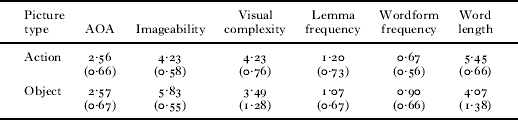
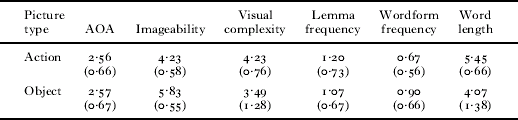
For spoken frequency we used the log values for lemma and wordform frequencies taken from the CELEX database (Baayen, Piepenbrock & van Rijn, Reference Baayen, Piepenbrock and van Rijn1993).Footnote 2Table 1 provides item characteristics for the stimuli in terms of AOA, imageability, visual complexity, lemma and wordform spoken frequency and word length (in phonemes). T-tests were carried out to compare the characteristics of the object and action items. There were no significant differences in AOA ratings (t(198)=0·14), or spoken frequency (t(198)=1·29). There was however, a significant difference in visual complexity (t(198)=5·01, p<0·001), with higher ratings for the action pictures. The difference in imageability ratings was also significant (t(198)=20·16, p<0·001), with action picture labels receiving lower ratings. Finally, the action labels were significantly longer than the object labels (t(198)=4·06, p<0·001). This is due to the fact that the -ing form of the verb was used for naming the action pictures.
Mean stimulus characteristics for the action and object pictures (standard deviations are in brackets)
The pictures were presented by means of an Apple Macintosh Powerbook G3/500 Mhz computer with 14·1″ screen with resolution of 1024×768 pixels. Pictures were presented in bitmap mode, in black outline on a white background, and were converted from the original pcx files (as supplied in the Object and Action Naming Battery) to pct format for presentation using Powerpoint (Macintosh version 11.1). The pictures were centred within a 16 cm×16 cm frame on each Powerpoint slide.
Procedure
Children were tested individually in a quiet room at their nursery/school. They were asked to name the pictures using a single word. Presentation of the action and object pictures was blocked and, prior to the presentation of each block, children were told which picture type they were to be presented with. In the case of the pictures of actions they were asked to name them using the progressive (-ing) form of the verb. The -ing form of the verb was selected as the target because, according to our experience, this is the most natural response to action pictures. Nevertheless, stem responses were also accepted as correct. Twelve action pictures and twelve object pictures not used in the main task were presented for practice. Each set of practice items was presented before the relevant block of trials. Two random orders of the action pictures and two random orders of the object pictures were rotated across children during testing. Half of the children saw the object pictures first, and half the action pictures first. In order to avoid fatigue, the three-year-olds were presented with sets of 20 pictures at a time, and the five-year-olds were presented with sets of 35 pictures at a time. Thus, it took ten sessions for the three-year-olds, and six sessions for the five-year-olds, to complete the whole set. Sets were presented at the rate of one a day, where possible and sessions lasted about ten or twenty minutes, depending on the child's level of concentration.
Individual trials involved the experimenter pressing a key on the computer keyboard, which initiated presentation of a picture. The picture remained on the screen until the experimenter pressed a key for the next trial. During testing, the experimenter noted any deviations in naming from the exact target name. Testing sessions were also audio-recorded and later transcribed by DG and checked by JM.
Results
Percentage error rates were calculated for the object and action pictures for the two age groups of children. A summary of the results is given in Table 2 according to picture type and age group. The data can be found in Appendix A.
Mean percentage error in naming the object and action pictures by children in the two age groups in Experiment 1 (standard deviations are in brackets)

ANOVAs were carried out on the subject and item data (denoted as F 1 and F 2 respectively). The variables were age group (three years, five years) and picture type (objects, actions). The five-year-olds were significantly more accurate than the three-year-olds (F 1(1, 60)=91·10, p<0·001, F 2(1, 198)=272·44, p<0·001). There was a significant effect of picture type, with object pictures producing fewer errors than action pictures, but this was only significant by subjects (F 1(1, 60)=9·63, p=0·003, F 2<1). The interaction of picture type and age group was significant (F 1(1, 60)=7·91, p=0·007, F 2(1, 198)=4·67, p=0·032).
Simple main effects revealed that the five-year-olds were more accurate than the three-year-olds for both the objects (F 1(1, 120)=62·98, p<0·001, F 2(1, 198)=102·87, p<0·001) and the actions (F 1(1, 120)=98·46, p<0·001, F 2(1, 198)=174·23, p<0·001). However, the object pictures produced significantly fewer errors than the action pictures for the three-year-olds (F 1(1, 60)=16·95, p<0·001, F 2(1, 396)=3·95, p=0·047) but not the five-year-olds (F 1<1, F 2<1).
Regression analyses
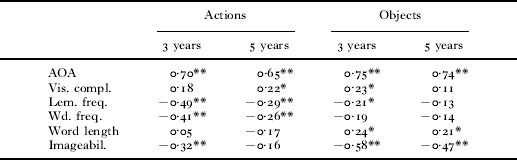
Before conducting regression analyses with the data we examined relationships between rated AOA, rated visual complexity, word frequency, word length and rated imageability and naming accuracy for the three-year-olds and the five-year-olds, using simple correlation (calculated over items). A summary is reported in Table 3. We also examined the distributions of the individual variables for skewedness. All variables approximated normal distribution.
Correlations of the predictor variables and error in naming the actions and objects for the two age groups in Experiment 1
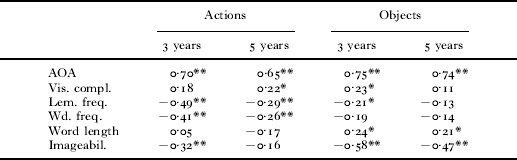
Vis. compl. – visual complexity, Lem. freq. – lemma spoken frequency, Wd. freq. – wordform spoken frequency, Imageabil. – imageability.
* p<0·05, ** p<0·01.
The results revealed that, in the main, the naming performance of the two age groups was affected similarly by the range of variables measured. The exceptions were that: (1) the correlation of action naming accuracy and visual complexity was significant for the five-year-olds but not the three-year-olds; (2) the correlation of action naming accuracy and imageability was significant for the three-year-olds but not the five-year-olds; and (3) the correlations of object naming accuracy with visual complexity and lemma frequency were significant for the three-year-olds but not the five-year-olds.
We expected a high correlation of naming accuracy with adult rated AOA, since this has been found in a number of previous studies, and this was confirmed here. For both the action naming data and the object naming data there were fewer errors with earlier acquired words. The correlations also revealed that both measures of word frequency correlated strongly with accuracy for action naming, for both age groups, with fewer errors to high frequency words. However, this was not the case for object naming, where, as noted above, there was a (weak) significant correlation with lemma frequency only in the data from the three-year-olds. The correlation of word length with accuracy was significant for object naming for both age groups, with longer words producing more errors, but this was not the case for action naming. Finally, the correlation of rated imageability with object naming performance was highly significant for both the older and younger children, with fewer errors for highly imageable concepts, while, as noted above, for action naming the correlation was significant only in the data from the three year-olds.
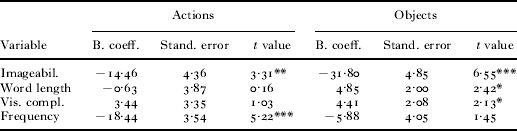
Separate simultaneous multiple regression analyses were carried out on the data for the three-year-olds and the five-year-olds. We included as predictor variables only those that might plausibly be associated with object or action naming. We included imageability, since it has been considered to have its locus within the semantic system (see, for example, Ellis & Morrison, Reference Ellis and Morrison1998) and so may indicate differences in the semantic organisation of nouns and verbs, and word length as a potential indicator of difficulty with the production of nouns and verbs. Visual complexity was included as a potential measure of the perceptual difficulty of the pictures, and finally word frequency was included as a measure of children's exposure to the nouns and verbs and their referents. The variable used was spoken lemma frequency, since this produced higher correlations with performance than wordform frequency.
Although we used rated AOA as a matching variable for our stimuli we did not include it in the regression analyses since it has been repeatedly demonstrated that this variable is strongly correlated with children's picture naming accuracy (and this was confirmed in the present data with the simple correlations). In our view, this demonstrates that adults are adept at providing estimates of the age at which children learn words, and this variable is not of interest for our aim of examining possible differences in the underlying representations of nouns and verbs. The results of the regression analyses are given in Table 4a for the three-year-olds and Table 4b for the five-year-olds.
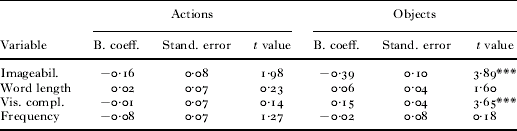
Multiple regression analyses with the error data for the three-year-old children in Experiment 1
* p<0·05, ** p<0·01, *** p<0·001.
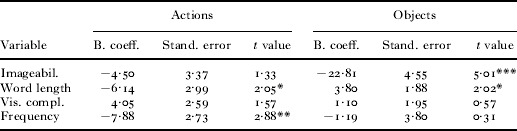
Multiple regression analyses with the error data for the five-year-old children in Experiment 1
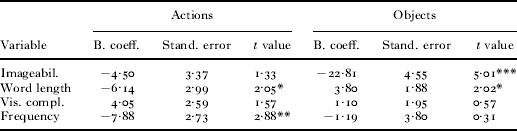
* p<0·05, ** p<0·01, *** p<0·001.
The analyses for the three-year-olds revealed that imageability and spoken frequency were significant predictors of action naming, while imageability, word length and visual complexity were significant predictors of object naming.
The analyses for the five-year-olds revealed that word length and spoken frequency were significant predictors of action naming performance, while imageability and word length were significant predictors of object naming performance.
Qualitative analysis of the errors
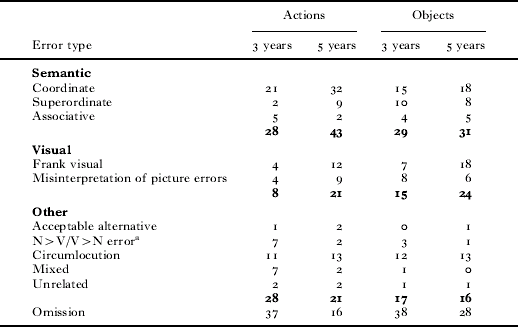
A qualitative analysis of the error responses was carried out. We distinguished between semantic type errors, visual type errors and other errors. Among the semantic type errors coordinate, superordinate and associative errors were included. In the case of coordinate errors the response is often not only semantically but also visually similar to the target. For example, cherry>‘apples’, cigar>‘cigarette’, weaving>‘knitting’, sailing>‘floating’. Examples of superordinate errors were over-general responses, such as cherry>‘fruit’, fruit>‘food’, planting>‘gardening’, watering>‘gardening’. In the case of associative errors there was a contextual relationship between target and error, for example, conductor>‘orchestra’, witch>‘Halloween’, floating>‘drowning’, knocking>‘opening’.
Among the visual type errors we included frank visual errors and misinterpretation of picture errors. Examples of frank visual errors are button>‘biscuit’, nest>‘hedgehog’, brain>‘hairnet’, dropping>‘yo-yoing’, knocking>‘cleaning’. In these errors there is no semantic relationship between target and response, and, in order to understand and classify these errors, the pictures themselves have to be taken into consideration: some visual aspect of the picture led the children to misinterpret the pictures. Examples of misinterpretation of picture errors are bee>‘beehive’, judge>‘wig’, bleeding>‘holding arm’, shaving>‘reflecting’. In these errors children named objects or actions that were present in the picture but did not constitute the target response. The children failed to make the necessary inferences in order to identify the true intention of the picture.
Among ‘other errors’ we listed noun-to-verb errors and verb-to-noun errors, circumlocutions, mixed errors and unrelated errors. Noun-to-verb errors were those when, instead of the object name, the verb associated with the object was produced (e.g. bell>‘rings’, ball>‘bouncing’). Verb-to-noun errors were when the object involved in the action (and present in the picture) was named (e.g. typing>‘typewriter’, dripping>‘tap’). Circumlocutions involved a multiword description of the target picture instead of a single lexical label (e.g. shower>‘water spray’, swinging>‘using a swing’, dripping>‘tap running’). In mixed errors, two error categories could be discerned in the response. In the case of unrelated errors we could not find a relationship between target and response. Finally, acceptable alternatives (i.e. synonyms or elaborated responses, such as bus>‘double decker’, watch>‘wristwatch’, typing>‘typewriting’, ringing>‘bell-ringing’), which are strictly speaking not errors, were also listed among ‘other errors’, since they were non-target responses. Table 5 gives the percentages of errors and omissions, broken down according to category, for the children in the two age groups.Footnote 3
Naming error, expressed as a percentage of total error, for the different categories for the two age groups in Experiment 1
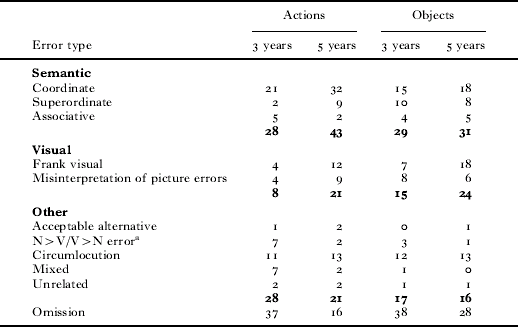
a N>V – verb produced for object picture, V>N noun produced for action picture.
Overall, the three-year-olds produced a high rate of omissions (‘don't know’ responses) for both types of picture, and there were many coordinate errors (as in Cycowicz et al., Reference Cycowicz, Friedman, Rothstein and Snodgrass1997). The predominant type of error for the five-year-olds was semantic (coordinates, superordinates and associative errors). In relation to the comparison of error types in response to object and action pictures, prior to carrying out the study we had anticipated that there would be a difference, which might reflect differences in their underlying semantic representations. However, the pattern of errors for the three-year-olds was very similar for both picture types. For the five-year-olds, the only difference we found was that there were more semantic type errors to actions than objects and a higher rate of omission errors to the objects than the actions.
Experiment 2
In Experiment 1 a verb disadvantage, in terms of picture naming accuracy, was observed for the three-year-olds but not for the five-year-olds. This result suggests that the verb disadvantage that has previously been observed in observational/diary studies, and that was examined here using the picture naming paradigm, is present at the start of language acquisition but disappears by the age of five. The possibility remains, however, that children will show greater difficulty in producing verbs than nouns in picture naming if a more sensitive measure of performance is used. For this reason, in Experiment 2 we administered the object and action naming task to a further group of five-year-old children, but this time we recorded naming latencies in addition to errors. We analysed the accuracy and latency data in this experiment using factorial and regression techniques in the same manner as in Experiment 1. We did not, however, carry out a qualitative analysis of the error responses in Experiment 2, as the analysis of errors in Experiment 1 had revealed a broadly similar pattern of errors for actions and objects.
Method
Participants
Participants were 32 children aged 5 ; 0–5 ; 6. They were recruited from two infant schools in the town of Chelmsford, UK. As in Experiment 1, children with language or learning difficulties or sensory problems were excluded from the sample. All children had English as their home language and were considered to be making normal progress by their teachers.
Materials and apparatus
The stimuli and apparatus were the same as used in Experiment 1, except that a short ‘beep’ was incorporated into the Powerpoint presentation to coincide with the keypress that initiated each trial. Latencies were recorded using the Soundstudio audio recording software (version 2.0.7, Felt Tip Software). This package provides a continual audio-recording of the test session, which was used in conjunction with the digitised waveform and timeruler to transcribe naming latencies in milliseconds. The beep was the signal to begin timing on the waveform record. Use of the package means that initial frication, which can result in delayed onset detection when using voicekey recording (e.g. Treiman, Mullenix, Bijeljac-Babic & Richmond-Welty, Reference Treiman, Mullenix, Bijeljac-Babic and Richmond-Welty1995), is no longer a problem. Furthermore, latencies for responses involving false starts and other pre-response vocalisations (e.g. ‘um’, ‘er’) are not lost to the analysis (as is the case with voicekey recording, where any sound closes the timing relay), because latencies can be calculated for target responses in the case of self-corrections, false starts and other pre-response vocalisations.
Procedure
Children were tested individually in a quiet room at their school. The instructions and presentation orders were the same as in Experiment 1. In order to avoid fatigue, children were presented with sets of 35 pictures at a time. Thus it took six sessions to complete the battery. Sets were presented at the rate of one a day, where possible, and sessions lasted about ten to twenty minutes, depending on the child's level of concentration. Children were asked to speak as clearly as they could, to use a single word for each picture (for actions the -ing form) and were told that the time they took to name each picture was being recorded. The children's responses were recorded using Soundstudio (see above) and transcribed and checked, as in Experiment 1, and errors made were noted by the experimenter during testing.
Results
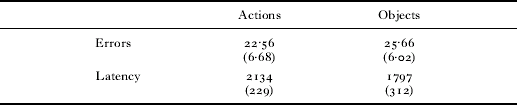
Percentage error rates and mean latencies were calculated for the object and action pictures. The data can be found in Appendix B. For two of the action pictures (begging and weaving) and two of the object pictures (judge and nun) latencies could not be calculated because there were no correct responses. A summary of the results is given in Table 6. It can be noted that the error rate here is somewhat higher than that reported for the five-year-olds in Experiment 1. This may be due to the fact that the five-year-olds in Experiment 2 (mean age=5·20) were on average younger than those in Experiment 1 (mean age=5·35 years). The difference in age, although slight, is significant (t(62)=3·71, p<0·001).
Mean percentage error and latencies (in ms) for naming the object and action pictures in Experiment 2 (standard deviations are in brackets)
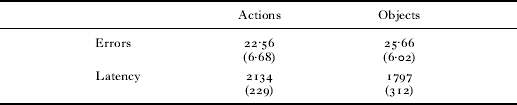
The subject and item error data were analysed with t-tests (repeated measures for the subject data and unrelated for the item data). There was a significant effect of picture type in the analysis by subjects (t 1(31)=3·134, p=0·004), with fewer errors for actions than objects; however, the difference was not significant by items (t 2(198)=0·753, p=0·452). The same analyses were carried out on the latency data. The effect of picture type was significant in both the subject and items analyses (t 1(31)=9·777, p<0·001, t 2(194)=4·904, p<0·001), with longer latencies for the action pictures.
Regression analyses
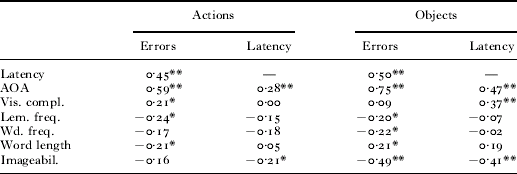
As in Experiment 1, before conducting regression analyses we examined the relationships between the independent variables and all the variables for which we had values using simple correlation. A summary is reported in Table 7.
Correlations of the predictor variables and error and latencies in naming the actions and objects in Experiment 2
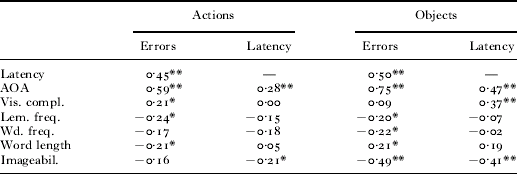
Vis compl. – visual complexity, Lem. freq. – lemma spoken frequency, Wd. freq. – wordform spoken frequency, Imageabil. – imageability.
* p<0·05, ** p<0·01.
The pattern of correlations for the accuracy data was largely similar to that observed in the data from the five-year-old children in Experiment 1. That is: (1) there was a strong correlation with rated AOA for both action and object naming accuracy; (2) imageability was highly correlated with object naming accuracy but not action naming accuracy; and (3) the correlation with visual complexity ratings was significant for action naming accuracy but not object naming accuracy. The pattern of correlations with the two frequency measures was different in Experiment 2 to that obtained in Experiment 1. In the present experiment both lemma and wordform frequency were significantly correlated with object naming accuracy, but only lemma frequency correlated significantly with action naming accuracy. In Experiment 1, the correlation of object naming accuracy and word frequency was not significant for either measure, while both correlated with action naming accuracy. A further difference in results from Experiment 1 is that word length was not significantly correlated with action naming accuracy in the results from the five-year-olds in that experiment, while the correlation was significant in Experiment 2.
Turning to the latency data, the correlation with rated AOA was again highly significant for both the objects and actions. There was also a strong correlation of rated imageability and object naming latency, in line with the results obtained for accuracy. The correlation of imageability with action naming latency was also significant, although weaker than that for object naming. This result was not obtained in the accuracy data. The only other significant correlation was between object naming latency and visual complexity ratings, again not observed in the accuracy data.
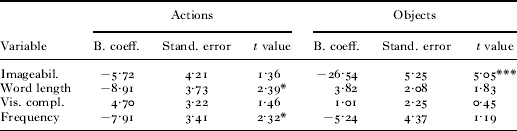
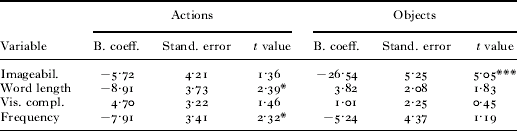
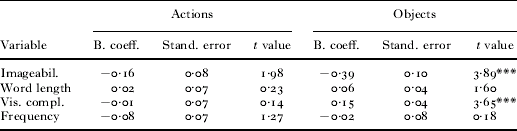
Separate simultaneous multiple regression analyses were carried out on the accuracy and latency data. The predictor variables were the same as those in Experiment 1: imageability, lemma spoken word frequency, word length and visual complexity. The results of the analyses are given in Table 8a and Table 8b.
Multiple regression analyses with the error data from Experiment 2
* p<0·05, ** p<0·01, *** p<0·001.
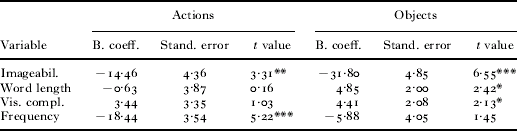
Multiple regression analyses on the latency data from Experiment 2
* p<0·05, ** p<0·01, *** p<0·001.
The analyses with the accuracy data revealed that frequency and word length predicted action naming performance, while imageability was a significant predictor of object naming performance. These results are in line with those obtained for the group of five-year-olds in Experiment 1. The only difference is that in Experiment 1 the effect of word length was significant for object naming and it was not here.
The analyses with the latency data revealed that the overall regression equation was not significant for action naming. In the case of object naming, imageability and visual complexity were significant predictors.
DISCUSSION
The present study used the picture naming paradigm with three- and five-year-old children to explore differences in naming objects and actions. We used regression analysis in an attempt to identify the variables that predict naming performance. We also reported qualitative analysis of the children's errors, in order to uncover possible differences in the underlying representation of object labels/nouns and action labels/verbs.
The results obtained in Experiment 1 with the three-year-old children support previous studies, using different methodologies, which show that verbs are acquired later than nouns. The verb disadvantage in terms of accuracy disappeared in the present study by the age of five. Clearly, children by this stage achieve adult-like status, when measured in terms of accuracy using the Object and Action Naming Battery. However, when latencies (a more sensitive measure of name retrieval than errors) were compared, a difference in favour of objects was apparent. Longer naming latencies for action pictures than object pictures have also been reported, using the same materials, for young and elderly adult participants (e.g. Bogka et al., Reference Bogka, Masterson, Druks, Fragioudaki, Chatziprokopiou and Economou2003; Druks et al., Reference Druks, Masterson, Kopelman, Clare, Rose and Rai2006). The adult data, in conjunction with the five-year-old latencies, indicate that action naming may be inherently more difficult than object naming.
Imageability and spoken frequency were the most robust predictors of naming performance in the regression analyses. Imageability was a significant predictor of object naming accuracy for both age groups in Experiment 1 and it was a predictor of action naming accuracy for the three-year-olds. Spoken frequency, on the other hand, was a robust predictor of action naming for both age groups, but it did not predict object naming. Experiment 2 confirmed the results for the older age group in Experiment 1, that is, imageability was a significant predictor of object naming accuracy, while spoken frequency predicted action naming accuracy. In the latency data, imageability was again a predictor of object naming but not of action naming.
The finding that different variables predicted object and action naming performance in both age groups suggests that the underlying semantic representations of nouns and verbs are different. In the Introduction we reviewed hypotheses arguing for different semantic organisation of nouns and verbs, with the former characterised by hierarchical structures and many correlated features, and the latter by matrix-like structures with looser and shallower organisation. Considering this, it is conceivable that imageability will have a different involvement in nouns and verbs, such that it would have a profound effect on the acquisition/availability of nouns and less on the acquisition/availability of verbs.
Rated imageability is measured by asking adults to rate the ease with which they can conjure up an image of a concept. The ratings, therefore, are likely to capture the presence/absence of sensory and perceptual features which constitute the semantic make up of objects to a larger extent than that of actions. Indeed, Funnell, Hughes & Woodcock (Reference Funnell, Hughes and Woodcock2005) suggest that the structural representations of early nouns are supported by detailed and specific perceptual information, obtained by personal interaction with the objects themselves. This is the reason for their ease of availability. Later acquired object names, on the other hand, are learnt in less direct situations and have, therefore, a less detailed, more rudimentary structural description. While Funnell et al. do not make claims in relation to imageability, it appears that early acquired objects/nouns have the same properties that highly imageable nouns are defined by. Funnell et al. do not discuss verbs; however, we think that what is true for later acquired nouns is true for all verbs. That is, sensory features do not so strongly underpin their semantic representations as in the case of nouns. Motor features, on the other hand, are crucial for the representation of action verbs.
Action naming was consistently predicted by spoken frequency for both the younger and older children. This supports the view that verb learning is a gradual and incremental process that takes place over multiple instances (e.g. Gleitman, Reference Gleitman and Bloom1994; Tomasello, Reference Tomasello1992). Sandhofer et al. (Reference Sandhofer, Smith and Luo2000), for example, showed that the most frequent nouns in caregivers' speech to young children tend to be count nouns, labels of solid objects that tend to behave grammatically similarly to each other (e.g. they pluralize by adding -s, in the majority of cases). From the point of view of the child acquiring language, therefore, generalising from one noun to another is relatively easy. The most frequent verbs in the input to young children, in contrast, were diverse in meaning and had variable argument structures. Thus learning one verb does not necessarily allow generalising to another, imposing a great burden on their acquisition (e.g. Gleitman, Reference Gleitman and Bloom1994). Therefore, frequency of exposure is essential for verb acquisition, and possibly less so for noun acquisition.Footnote 4
The qualitative analyses of the error responses from Experiment 1 revealed that the three-year-olds made a large number of omissions in the case of both actions and objects. The omissions tended to be on items that are outside the realm of experience of young children, such as cigar, judge and waitress, weaving, begging and shaving. The large number of omissions and errors overall may explain the lack of a difference in the relative distribution of error types for objects and actions in this age group. Animal pictures, however, were well named, similarly to the findings of D'Amico et al. (Reference D'Amico, Devescovi and Bates2001), Funnell et al. (Reference Funnell, Hughes and Woodcock2005) and McKenna & Parry (Reference McKenna and Parry1994). The five-year-old children, who made significantly less errors overall, made more semantic type errors (coordinates, superordinates and associative errors) than the younger children, and they were more likely to make such errors in response to actions than to objects. With object pictures, there were more omissions. This difference in error type may reflect the semantic representation differences between nouns and verbs. It is possible that the hierarchical semantic organisation of nouns prevented semantic errors in naming objects since the alternative – the superordinate – being often abstract, would not be available to the children (perhaps not yet acquired). In the case of verbs, whose semantic organisation is shallower/more diffuse, when the target response is not known, it is possible for the children to access a verb related in meaning.
To conclude, our study showed that picture naming is a suitable paradigm to use with children as young as three years old, and that naming latencies could be reliably collected with five-year-old children with no loss of data by using a methodology that did not involve the experimenter's keypress or voicekey activation as used in similar previous studies. We were able to show that the noun advantage reported in previous studies using different methodologies is replicable in picture naming. We also found a difference in the variables that affected object and action naming in terms of both accuracy and latencies. We interpreted this as being due to the differing underlying semantic representations of nouns and verbs, and the different manner in which they are acquired. Finally, since we found that action naming (and verb production) was more difficult for the children than object naming, an interest for a future study would be to focus on action naming and explore more systematically than was possible in the present study (due to the constraints of having to match the action items with the object items) the factors that contribute to their complexity.
APPENDIX A
Stimuli in ascending order of difficulty with number of errors made by the three-year-olds (n=30) and the five-year-olds (n=32) in Experiment 1

APPENDIX B
Stimuli in ascending order of difficulty with number of errors and latencies for the five-year-olds (n=32) in Experiment 2