




No CrossRef data available.
Article contents
Gender differences in the transition to early parenthood
Published online by Cambridge University Press: 10 February 2006
Abstract
Data gathered over the course of a 25-year longitudinal study of 1,055 young people was used to examine gender differences in the onset of early parenthood and the developmental processes that place males and females at risk of becoming a young parent. Results revealed clear gender differences in the timing of early parenthood, with females being twice as likely as males to become a parent between the ages of 16 and 25 years. In contrast, the risk factors and life course processes that placed males and females at risk of an early transition to parenthood were very similar. Two exceptions were a gender-specific effect for maternal age and exposure to parental change, suggesting that having been raised by a younger mother and having experienced parental changes in your family of origin increased risks of early parenthood for females but not males. These findings contribute to our understanding of the effects of gender on life course development.
This research was funded by grants from the Health Research Council of New Zealand, the National Child Health Research Foundation, the Canterbury Medical Research Foundation and the New Zealand Lottery Grants Board.
Information
- Type
- Research Article
- Information
- Copyright
- © 2006 Cambridge University Press
In recent years, there has been considerable theoretical and empirical interest in the importance of gender for child development and psychopathology across a range of areas, including crime and antisocial behavior (e.g., Keenan, Loeber, & Green, 1999; Silverthorn & Frick, 1999), mental health (e.g., Crick & Zahn-Waxler, 2003; Nolen-Hoeksema & Girgus, 1994), physical health (e.g., Fillingim, 2003), pregnancy/childbearing (e.g., Coley & Chase-Lansdale, 1998), and suicidal behavior (e.g., Beautrais, 2002). Of particular interest has been the extent to which there are gender differences and similarities in the developmental trajectories and causal processes that shape male and female development, with some arguing that different developmental models need to be developed for males and females (e.g., Keenan & Shaw, 1997; Silverthorn & Frick, 1999), and others suggesting that substantial overlap may exist in the risk factors and life course processes that influence male and female development (e.g., Moffitt, Caspi, Rutter, & Silva, 2002).
One area of development in which gender differences are perhaps most likely to manifest is in the transition to early parenthood given the differing biological and social roles that males and females have in the conception and care of children. For example, compared to their early parenting male peers, younger mothers are much more likely to assume the role of primary caregiver, and in many cases, may be the sole parent. Consistent with this is research showing that an early transition to parenthood has far-reaching physical, social, and emotional consequences for females. These include educational underachievement (Klepinger, Lundberg, & Plotnick, 1995; Marini, 1984); socioeconomic disadvantage (Furstenberg, Brooks-Gunn, & Morgan, 1987; Williams, McGee, Olaman, & Knight, 1997), welfare dependence (Moore, Morrison, & Glei, 1995), reduced marital opportunities (Furstenberg et al., 1987), maternal depression (Colletta, 1983; Williams et al., 1997), and parenting problems, including increased rates of physical punishment and child abuse (Haskett, Johnson, & Miller, 1994; Woodward & Fergusson, 2002). Adding to these concerns are recent findings suggesting that early motherhood may now be an even more deviant and disadvantaging life event than in previous decades (Butler, 1992; Maughan & Lindelow, 1997; Moffitt & Team, 2002), with many contemporary young mothers now raising their children in mother headed households, with little or no financial or emotional support from a partner, and in a socioeconomic climate of declining benefit levels, qualification inflation, and increased labor market demands (Hotz & Williams-McElroy, 1997).
Given recent debates about the importance of gender for life course development and the differing biological and social roles of younger mothers and fathers, it is surprising that there have been no systematic evaluations of the extent to which gender differences exist in the prevalence and developmental processes associated with an early transition to parenthood. Until recently, almost all studies concerned with early parenthood have been based on samples of younger mothers and their children (Brooks-Gunn & Chase-Lansdale, 1995; Coley & Chase-Lansdale, 1998; Furstenberg, Brooks-Gunn, & Chase-Lansdale, 1989). Consequently, very little is known about the full extent of early fatherhood or the developmental processes that place young men at risk of fathering a child and/or becoming a parent at an early age. Of the handful of recent studies that have examined developmental issues relating to early fatherhood, virtually all have been based on all male samples (Dearden, Hale, & Blankson, 1994; Fagot, Pears, Capaldi, Crosby, & Leve, 1998; Jaffee, Caspi, & Moffitt, 2001; Pears, Pierce, Kim, Capaldi, & Owen, in press; Thornberry, Smith, & Howard, 1997). Furthermore, many of the samples used in these studies consist of selected samples of high risk young males recruited during middle childhood or early adolescence (Fagot et al., 1998; Pears et al., in press; Stouthamer-Loeber & Wei, 1998; Thornberry et al., 1997).
Studies concerned with the developmental processes associated with an early transition to motherhood have linked a wide range of antecedent selection factors to an early transition to parental roles and responsibilities for women (Brooks-Gunn & Chase-Lansdale, 1995; Chase-Lansdale & Brooks-Gunn, 1994; Furstenberg et al., 1989; Jaffee, Caspi, Moffitt, Belsky, & Silva, 2001; Miller-Johnson et al., 1999; Woodward, Fergusson, & Horwood, 2001). These factors span an individual's childhood social background (poverty, welfare dependence, large family size), family experiences (family status, maternal age, parental educational underachievement; family conflict, parent–child relations), behavioral adjustment (conduct problems), educational achievement (IQ, school performance), adolescent peer interactions (rejection, involvement with deviant peers) and risk taking behavior (early sexual behavior, drug use; Bardone, Moffitt, Caspi, Dickson, & Silva, 1996; Geronimus & Korenman, 1992; Manlove, 1997; McCormick & Brooks-Gunn, 1989; Morgan, Chapar, & Fisher, 1995; Serbin et al., 1998; Serbin, Moskowitz, Schwartzman, & Ledingham, 1991; Udry, 1979; Woodward, Fergusson, et al., 2001).
Although much less research has been done with males, findings from studies examining the risk factors and life course processes associated with early fatherhood generally suggest marked similarities between the psychosocial profiles of males and females becoming parents at a young age. Consistent with the above, studies of young fathers suggest that both family and individual factors play an important role in the prediction of early fatherhood. Antecedent factors linked with an early transition to fatherhood include social background (socioeconomic disadvantage), family life (maternal age, parental change, presence of older siblings in home), behavioral adjustment (delinquency), educational (poor school engagement, educational underachievement), peer factors (deviant peer involvement), and risk-taking behavior (early onset sexual activity, substance use/abuse; Dearden et al., 1994; Fagot et al., 1998; Jaffee et al., 2001; Pears et al., in press; Stouthamer-Loeber & Wei, 1998; Thornberry et al., 1997; Xie, Cairns, & Cairns, 2001).
Adding to these findings from single gender studies are recent comparative results from the Carolina Longitudinal Study (Gest, Mahoney, & Cairns, 1999; Xie et al., 2001) showing that school aged males and females who were aggressive, poor school achievers, unpopular with their peers, and who came from low socioeconomic status (SES) backgrounds were most at risk of becoming parents early (Gest et al., 1999). This risk profile characterized those becoming parents by age 20 as well as those becoming parents by age 23.5 years. A second study from the same group examining a broader range of antecedent risk factors also demonstrated clear similarities in the risk profiles of teen mothers and fathers, with early parenthood being linked with individual (high aggression, low academic ability), family (low SES), and peer factors (low popularity; Xie et al., 2001). However, some gender specific effects were also found, with African American ethnicity, socioeconomic disadvantage, and peer affiliations being more predictive of teen motherhood than teen fatherhood.
Taken together, these findings suggest a number of key points. First, findings suggest that for both males and females, the transition to parenthood represents a highly selective process whereby those individuals raised in families characterized by socioeconomic adversity, parental instability, and maternal role models of young and single motherhood, as well as those who have limited educational and personal resources are the most likely to become parents at an early age. Second, these findings highlight the possibility that there may be a substantial overlap in the antecedent risk factors associated with early motherhood and early fatherhood. Third, as might be expected given the differing biological and social roles of males and females in the processes of conception and early parenting, findings suggest that it is possible that some gender differences might exist in the developmental processes that place males and females at risk of an early transition to parenthood.
Against this general background, the goal of this paper is to extend our understanding of the role of gender in the transition to parenthood, and in particular, the extent to which gender differences exist in the onset of parenthood by age 25 and the developmental processes placing young people at risk of early parenthood. As noted above, most previous studies have tended to focus exclusively on teenage parenthood, and especially teenage motherhood. However, in the last 40 years there has been a dramatic shift in the age of entry to parenthood, with most contemporary young people now deferring childbearing and fatherhood until their late 20s or early 30s. This population change, evident across most industrialized countries, has increased markedly the disparity between teenage and older (cohort typical) parenthood. It also suggests that, in addition to teenage parenthood, some consideration should also be given to those young people making an early or substantially off-time entry to parenthood relative to the norm. There is some support for extending analyses of early parenthood to include both teenage and younger parents (<25 years). Specifically, there is growing evidence to suggest that the developmental risks associated with early motherhood may not be unique to the offspring of teenage parents, but may, in fact, represent a special case of a more general trend for childhood risks to increase with increasing youth of the mother (Fergusson & Woodward, 1999; Ketterlinus, Henderson, & Lamb, 1991; Ragozin, Basham, Crnic, Greenberg, & Robinson, 1981). For example, results from the Christchurch Health and Development Study have shown clear and pervasive linear associations between maternal age at first childbirth and children's later educational and psychological functioning, with decreasing maternal age being associated with increasing rates of later educational, psychosocial, and mental health problems up to the age of 18 (Fergusson & Woodward, 1999). Thus, for the purposes of this study early or off-time parenthood was defined as having become a parent by age 25.
To examine gender differences in the transition to parenthood, prospective longitudinal data collected on a large representative birth cohort is used to develop parallel models for males and females of (a) the timing of early parenthood and (b) the antecedent risk factors and life course processes associated with early parenthood (by age 25). Antecedent risk factors span a wide range of developmental domains (family background, structure and functioning; individual characteristics; peer relations) and periods of development (childhood, adolescence). This approach not only has the advantage of allowing for direct gender comparisons, but also helps to overcome many of the methodological problems that have hindered research with younger fathers. These problems include difficulties associated with the assessment of paternity from medical records and/or maternal report, the need to recruit representative samples of young fathers that encompass both involved and uninvolved fathers, and problems relating to sample retention due to the higher rates of repartnering and blended families among younger parents.
The specific aims of the study were as follows:
- To examine gender differences in the rate of onset of early parenthood for males and females within the cohort over the period from 16 to 25 years.
- To compare the psychosocial profiles of male and female cohort members who did and did not become parents by age 25 years. A wide range of prospectively measured childhood and adolescent characteristics were examined. Childhood factors included measures of family social background, structure, family functioning and the quality of family relations, and child characteristics such as intellectual ability and behavioral adjustment. Adolescent factors included measures of deviant peer involvement and risk taking, including early sexual intercourse, drug use, novelty seeking and deviant peer relations.
- To develop multivariate models of the risk factors and life course processes associated with early parenthood risk for males and females, and to test for gender differences in the developmental processes associated with early motherhood and early fatherhood.
Methods
Sample
Participants were members of an unselected birth cohort that has been extensively studied as part of the Christchurch Health and Development Study. This study consists of a longitudinal study of a birth cohort of 1,265 children (635 males, 630 females) born in Christchurch, New Zealand. Christchurch is the second largest city in New Zealand (NZ), with a current population of approximately 320,000 (84% NZ European, 7% NZ Maori, 2% Pacific Island, 4% Asian, 4% other). The sample for this study was recruited over a 4-month period during 1977 by contacting mothers of all live-born children giving birth in public and private maternity hospitals within the Christchurch urban region. Of the 1,310 mothers giving birth during this time, 97% agreed to participate. These children and their families have now been studied at birth, 4 months, 1 year, at annual intervals to age 16, and again at ages 18, 21, and 25 years. Based on a multi-informant model, data collection spans a range of sources, including parent interviews, teacher assessments, self-reports, standardized psychometric tests, and medical and official records. An overview of the study design has been given previously (Fergusson, Horwood, Shannon, & Lawton, 1989).
Measures
Early parenthood
At age 25, sample members were asked if they had ever given birth to, or fathered a child. For each child identified, they were then asked to provide details of the child's age, gender, living arrangements, as well as their current involvement with the child. Comparison with parental status information collected during earlier assessment phases showed high (100%) agreement between earlier and age 25 reports of parenthood status. For the purpose of this study, early parenthood was defined as having become a biological parent by age 25 years. Both custodial and noncustodial parents were included. By age 25, 220 (21.5%) sample members had become parents. Only 17% of sample members becoming parents by age 25 had been or were currently legally married to the other biological parent of their child.
The description of the timing of these young people's transition to parenthood as early is justified on the grounds that (a) the majority (78%) of the cohort had yet to become parents at age 25, and (b) national demographic data indicated that, for the same period, the median age of first parenthood for males and females was 28.3 and 30.1 years, respectively (personal communication, Statistics New Zealand). We would also note that on the basis of recent OECD international comparisons, New Zealand has one of the highest rates of teenage childbearing (27.7/1,000) in the developed world, falling behind the United States (45.9) and England and Wales (29.2) for the same period (2001; Boddington, Khawaja, & Didham, 2003).
Prospective childhood measures
To examine the extent to which the timing of early parenthood was influenced by an individual's earlier childhood and adolescent experiences, a series of measures of social background, family structure, family functioning, behavioral adjustment, cognitive ability, and adolescent functioning were identified for inclusion in this analysis. These measures were identified on the basis of previous research and theory linking these factors to an early transition to parenthood for males or females. Furthermore, with the exception of ethnic identification and child abuse exposure, all childhood measures were assessed prior to the first cohort member becoming a parent. A description of each of these measures is provided below.
Social background
Three measures of each sample member's family social background were included. First, family SES at the time of the sample member's birth was assessed using the Elley and Irving (1976) scale of SES for New Zealand. This scale categorizes families into six classes on the basis of paternal occupation. For the purposes of this analysis, this scale was collapsed into three levels: professional/managerial, clerical/technical/skilled, and semiskilled/unskilled/unemployed. An account of the construction and validation of this scale is given by Elley and Irving (1976). Second, maternal education was scored according to the highest academic qualification reported by the sample member's mother at the time of their birth and coded as 1 = no formal qualifications, 2 = high school qualifications, or 3 = tertiary level qualifications. The third measure was the young person's ethnicity. This was classified as either New Zealand Maori or non-Maori based on the individual's self-reported ethnicity at age 25.
Family structure. Three measures of family structure were included. Age of the sample member's mother at the time of first childbirth and the type of family (single/two parent) entered by each respondent at birth were the first two measures. Third, on the basis of comprehensive life history data collected annually from birth to 15 years, a composite measure of the total number of parental changes due to separation/divorce, death, remarriage, and reconciliation was formed.
Family functioning. Four measures describing sample member's childhood family relationships were included. The first measure consisted of the extent to which each sample member's family was characterized by interparental conflict. Interparental conflict was assessed on the basis of three items describing the quality of marital relations during the preceding 12 months. These questions were asked annually from birth until age 10, and included (a) whether the parents had engaged in prolonged arguments, (b) whether the child's mother reported an assault by her partner, and (c) whether the child's mother reported having experienced sexual difficulties. These items were then summed to produce a scale measure of interparental conflict during the first 10 years of the sample member's life. Second, at age 18 and 21, sample members were interviewed about the extent to which their mother and father had used physical punishment during their childhood years (birth to age 16). Ratings of maternal and paternal behavior were then combined into a composite 4-point scale based on the highest level of exposure to physical punishment reported at either age 18 or 21 (Fergusson & Lynskey, 1997). This classification consisted of parents never used physical punishment, parents seldom used physical punishment, at least one parent regularly used physical punishment, and at least one parent used physical punishment too often or too severely. Third, at age 18 and 21, sample members were also interviewed about their experience of childhood sexual abuse prior to the age of 16 years. Respondents who reported having been sexually abused by a parent or another person were asked a further series of questions relating to the extent and nature of their abuse experiences (Fergusson, Lynskey, & Horwood, 1996). On the basis of this questioning, sample members were classified into four groups based on the most severe form of sexual abuse reported at either age 18 or 21. These groups were no sexual abuse; noncontact sexual abuse; contact sexual abuse not involving attempted or completed intercourse; and sexual abuse involving attempted or completed oral, anal, or vaginal intercourse. The final measure of childhood family relations consisted of sample members' perceived attachment to their parents. This was assessed at age 15 using the 28-item Inventory of Parent and Peer Attachment (Armsden & Greenberg, 1987). A total parental attachment score was computed by summing the trust and communication subscale scores and then subtracting the alienation subscale score from the total. Examples of items from the parental attachment scale include, “I tell my parents about my problems and troubles” and “My parents help me to understand myself better.” The coefficient α for the parental attachment scale was .87.
Child characteristics. The earlier behavior and school achievement of sample members was described using four measures. The first two measures assessed the child's tendencies to conduct and attentional problems in middle childhood. At each year from age 7–13, parent and teacher reports of these behaviors were obtained using instruments that combined items from the Rutter (Rutter, Tizard, & Whitmore, 1970) and Conners (1969, 1970) behavior rating scales. Conduct problem items spanned a range of behaviors relating to disobedience and defiance of authority, fits of temper and irritability, aggression or cruelty to others, destruction of property, lying, stealing, and similar behaviors. Attentional problem items spanned a range of behaviors relating to inattention, poor concentration, short attention span, distractibility, restlessness, and hyperactivity (Fergusson, Horwood, & Lloyd, 1990). All items were scored on a 3-point scale ranging from 1 (not at all) to 3 (a great deal). For the purposes of the present analysis the parent and teacher item scores were summed for each year and then averaged over an interval of 7–13 years to create two global measures of the child's tendencies to conduct and attentional problems in middle childhood. This procedure was used to reduce the effects of situational and rater bias. The resulting scales were of excellent reliability with coefficient α values of .97 for the scale of conduct problems and .93 for attentional problems. The third measure consisted of the Test of Scholastic Abilities, which was administered at age 13 to assess young people's scholastic ability. This is a general purpose test designed to assess “verbal and numerical reasoning abilities deemed to be prerequisites for success in academic aspects of the school curriculum” (Reid, Jackson, Gilmore, & Croft, 1981, p. 4). An account of the construction and validation of this measure has been provided by Reid et al. (1981). The reliability of this test, assessed using coefficient α, was .95. The final measure was a teacher rated assessment of each sample member's school grade point average. When sample members were aged 11, 12, and 13 years, their class teacher was asked to rate their performance in five curriculum areas: reading, written expression, handwriting, spelling, and mathematics. Ratings were made on a 5-point scale that ranged from very good to very poor. For this analysis, teacher ratings were summed over the five curriculum areas and then averaged over the 3-year period to provide a robust measure of the individual's school performance over the interval from 11 to 13 years. The reliability of this measure, assessed using coefficient α, was .96.
Adolescent functioning. Four measures of adolescent risk taking and behavior spanning early substance use, sexual behavior, novelty seeking, and deviant peer involvement were included. Early substance use was assessed by interview at age 15. Those reporting using cigarettes, alcohol, or cannabis at least monthly in the last year were classified as early regular substance users. Early sexual intercourse was assessed at ages 15 and 16 years. Sample members were questioned about whether they had ever engaged in consensual sexual intercourse, with those responding positively being asked to provide an estimate of the age at which they initiated consensual intercourse. Those reporting having consensual sexual intercourse before age 16 were classified as having early sexual intercourse. Novelty seeking was assessed at age 16 using novelty seeking items from the Tridimensional Personality Questionnaire (Cloninger, 1987). This scale was found to be of moderate reliability (α = .76). Finally, to provide a measure of the extent to which sample members were involved with delinquent or substance using peers at age 15, an index of deviant peer affiliations was constructed. This index was based on sample member's reports of the extent to which their best friend and other friends used tobacco, alcohol, and cannabis, truanted, or broke the law. These items were summed to produce a scale measure of the extent to which the sample member reported affiliating with delinquent or substance using peers. The construction of this scale has been described previously (Fergusson & Horwood, 1996), and was of moderate reliability, with an α coefficient of .76.
Statistical analysis
The analysis was conducted in four stages. In the first stage), life table methods were used to estimate the accumulative rates of parenthood for males and females over the interval from 16 to 25 years, with a log-rank test used to compare the rate of parenthood onset in the two groups.
In the second stage the associations between rates of parenthood by age 25 and a series of risk factors were examined separately for males and females. For the purposes of data display all continuously scaled risk factors were classified into a series of broad class intervals to permit an examination of the extent to which variations in risk were associated with changes in the rate of parenthood. Life table estimates of the accumulative rate of parenthood by age 25 were calculated for each level of each risk factor, and for each gender group. The strength of association between the risk of parenthood and the risk factor was assessed using the log-rank test. The analysis was then extended to test for gender differences in the strength of risk factor associations. This was achieved by fitting a nested proportional hazards regression model for each risk factor of the form:

where h(t; Xi) is the hazard or instantaneous risk of transition to parenthood at time t for participant i; ho(t) is an arbitrary baseline hazard function; Gi is the individual's gender; and variables Xim and Xif represent the risk factor Xi for males (m) and females (f), respectively. Specifically, Xim was a variable that took the value Xi if the subject was male, and zero otherwise. Conversely, Xif was a variable that took the value Xi if the subject was female, and zero otherwise. The coefficient B1 represents the gender difference in the rate of parenthood. The coefficients B2m and B2f represent the impact of the risk factor Xi on the rate of parenthood for males and females, respectively. A test of the equivalence of the risk factor association for males and females may be obtained from a Wald chi square test of the null hypothesis that B2m = B2f.
In the third stage of the analysis, the nested model above was extended to develop a multivariate model of the significant predictors of parenthood. The general model fitted was of the form:

where h(t; Xi), and ho(t) were defined as above; Gi was the individual's gender; and Xijm and Xijf were the set of predictors Xij for males and females, respectively. In fitting this model all variables were scaled in their original metric as described above, rather than in class intervals. Model fitting was conducted using both forwards and backwards methods of variable selection to identify the best fitting and most parsimonious set of predictors (Greenland, 1989). A test of the significance of each risk factor in the fitted model was obtained from a Wald chi square test of the joint hypothesis B2jm = B2jf = 0. As previously, tests of the equivalence of the effect of each risk factor for males and females were derived using Wald chi square tests of the hypothesis B2jm = B2jf for each risk factor. In the final fitted model, risk factor effects that were not significantly different between males and females were constrained to be equal.
In the final stage of the analysis, the results of the fitted proportional hazards model were used to construct a risk factor index for each sample member by computing a weighted sum of the significant predictors for each sample member with each variable weighted by its regression coefficient. Separate scores were calculated for males and females. The resulting scores were then classified into a series of class intervals and life table estimates of the rate of parenthood for males and females were calculated for each level of risk.
Sample size and sample bias
The present analysis is based on a sample of 1,055 participants (522 males, 533 females) for whom information was available on parenthood up to age 25. This sample represented 83% of the initial cohort of 1,265 participants. However, as a result of sample attrition and missing observations on some variables the sample N values vary somewhat between analyses and the final prediction model is based on a sample of 949 participants. To examine the impact of sample loss on analysis conclusions, regression imputation of missing observations on the predictor variables was conducted using the impute function of Stata (StataCorp, 1999), and the regression analyses repeated with missing values replaced by their imputed estimates. This analysis produced essentially identical conclusions to the results reported here, suggesting that the effects of missing data and possible sample selection bias on the results were minimal.
Results
Rates of early parenthood in the cohort
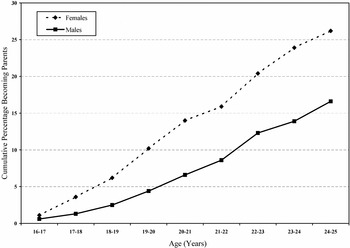
Figure 1 shows a plot of the cumulative percentages of males and females who became biological parents over the interval from 16 to 25 years. The earliest age of entry to parenthood for both males and females was 16 years, with six (1.1%) females and three (0.6%) males becoming parents at age 16. This early gender difference in the rate of parenting onset persisted throughout the period from 16 to 25 years, with the rate of early motherhood consistently being 1.5 to 2 times the rate of early fatherhood. By age 25 years, 26.2% of females and 16.6% of males had become parents. A log-rank test showed this difference to be highly significant, χ2 (1) = 14.9, p < .0001.

The proportion of young men and women becoming parents by age 25.
Family of origin and individual predictors of parenthood by age 25
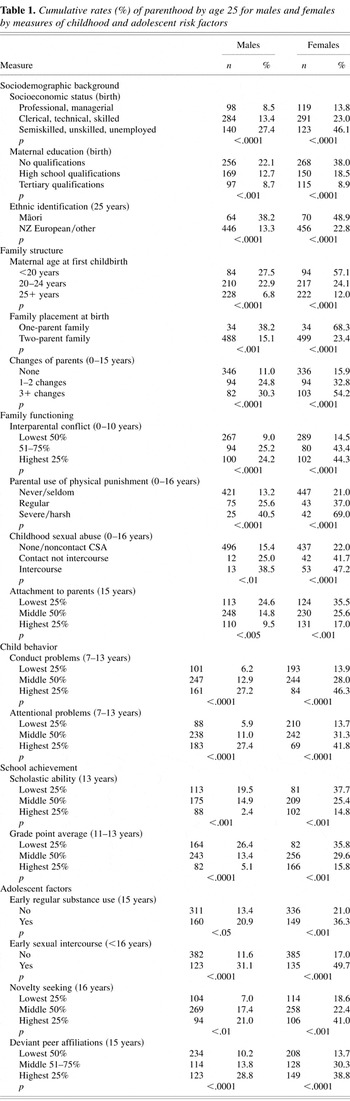
Although the above results confirm the presence of strong gender differences in the rate of onset of early parenthood, the extent to which differences also exist in the developmental processes that place young men and women at risk of an early transition to parenthood remains unclear. This issue is examined in Table 1, which shows the associations between a series of childhood and adolescent risk factors describing the sample member's life history and experiences prior to age 16 and rates of parenthood by age 25. Childhood risk factors reported in this table include measures of young people's family of origin (family social background, structure, and functioning) and measures of their earlier personal characteristics (behavioral adjustment, scholastic ability, and grade point average). Adolescent risk factors spanned a range of risk taking measures, including early sexual risk taking, substance use/experimentation, nov elty seeking, and deviant peer involvement. The associations are shown separately for males and females, and for each comparison, the strength of association has been tested using the log-rank test. Examination of the table leads to the following conclusions:
- For both males and females, all risk factors in the table were significantly (p < .05) related to the risk of early parenthood. Strong associations between early parenthood risk and childhood social disadvantage, parental role models of young single parenthood, family dysfunction, educational underachievement, behavioral maladjustment, and adolescent risk taking clearly demonstrate the highly selective nature of the timing of parenting onset for both males and females. Furthermore, across both gender groups there were clear and pervasive tendencies for rates of early parenthood to increase with increasing levels of exposure to earlier social, family and individual adversity.
- Despite the lower rate of early parenthood for males, the associations between antecedent risk factors and rates of early parenthood appear to be similar across gender groups. This is illustrated by a comparison of the profiles of the relative risk of parenthood in the highest risk group compared to the lowest risk group for each risk factor across males and females. For both gender groups these relative risks typically ranged between 2 and 5, and for both groups the median relative risk was 2.9. The similarity in the psychosocial backgrounds of young males and females becoming parents by age 25 years was further confirmed by fitting a series of nested proportional hazards regression models to test the equality of regression slopes across males and females for each risk factor (see the Methods section). These analyses failed to reveal any significant gender differences in the regression slopes.
Cumulative rates (%) of parenthood by age 25 for males and females by measures of childhood and adolescent risk factors

Multivariate model of earlier life course predictors of early parenthood: Do gender differences exist?
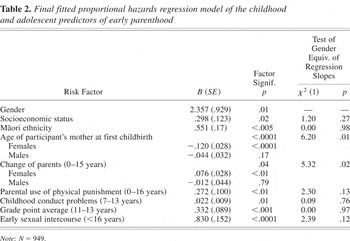
The above results suggest that the risk of an early transition to parenthood was related to a wide array of childhood and adolescent risk factors, and that although there were clear gender differences in the rate of parenthood, the various risk factors appeared to act in a similar way for both males and females. To examine the multivariate properties of the data, a nested proportional hazards regression model was fitted using the risk factors in Table 1 as predictors of parenthood. In this analysis all continuous variables were scaled in their natural metric as described in the Methods section, rather than in the arbitrary categories used in Table 1. For each factor having a significant net effect in the fitted model, tests of the equality of the model parameters between males and females were also conducted. The results of the final fitted model are given in Table 2, which shows the fitted model parameters, standard errors and test of significance of each factor in the model, together with the results of the tests of gender equivalence of the model parameters for males and females. Table 2 shows the following:
- The analysis identified nine factors that made significant net contributions to the prediction of early parenthood in the cohort. These factors included: gender (p < .01); family SES (p = .02); Maori ethnicity (p < .005); age of respondent's mother at first childbirth (p < .0001); changes of parents (p = .04); parental use of physical punishment (p < .01); childhood conduct problems (p = .01); teacher rated grade point average (p < .001); and early onset sexual intercourse (p < .0001).
- In addition, there was evidence of a significant gender difference in the regression slopes for males and females on two of the nine predictor variables. For the age of the respondent's mother at first childbirth, the estimated coefficient for females was large and highly significant (B = −.120, SE = .028, p < .0001) compared to the coefficient for males that was smaller and statistically nonsignificant (B = −.044, SE = .032, p = .17). A similar pattern of results was found for the effects of exposure to parental changes during childhood, with the estimated coefficient being significant for females (B = .076, SE = .028, p < .01) but not for males (B = −.012, SE = .044, p = .79). These results indicate that having a mother who herself first gave birth at a younger age and having been exposed to multiple caregiver changes were more influential in predicting early parenthood for females than for males. However, there was no evidence that the regression parameters for any other risk factor varied significantly with gender.
Final fitted proportional hazards regression model of the childhood and adolescent predictors of early parenthood

More generally, these findings suggest that the onset of parenthood was influenced by a wide array of risk factors, and that to a large extent, the risk factors and life course processes associated with early motherhood were similar to the risk factors and life processes associated with early fatherhood. Those most at risk of an early transition to parenthood were Maori females from low SES backgrounds, who were born to mothers who themselves were young at first childbirth, who experienced multiple family changes, who experienced frequent or severe physical punishment in childhood, who exhibited early-onset conduct problems, who did less well at school, and who engaged in early-onset sexual behavior. Conversely, those least at risk were non-Maori males from high SES backgrounds, who grew up in stable family environments, who were not subject to physical punishment, who did not develop conduct problems in childhood, who did well in school, and who exhibited later onset of sexual intercourse.
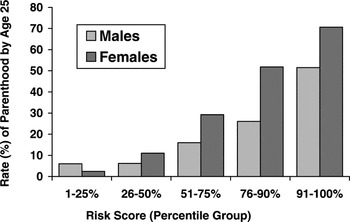
Although results from the proportional hazards regression analysis identified the significant predictors of parenthood, the model parameters by themselves do not give a clear indication as to how the different risk factors combine to influence the accumulative risk of parenthood up to age 25. This issue is examined in Figure 2. In this figure, the regression parameters in Table 2 were used to estimate a weighted risk factor score for males and females. The resulting score was then classified into a series of class intervals and the probability of parenthood by age 25 calculated for each group. The figure shows the observed rates of parenthood for males and females for each level of the risk factor score. For both males and females, there was evidence of substantial variability in the rate of early parenthood with increasing levels of risk exposure. For those in the lowest quartile of the risk score, the rate of parenthood was 6% for males and 2.4% for females. By comparison, in the highest decile of risk scores, rates of parenthood had increased to 52% for males and 71% for females. At all but the very lowest level of risk, the observed rate of parenthood was consistently higher among females than males, reflecting the higher rate of transition to parenthood among females.1
It has been suggested that the use of regression weights to calculate a risk factor index may capitalize on sample specific properties that may not generalize to other samples and that a risk score calculated using unit weights may be more appropriate. We would note that in this sample a unit weight risk score performs just as well as the regression-based risk index. For example, a simple risk score can be calculated by categorizing the significant predictor variables as shown in Table 1, assigning a value of 0 to the lowest risk category for each predictor, a value of 1 for the next highest risk category, and a value of 2 for the highest risk category (if applicable) and then summing the significant predictors for males and females separately. When tabulated against the rate of parenthood by age 25, this index produced an almost identical pattern of results to those seen in Figure 2.

The rates (%) of parenthood to age 25 for males and females by proportional hazards risk score.
Supplementary analysis
The above results are based on an examination of the transition to parenthood up to age 25. However, as noted previously, descriptions of early parenthood are commonly associated with teenage parenthood, and it could be suggested that the risk factors and life processes associated with transitions to parenthood in the teenage years may be different to, or contribute in a different way, to parenthood onset in the early 20s. To examine this issue, a sensitivity analysis was conducted in which the end point of follow-up for the proportional hazards model was varied over the age range from 18 to 25 years. In general, these analyses identified a consistent set of predictors of parenthood for all end points, and the parameter estimates for these risk factors were very similar across all models. However, the precision of estimation was reduced for models fitted at the youngest ages, reflecting the lower accumulative rates of parenthood in the teenage years. As a result, tests of gender differences in the effect of different risk factors were typically nonsignificant for models fitted for teenage parenthood, despite the fact that parameter estimates for these models suggested similar gender differences in effect sizes to those reported in Table 2 for the measures of changes of parents and age of respondent's mother at first childbirth. These findings suggest that, in general, the same set of risk processes were operating in a similar fashion for both males and females to predict both teenage and later parenthood.
Discussion
In this study we used prospective data collected over the course of a 25-year longitudinal study to examine gender differences in the timing and early life course experiences that place young people at risk of an early transition to parenthood. This study contributes to a growing body of research concerned with gender and life course development by comparing the risks of early parenthood for males and females, as well as the psychosocial profiles of younger mothers and fathers. Of particular interest was the extent to which the childhood and adolescent risk factors and life course experiences associated with early parenthood were the same or different for males and females. The study's large representative sample of males and females, its prospective longitudinal design, repeated measures over time, and multimethod approach make it uniquely suited to addressing these important questions. The major study findings and their theoretical and applied implications are discussed below.
Gender differences in the onset of early parenthood
Consistent with previous research, there were clear differences in the risk of early parenthood for males and females in this cohort. Although both gender groups began the transition to parenthood during their 16th year, the rate of parenting onset among females was approximately double that for males, with this difference persisting throughout the teenage years and early 20s. By age 25, just over a fifth of the cohort had become parents, with around 60% of these being women. This is consistent with rates of early parenthood from US samples, which show that by age 25, 22.6% of young people have become a biological parent, with rates being three times higher in females (33.6%) than males (11.3%; Cohen, Kasen, Chen, Hartmark, & Gordon, 2003).
Although these findings suggest that a substantial number of young people become parents by age 25, they also highlight that the transition to parenthood for this early parenting group is off-time relative to their peers given that nearly 75% of females and 85% of males in the cohort were still yet to become parents. Findings also confirm a significant shift in the onset of parenting for contemporary youth, and are in line with recent national data showing a shift toward the deferment of parenthood until the early 30s (personal communication, Statistics New Zealand, 2003). Given clear demographic shifts toward delayed parenthood and the growing disparity between the life course experiences of younger and older parents, there is perhaps a need to reconsider our notions of early or off-time parenthood to include not just teenage parents, but also those individuals who make the transition to parenthood in their early 20s, at an age that is now much earlier than most of their peers.
Gender differences in the antecedent risk factors associated with early parenthood
In contrast to strong gender differences in the prevalence of early parenthood, findings suggested that the psychosocial profiles of early parenting males and females were highly similar. Irrespective of gender, bivariate analyses showed that early parenthood was correlated with a wide range of childhood factors spanning socioeconomic disadvantage, maternal role models of young single parenthood, interparental conflict and family breakdown, punitive parenting, sexual abuse, weak parent–child bonds, Maori ethnicity, childhood behavior problems, and educational underachievement. Furthermore, a series of adolescent lifestyle factors were also linked with early parenthood, suggesting that adolescents with novelty seeking tendencies who initiated sexual intercourse early (<16 years), engaged in early drug use and who socialized with deviant peers were at increased risk of becoming a young parent. Also of note was the finding that for males and females, rates of early parenthood increased with increasing levels of earlier psychosocial adversity.
The strong overlap in the psychosocial profiles of younger mothers and fathers was further confirmed when multivariate modeling methods were applied to the data. These analyses sought to identify the key childhood and adolescent predictors of early motherhood and early fatherhood, and to test for possible gender specific effects that might imply that one gender was more vulnerable to the effects of a risk factor than the other. Results revealed marked similarities in the risk factors and life processes placing both males and females at risk of a becoming a young parent. In particular, the nested regression model identified eight significant risk factors for early parenthood (aside from gender). For six of the eight risk factors, no significant gender differences in model coefficients were found, suggesting that, for the most part, the same childhood and adolescent risk factors were predictive of both early fatherhood and early motherhood and contributed to parenthood risk in a similar manner for both gender groups. The two exceptions to this were the effects of age of the respondent's mother at first childbirth and exposure to parental changes during childhood (birth to 15 years), with results suggesting that early exposure to maternal role models of young parenthood and parental changes may be more salient for girls than for boys in predicting a subsequent early entry to parenthood.
An examination of the relationship between risk exposure and subsequent parenthood risk showed that the effects of these earlier life course adversities and disadvantages were cumulative. At low levels of risk exposure (≤25th percentile) rates of parenthood remained low. However, with increasing levels of risk exposure (both in terms of the severity and diversity of risk factors) a steady and rapid increase in rates of early parenthood was evident for both males and females. Females in the highest risk decile of the cohort were approximately 30 times more likely to become a parent, whereas males in this decile were almost 9 times more likely to become a parent than their lowest risk peers.
The key independent predictors of early parenthood risk identified in this analysis are in general agreement with other studies of younger mothers and fathers. In particular, childhood conduct problems and/or antisocial behavior have been shown to be one of the most robust predictors of pregnancy and early childbearing/fatherhood (Bardone et al., 1996; Fagot et al., 1998; Jaffee et al., 2001; Serbin et al., 1991; Stouthamer-Loeber & Wei, 1998; Woodward & Fergusson, 1999). For example, results from the Dunedin longitudinal study showed that among the 77 study members who had become parents before age 21, 58% had a prior diagnosis of conduct disorder (Moffitt et al., 2002). Furthermore, educational underachievement has also been previously linked with an early onset of parenthood among females (Fergusson & Woodward, 2000b; Hoffman, Foster, & Furstenberg, 1993; Hotz & Williams-McElroy, 1997; Klepinger et al., 1995; Upchurch & McCarthy, 1990). Although there has been some debate as to whether an early transition to parenthood serves to disrupts schooling or whether in fact, poor school achievement makes early parenthood more likely, converging evidence now exists to suggest that for females at least, the latter life sequence is more frequently the case (Fergusson & Woodward, 2000b; Maynard, 1995; Upchurch & McCarthy, 1990). Extending on this, the present study suggests that educationally underachieving young males are also more likely to father a child than their higher achieving male peers. The extent to which these at risk young fathers will remain a part of their children's lives will be of interest.
In conjunction with individual tendencies to early onset conduct problems and lower educational attainment, it is clear from the present study that young people's experiences in their family of origin play an important role in determining parenthood timing. Similar to the findings of Gest et al. (1999), family SES was predictive for both males and females even after taking into account more proximal child and family factors. This could reflect class-related differences in attitudes toward family formation and parenthood timing, and/or increased economic barriers to alternative life paths such as going to university or further career training (Fergusson & Woodward, 2000a). Maori ethnicity was also predictive of an earlier transition to parenthood for males and females. Although the reasons for this are not clear, previous international studies have also demonstrated cultural differences in parenthood timing. There is also some suggestion from previous analyses of this cohort that young Maori women who became pregnant were less likely to seek a termination than other women (Woodward, Horwood, & Fergusson, 2001).
In addition to social demographic factors, findings from this study also highlight the importance of young people's experiences in their family of origin in determining the timing of their own transition to adult parental roles. Three family process factors made significant and unique contributions to early parenthood risk. First, there was evidence to suggest that for both males and females, having been raised in a family environment characterized by high rates of physical punishment was associated with an increased risk of an early transition to parenthood. One possible explanation for this finding could be that parental negativity may hasten young people's exit from the family, thus weakening family of origin ties as well as parental monitoring of activities and decision making. To date, few studies have examined linkages between specific parental practices and parenthood risk. However, given concerns about the intergenerational transmission of negative parenting practices, developing a better understanding of the process by which childhood exposure to punitive parenting increases risk of early parenthood would seem an important issue for future study.
Second, a family factor linked with early parenthood risk was the age of the respondent's own mother at first childbirth, with findings showing that having been raised by a mother who was herself a young parent contributed to early parenthood risk. However, this association was only evident for females, suggesting that exposure to maternal role models of early motherhood is more likely to encourage an accelerated entry to parenthood among daughters than among sons. An important question that needs to be addressed by future research is the extent to which the age of a child's father influences later parenthood timing. It could be hypothesized on the basis of gender role modeling theory that just as childhood exposure to young motherhood appears to be more salient for daughters, the age of the father's own entry to fatherhood may be more predictive for sons.
Third, a gender difference was also evident for the effects of exposure to parental separation on later risks of early parenthood. The number of parental transitions experienced by young people in their family of origin made a unique contribution to early parenthood risk for females, but not for males. Because most family breakdowns (approximately 90%) occurring within the cohort resulted in children living with their mothers, these results could reasonably be interpreted as suggesting that spending time in a mother headed household may place daughters, but not sons, at increased risk of themselves becoming young, and in many cases, single mothers. Several mechanisms could account for this association. One explanation could be that children subject to multiple parental transitions are more likely than children from intact families to be exposed to parental dating behaviors and conversations that serve to heighten their sexual awareness and acceptance of sexual relations (Maccoby, 1991). A second explanation is that disrupted family relations during childhood may impair parental monitoring of girl's activities and behaviors. A third explanation could be that family breakdown may potentially weaken family ties and increase the likelihood that young people will seek out intimacy and new family connections through early partnership formation and parenting. Finally, these findings may reflect differences in expectations, either conscious or unconscious, of parenthood as a result of earlier experiences of family life patterns. For example, from an evolutionary perspective, early stressful family experiences involving fewer economic resources, punitive parental care, and high levels of family disruption (especially among girls) may well incline young people toward a more quantity-oriented, rather than quality-oriented, reproduction strategy (Belsky, Steinberg, & Draper, 1991). Such a strategy would involve investing in early sexual partnering and more children, as opposed to the achievement of a stable partnership and the mutual investment in fewer children. Further research should help to clarify the relative role of psychosocial, evolutionary, and also importantly genetic processes in explaining the clear link between early rearing context and the developmental timing of young people's transition to parenthood.
Collectively, these findings suggest that the transition to early parenthood represents a highly selective process. Early parenting young men and women share a diverse range of psychosocial disadvantages encompassing behavioral, intellectual, familial, and socioeconomic adversity that likely not only conspire to increase their risk of an early transition to parenthood, but that would also be expected to affect their ability to provide an optimal childrearing environment for their developing infant. In addition to the diverse difficulties of early parenting young men and women, findings also highlight the need to distinguish between gender differences in prevalence and underlying etiological processes. Such findings add to our understanding of the effects of gender on life course development and raise a number of important questions and issues for further consideration.
The first issue concerns the mechanisms by which strong gender differences in rates of early parenthood emerge. Several possibilities exist. First, the elevated rates of teen and young parenthood among females in the cohort may reflect differences in the onset of sexual development and behavior because girls tend to mature and initiate sexual intercourse earlier than boys. Second, and related, these gender differences might also reflect general population trends for females to be more likely to become romantically involved with older and more sexually active partners compared to their male peers.
The second issue concerns the mechanisms that account for the striking similarities in the social backgrounds of younger parents as well as the marked overlap in life course processes that place young males and females at risk of an early transition to parenthood. One interpretation of these findings is that individuals from similar family backgrounds and with similar cognitive abilities and behavioral tendencies are more likely to meet each other and to form an attraction than individuals who do not share a common psychosocial profile (Kandel, Davies, & Baydar, 1990; Krueger, Moffitt, Caspi, Bleske, & Silva, 1998). Such assortative pairing between similar individuals is likely to reinforce commonalities and give rise to similar life course outcomes, including an earlier onset of parenthood.
If this is the case, it raises important issues regarding the intergenerational consequences of these partnerships on both social and genetic grounds. Children born as a consequence of these partnerships are likely to be at substantial risk, not only because of their parents' immaturity but also because, due to assortative pairing, both contributing partners are more likely to be characterized by common problematic developmental histories and genetic tendencies. Early data from the Dunedin longitudinal study provides some support for this possibility. Specifically, findings suggest that children born to early parenting sample members may be at unusually high risk for antisocial behavior by virtue of having been born to two parents who are both young and inexperienced, and who have higher rates of antisocial behavior than their peers (Moffitt et al., 2002). Follow-up evaluations of these high risk individuals and their new families should help to shed light on these processes and their implications for the children of these younger parents.
References
REFERENCES
Armsden, G. C., &
Greenberg, M. T.
(1987).
The inventory of parent and peer attachment: Individual differences
and their relationship to psychological well-being in adolescence.
Journal of Youth and Adolescence,
16,
427–454.Google Scholar
Bardone, A. M.,
Moffitt, T. E.,
Caspi, A.,
Dickson, N., &
Silva, P.
(1996).
Adult mental health and social outcomes of adolescent girls with
depression and conduct disorder.
Development and Psychopathology,
8,
811–829.Google Scholar
Beautrais, A.
(2002).
Gender issues in youth suicidal behaviour.
Emergency Medicine,
14,
35–42.Google Scholar
Belsky, J.,
Steinberg, L., &
Draper, P.
(1991).
Childhood experience, interpersonal development, and reproductive
strategy: An evolutionary theory of socialization.
Child Development,
62,
647–670.Google Scholar
Boddington, B.,
Khawaja, M., &
Didham, R.
(2003).
Teenage fertility in New Zealand.
Wellington, NZ:
Statistics New Zealand.
Brooks-Gunn, J., &
Chase-Lansdale, P. L.
(1995).
Adolescent parenthood. In
M. Bornstein (Ed.),
Handbook on parenting: Vol 3. Who is the parent? (pp.
113–149).
Mahwah, NJ:
Erlbaum.
Butler, A. C.
(1992).
The changing economic consequences of teenage childbearing.
Social Science Review,
March,
1–31.Google Scholar
Chase-Lansdale, P. L., &
Brooks-Gunn, J.
(1994).
Correlates of adolescent pregnancy and parenthood. In
C. B. Fish &
R. M. Lerner (Eds.),
Applied developmental psychology (pp.
207–236).
New York:
McGraw–Hill.
Cloninger, C. R.
(1987).
A systematic method for clinical description and classification of
personality variants: A proposal.
Archives of General Psychiatry,
44,
573–588.Google Scholar
Cohen, P.,
Kasen, S.,
Chen, H.,
Hartmark, C., &
Gordon, K.
(2003).
Variations in patterns of developmental transitions in the emerging
adulthood period.
Developmental Psychology,
39,
657–669.Google Scholar
Coley, R. L., &
Chase-Lansdale, P. L.
(1998).
Adolescent pregnancy and parenthood: Recent evidence and future
directions.
American Psychologist,
53,
152–166.Google Scholar
Colletta, N. D.
(1983).
At risk for depression: A study of young mothers.
Journal of Genetic Psychology,
142,
301–310.Google Scholar
Conners, C. K.
(1969).
A teacher rating scale for use in drug studies with children.
American Journal of Psychiatry,
126,
884–888.Google Scholar
Conners, C. K.
(1970).
Symptom patterns in hyperkinetic, neurotic and normal
children.
Child Development,
41,
667–682.Google Scholar
Crick, N., &
Zahn-Waxler, C.
(2003).
The development of psychopathology in females and males: Current
progress and future challenges.
Development and Psychopathology,
15,
424–443.Google Scholar
Dearden, K.,
Hale, C., &
Blankson, M.
(1994).
Family structure, function and the early transition to fatherhood in
Great Britain: Identifying antecedents using longitudinal data.
Journal of Marriage and the Family,
56,
844–852.Google Scholar
Elley, W. B., &
Irving, J. C.
(1976).
Revised socio-economic index for New Zealand.
New Zealand Journal of Educational Studies,
11,
25–36.Google Scholar
Fagot, B. I.,
Pears, K. C.,
Capaldi, D. M.,
Crosby, L., &
Leve, C. S.
(1998).
Becoming an adolescent father: Precursors and parenting.
Developmental Psychology,
34,
1209–1219.Google Scholar
Fergusson, D. M., &
Horwood, L. J.
(1996).
The role of adolescent peer affiliations in the continuity between
childhood behavioral adjustment and juvenile offending.
Journal of Abnormal Child Psychology,
24,
205–221.Google Scholar
Fergusson, D. M.,
Horwood, L. J.,
Shannon, F. T., &
Lawton, J. M.
(1989).
The Christchurch Child Development Study: A review of
epidemiological findings.
Paediatric and Perinatal Epidemiology,
3,
278–301.Google Scholar
Fergusson, D.,
Horwood, L., &
Lloyd, M.
(1990).
Confirmatory factor models of attention deficit and conduct
disorder.
Journal of Child Psychology and Psychiatr,
32,
257–274.Google Scholar
Fergusson, D. M., &
Lynskey, M. T.
(1997).
Physical punishment/maltreatment during childhood and adjustment
in young adulthood.
Child Abuse and Neglect,
21,
617–630.Google Scholar
Fergusson, D. M.,
Lynskey, M. T., &
Horwood, L. J.
(1996).
Childhood sexual abuse and psychiatric disorder in young adulthood:
I. Prevalence of sexual abuse and factors associated with sexual
abuse.
Journal of the American Academy of Child and Adolescent
Psychiatry,
35,
1355–1364.Google Scholar
Fergusson, D. M., &
Woodward, L. J.
(1999).
Maternal age and educational and psychosocial outcomes in early
adulthood.
Journal of Child Psychology and Psychiatry and Allied
Disciplines,
40,
479–489.Google Scholar
Fergusson, D. M., &
Woodward, L. J.
(2000a).
Family socioeconomic status at birth and rates of university
participation.
New Zealand Journal of Educational Studies,
35,
25–36.Google Scholar
Fergusson, D. M., &
Woodward, L. J.
(2000b).
Teenage pregnancy and female educational under-achievement.
Journal of Marriage and the Family,
62,
147–161.Google Scholar
Fillingim, R.
(2003).
Sex-related influences on pain: A review of mechanisms and
implications.
Rehabilitation Psychology,
48,
165–174.Google Scholar
Furstenberg, F. F.,
Brooks-Gunn, J., &
Chase-Lansdale, L.
(1989).
Teenaged pregnancy and childbearing.
American Psychologist,
44,
2.Google Scholar
Furstenberg, F. F.,
Brooks-Gunn, J., &
Morgan, S. P.
(1987).
Adolescent mothers in later life.
New York:
Cambridge University.
Geronimus, A. T., &
Korenman, S.
(1992).
The socioeconomic consequences of teen childbearing
reconsidered.
The Quarterly Journal of Economics,
November,
1187–1214.Google Scholar
Gest, S. D.,
Mahoney, J. L., &
Cairns, R. B.
(1999).
A developmental approach to prevention research: Configural
antecedents of early parenthood.
American Journal of Community Psychology,
27,
543–565.Google Scholar
Greenland, S.
(1989).
Modelling and variable selection in epidemiologic analysis.
American Journal of Public Health,
79,
340–349.Google Scholar
Haskett, M. E.,
Johnson, C. A., &
Miller, J. W.
(1994).
Individual differences in risk of child abuse by adolescent mothers:
Assessment in the perinatal period.
Journal of Child Psychology and Psychiatry,
35,
461–476.Google Scholar
Hoffman, S. D.,
Foster, E. M., &
Furstenberg, F. F., Jr.
(1993).
Reevaluating the costs of teenage childbearing.
Demography,
30,
1–13.Google Scholar
Hotz, V. J., &
Williams-McElroy, S.
(1997).
The impacts of teenage childbearing on the mothers and the
consequences of those impacts for government. In
R. A. Maynard (Ed.),
Kids having kids: Economic costs and social consequences of teen
pregnancy (pp.
55–94).
Washington, DC:
Urban Institute Press.
Jaffee, S.,
Caspi, A.,
Moffitt, T. E.,
Belsky, J., &
Silva, P.
(2001).
Why are children born to teen mothers at risk for adverse outcomes
in young adulthood? Results from a 20-year longitudinal study.
Development and Psychopathology,
13,
377–397.Google Scholar
Jaffee, S. R.,
Caspi, A., &
Moffitt, T. E.
(2001).
Predicting early fatherhood and whether young fathers live with
their children: Prospective findings and policy reconsiderations.
Journal of Child Psychology and Psychiatry,
42,
803–815.Google Scholar
Kandel, D.,
Davies, M., &
Baydar, N.
(1990).
The creation of interpersonal contexts: Homophily in dyadic
relationships in adolescence and young adulthood. In
L. Robins &
M. Rutter (Eds.),
Straight and devious pathways from childhood to adolescence
(pp.
221–241).
Cambridge:
Cambridge University Press.
Keenan, K.,
Loeber, R., &
Green, S.
(1999).
Conduct disorder in girls: A review of the literature.
Clinical Child and Family Psychology Review,
2,
3–19.Google Scholar
Keenan, K., &
Shaw, D.
(1997).
Developmental and social influences on young girls' early
problem behavior.
Psychological Bulletin,
121,
95–113.Google Scholar
Ketterlinus, R. D.,
Henderson, S., &
Lamb, M. E.
(1991).
The effects of maternal age-at-birth on children's cognitive
development.
Journal of Research on Adolescence,
1,
173–188.Google Scholar
Klepinger, D. H.,
Lundberg, S., &
Plotnick, R. D.
(1995).
Adolescent fertility and the educational attainment of young
women.
Family Planning Perspectives,
27,
23–28.Google Scholar
Krueger, R. F.,
Moffitt, T. E.,
Caspi, A.,
Bleske, A., &
Silva, P. A.
(1998).
Assortative mating for antisocial behavior: Developmental and
methodological implications.
Behavior Genetics,
28,
173–186.Google Scholar
Maccoby, E. E.
(1991).
Different reproductive strategies in males and females.
Child Development,
62,
676–681.Google Scholar
Manlove, M.
(1997).
Early motherhood in an intergenerational perspective: The
experiences of a British cohort.
Journal of Marriage and the Family,
59,
263–279.Google Scholar
Marini, M. M.
(1984).
Women's educational attainment and the timing of entry into
parenthood.
American Sociological Review,
49,
491–511.Google Scholar
Maughan, B., &
Lindelow, M.
(1997).
Secular changes in psychosocial risks: The case of teenage
motherhood.
Psychological Medicine,
27,
1129–1144.Google Scholar
Maynard, R.
(1995).
Teenage childbearing and welfare reform: Lessons from a decade of
demonstration and evaluation research.
Children and Youth Services Review,
17,
309–332.Google Scholar
McCormick, M. C., &
Brooks-Gunn, J.
(1989).
The health of children and adolescents. In
H. E. Freeman &
S. Levin (Eds.),
Handbook of medical sociology (pp.
347–380).
Englewood Cliffs, NJ:
Prentice–Hall.
Miller-Johnson, S.,
Winn, D.-M.,
Coie, J.,
Maumary-Gremaud, A.,
Hyman, C.,
Terry, R.,
et al.
(1999).
Motherhood during the teen years: A developmental perspective on
risk factors for childbearing.
Development and Psychopathology,
11,
85–100.Google Scholar
Moffitt, T. E.,
Caspi, A.,
Rutter, M., &
Silva, P. A.
(2002).
Sex differences in antisocial behaviour: Conduct disorder,
delinquency and violence in the Dunedin Longitudinal Study.
Cambridge:
Cambridge University Press.
Moffitt, T. E., &
Team, E.-R. S.
(2002).
Teen-aged mothers in contemporary Britain.
Journal of Child Psychology and Psychiatry,
43,
727–742.Google Scholar
Moore, K. A.,
Morrison, D. R., &
Glei, D. A.
(1995).
Welfare and adolescent sex: The effects of family history, benefit
levels, and community context.
Journal of Family and Economic Issues,
16,
207–237.Google Scholar
Morgan, C.,
Chapar, G. N., &
Fisher, M.
(1995).
Psychosocial variables associated with teenage pregnancy.
Adolescence,
30,
275–289.Google Scholar
Nolen-Hoeksema, S., &
Girgus, J. S.
(1994).
The emergence of gender differences in depression during
adolescence.
Psychological Bulletin,
115,
424–443.Google Scholar
Pears, K. C.,
Pierce, S. L.,
Kim, H. K.,
Capaldi, D. M., &
Owen, L. D.
(in press).
The timing of entry into fatherhood in young, at-risk men.
Journal of Marriage and the Family.
Ragozin, A. S.,
Basham, R. B.,
Crnic, K. A.,
Greenberg, M. T., &
Robinson, N. M.
(1981).
Effects of maternal age on parenting role.
Developmental Psychology,
18,
627–634.Google Scholar
Reid, N. A.,
Jackson, P. F.,
Gilmore, A., &
Croft, C.
(1981).
Test of scholastic abilities.
Wellington, NZ:
New Zealand Council for Educational Research.
Rutter, M.,
Tizard, J., &
Whitmore, K.
(1970).
Education, health and behaviour.
London:
Longmans.
Serbin, L. A.,
Cooperman, J. M.,
Peters, P. L.,
Lehoux, P. M.,
Stack, D. M., &
Schwartzman, A. E.
(1998).
Intergenerational transfer of psychosocial risk in women with
childhood histories of aggression, withdrawal, or aggression and
withdrawal.
Developmental Psychology,
34,
1246–1262.Google Scholar
Serbin, L. A.,
Moskowitz, D. S.,
Schwartzman, A. E., &
Ledingham, J. E.
(1991).
Aggressive, withdrawn, and aggressive/withdrawn children in
adolescence: Into the next generation. In
D. J. Pepler &
K. H. Rubins (Eds.),
The development and treatment of childhood aggression (pp.
55–70).
Hillsdale, NJ:
Erlbaum.
Silverthorn, P., &
Frick, P. J.
(1999).
Developmental pathways to antisocial behavior: The delayed-onset
pathway in girls.
Development and Psychopathology,
11,
101–126.Google Scholar
StataCorp.
(1999).
Stata statistical software: Release 6.0 [program].
College Station, TX:
Author.
Stouthamer-Loeber, M., &
Wei, E. H.
(1998).
The precursors of young fatherhood and its effect on delinquency of
teenage males.
Journal of Adolescent Health,
22,
56–65.Google Scholar
Thornberry, T. P.,
Smith, C. A., &
Howard, G. J.
(1997).
Risk factors for teenage fatherhood.
Journal of Marriage and the Family,
59,
505–522.Google Scholar
Udry, J. R.
(1979).
Age at menarche, at first intercourse, and at first
pregnancy.
Journal of Biosocial Science,
11,
433–441.Google Scholar
Upchurch, D. M., &
McCarthy, J.
(1990).
The timing of a first birth and high school completion.
American Sociological Review,
55,
224–234.Google Scholar
Williams, S.,
McGee, R.,
Olaman, S., &
Knight, R.
(1997).
Level of education, age or bearing children and mental health of
women.
Social Science and Medicine,
45,
827–836.Google Scholar
Woodward, L. J., &
Fergusson, D. M.
(1999).
Early conduct problems and later risk of teenage pregnancy in
girls.
Development and Psychopathology,
11,
127–141.Google Scholar
Woodward, L. J., &
Fergusson, D. M.
(2002).
Parent, child and contextual predictors of childhood physical
punishment.
Infant and Child Development,
11,
213–235.Google Scholar
Woodward, L. J.,
Fergusson, D. M., &
Horwood, L.J.
(2001).
Risk factors and life processes associated with teenage pregnancy:
Results of a prospective study from birth to 20 years.
Journal of Marriage and the Family,
63,
1170–1184.Google Scholar
Woodward, L. J.,
Horwood, J. L., &
Fergusson, D. M.
(2001).
Teenage pregnancy: Cause for concern.
New Zealand Medical Journal,
114,
301–303.Google Scholar
Xie, H.,
Cairns, B. D., &
Cairns, R. B.
(2001).
Predicting teen motherhood and teen fatherhood: Individual
characteristics and peer affiliations.
Social Development,
10,
488–511.Google Scholar
The proportion of young men and women becoming parents by age 25.
Cumulative rates (%) of parenthood by age 25 for males and females by measures of childhood and adolescent risk factors
Final fitted proportional hazards regression model of the childhood and adolescent predictors of early parenthood
The rates (%) of parenthood to age 25 for males and females by proportional hazards risk score.
 You have
Access
- 33
- Cited by