Introduction
Entrepreneurship and innovation have been recognised globally by governments as important foundations of economic growth and social development (European Commission, EC, 2013; OECD, 2010; WEF, 2014, 2016). This has seen the development of national and regional policies incorporating entrepreneurship and innovation activities and outcomes (Gilbert, Audretsch, & McDougall, Reference Gilbert, Audretsch and McDougall2004; Lundström & Stevenson, Reference Lundström and Stevenson2010; OECD, 2009, 2010a). It has also increased demand for quality entrepreneurship education programs that are effective in supporting these policies (Belitski & Heron, Reference Belitski and Heron2017; Higgins & Galloway, Reference Higgins and Galloway2014; Matlay, Reference Matlay2009; Oganisjana & Matlay, Reference Oganisjana and Matlay2012; O'Connor, Reference O'Connor2013; O'Connor, Fenton, & Barry, Reference O'Connor, Fenton and Barry2012).
The field of academic research into entrepreneurship has also developed significantly in recent decades, with respect to the number of entrepreneurship courses, researchers and related scholarly journals (Audretsch, Kuratko, & Link, Reference Audretsch, Kuratko and Link2015; Sarasvathy & Venkataraman, Reference Sarasvathy and Venkataraman2011; Shane, Reference Shane2012; Shane & Venkataraman, Reference Shane and Venkataraman2000). This has strengthened the overall capacity of the academic community to deliver entrepreneurship programs and explore entrepreneurial people, processes, policies and practices.
While entrepreneurship has traditionally focussed on the entrepreneur and new venture creation, recent studies signal the need to include contextual factors surrounding the entrepreneurial phenomena (Autio, Kenney, Mustar, Siegel, & Wright, Reference Autio, Kenney, Mustar, Siegel and Wright2014; Toutain, Fayolle, Pittaway & Politis, Reference Toutain, Fayolle, Pittaway and Politis2017; Croce, Reference Croce2017; Hunter & Wilson, Reference Hunter and Wilson2007; Mika, Warren, Foley, & Palmer, Reference Mika, Warren, Foley and Palmer2017; Zahra, Reference Zahra2007; Zahra, Wright, & Abdelgawad, Reference Zahra, Wright and Abdelgawad2014. Adopting a ‘systems’ perspective has been recognised in prior work on business ecosystems (Clarysse, Wright, Bruneel, & Mahajan, Reference Clarysse, Wright, Bruneel and Mahajan2014; Iansiti & Levien, Reference Iansiti and Levien2004; Moore, Reference Moore1993; Zahra & Nambisan, Reference Zahra and Nambisan2012), and national innovation systems (Freeman, Reference Freeman1995; Lundvall, Reference Lundvall2007, Reference Lundvall1992; Nelson, Reference Nelson1993). The emerging field of entrepreneurial ecosystems (EE) provides new frameworks for evaluating complex factors involved in economic growth within macro and micro contextual environments (Isenberg, Reference Isenberg2011, Reference Isenberg2014; WEF, 2013). Akin to business ecosystems, the EE approach is holistic and recognises that businesses do not evolve in a vacuum; rather they are relationally embedded with suppliers, customers and financiers. Entrepreneurial education should therefore be understood within the context of a wider system.
From an ecosystem perspective, the different dimensions of teaching and learning should be integrated (Toutain & Mueller, Reference Toutain and Mueller2015; Mueller, Toutain & Bornard, Reference Mueller, Toutain and Bornard2016; Belitski & Heron, Reference Belitski and Heron2017; Maritz, Koch, & Schmidt, Reference Maritz, Koch and Schmidt2016; Schmidt & Molkentin, Reference Schmidt and Molkentin2015). To achieve the outcomes expected for students and the economy, experiential learning is a recommended pedagogy for entrepreneurship education (Jones, Reference Jones2011; Mason & Arshed, Reference Mason and Arshed2013; O'Connor, Fenton, & Barry, Reference O'Connor, Fenton and Barry2012). Teaching approaches in entrepreneurship vary from primarily theoretical to predominantly applied (Neck & Greene, Reference Neck and Greene2011; Winkel, Vanevenhoven, Drago, & Clements, Reference Winkel, Vanevenhoven, Drago and Clements2013). However, there are increasing expectations for entrepreneurship programs to result in the creation of economic value and jobs (Duval-Couetil, Reference Duval-Couetil2013; Jackson, Reference Jackson2009; Morris, Neumeyer, & Kuratko, Reference Morris, Neumeyer and Kuratko2015). While recognising divergent approaches, the broad scope of anticipated student outcomes from such courses raises significant questions about what the content and delivery of enterprise and entrepreneurship education programs should contain. How can an academic program be designed to simultaneously create entrepreneurial knowledge, skills and competencies, as well as new ventures and jobs? Our research examines this issue by exploring the delivery of an entrepreneurial education program from an EE perspective. The over-riding research question guiding this study is: How can the emerging EE approach to the creation of economic value align with entrepreneurial education delivery and expectations?
The research method adopted for this project is an in-depth single case study (Patton, Reference Patton2015). Our paper is structured as follows. First, we provide a brief overview of the nature and expectations of entrepreneurial education including teaching and learning pedagogies. Next, we review the EE literature and introduce the core components of an EE framework. We then apply the EE framework using an original case study of an innovative French educational unit. In the conclusion, insights from this study are discussed and further research projects proposed.
Entrepreneurial education
Enterprise and entrepreneurship education encompass formal and informal processes that develop an entrepreneurial mindset, plus the knowledge, skills and abilities to live and work in an entrepreneurial economy (Oganisjana & Matlay, Reference Oganisjana and Matlay2012). Although this is potentially much broader than academic programs in entrepreneurship, higher education institutions play a key role. University education aims to be transformational for individuals and their future careers. From a national policy perspective, university graduates are recognised as key members of the workforce for a knowledge economy, and human capital is a key driver of economic growth (Lundvall, Reference Lundvall2007). Positive links between entrepreneurship education and entrepreneurship-related human capital assets, and with entrepreneurial outcomes (such as new venture creation and entrepreneurial performance), were demonstrated in a meta-analysis of 42 independent studies by Martin, McNally, and Kay (Reference Martin, McNally and Kay2013).
Although research on entrepreneurship education assumes many different definitions, guidelines for UK higher education institutions have been clarified as follows (QAA, 2018). Enterprise education involves ‘an enhanced capacity to generate ideas, and the behaviours, attributes, and competencies to make them happen’. Whereas, entrepreneurship education builds on enterprise education by focusing on ‘the application of enterprising competencies into the creation of cultural, social or economic value … which can, but does not exclusively, lead to venture creation’. Further, the combination of enterprise and entrepreneurship education in these UK guidelines is called ‘entrepreneurial education’ (QAA, 2018). This term is adopted in this paper to reflect broad goals and programs which incorporate both types of outcomes.
Academic programs in entrepreneurship
The number of entrepreneurship courses offered by university business schools and specialist entrepreneurship centres has increased, along with the range of specialist topics being offered (Maritz, Jones, & Shwetzer, Reference Maritz, Jones and Shwetzer2015; Valerio, Parton, & Robb, Reference Valerio, Parton and Robb2014; Winkel et al., Reference Winkel, Vanevenhoven, Drago and Clements2013). From their survey of 321 universities in 60 countries, Winkel et al. (Reference Winkel, Vanevenhoven, Drago and Clements2013) reported the top five courses in entrepreneurship programs: Introduction to Entrepreneurship, New Venture Creation, Small Business Management, Practicum/Consulting/Experiential, and Creativity and Innovation. That study found undergraduate degrees were most popular, with 25% of the institutions offering an undergraduate entrepreneurship major, 48% offering an undergraduate minor for business or nonbusiness students, 41% offering graduate majors, 25% offering graduate minors and 19% offering entrepreneurship PhDs. In addition, 36% were offering internship opportunities with local companies, and 32% had small business incubators available (Winkel et al., Reference Winkel, Vanevenhoven, Drago and Clements2013). However, the diversity of expected outcomes from entrepreneurship education creates challenges for comparison and assessment of these programs (Duval-Couetil, Reference Duval-Couetil2013).
Teaching and learning methods in entrepreneurship
A wide range of teaching and learning strategies, linked to different learning objectives and outcomes, are used within entrepreneurship courses (Bliemel, Reference Bliemel2014b; Duval-Couetil, Reference Duval-Couetil2013; Maritz, Jones, & Shwetzer, Reference Maritz, Jones and Shwetzer2015). There are at least four primary world-views on entrepreneurship education: (i) the entrepreneur, (ii) the entrepreneurial process, (iii) entrepreneurial cognition and (iv) the entrepreneurial method. The first relates to understanding the psychology and motivation of the individual entrepreneur and may involve students examining cases of successful entrepreneurs, or examining their own entrepreneurial tendencies (Lyons, Lynn, & Bhaird, Reference Lyons, Lynn and Bhaird2015). The second focuses on the development of the business venture, usually at the start-up and growth phases, and can draw upon case examples, simulations or the development of student-led ventures. This typically involves business model design, strategy and planning, plus a range of related business skills (e.g. marketing, financial management, HR management, capital raising). The third deals with the mindset of the entrepreneur, in particular how they identify opportunities, acquire and use knowledge, make strategic decisions and deal with personal and professional challenges (Shepherd & Patzelt, Reference Shepherd and Patzelt2018). The fourth world-view builds on the work of Sarasvathy and Venkataraman (Reference Sarasvathy and Venkataraman2011), who proposed that the approach taken by entrepreneurs in identifying and exploiting opportunities is analogous to the approach taken by scientists in the scientific method. This builds on the theory of effectuation (Sarasvathy, Reference Sarasvathy2001), but has not been widely explored by academic research (Duening & Metzger, Reference Duening and Metzger2014). Each reflects different approaches, and assumes different priorities for learning activities and outcomes (Neck & Greene, Reference Neck and Greene2011; O'Connor, Reference O'Connor2013). In practice, many programs are combinations of these approaches.
The teaching and learning methods adopted within entrepreneurship courses may reflect traditional and/or a range of experiential approaches linked to course objectives, content and audience (Daniel, Reference Daniel2016; Lackéus, Reference Lackéus2015). Where the learning outcomes include the development of entrepreneurial behaviours and mindset, the pedagogies for this type of entrepreneurial learning include personal development and reflection (Daniel, Reference Daniel2016; Parris & McInnis-Bowers, Reference Parris and McInnis-Bowers2017; Pittaway & Cope, Reference Pittaway and Cope2007). Neck and Greene (Reference Neck and Greene2011: 68) propose teaching entrepreneurship with a practice-based method as a way of thinking and acting, rather than as a process:
Starting businesses helps students ‘feel’ what it is like to assume the role of an entrepreneur. Serious games and simulations allow students to play in virtual worlds that mirror reality. Designed-based learning encourages student to observe the world through a different lens and create opportunities. Finally, reflective practice gives permission to our students to take time, think, and absorb the learning of their practice-based curriculum. Together, our portfolio of feeling, playing, observing, creating, and thinking is the entrepreneurship method and a prescription for practice.
Utilising a portfolio of teaching pedagogies is important in entrepreneurship to enable learning to be individually constructed, and to allow for co-creation of knowledge with peers/others (Daniel, Reference Daniel2016; Fayolle, Reference Fayolle2013; Löbler, Reference Löbler2006). Experiential learning approaches in entrepreneurship align with foundational theories of human learning and development by Dewey, Lewin and Piaget (Kolb & Kolb, Reference Kolb and Kolb2005). Learning is a holistic process that involves active engagement, challenge and reflection on experiences (Kolb & Kolb, Reference Kolb and Kolb2005, Reference Kolb and Kolb2009).
The design thinking approach for creative problem solving, as developed at Stanford University, provides a methodology that aligns with these principles of experiential entrepreneurial learning (Daniel, Reference Daniel2016; Schumacher & Mayer, Reference Schumacher and Mayer2018). Daniel (Reference Daniel2016) reported positive impacts on student motivation and their performance satisfaction with a design thinking approach from a study of 66 undergraduate students in Portugal. Key features of this learning process included creating a classroom culture that fosters collaboration, creativity and autonomy with multidisciplinary teams focused on problem-solving (user-centred approach), and hands-on testing of ideas using prototyping, testing and implementation to ensure active participation, with the teacher acting as a facilitator (Daniel, Reference Daniel2016). Design thinking was adopted as one of a series of alternative ways of developing entrepreneurial mindsets by Parris and McInnis-Bowers (Reference Parris and McInnis-Bowers2017) in an introductory business course focussed on preparing socially conscious practitioners. As with any applied methodology or process tool, there are critiques of design thinking which highlight the need for stronger theoretical grounding as found in the design research field of designerly thinking and concerns for nondesigners applying this approach (Laursen & Hasse, Reference Laursen and Hasse2019).
Many other experiential learning approaches have been trialled and/or adopted in entrepreneurship courses. For example, Bolinger and Brown's (Reference Bolinger and Brown2015) learning from venture failure concept has been used to enable students with experiences of entrepreneurial ventures to perceive and assess the complexity of issues involved in failure (Cope, Reference Cope2011; Minniti & Bygrave, Reference Minniti and Bygrave2001; Singh, Corner, & Pavlovich, Reference Singh, Corner and Pavlovich2007). Academic and outreach activities to foster entrepreneurial drive Footnote 1 were reported by undergraduate business students who participated in a study to measure the key attitudinal dimensions of entrepreneurial drive by Florin, Karri, and Rossiter (Reference Florin, Karri and Rossiter2007). While many of these activities were quite generic (participating in extracurricular activities, volunteering, organising events, leading a club, studying personal selling), even those proposed to show entrepreneurial proactive behaviour did not include the types of projects and learning activities that would typically be included in coursework on strategy, innovation or entrepreneurship – especially in academic programs that offer these subjects as a major (e.g. ‘live’ case studies, projects for/with companies, hosting entrepreneurs and angel investors). To address the transformational shifts in the business environment, Karakas (Reference Karakas2011) proposed and tested a positive management education model, aligned with the six key contextual changes (complexity, community, creativity, spirituality, flexibility and positivity), which aims to develop ‘creative minds, passionate hearts and kindred spirits’. Other experiential activities that increase entrepreneurial skills and creativity include learning through interactive drama (Boggs, Mickel, & Holtom, Reference Boggs, Mickel and Holtom2007), visualisation techniques (Gundry & Kickul, Reference Gundry and Kickul1996), arts-based learning (Kerr & Lloyd, Reference Kerr and Lloyd2008), social entrepreneurship competitions (Huster, Petrillo, O'Malley, Glassman, Rush, & Wasserheit, Reference Huster, Petrillo, O'Malley, Glassman, Rush and Wasserheit2017) and learning teams (Borredon, Deffayet, Baker, & Kolb, Reference Borredon, Deffayet, Baker and Kolb2010; Hunter, Vickery & Smyth, Reference Hunter, Vickery and Smyth2010). In addition, Pittaway, Aissaoui, Ferrier, and Mass (Reference Pittaway, Aissaoui, Ferrier and Mass2019) identified five different types of spaces used in US universities to support different dimensions of the innovation process and entrepreneurial learning activities. These included ideation (idea gestation and idea sharing), incubators and accelerators (hosting growth and launch stages of new ventures), materialisation (building prototypes), integrative (connecting all resources from ideation to launch and growth) and entrepreneurial dorms (creating community).
Entrepreneurial ventures
Although many entrepreneurship courses now include live cases, interviews, field trips, simulations, business games, role playing, pitch presentation competitions and research projects, there are also opportunities provided in some programs for ‘practicing’ entrepreneurship with an ‘actual business start-up’ (Bliemel, Reference Bliemel2014a; Cooper, Bottomley, & Gordan, Reference Cooper, Bottomley and Gordan2004; Crispin, McAuley, Dibben, Hoell, & Miles, Reference Crispin, McAuley, Dibben, Hoell and Miles2013; Mason & Arshed, Reference Mason and Arshed2013; Vanevenhoven, Reference Vanevenhoven2013). For example, Neck and Greene (Reference Neck and Greene2011) report that starting businesses as part of coursework has become mainstream at Babson College in the United States. Their new venture creation course, which is a blend of theory and practice, is required for all first-year undergraduates to allow students to practice business and entrepreneurship so that the content comes alive. The objectives of this course include:
• Students practice entrepreneurship and generate economic and social value.
• Students understand the nature of business as an integrated enterprise and knowledge of all key business areas is essential in developing a well-rounded business aptitude in preparation for the real world.
• Students use information technology (IT) for decision-making and productivity and learn that IT is essential in supporting all areas of a business.
• Students experience social responsibility and philanthropy through the donation of their time (6 hr minimum) and business world (Neck & Greene, Reference Neck and Greene2011: 63).
This type of experiential learning develops knowledge and skills about the enterprise, the business processes involved (e.g. leadership, decision making under uncertainty, communication, teamwork), as well as specific insights about themselves. Access to the types of resources normally provided in business incubators (e.g. investors, mentors, advisors, intellectual property) also becomes important supporting infrastructure for new ventures to survive and grow (Neck, Meyer, Cohen, & Corbett, Reference Neck, Meyer, Cohen and Corbett2004; O'Connor, Fenton, & Barry, Reference O'Connor, Fenton and Barry2012). As providing this infrastructure for entrepreneurship students requires investment, it is a strategic decision for the institution and links to the mission and objectives for engagement and enterprise development (Belitski & Heron, Reference Belitski and Heron2017). Access to local, regional or international business/industry for internships and live projects is important to provide experiential learning opportunities and contribute to developing an entrepreneurial mindset (Blenker, Korsgaard, Neergaard, & Thrane, Reference Blenker, Korsgaard, Neergaard and Thrane2011; Pittaway & Cope, Reference Pittaway and Cope2007). Group venture planning or consultancy projects are commonly used to provide these types of learning experiences (Cooper, Bottomley, & Gordan, Reference Cooper, Bottomley and Gordan2004; Kunkel, Reference Kunkel2002; Litzky, Godshalk, & Walton-Bongers, Reference Litzky, Godshalk and Walton-Bongers2010; McCrea, Reference McCrea2010; Nikolova & Andersen, Reference Nikolova and Andersen2017). Another format, known as the ‘value challenge’, involves teams of students engaging in ‘enterprise’ activities to increase the value of a fixed sum of start-up capital (e.g. £20 in UK, $25 in USA) over a fixed time period (Mason & Arshed, Reference Mason and Arshed2013).
Entrepreneurial ecosystems
The EE framework provides a new approach for understanding the many complex and dynamic factors involved in economic growth and social development. Aligned with the broader view of entrepreneurship as a social process embedded in context (Cope, Reference Cope2011), this EE approach has become popular with entrepreneurial leaders and policy makers from around the world (Stam & Spigel, Reference Stam and Spigel2016). Academic scholars from a range of disciplines (including entrepreneurship, economic geography and urban economics) are currently debating the definitions, core elements and their linkages, the measures and metrics for profiling and evaluating an EE and proposing a future research agenda (including Alvedalen & Boschma, Reference Alvedalen and Boschma2017; Brown & Mason, Reference Brown and Mason2017; Kuratko, Fisher, Bloodgood, & Hornsby, Reference Kuratko, Fisher, Bloodgood and Hornsby2017; Mack & Mayer, Reference Mack and Mayer2016; Stam, Reference Stam2015; Stam & Spigel, Reference Stam and Spigel2016).
At the time of writing, special issues on the aspects of EE were just released or forthcoming for several major journals including Strategic Entrepreneurship Journal, Small Business Economics, Industrial and Corporate Change, Journal of Enterprising Communities and Academy of Management Discoveries. Yet, while these scholarly debates unfold/continue, the EE framework as outlined by Isenberg (Reference Isenberg2010, Reference Isenberg2011, Reference Isenberg2014, Reference Isenberg2016) has been adopted, adapted and applied by policy makers and researchers in many countries (e.g. Australia, France, Germany, India, Kenya, New Zealand, Nigeria, Scotland, Saudi Arabia, South Africa, Vietnam and the United States). In addition, the EE framework has been recognised and utilised by leading international agencies including the World Economic Forum (WEF), the Organization for Economic Co-operation and Development (OECD), the World Bank and the European Commission (EC).
A comprehensive definition of an EE was provided by Mason and Brown (Reference Mason and Brown2014) from their study for the OECD of growth-oriented entrepreneurship, as follows:
…a set of interconnected entrepreneurial actors (both potential and existing), entrepreneurial organisations (e.g. firms, venture capitalists, business angels, banks), institutions (universities, public sector agencies, financial bodies) and entrepreneurial processes (…) which formally and informally coalesce to connect, mediate and govern the performance within the local entrepreneurial environment (Mason & Brown, Reference Mason and Brown2014: 5).
This definition captures the complexity of these ecosystems, which are dynamic and co-evolving communities of diverse actors who create and capture value through increasingly sophisticated models of both collaboration and competition (Visnjic & Neely, Reference Visnjic and Neely2013). In this type of dynamic context, new and existing firms have better opportunities to grow and create employment than in traditional industry silos, thereby fostering innovation (Williamson & De Meyer, Reference Williamson and De Meyer2012). The key players in an EE are not just entrepreneurs and small high growth potential firms, but also the organisations and institutions which contribute to shaping the context, as well as large firms that may provide opportunities to access markets, technologies or expertise. The quality of the links between the key players, as well as the mindsets of the different actors involved, are also important factors for effective collaboration to occur.
The components of EE
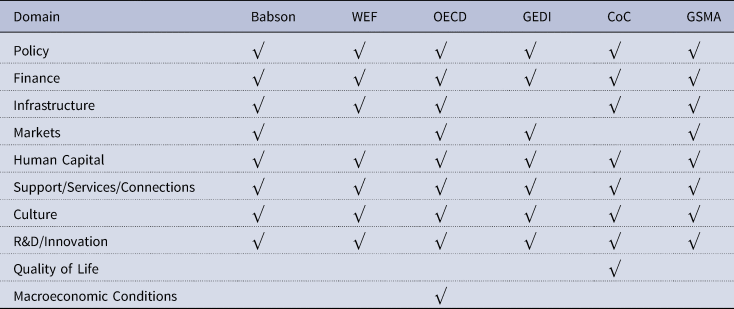
Six core components of an EE were proposed by Isenberg (Reference Isenberg2010, Reference Isenberg2011, Reference Isenberg2014), and three additional domains were recommended by the WEF (2013) from their survey of entrepreneurs' perceptions of EE. The Aspen Network of Development Entrepreneurs (ANDE, 2013) reviewed the EE frameworks from a series of different organisations in their project to develop a diagnostic toolkit for EE, as summarised in Table 1. Although each of these frameworks was prepared for a slightly different purpose, there is a high level of consistency in the core domains of the EE.
Entrepreneurial ecosystem framework analysis

Source: ANDE (2013) Entrepreneurial Ecosystem Diagnostic Toolkit.
Notes: Babson, Babson Entrepreneurship Ecosystems Project; WEF, World Economic Forum Entrepreneurship Ecosystem; OECD, OECD Entrepreneurship Measurement Framework; GEDI, George Mason University's Global Entrepreneurship and Development Index; CoC, US Council of Competitiveness Asset Mapping Roadmap; GSMA, GSM Association Information and Communication Technology Entrepreneurship.
The overall EE framework, shown in Figure 1, provides a structure for understanding and evaluating the enabling environment in which entrepreneurial firms can grow (Mazzarol, Reference Mazzarol2014a; Isenberg, Reference Isenberg2010; WEF, 2013). As each ecosystem is unique, shaped by the local assets and conditions, and evolving, a holistic approach is required to ensure the inter-related components are mutually reinforcing to stimulate self-sustaining venture creation (Isenberg, Reference Isenberg2010, Reference Isenberg2011).
Components of the entrepreneurial ecosystem.
Source: Mazzarol (Reference Mazzarol2014a) – adapted from Isenberg (Reference Isenberg2010); WEF (2013).

Government policy
The role of government is to facilitate and foster a vibrant environment for entrepreneurial ventures to be successful and sustainable, rather than providing direct investment schemes (Isenberg, Reference Isenberg2011). Policies may be specific to encourage and support the growth of small and entrepreneurial business developments, as well as general policies and regulations for taxation, financial services, telecommunications, transportation, labour markets, immigration, education and health (Mazzarol, Reference Mazzarol2014a). Policy makers are advised to target four aspects of the EE including (1) entrepreneurial actors, (2) entrepreneurial resource providers, (3) entrepreneurial connectors and (4) entrepreneurial orientation (Brown & Mason, Reference Brown and Mason2017; Mason & Brown, Reference Mason and Brown2014).
Regulatory framework and infrastructure
Regulation and infrastructure act as potential enablers or inhibitors of small business creation and growth (Mazzarol, Reference Mazzarol2014b; WEF, 2013). The ease of ‘doing business’ is reviewed and reported each year by the World Bank focusing on 11 areas of business regulation in 189 countries (World Bank, 2016). This analysis, which includes the complexity and cost of regulatory processes and the strength of legal institutions, provides rankings and detailed summaries including notes on key areas of improvement. Access to basic infrastructure, including utilities, telecommunications and transportation, which are essential for business operations also need to be considered within the EE context.
Funding and finance
Access to funding/finance is another fundamental requirement for new and growing businesses. Research on entrepreneurs, microbusinesses and small and medium-sized enterprises (SMEs) shows personal resources and informal loans from friends and family are often the preferred source of funds for many new and small businesses. However, to fund significant growth external debt is generally preferred to external equity (Clark & Douglas, Reference Clark and Douglas2012; Vos, Yeh, Carter, & Tagg, Reference Vos, Yeh, Carter and Tagg2007). The status of the financial sector can be evaluated using a set of indicators provided by ANDE (2013) for banks, venture capital, angel investors, private equity, public stock markets and philanthropic activity. Access to credit is measured in the World Bank's Doing Business study by considering the sharing of credit information and the legal rights of borrowers and lenders with respect to secured transactions (through collateral laws and bankruptcy laws) (World Bank, 2016). New sources of funding from online sources or crowdfunding platforms are providing alternative sources of funds for entrepreneurs with new business ideas (Mazzarol, Reference Mazzarol2014b).
Culture
Developing a culture in which entrepreneurship is highly valued can be assisted by communications strategies to profile entrepreneurial business growth, education programs to increase knowledge and awareness, and celebrations of awards to recognise innovations (WEF, 2013). Culture is one of the key intangibles influencing entrepreneurial activities, as shared values and norms influence attitudes and patterns of behaviour (Barney, Reference Barney1986). Society's tolerance for risk, mistakes and failure is one of the specific cultural attributes that is relevant for EE (Isenberg, Reference Isenberg2011; WEF, 2013). Attitudes towards innovation, creativity and experimentation are also key cultural factors, which affect the acceptance of new ideas and willingness to engage in entrepreneurial business practices (Isenberg, Reference Isenberg2011). The social status accorded to entrepreneurs is relevant as this may act to either encourage or inhibit people from establishing and growing entrepreneurial enterprises (Isenberg, Reference Isenberg2011). Similarly, if there is a preference for self-employment versus working as an employee within the culture, this can increase the numbers of small and entrepreneurial businesses (WEF, 2013). In addition, societal norms for personal drive, ambition and wealth creation can play a major role in the cultural dimension of the ecosystem (Isenberg, Reference Isenberg2010).
Mentors, advisors and support systems
A business mentor is typically an experienced business person who is empathetic and usually independent of the business, who volunteers his/her time to provide advice and act as a sounding board over an agreed period. Mentoring may be organised formally via an official program offered by a mentoring organisation or informally by the individuals involved. By contrast, advisors are normally employed by business consulting organisations or government organisations/agencies, to provide business intelligence for fees. Specialist professional service firms offer specific advice, e.g. law, accounting, auditing, taxation, IT, intellectual property or investment banking. Advice for entrepreneurs may also be provided within incubators or accelerators, from peer networks of entrepreneurs or business networks such as the Chamber of Commerce (WEF, 2013).
Universities as catalysts
Universities can contribute to the EE as catalysts for change through their academic programs, research and economic development activities (Mazzarol, Battisti & Clark, Reference Clark and Douglas2012; Fetters, Greene, Rice, & Butler, Reference Fetters, Greene, Rice and Butler2010; WEF, 2013). Academic programs produce graduates with the knowledge and skills to contribute to the growth of new and existing companies. Via internships, students contribute to problem solving for organisations; training high technology, science and engineering students in business/entrepreneurship areas enables them to develop their new ideas into marketable products and ventures. Theoretical and applied research on new and emerging domains and fields contributes to the knowledge-based economy. Staff and student connections with industry/business to address their problems/issues enable the University to have an influence on their growth and performance. Converting new ideas into innovations is encouraged and supported by Universities by providing infrastructure for commercialisation via research centres, or by supporting incubators, accelerators or technology parks on or close to campus. In addition, their stakeholder networks enable Universities to facilitate collaborations amongst the key actors and serve as a hub for the development of entrepreneurial capacity and ventures (Wadee & Padayachee, Reference Wadee and Padayachee2017).
Education and training
The focus of education and training system is to provide the knowledge and skills required by the workforce operating in an entrepreneurial economy. To support innovation in a wide range of industry sectors, the workforce needs educated and trained employees and entrepreneurs. The generic and specific skillsets needed by each sector are determined by consultation with industry professional bodies and education providers. Specific formal and informal education and training programs for entrepreneurs are also recommended (WEF, 2013). As discussed above, Universities contribute to the development of entrepreneurial knowledge, skills and abilities for this core component of an EE, but they are only one of the potential players in the education and training system.
Human capital and workforce
Human capital represents the total knowledge, talents, skills and abilities of individuals that can contribute to the workforce and create economic value. This was rated by entrepreneurs as one of the top three most important EE components for the growth of early-stage companies (WEF, 2013). There are many different kinds of talent and expertise needed in a dynamic entrepreneurial knowledge economy. As global markets change, business models, employment systems and workforce patterns also change, e.g. the rise of independent contractors in lieu of employees (McKeown & Phillips, Reference McKeown and Phillips2014).
Local and global markets
Access to markets is very important for early-stage and growth companies (WEF, 2013). Yet there are many challenges for new market access including geographic locations, distribution channels, visibility and access to key decision makers. Assistance is potentially available from suppliers and customers, as well as from industry/trade organisations. Market segmentation is a key process for identifying and evaluating potential target markets. Establishing and leveraging productive relationships with large companies is recommended for early-stage and growth companies (WEF, 2013).
Entrepreneurial education and EE
Entrepreneurial education has a significant role within the EE and thereby contributes to economic growth and development. Two of the core components of the EE explicitly focus on education activities and outcomes, i.e. Universities as Catalysts and Education and Training. These activities contribute directly to the Human Capital and Workforce component and to the development of a Culture that values entrepreneurial people, processes and performances. Education also contributes indirectly to the Mentors, Advisors and Support Systems as these processes include the transfer of tacit and explicit knowledge. These inter-relationships between the entrepreneurial education activities and outcomes demonstrate the complex, integrated and holistic nature of the EE framework.
Prior research on links between entrepreneurial education and EE includes a case study of a German entrepreneurship program by Maritz, Koch, and Schmidt (Reference Maritz, Koch and Schmidt2016). This project included discussion of an entrepreneurial university that incorporates the University as Catalyst elements and activities including entrepreneurial education, research and enterprise and stakeholder engagement. Connections from the entrepreneurship program to the broader context within and beyond the university, such as the national system for entrepreneurship (Acs, Audretsch, Lehmann, & Licht, Reference Acs, Audretsch, Lehmann and Licht2016; Acs, Autio, & Szerb, Reference Acs, Autio and Szerb2014), were found to be important and difficult to separate out as they are intertwined and overlapping. Schmidt and Molkentin (Reference Schmidt and Molkentin2015) outlined a consortium approach to developing a regional interuniversity ecosystem for entrepreneurship education in northeast Ohio, USA. Collaboration from 11 institutions established a regional network of faculty, students and staff to share undergraduate course ideas and materials (such as program information, speakers, facilities and advice). Focusing on two specific programs, an Entrepreneurship Immersion Week which rotates around the member institutions, and a new venture idea and feasibility competition (ideaLabs), the consortium ecosystem provides some entrepreneurship opportunities for undergraduate students of all disciplines. These are additional face-to-face programs beyond the normal academic offerings of the member institutions which suit a local area/region with multiple small institutions. Many institutions focussing on entrepreneurial education would employ their own academic specialists and offer their students a greater variety of entrepreneurship learning activities than this specific consortium.
Stakeholder engagement and collaboration was found to be strong and extensive for entrepreneurship education by Bischoff, Volkmann, and Audretsch (Reference Bischoff, Volkmann and Audretsch2018) in their examination of the key stakeholders in the EE of 20 European higher education institutes. Although, the type of involvement, the strength of engagement, the geographical scope of collaborations and formalisation of stakeholder management varied among these institutions (Bischoff, Volkmann, & Audretsch, Reference Bischoff, Volkmann and Audretsch2018). Another European study of learning communities in entrepreneurship focused on the contributions and expectations of all the main actors, such as students, teachers, directors, parents and external partners. This research, conducted in the Netherlands, Finland, Spain and Germany, examined entrepreneurship education programs across primary, secondary and higher education levels to test an education EE conceptual framework with five dimensions: (i) the learning framework; (ii) networks and connections; (iii) entrepreneurial culture; (iv) pedagogical solutions and (v) learning spaces and materials (Byrne, Fayolle, & Toutain, Reference Byrne, Fayolle, Toutain, Chell and Karatas-Ozkan2014; Mueller et al., Reference Mueller, Toutain and Bornard2016; Toutain, Mueller, & Bornard, Reference Toutain, Mueller and Bornard2019). The factors impacting on the entrepreneurial intentions of students were examined in a Spanish postgraduate program which is integrated into an EE by Ferrandiz, Fidel, and Conchado (Reference Ferrandiz, Fidel and Conchado2018).
Each of these prior entrepreneurship education ecosystems studies has a different purpose, focus, unit of analysis and conceptual framework. This means that the findings, which are relevant and interesting, are not directly comparable, nor do they build upon a common literature as this is an emerging field and the authors come from different disciplinary backgrounds. Our exploratory research project, which is part of a longitudinal collaborative international research programme on EE, examines the EE approach to entrepreneurial education using the conceptual model of an EE outlined above. This EE conceptual framework provides a replicable structure for mapping the key elements of a specific EE. Each of the core components of the EE framework will be considered and discussed in the case study that follows.
The Entrepreneurial Garden case study
The case research method
The over-riding research question addressed in this paper is: how can the emerging EE approach to the creation of economic value align with entrepreneurial education delivery and expectations? To examine the EE approach to entrepreneurial education, we have used an in-depth qualitative case study of The Entrepreneurial Garden (TEG) at Burgundy School of Business (BSB) in Dijon, France. As the unit of analysis for this exploratory research is the EE, the study includes TEG as the central academic unit/hub and all of the nine components that are involved to create an EE (as outlined in the EE conceptual framework). TEG was selected for this case study using purposeful sampling (Patton, Reference Patton2015) as this academic unit was established with an ecosystem approach and incorporates the interconnected entrepreneurial actors, organisations, institutions and processes from the Mason and Brown (Reference Mason and Brown2014) definition of an EE. Data was collected on TEG and key factors for all nine of the EE core components drawing upon the ANDE (2013) protocols for research on EE (Mazzarol, Reference Mazzarol2014a; Isenberg, Reference Isenberg2011; WEF, 2013). Semistructured interviews were conducted with academic staff from BSB and TEG, as well as key stakeholders such as the representatives from the regional development agency, business angels and business advisors (Yin, Reference Yin2018). Documentation examined included internal reports and articles sourced from the public domain (ANDE, 2013). The data was analysed in terms of the key factors for each of the core components, as well as their linkages to other components (ANDE, 2013; Mazzarol, Reference Mazzarol2014a; WEF, 2013).
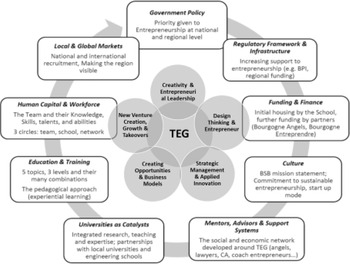
Following an introduction to the TEG case context and concept, the analysis of TEG as an ecosystem is outlined using all of the key components of the EE framework. A summary of the TEG ecosystem analysis is also provided in Figure 2.
The Entrepreneurial Garden (TEG) as an entrepreneurial ecosystem (EE).

The context: Burgundy and the BSB
BSB, founded in 1900Footnote 2, is a leading teaching and research business school holding international accreditations (AACSB and EQUIS) and belonging to the network of top French academic institutions in business and management. BSB is located in Dijon, the capital of Bourgogne-Franche Comté, and north of the Auvergne Rhône Alpes region, which is one of the most dynamic regions of France in terms of innovation, entrepreneurship and growthFootnote 3. BSB is a private, nonprofit institution offering a range of degree programs where students experience high-quality education (the Master in Management program is ranked in the Financial Times amongst the Top 80), and delivering a personalised approach within an international environment. In terms of size, BSB relies on a faculty of 60 professors and researchers, has 2,300 students (including 500 international students of 65 nationalities), and an international network of 10,000 alumni.
BSB created a formal students' incubator in 2009, capitalizing on the ongoing experience of coaching student business projects (ESC Entreprendre, a students' association created in the mid-1990s) and courses in Entrepreneurship (since 2000). Involving one, then two faculty members, and related to teaching, mentoring and research, this incubator had grown over time with increasing interest of students in entrepreneurship and it required a more dedicated structure. Hence, this incubator project led to the birth of TEG, launched in 2013, with new dedicated premises in 2016.
The concept: TEG
TEG is a centre for entrepreneurship and small business management, which was established to contribute to sustainable entrepreneurial growth and applied entrepreneurial education and research. The TEG vision (shared by the team and the board of the business school) is:
To contribute to the development of a sustainable entrepreneurship, creator of economic, social and environmental value, relying on innovation and cooperation, for which the entrepreneur learns to become an author (Burgundy School of Business (BSB), 2018).
TEG is focussed on five fundamental themes: (i) creativity and entrepreneurial leadership; (ii) design thinking and entrepreneur; (iii) strategic management and applied innovation; (iv) creating opportunities and business models, and (v) new venture creation, growth and takeovers. TEG has adopted an entrepreneurial education approach to provide enterprise education focussed on enhanced competencies, as well as specific entrepreneurship education learning opportunities.
TEG differs from traditional academic and research centres by combining dedicated facilities for entrepreneurial venture development integrated with academic programs and resources. TEG was designed as the central hub at the heart of an ecosystem, which includes many different players who each contribute to the collective agenda of developing enterprises, entrepreneurial mindsets and entrepreneurial competencies: entrepreneurs, businesses, students, lecturers, academics, researchers, coaches, experts, institutions. Reflecting its name, TEG provides collaborative workspaces and operates with innovative, multidisciplinary pedagogy to nurture growth.
The pedagogical approach adopted by TEG is based upon experiential learning and includes the establishment of an open educational environment connected to key players in the community. In some of the papers offered, learners are enabled to experience real problems and to interact with the main actors in the EE. Thus, TEG provides an environment that facilitates interactions between learners (students) and those involved in entrepreneurship, whether they are professionals, institutions, researchers, advisers, entrepreneurs or teachers. In this way, these activities presented in TEG reinforce exchanges between learning and the external environment.
TEG as an EE
Government policy
Government interest in entrepreneurship has been steadily growing in France for the past 5–10 years. This interest has stimulated the birth of academic programs in most of the business schools and universities, an increase in support of student entrepreneurs (e.g. more and more incubators in the business schools), and support at the level of the administrative regions (DECA-BFC in Bougogne-Franche Comté), plus a university organisation (called PEPITE). BSB started to work on these types of initiatives in the mid-1990s; however, formalisation of BSB's interest has grown in parallel to the national movement. A regional scheme for youth entrepreneurship is progressively emerging involving the main actors (including TEG) and allied with political interests. TEG's principles align with these political orientations. For example,
Encouraging and supporting activity creation/re-employment for young people, and contributing to the attractiveness of our region by strengthening territorial cooperation and the networking of young entrepreneurs (Burgundy School of Business (BSB), 2017).
Regulatory framework and infrastructure
With increased national and regional focus on entrepreneurship in France, support for creating businesses has increased. At the national level, the BPI (public bank for investment) has developed many products, projects and programs to support firm creation and development. At a regional level, the regional council has also set up programs to support entrepreneurship and small firm growth. For example, the funding of doctoral students by the regional council includes a specific program in Entrepreneurship designed by TEG to help them to create an activity around their doctoral project. In terms of infrastructure, TEG provides offices and premises for students' projects (open spaces for emergent projects, offices for more advanced projects, with web access and a postal address), and after-hours access to these facilities if required (evenings/weekends).
Funding and finance
TEG provides links to former entrepreneurs who belong to the national Réseau Entreprendre and often visit TEG to offer mentoring and initial funding to start ups (via local experienced entrepreneurs). In addition, there is an office of Bourgogne Angels (same type of organisation but specialised in funding) within TEG's premises. Both organisations provide mentors and jury members (who assess student's pitches (1) for enrolment in the incubator, and (2) at the end of their entrepreneurial projects), and this enables the TEG students to develop relationships with potential funders. In addition, the presence of young chartered accountants at TEG once a week provides opportunities for students to access specific advice and technical guidance on the funding of their new venture projects. Another interesting additional source of information on ‘crowdfunding and microcredit’ is also available from a specialist BSB research group in this area.
Culture
Aligned with the BSB mission statement, TEG has adopted an orientation towards sustainability and social responsibility. The TEG team explicitly aims to transmit and inspire sustainable values around environmental issues, societal and human implications, and economic sustainability in coursework, as well as in their processes of mentoring students and projects. Experiential learning and teaching was selected as the DNA of all the programs or workshops/seminars offered by the TEG team. In addition to these pedagogies, TEG has chosen to act and be different to other centres/units in terms of its localisation, organisation and governance: outside of the main campus, in dedicated premises, a collaborative team of senior and junior faculty members, working in an open space in project mode, sharing facilities with students and visitors. The TEG culture which reflects and values a proactive entrepreneurial spirit, creativity and innovation is strongly supported by BSB senior management, facilitated by the recruitment processes including cultural alignment criteria, and fostered by mentoring of new staff members.
Mentors, advisors and support systems
At TEG, practitioners are a fundamental part of the ecosystem. The TEG team has developed partnerships with a number of different types of institutions including experienced entrepreneurs (from the Réseau Entreprendre and from the Bourgogne Angels); business advisors (from the local Chamber of Commerce, the association of young lawyers and the local group of chartered accountants); other incubators with different profiles (the regional high tech incubator, the university organisation providing support to students entrepreneurs), and the BSB students associations (which focus on business and counselling activities). Some of these organisations have an office at TEG, are present once a week for interviews, or come to interact with the students as coach or jury (assessing pitches-ask questions, provide feedback and evaluate projects). This provides TEG's future entrepreneurs with regular contact with practitioners, opportunities to interact at monthly lunches and fortnightly workshops where they ‘pitch’ their projects, and feedback from professional experts. Co-location at TEG's premises also creates opportunities for informal chats and discussions with faculty members, business angels, experienced entrepreneurs and other experts.
Universities as catalysts
TEG serves as the home for entrepreneurship and SME research, lecturing, and counselling; with one team located in a special-purpose building aiming to catalyse enterprise development. This design incorporates all five of the types of entrepreneurship spaces discussed by Pittaway et al. (Reference Pittaway, Aissaoui, Ferrier and Mass2019) to support innovation and entrepreneurial learning: ideation room for 10–20 students, incubator offices and meeting rooms, materialisation room for prototyping and design thinking, an integrative hub space to connect stakeholders and integrate resources, and community spaces for sharing (kitchen, garden, patio, offices and events). The team includes former BSB students, faculty members with a dual focus on culture management and engineering, and multidisciplinary researchers focusing on entrepreneurship, small firm management, innovation, education, anthropology and sustainable development. TEG has partnerships with engineering schools and arts schools, which enables mixed groups of students working together on projects. TEG also has a wide international research and teaching network with visiting experts and faculty from around the world.
Education and training
TEG offers experiential education and training in five specialist areas (noted above) at beginner, advanced and executive levels including both full semester and intensive ‘block’ courses. In terms of pedagogy, three main convictions drive TEG's actions: (i) individual skills have to be enhanced (personal value); (ii) entrepreneurship is based on the diversity of individuals who are constantly reacting to their surroundings (they are thus both the producers and the products of their constantly evolving ecosystem); and (iii) entrepreneurial behaviour produces personal, economic and social value. This has led the team to develop customised programs and new pedagogical methods. TEG's courses and pedagogy are defined by the following principles: (i) collective learning and effectual teaching constitute the basis of the teaching methods (including reflexivity and peer learning); (ii) academic professionals and practitioners are part of the educative and pedagogical teams; (iii) each participant learns entrepreneurship by experiencing real-life situations; and (iv) daily individual and collective feedback on their learning activities and insights. Pedagogical innovation includes experimentation with active learning approaches to entrepreneurial education that are designed, tested on small groups and classes, then modified, and scaled up for larger groups. Two examples include creativity methods to develop creative mindsets, and horse coaching to raise self-awareness and understanding of interactivity. Each year, TEG provides enterprise training to 1,400 business school students from a range of disciplines including marketing, finance and international business. In addition, entrepreneurship education papers (Creating Opportunities and Business Model; New Venture Creation) provide opportunities for 60 students to use the incubator services, and typically 6–10 students create their own new business each year. Without TEG's ecosystem design, infrastructure, systems, programs, staffing and networks, BSB students would not have opportunities for internships, entrepreneurship projects or new venture creation. Nor would the local and regional business community have incentives and opportunities to proactively engage with entrepreneurship students. While education and training is considered as just one of the components of any EE, as outlined in this paper it is TEG's core business, connecting and integrating TEG's activities.
Human capital and workforce
TEG considers their human capital development capacity within three overlapping circles: (i) the inner circle is composed of the TEG team and its close partners; BSB has established a dedicated team for TEG, including faculty members with different and complementary work experiences, research and teaching interests, a former young entrepreneur to look after the incubator, and a research engineer specialised in business models; (ii) a second circle which corresponds to the business school and regular lecturers; TEG has created a network of close partners, researchers, practitioners and lecturers, who provide workshops, lectures and discussions for the students; and (iii) a third circle which is the wider network developed around TEG including ‘weak ties’ to many individuals and organisations locally, regionally and internationally. TEG team members are involved in a three-phase recruitment process for additional staff which includes assessment of applications by TEG staff for a match with priorities (including active pedagogy, compatible research interests), an initial interview (by two TEG staff including Head), and followed by the classical HRM process.
Local and global markets
TEG's core activities of education, research and enterprise development involve connections with impacts that are local, regional, national and international. One of TEG's primary objectives is:
Making our region more visible on a national and international scale through its pedagogical innovation, recognition of its scientific work and its role as an accelerator in the emergence of tomorrow's start-ups (Burgundy School of Business (BSB), 2017).
With national and international recruitment of students, TEG's impact can be broad. However, the incubation activities and coaching of projects are exclusively targeting BSB students and alumni at this stage. Yet, TEG's expertise in entrepreneurial education and in small firm management targets a wider audience, including executive education, other institutions interested in entrepreneurship courses, or organisations supporting small firm growth and development. TEG's research activities target local industries (e.g. the food industry, with a sponsored research chair specialised in business models for the food sector), or other regional activities (e.g. tourism in Burgundy, linked to a specific research program), or entrepreneurial education (e.g. pedagogy experiments).
Discussion and conclusions
In this paper, we have outlined and applied a comprehensive EE framework to examine how this emerging approach to economic value creation aligns with the expectations for entrepreneurial education programs. TEG at BSB in Dijon, France, offers entrepreneurial education, research and enterprise development as an integrated portfolio within an EE. Our analysis of TEG's EE shows how an academic unit can be created, structured and organised to develop entrepreneurial ventures, while also delivering enterprise education and research. This detailed case study potentially provides an exemplar for other universities looking to achieve academic and enterprise objectives simultaneously by adopting an EE approach. Rather than maintaining separate infrastructure for academic departments and enterprise centres/incubators, the EE approach focuses on the proximity of the key partners in the ecosystem. Reflecting its name, TEG provides collaborative workspaces and multiple types of entrepreneurial learning spaces that facilitate engagement and nurture growth of individuals and enterprises
Although TEG evolved from prior entrepreneurship activities at BSB, the recent changes in strategy and operations align this academic unit with the macroeconomic policies and priorities of national and regional government organisations and agencies. While senior leadership in many universities are discussing the importance of relevance and impact for business, industry and economic growth, BSB leaders have committed resources to enable TEG to operate proactively with industry partners and function as a stand-alone unit. Leveraging funding from partners is a critical element for the growth of new and entrepreneurial ventures at TEG. Co-location of key players within the EE, facilitated by the incubation and integration entrepreneurial learning spaces, is another major feature of TEG which contributes to resources, culture, education, human capital and access to markets.
TEG's ecosystem design enables this relatively small unit (six full-time equivalent (FTE) core academic staff and two FTE administrative support staff) to increase both educational and economic outcomes including growth in student enrolments, learning outcomes, employability and new ventures. Establishing a ‘one-stop shop’ for entrepreneurship activities facilitates critical mass, as well as providing easier and improved access for both external and internal parties to the entrepreneurship specialists. The open innovation approach, which is fundamental to the ecosystem design, also increases TEG's capacity and resources. Other benefits of this ecosystems approach for TEG included transaction costs reduction; synergies between the actors; raising the profile of the unit, the stakeholders and the outcomes (from stories of student success and new ventures); growth in capacity and enrolments; encouraging researchers to collaborate and address issues relevant to local/regional communities; contributing to regional economic development; and providing the facilities/space for stakeholder events (e.g. angel network meetings, business network training/workshops and meetings).
The EE approach also has advantages for stakeholders, the region and the University. Opportunities for local networks, such as lawyers, accountants, business support agencies and funding agencies, include a better understanding of needs (technical, competencies) and sector trends, greater connectivity with teachers/researchers and entrepreneurs, and new future customers/clients. Regional benefits from the EE include an increasing profile for entrepreneurial activities and a better understanding of the strengths and weaknesses for the region's future growth. Advantages for the University include greater capacity in entrepreneurial education from the integrated EE approach (team experience, training competencies, research contributions and the incubator), as well as an increasing profile and reputation for entrepreneurial outcomes.
However, there were also some challenges associated with this approach (e.g. linked to the trade-off between impact and publications), as the academics spent more of their time interacting with practitioners (for projects and events), they had less time for writing up their research publications. Note, within this University, these trade-offs are managed with specific performance measures for the institution, the unit and the academic staff aligned with the strategic mission and goals. BSB has not had any difficulty recruiting high-quality academic staff and also has an international network of scholars who regularly visit and contribute to the teaching and research programs. Other operational factors that need to be considered include time allocations for the organisation of the local partner events held in TEG space, student/partner liaison activities and engaging in stakeholder relationship management including both formal and informal communications with EE partners. As the quality of the program is dependent on the academic expertise of staff and their credibility and relationships with the local partners, it is important to hire scholars who fit with the aspirations, culture and expected outcomes of the unit.
In terms of entrepreneurial education, TEG has clearly defined principles that underpin the pedagogy utilised in their entrepreneurship program. These principles closely align with TEG's vision and strategic themes to ensure teaching and learning experiences are focussed on the growth of entrepreneurial mindsets and enterprises. TEG's ecosystem serves as an open learning environment so that their students have opportunities to experience real problems and interact with all of the main actors/partners in the EE. TEG's educational processes and practices are consistent with fundamental experiential learning theories, and also incorporate many of newer experiential approaches to developing entrepreneurial skills, creativity and sustainable business ventures.
In terms of the EE framework, this case study highlights the connections between the nine core components and the importance of the quality of the linkages, as well as the multidimensional proximity effects (far beyond the sole spatial proximity). An EE needs to grow and develop from local resources and expertise, reaching further afield as required to build scale and scope. This was demonstrated by BSB leveraging its funds and expertise, with other entrepreneurial players, resources and networks to create the TEG ecosystem. For Universities looking to expand their entrepreneurial education activities and outcomes, the EE framework provides a structure for identifying and connecting with the key players and resources.
Identifying, discussing and illustrating the EE components provides valuable information, which can contribute to further refinement of the EE framework, as well as insights for the case study organisation. For example, the case study highlights the role of TEG's mission/purpose as a driver for the unit's structure, culture and activities; however, the EE framework does not include a specific component that represents this type of overarching strategic organisational purpose. In Figure 2, we added TEG's strategy in the centre of the EE framework to address this omission.
There are significant opportunities for further research on the contribution and connections between the EE approach and entrepreneurial education programs. This single case study highlights a series of key links between entrepreneurial education activities and this comprehensive EE framework for venture creation. Additional case studies using this EE framework would be useful to compare and benchmark the entrepreneurial activities involved in other localised ecosystems. Examining the contributions, interactions and interplays between the key players in the ecosystem would be valuable, as well as analysis of the outputs/outcomes of the ecosystem in terms of value added at different levels (e.g. individuals, schools, regions).
Further research to track and map the inter-relationships between the key factors in each of the core components of the EE is needed. Also, longitudinal studies should be used to show the evolution of an EE, and development of metrics to measure the major factors in each of the core components. Given the significance of entrepreneurship for economic and social developments, studies such as these potentially contribute not only to entrepreneurial education, but also to economic value creation.