2018 marks the twenty-first anniversary of the establishment of the Portable Antiquities Scheme (PAS) in 1997 as an initiative to record archaeological objects found by members of the general public. Initially set up in pilot form, in 2003 it was extended to the whole of England and Wales.Footnote 1 Surveys of Roman period finds recorded by the PAS have been published in Britannia since 2004. This fifteenth annual report summarises the general character and distribution of Roman finds reported in 2017 and publishes significant individual artefacts recorded by Finds Liaison Officers.
OVERVIEW
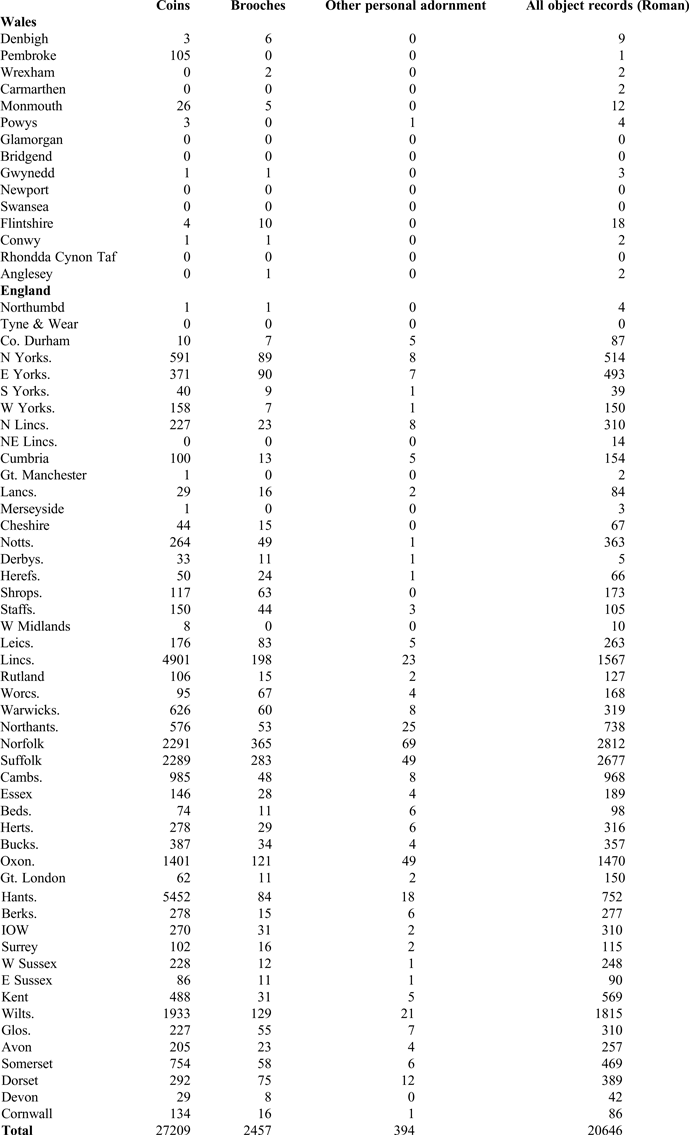
The summary of the Roman period finds reported to the PAS in 2017 begins as in previous reports with a discussion of their distribution. Table 1 presents the numbers of object types recorded on the database by county, using older administrative boundaries for consistency with previous reports; counties are as usual grouped by PAS region. The first three categories comprise coins, brooches and other personal ornaments made of metal, the numerically most significant categories of Roman period finds. The fourth column in the table shows the number of records of Roman objects in all materials, including metallic and non-metallic objects (i.e. ceramic, glass and stone objects and building materials), made for each county. This follows the same format used for presenting the 2016 finds.Footnote 2 As a single record, for example a description of a ceramic assemblage or coin hoard, may sometimes document more than one item, the total number of Roman objects documented in the year is larger than the number of records. The number of Roman coins documented in 2017 both in toto and in some counties is therefore greater than the number of Roman period records. Nonetheless the distribution of records can reasonably be considered as a proxy indicator for the distribution of object findspots. 2017 saw many records made for Roman objects found both in eastern England, in particular in coastal counties from north Yorkshire to Suffolk, and in some central southern English counties, especially Oxfordshire, Hampshire, Wiltshire and Somerset. In western England and Wales the number of records is much smaller. The documenting of a small number of large hoards during 2017 is partly responsible for the very high numbers of coins in some counties. Significant examples include hoards from Angle, Pembs. (NMGW-C6E489), North Rauceby, Lincs. (LIN-F6D516), Warmington, Warwicks. (WMID-7AECFC), Ellingham, Harbridge and Ibsley, Hants. (WILTD0893) and Whitelackington, Somerset (SOM-D31FA2).Footnote 3 If these individual hoards are set aside, the regional variability in the distribution of PAS finds closely follows the pattern established in previous years. As previously noted, this is determined by multiple causes, including the availability of metal objects in antiquity, historic and contemporary farming practice and the intensity of metal-detector use.Footnote 4
numbers of non-ceramic artefacts recorded by the pas in 2017 by county and type

With the addition of the coins recorded in 2017 (27, 209) more than 257,000 Roman coins have been recorded by the PAS, as calculated from these annual totals, an outcome of the long-standing emphasis on recording large assemblages of Roman coins in toto.Footnote 5 The tabulation format this year means that the frequency of coins documented relative to all other metallic objects in 2017 can only be compared directly to the 2016 data. As for 2016 finds, the outnumbering of brooches by coins at a ratio of more than 10 to 1 suggests that patterns of discovery and documentation again approximate to those established from 2003 onwards.Footnote 6
28,162 brooches have been documented by the Scheme since 2003 in these annual reports, including the examples recorded in 2017.Footnote 7 As always this number comprises brooches with date-spans across the late Iron Age–Roman transition as well as brooches dated to within the Roman period proper. The distribution of 2017 brooch finds is very similar to previous years in two major respects. First, the highest concentrations are documented in eastern England and in some southern and south-western English counties. Second, in several counties in the west and north-west of the English Midlands, the ratio of brooches to coins is much higher than average, from 1:3 (for example Cheshire or Staffordshire) to 1:2 or greater (e.g. Herefordshire or Shropshire).Footnote 8 Other jewellery and dress items (mainly finger-rings and bracelets) are again the most frequently documented metal artefact types after brooches, but their numbers are much smaller. The most significant single assemblage of (non-coin) objects found in 2017 is the hoard from near Gloucester, comprising c. 100 sheet bronze fragments probably collected for recycling. As well as statue fragments and a scrap of an inscription from a likely statue base, it also includes a complete dog statuette with its anatomical details rendered with a degree of stylisation.Footnote 9
ARTEFACT DESCRIPTIONS
The following 24 entries publish individual highlights among the past year's discoveries recorded by members of the PAS and Treasure Department at the British Museum.Footnote 10 They are selected because of their contribution to the study of the visual and material culture of Roman Britain. The reference number associated with each record is the unique identifier which can be used to consult these object records on the PAS website: www.finds.org.uk. One object (the Nether Wallop ring, No. 21) was also treated as a Treasure case and is thus also designated with its Treasure number in the format of year (20XX) and reference number (TXX).Footnote 11
The silver, copper- and lead-alloy artefacts published here belong to diverse ‘small find’ functional categories, made between the late Iron Age and the fifth century a.d. The forms and decoration of these objects draw on Classical and Iron Age traditions. The ten figurines include both more commonly documented deities (Minerva, Mercury) and less common images, including a highly classicising figurine of Neptune and a stylised rider from a ‘horse-and-rider’ statuette. Personal ornaments include three brooches of types not previously documented in Britain and a possible hairpin. There are also five leatherwork fittings from harness and baldrics, a likely furniture fitting in the form of a griffin and an anthropomorphic vessel mount, as well as a stylus of late Roman type, a decorated pair of dividers and a large decorated fragment of a lead tank carrying an apotropaic image not previously seen on these possibly Christian objects.
CUMBRIA
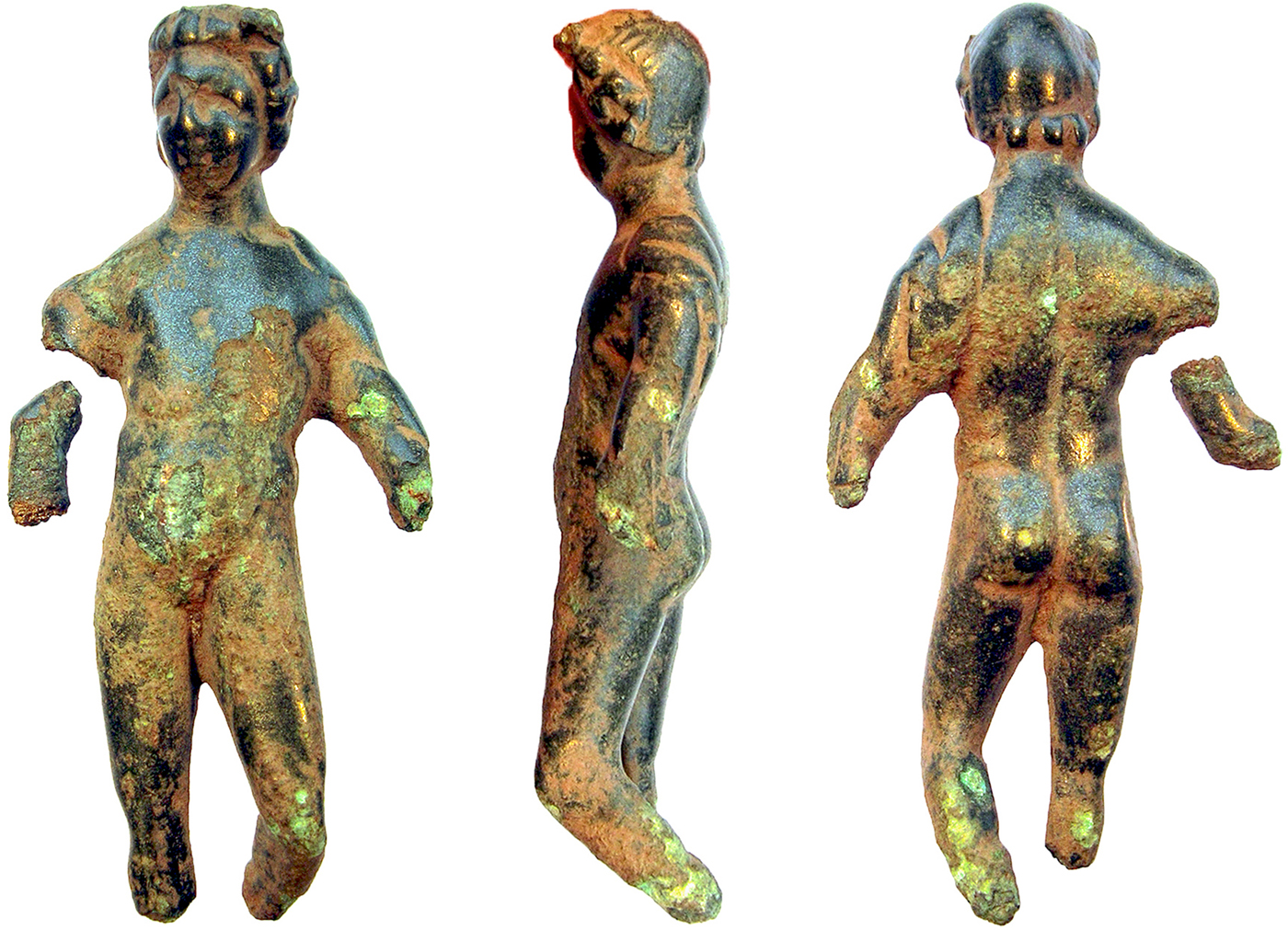
(1) Westward (LANCUM-678D1 F) (fig. 1).Footnote 12 An incomplete cast copper-alloy figurine, being a well-modelled rendering of a nude male deity but worn and pitted by corrosion and missing its extremities due to old breaks. The lower right arm has broken off but survives. The figurine is 71 mm tall, 30 mm wide and weighs 39.3 g. The god, naked save for a chlamys draped over the left shoulder and arm, stands in contrapposto pose, left leg bent and right straight. His coiffure is visible as a thick clumped fringe encircling his head and as traces of locks in grooves on the otherwise very worn top of his head. On the oval face traces of eyes and nostrils can be seen but the detail is otherwise lost to wear. Traces of musculature, the spinal groove and genitalia are visible on the god's torso; the effectiveness of the modelling of anatomy is best displayed in the buttocks and legs which are broken off at the calves.
Westward, figurine of Apollo (No. 1). Scale 1:1. (Photo: D. Boughton; © D. Boughton)

This figure of a slender male youth can be identified as the god Apollo, one of the less frequently attested male deities from Britain.Footnote 13 In this case the worn remnants of the coiffure on top of the head are better interpreted as those of a topknot rather than as the wings of Mercury, although there are no traces of the longer strands of hair which fall to the shoulders on other representations of Apollo.Footnote 14 The missing hands may have held more diagnostic attributes of the god, for example the plectrum and lyre. The pose of the deity and the draping of the chlamys across the shoulder are echoed in other figurines of Apollo, for instance in a find from near Oxford (probably Woodeaton) and the more languid classicising statuette with delicately modelled topknot from London.Footnote 15 Similar figurines of slender male figures documented by the PAS may also be identified as further examples of Apollo, for instance at Chattisham, Suffolk (SF-902DD3) and Corse, Glos. (GLO-058493).Footnote 16
CHESHIRE
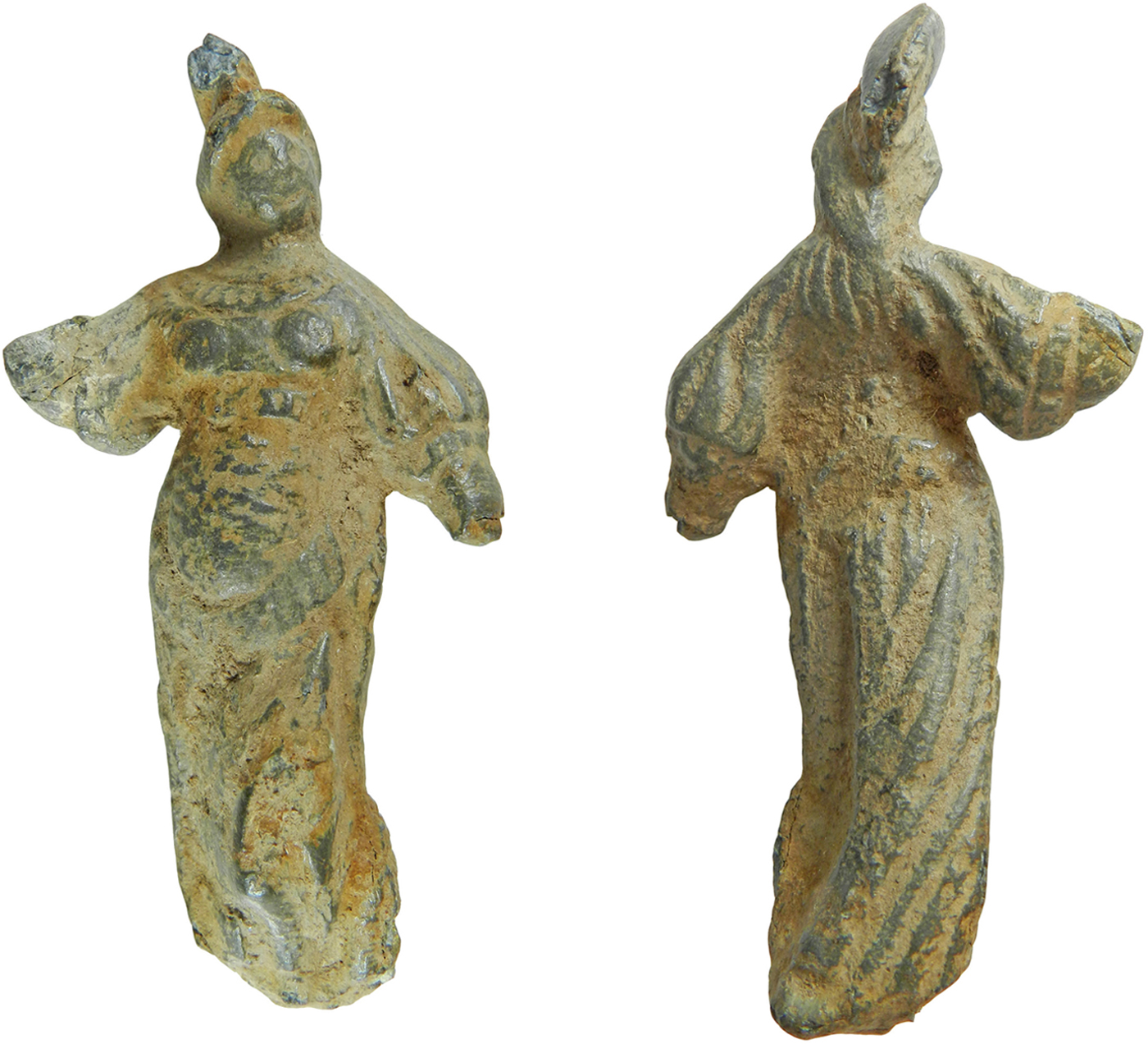
(2) Capenhurst (LVPL-1CA02C) (fig. 2).Footnote 17 A small lead-alloy figurine of Minerva, worn and with both forearms lost. It is 52 mm high, 25 mm wide and 10 mm thick; it weighs 26.6 g. The head with a high crested helmet and much worn face (the outsize eyes and mouth may just be distinguished) tilts a little to the right. The somewhat sinuous figure may stand in contrapposto pose, but little of it is visible beneath the voluminous short-sleeved chiton. Traces of the modelling of the breasts may be seen on the upper torso. The material is pulled tighter across the abdomen of the figure; the pleating of the chiton on the upper arms and curving folds at the shoulders and where the garment falls to the feet are better preserved.
Capenhurst, figurine of Minerva (No. 2). Scale 1:1. (Photo: V. Oakden; © V. Oakden and National Museums Liverpool)

A small number of Minerva figurines have been documented among PAS finds of statuettes, surprisingly few perhaps in contrast to the general popularity of the goddess among surviving bronze figurines from the province.Footnote 18 PAS finds include two very similar examples of this distinctive rendering of Minerva, one also in lead alloy from Cheshire (WMID-B76FD0), the other from Carew, Pembs. A similar example, more finely modelled, is documented by Faider-Feytmans among the ‘objets douteux’ from the collection at Arlon, Belgium.Footnote 19 Although lead alloy is a less common material for figurines, cast images of several different gods are nonetheless documented in this material.Footnote 20
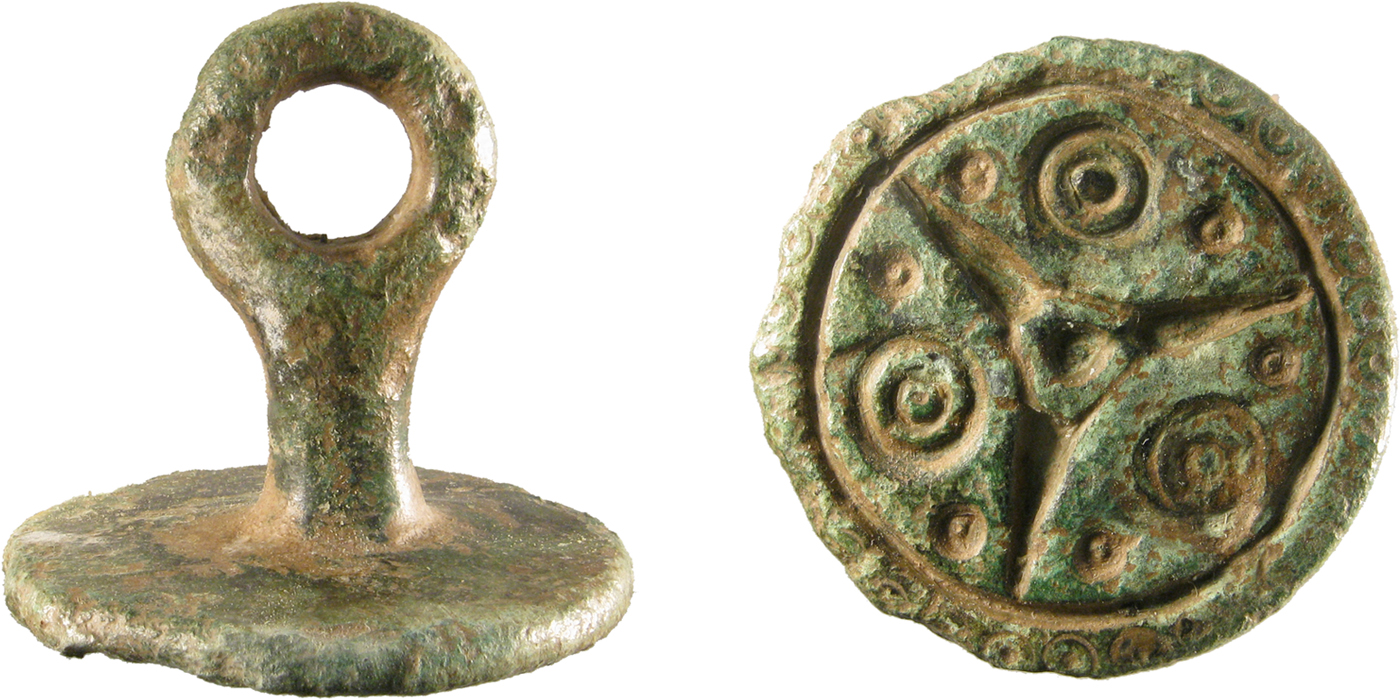
(3) Alsager (WMID-924C13) (fig. 3).Footnote 21 A complete copper-alloy fob or dangler of late Iron Age or early Roman date, quite worn with a dark green patina. This example is 28.5 mm long while the disc is 30 mm in diameter and 4.2 mm thick. It weighs 21.5 g. The fob comprises a circular decorated disc from the back of which projects a shank with suspension loop. The disc has a border, separated by a groove from the main body of the decoration, which carries (where it is preserved) repeated circular motifs. Within this border the decoration is divided into three subordinate zones by a triskele-like motif, its legs tapering towards the edge and with a triangular setting at its centre. Each smaller zone includes a circular motif formed by two concentric ridges and grooves, with a circular hollow on either side with a raised dot at its centre. The reverse of the disc is plain and flat. The integrally cast shank is rounder in section nearer the disc but flattens where it expands to accommodate the near circular suspension loop.
Alsager, fob or ‘dangler’ (No. 3). Scale 1:1. (Photo: V. Oakden; © V. Oakden and National Museums Liverpool)

The purpose of these fobs is not certain. They may have hung from items of equipment, personal apparel or horse harness. Jope and Macgregor documented respectively 17 and 9 triskele-decorated examples from the British Isles but recent synthesis is lacking and the date range for the object type remains broad (c. 200 b.c. to a.d. 200) thanks to the dearth of stratified examples.Footnote 22 Many more have now been documented by the PAS (78) than in existing corpora. The vast majority are openwork objects, unlike the Alsager fob, but the decoration is almost always configured in the form of a triskele, albeit typically with curving members. Well-preserved examples include fobs from West Hanney, Oxon. (LVPL-720A75), Bampton, Oxon. (BH-33103E), and Woore, Shrops. (LVPL-78F55A). A fob from Brandon and Bretford, Warwicks. (WMID-39EFF8), is one of the few other non-openwork examples, but its decoration, a single circle extending over the whole surface, is much simpler. Ring-and-dot motifs also occur on other examples, the most striking instance being on the swastika-form fob from Streatley, West Berks. (SUR-8328CA), the iconographically most complex instance, where they are distributed along the arms which carry stylised water birds.Footnote 23
EAST YORKSHIRE
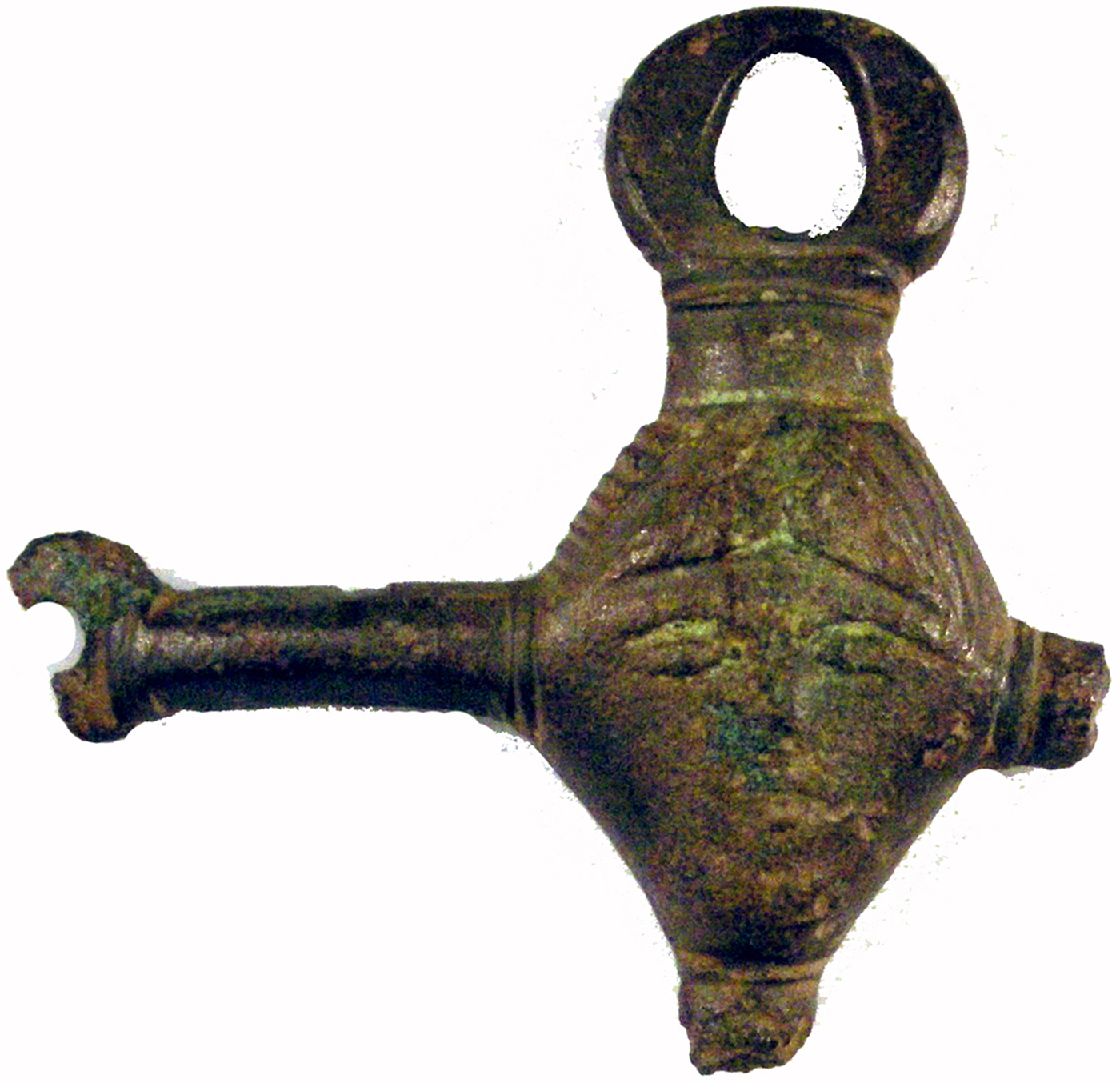
(4) Fulford (YORYM-0ABE90) (fig. 4).Footnote 24 An incomplete and worn cast copper-alloy bucket mount of late Iron Age or Roman date. The mount is 47.3 mm long, 49.5 mm wide and 6.5 mm thick; it weighs 19.2 g. The central element takes the form of a flat ovoid face with incised features. Traces of eyes and eyebrows survive better than those of nose or mouth. The ridged right side of the face hints at swept-back hair. The back of the central element is slightly concave. Above the face a large circular suspension loop projects from a wide collar with a raised moulding. Arms extend from the sides and base of the central element. Little survives of two of these, while the third terminates in a small broken attachment loop. There are circular transverse mouldings at the beginning of each arm and (in the single surviving case) where they meet the attachment loop. Each arm curves slightly to follow the shape of the vessel to which the mount was attached.
Fulford, bucket mount (No. 4). Scale 1:1. (Photo: R. Griffiths; © R. Griffiths and York Museum Trust)

Buckets mounts of this early first-century a.d. type with anthropomorphic rather than zoomorphic decoration are not common. The Fulford mount is paralleled in its general form by a find from Thealby, Lincs.Footnote 25 A similar example is documented as a PAS find from West Bergholt, near Colchester, now in Colchester Museum.Footnote 26
NORTH LINCOLNSHIRE
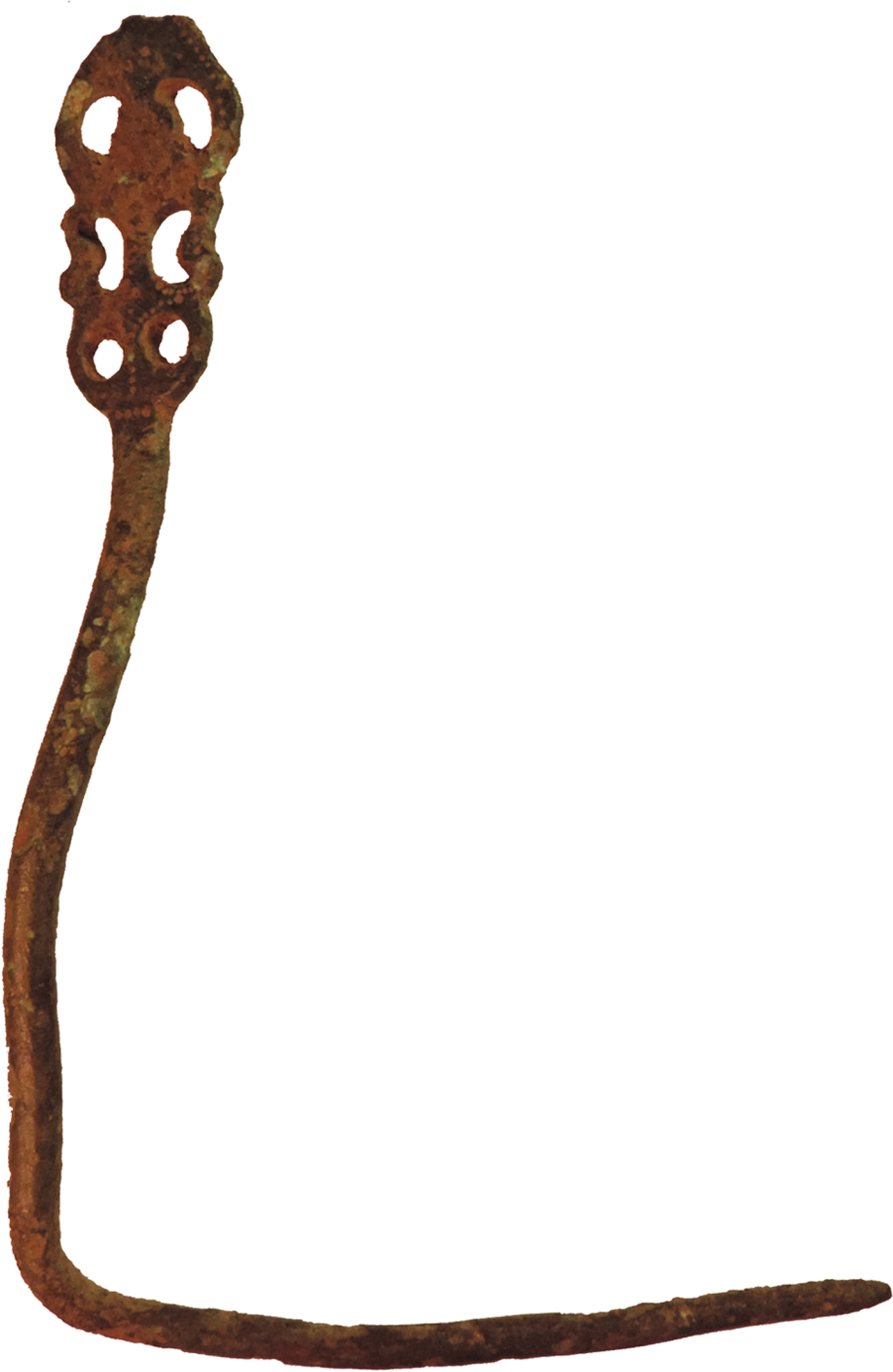
(5) South Ferriby (NLM-F24D77) (fig. 5).Footnote 27 A cast copper-alloy possible hairpin, slightly tapering to its point and round in section. It is 57.7 mm long and has a diameter (shaft) of 2.6 mm. The head is 8.7 mm wide and 1.4 mm thick. The object weighs 3 g. The pin has a flat openwork multi-lobed head, the decoration being arranged symmetrically around a central axis, comprising (from top to bottom), opposed comma, crescent and circular perforations. It may not be complete at the top of the head. Where better preserved the surface of the head carries rows of punched motifs, in a short line across the junction between head and shaft, extending along the head's axis, partially enclosing each perforation and running along the edges of the head. As preserved the shaft bends at 90 degrees.
South Ferriby, hairpin(?) (No. 5). Scale 1:1. (Photo: M. Foreman; © North Lincolnshire Museum)

The South Ferriby object belongs to a group of possible hairpins with a resemblance to military standard heads, although unlike some other examples, in this case there is no perforation or ‘eye’ near the point of the pin.Footnote 28 Three examples with flat perforated heads documented in late Neronian or Flavian contexts from the Bloomberg excavations in central London are recent additions to the corpus, one being quite similar in form to the South Ferriby pin but much better preserved, especially with regard to the head, on which a crescent terminal and suspended pendants survive, as well as much clearer punched decoration.Footnote 29 Excavated instances are often from mid- to late first-century a.d. contexts on sites with a connection to the Roman army. A few kilometres to the west of South Ferriby a likely first-century a.d. military garrison has been posited at Old Winteringham, controlling the Humber crossing on its southern side.Footnote 30
LINCOLNSHIRE
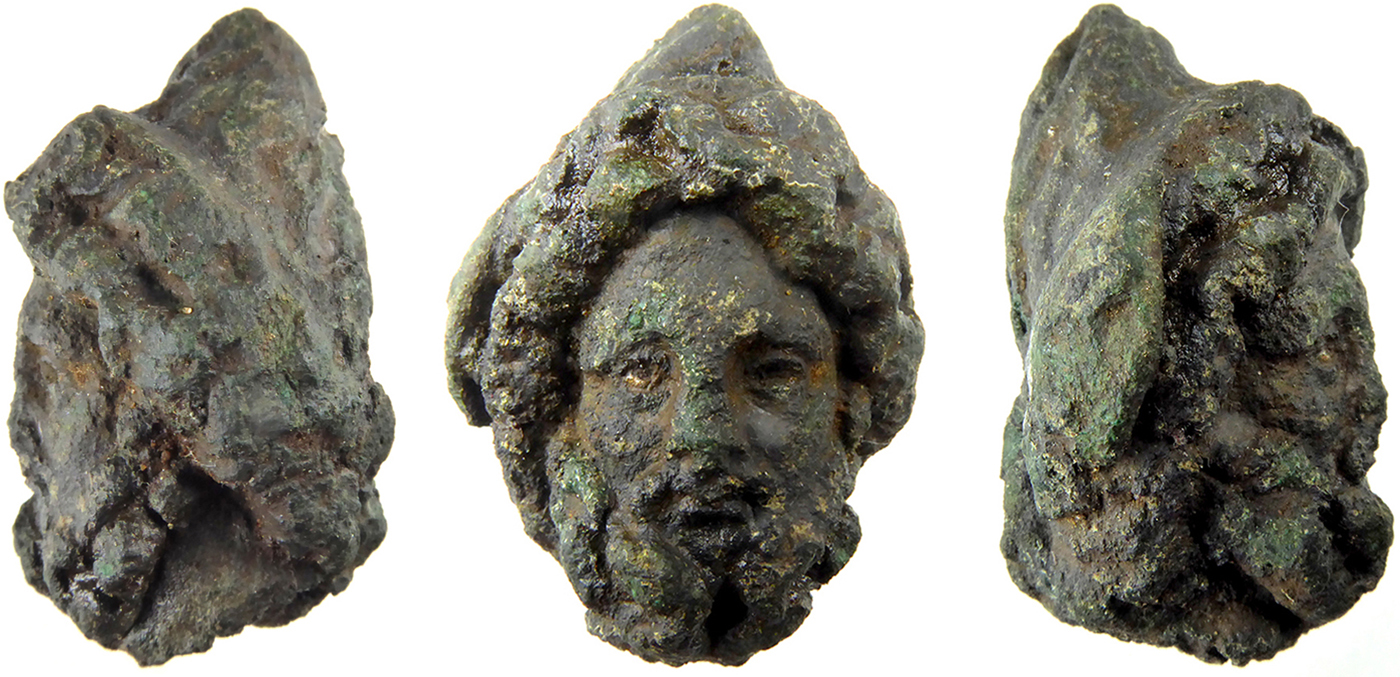
(6) Scamblesby (PUBLIC-88E8E8) (fig. 6).Footnote 31 A cast copper-alloy head from a figurine of Vulcan with a light green patina. The head is 36.4 mm long and 25.4 mm wide; it weighs 56.1 g. Although poorly preserved, enough detail survives to suggest that this was quite finely modelled. Beneath the conical cap emerges a luxuriant fringe of curly hair. This fringe and the full and clumpy beard frame a face in which the individual features remain visible. On either side of a worn nose the eyelids and eyebrows are distinctly rendered. Beneath a thick moustache the open lips of the mouth are visible.
Scamblesby, head of figurine of Vulcan (No. 6). Scale 1:1. (Photo: P. King; © P. King)

Vulcan is a less common deity among the figurines documented from Britain.Footnote 32 The Scamblesby head is closely paralleled in another bronze figurine from Cirencester, identified by Henig as Vulcan, correcting Toynbee's previous identification of it as a representation of Jupiter Dolichenus.Footnote 33 A highly classicising figure of the god is also documented at Richborough.Footnote 34 Among a small number of other PAS examples are a likely head of Vulcan from Ticehurst, Sussex (SUSS-6F95A6), and a headless torso plausibly attributed to an image of the smith god from Barnetby-le-Wold, North Lincs. (NLM1132).
NOTTINGHAMSHIRE
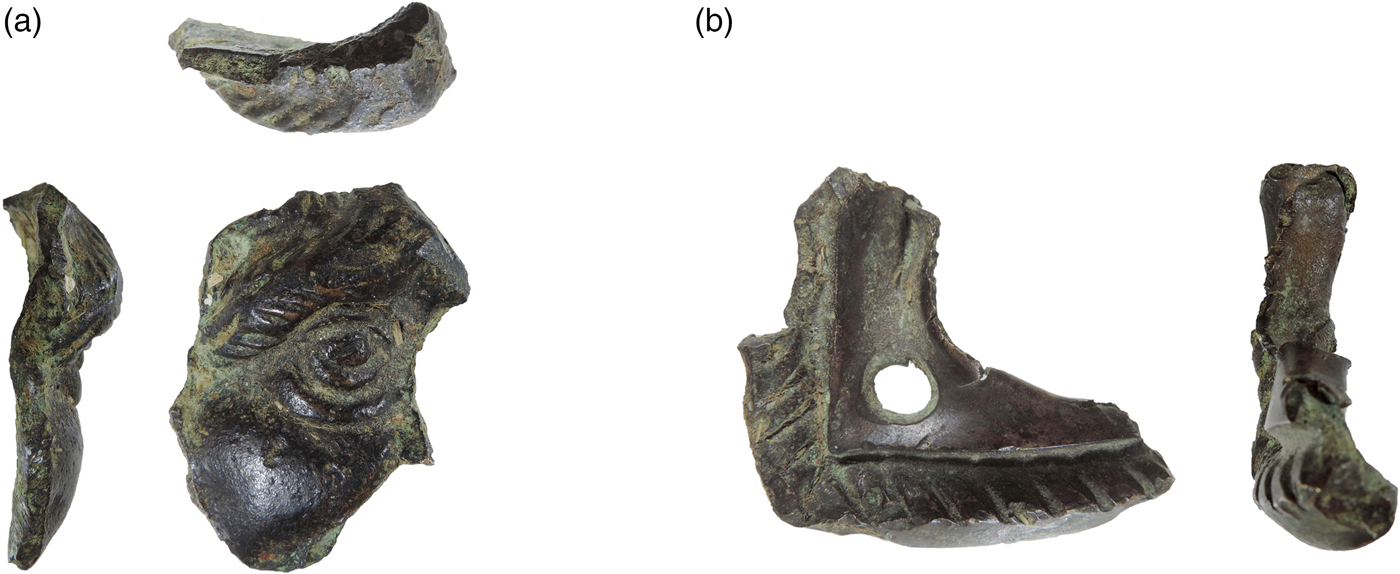
(7) Balderton (DENO-820CDA) and (DENO-8289E9) (figs 7a and 7b).Footnote 35 Two copper-alloy fragments found in close association, one of a face, the other of an attachment plate or base. The former (a) is 33.9 mm long, 22.1 mm wide and the metal is c. 2–3 mm thick; it weighs 15.6 g. The fragment consists of the right eye, eyebrow and cheek of an anthropomorphic figure, portrayed in considerable detail. Above the distinctively modelled eyebrow, with its rope-like texture rendered by angled grooves, are the tips of strands of hair, seemingly swept to the right. Within the shallow eye socket the lower eyelid, iris and pupil are modelled. The latter may have held an inlay as a setting.
a. Balderton, fragment of face from statue or appliqué (No. 7a). b. Balderton, fragment of statue base or fitting (No. 7b). Scale 1:1. (Photos: A. Willis; © A. Willis and Derby Museums Trust)

The second fragment (b) is roughly triangular in shape, from the corner of a rectangular object (DENO-8289E9). It is 38 mm long and 34.8 mm wide; it weighs 17.9 g. Where preserved at the corner it has short sides up to 8.8 mm high. Along the two intact edges are cable mouldings rendered by diagonal grooves. Little remains of the principal flat surface of the object. In the corner is a rough-edged circular perforation which may have served for attachment.
The objects are not easily categorised. They may represent fragments of a free-standing statue and its base. Similar cable mouldings have been documented on other statue bases, albeit rather smaller, for example at Therfield, Herts.Footnote 36 Numerous other small bronze statue fragments have been documented by the PAS.Footnote 37 Alternatively the head is a fragment of a bronze appliqué furniture bust, perhaps like youthful (Bacchic) figures documented at the villas at Littlecote (Bacchus-Antinous) or Tarrant Hinton (satyr), with the rectangular plate also serving as a related fitting.Footnote 38 Other examples of such fittings have been identified from PAS finds, for example the busts of Antinous from Market Rasen, Lincs., and Capel St Mary, Suffolk.Footnote 39 However the Balderton fragment is larger than any of these comparable pieces.
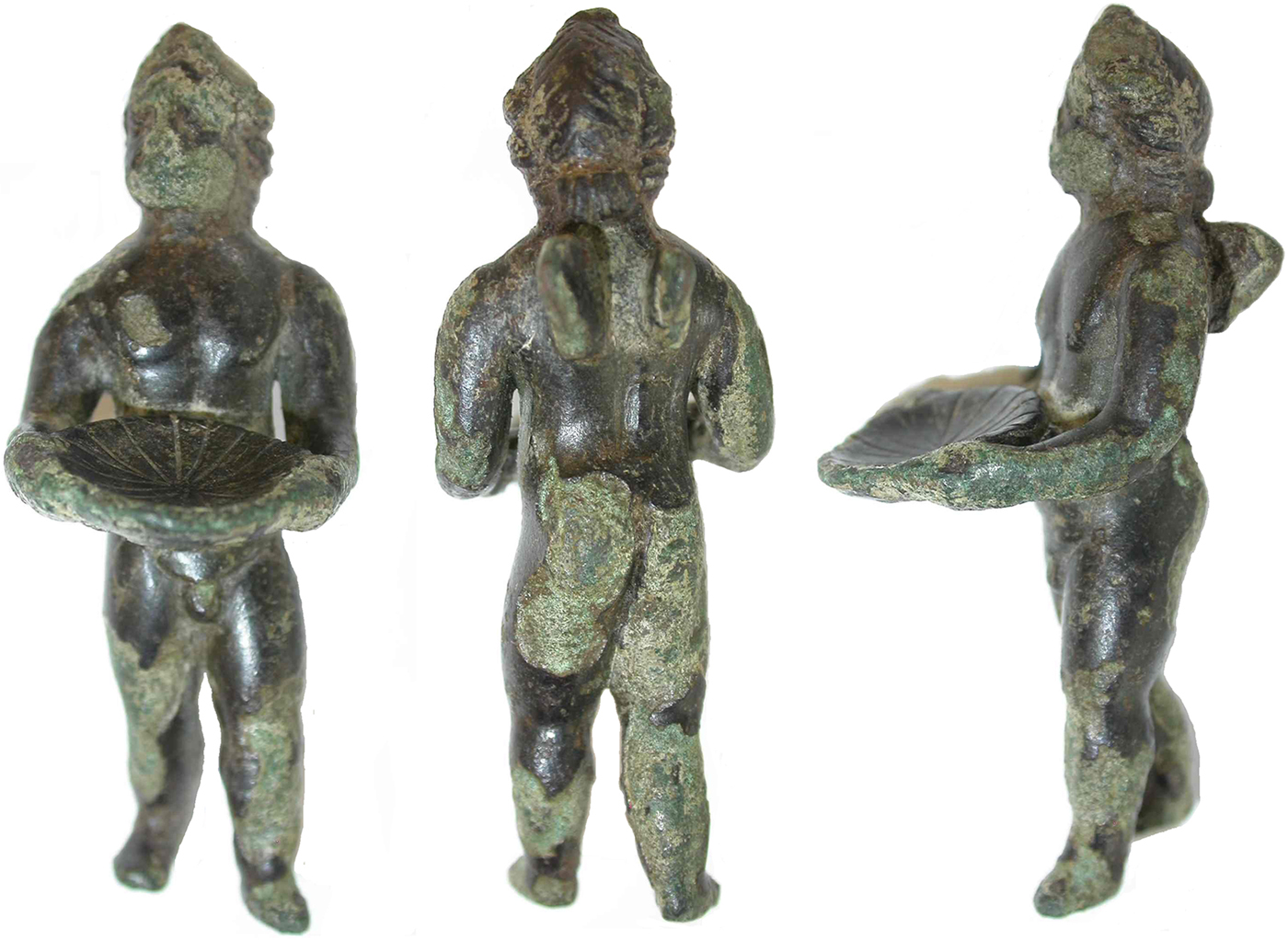
(8) Mansfield Woodhouse (DENO-1271B3) (fig. 8).Footnote 40 A copper-alloy figurine of Cupid holding a vessel. The figurine is 69.3 mm high, 24.6 mm wide at the shoulders and measures 35.2 mm from the front of the vessel to the tip of the wings; it weighs 60 g. The figurine is worn and has lost its patina in places, but otherwise survives complete. The face is very worn, with little of its features visible except for the eyes. Of the hair the topknot has become an abraded peak, while a little more can be made out of the thick clumpy fringe which framed the face and of the herringbone incisions which show the texture of the coiffure on the crown of the head. The detail of the thick-necked godlet's body survives a little better; the pectoral muscles, spinal groove and genitals are clearly modelled as is the musculature of the legs. Two stubby wings sprout from the shoulder blades. The interior of the vessel, a shallow circular dish, bears radial lines which converge on its centre.
Mansfield Woodhouse, figurine of Cupid (No. 8). Scale 1:1 (Photo: A. Rohde; © A. Rohde and Derby Museums Trust)

Figurines of Cupid are documented widely in Britain, including several PAS findsFootnote 41 This may be one figure from a scene of the toilette of Venus, bearing appropriate utensils; an example survives from Augst, with a Cupid placed on either side of Venus on a U-shaped base, one carrying a handle in one hand (the remainder of the object being lost) and the other an oil flask.Footnote 42 Other Cupid figurines carrying objects related to washing include one of the Piercebridge Cupids, with vessels in its hands (FAPJW-D8ABE4) or the figure equipped with a mirror from an unknown findspot, now in the Rheinisches Landesmuseum Bonn.Footnote 43
WORCESTERSHIRE
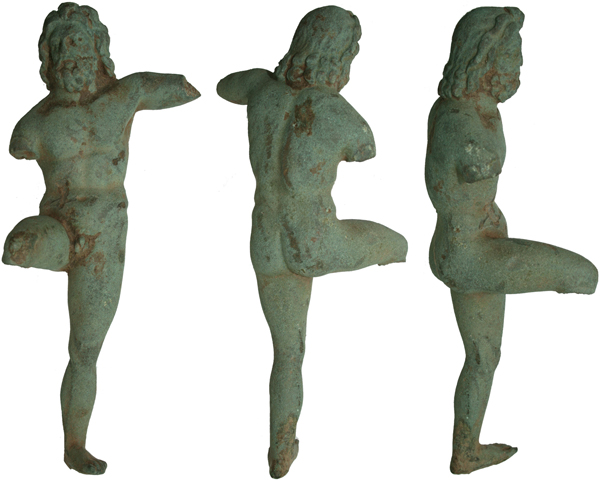
(9) Longdon (GLO-082F26) (fig. 9).Footnote 44 An exceptionally well-modelled but incomplete copper-alloy figurine depicting Neptune. The figurine is 113 mm tall and 46 mm wide; it weighs 162 g. The god is rendered as a nude figure, standing on his left leg with his right leg raised and extended, the thigh being perpendicular to the torso. Although broken just below the knee on the right leg, the downward angle of the lower leg indicates that the right foot rested on an object, to judge from other examples perhaps a ship's prow, dolphin or rock.Footnote 45 The trident likely held in the left hand has been lost along with most of the arm, of which enough survives to suggest that it extended at a right angle to the body. The right arm extends downwards at an angle, but is also broken just below the shoulder; on better preserved examples the forearm rests on the raised right leg. The head seems to have been quite finely modelled with careful rendering of the long wavy hair down to the shoulders and the thick curly beard, but the detail is very worn. Wear is especially heavy on the facial features; the brow ridge, recesses for the eyes as well as the placing of the nose and mouth are just visible. The trunk of the figure is also precisely modelled, with careful detailing of the muscles of chest, abdomen and back as they move with the turning of the upper limbs. Finer details are also rendered including the navel and genitalia.
Longdon, figurine of Neptune (No. 9). Scale 2:3. (Photo: K. Adams; © K. Adams and Bristol City Council)

The figurine derives ultimately from the fourth-century b.c. statue of Poseidon created by Lysippos, most famously surviving in the heavily restored Lateran sculpture.Footnote 46 Small-scale bronze versions are documented from Gaul to India.Footnote 47 Other media too show similar representations of the god.Footnote 48 Wear notwithstanding, the figurine can be placed among the more classicising small bronzes from Roman Britain.Footnote 49 Neptune is not a deity commonly figured in small-scale bronze images from the province, though a slightly larger corpus of marine deities survives in stone.Footnote 50 A figure of Neptune might evoke the conquest of a province in the Ocean, but might have had a more local resonance, being ‘the god of every river’.Footnote 51
OXFORDSHIRE
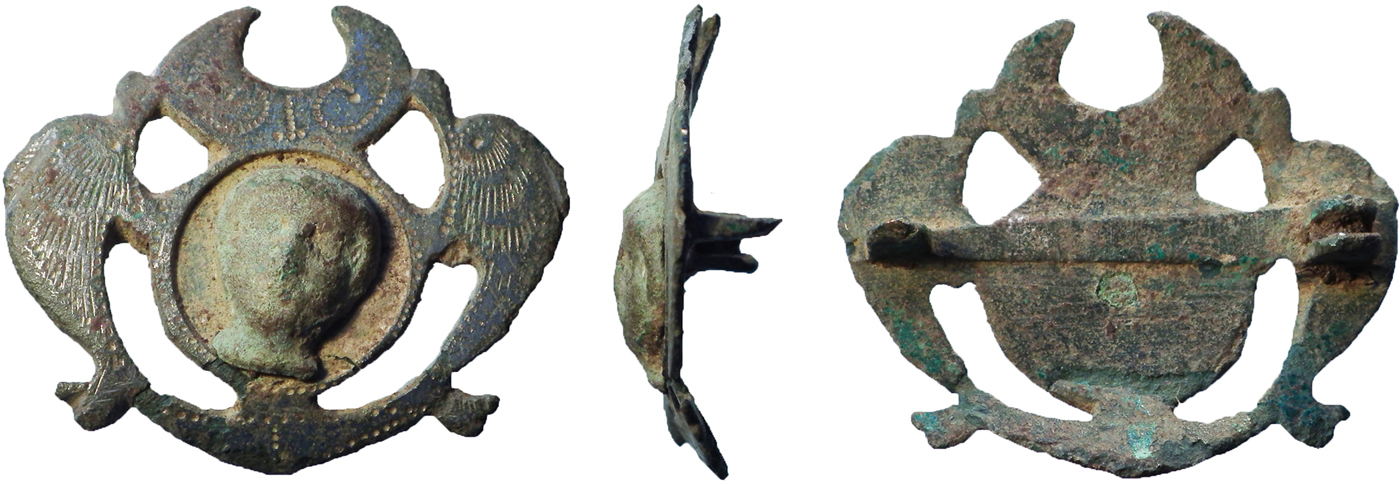
(10) Letcombe Bassett (SUR-78ACA0) (fig. 10).Footnote 52 A copper-alloy openwork brooch with a white metal surface coating, some detail being lost to wear. It is 41.6 mm wide, 35.1 mm high and 8.1 mm thick (including hinge etc.); it weighs 10.9 g. The brooch takes the form of two opposed dolphins which frame a tripartite central element. From top to bottom the latter comprises a crescent joined to the tips of the dolphins’ noses, a recessed disc carrying a worn relief-moulded clean-shaven head (at an angle to the disc), on which the eyes and short hair are visible, and an anchor-like bar connecting both dolphins’ tails. The bar, disc and crescent are decorated with rows of punched dots, laid out in a scrolling symmetrical arrangement on the crescent. The texture of the dolphins’ skin is rendered as rows of hatched lines. On the dolphin to the right an eye and rows of punched dots around its head and foreparts can be seen. On the back the catchplate and hinge are placed at opposite ends of a tapering raised strip. The pin is lost.
Letcombe Bassett, openwork brooch (No. 10). Scale 1:1. (Photo: D. Williams; © D. Williams)

The brooch, of a form dated to the first and second centuries a.d., thus combines popular motifs for personal ornament (dolphins and crescent) evoking felicity and protection with a facing head, an occasional motif.Footnote 53 There appear to be no British parallels but the brooch closely resembles a find from Xanten.Footnote 54
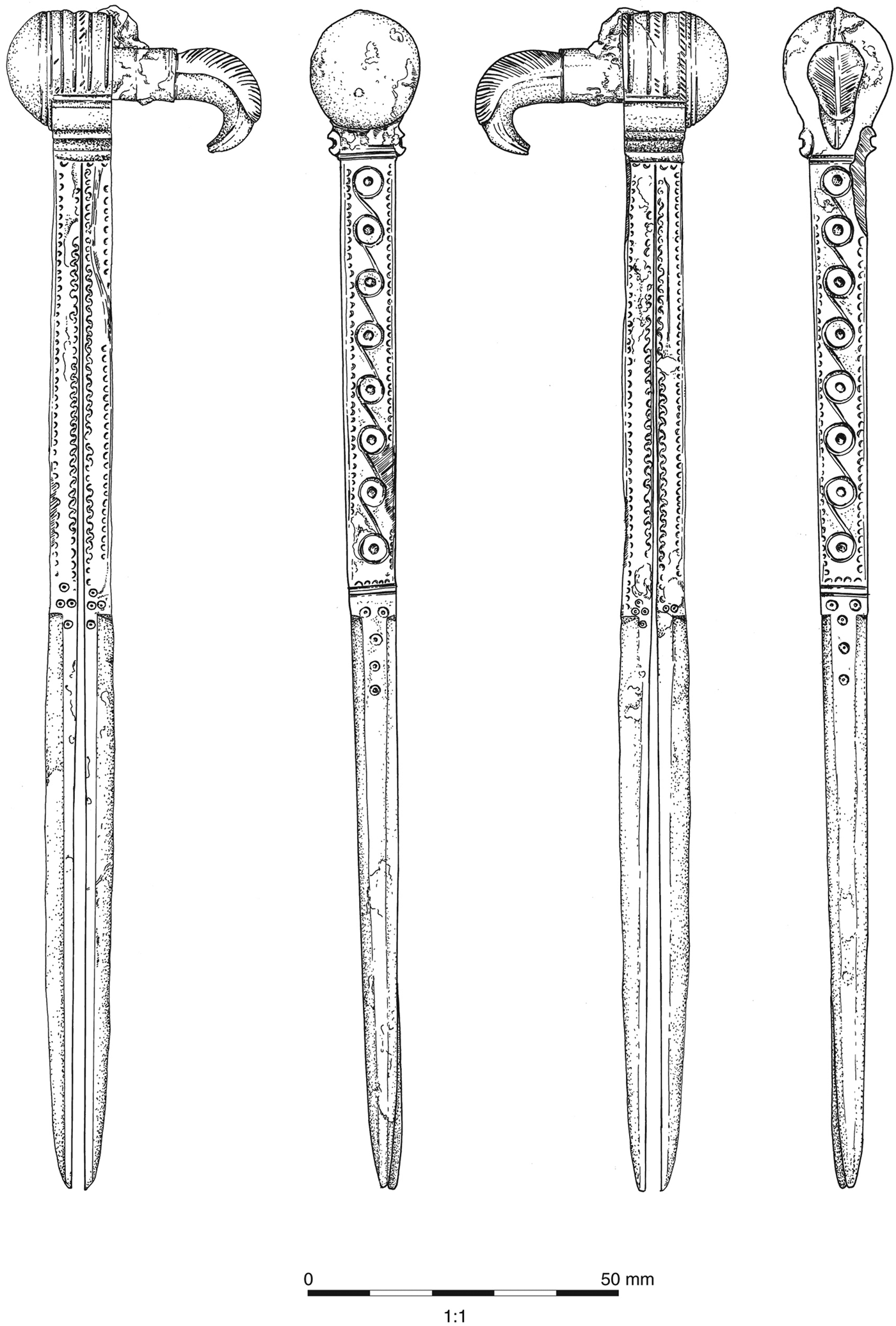
(11) Lyford (BERK-8A377C) (fig. 11).Footnote 55 A pair of complete cast copper-alloy dividers of late Roman or early Saxon date. The dividers are 175 mm long and weigh 117.7 g. They take the form of two straight tapering arms, joined by a now corroded iron spindle or rivet which forms a hinge. The ends of the spindle have copper-alloy mounts, one in zoomorphic form and the other a dome. On the stylised head of the former the crest, brow ridges, eyes and beak are defined with incised decoration. These may render an eagle's head, but the crest is more reminiscent of a griffin's, even if ears appropriate to the latter are lacking. The dome on the reverse of the spindle has incised circumferential lines around its widest point. The zoomorphic head is attached to a circular-sectioned rod through which is a slot containing the remains of an iron peg. When the arms were opened to the desired width the peg would have been pushed down to lock them in place.
Lyford, dividers (No. 11). Scale 1:2. (Photo: A. Byard; © A. Byard)

Crescentic mouldings define the junction of spindle and arms. For half their length the arms are rectangular in section, narrowing into faceted form before tapering to the tip. They are extensively decorated. On the wider, external faces their upper half carries running ring-and-dot motifs. Traces of red enamel survive in several instances. These are framed by a border of crescentic stamps. Where the dividers begin to taper and the arms are faceted are a pair of ring-and-dot motifs and three single instances arranged vertically. The narrow faces of the upper arms are also edged with crescentic stamps. Where the dividers taper below a cluster of four ring-and-dot motifs occurs on these faces too.
Roman dividers, used for laying out texts, portable and monumental, and for craft purposes, are uncommon objects and the majority of known examples are undecorated utilitarian forms with domed heads at both ends of the spindle.Footnote 56 A pair quite similar to the Lyford dividers with an avian head on the spindle and enamelled decoration is attested at Shouldham, Norfolk, perhaps of first- or second-century a.d. date.Footnote 57 In this case, however, the presence of running ring-and-dot motifs like those found on late Roman belt fittings or nail-cleaners may indicate a later date.Footnote 58
(12) Lewknor (BERK-41C728) (fig. 12).Footnote 59 A complete, though slightly damaged, cast copper-alloy military phalera of later second- or third-century a.d. date, with a mid-green patina. It is 82.5 mm in diameter, 7.9 mm thick and weighs 134.4 g. The openwork design comprises three paired trumpet spiral (Trompetenmuster) motifs arranged as a triskele within an outer border around which run a pair of lightly grooved lines on the inner and outer edges. The fixing hole at the centre of the phalera is quite worn. The reverse is flat and plain. Similar phalerae with Trompetenmuster decoration are documented in Germany (Dormagen, Zugmantel)Footnote 60 and a smaller PAS example from Hanslope, Bucks. (BUC-384F77).Footnote 61
Lewknor, phalera (No. 12). Scale 1:1. (Photo: A. Byard; © A. Byard)

(13) Crowmarsh (BERK-7F09EE) (fig. 13).Footnote 62 A worn and incomplete cast copper-alloy figurine of Mercury. The figurine is 100.8 mm tall, 35.9 mm wide and weighs 111.1 g. The slender god stands in contrapposto pose, with left leg straight and right bent. The head is very worn but a thick fringe of hair encircles the face; some details of its swept-back strands and of the emerging wings can be distinguished. On the face traces of eyes, nose and mouth are visible. On the trunk of the figurine little detail seems to be rendered other than the genitals, fringed above by pubic hair. The figure's right arm bends across the chest, an object perhaps held in his outsize ‘mitten’ hand. The left arm bends across the waist, with a projecting element from the hand indicating some object originally held, although not obviously a caduceus. Apart from the buttocks there is little modelling of leg musculature. The god wears ankle boots, perhaps also intended to be winged. Mercury remains the commonest attested figurine from Roman Britain, as Durham's corpus and the many attested PAS examples show.Footnote 63 This is a more schematised rendering than most and the combination of poor preservation and limited modelling obstructs detailed comparison with other examples.
Crowmarsh, figurine of Mercury (No. 13). Scale 2:3. (Photo: A. Byard; © A. Byard)

NORFOLK
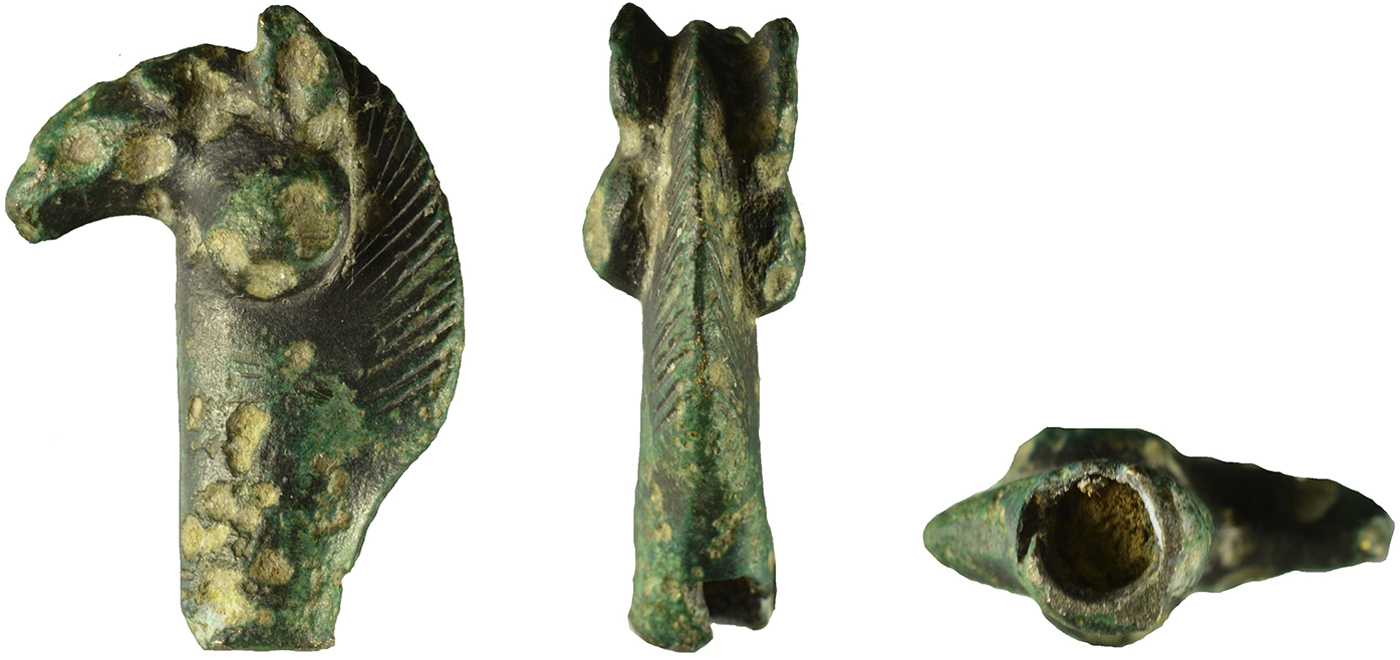
(14) Broome (SF-477084) (fig. 14).Footnote 64 An incomplete cast copper-alloy socketed zoomorphic mount, rather worn with a dark green pitted patina. The mount is 27.4 mm long, 20.5 mm wide from beak to crest and 4.9 mm thick at its midpoint; it weighs 9.7 g. It takes the form of the head and neck of a griffin, with a curved beak and pointed ears modelled in low relief. A swelling crest runs down the griffin's neck, on which parallel oblique grooves render its feathers. At the base of the mount is a circular moulded socket, broken on one side.
Broome, zoomorphic mount (No. 14). Scale 1:1. (Photo: A. Bliss; © Suffolk County Council)

Although there is no specific parallel to this object, it is one of many copper-alloy figural mounts documented by the PAS, usually of uncertain function, although some were probably attached as terminals to ritual objects.Footnote 65 The griffin is one of the various divine and monstrous images which sometimes decorate portable objects.Footnote 66
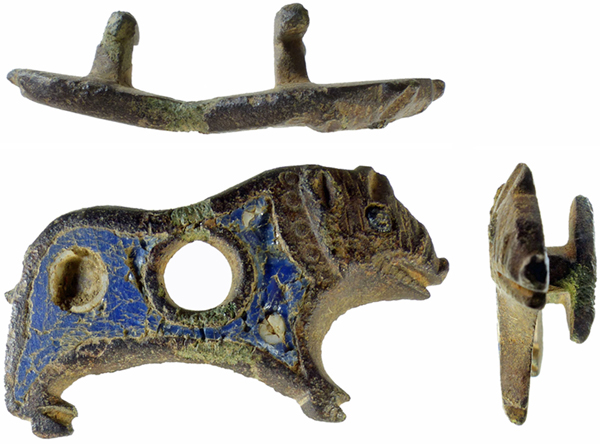
(15) Guestwick (NMS-F70707) (fig. 15).Footnote 67 An incomplete enamelled copper-alloy zoomorphic strap fitting in the form of a boar, facing right. The strap fitting is 28 mm long and 8.4 mm thick (excluding rivets); it weighs 5.9 g. The head is modelled in some detail, with one ear moulded in higher relief. The recessed eye is inlaid with black enamel. The mouth is rendered by a transverse groove just below the stubby snout. The head is incised with fine grooves, perhaps indicating bristles. The animal appears to wear a collar, indicated by a line of punched circles. The body is rendered by a recessed cell filled with blue champlevé enamel and three spots of white enamel (shoulder, top of foreleg and flank). The larger spot on the flank carries a central recess with traces of a red substance within; the finder noted the presence of a dark-coloured enamel filling when discovered, now lost. In the centre of the enamelled field is a circular perforation. This would have held a loop for a pivoting copper-alloy ring. Both legs terminate in cloven trotters. There are traces of a tail. The reverse carries two T-shaped attachment rivets, one damaged in antiquity.
Guestwick, enamelled strap fitting (No. 15). Scale 1:1. (Photo: J. Shoemark; © Norfolk County Council)

The boar is a common motif for zoomorphic enamelled brooches but the rivets clearly indicate that the Guestwick object is not a brooch. Instead it belongs to a group of small enamelled strap fittings, widely documented across northern Europe and of uncertain function. This example fits Boucher's C2 type, though it differs in detail from the other example of this form (of unknown provenance). Further fittings in this object group have been documented as PAS finds from across southern Britain, mostly geometric in form, commonly circular.Footnote 68 A recently reported example from Royston, Herts. (BH-B0D00E), of possible canine form is not attested among forms documented by Boucher. The object type is tentatively dated to the period between the late first and mid-third centuries a.d.
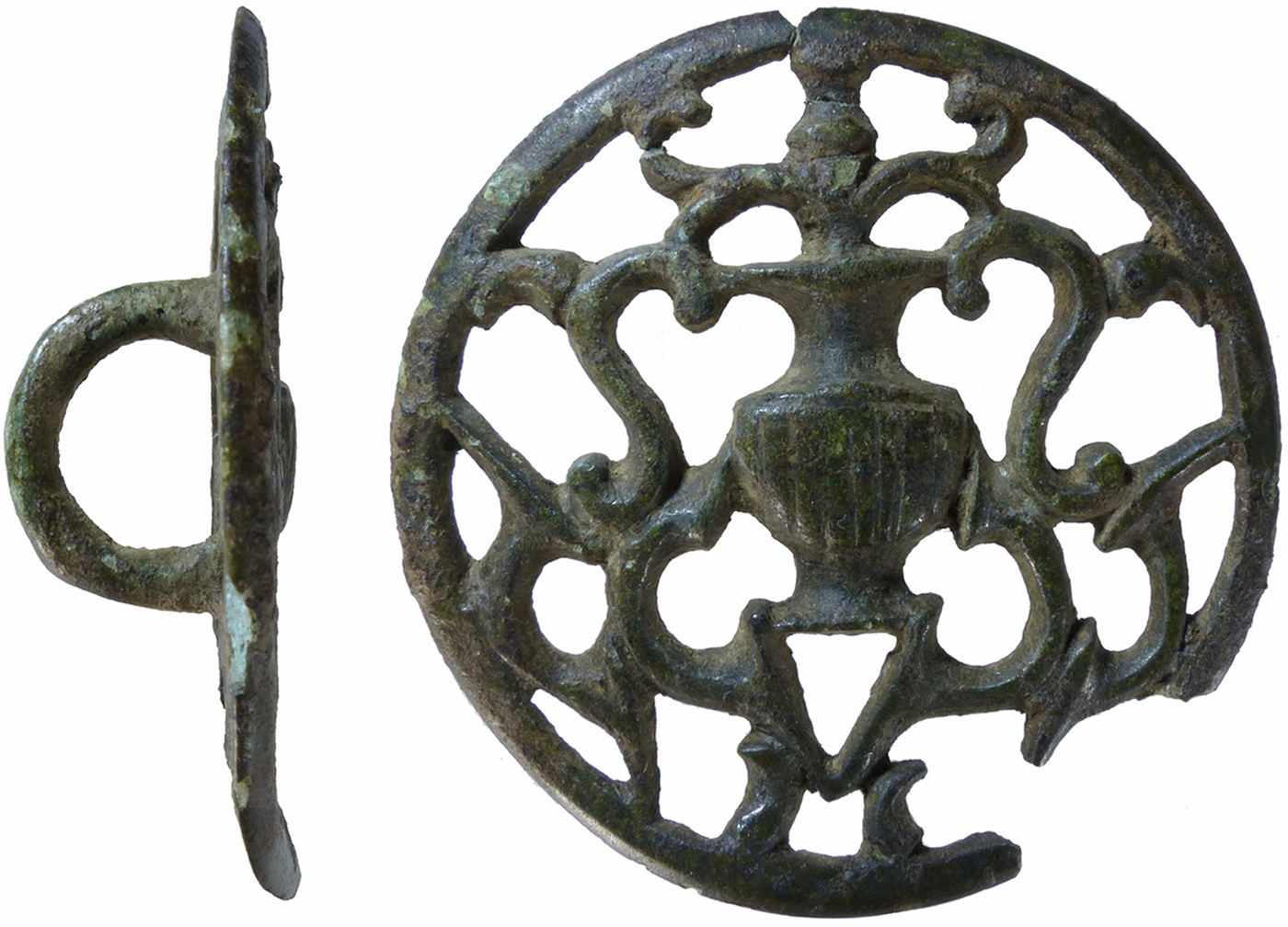
(16) Long Stratton (NMS-74185A) (fig. 16).Footnote 69 A circular copper-alloy openwork baldric fitting with an integral D-shaped loop on the reverse, dated to c. a.d. 120–300. A small part of the rim is missing. It is 52.5 mm in diameter and 1.8 mm thick (18 mm with loop) and weighs 21.8 g. Symmetrically arranged S-shaped and trumpet-like motifs surround a cantharos above a triangular aperture. The cantharos is narrow-necked with a pedestal base and its body is engraved with vertical lines. As well as decoration in the form of text or geometric motifs, other openwork baldric fittings also carry central images including avian and human figures, but no direct parallel has been found for this example.Footnote 70 The felicitous spirit of the central motif may be paralleled in the vine scroll decoration of an unprovenanced silver fitting.Footnote 71
Long Stratton, baldric fitting (No. 16). Scale 1:1. (Photo: G. Crace; © Norfolk County Council)

SUFFOLK
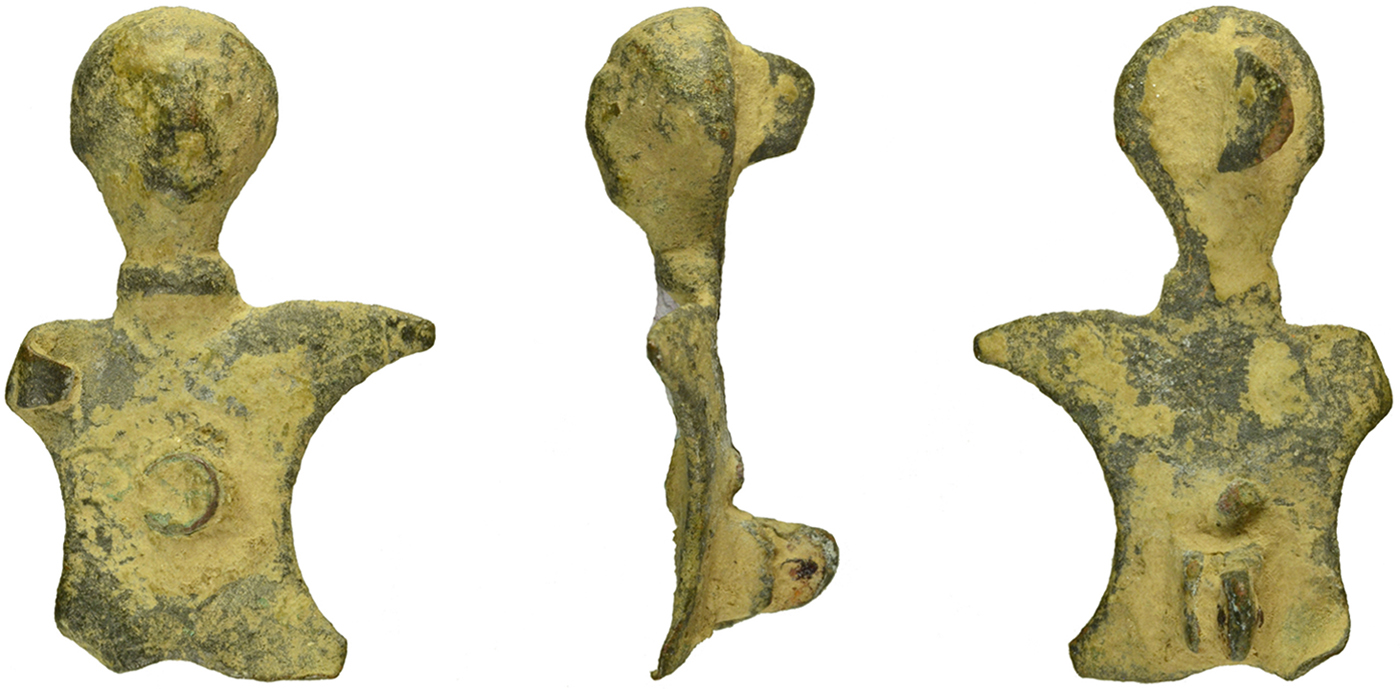
(17) Exning (SF-3146B9) (fig. 17).Footnote 72 An incomplete and rather poorly preserved copper-alloy continental plate brooch with an uneven brownish patina. The brooch is 30 mm long, 19.2 mm at its widest and 1.4 mm thick (9.4 mm with catchplate); it weighs 4.8 g. The brooch takes a highly stylised anthropomorphic form, the body being formed by two opposed crescents or peltae, giving four very worn projecting ‘limbs’. At the centre is a raised circular boss, while a human head projects from the body of the brooch, separated from it by a transverse collar. On the reverse of the brooch the remains of a catchplate and of a double-lugged pin hinge survive (the pin is lost).
To our knowledge the Exning brooch is the first example of this brooch type to be reported from Britain. Feugère notes two instances of the same brooch, one unprovenanced and the other from Ouhans (Doubs, France) and dates the type to c. a.d. 50–125.Footnote 73
Exning, plate brooch (No. 17). Scale 1:1. (Photo: A. Bliss; © Suffolk County Council)

ESSEX
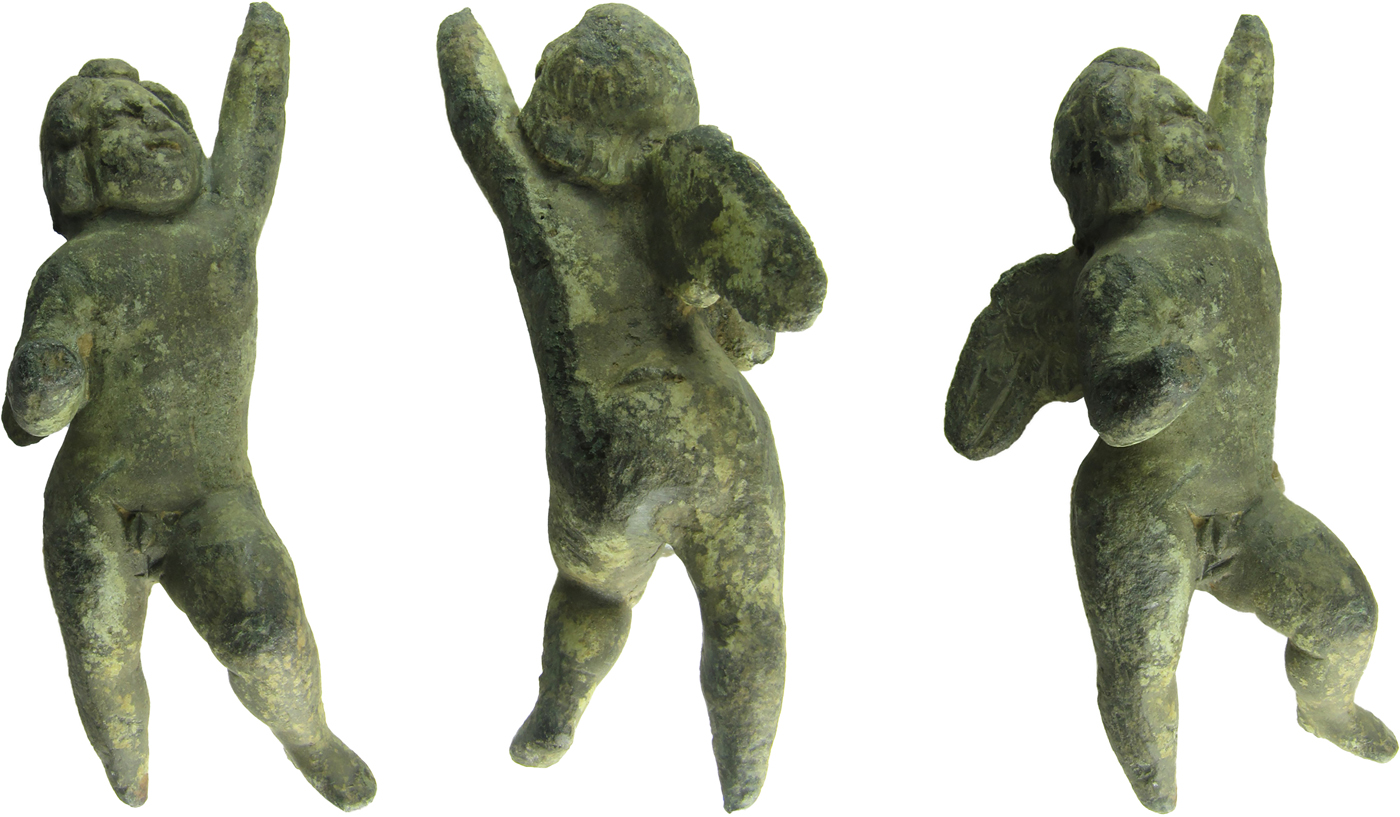
(18) Hatfield Heath (ESS-C4F7C7) (fig. 18).Footnote 74 A copper-alloy figurine of Cupid in flight. The statuette is 66.2 mm tall, 24.3 mm wide and weighs 49.6 g. On the figurine's full face the eyes are carefully modelled though nose and mouth are heavily worn. Although the head is worn, the topknot and strands of the thick clump of hair which frames the face can be seen. The left arm is outstretched (hand missing) while the right is bent and broken just below the elbow. The left leg is bent and raised, while the right is straight (the foot is lost). The large surviving right wing sprouts from the shoulder blade; on its inner face careful detailing of the plumage survives, including longer wing tip feathers. Along with the figurine from the river deposit at Piercebridge (NCL-2C40A4), this provides a further example from Britain of Cupid taking flight.Footnote 75
Hatfield Heath, figurine of Cupid (No. 18). Scale 1:1. (Photo: S. Flynn; © Colchester and Ipswich Museum Service)

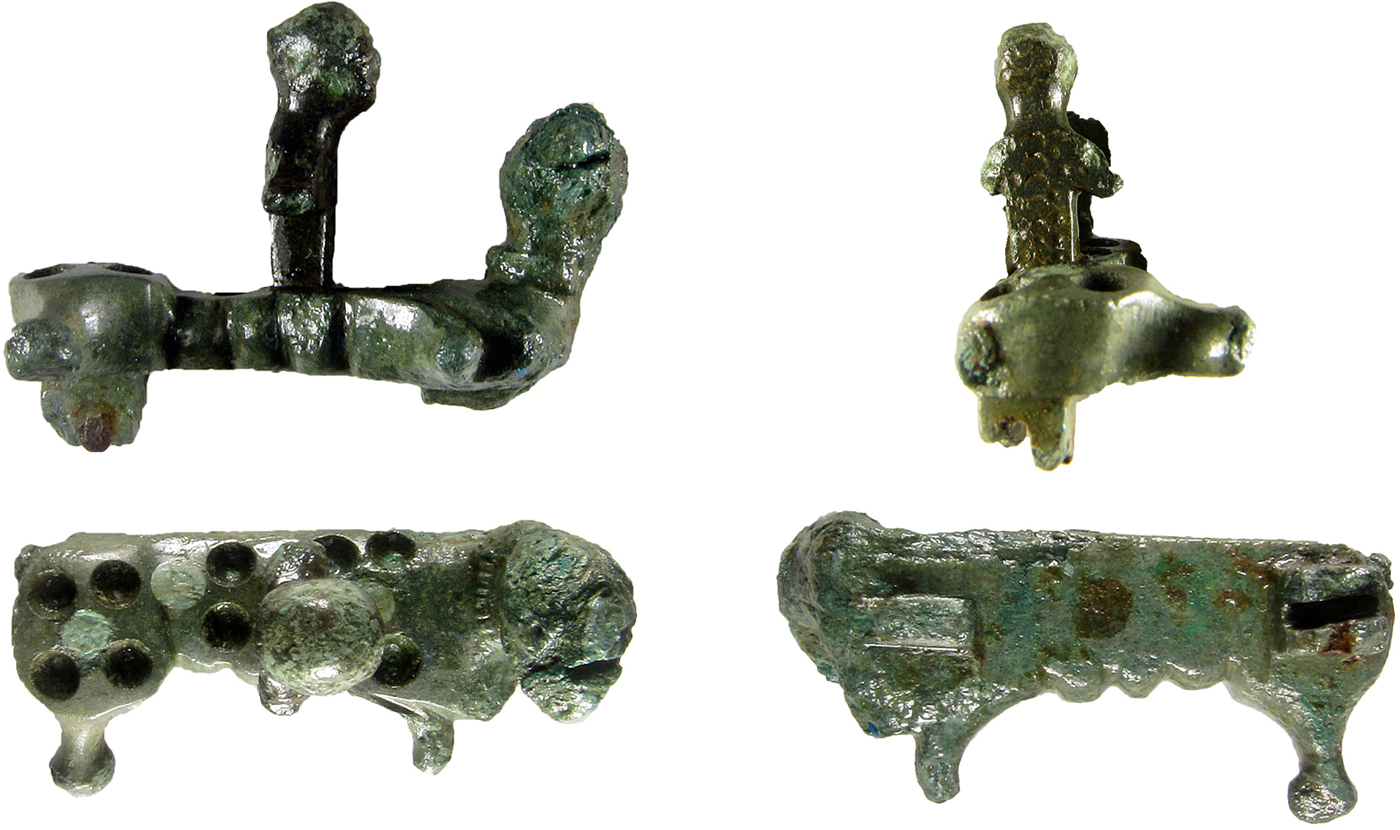
(19) Birch (ESS-691516) (fig. 19)Footnote 76 A copper-alloy brooch in the form of a half-figure mounted on a leopard. It is 29.6 mm long from hind quarters to neck and the body is 5.1 mm wide at is centre, thicker at head and haunch. The brooch is 25.7 mm high (including lug and catchplate) and weighs 10.7 g. Both rider and feline are schematically rendered. From the bar-like body of the animal extend its more fully modelled head and neck, turned to the right, and the short surviving part of a right back leg from the rounded haunch. A tail may once have been present but survives only as a slight projection. The swellings on the body indicate the leopard's female sex. At the junction between neck and body are raised mouldings with parallel incisions, perhaps a mane. Otherwise little detail of the head survives. The spots are rendered by thirteen circular recesses on the animal's back, five arranged in a quincunx on the haunch. Three of these contain off-white material, probably the decayed remnants of enamelling. Below the animal's body are the remains of a catchplate (shoulder) and lug (haunch); the pin is missing. The figure of the seated rider (only the torso and arms were rendered) is poorly preserved. Both of the arms are broken away, though more of the right survives. On the outsize head some limited modelling of facial features can be seen, including traces of eyes and mouth and some curving incisions on the back of the head to render the hair. More visible are the incised arcs on the front and back of torso, perhaps to render clothing or an animal skin.
Birch, leopard-and-rider brooch (No. 19). Scale 1:1. (Photo: B. Paites; © Colchester and Ipswich Museum Service)

The most plausible interpretation of this image is as Bacchus riding a leopard, a small format translation of a common image. As a brooch it has a possible votive purpose or apotropaic force if the god is rightly identified. Two examples of very similar brooches are known (Augst and Rottweil) and the type is dated to the first half of the second century a.d., based on the stratigraphic context of the Rottweil brooch.Footnote 77 Similar brooches featuring the female panther only without a (surviving) rider are more common, among which are three examples from Britain documented by the PAS (Chilton, Oxon. (SUR-1460B5); Little Waltham, Essex (CAM-925392); Bradfield Combust with Stanningfield, Suffolk (SF 93 84)), sharing the same configurations of enamelled decoration and modelling of the head and haunch.Footnote 78
HERTFORDSHIRE
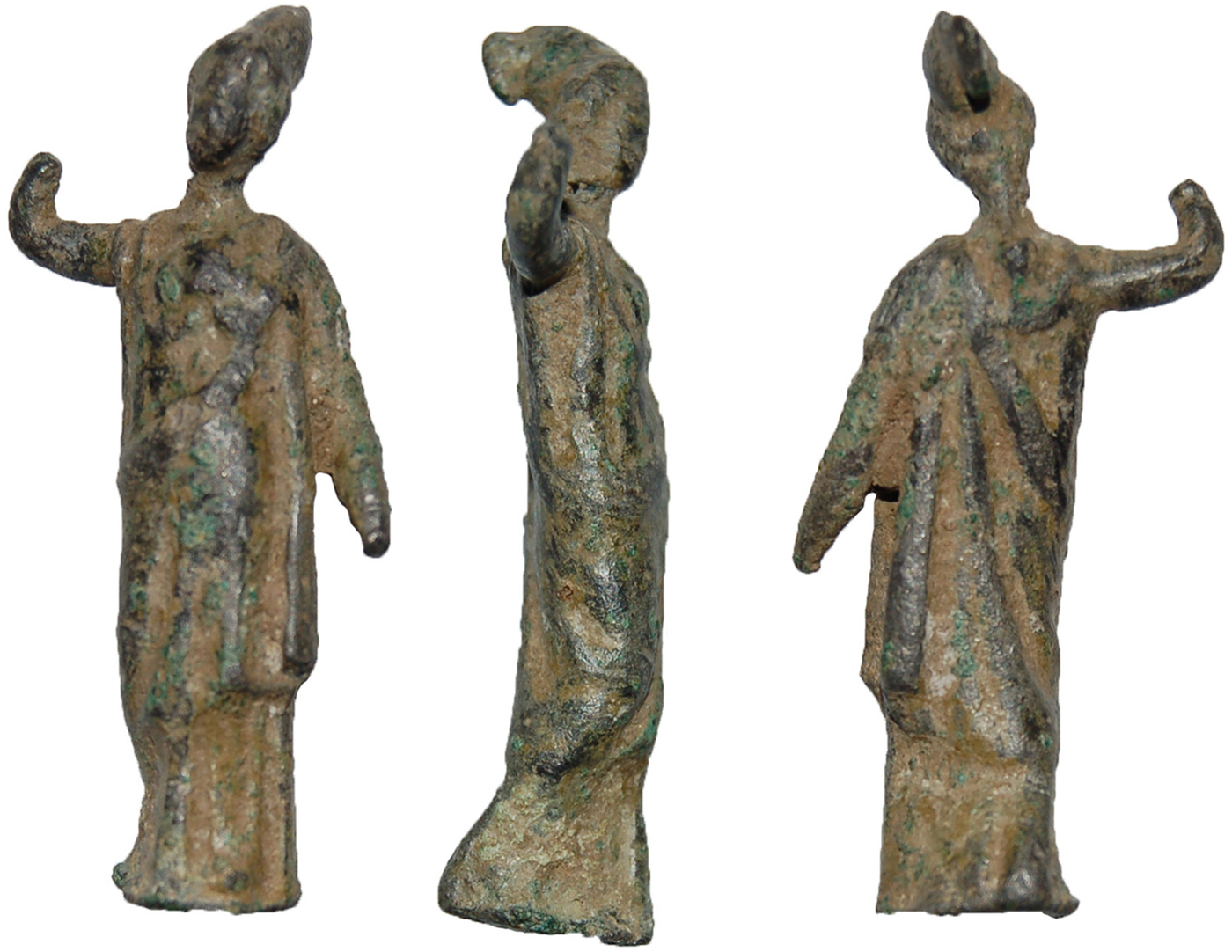
(20) Redbourn (BH-FBEE8C) (fig. 20).Footnote 79 A cast copper-alloy figurine representing a standing Minerva on a flat quasi-circular base. The figurine is 47 mm high, 22 mm wide from arm to arm and 9 mm wide on the body; it weighs 17.5 g. The deity's head is inclined slightly to the left and wears a helmet with a curved crest. Her facial features are barely rendered, although a moulding representing the nose is just visible. The raised right arm may once have held a spear but the forearm is broken just below the elbow. The left arm, missing the hand, is held slightly away from the body. The goddess wears a short-sleeved chiton which hangs to the feet, over which a cloak falls diagonally across the body and is tied at the back below the left shoulder. A circular area on her chest may represent the aegis. Under the grooves which render the folds of cloak and chiton her contrapposto stance is visible, with left leg bent.
As noted above (No. 2), Minerva is the most frequently documented goddess in figurine form in Britain. This type, i.e. in which she wears a cloak over a chiton (Type Ia amongst the figurines documented at Augst), is one of the commonest attested variants in Britain and beyond.Footnote 80
Redbourn, figurine of Minerva (No. 20). Scale 1:1. (Photo: P. Walton)

DORSET
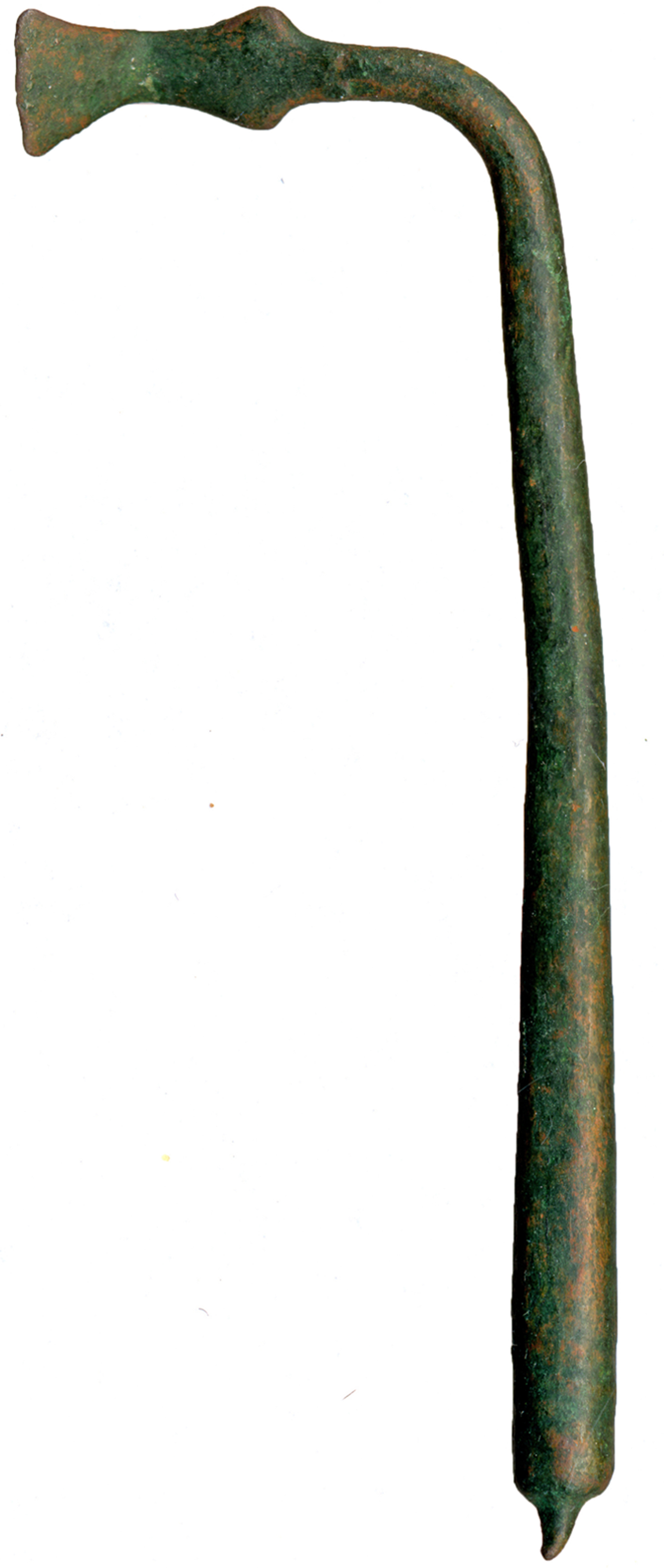
(21) Winfrith Newburgh (DOR-A0F03A) (fig. 21).Footnote 81 An incomplete, bent copper-alloy stylus. It is 70.1 mm long and weighs 6.7 g. The shaft of the stylus, circular in cross section, tapers at one end towards a spatula-like terminal. The spatula is offset from the shaft by distinctive sloping shoulders and has an elongated trapezoidal outline with concave or waisted sides. At the other end the shaft thickens towards the short surviving stub of the stylus point which is offset from the shaft with a marked step.
Winfrith Newburgh, stylus (No. 21). Scale 1:1. (Photo: C. Hayward Trevarthen; © Somerset County Council)

This is a third- to fourth-century form, ‘Formgruppe V91’ in Schaltenbrand-Obrecht's recent typology, with examples documented on continental European and British sites, the latter including Baldock, Bancroft, Richborough and Shakenoak Farm, as well as unprovenanced examples in museum collections. The Winfrith Newburgh stylus is closely paralleled in several examples from Augst.Footnote 82 Two similar styli have been recorded in neighbouring Wiltshire from Salisbury (WILT-C9D9E3) and Lacock (WILT-5DB766). These are among more than 100 Roman iron and copper-alloy styli recorded to date by the PAS. Together with excavated examples they provide important evidence for writing in a rural milieu, otherwise poorly attested in surviving inscriptions.Footnote 83
HAMPSHIRE
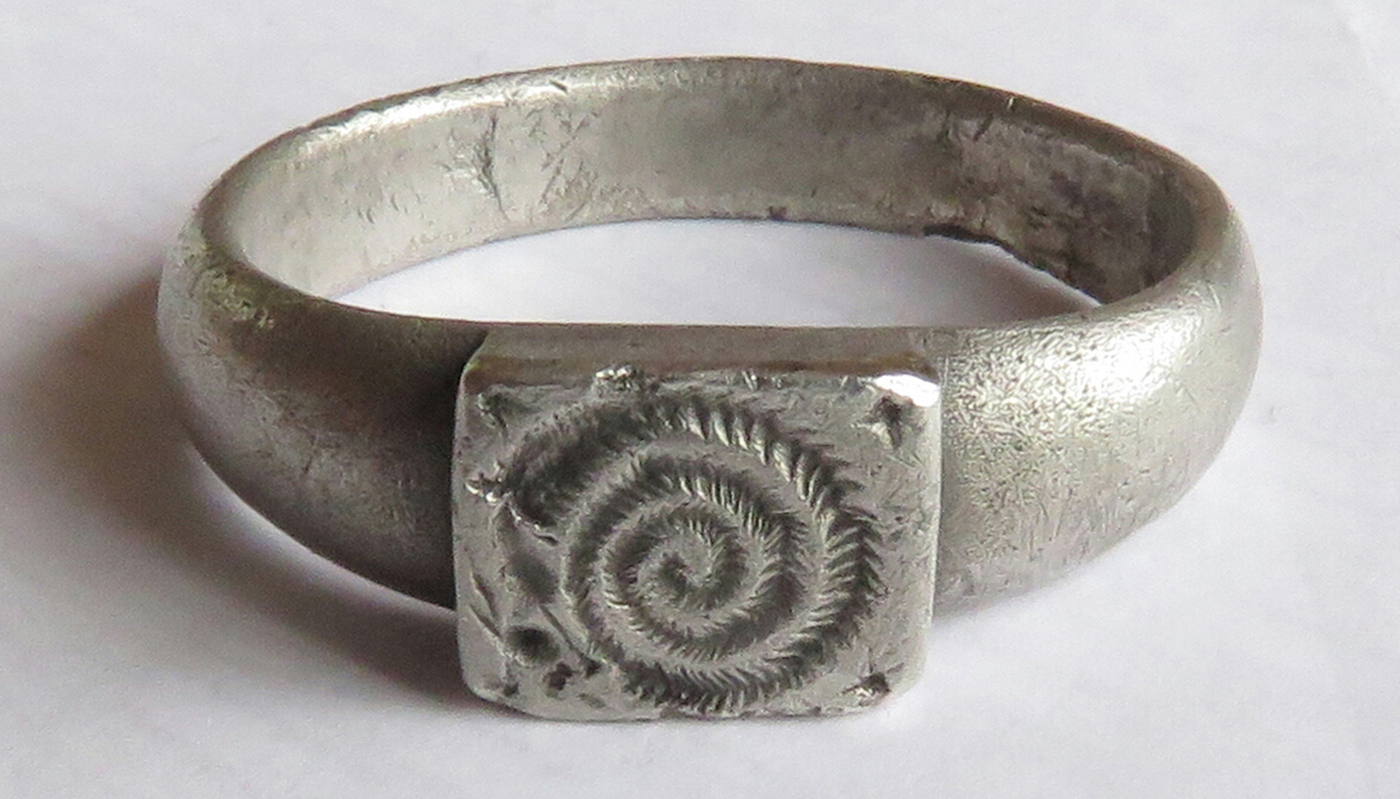
(22) Nether Wallop (WILT-17E7E6; Treasure no.: 2017T431) (fig. 22).Footnote 84 A complete silver finger-ring, measuring 26.4 mm in diameter, with a maximum thickness of 2.1 mm, and weighing 8.3 g. The hoop widens slightly where it joins the rectangular bezel (10 by 8.4 mm). The bezel is flat on its inner face and slightly convex on its outer. The decoration on the latter comprises a spiral formed by repeated chevrons, smaller in the centre and larger towards the edges. This can be read as a zoomorphic motif, a sea-dragon perhaps (in Gerard and Henig's words, a ‘wyrm-like creature’) curled twice around its tail and widening towards a broad flat head, with the chevrons evoking scales.Footnote 85 At the end of the spiral is a possible quadruped which it pursues. At three corners of the bezel an X motif is engraved. The ring is one of 54 known examples of the Brancaster type dated by Gerard and Henig to the late fourth and fifth centuries a.d. Of these almost half (24) have been documented by the PAS. With its box form and square bezel this is an example of their most common type (IA1).Footnote 86 Although the specific decoration on the Nether Wallop ring is unparalleled, other rings also carry fantastic or mythological beasts as well as busts, Christograms, avian imagery and mottoes.
Nether Wallop, ‘Brancaster’ type ring (No. 22). Scale approx. 2:1. (Photo: R. Henry; © R. Henry and Salisbury and South Wiltshire Museum)

WEST BERKSHIRE
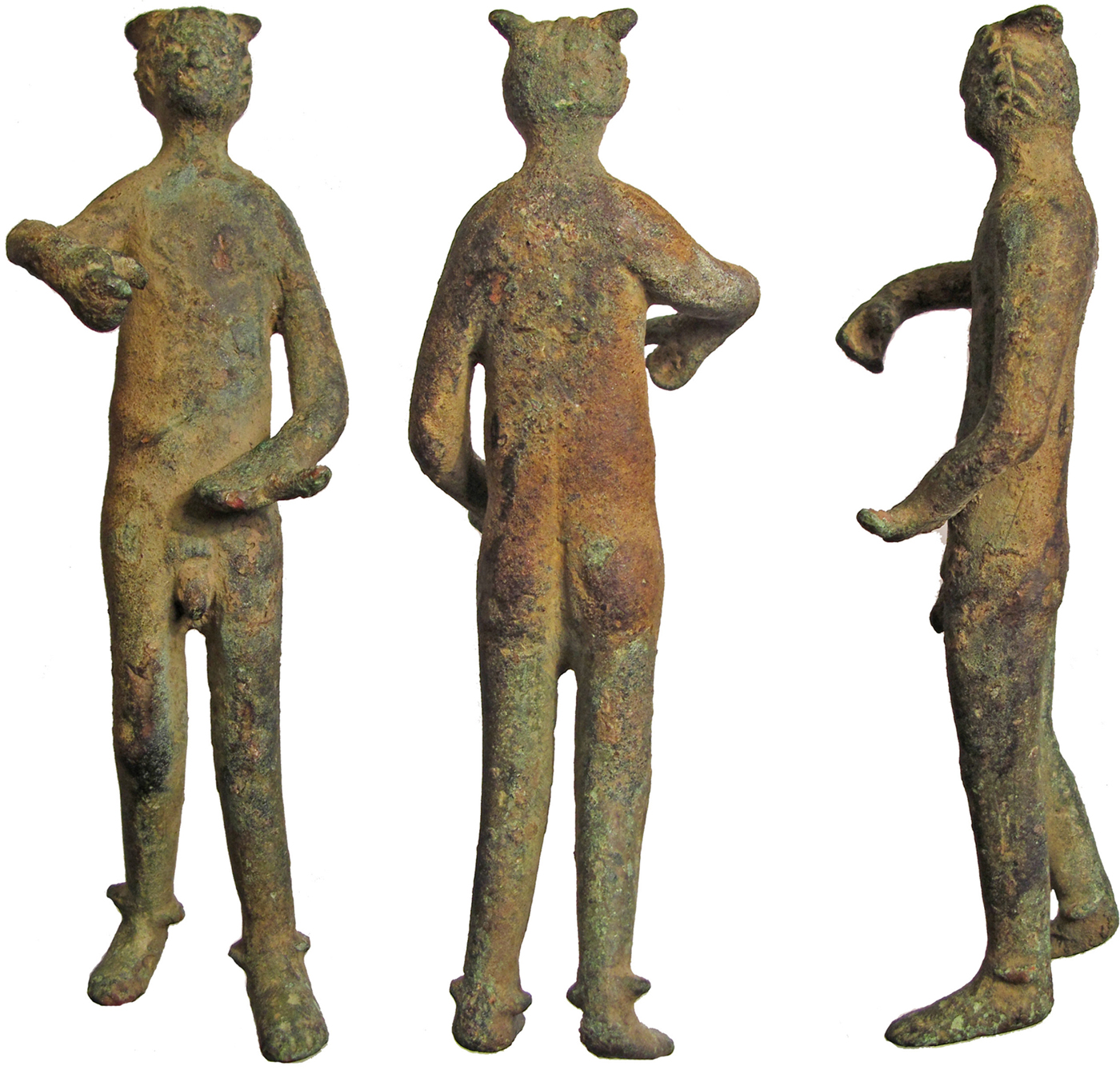
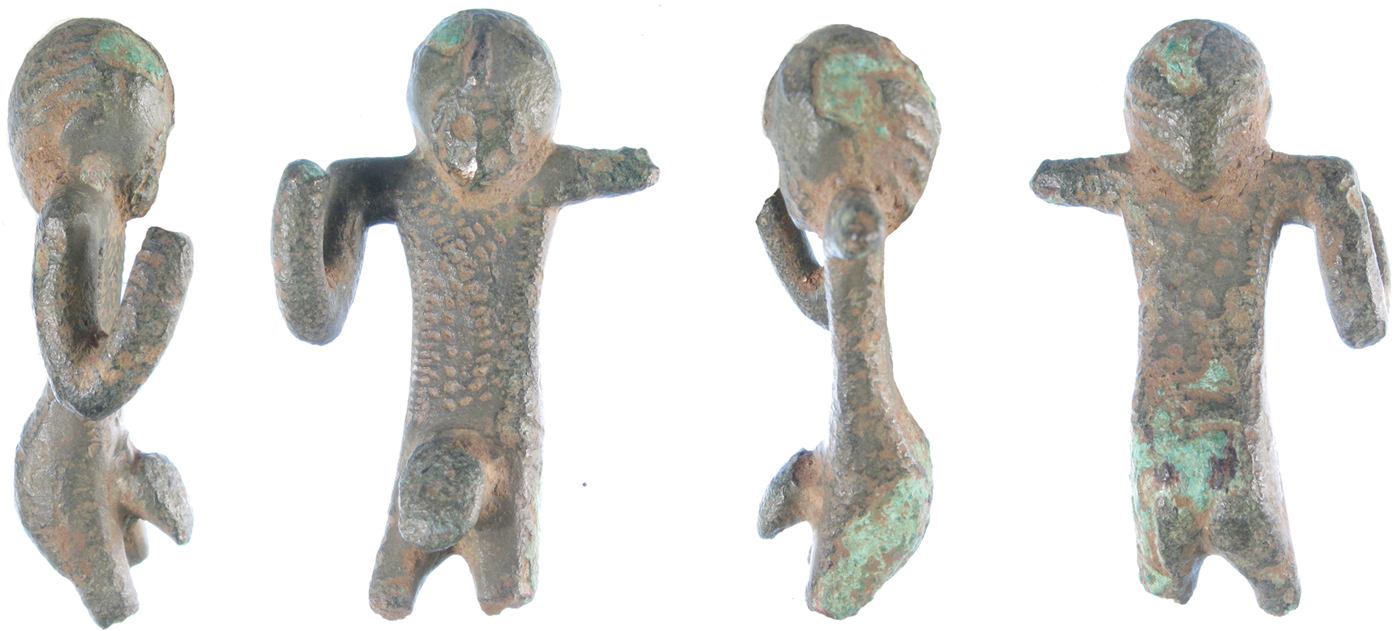
(23) Brightwalton (WAW-E2E847) (fig. 23).Footnote 87 A small and incomplete copper-alloy figurine of ‘horse-and-rider’ type, with a dark brown and heavily pitted patina. It is 40 mm tall, 25.5 mm wide and 12.1 mm thick; it weighs 17.8 g. The worn figure, missing its lower legs, most of its left arm and part of its right, is highly stylised. On the outsize sub-spherical head traces of the lentoid eyes and nose are visible; slight traces of the moustache, beard and mouth can be discerned. Parallel lines render the sweeping of the hair from the high forehead to the back of the head. The torso is slender, swelling a little at the buttocks, with the left arm (seemingly) extending outwards from angular shoulders, while the right arm extends forward with an upward-reaching forearm. The torso is covered with long rows of short parallel incisions; these can also be observed down the right-hand side of the figure's back, a possible indication of dress or armour. From the abdomen projects a broad tapering penis. The detailing of the buttocks is mostly lost to corrosion; the parted legs break off below the thighs.
Brightwalton, figurine of horse and rider type (No. 23). Scale 1:1. (Photo: A. Bolton; © A. Bolton and Birmingham City Council)

The pose and raised right arm of the figure assimilate it to the spear-armed horse-and-rider type documented across the province. Its findspot is at the southern margin of the distribution of these figurines as identified by Durham, which vary significantly in iconography, style and size. Footnote 88 Some other PAS examples are also nude or partly nude.Footnote 89
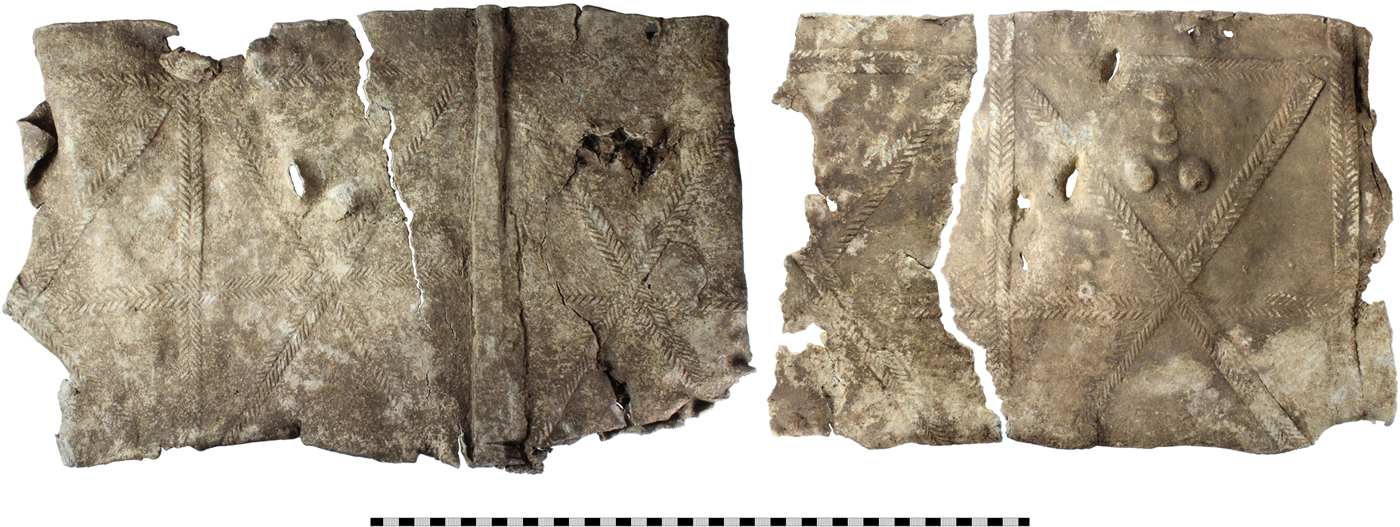
Preshute, fragment of decorated lead tank (No. 24). Scale 1:5. (Photo: R. Henry; © R. Henry and Salisbury and South Wiltshire Museum)

WILTSHIRE
(24) Preshute (WILT-95F01A) (fig. 24).Footnote 90 Three large cast sheet lead fragments bearing relief decoration, including a phallic motif, from the side panels of a circular lead tank. When discovered the fragments were rolled and folded and have been partly unfolded by the finder. Fragment A, the largest (500 mm long by 300 mm high), carries the remains of four decorative panels, one being still partly folded over. The joining Fragments B (150 mm long by 283 mm high) and C (300 mm long by 290 mm high) carry parts of two decorated panels. Some of the top and bottom of the panels has been lost; on the upper edge are some indications of pleating.
The main decorative element comprises raised straps, all decorated with continuous chevrons. Vertical dividers separate individual rectangular panels and extend above the upper horizontal border of those panels. Too little of the base of the panels is preserved to determine whether a lower horizontal border was also present. Each panel is subdivided into six triangular sections by horizontal and diagonal straps. In small details there is some variation between panels, for example where the straps overlap or in the apparent sequence in which they were impressed in the mould. In the upper part of the right-hand panel of Fragment C an additional motif can be identified, namely a phallus formed by the arrangement of six raised spherical motifs, two larger for the testicles, four overlapping smaller circles for the penis. On Fragment A a further vertical lead strip marks the seam on the front of the tank where two lead sheets have been joined, coinciding with the border between two panels. Several perforations relate to likely deliberate damage, especially on Fragment C near the phallic motif.
The dimensions and iconography indicate that this is part of a late Roman lead tank, the fourth and largest fragment of such tanks to be documented by the PAS, others being from Lincoln (LIN-9C11F6), Ludford, Lincs. (LIN-E8F806), and Thompson, Cheshire (NMS-4CEB66).Footnote 91 The Preshute example lies on the southern margins of the distribution of the 31 lead tanks now documented from Britain, which are dated mainly to the fourth century a.d. and possibly later.Footnote 92 They are typically circular with two separate sheets for the sides welded onto a separate base. The dimensions in this case suggest that the Preshute tank was of a similar size to others, most being between 0.5 and 1 m in diameter and having sides of 0.2 to 0.6 m in height. The decoration fits the common preference for panels enclosed by raised straps, though the chevron or herringbone patterning on this example is not as common as cable or lattice.Footnote 93 No single example directly parallels the arrangement of straps in this case, although there are some similarities with the decoration of the Icklingham tank discovered in 1939, in particular the use of chevron strapping and raised discs.Footnote 94 However, this is the first documented occurrence of a phallic motif on a lead tank. As an apotropaic device its presence may be a defensive counterpart to the utere felix motto on other examples.Footnote 95 Formerly thought to be associated with baptism from the frequent presence of the Christogram, a wider range of ritual uses for these tanks, not exclusively Christian, has been championed by Crerar. This possibility of non-Christian or secular purposes, associated with bathing, is further supported by examples from Pannonia and Germany which bear hunting scenes and, in one case (Szabadbattyán, 30 km east of Lake Balaton, Hungary), images of pagan gods, namely Jupiter and an unidentified female deity.Footnote 96 Like the Preshute tank, many others from Britain bear evidence of deliberate destruction, though religious or mundane motives for this are not easily differentiated.Footnote 97 In this case the focus of damage near the phallic motif may not be coincidental.